




-
Recent Posts
- The Last First: Winter K2 (2026) ☆☆☆(3/4): A deadly expedition at K2
- Look Back (2026) ☆☆☆1/2(3.5/4): A collaboration between two talented girls
- Céline and Julie Go Boating (1974) ☆☆☆(3/4): A long but delightful romp
- The Stranger (2025) ☆☆☆(3/4): Nothing matters to him…
- Digger (2026) ☆☆(2/4): Another ambitious misfire from Iñárritu
- The Assassin(s) (2026) ☆☆1/2(2.5/4): Against a cover-up
- Blanket Wearer (2024) ☆☆☆(3/4): Her penniless one-year nomad project
- The Dreamed Adventure (2026) ☆☆☆(3/4): An archaeologist back in her hometown
- Late Fame (2025) ☆☆☆(3/4): Sudden attention to an old ex-poet in New York City
- Possible Love (2026) ☆☆☆1/2(3.5/4): A sublime quartet drama by Lee Chang-dong
Blogroll
Interesting Windows
Movies
Categories
Meta
Archives
My Photos
-
Join 831 other subscribers
Blog Stats
- 1,339,449 hits
Seongyong’s Twitter
Tweets by kaist455
Candyman (1992) ☆☆☆(3/4) : Some urban legend is too (un)real

“Candyman”(1992) is something we do not come across often. It is not only a scary movie but also an evocative horror movie with the intriguing idea about urban legends. We all know the urban legends have the roots in our collective fear of living anonymously in the cities, and the movie puts an interesting spin on it. What if some urban legend is real? And what if it’s possible that it is real because it is believed to exist, rather than the other way around? What if it gets the power from the collective belief? If such a thing is possible, then what can be said of the religious or supernatural entities people believe in? Can the same thing be said of them? The movie deals with its idea in a clever way, and it leaves us something to think after we are reasonably scared by the things happening on the screen.
It is always welcoming to have the characters who are reasonable in the horror movies, and Helen(Virginia Madsen) and Bernadette(Kasi Lemmons) are well-qualified for that. They are the graduates researching for their doctorial thesis at the University of Illinois, Chicago. Their research subject is the urban legend, and the one that particularly interests them is about Candyman, who people say will come to whoever dares to summon him by saying his names five times while looking at the mirror and will leave the bloody carnage behind him.
Like any other academic researchers, Helen and Bernadette don’t seriously believe what they hear from the interviews. But they become interested when they coincidentally come to know that Candyman is believed to exist by the people living in the Cabrini-Green Housing complex in Near North Side area of Chicago; they believe Candyman is living in one of those empty tenement. Helen thinks there are the materials worthy of their thesis, and she decides to delve deeper in this subject, despite Bernadette’s concern.
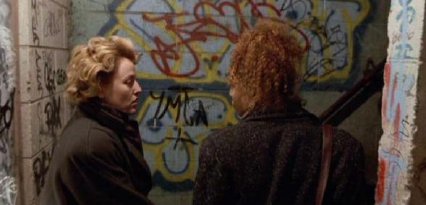
Her concern is well-justified. Now it is fading into the history by the on-going gentrification process, but Cabrini-Green has been one of the criminally notorious housing complex in USA. Through the movie, made in 1992, we get some glimpses of the environment far, far worse than now. The gang members hang around the front entrance of those coercively looking buildings, and there are dark, dirty, deserted places you do not want to go inside in the buildings. And we see our characters bravely go into these places with the intellectual interest and purpose.
The director/writer Bernard Rose, who would make “Immortal Beloved” after this movie, focuses on the atmosphere at the first half. He knows how to visually mount the unease on the screen. Frequent overhead shots have a subtle menacing tone with Phillip Glass’ effectively spooky score. The despair and terror are palpably felt in the corners in Cabrini-Green scenes, and, like Helen, we can see the real world is as horrible as the Candyman legend. This is the dangerous world in which terrible incidents happen and are neglected by the people outside including the police. People living there everyday may just choose to believe the boogeyman whom no one can stop is responsible for all these happenings.
But is it just an urban legend born out of the despair of the lower class? Helen seems to think so, but, unfortunately for her, the movie is based on the short story “The Forbidden” written by the executive producer Clive Barker, who was called “The Future of Horror” by Stephen King. Like his famous first movie “Hellraiser”(1987), Clive Barker’s horror stories are gruesome and brooding tales of flesh and blood with the supernatural elements, and “Candyman” is no exception. As you probably guessed it already, it turns out that Candyman is real, and the truth behind him is a lot more intriguing while quite horrifying in itself. It seems that Helen’s study makes Candyman piqued more than casually calling his names five times in the mirror.
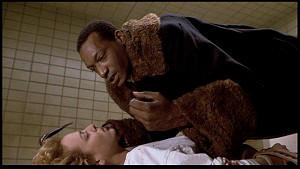
Helen eventually finds herself in a big serious trouble with the police while the shocking incidents happen around her. She knows what’s going on but she cannot say about it because nobody can believe her story. To make the matters worse, she is framed for the incidents and nobody believes her innocence – least of all her untrustworthy husband who never quite says he trusts her words. Following her ordeal, we see frightening things more than before. There is some blood to be shed, and Rose skillfully handles the violent moments while never losing the tension and dread piled upon from the start.
And he had the talented cast. Inexplicably, Virginia Madsen had never gotten the chance to fully utilize her talent till her Oscar-nominated performance “Sideways”(2004), and “Candyman” was one of few bright spots in her career before “Sideways”; she is good as a frightened but brave woman who tries to solve her impossible problem. Kasi Lemmons, who would direct “Eve’s Bayou” and “Talk to Me”, also makes a good impression as Helen’s best friend and co-writer. Tony Todd is seductively menacing as a dreadful entity with his hulking presence and deep voice(he would reprise his role in the following worthless Candyman sequels).
Even 18 years after it came out, “Candyman” still holds well as an effectively creepy movie. After the success of “Hellraiser”, several Clive Barker’s works have been translated into the movies for years, but this movie still occupies the top position among others. I think it is a lot better than “Hellraiser”, which just drones on the blood and other freakish things with some interesting ideas nearly untouched. “Candyman” has the interesting idea to explore, proceeds with it, and never loses the grip on the idea even when it goes bloody. In the end, even the expected horror movie cliché serves for its idea and provokes another thought in our head while the end credit rolls. Preposterous, yeah, but somehow it’s logical in its philosophy.

Posted in Movies
Tagged Baby, Bees, Cabrini-Green, Chicago, Hook, Horror, Murder, Urban Legend
8 Comments
The Unjust (2010) ☆☆☆(3/4) : Mean System
There is one scene that strikes me hard in the middle of “The Unjust”. It is one of many unjust things happening on the screen, but none of two main characters who occupy that scene is someone we are sorry for. They are just the strong and the weak according to the rules of the system they belongs to. Both know that. They also know what each of them can or must do and willingly follow the rule. The weak literally kneel before the strong and begs for his mercy. The strong accepts with a haughty attitude – but we know that he also has someone he has bow to above him.
Don’t mistake it. The characters I described above do not belong to the criminal organization; they are public servants. The one is a policeman and the other one is a prosecutor.
From showing the complex relationship between the police, the public prosecutor’s Office, and the people who deal with them, “The Unjust” tells us a bitter story about how this unjust system works. There is no way for its individuals to remain clean when the system is corrupt. Inexorably, they always get dirty while trying to do the right thing, or believing that they’re trying to do the right thing.
The movie starts with a sensational serial killing case shocking the whole nation(this is probably the third or fourth time I encounter the serial killing in Korean movies in this year). Recently having a prime suspect get killed, the police have lots of pressure from the citizens, the media, and, above all, the President who demands that the case be solved as soon as possible. They must find a way to solving the case or any other ways for retaining their public image.
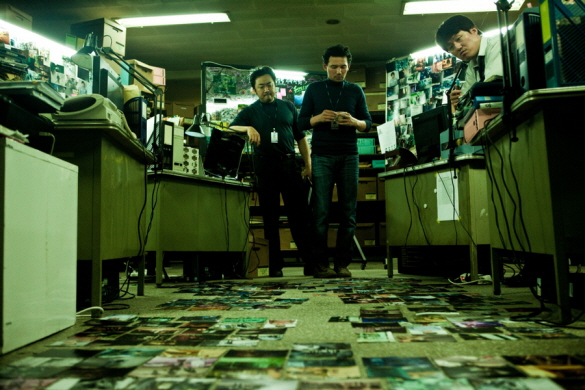
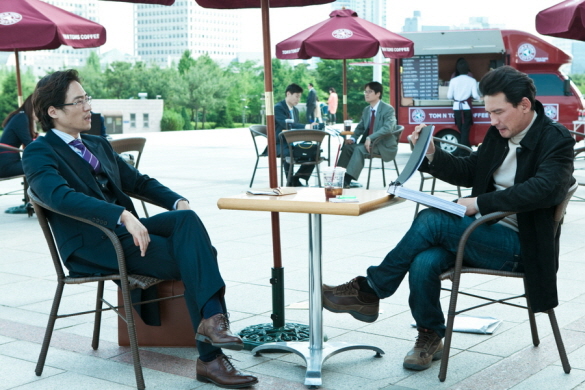
They choose Choi Cheol-gi(Hwang Jeong-min) as the new chief of the special investigation team. He is a cop with the good record, but that is not the main reason he is chosen for; he is chosen due to his lack of personal connections. If the investigation is failed, his discharge will not hurt anyone in the police. Cheol-gi knows that well when one of his superiors personally asks him to take the case, but he accepts it. He has been always denied promotion(mainly because he did not graduate from the Police Academy) and is willing to bet his career on this murder case.
However, the movie is not about solving the murder case. Under his superiors’ silent consents, Cheol-gi does a risky cleaning job. With his men he trusts, he assembles the other possible suspects and analyzes them for sorting out the most plausible suspect. It does not matter whether that suspect is guilty or not. All Cheol-gi has to do is asking Jang Seok-gu(Yoo Hae-jin), a mob boss who has been associated with him, to get the suspect and ‘persuade’ him to be the serial killer the whole nation is looking for. Their scheme ends up being successful and everybody goes happily along with it. However, the things get messy for them when the case is handled by prosecutor Ju Yang(Ryoo Seong-beom), who also has his own dirty business to be taken care of.
With the original screenplay by Park Jeong-hoon(the writer of “I Saw the Devil”, the most controversial Korean movie of this year), the director Ryoo Seung-wan(“The City of Violence”(2006)) carefully maps out the positions of his three main characters and others from the start with the subtitles informing the date, the time, and the names. As the plot thickens, the details about their complicated relationships are succinctly delivered to us and we come to understand how they affect each other as well as their motives. Their interests are so entangled with each other that one conflict of interests logically results in other conflict. Or, the one is solved, and then here comes another one. This seems endless until someone is pulled out from this power game.

While closely observing the dynamics between them, the movie looks far more widely at the system and its excruciating mechanism in the Korean society. It is not different from what you saw in HBO TV series “The Wire”; the system is adamantine and the individuals are usually helpless in front of its effects – especially in case of the ones occupying the lower strata. Although there are some shifts in the power game, it is eventually clear that who has the power to wield and who is the nearest at the top and who will remain no matter what happens. Although Ryoo Seung-wan said he was not intended to make the movie as a social critique, the Korean audience will feel lots of familiarity to the society shown in the movie thanks to the recent big scandals associated with the Public Prosecutor’s Office. They probably have gut-chilling feeling at the end of movie because they know too well that this is how the system works not only in the movie but also in their reality.
Regardless of whether the movie is a social critique or not, Ryoo Seung-wan makes a compelling urban noir movie. Compared to his previous works, “The Unjust” is a more controlled work with lots of confidence as usual. The pace is brisk in most parts, the humor is well-integrated into the story, and the characters are solid. The world they inhabit is presented realistically as well as stylishly from the filthy garage disposal factory to the luxurious gallery party. There is only one notable short action scene in the movie, but, even with that scene, Ryoo proves again that he is very good at making effective physical action sequence; you can really feel the desperation in their struggle.

The actors efficiently do what exactly their given roles demand. Ryoo Seung-beom is standout with his over the top performance in the ensemble. As a haughty prosecutor, he chews his scenes with the exaggerated mannerism and speech pattern, but his character somehow fits into the story as well as the machine as a cog. He never loses the sense of humor in his character and I forgave him for appearing in “No Mercy”, one of the worst Korean movies of this year. Hwang Jeong-min, who previously acted with Ryoo before in another urban noir “Bloody Tie”, holds the center while giving another solid performance after his scene-stealing supporting turn in “Blades of Blood” in this year. Yoo Hae-jin is relatively weak compared to the intensity of his co-stars, but he is as good as the rest of the talented cast including Cheon Ho-jin, Jeong Man-sik, and Song Sae-byeok.
The main characters of “The Unjust” are pretty much unlikeable in various degrees and it was hard for me to care about these dirty rotten scoundrels. I once talked about some other Korean movie with the other online critic through the twitter a few days ago, and I made the mistake by simply saying I hated that movie because “I didn’t care about the characters.” I indeed didn’t care much about its characters, but the real problem was it failed in pulling me in their story. In contrast, “The Unjust” has an interesting story and unlikeable but interesting characters, and, like any good stories, it observes what will happen when they roll around. The movie grasped me strongly enough to care about what will happen at least with the story, the style, and the performances. While feeling a little distant, I could feel its energy and laughed with the audiences at several humorous moments.
Although it loses some of its power around the conclusion(it could have been shortened for a bigger effect), the movie still holds well itself with the ironic ending. After entertaining us for 2 hours, the movie pointedly tells us that the corrupt system cannot be changed easily and people go along with it. Sadly, that happens a lot in our reality.

Posted in Movies
Tagged Corruption, Drama, Korean Movie, Police, Presecutor, Serial Killing
1 Comment
Motel Hell (1980) ☆☆☆(3/4) : It’s “tastier” than you think!
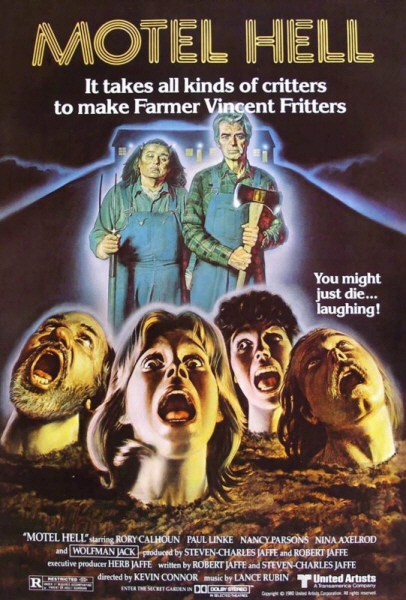
You will probably be repulsed by the premise of “Motel Hell”(1980). I talked about it to the peers in my lab in last week and they were all understandably disgusted. However, the movie is a lot funnier than you think. This is a trashy B-horror movie , but it is an enjoyable trash made with the macabre sense of humor and the villains with the personalities. Spiced with such goodies like these, its gruesome subject is somehow acceptable, and, dare I say, a tasty fun.
Vincent(Rory Calhoun) is a rural farmer well-known around his town and its surrounding area for his specialty. While running the motel(Motel Hello – with ‘o’ constantly flicking on and off) and his family farm in a remote place with his naughty sister Ida(Nancy Parsons), he sells his special smoked pork, a very popular product thanks to his “secret” recipe.
Not so surprisingly, his secret is none other than….. the human meat(“It takes all kinds of critters to make Farmer Vincent fritters!”). Whenever the quiet night deepens, Vincent sets out for hunting his “livestock”. His victims, mostly strangers who are unfortunately passing by the town with their vehicles, are captured by several kinds of traps placed on the roads nearby the motel.

The horrible fate is awaiting for them in Vincent and Ida’s secret garden at the back of their house. The victims are buried in the ground up to their necks. Their vocal cords are surgically cut for preventing them from making sounds except spooky gurgling sounds. They are fed like animals until they are fattened enough for the slaughter later. I wondered how the bathroom business can be taken care of for them during this horrible process, but I don’t want to know.
Fortunately for us, the director Kevin Conor wants to make laughs out of this crazy premise while trying to scare the audience. He and his crew know that a good horror movie depends on the build-up process for the full-blown shock at the climax. Although the plot is rickety and problematic, Vincent and Ida are amusingly horrible enough to carry their story to its finale with their quirkiness, and the writers Robert and Steven-Charles Jaffe provide them several hilarious one-liners (“Sometimes I wonder about the karmic implications of these actions”). Calhoun and Parsons seem to understand their material well; they surely have a diabolical fun with their outrageous roles.
The movie is basically a black comedy, and we are mainly treated with small funny moments instead of the gory details of their deeds. We see how they jovially go on with their work at night and maintain a little weird but folksy image of theirs on day. After an innocent girl named Terry(Nina Axelord) is brought to their house by Vincent after “the accident” happening to her and her biker lover, the daily life of Vincent and Ida becomes a little troublesome but they keep on working while merrily hiding their secret from this vulnerable girl. Their garden is grotesquely silly with those poor extras’ heads rotating on the ground, and I personally could not help but giggle at Vincent’s outrageously conceived slaughter method.
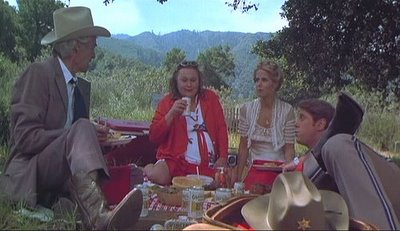 How naive Terry is, by the way. When she wakes up after the accident, she asks about her boyfriend. Vincent tells her that he died and was buried afterward. She does not have a problem with that after seeing his “grave” in the cemetery; nor does a young bumbling town sheriff(Paul Linke)who is incidentally Vincent and Ida’s relative.
Meanwhile, Vincent takes a fancy to Terry from the beginning. He wants her to accept his ways of living someday. He is old enough to be her father, but he is still a charming guy in front of her eyes, perhaps in a Freudian way. Consequently, Terry is unwittingly becoming the bride of monster, and the sheriff, who also likes her in a clumsy(and quite insensitive in the standard of the 21th century) way, finally begins to have some suspicion about his good old relatives.
After the tactful restraint on blood and gore, the movie finally delivers the violently entertaining finale where “Night of the Living Dead” strolls with “The Texas Chainsaw Massacre”. We have the ingredients rightfully expected from that kind of cross: the woman in a mortal danger, the maniac going berserk, the risky chainsaw duel, the last-minute heroic rescue, and the hideously groaning sounds from outdoors. Despite the flaws due to low budget and the lack of synergy, these elements are skillfully mixed on the screen and the movie does not lose its sense of twisted humor even in this mayhem. I guarantee you, if you understand its morbid comedy, the final words from Vincent is something you’ve got to hear for yourself from him, not from me.
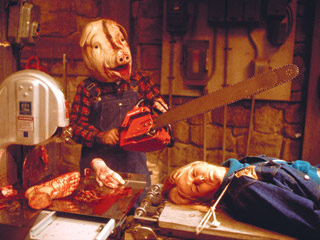
Like the time when “Motel Hell” was made, there are still those depressing horror movies only focusing on shocking the audiences with gratuitous violence and cruelty. The main characters of “Motel Hell” are undoubtedly insane and cruel, but they do have personalities and wits unlike those bland killers in Dead teenager movies or torture porns like Saw series. The movie matches them with innocent bystanders in a comically macabre way, and it pulls it off nicely without damaging our entertainment. We immediately do not take it seriously from the start – we have a good time while flinching at what we see. This movie is a nice proof that you can make the movie with any tasteless subjects if you have style, skill, and the characters to handle. Hmm.. yummy, isn’t it?
Wall Street: Money Never Sleeps (2010) ☆☆1/2(2.5/4) : Gordon Gekko Strikes Back?

Despite considerable expectation before its release, Oliver Stone’s “Wall Street: Money Never Sleeps” is a little disappointing. It criticizes the current situation more or less than it chronicles the recent financial crisis at Wall Street. The movie begins to lose its edges and sink into unconvincing melodrama as the plot progresses. Maybe Stone thought his movie did not have to deliver the message to his audiences in this time. Several well-made documentaries including “The Inside Job” unforgivingly have already pointed out the problems still remaining in Wall Street, and, above all, most of us know well about how bad the things are now and who are responsible for the unprecedented financial catastrophe in US economy.
In “Wall Street”(1987), Stone tried to warn us about the danger from the motto “Greed is good”. The movie was well-received from the critics and audiences, but the end result was not what Stone might hope for. Thanks to its energetic depiction of the financial business world and one of the most memorable villain performances by Michael Douglas as a ruthless but charismatic corporate raider Gordon Gekko, “Wall Street” was responsible for young people drawn to Wall Street probably as much as “Red Shoes” for young girls drawn to ballet. And Wall Street has followed that motto too much as Gekko says in the movie. “Someone reminded me that I once said greed is good. Now it seems it’s legal now.”
In previous movie, it was implied that Gekko would be in a big legal trouble at the end of story, and it is true indeed. “Wall Street: Money Never Sleeps” opens with Gekko getting out of the prison after serving 8 years in 2001. He seems to lose nearly everything at that time, but, after another 7 years later, he somehow reinvents himself as the messenger with a dire news for the American people. He writes the book(“Is Greed Good?”), appears on TV, and gives the lectures for alerting the imminent financial disaster to people.
His daughter Winnie(Carey Mulligan) is his only family now, but their relationship has been estranged for years. Due to the painful past caused by her father, she does not want to involve with him or anything associated with him while working for a liberal online political magazine. Interesting thing is, her boyfriend Jacob Moore(Shia LaBeouf) works as one of the traders in Keller Zable Investment, one of big investment banks in Wall Street – but they seem to love each other enough for their possible marriage in the future.
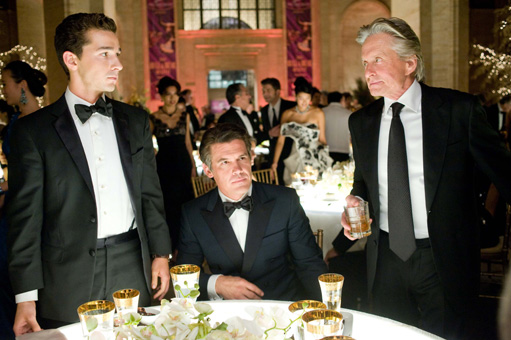
Even after going through the massive dreck named “Transformers 2”, LaBeouf is still good at playing a good-willed, enthusiastic, likeable young man eager to learn more and achieve far more. As a protégé of his boss, Louis Zabel(Frank Langella with touching dignity), he is one of the prominent traders in the company. Currently, he is trying to raise the moneys for financing the research on the alternative green energy source. He believes he can make the differences in the world – with lots of money from pioneering in the future industry, of course.
Everything seems to be fine for hopeful Jacob, but some negative rumor drives his company near bankruptcy. That makes Zable kill himself out of humiliation. While meeting with Gekko several times, Jacob learns about who is responsible for this and he tries to revenge on Bretton James(Josh Brolin). Gekko can help him, and he wants something in exchange for his help – it may be more than what he seems to want as Winnie warns Jacob.
Like its predecessor, the strength of “Wall Street: Money Never Sleeps” lies in drawing us into that electrifying world where the money really never sleeps. Its succinct presentation of how the things works out in several exciting sequences instantly reminded me of that busy, exhilarating screen-split sequence in the 1987 movie. Care-free atmosphere before the financial crisis is effectively conveyed by the moment like a grand, luxurious charity party sequence. The shock of following disaster – something far more abstract but also far more realistic than “2012” – is also effectively conjured up within a minute.

Ironically, that is the point around which the movie runs out of its steam and the problems inherent in the screenplay become noticeable to us. The movie feels sluggish during the third act, and the predictable finale that could have packed more punches in itself. Mulligan is charming and her scene with Douglas is convincing, but the script resolves their problem in a way too convenient and arbitrary. And Susan Sarandon, as Jacob’s mother, is stuck in the shallow character whose main function is to notify us how things are bad outside Wall Street. Her situation took me back to when I saw those desperate real estate advertisements around Chicago in this April.
It goes without saying that Michael Douglas is the best thing in the movie. I was disappointed to see that his reprise of Oscar-winning performance mostly takes a backseat to LaBeouf’s main storyline, but Douglas is still enjoyable to watch as an aged, wiser version of his definite role. His performance is not far from his another good performance of this year in a better movie “A Solitary Man”, where he plays a disgraced business man who has to solve his personal problems including his family(Coincidentally, Sarandon co-starred with him in that movie as an real estate broker ex-wife).
I have to admit that I enjoyed watching “Wall Street: Money Never Sleep”, but I also felt a little regret over bringing my friend in the screening room with me after talking about it a lot to him(Later, I promised to show him “The Social Network” or “The American” in next month). It is entertaining, and it’s good to see Gekko back in action. Despite all that, it is as satisfying as “Wall Street” on the whole; it left me the impression of prolonged epilogue. Maybe was I too greedy? – But I believe greed is always good in case of watching movies.

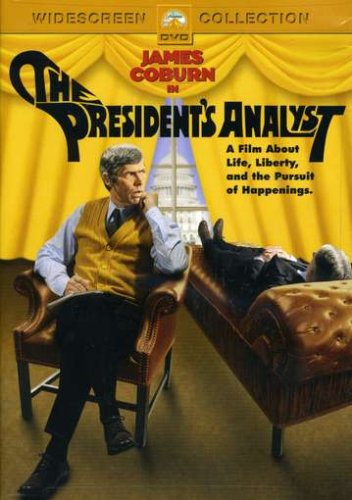
The President’s Analyst (1967) ☆☆☆1/2(3.5/4) : The loneliest (and the most paranoidal) analyst in the world

While it is one or two steps behind “Dr. Strangelove”, “The President’s Analyst”(1967) is a very good black comedy sniggering at Cold War paranoid. Maybe it is not as ruthless as that great comedy, but the movie romps cheerfully on its subjects with a take-no-prisoner attitude. And during this loony joy ride, we eventually discover that the movie foretold something very accurate more than 40 years ago.
We have seen many psychiatrist whose lives become more burdensome than usual thanks to their unusual patients in the movies(“Analyze This”) and TV series(“The Sopranos” and “In Treatment”), but I think no one can top our hero Dr. Sidney Schaefer(James Coburn). His new patient is none other than the president of the United States, the most powerful figure in the world who incidentally does not appear on the screen.
It turns out that he was recommended by his mentor/analyst Dr. Lee-Evans(Will Geer) and have been thoroughly inspected by CEA(Central Enquiries of Agency – I’m not kidding) for his qualification, mainly through a CEA agent Don Masters(Godfrey Cambridge) who has disguised himself as one of his patients. Although at first flabbergasted by this sudden news, Schaefer is soon exulted for his prospects; he even has a meandering montage accompanied with a pop song while he aimlessly wanders around New York. Damn the ’60s, but who wouldn’t indulge in it?
His work begins immediately right after he is introduced to the safe house in Georgetown where he and his girlfriend(Joan Delaney) can live comfortably. Everything seems to be fine at the start. Now he has only one patient except agent Masters who really has the problems of his own. Below his new house, there is a secret underground tunnel connected directly to the White House, and he can come immediately to the president whenever he is summoned with an annoying red right signal.
Schaefer feels proud about his job as the doctor who exclusively listens to the presidential difficulties, but, after few days, he realizes counseling with the man “who carries the load that will kill ten men” is far more toilful than he thought. The president’s schedule is so jammed with domestic and international affairs that he should be always ready for his service no matter what he is doing. Furthermore, he is not allowed to tell anything about the sessions to any other people, including his girlfriend, for security reasons. And he is constantly monitored by the government agencies just in case.
The movie has lots of fun with this suffocating situation. With his private life almost completely disrupted, Schaefer is more conscious of his surroundings than before; he becomes paranoid as correctly diagnosed by himself(“If I were a psychiatrist, which I am, I would say I’m rapidly turning into a paranoid personality, which I am!”). Poor guy, his case is not just delusion problem. Regardless of whether that weird moment at the restaurant and other things are real or not, our doctor really does not have anyone to trust.
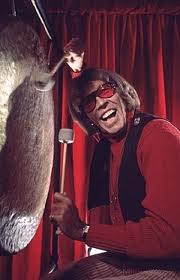
After he finally gets out of the White House, the story goes wackier with personal and social paranoia overlapping. No matter which side of the Cold War they are on, every national secret agency in the world goes after Schaefer for his invaluable information about US president as soon as they hear about his escape. FBR(Federal Bureau of Regulation – I’m not kidding in this case, either) director Harry Lux(petite-looking Walter Burke) is literally dead serious; he wants Schaefer dead for the national security. CEA people do not want that, but that does not mean that it is not an option for them. And some mysterious organization observes everything in this madness.
The director Theodore J. Flicker is unflinching with his satire on Cold War paranoia. There are several points where the plot becomes shaky, but his screenplay relentlessly provides hilarious moments with barbs one by one. Some jokes are pretty much like the time capsule in the need of explanations for us now, but most of jokes work well in the movie. The shot with FBR agents smaller than five feet in a bureaucratic office is a joke with an expired date to many audiences at present, but it still remains a funny visual gag in contrast with CEA agents gathering in the place that looks like some college professor’s office.
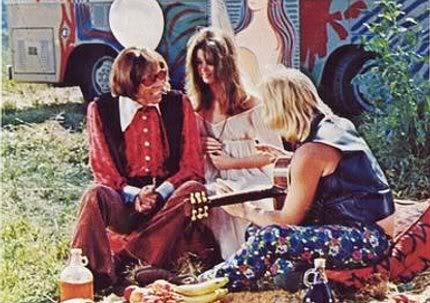
Flicker also mercilessly makes fun of several aspects of American society in the ‘60s for good laughs. While Schaefer runs for his life and sanity, he comes across a family from New Jersey suburb, and they turn out to be far more than ” a typical American family”. Also, there is an outrageous sequence later where Schaefer finds temporal peace at the meadow after hooked up with hippie band members – without knowing that an insidious chain of incidents is progressing step by step nearby.
Interestingly, “The President’s Analyst” foreshadowed the anxiety to come in the next era. After Watergate scandal, American audiences of the ‘70s found themselves surrounded by dark paranoid/conspiracy movies at the theaters. As a matter of fact, the movie sometimes farcically evokes that foreboding atmosphere of those movies like “The Parallex View”(1974) with curious visual composition in several shots .
And then it grows more preposterously when a shadowy organization reveals itself at the finale with the exaggerated set suitable for spy spoof movies. However, at this point, we realize how the movie correctly predicts our time when the absurd plan of the organization is introduced with a funny old-fashioned education movie. Just think about how much conveniently we communicate with each other now, and how much digitalized and vulnerable we have become in that progress. A fantasy in the 1960s becomes something far more plausible thing in the 21th Century by the technological advancement, and that outrageous brave new world presented in the movie is alarmingly prophetic to us.
The movie is one of few comedies in James Coburn’s career, and he gives a rare neurotic performance as the doctor who goes unhinged by the craziness surrounding him. While his character is bounced around here and there like a pinball, Coburn provides the gravity barely maintained at the center of the lunacy. The way he turns his charming smile into that manic grin of a paranoid is absolutely hilarious.
The supporting actors ably support Coburn with fine comedy performances. William Daniels personifies shallow hypocrisy as the head of middle class family who is “as liberal in the same tradition as the president”. I wonder whether he has a NRA membership card in his house. Pat Harrington Jr. is unabashedly plastic as a bland head of the shadowy organization – there is a silly good reason for that nauseating impression.
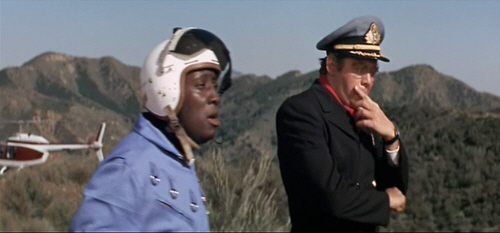
Special mention must go to Godfrey Cambridge and Severn Darden as two secret agents who seriously become the doctor’s patients. Cambridge has a classic deadpan moment with the stream of consciousness about his self-hate problem associated with the word Dr. Laura Schlessinger foolishly blurted out on her radio show a few months ago. How Cambridge and Coburn handle the awkwardness following that is as funny as that. Darden is an equal comic counterpart as a KGB agent Kropotkin; the way he is courteously enthralled by Freudian analysis on his daddy issue is another big laugh. He also has a very amusing line for us, by the way. “Every day your country becomes more socialistic, my country becomes more capitalistic. Pretty soon we will meet in the middle and join hands.”
Maybe I was born too late for enjoying everything supposed to be funny in it, but “The President’s Analyst”(1967) still could come to me as a hilarious movie. Of course, there are many aspects as dated as “The Graduate”, another funny movie that came out in the same year, and the movie clearly has its one foot stuck in that era. However, its hysterical satire on Cold War paranoid still can induce lots of laugh from us, and, above all, the movie looks beyond its time rather than remaining behind it. This is not just a laughable spy spoof – It is frighteningly insightful comedy at its core. And who would have thought that it prophesied the rise of certain movie villains during the last decade? If you know what I mean, you will also probably know they actually spend lots of money around us because they want us to like them – just like the villain of this movie. Well, screw them all.
Small Trivia: Yes, CEA and FBR and are actually CIA and FBI. According to the producer Robert Evans, he was visited by FBI agents during the production and was pressured by the studio after that. Evans changed the names through re-dubbing the voice track, but he personally believes his telephone was monitored from then on.
Posted in Movies
Tagged Analyst, Comedy, Communication technology, Conspiracy, Paranoid, President, Psychology, Spy
6 Comments
My first movie review in English

This is my first movie review written on 08/12/07. I found several errors, but I decided to keep them intact. By the way, the movie was one of the worst Korean movies of the last decade. I initally gave the movie one and half stars out of some pity, but I want to give it BOMB now. The movie was far worse than “The Last Airbender”.
Here is some good news for the audience who will see ‘D-war’. It’s not that terrible. (If you really want to see catastrophe, watch ‘Habando’, which I gave zero stars without hesitation) It was such honor (or dishonor, whatever you like) to see overblown, disjointed direct-to-video movie projected on huge screen with people around me. However, it was quite depressing 90 minutes. I hate flat, lifeless character-interacting scenes, I was not amused by its cheap humor that evoked very small laughter from audience, and I was at a loss during spectacularly unconvincing and unrealistic finale. In case of CG, the monsters are more or less convincing than hideous monster from ‘Deep Rising’. Two attack scenes, good on their own, are just average showcasing of CG without purpose in the movie. The final showdown does not take place in L.A., and I’d rather see that leftover sets and monsters and soldiers from ‘The Lord of the Rings’ appearing in the middle of smashed L.A.
Last year, ‘Lady in the Water’ introduced outrageous Korean folk tale with not-so-Korean names to U.S. audience. This year, ‘D-war’ will provide them another one, which is told by literally ubiquitous Robert Forster. I was glad to see Scott Wilson in ‘The Host’, but Robert Forster in ‘D-war’? U.S. critics will probably have the field day with comparing Mr. Forster and Mr. Wilson in their respective movies. It’s disheartening to see that Academy award nomination didn’t help Mr. Forster’s career, and the only consolation is, like Peter O’Toole in ‘Phantoms’, that Mr. Forster speaks some preposterous lines without laughing. That’s the sign of veteran actor who started the career with ‘Reflections in a Golden eye’ 40 years ago. Anyway, he’s still working, so don’t worry folks.
Speaking of director Hyung-rae Shim, I won’t say anything offending to him. He just tried hard to make the film he wanted, and now he gets his wishes. However, he does the most annoying thing I have ever seen on the screen. He seems to think quite seriously of himself and the movie, and, with lame inclusion of ‘Arirang’ at the end of movie, he shows production pictures with some serious statement. I hope he will never show translated version of it or whatsoever to U.S. critics. They will have gut-busting laugh. It is just like the student who submits lousy report after long, long time with some notes saying ‘I tried very, very hard against all odds and this will be my magnum opus. Help me please’. I’m a graduate student who has been as ruthless as Anton Ego to undergraduates about their grade, and big minus point will be guaranteed if I have to grade the one like that.
One of the standards of late Gene Siskel is, ‘Is this movie better than a documentary of the same actors having lunch?’. Mr. Shim, the answer for your movie is ‘NO’, and maybe you will have to prepare pretty interesting documentary ‘The Making of D-War’ for DVD supplement. Or, based on your ‘reported’ stubbornness and determination, maybe I should ask Roger Ebert about how to make Werner Herzog get interested in you. Maybe you can show Mr. Herzog that you also can move the big steamboat ship to the top of mountain. Maybe Mr. Herzog will get interested and make the documentary about your next big gamble. Now, that’s the movie I’d like to see. (* 1/2)
Educating Rita (1983) ☆☆1/2(2.5/4) : When the movie doesn’t believe in characters

The main problem of Lewis Gilbert’s “Educating Rita”(1983) is it does not believe in its two characters much. If the movie just had concentrated on the dynamics between these interesting people, the result could have been a lot, or a little at least, better than what we get now. However, it pads their story with useless elements, and that is the major mistake of this movie. Whenever it does not have two good characters created by two fabulous performers on the screen, the movie loses its power in most cases, and, alas, that happens quite frequently throughout the story. While enjoying good parts of it, I lost my interest minute by minute.
This is the good example where a nice play loses considerable amount of potential when it is adapted on the screen. After watching Willy Russell’s famous original play on the stage in Seoul a few years ago, I came to like the movie less than my initial watching in 2002. The play itself was lean, brisk, witty, and entertaining to watch with only two characters on the stage in less than two hours. Although the education itself was not so visible on the stage, the banter between two characters sold the story as well as the relationship between them. Unfortunately, the makers of the movie forgot or overlooked what makes the play tick on the stage, and the movie swayed from that from time to time while becoming nearly ponderous at times.
The story is very familiar to you even if you have not seen the movie. It is about how two very different characters incidentally meet each other on their paths, how the relationship grows out between them, and how that relationship changes both of them in the end. We know the formula, and we know what stations the story will stop and pass by, and there are many movies based on that premise with “Pygmalion”(1938) and “My Fair Lady”(1964) as the prime examples.
Professor Higgins of this time is an incompetent middle-aged English literature professor named Frank(Michael Caine). Frank is a typical burned-out case stuck in campus. As an ex-poet, he had given up poetry for a long time and his interest in his classes is more or less than in poetry. He is more interested in alcohol(he hides his whiskey bottle behind the books in his office) and does not give a damn about coming to his class in inebriated state. As long as he does not commit such a thing like “rape on a grand scale”, nobody in the administration will make a fuss about him anyway, and he has been going along with that while behaving like some drunken sage, which he is not, of course.

Tim Piggott-Smith(Frank) and Laura Dos Santos(Rita) in 2010 London revival (courtesy of Catherine Ashmore)
- One day, he comes across a life force of his lifetime. Her name is Susan(Julie Walters), who prefers to be called Rita. This young cockney married hairdresser has wanted and searched for something better that cannot be found in her working class life, so she signed up for the university program named The Open University and Frank is assigned as her reluctant tutor. He accepted his new assignment mainly for money, and, as he shamelessly admits, he is not a good teacher anyway. But Rita is persistent, and she thinks Frank needs help.
So the education begins – and the start is rickety for them. Frank cannot help but marvel about Rita’s spirit as well as her illiteracy. About the solution for the problem inherent in certain Ibsen’s play, she gives him astoundingly short answer. In case of literature criticism assay, she includes the reference to Harold Robbins’ novels. Nevertheless, her desire to learn is indomitable, so she gets better while several books and plays and poems are quoted and phrased and exchanged between them on the screen. After the interlude for her summer school and his summer vacation in France, Rita seems to be a lot different from what she was at the beginning – and Frank does not like it because he comes to love what she was while his idealism awakened by her fresh energy.
Although the names like Blake, Forster, Wordsworth, and Chekhov are mentioned in a superficial way without delving into them seriously, the movie could have gotten away with that fault. Frank and Rita are engaging characters. The interactions between them are the key moments of the story, and Caine and Walters are good sparring partners with nice chemistry when they are together. Whenever they begin the conversation, the movie becomes lively and joyful and it almost sells the story to us.

Park Yong-su(Frank) and Lee Seung-Bee(Rita) in 2008 South Korean revival (courtesy of NewsHankuk)
Sadly, Russell, who adapted his own play, seemed to be not so confident about his material, and he did lots of unnecessary things in his adaptation. Unlike the stage version, he surrounds his main characters with shallow supporting characters. They do not carry much weight in the story, and most of them, including Rita’s insensitive husband, her flamboyant new roommate, and Frank’s secretary/lover who cheats on him, could only be mentioned in the dialogues like the original play. In fact, their scenes feel so redundant that it would not have made much difference if they had been cut from the movie.
To make the matters worse, this redundancy dilutes the intensity in the drama as a result. While the stage version quickly jumps between one scene from another at Frank’s office, the movie totters along the storyline while jammed with what happens outside Frank and Rita’s relationship and the campus. The good moments are buried by these lifeless scenes as a consequence. The ending feels very artificial and Russell unwisely added the extra scene to his original ending. In addition, the music by David Hertschel, a synthesizer score imitating chamber music, is so annoyingly dated that it reminds me trying to be hip is the shortcut to being old-fashioned.
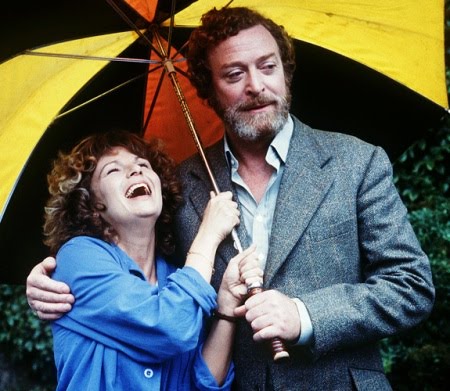
Caine and Walters won Golden Globe and BAFTA awards and were nominated for Oscar; They deserved them. Julie Walters, who played the role in the original London play, is delightful as the heroine. Although her character becomes less interesting after the transformation and we miss her former self like Frank, Walters is still good to watch despite a little stagy at times. Although this was her breakthrough performance at that time, it took another extra years for her to be fully noticed by us with her another Oscar-nominated performance in “Billy Elliot”(2000) and a supporting part in Harry Potter series.
Michael Caine is simply fantastic, and this is one of the best performances in his career. Even when in bad movies, he is rarely uninteresting, and what he does in the constraints of the story is something to behold. Not only he is very funny in the delivery of lines, but also he is very subtle in characterization. With his weary eyes and tired facial expressions, Caine conveys a lot about his character including self-pity and ennui to us; we instinctively feel Frank’s inner thoughts and feelings even when he does not say much. The less I like the movie, the more I admire Caine’s meticulous performance.
The movie is not so satisfying or not so disappointing overall, but it is still enjoyable and charming to watch because of a wonderful duo performance the movie ironically trapped in itself during its attempt to opening up for them. Considering several movies that are successful with focusing on the limited space and performances from the stage plays(e.g. “Slueth”(1972)- which incidentally has another good performance by Caine), it is quite regrettable that the movie did neither trust nor serve two talented performers well. If only the movie had just let them do what they could and observed them without doing anything.


