My campus in the Morning Fog… and a brown bunny.

Revenge is served raw and simple in “Bedevilled”(2010). The movie delivers exactly what it promises to us, but that is not for free. There are barbarous scenes that make you wince, and then there are bloody scenes that make you cringe, but this South Korean revenge thriller has gallons of emotions to spurt on the screen in its sad, wretched character. It carefully prepares its ground while seemingly following the typical formula of revenge movies featuring abused heroines. It continuously accumulates explosives beneath its surface as the plot progresses. And then, when the time comes, it explodes its anger magnificently like a harrowing bloody aria.
First, let me introduce Hae-won(Ji Seong-won), a frigid young lady who has led a typical lonely urban life in Seoul with her clean, sterile flat that looks like nothing more than a sleeping place. Shortly after having unpleasant experience as the key witness to some incident, she gets in another trouble at the bank where she works. She is quickly forced to have a vacation for an undetermined period, and, quite stressful due to these happenings, she decides to visit the remote island where she spent her childhood with her grandparents. This place looks ideal for having peace of mind – and also ideal for the Ten Little Indian game. Less populated than before, only 9 people live there when she returns.
As soon as she puts her foot on the island, Hae-won is eagerly greeted by her old childhood friend Bok-nam(Seo Yeong-hee), who has constantly tried to correspond with Hae-won for many years but gained very little from the girl whom she has adored since their parting. Bok-nam has always been faithful to their friendship none the less. She even has kept the empty house clean that belonged to Hae-won’s grandparents while yearning for Hae-won’s return every day. With such sincere hospitality from Bok-nam, Hae-won begins to relax in the place that is now vaguely familiar to her.
The Korean title of “Bedevilled” is ”An Account of the Kim Bok-nam murder case”, so the film shifts its focus from Hae-won to Bok-nam as the plot thicken. It turns out that there is a desperate motive behind Bok-nam’s lively facade. The island community is not just conservative but maliciously conservative; Bok-nam has been mistreated like a labor/sex slave under its patriarchal savageness. Her hateful husband’s part-time job is finding any excuse for beating her. Her lecherous brother-in-law does something inappropriate for the in-laws whenever he gets the chance to be alone with her. A stern matriarch, ironically a firm believer of good old time patriarchy, justifies Bok-nam’s ordeals. The others in the island, mostly elder ladies, go along with the matriarch without any objection while exploiting Bok-nam’s labor every day. Bok-nam’s only small consolation is her daughter, but this innocent young girl begins to realize her potential as daddy’s little girl – she will follow her mother’s footsteps someday. As an uneducated woman who has spent her whole life in the island, Bok-nam’s only hope is her friend now. She asks Hae-won for help. And she tries another escape.

From what I described to you, you probably have a pretty good idea of what will happen as a consequence. A heartbreaking tragedy happens. An infuriating situation is unfolded. Some time later, the sun scorchingly shines on the island as usual. Bok-nam maddeningly keeps working at the potato field, and something is….. snapped.
The director Jang Cheol-soo worked as an assistant director in Kim Ki-duk’s masterpiece “Spring, Summer, Fall, Winter… and Spring”. In one interview, he said, “The only theory that he[Kim Ki-duk] taught me was: ‘To make the audiences can’t take their eyes off the screen.’”. His first feature-length movie clearly shows that he does not forget what he learned from his mentor. The barbaric moments in the film are depicted realistically as the parts of mundane daily life – they are all the more horrifying because of that approach. Even when the situation gets bloodier and more intense later in the second half, the movie does not lose its coolness while phlegmatically presenting devastatingly violent scenes one by one.

While keeping the violence on the screen under control, Jang Cheol-soo patiently builds tension in his small mean world while Hae-won starts to rediscover the ugliness of her hometown. The island is shown with unadorned natural beauty, and there are some tender moments between few characters we come to care while the subtle air of malevolence creeps in under the daylight. The isolated beautiful place and a desperate character inside it took me back to Kim Ki-duk’s “The Isle”, whose extreme violence with fish hooks was jaw-droppingly memorable even to South Korean audiences. In case of “Bedevilled”, a sickle and a whetstone come handy for the woman as mad as Sweeney Todd, and there are several carotid arteries to be punctuated – and lots of blood to be ejaculated.
It goes without saying that the movie has an uncomfortable aspect due to its brutal depiction of violence. Like many violent movies about revenge, it tries to make us accept its extreme violence as promised catharsis, and some critic criticized the film for the manipulative side behind its catharsis. It is surely manipulative and sometimes it is a little too blatant, but, I dare to say, it’s a manipulation too good to be called manipulative. Above all, unlike vile exploitive movies such as “I Spit on Your Grave”, the movie has the story and its characters and develops them amidst tons of savageries. We come to know that lots of anger, torments, and grievances have been accumulated in heroine’s heart with thousand cuts. We get to know a desperate woman capable of deep hate as well as deep love. We do not demand a clear explanation for that eerie moment when she is finally detonated for we see that every possibility of love and hope has been completely and heartbreakingly obliterated in front of her. And we understand that she is driven to do something far more destructive than suicide as a result; she goes for the total annihilation with a vengeance.
And that simple black and white situation in the story turns out to be a little deeper than we thought at first. Throughout the movie, little things about its characters are mentioned or implied here and there. Male characters are thoroughly despicable and beastly(will the movie be as influential as “Deliverance”?), but they are interesting cases of self-hate. It is apparent that Bok-nam’s husband and his brother are sick of their meaningless life stuck in the island. They know only reason why their detestable deeds are tolerated is that “the men are needed for hard work”, as elder ladies say. I wonder whether they see their future from a mute, helpless old man taken care of by elder ladies, who seems to have a miserable story of his own in the past according to a brief conversation.

It is the testimony to the supporting actors’ talents that their characters are presented like ordinary people we may meet in the conservative Korean rural villages(Baek Soo-Ryeon is standout as a heartless matriarch who might have been the same as Bok-nam in her past). Their performances are plain but nuanced while the presence of tightly-knitted community is conveyed well through them. They are not wild-eyed villains; they are weak, ugly human beings whom you can find in any places where the weak are mistreated in the name of traditions, religions, or whatever excuses they have. They are at a loss when they suddenly realize the table is completely turned. The way the abusive relationship between Bok-nam and her husband is worked nicely into the payoff scene later is another interesting point I leave for you.
If you have seen Seo Yeong-hee in “The Chaser”, you definitely remember her terrifying ordeal with chisel and hammer in that gripping violent Korean thriller. Again, she fearlessly hurls herself into another horrific ordeal, and she propels the film with her memorably harrowing performance. Not only she convincingly transforms herself into a dowdy country woman(When her character tries to look sassy, she looks sassy in corny way), but also she displays the transformation of her character with equal conviction. From a miserable but plucky abused woman desperately clinging on the faint glimmer of hope at the start, she turns into the wrathful exterminating angel with a sickle, and then, in the climax, she comes off as a tragic monster as pitiful as the heroine of “Monster”, another harrowing tale about a crushed woman driven to serial killings. There is small poignancy when, bewildered by the kindness from a stranger for the first time in a long time, she says, “A kind man exists in the world after all.”

While Seo Yeong-hee has gotten lots of accolades, it should be mentioned that Ji Seong-won’s solid performance as Hae-won is crucial because the relationship between these two women is the major driving force behind the narrative. Hae-won can help her friend, but she only patronizingly points out her friend’s problems without any real support. She even turns blind eyes to her friend’s situation and calls her a liar. And then she does a far worse thing to her friend when the villagers decide to impertinently accuse of Bok-nam for something she didn’t commit.
This exactly mirrors her behaviors at the start. In the opening sequence, when her car passes by some incident on the streets, she callously disregards some woman in a possibly serious danger. Later, there is a chance to help the police, and there is a moment to feel indignant enough to do that, but she does not choose to help them for she wants to avoid troubles. It may be sort of the defensive mechanism of her psyche against male-dominated South Korean where it is quite burdensome to live as a woman due to those insensitive bullies. Ji Seong-won quietly implies something neurotic inside her character without giving any excuses for her character’s behaviors. She can be cordial if she wants, but she is mostly cold and hostile to the people as weak as her, like when she heartlessly rejects the tearful plea from a old lady with mortgage problem at her bank(Yes, I could not help but think of Sam Raimi’s recent horror movie “Drag Me to Hell” while watching this scene).

With a pointed social commentary on South Korean society, the movie also works as a familiar moral tale. It is wrong to crush the weak, and it is also wrong to remain silent to that when you can do the right thing. As the human beings with free will, Hae-won and others can choose to help Bok-nam, but they choose not to do that for their self-serving reasons. Regardless of whether they are indirectly or directly involved in Bok-nam’s misery, the characters responsible for that are all guilty in the view of the film. All of them are unsparingly punished in the end, and Hae-won especially gets one hell of lesson for ignoring her friend’s pain: “You’re too unkind.”
“Bedevilled” is one of the notable South Korean films of this year. It jolts us by pushing its heroine to lots of cruel situations, but it has a clear, straight attitude toward them. It is angry about them, and it is angry enough to give us several powerful scenes with emotional weights, sweep us with blood-soaked emotions, and conclude its story neatly with surprisingly serene sadness accompanied by a small lesson. After watching it, maybe you will be a little more caring to things happening around you.
Again, 2010 has been a good year for South Korean movies. To be frank with you, after enduring five truly awful movies(I cannot still forget that one of them has a naked, chained woman crawling with a dog collar on her neck) during first three months, I doubted whether South Korean movies had passed its peak. I even confided my doubt to David Bordwell and others at the Ebertfest in this April. But my thought fortunately turned out to be wrong right after April. In May, Lee Chang-dong’s “Poetry”, Im Sang-soo’s “The Housemaid”, and Hong Sang-soo’s “Hahaha” were introduced at Cannes along with “Bedevilled”. All of them were greeted with positive responses in here as well as Cannes and they are all in my 2010 list for the best South Korean movies. In addition, although we got considerable amount of bad movies, there have also been the other good Korean movies following them. It’s not over yet, at least for now.
 The main strength of “Monsters” lies in how it shows its idea to us. It has an interesting premise and presents its world developed from it in a quite convincing approach that reminds me of “District 9”, a well-liked SF movie released in last year. We will see an alternative world that where the life goes as usual except the accidental visitors from outer spaces, and it gives us some interesting social commentaries on our real world along with decent CGIs. Although there are several weaknesses that cannot be overlooked, the movie diligently jumps over many of its hurdles and I respected that even during my first insipid viewing.
And it grows on me after the second viewing. I have to admit that I felt cold to the movie during the first watching for several reasons(I will talk about them later) even though I admired how the director Gareth Edwards develops his simple idea into the world felt real to me. However, after disastrous viewing experience with recent SF garbage named “Skyline”, another movie associated with the invasion from the outer space, I seriously reconsidered my opinion again. Not long after that misfortune, I watched “Monsters” again(in HD), and I discovered how this small movie handles its materials well even when faced with its limits. I found myself liking its world more than before.
Many reviews have compared the movie to “District 9” or “Cloverfield”, but it belongs to different territory. This is not a blockbuster SF movie; this is an independent movie that happens to be a SF movie. Its budget was around half million dollar, the production crew mainly consisted of only 7 people(including two lead actors and Edwards who also worked as a cinematographer), nearly all supporting actors were the non-professionals instantly hired right on the locations, and considerable amount of its post-production was done in the director’s bedroom later. The movie is closer to “Paranormal Activity” than two SF movies previously mentioned.
The movie informs us briefly about its big picture before the opening sequence. Six years ago, it was discovered that there was the possibility of the alien life forms in some area of the solar system. A space probe was subsequently sent there for acquiring the samples for confirming it, but, unfortunately, the returning space probe was crashed down in US-Mexico border region during re-entry, and that was how all the troubles began. Not so long after the crash, alien life forms came out of the probe, and they quickly spread around the area.

As a consequence, northern part of Mexico was soon quarantined by US and Mexico military. The big wall was built around Mexico-US border for blocking aliens. Nothing is changed much after six years even with their drastic measures. There are always the reports on TV about endless night battles between those humongous aliens and US/Mexico military. People protest about the collateral damages caused by the conflicts and mourn for the victims. Sounds familiar, doesn’t it?
Despite such a big change, people on the earth continue their life after that incident of the century. Edwards shot his movie entirely on the locations in Mexico, Belize, Guatemala, Costa Rica, and Texas. The world shown in the movie is as real and vivid as ours. Small props like gas masks, road signs, warning signs, TV reports, and extra CGIs help its verisimilitude. Edwards decided to depend on the improvisations from his actors instead of using a prepared screenplay from him, and he gave them the situations with short descriptions and asked them to fill the blanks. Thanks to the spontaneity resulted from this approach, we come to believe that what we see is the real world, and we also believe the people in it. This is a slice of, uh, parallel life in Central America.
The characters the movie is interested in are Andrew(Scoot McNairy) and Samantha(Whitney Able). Andrew is a photojournalist, and he is instructed by his employer to bring Samantha, the employer’s daughter, from Mexico to home. After meeting each other in the hospital in San Jose, they take a northbound train to the port where they can ride in a ferry. They manage to arrive at the port, but they have a problem in the morning of departing day, so they have only option – going through the quarantined area to get to the border.
They hire some people who can take them across the dangerous area. They go through the checkpoint. The boat carries them along the quiet river with unseen menace. They go through the forest where the sound of monsters can be heard from time to time. Like “Jaws”, “Monsters” knows “less is more”; we only hear their sound or see parts of them in the dark in most cases, and these are effective enough to inspire our anxiety. By using CGIs for creating weird sights, Edwards imbues these moments with ominous atmosphere, and the characters’ journey sometimes looks like the cross between Joseph Conrad and Graham Greene. When they arrive at US area, its barren sight evokes of that of New Orleans after Katrina.
 Above all, this is a monster flick, Edwards eventually delivers what we wait for near the end. I have to admit that CGI plainly reveals the limits in the production, but the “climax” sequence is awe-inspiring filled with eerie feelings. The monsters, looking like octopus, look freakish, but they have their own elegance. They are not much different from any other animals on the earth. They just want to lead their life while looking for their food(no, it is not what you think). And they do not like to be provoked – we all know how angry the animals become when they are provoked.
While I liked its world, I have to point out that there are several things that I did not like and still do not. While the movie trudged along its weak plot toward the north, sometimes I lost my interest during the first watching. The narrative lags during the second half especially after that fearful night scene. Furthermore, the story constantly felt like constrained throughout the movie even I was well aware of its limits. Eventually it felt more like a hollow stunt of stretching its idea into a feature-length story.
The second viewing helped me a lot in changing my opinion. It strengthened its strong points and covered its major weakness. The plot still shows its artifact sides, but the chemistry between two actors are small but palpable(They had a relationship then, but now they’re married), and the movie wisely does not force them into a typical romantic plot although it dabbles with it for some time. They are reluctant people getting to know each other in their journey, and that’s enough for me. And the ending is more resonant because I know what happens in that chaotic opening sequence.
“Monsters” is good not only because it overcomes its limits but also because it manages to be an interesting SF movie on its own. They spent around 10 million dollar with “Skyline” with one idea, and what we got is no more than a pointless(and literally brainless) presentation from CGI company. “Monsters” was made with only a twentieth of it, but the director and the crew put lot of efforts and skills, and the end product is, if not wholly satisfying, interesting enough to make me decide to give it a second chance. Now that’s called efficiency.


Leaves are falling from trees, Cats are resting on their places, Geese are begging something to eat, and Asian Raccoon dog is night by night getting fat .
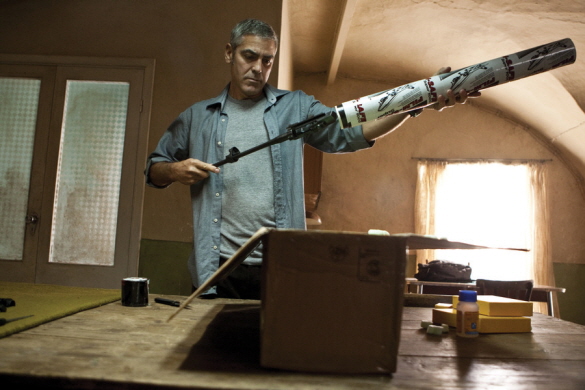
When “The American” was scheduled to be released in next week in South Korea(the release is recently postponed to the last week of this December, by the way), the trailer was shown at the screening room and the leaflets were prepared for the audience. The way they advertised this movie was seriously misguiding in many aspects. They tried to make believe our audiences that the movie belonged to the territory of the Bourne trilogy or recent blockbuster action movies like “Knight and Day”.
“The American” belongs to a far, far different territory. It is based on Martin Booth’s novel “A Very Private Gentleman”, and, as you probably guess from the novel’s title, this arthouse movie is a calm character study on a very private character who is a cold, efficient machine who seems to have been devoid of basic human emotions. It has some “action scenes”, but this is the movie that depends on the quiet tensions and ambiguity in the story. It fascinates us with its hero instead; It beckon us to watch what its hero is doing now, how he interacts with the people approaching to him, and, this is the most elusive element in the movie, how he thinks or feels.
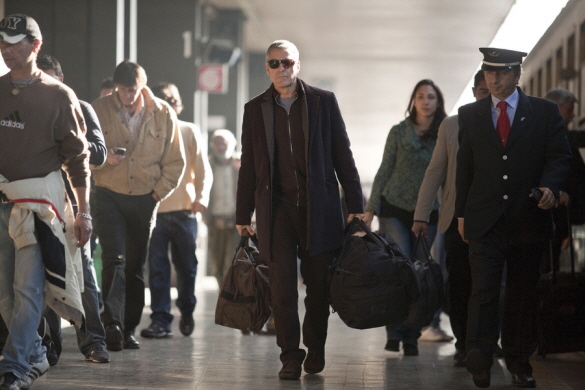
The movie gives two names to its American hero(George Clooney), but whether his real name is Jack or Edward does not matter to us. His profession defines his identity, not his names. He is a competent killer and he can be quite heartless without any hesitation if the situation requires him to be, as shown in the opening scene at the snowfield in Sweden. It seems some Swedish guys are running after him for the reasons not clearly explained in the plot, and, as instructed by his boss, he goes into hiding in the rural area of Italy.

Disguising himself as a photographer, he arrives in some quiet country town and gets his temporal residence in this pastoral place. Not long after that, his boss Pavel(Johan Leysen) gives him a new assignment. Rather than killing somebody, it is making a special rifle for the unspecified job. He soon meets a woman named Mathilde(Thekla Reuten). Their conversation at the open place surrounded by people is terse, but Rowan Jaffe’s screenplay is economically effective. The technical specifics of the job are precisely conveyed between them; he gets nothing but what he needs to know for the operation and that is all.
We see how he works on this assignment while maintaining his cover. As a disciplined man, he starts his day with the exercise. While unassumingly going around town, he visits the garage recommended by the town priest(Paolo Bonacellni) and acquires what he needs for his production. While privately working in his room, he is meticulous enough to make a elaborate killing machine and keep his secret operation undetected by others – he is certainly a skilled craftsman. And he visits a brothel near the town and gets involved with one of the prostitutes, Clara(Violante Placido).
It looks like his problem keeps following him. He is constantly vigilant about his surroundings. As a seasoned professional, he cannot trust anyone easily. The town priest sees the man hiding himself inside the austere facade from him, but he declines to tell anything to the priest. There is a certain tension between him and Mathilde, but we can never be sure about what kind of tension it exactly is. In case of Clara, well, she likes him and it is possible that she begins to melt his cold heart, but his reserved attitude reminds us that anything can happen in his world.
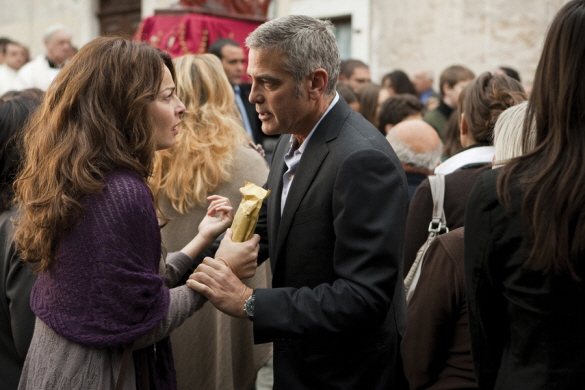
The director Anton Corbijn, who previously impressed me with a good musician biopic “Control”, makes the movie reminiscent of those dry, hard-boiled European crime dramas made in the 60-70’s. Like Jean-Pierre Melville’s great movie “Le Samouraï”, the movie has an interesting character who strictly leads a barren, lonely life mainly occupied with his profession while rarely showing the thoughts and feelings. George Clooney, one of the most likeable Hollywood stars, is probably the last man you can imagine for such a distant character, but he pulls it off with his steely performance that stealthily implies a man who wants to finish his journey in the cold. Clooney has been expanding his career wisely while going between the commercial movies and the serious ones, and he succeeds again with something different.
Corbijn diligently builds the tension in his movie while making the small moments with lots of care. The movie looks fabulous with the good locations. Whether it is the dark alleys lighted by the blue fluorescent lights and orange sodium lights or the quiet sunny places outside the town, there is always the subtle anxiety. When the situation is suddenly changed, it takes some effort for us to sense that. Once you sense it, the tension on the screen becomes palpable to you despite the calm surface.
Under Corbijn’s firm direction, the key supporting actors keep themselves on a thin line and ably walk on it. They are relatively unknown compare to Clooney, but each of them does a credible job that suggests something more than it meets the eyes. While Thekla Reuten has a good scene with Clooney where her character willingly puts herself on the matter of trust and doubt, Placido is attractive as a prostitute who may want to give her reticent client more than his pleasure. And Leysen does far more than phoning his performance at the other end of the line.
“The American” can provide you a compelling experience as long as you know how it is about rather than what it is about. While not resorting to a typical auto-pilot storyline or obligatory shootout sequences following it, it quietly and proficiently examines something deeper inside the story with an assured hand. With its laconic attitude and cool machine-like efficiency, it is distant as much as its central character but it makes us curious about him. As the men whose job is killing other human beings, the killers cross the line and enter the world different from ours. It has different moral codes and it is not a warm place. The story of “The American” asks us the same thing many movies about such people have asked us. Can its hero bring himself to the world he probably left a long time ago? You’ll see.

“The Social Network” is simply riveting. I have no idea about how much of its story is fictional, but, as the fiction, the movie is smooth, fast, clever, and entertaining as the drama of a young man who finds himself as the youngest billionaire in the world and does not give a damn much about that. He only cares about what he made in his tunnel vision, but that vision was keen enough to perceive the possibility that eventually results in something worth around 25 billion dollars at present.
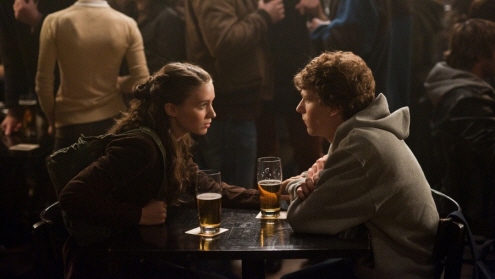
When we meet Mark Zuckerberg(Jesse Eisenberg) at the start, there is something awkward about this nerdy Harvard undergraduate student. He is dating with a girl named Erica(Rooney Mara) at the campus bar and tries to get intimated with her. His strategy is abnormal; he constantly spurts out the things he knows and he keeps changing subjects. He wants to impress her with that, but this quick verbal exchange in a few minutes makes her only exasperated and insulted. Their meeting soon results in a breakup with the incisive comment from her.
Angry about this, and also a little intoxicated by beer, Zuckerberg, a computer science major, executes a mean revenge on her. He writes about her insultingly on his blog, which is open to everybody in the campus. He goes far meaner. He hacks into the campus network, acquires the photos of every Harvard female students from the dormitory websites, and then posts them to be rated for “Hotness” on the website he improvisedly makes. The result from this crude prank is bigger than he and his accomplice and “best friend” Eduardo “Waldo” Saverin(Andrew Garfield) thought; the campus network is crashed thanks to its popularity among (mainly male) students. Zuckerberg gets probation for this, but he is not anonymous nerd anymore now – everybody knows him around the campus.
That is how he gets the attention of the Winklevoss twin brothers(Armie Hammers playing both and Josh Pence as a body double) and Divya Narendra(Max Minghella). They ask Zuckerberg to help them for making a website for the campus online dating, and he sees something far more innovate in this request. Without telling them anything, he makes his own website from his own programming codes with the financial help from Saverin. Their “The Facebook” becomes popular in a short period in their campus, and it gets expanded rapidly among the other American universities. Furthermore, its success reaches to the global level thanks to Sean Parker(Justin Timberake), the originator of Napster. However, like any case of a massive success, the big problems begin for Zuckerberg.
It was reported that Zuckerberg himself was not so happy with the movie, but I think I can say Aaron Sorkin’s screenplay, based on the book “The Accidental Billionaire” by Ben Mezrich, is pretty much fair to him as much as the people surrounding him. While maintaining fairly objective viewpoint, the movie makes the audiences understand Zuckerberg as well as others. The Winklevoss brothers and Narendra surely have the decent reasons to be angry about Zuckerberg’s “theft”, but could Facebook have been possible if not for his genius? Furthermore, can it be said that his deed was an intellectual property theft? Can it be said these rich boys are just angry because “things didn’t go exactly the way they were supposed to for them”, like Zuckerberg says in the movie?
In case of Saverin, he really has lots of reasons to be bitter about his friend. He sincerely helped his friend as the appointed CFO of Facebook with lots of efforts. Although the movie also clearly points out that he was not suitable for that job despite his efforts, he does not deserve such a cruel betrayal that mainly results from Zuckerberg’s narrow view and Parker’s influence on Zuckeberg. Andrew Garfield, who has been steadily gaining the recognition with “Boy A” and recently released “Never Let Me Go”, gives a low-key but splendid performance as the sympathetic conscience of the movie.

And Zuckerberg is the compelling center of the story. In his focused performance with the quiet intensity, Jesse Eisenberg presents us a complex human being who is a very intelligent man with the flaws usually observed from the brilliant minds. He is arrogantly confident about his intelligence. He usually wants to spend his time with what he does well and does not like to be bothered with anything else. And he can be really vicious when it comes to his business or his feeling. There are several incidents which might have been perpetrated by him, but the movie does not give the clear answers.
The funny irony is that Zuckeberg intuitively found the way how the human relationships can be absorbed and operated in the electronic world although he does not understand much about them. Maybe he knows the equations and the constants, but he does not understand the variables. The human relationships are more baffling to him than the computer programming. He inadvertently hurts his people, and he seems to be a little sorry for that, but his brain seems to care more about his work even when he is sandwiched between two big lawsuits.
Like any lonely nerd, he wants someone he can get along with as his equal, and Parker is the guy. Justin Timberake is terrific with his memorably flamboyant performance that will probably garner an Oscar nomination along with Eisenberg and Garfield. Living on his past fame from Napster, Parker sees the second chance from Facebook. He captures Zuckerberg’s attention instantly with his paper-thin but brash confidence right from their first meeting. He soon joins the business despite Saverin’s discontent. It was opportunistic indeed, but it cannot be denied that Parker moved Facebook to the next level of a far bigger success.

Zuckerberg is drawn to what Parker promises to him, but, unlike Parker, he has little interest in the indulgence with his success. Sure, he has wanted to join boy’s club and now belongs to the club because he owns it, but he is the last man to have a fun with that. Even after his big success, he still is a socially inept young man who prefers to work with his laptop in an empty office than goes to the party. Look at how much his attire is unchanged throughout the movie except the lawsuit sequences.
While frequently going back and forth between two lawsuits and the main storyline, Sorkin’s script provides a clear sight of how Facebook was developed despite lots of informations crammed into two hours of the running time. Even to the audience unfamiliar with its technology and the legal and business problems associated with it, the movie eventually comes to them as an exhilarating story of the success and its following ramification. The dialogues are precise and effective, and they are delivered as fast as the brisk pace of the movie.

As with “Zodiac”, his best work to the date, David Fincher handles the movie in a more controlled style compared to his boldly stylish movies like “Fight Club”. Rather than drawing attention with how it looks, he focuses on how it is effectively presented as a well-told story on the screen. Like he effortlessly transported us to San Francisco in the 1970s in “Zodiac”, Fincher immediately immerses us in the competitive world inside the Harvard University, and we willingly follow the characters and their fascinating story.
Thanks to Fincher’s agile direction, Sorkin’s shrewd screenplay, and the pitch-perfect ensemble performance, “The Social Network” is one of the best dramas we have encountered in this year. The movie gives not only an exciting look on how Facebook was originated but also an equally interesting human story about it. One of few notable things it does not delve deep into is how Zuckerberg’s creation influences our world, but that is something we have to see for ourselves later, not now. Will they make the sequel for that?


They were photographed few hours ago…

Spending almost two hours with the relentlessly drunk character is not a pleasant thing at all, and it is also not easy to watch the man who chooses to abandon himself to his own hell. He is almost near at the bottom. All he can do is moving further to the final destination he has been reaching for. He still has some fancy about getting out of his torment, but it only reminds him that he has already crossed the line. He screams out of frustration near the end of the movie, “It’s not possible…. not in this world!”
John Huston’s “Under the Volcano”(1984) poignantly looks at one of the bleakest state of mind. This is a sad portrayal of a man struggling with his addiction and the agonizing contradiction resulting from it. As one character in the movie says, no one can live without love, but he cannot accept it even if he has desperately yearned for.
The movie is mainly about one unfortunate day of the former British consul Geoffrey Firmin(Albert Finney) who has been stuck in Cuernavaca, Mexico. According to him, he resigned his post for himself, but that may be not true considering his present state. He is a drunkard going through the final stages of alcoholism where the drinking is necessary for getting “sober”. He says he can deal with his addiction(“Surely you appreciate the fine balance I must strike between, uh, the shake of too little and, uh, the abyss of too much”), but his abstinence is just the brief moment of looking at his glass. His body soon craves for alcohol, he frantically searches for the bottle, and, after satisfying the need, he passes out.
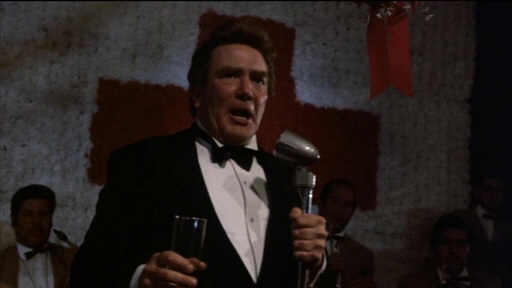 The year is 1938, and the movie starts with the evening of November the 1st, the eve of the Day of the Dead in Mexico. We see the town people mourning for the dead, the wreaths, the skull ornaments, and the consul staggering around them. Drunk as usual, he goes to the bar adjacent a shabby cinema to meet his friend Dr. Vigil(Ignacio López Tarso) for another drink. He drinks more at the Red Cross ball, where he bursts out the drunken tirade in front of people after encountering the fascistic influence creeping into Mexico from Europe. He is taken to a town church by Dr. Vigil later, and he prays for what he acutely needs: the return of his beloved and divorced wife.
In the next morning, his wife Yvonne(Jaqueline Bisset) really comes back to him. He looks back at her on the doorstep of the bar where he is just starting another day of bottles. He cannot believe this ‘miracle’, let alone his unreliable eyes. He neglects the sight of her and keeps on his rambling. And then he looks back at her again. It cannot be, he seems to think, and he goes back to his soliloquy. But still she is there right behind him. “Is it really you?”, he asks.
After that, we see how the consul, Yvonne, and the consul’s half-brother Hugh(Anthony Andrews) spend the rest of the day together. The consul manages to be relatively better for the time being with the help from Yvonne and Hugh. They go to the festival together in the afternoon and then travel around the area by bus. Yvonne wants a new beginning with her ex-husband and the hope begins to look like something tangible to them. However, it seems to be too late for the consul and the fateful night for all of them is approaching with the darkening sky.
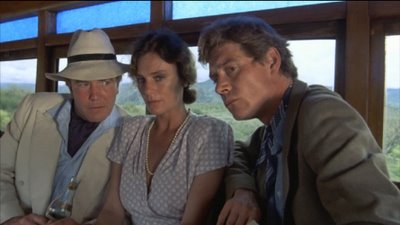
“Under the Volcano” is not a hopeful story. Neither is Malcolm Lowry’s novel of the same name the movie is based on. As a lifelong alcoholic, Lowry spent his hellish days in Mexico around the 1930s and his experience during that period became the basis for his only major work. He eventually went to the north with his second wife(like the characters in his book hope), and he resided for several years in Canada where he finished the harrowing masterpiece that his whole tragic life had been burned for.
Because of its complex structure and “The stream of alcoholic consciousness” style, Lowry’s novel had been deemed unadaptable by many since its publication(Luis Buñuel once tried it but gave it up soon). Rather than trying to make a faithful adaptation, Huston and the screenplay writer Guy Gallo selected the materials presentable on the screen and did the best with them as far as they could. After all, Lowry’s book is essentially the story of a drunkard at the core, and Huston and Gallo did not miss that point in their reconstruction of the source material.
Huston prudently avoided those dizzy camera tricks usually expected from the dramas about alcoholism. Instead, he emphasized on the lucid, natural physical presentation of the rural Mexican town where the characters are surrounded by its beautiful scenery – including the houses, the bars, the streets, the square, and the looming presence of an active volcano Popocatepetl, the main recurring symbol of the unrest before the World War II in the novel.

The cinematographer Gabriel Figueroa, who worked with Buñuel in several movies including “The Exterminating Angel”, provides the contrasting atmospheres for this world. When the sun goes down, the bright but washed-out feeling of the day scenes is gone, and we are in the dim world where ugly things happen in the lights and shadows. For the night scene at the Farolito bar, Huston added more authenticity by casting real prostitutes because “no decent lady can play a prostitute as well as a real one.”
The rest of the job mostly depends on Albert Finney, and the state of alcoholic mind is masterfully conveyed by his Oscar-nominated performance. Playing an alcoholic character is a tricky path with the danger of overacting, but Finney never loses his control even at the slightest moment. With his restrained, carefully-modulated performance, he gets everything so right about a drunken man- the speech pattern, the facial expression, the befuddled gaze, and the awkward body coordination – that you can instantly sense his character’s damaged side even when he wears those big sunglasses.
While we know little about the consul’s background or what has driven him to his suicidal alcoholism except some implications(the novel gives more detailed information), Finney reveals to us a human being who tries hard but fails to express his thoughts and feelings in the incorrigible condition. He is probably an intelligent man with some sense of humor, but, like any other alcoholics, he is not someone easy to get along with. He perceives the impending war through an occasionally keen view, but his muddled speech criticizing the negligence of it results only in his embarrassment at the party. He may be wise enough to advise his brother not to involve with the matter of the locals when they come across an incident on the roadside, but he finds himself entangled with it later. He cannot help himself. His mood swings up to the hopeful prospect and then, accelerated by alcohol, it rapidly flows down into the spiteful despair.

Although their roles are seemingly thankless ones, Jaqueline Bisset and Anthony Andrews are no less crucial than Finney in providing the human dimensions to the story. It seems that Hugh and Yvonne had an affair with each other in the past and that complicates the relationship between them and the consul, but they sincerely care about the consul. They try to stay with him like good hospice workers even after being hurt and rejected by him in the painful scene where he lashes them with his bitterness toward them. Although it is not explained well in the movie, there is more than love in their persistence. Perhaps, like us, they see a man struggling inside his mind from the consul and think that he still needs them even if he disregards them.
While watching the movie, it is hard not to think about John Huston. Like Lowry, He was a notorious drinker, and the consul is not so far from the notable characters in his movies, which are also not so different from Huston himself. Driven by their impulses and obsessions, many of his characters go through the destructive path that ultimately results in the bitter ending, and that was exampled best in his masterpiece “The Treasure of Sierra Madre”. In case of “Under the Volcano”, the situation is a little different; the plight is almost over for the consul from the beginning and the death, which literally represented by the Day of the Dead, is waiting for him.
The same can be said of Huston around the time he set to make this movie. He knew his time was short due to his ailing health. He even wrote the letter for Jack Clayton, who had worked with him before, just in case of his possible death in the production. However, Huston reconsidered his thought and decided not to send the letter in the end. He eventually completed the movie, and then went on making another two movies before his death in 1987.
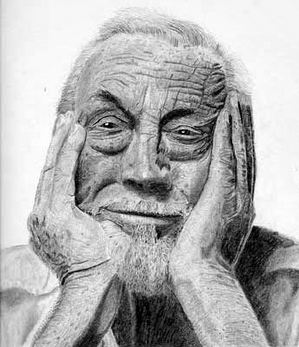
(the pencil drawing by William J. Gibson)
In the essay accompanied with the wonderful Criterion DVD released in 2007, the critic Christian Viviani suggests that the movie was the exorcism for Huston. I agree to that. As widely known, Huston was not a nice guy, and he had damaged many relationships with drinking and gambling and other things he did as if he had been entitled to do. After surviving more than 40 years of his adventure in the movie business, he might have been afraid of leaving the bad memories of himself to the people he cared. He might have seen his fears in the doomed story of the hero who hurts his people and hurls himself into the miserable solitary among strangers.
Nevertheless, he tackled to the challenge with the unflinching observation on his subject, and his exorcism was as successful as Bergman’s “Cries and Whispers”. His last two movies are also associated with the death in one way or another, but they are more like the liberation compared to the darkness of “Under the Volcano”. Furthermore, he helped and got closer to his children while making his last movies with them. The memorable main title sequence with the dancing skeletons in “Under the Volcano” was shot by his son Danny Huston, a successful Hollywood supporting actor at present. In “Prizzi’s Honor”, a delightfully cynical gangster black comedy, he gave his daughter Anjelica Huston the breakthrough role in her career and she won an Oscar for her performance. And he had his other son Tony Huston adapt James Joyce’s short story for his moving swan song “The Dead”. Like the consul, but in a far more positive way, Huston moved on with the remaining strength and concluded his illustrious career with three wonderful movies.
As a harrowing drama about alcoholism, “Under the Volcano” deserves to be remembered with other more well-known alcoholic dramas like “The Lost Weekend” and “Leaving Las Vegas”. I have come across several reviewers who do not particularly like it while admiring it because of its sheer bleakness. As a matter of fact, the movie might be bleaker than “Leaving Las Vegas” for the consul ultimately despairs of being incapable of love and even rejects the solace he could have gotten. But he carries on with all his heart – and his bottles. Through him, the movie somehow touchingly reminds us that every drunk tries to struggle with oneself in one’s chemical brain cloud no matter how futile it is. They let down not only others but themselves when they fail.

Footnote: I must mention Alex North(1910-1991) for I came to know this movie through his work. As the legendary Hollywood film composer, he made a striking debut with his groudbreaking jazzy score for “A Streetcar Named Desire”(1951) and got the first Oscar nominations along with “Death of a Salesman”(1951). With his sparse but functional score for “Under the Volcano”, he scored his last and 15th unsuccessful nomination(he is still the biggest loser among the Hollywood composers). In the end, North got a Life achievement award from Academy in 1986 for his contributions and he was the first film composer to receive the award.
In his acceptance speech, as the composer who had followed his heart in selecting his projects, he urged filmmakers “to convey and encourage hope, humor, compassion, adventure, and love, as opposed to despair, synthetic theatrics, and blatant bloody violence. And sex, sex, sex, by all means… indeed, but with a bit of mystery, a touch of charm and elegance, and lots of imagination.” Amidst those cynically soulless commercial products, there are still talented people who follow his words.