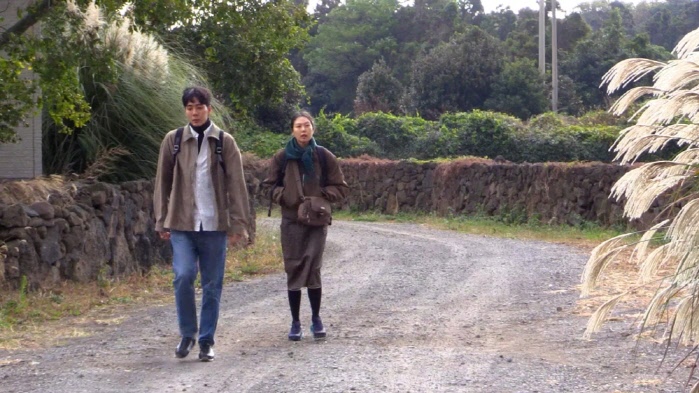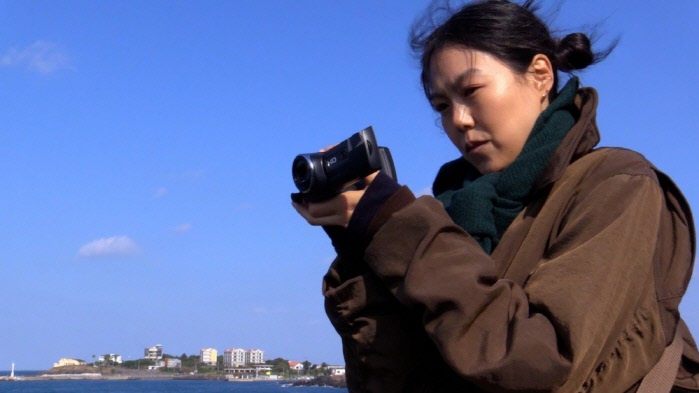
Hong Sang-soo’s latest film “Nowhere to Lay My Eyes”, which won the Best Director award at the Locarno Film Festival several months ago, is another modest but enjoyable work from Hong, who is incidentally one of the steadiest filmmakers working in South Korean cinema in my inconsequential opinion. Within its rather short running time (72 minutes), the movie serves us a number of plain but subtly amusing moments generated among a handful of main characters, and it certainly helps that it is anchored well by another good performance from its wonderful lead actress
Kim Min-hee, who received the Best Actress award at the Locarno Film Festival and has been one of Hong’s main collaborators during last several years besides getting personally involved with him several years ago (She gave birth to their first son in last year, by the way), plays Sang-hee, a young woman who visits her mother’s residence in Jeju Island along with her younger brother Sang-won (Shin Seok-ho). Their mother, Jong-won (Choi Myung-gil), has a local restaurant which has been quite successful, and she is currently living with her second husband Soon-yeong (Kwon Hae-hyo) in their cozy modern house.
Sang-hee and Sang-won are wholeheartedly welcomed by their mother and her second husband, and we get to know more about Sang-hee as these four people talk more with each other. While she currently works at some small snack import company, she has also pursued a career of experimental filmmaking mainly because of her longtime artistic passion, though she still has to depend a lot on the income from her main job.
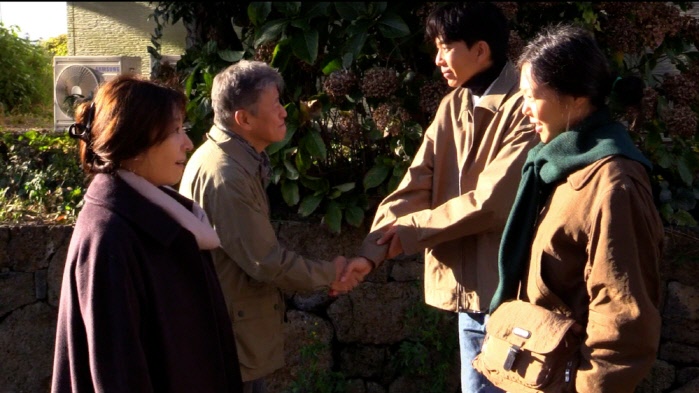
Incidentally, Soon-yeong is a documentary filmmaker who has been working on his little personal project, so he and Sang-hee come to have a brief discussion on the artificial aspects of documentary at one point. As trying to make her point on the subject, Sang-hee even mentions the ongoing conflict between Israel and Palestine, but the movie unfortunately sidesteps this important political issue along with her following argument, which is not so far from those superficial “Both Sides” arguments.
As they spend more time together with some drinking (How can Hong’s film possibly exist without drinking?), everything seems to feel nice and cordial among Sang-hee and the three other main characters, but we gradually gather how Sang-hee is not so comfortable with being with her family. For example, her mother often compliments or supports her a bit on the surface, but it becomes more apparent to us that she actually does not regard her daughter’s artistic passion that highly.
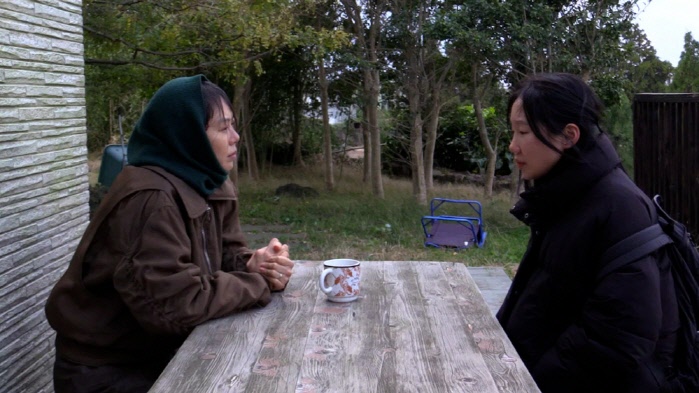
As leisurely moving from one episodic moment to another, the movie shows some emotional sensitivity at times. When Sang-hee subsequently meets Soon-yeong’s daughter Joo-won (Park Mi-so) on the next day, she feels more comfortable as they openly talk about several things in private. As a painter, Joo-won understands well how serious Sang-hee is about her artistic passion, and their casual conversation becomes more interesting as they talk a bit about the metaphysical meaning of eternity. I must confess that I am not so sure about whether I totally understand their discussion, but Kim and Park are so effortless in their spontaneous interactions that I can tell you that this wonderful conversation scene is the undeniable highlight of the film.
Another good scene follows not long after that. As Hong’s camera steadily focuses on them (Again, Hong serves as the producer/editor/cinematographer/composer of his film in addition to handling the sound of the movie), Sang-hee and her three family members have a nice dinner during their casual conversation, and the movie subtly conveys to us some strain beneath the cheerful mood among them. In the next morning, there comes a bit of tension as Sang-hee suddenly goes outside without telling anyone, and her family members naturally become concerned as she and her younger brother should not be late for catching their return flight to Seoul.
Although Kim’s phlegmatic narration does not signify anything to us, her solid performance quietly conveys to us whatever is churning behind her character’s gentle appearance, and the movie often reflects that via the frequent sounds of blowing winds on the soundtrack. Around the end of the story, the camera simply looks at Sang-hee doing what may be her next filmmaking project, but this somehow leaves some real poignancy on us, just like when Sang-hee’s family members silently watch one of her YouTube clips during her sudden absence.
Kim is also supported well by several other main cast members of the film. Because he has steadily collaborated with Hong since “In Another Country” (2012), Kwon Hae-hyo certainly draws our attention first, Choi Myung-gil, Shin Seok-ho, and Park Mi-so also hold each own place well around Kim without overshadowing Kim at all.
In conclusion, “Nowhere to Lay My Eyes” is another engaging work from Hong during this year after “The Day She Returns” (2026). They are simply as good as you can expect from him, but he surely demonstrates that he is still as productive as he always has been during last 30 years since his first feature film “The Day a Pig Fell into the Well” (2026), and I am already waiting for Hong’s next film to come.