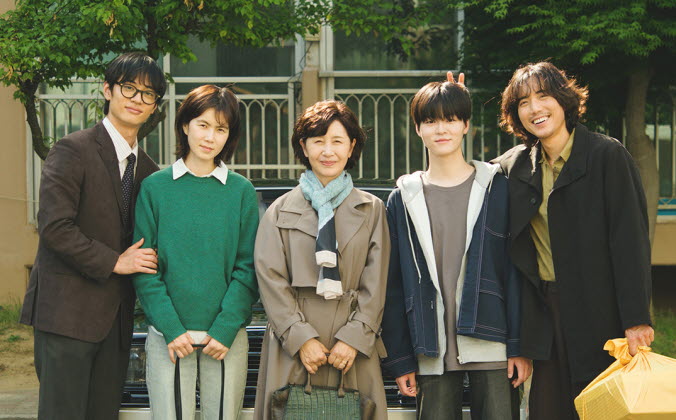
My late mentor/friend Roger Ebert once said that he likes movies about good people, and South Korean independent film “Journey There” is one of such cases in my humble opinion. Calmly and sensitively observing how its old heroine comes to have a sort of alternative family, the movie gradually engages us via her genuine decency and kindness, and we are often touched by what slowly happens between her and two good strangers unexpectedly coming into her life.
The movie opens with a big change in the life of an old lady named Choon-hee (Kim Hye-ok). Since her husband’s recent death, she has been left alone in their house incidentally designed and built by her husband, and now she decides to move out of the house due to a personal reason to be revealed later in the story. After putting the house on sale, she promptly moves to a nearby apartment complex along with several personal stuffs including her husband’s car and grand piano, and we get a little amusing moment from how she is transferred to her new residence along with her husband’s car. Although she does not know how to drive at all, the car feels important to her as much as the grand piano, and we later see her pay some attention to its maintenance day by day.
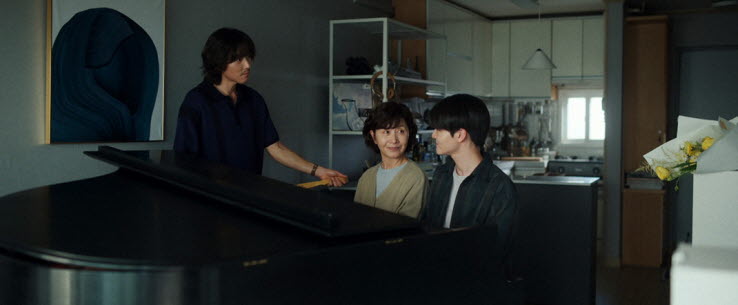
However, Choon-hee faces a trouble in case of moving the grand piano into her residence, which happens to be on the first floor of one of the apartment buildings in the complex. Due to a tree blocking the balcony of her apartment, the grand piano cannot be moved into her residence at any chance, unless she has that tree cut right now. She does not like that option that much, but, fortunately, there comes an unexpected offer from Min-joon (Justin H. Min), a Korean German lad who has lived on the 15th floor of the same apartment building. He gladly takes the grand piano into his apartment, and he and Choon-hee soon befriend each other as new neighbors while she frequently visits his apartment for taking care of the grand piano.
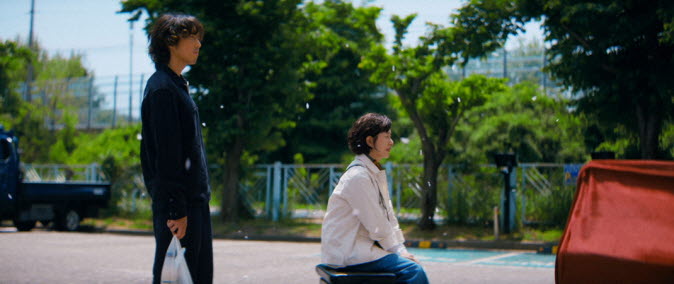
As they come to spend more time with each other, Choon-hee and Min-joon get to know each other more. Min-joon, who was adopted by his German foster parents many years ago, came to South Korea for finding his biological mother, and he even put his promising musician career in suspension just because of that. Choon-hee’s husband, who was a prominent architect, actually had hearing impairment, but that did not stop him at all from pursuing his own passion toward music, and that is why his grand piano has been such a precious reminder of him to Choon-hee. Although she does not know that much about playing music, she comes to learn bit by bit from Min-joon, and she certainly feels happy as remembering her husband more.
Meanwhile, there comes another figure to draw our attention. It turns out that Min-joon has been teaching a shy but promising adolescent piano prodigy named Seong-chan (Park Dea-ho), and Choon-hee comes to regard Seong-chan and Min-joon as a son and a grandson she never had (She and her husband did not have any child between them, by the way). When she later learns that Seong-chan really needs some help and support for his possible future career, Choon-hee does not hesitate to step forward for that, and that is certainly appreciated a lot by both Min-joon and Seong-chan.
Wisely preventing itself from becoming too sentimental, the movie leisurely takes some time in developing its story and characters more. As Choon-hee goes through her daily life as usual, we observe more of her inner goodness, and the story keeps sticking to its calm and restrained attitude even when we get to know more about a serious personal matter behind her casual appearance. Although the story does not spell them out at all, it subtly lets us sense more of Min-joon and Seong-chan’s respective personal issues, and we are accordingly moved by how they come to find love and comfort from their growing relationship with Choon-hee.
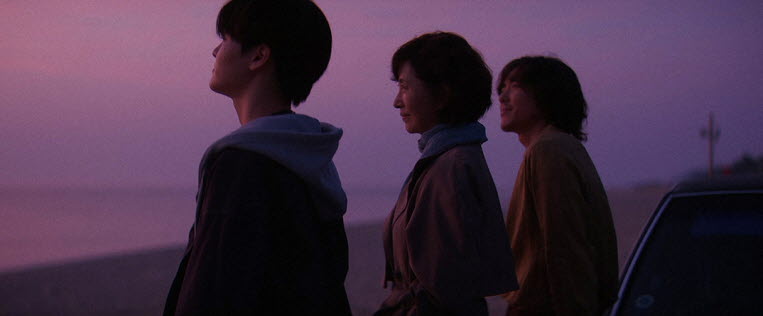
Later in the story, there is a tenderly touching scene where Choon-hee encourages Seong-chan more when they have a little airport picnic along with Min-joon. She just talks about what she and her husband wished to do right before his death, but both Min-joon and Seong-chan get her point nonetheless, and that is followed by a lovely poetic moment which accentuates the deep emotional bonds among these three good people.
The main performers of the film are effective in their humble low-key acting. While Kim Hye-ok, a wonderful veteran actress who has been active for more than 30 years, gently holds the center as required, Justin H. Min, who has been more prominent thanks to his breakout supporting turn in Kogonada’s “After Yang” (2021), ably goes back and forth between humor and drama in his likable performance, and he and Kim constantly complement each other well throughout the film. Despite his rather under-developed role, Park Dae-ho holds his own small place mostly well between Kim and Min, and several other supporting performers in the film including Gong Min-jeung, Kim Jong-goo, and Kwon Hae-hyo are also well-cast in their respective parts.
Overall, “Journey There” is another commendable work from director/co-writer Kim Jin-yu, who previously made a solid feature film debut in “Bori” (2018). While it may require some patience from you due to its rather slow narrative pacing, the movie will engage you and then touch you with its gentle and thoughtful heart, and its poignancy will linger on your mind for a while after it is over.
Sidenote: Like “Bori”, which is incidentally about a little girl who wants to have hearing impairment just like her family members, the movie is presented with the subtitle for audiences with hearing impairment. I sincerely hope that more South Korean movies will show such consideration like that.