Bruce Beresford’s 1991 film “Black Robe” is about the grueling journey of a Jesuit missionary about whom we never get to know that much except his adamant religious dedication. While we are supposed to care about his agony and struggle, this grim and melancholic drama film curiously remains rather distant to its titular character, and you may wonder whether there is any particular point to reflect on as the story eventually arrives at its bleak anti-climactic ending.
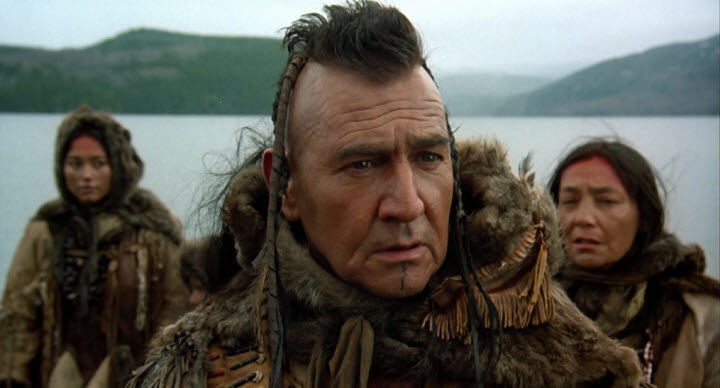
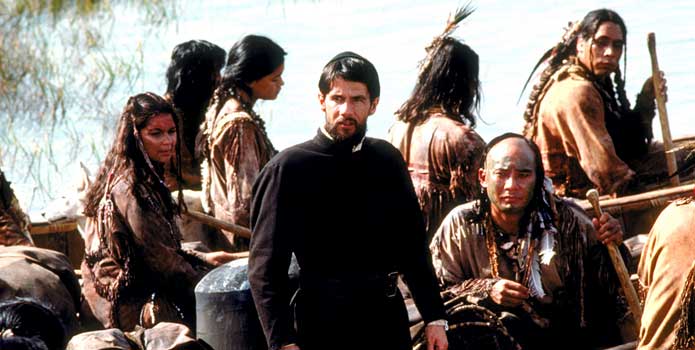
The story is set in the New France area of Canada in the middle of the 17th century, when Canada was a colonial area of France. In a French settlement which will become Quebec City later, we meet a young Jesuit priest named Father Paul LaForgue (Lothaire Bluteau), and we see him preparing to join a Catholic mission in a distant indigenous village located somewhere in the wilderness area outside the settlement. Although he must traverse a distance of 2,400 km with some help from a group of members of an indigenous tribe, he is not concerned that much just because he firmly believes that he is doing the work of God for those indigenous people out there, and he soon departs along with those indigenous people led by a dude named Chomina (August Schellenberg).
As Father LaForgue takes a long journey along with Chomina and several other indigenous people by their wooden canoes, the movie shows more of the harsh and gloomy aspects of the wilderness environment surrounding them. Winter is coming, and the weather naturally becomes colder day by day, so the movie occasionally gives us wide and impressive landscape shots shining with cold and bleak natural beauty to behold.
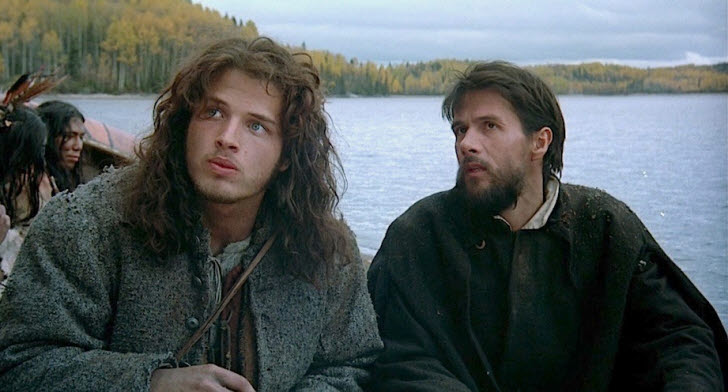
Despite his long and difficult journey, Father LaForgue remains unflappable in his stoic attitude – even after he is nicknamed “Black Robe” by Chomina’s indigenous people. Via several brief flashback scenes, we come to learn that he was once a promising young man of some French aristocrat family, but that is all we can know about him, and the movie never delves that deep into how he came to choose to become a man of God.
Instead, the screenplay by Brian Moore, which is based on the novel of the same name written by him, pays more attention to the issues of belief between its idealistic hero and his indigenous companions. While Father LaForgue believes that Chomina and his fellow indigenous people need to accept Christianity someday, they do not give much damn about Christianity from the beginning. After all, they were just hired to take Father LaForgue to his destination, and he is merely an outsider trying to meddle with their own way of life.
Never overlooking the humanity of Chomina and several other indigenous characters in the story, the movie wisely avoids presenting them as sort of noble savages, and we observe more of how harsh and barbaric their wild world can be at times. At one point in the middle of the story, there comes a bunch of indigenous folks from some other local tribe, and they turn out to be very cruel and ruthless as being quite determined to humiliate and torture Father LaForgue and several others as much as possible.
Even at that point, Father LaForgue remains firm and aloof as firmly and desperately adhering to his religious belief, but we come to question whether his plight and predicament will really mean anything at all in the end. Sure, he can be admired for sacrificing a lot of himself in the name of his religious faith, but it should be pointed out that he and his Jesuit organization are more or less than a representative of European colonialism from the very start. Furthermore, all of those indigenous people out there in the New Canada have their own religious beliefs for many years, and it is not so surprising that he is often regarded as nothing more than an annoying intruder by Chomina’s fellow indigenous people.
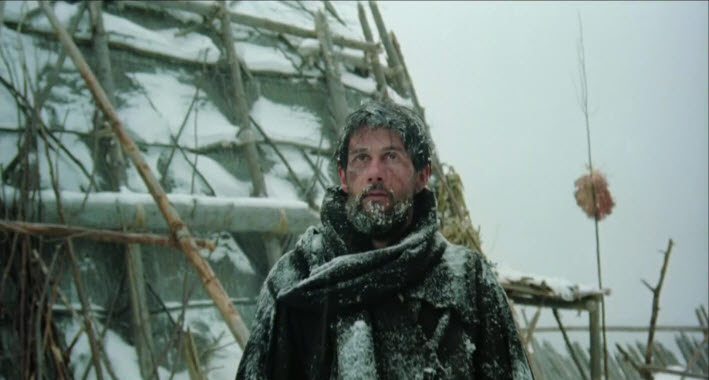
As often observing the story and characters from the distance without enough emotional interest, my mind often compared the movie with Roland Joffé’s “The Mission” (1986), which is overlapped with the movie to a considerable degree in terms of story themes and subjects. Compared to that visually stunning but ultimately superficial drama film, “Black Robe” has more narrative focus and human interest at least, but it is also inherently limited by its rather bland Jesuit priest hero, and it also does not throw many hard questions on religion and faith as sticking to its non-judgmental attitude a bit too much.
Anyway, the movie did a fairly commendable job of immersing us into its period background thanks to its skillful crew members including cinematographer Peter James, and the main cast members manage to bring some life and personality to their archetype roles. While Lothaire Bluteau, who was incidentally more compelling as the titular character of Denys Arcand’s “Jesus of Montreal” (1989), humbly holds the center as required, several other cast members in the film including Aden Young, Sandrine Holt, and August Schellenberg are well-cast in their respective supporting parts, and Schellenberg is particularly wonderful when his character comes to show more decency and dignity than expected.
In conclusion, “Black Robe” is not wholly without interesting elements, but I don’t think it is on par with Beresford’s better films such as “Tender Mercies” (1983) or, yes, “Driving Miss Daisy” (1989). I appreciated a lot of efforts put on and behind the screen, but the movie somehow failed to engage me enough during my viewing, and I only felt rather hollow and depressed in the end.