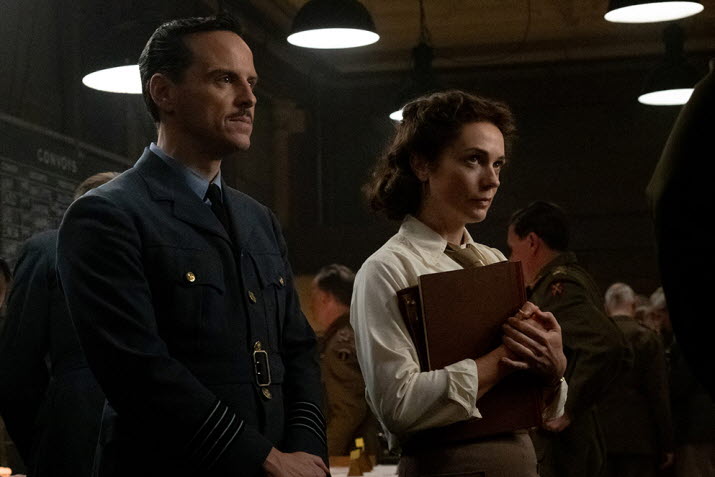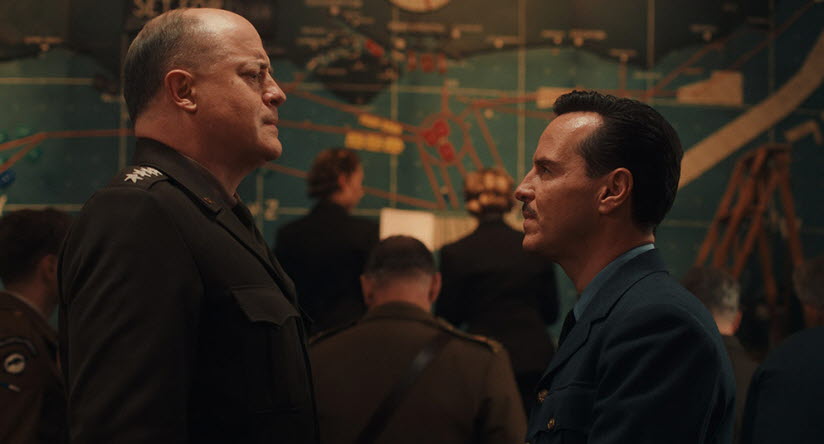
“Pressure” is a World War II movie inspired by a particular real-life story behind the Battle of Normandy in June 1944, a major turning point crucial for the eventual victory of the Allied. In that important battle in question, the weather on the coast of Normandy, France was quite crucial to say the least, and the movie presents a compelling drama surrounding one meteorologist who contributed a lot to the correct weather forecast for the Allied army ready to land on the coast of Normandy on that historical day.
He is James Stagg (Andrew Scott), and the story, which is adapted from the stage play of the same name by co-writer David Haig, begins with him leaving for Southwick House, the seat of the Supreme Headquarters Allied Expeditionary Force (SHAEF). Although he is understandably concerned a lot about his pregnant wife expected to give birth to their child sooner or later, he has an immediate duty to handle as soon as possible, and his dear wife understands that well.
Right from his first day in SHAEF, Stagg does not get along with that much with many of his staff members including Irving P. Krick (Chris Messina), an American meteorologist whose casual attitude is contrasted a lot with Stagg’s unflappable appearance. Absolutely serious about his job, Stagg quickly demands to his staff members that they should gather all the weather data collected over the wide area surrounding Normandy, and we soon see them busily working over a lot of weather data sent to them hour by hour.
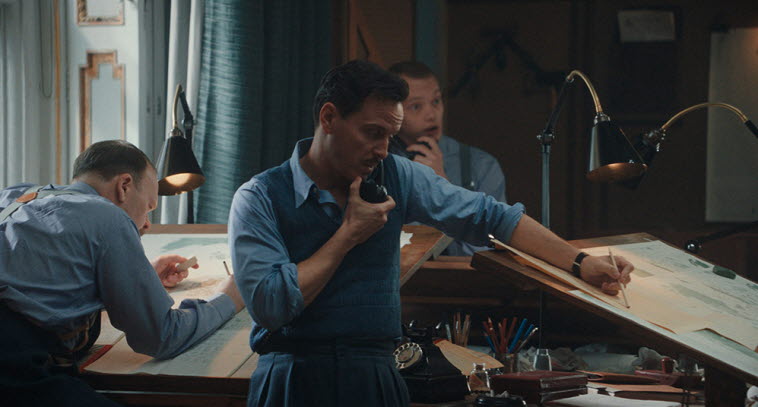
After checking the previous weather records, Krick concludes that the weather on the scheduled D-Day will be fairly fine, but Stagg is skeptical because, as a well-experienced professional who has observed the weather of the Northern Europe for many years, he knows well how unpredictable it can be due to many variables which can be suddenly changed at any time. Krick has earned the trust of General Dwight D. Eisenhower (Brendan Fraser) because he has been quite accurate in his weather forecast in the Northern Africa, but, as Stagg flatly points out at one point in the story, the weather pattern of the Northern Africa is usually quite more stable and predictable compared to that of the Northern Europe.
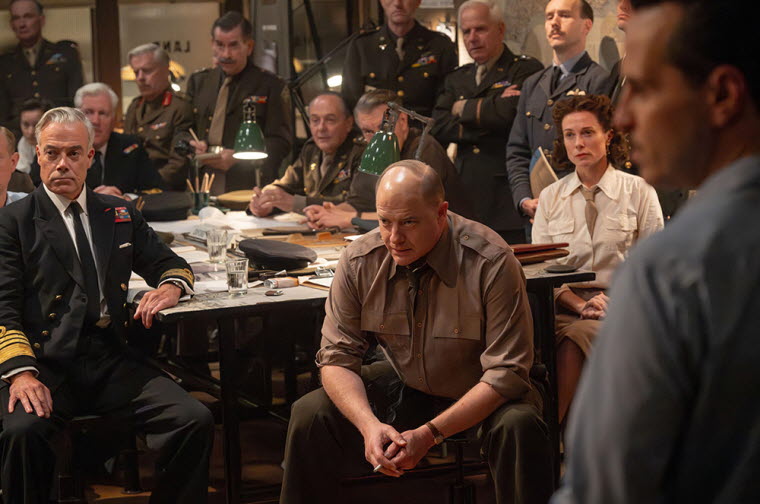
Despite the pressures from not only Eisenhower but also many other top-ranking generals and admirals including General Sir Bernard Montgomery (Damien Lewis), Stagg sticks to his professional conclusion, and that certainly causes a lot of frustration for Eisenhower and his colleagues. While he can just ignore Stagg’s warning, Eisenhower knows too well that his massive operation can be a catastrophic failure at any chance, and, mainly due to what disastrously happened during one big military exercise for the D-Day, he decides to be more cautious about his eventual decision.
Many of you will not certainly be surprised that much if you are familiar with the history of the World War II, but the adapted screenplay by Haig and director/co-writer Anthony Maras steadily keeps the story and characters rolling before eventually arriving at its expected finale. While constantly reminding us of what is being at stake for the main characters in the story, it also pays some attention to how Stagg and his staff members work step by step, and we can sense their considerable efforts even though we do not wholly understand how they exactly do their jobs.
Above all, the movie stays focused on the gradual dramatic tension between Stagg and Eisenhower. Although he often feels quite frustrated with Stagg’s rigid integrity, Eisenhower comes to admire and appreciate Stagg’s professional dedication, and he eventually takes a big chance with Stagg’s last-minute weather forecast on that historical day. As dedicating himself more and more to his important task, Stagg becomes more aware of his big responsibility than before, and we gradually sense more of whatever is churning or trembling behind his phlegmatic façade.
Needless to say, everything in the story culminates to what happened on the coast of Normandy on that important day, and the movie wisely takes a restrained approach. After all, it is virtually impossible to surpass what is so vividly and realistically presented during that unforgettable opening sequence of Steven Spielberg’s “Saving Private Ryan” (1998), isn’t it?
As the movie continues to focus on the story and characters as usual, the main cast members often shine in their respective parts. While Andrew Scott dutifully holds the center as required, Brendan Fraser, Chris Messina, Damien Lewis, and Kerry Condon are effective in their supporting roles, and Fraser is somehow convincing even though he seems rather miscast at first. Besides looking as commanding as required by a number of big scenes of his, he is also good in several quieter scenes with Condon, who provides some warm tenderness despite her rather functional character.
Overall, “Pressure” is a well-made historical drama to enjoy, and I think it is more entertaining than “De Gaulle: Résistance” (2026), a French World War II drama film which happened to be released in South Korean theaters in the same week. Both of them are incidentally about an unflappably principled hero, but the latter bored me due to its bland and superficial handling of story and characters while the former engaged me with its solid storytelling and several good performances to enjoy, and I am sure that you will have a more entertaining time with the former.