“Your Mother Your Mother Your Mother” is a seemingly modest but undeniably striking genre piece to be admired and appreciated. While it initially draws our attention with a criminal hero of specific religious background, the movie engages us more as deftly going back and forth between seriousness and absurdity, and its interesting genre experiment is held together by its undeniably charismatic lead performer.
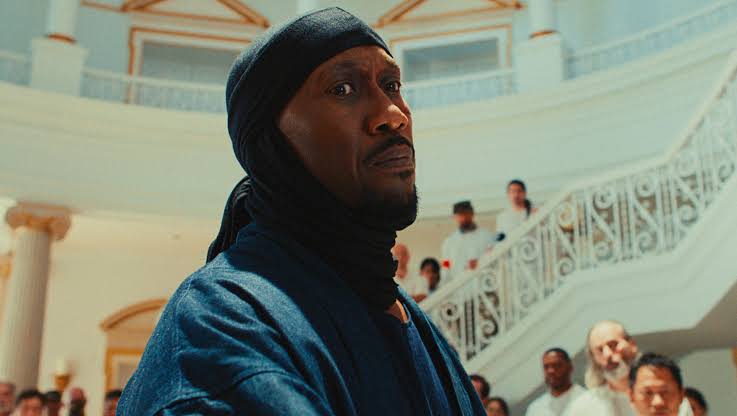
Mahershala Ali, who has steadily impressed us with a number of terrific performances during last several years, plays Latif, an ex-military Muslim hitman living in Houston, Texas. The opening scene shows Latif doing his latest job for a local criminal boss, and then he receives a sudden call from his adolescent daughter Fatiha (Adia). His wife, who recently gave birth to their third child, suddenly died, and now he has to take care of his three kids alone by himself while also struggling to cope with his grief and the accompanying doubt on his religious faith.
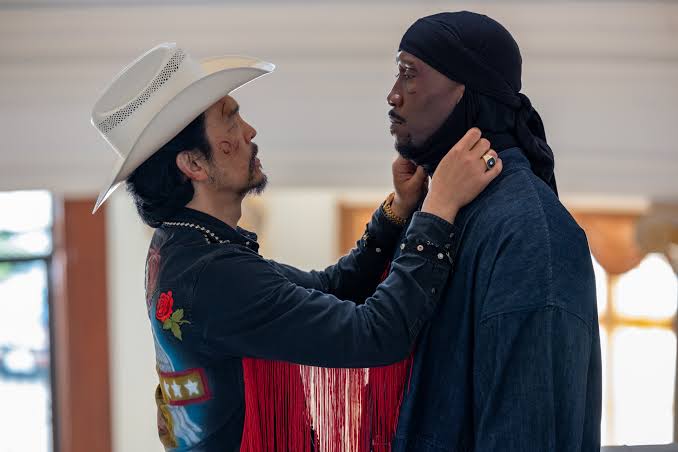
The early part of the film observes how things become more difficult for Latif. When it turns out that his infant child must be fed on breast milk instead of formula, he must search for any woman who can donate some breast milk, and that leads to a rather humorous scene where he and his children drop by one place after another in their neighborhood. Furthermore, the aforementioned local criminal boss has another job to be handled by Latif. A young nephew of the boss happens to get himself in trouble with a right-wing Korean American Christian pastor named Hwan Yoon (John Cho) due to his sleazy pornography business, and the boss wants Latif to eliminate Pastor Yoon even though Latif is understandably not so willing to do that.

It goes without saying that Latif soon finds himself getting cornered more between these two conflicting groups, but the movie takes some time for developing its main characters more along the story. While we observe more of how Latif has been estranged from his kids since his wife’s death, we also sense more of his inner crisis as he comes to have more doubt on what he has been doing for years. While his criminal activity has been tolerated by several others close to him including his wife and a local imam, there eventually comes an inevitable point where the others around him are thrown into serious danger because of his actions, and now he must deal with the consequences of what he inadvertently caused.
As its hero struggles to handle his increasingly messy circumstance later in the story, the movie doles out a series of impressive moments to remember. When Latif finally meets Pastor Yoon, the entrance of the latter is effortlessly depicted via smooth camera movement, and the movie gradually dials up the level of tension between these two characters even though they simply talk with each other on the surface. There are also several effective physical action sequences, and the movie wisely stays focused on what is being at stake for its main characters without hurrying itself at all even during its most violent moments.
In the end, there comes an unexpected moment which will certainly catch you off guard. At first, this feels quite jarring compared to what has been so realistically built up along the story, but, as I reflect more on what and how the movie is about, it somehow makes sense in the context of its hero’s religious conflict, and so does a brief but crucial moment between him and Pastor Yoon around the end of the story.
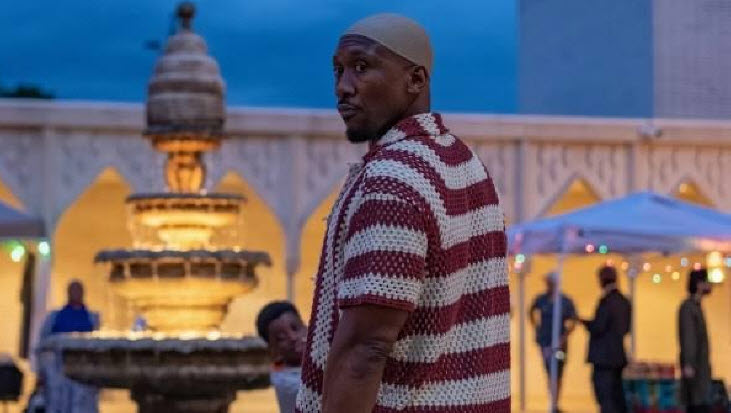
Ali’s restrained but indelible performance ably carries the movie from the beginning to the end, and this is definitely one of his best performances. Despite his two Oscar-winning turns in “Moonlight” (2016) and “Green Book” (2018), it seems that Hollywood does not know well how to utilize his talent and charisma, and that was particularly evident when he and director/writer/co-producer Bassam Tariq attempted to make a Blade movie for Marvel Cinematic Universe (MCU) but only came to drop out from the project after a lot of delay and frustration for them. Fortunately, they could work together in this movie instead, and the result will surely be regarded one of the highlights for their respective movie careers.
Tariq also assembles a group of engaging performers around Ali. While Giancarlo Esposito, an ever-reliable character actor who has been more prominent thanks to his Emmy-nominated supporting turns in TV drama series “Breaking Bad” and “Better Call Saul”, has a couple of good scenes as a stern local imam, and Abubakr Ali, Tramell Tillman, Tiffany Boone, Laith Nakli, Jahleel Kamara have each own moment to shine, Adia holds her small own place well during her several substantial scenes with Ali. In case of John Cho, he is surprisingly menacing as the main opponent of Ali’s characters, and he and Ali give some of the most compelling moments in the movie.
In conclusion, “Your Mother Your Mother Your Mother”, whose very title is derived from a saying Prophet Muhammad as shown at the beginning of the movie, is another interesting work from Tariq, who previously made a feature film debut with “Mogul Mowgli” (2020). With “Your Mother Your Mother Your Mother”, he demonstrates more of his considerable talent and potential than before, and I will certainly have some expectation on what may come next from this promising filmmaker.