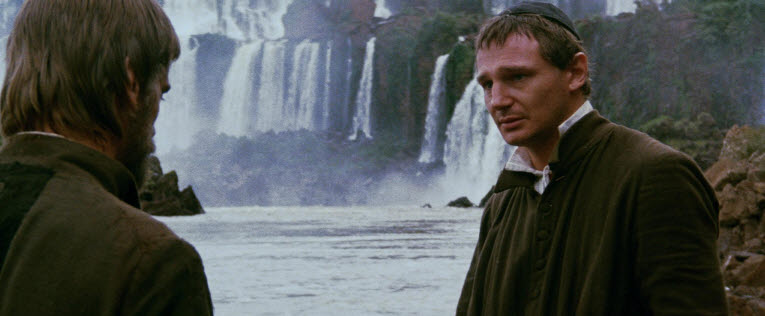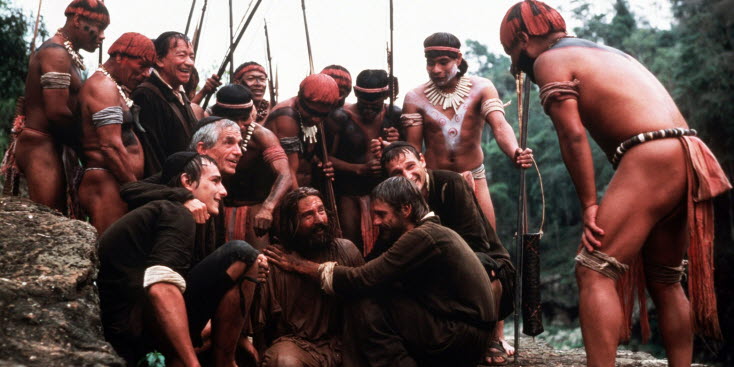
Roland Joffé’s 1986 film “The Mission”, which happened to be re-released in South Korean theaters a few weeks ago, is worthwhile to watch from a big movie theater screen at least once for a number of admirable technical qualities. However, these superb technical qualities of the film still cannot compensate for its glaringly flawed narrative which I observe from the distance with some reservation again, and that is really a shame to say the least.
Anyway, let’s just behold for a while what Joffé and his crew members including cinematographer Chris Menges, who deservedly won his second Oscar for this film after Joffé’s previous (and much better) work “The Killing Fields” (1984), achieve so vividly on the screen. For transferring us into a remote jungle area near Asunción, Paraguay in the middle of the 18th century, they really went to a number of real locations in several South American countries, and what they captured on the camera is often marvelous enough for us to overlook the flawed movie itself. When I saw the film for the first time in 1994 via a video CD copy which came along with a personal computer purchased by my parents, I was instantly mesmerized by the awe-inspiring opening scene dominated by the vast scale of the Iguazu Falls, and I must tell you that I found myself captivated and then enthralled again by this undeniably stunning visual moment when I revisited the film at a local arthouse movie theater during this afternoon
However, what follows next is not that special in comparison. We are introduced to a Jesuit missionary priest named Father Gabriel (Jeremy Irons), and the movie follows his sincere attempt to lead those indigenous jungle tribe people to Christian conversion. I am sure that this priest is full of good intention and faith, but you may observe that he is basically meddling with the life of those indigenous people, which was, let’s face it, relatively less troubled before their world was invaded and then exploited by European colonialism. In the other words, he is just a more benign representative of European colonialism just like the heroine of 1955 classic Hollywood musical film “The King and I” (1956).
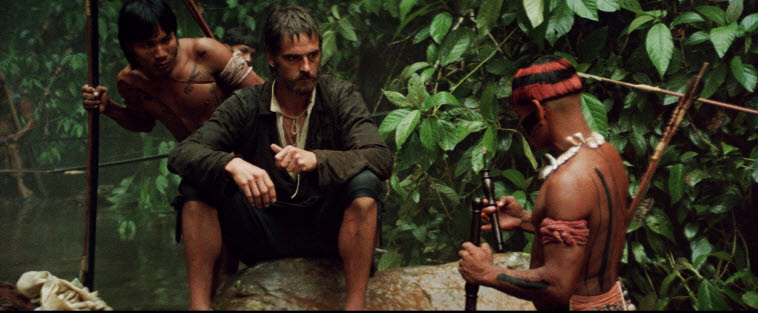
The first act of the story is mainly about the conflict between Father Gabriel and a cruel mercenary/slave trader named Captain Rodrigo Mendoza (Robert De Niro). While Father Gabriel gradually gains the trust of those indigenous tribe people in the jungle, Mendoza keeps capturing and then enslaving many indigenous people out there, and he callously disregards Father Gabriel’s protest when they happen to come across each other at one point.
Of course, there soon comes a moment of conversion and penance for Mendoza shortly after he accidentally kills his younger brother due to their romantic triangle with some beautiful lady. While becoming quite morose and regretful, Mendoza agrees to do some act of penance under Father Gabriel, and that leads to another astonishing scene to remember. I have no idea on how much the performers in the film actually endured during the shooting, they really look like going through a risky journey in the middle of a wide jungle area, and De Niro seems to be really throwing himself into his character’s several grueling moments of physical struggle during this scene. In my inconsequential opinion, that is a lot more impressive than any kind of big CGI spectacle from Hollywood.
However, the screenplay by Robert Bolt, who won no less than three Oscars for David Lean’s “Lawrence of Arabia” (1962) and “Doctor Zhivago” (1965) and Fred Zinnemann’s “A Man for All Seasons” (1966), fails to develop credible characters to hold our attention. Both Father Gabriel and Mendoza are flat archetypes merely placed in contrast with each other at times, and Mendoza’s personal drama feels quite superficial as the screenplay just scratches the surface without delving much into the potentially complex aspect of his quest for salvation and redemption. For example, how does he really feel about those indigenous tribe people he once enslaved without any hesitation? And how do those indigenous tribe people actually feel about his dark past before eventually having a rather contrived moment of forgiveness and acceptance between them and him?
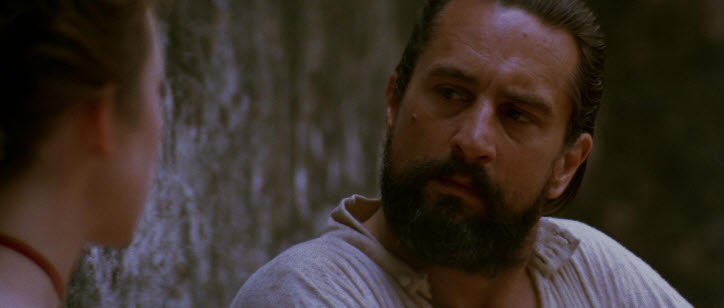
The second half of the movie becomes a bit more interesting as Father Gabriel and Mendoza and their indigenous tribe people are cornered by a geopolitical negotiation among Spain, Portugal, and the Vatican. As a representative of the Vatican, Cardinal Altamirano (Ray McAnally) knows well that he must do what should be done for protecting and maintaining the power and influence of his system, but he is quite morally conflicted as shrewdly observing what will be destroyed by his eventual decision. To me, he is actually a more interesting figure than Father Gabriel or Mendoza, and you may often sense a better film somewhere inside his several key scenes in the movie.
As Father Gabriel and Mendoza try to fight against what will inevitably happen to their indigenous tribe people, the movie brings some action to upon the screen, but it unfortunately fizzles without much dramatic impact. At least, the score by late Ennio Morricone, a legendary film music composer who should have won an Oscar for this film (He lost to none other than Herbie Hancock, who won the award instead for his far less prominent score for Bertrand Tavernier’s “’Round Midnight” (1986)), goes all the way for a dramatic finish during the end credits, and his score, which can be described as a heavenly mixture of chorus, orchestra, and local ethnic instruments, is the true star of the film along with Menges’s splendid cinematography.
On the whole, “The Mission” is not a total dud at least, but it looks more like one of those supposedly prestigious but ultimately forgettable Best Picture Oscar nominees at this point (It received no less than 7 nominations, by the way). Believe or not, it also actually won the Palme d’Or award besides the Technical Grand Prize at the 1986 Cannes Film Festival, and this surely demonstrates well that Cannes is not so good at choosing a top prize winner just like the Academy Awards. While my eyes and ears were not bored at all, it is still not good enough to touch my mind and heart, and that is all I can say for now.