
“The Hunger Games: Sunrise on the Reaping” is an effective prequel which knows well what often made its franchise entertaining. While this is basically a variation of what we already saw from “The Hunger Games” (2012) and “The Hunger Games: Catching Fire” (2013), it is supported well at least by solid storytelling and the good efforts from a number of engaging performers, and we willingly go along with that even though we all know well how the story eventually ends.
The story is about the dark past of Haymitch Abernathy, who was played by Woody Harrelson in “The Hunger Games” and its following three sequels and whose younger self here in this film is played by newcomer Joseph Zada. After quickly establishing young Abernathy and his romantic relationship with a local girl during the opening scene, the movie quickly moves onto another annual reaping ceremony. As demanded by the powerful dictatorship of President Snow (Ralph Fiennes) in the Capitol, each of 12 Districts surrounding the Capitol must send two young people as tributes to be thrown into “the Hunger Games” every year, and those tributes are selected via a mandatory lottery supervised by a Capitol representative.
However, this time, the four tributes will be selected for the 50th anniversary of the Hunger Games, and Abernathy happens to be selected as one of the four tributes from District 12 due to an unexpected incident. He and three other District 12 tributes are promptly sent to the Capitol under the supervision of their Capitol representative Drusilla Sickle (Glenn Close, who seems to be demonstrating that she can be as maliciously flamboyant as Amy Madigan in “Weapons” (2025)), and we soon see how the Capitol becomes much grander and more colorful compared to what was shown in the previous prequel “The Hunger Games: The Ballad of Songbirds & Snakes” (2023).
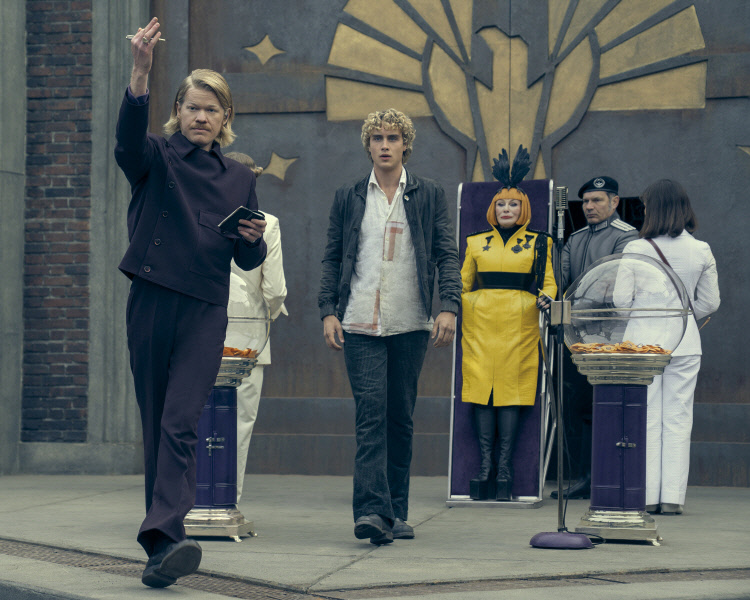
Before being thrown into the Hunger Games, Abernathy and his three fellow tributes from District 12 get to know each other a bit. While Maysilee Donner (Mckenna Grace) is a feisty young lady determined to fight as much as possible, Wyatt Callow (Ben Wang) is a nerdy boy incidentally from an oddsmaker family, and Louella McCoy (Molly McCann) is a little girl whose aching vulnerability instantly draws a lot of care and sympathy from Abernathy.
As guided by two mentors played by Lily Taylor and Maya Hawke, Abernathy and his fellow tributes try to find any possible way for surviving in the Hunger Games as long as possible. While they try to form temporary alliance with some other tributes, there also comes an unexpected help from Plutarch Heavensbee (Jesse Plemens), a young cameraman who has been observing Abernathy from the very beginning.
As the screenplay by Billy Ray and Michael Lesslie, which is based on the novel of same name by Suzanne Collins, steadily builds up its momentum during its first half, the movie adds more style and personality to its dystopian background. As the tributes are presented one by one, they have to endure the smarmy and condescending attitude of Caesar Flickerman (Kieran Culkin), the longtime host of the Hunger Games, in front of a lot of excited audiences, and that is just a prelude to a number of big moments including a grand parade which goes disastrously wrong later.
In the meantime, Abernathy gets marked as someone to be eliminated as soon as possible after impulsively doing a big act of defiance right in front of President Snow. President Snow surely shows Abernathy that he is not someone to mess with, and Abernathy soon finds himself in a very tricky position as being gradually pushed toward resistance by Heavensbee from the behind.

Once the Hunger Games is eventually started, the movie efficiently doles out a series of threats and perils while our hero tries to not only survive but also throw a big blow to the evil system cornering him in one way or another. He and the other tributes are placed on what is supposed to be a merely beautiful piece of land, but this area is packed with various lethal stuffs, and the movie has lots of nasty fun with that (I particularly like butterflies which can do more than merely swarming over their target, by the way).
Needless to say, the other tributes besides Abernathy are more or less than figures to be eliminated one by one along the story, but we come to care about some of them in addition to paying more attention to what is being at stake for Abernathy. Zada is convincing as his character goes from youthful innocence to weary desperation along the story, and his earnest performance functions as a nice counterpoint to the more colorful actings from a bunch of supporting performers surrounding him. While McKenna Grace, Ben Wang, Molly McCann have each own moment as Abernathy’s fellow tributes, Iona Bell, Percy Daggs IV, Jhaleil Swaby, and Laura Marcus are also well-cast as several other notable tributes in the story, and more notable cast members in the film including Jesse Plemons, Elle Fanning, Kieran Culkin, Kelvin Harris Jr., Billy Porter, and Ralph Fiennes bring some extra personality to their respective supporting parts.
Overall, “The Hunger Games: Sunrise on the Reaping”, directed again by the franchise stalwart Frances Lawrence, shows some improvement compared to “The Hunger Games: The Ballad of Songbirds & Snakes”, which did not impress me enough for recommendation. Considering that it is bound to make some success in the box office just like its predecessors, there may be another sequel or prequel or whatever within several years, and I can only hope that will be as good as this fairly entertaining film at least.