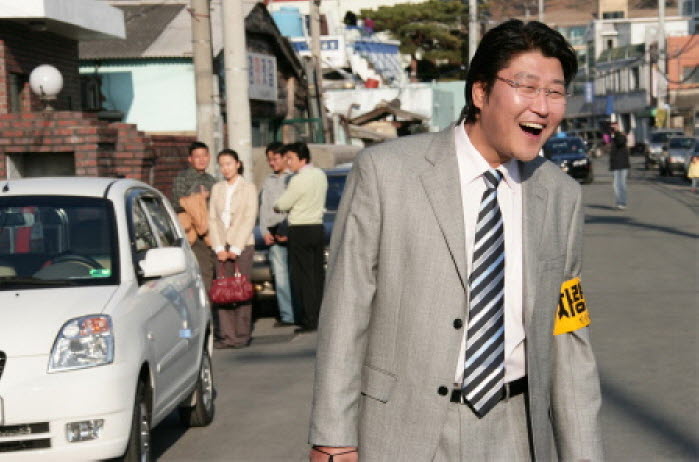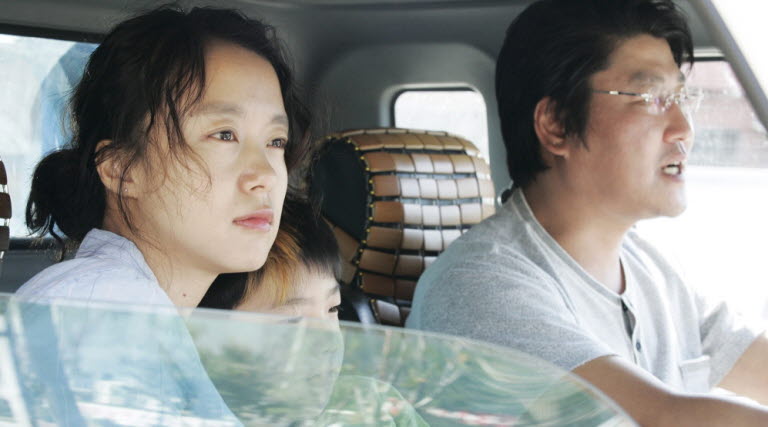
South Korean filmmaker Lee Chang-dong’s 2007 film “Secret Sunshine”, which was recently re-released in selected South Korean theaters along with his several other previous works, is a somber but compelling drama about life and faith. As closely following a series of agonies and confusions its plain ordinary heroine’s life, the movie gives a number of powerfully thought-provoking moments to remember, and it certainly leaves us a lot of things to muse on when it eventually arrives at its ambiguous but haunting last scene.
At the beginning, the movie simply observes how its heroine, Shin-ae (Jeon Do-yeon), tries to have a new beginning for her life not long after her husband died. She moves from Seoul to a little local town named Miryang just because it is her husband’s hometown, and we soon see her settling along with her little son while working as a piano teacher in her new neighborhood.
On the surface, everything seems to be going well for her, and everyone in the neighborhood including a local garage owner named Jong-chan (Song Kang-ho) is pretty nice to her. She often tells others that she is soon going to buy a piece of land for a new house for her and her son, and Jong-chan gladly introduces her to a local real estate broker, though she does not seem that eager to purchase any piece of land right now.
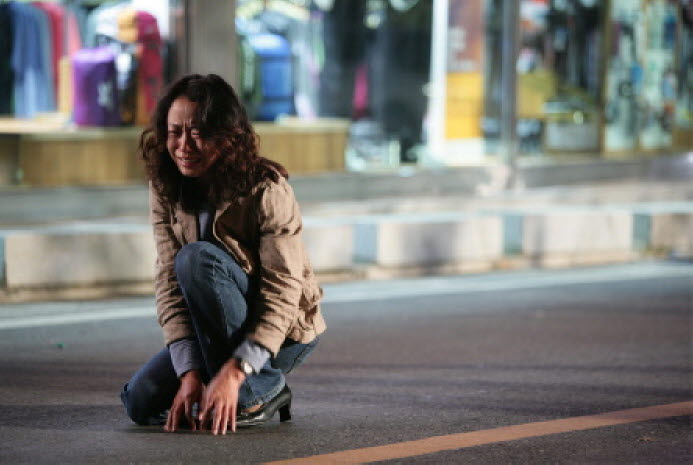
After slowly and carefully establishing its heroine and several other main characters around her, the movie takes a sudden plot turn to our little shock and surprise. Something quite unexpected and devastating happens to Shin-ae, and then the movie becomes more tense as she tries to handle this serious happening for herself. In the end, the police come to investigate the case, and that subsequently leads to a distant but undeniably heartbreaking moment as the camera simply observes Shin-ae and others from the distance.
While struggling to recover from her consequence shock and grief, Shin-ae is asked to attend a local church meeting by one of her neighbors, who is incidentally one of the deacons of that local church. Not so surprisingly, she refuses that with a harsh question on God, but then, what do you know, she comes to find an unexpected chance for letting out her grief and pain when she happens to drop by that church meeting. Again, the movie simply watches her emotional reactions without any redundant touch, and that is more than enough for us to have more understanding on her state of mind.
However, not long after she seems more stabilized as diligently sticking to her Chrisian faith for a while, there comes another incident to shake her up quite badly. At one point in the middle of the story, Shin-ae decides to meet a certain character for peace and forgiveness, but she only finds herself very rattled and exasperated by what she gets instead. If God does exist as she and her fellow Christians believe, why does God so cruelly take away a possible chance for closure and moral victory from her?
What follows next during the latter half of the movie is often quite painful and harrowing to watch to say the least. As being thrown into more agony and confusion, Shin-ae comes to have more doubt and anger toward faith and God, and she consequently commits a number of serious transgressions including the one which results in the most humorous moment in the film. It is clear that she desperately hopes for any message or response from God, but God seems to be just silent as usual – or non-existent from the very beginning.
The mood surely becomes melodramatic from time to time, but Lee’s screenplay, which is based on short story “The Abject” by Lee Cheong-jun, continues to stick to its phlegmatically objective attitude to the story and characters – even during the finale where its heroine gets another ironic moment to hurt her feelings. What she does next right after that feels rather elusive as we can only guess whatever is churning inside her mind, and then there comes a seemingly mundane but undeniably sublime final shot to be appreciated.
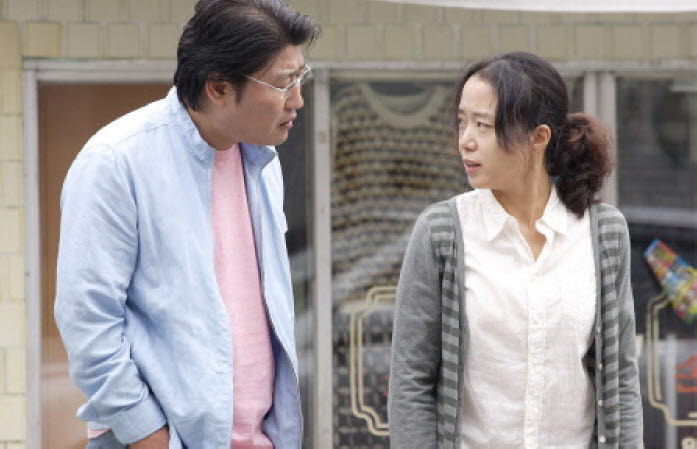
As the emotional center of the film, Jeon Do-yeon, who has been one of the best performers from South Korea cinema during last three decades, is utterly captivating in one of the best performances in her long and illustrious career. While never overlooking her character’s human flaws at all, Jeon did a splendid job of oscillating between belief and doubt without any misstep, and she ably conveys to us her character’s emotional drama whenever the camera focuses on her expressive face.
On the opposite, Song Kang-ho, who has been a legendary figure in South Korean cinema as much as Jeon provides an effective low-key performance which provides the solid ground for his co-star’s showier performance. Besides functioning as a sort of comic counterpart to Jeon’s character, Song subtly embodies his character’s good will and decency without exaggerating them at all, and we come to care more about his character than expected. Just like Song and his co-star, a number of the supporting performers surrounding them are equally convincing as plain ordinary figures you may come across in the mundane background of the movie, and it is no surprise that some of them became more notable after this film.
On the whole, “Secret Sunshine”, whose Korean title is incidentally “Miryang”, remains one of the best South Korean films during the last three decades besides being one of the career highlights for not only Lee but also his two lead performers. Although more than 20 years passed since it came out, it does not feel aged at all, and I am glad that I could watch it at a big movie screening room again.