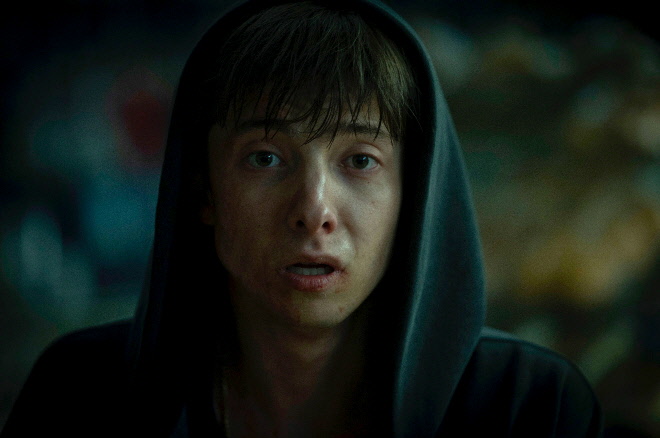
“Leviticus” is a moody but engaging horror film about two young gay men who find themselves in a serious peril due to their Christian elders. Although it is sometimes a little too dry or vague at times, the movie continues to hold our attention with a series of effective moments of tension and dread, and we come to care more about what may happen to them in the end.
After the disturbing opening scene which sets its overall tone, the story observes what has been going on between Naim Reid (Joe Bird) and Ryan Whelan (Stacy Clausen), two adolescent boys living in some rural town of Australia. At first, they seem to clash with each other on the surface, but it soon turns out that they have actually been sexually attracted to each other, though Naim is hesitant about going further with Ryan.
Probably because he is going nowhere with Naim, Ryan subsequently becomes attracted to Hunter (Jeremy Blewitt), who is incidentally the teenage son of a local pastor. Under this pastor’s leadership, Naim’s mother Arlene (Mia Wasikowska) and several other parishioners have been your average conservative Christians, and they certainly do not approve of homosexuality at all.
After seeing Ryan having a very intimate moment with Hunter, Naim becomes quite angry and zealous, and he eventually tells his mother and the pastor about what is going on between Ryan and Hunter. Not long after that, someone called the “Deliverance Healer” is brought by the pastor, and this dude performs a rather disturbing ritual upon Ryan and Hunter in front of everyone else including Naim.
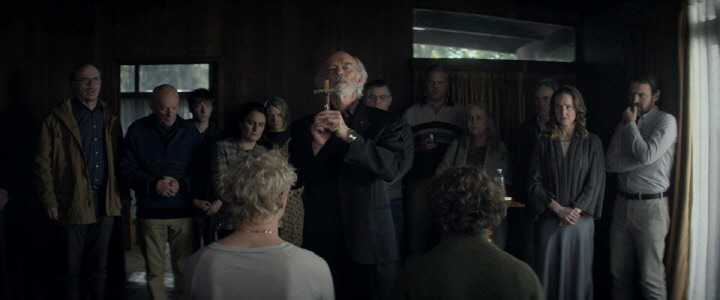
Of course, it does not take much time for Naim to realize that he made a very big mistake. Both Ryan and Hunter begin to experience a mysterious happening, and then the situation becomes all the more serious when Naim also goes through that ritual after confessing his homosexuality to his mother. He soon finds himself stalked and menaced by something which seems to be Ryan on the surface, and he later comes to learn that Ryan has also been threatened by what seems to look like Naim.
It turns out that the ritual put a certain supernatural curse on them and Hunter. Regardless of whatever it actually is, their supernatural stalker will relentlessly follow them to the end as looking more like whatever their heart really desires, and the only option for survival for them is staying away from their person of desire as much as possible.
This surely looks like a metaphor of all those drastically cruel conversion therapies inflicted upon LGBTQ+ teenagers by their misguided parents. In addition, it will instantly remind you of the story premise of David Robert Mitchell’s “It Follows” (2014), whose elusive but dangerous supernatural entity keeps following the terrorized heroine after she is “marked” due to a seemingly plain sexual encounter.
As they try to find any solution for their increasingly grim situation, Naim and Ryan are reminded more of how hopeless their current status is. It looks like there is no way to save them from that horrible curse except the aforementioned option, and they also have to deal with homophobia as their homosexuality is known more to others around them. Furthermore, Naim still does not tell Ryan anything about what he did to Ryan and Hunter, and that naturally functions as another source of suspense in the story.
The screenplay by director/writer Adrian Chiarella, who made a feature film debut here after making several short films, diligently builds up the sense of dread via several effective scenes where Naim is not so sure about whether he is really with Ryan or not. The more they feel attracted to each other despite the curse, the more their supernatural stalker looks like either of them. This certainly disturbs them all the more than before, but their mutual matter of heart remains something not so easily suppressed at all.
The movie certainly depends a lot on the natural chemistry between its two main performers at its center. Joe Bird, who was memorable in Danny and Michael Philippou’s “Talk to Me” (2022), and Stacy Clausen is believable as their characters pull or push each other along the story, and that is the main reason why there is some genuine poignancy as their characters come to bond more with each other despite their increasingly deadly curse.
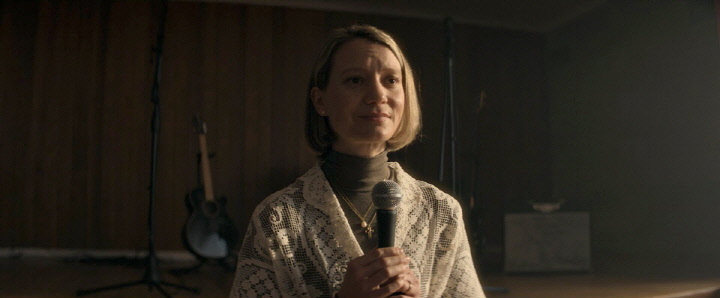
In contrast, several other main cast members including Mia Wasikowska, Jeremy Blewitt, Ewen Leslie, and Davida McKenzie are under-utilized due to their rather thin supporting roles. Wasikowska, who also serves as one of the executive producers of the film, is mostly stuck with looking as aloof and stern as required by her thankless role, and we seldom get to sense what her character really feels about Naim.
Overall, “Leviticus” is not entirely without weak aspects, but it is still a solid genre piece supported well by its good mood and the commendable efforts from Bird and Clausen. In my trivial opinion, Chiarella is a talented filmmaker with considerable potential, and it will be interesting to see what may come next after this modest but admirable debut feature film of his.