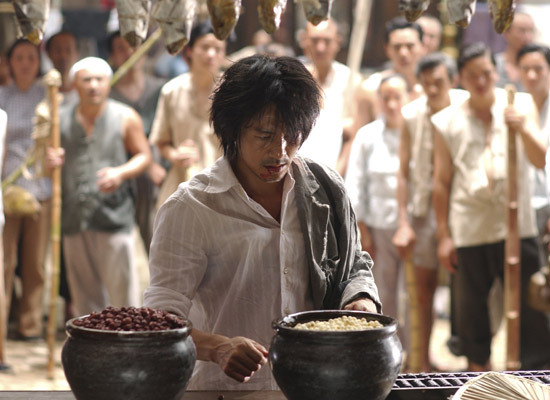
Stephen Chow’s 2004 film “Kung Fu Hustle”, which was re-released in selected South Korean theaters in this week, willingly and unabashedly goes all the way for its goofy but undeniably spirited entertainment. At first, you may roll your eyes at times because of its numerous moments of silly comedy and exaggerated action, but then you will find yourself gladly going along with that thanks to its infectious fun and excitement, which incidentally remain fairly intact even after more than 20 years.
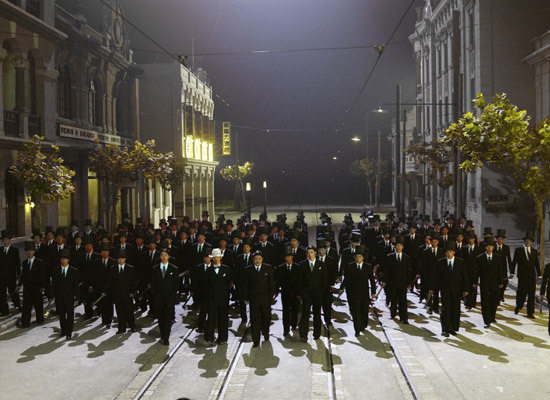
The story, which is set in a sort of fantasy version of Shanghai during the 1940s, begins with how a powerful criminal organization, which is called the Axe Gang, takes control over the city. As its vicious leader and his countless gangs do some aggressive expansion for their criminal organization, this process is cheerfully intercut with a big dance sequence to behold, and the overall comic tone of the film is quickly established thanks to that.
It seems that no one can possibly stop the Axe Gang, but then there comes an unexpected trouble for them to deal with. Outside the city, there is a slum neighborhood named Pigsty Alley, and a small-time criminal named Sing, played by Chow, tries to extort some money from the residents of Pigsty Alley on one day, but he and his bumbling sidekick miserably fail to our little amusement. Eventually, he only ends up getting himself sandwiched between the residents of Pigsty Alley and the Axe Gang after inadvertently causing a big conflict between these two groups.
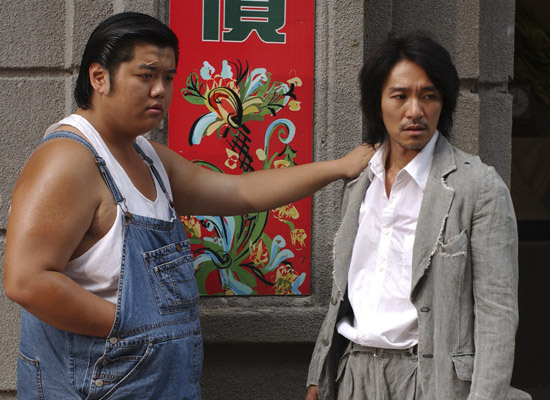
At first, the residents of Pigsty Alley look quite helpless in front of those Axe Gang members, but, surprise, it turns out that some of them are actually martial arts masters who have hidden themselves for many years. Needless to say, these hidden masters quickly overpower many Axe gangs on the spot, and the leader of the Axe Gang is certainly not so amused about that. Soon, he recruits several other masters who may be able to defeat his mighty opponents, and this surely causes more threat to the residents of Pigsty Alley.
As the masters of the Pigsty Alley and their opponents clash with each other in one way or another, the movie gleefully bounces among many different modes including drama, comedy, and horror. While the movie apparently uses a lot of CGI for those preposterously exaggerated actions unfolded across the screen, it competently handles them with enough wit and energy, and you can clearly sense that it is really eager to try anything for more amusement and excitement for us. I particularly like the scene featuring a couple of masters who can be quite lethal with their certain Chinese instrument, and I am still amused by a little homage to Stanley Kubrick’s “The Shining” (1980) around the middle point of the story.
Meanwhile, the movie also focuses on how Sing clumsily attempts to show others around him that he can be a hardcore criminal. No matter how much he tries, he always comes to make a fool of himself instead, and one of his funniest moments in the film comes from when he and a certain character do an outrageous chase scene not so far from Wile E. Coyote and the Road Runner.
Sing looks quite pathetic at times, but Chow’s likable presence steadily holds our attention, and the movie even tries a little possibility of romance between his character and a young mute woman who still remembers what happened between them many years ago. This feels rather redundant in my humble opinion, but I appreciate a brief but nice touch during these two characters’ certain key scene at least.
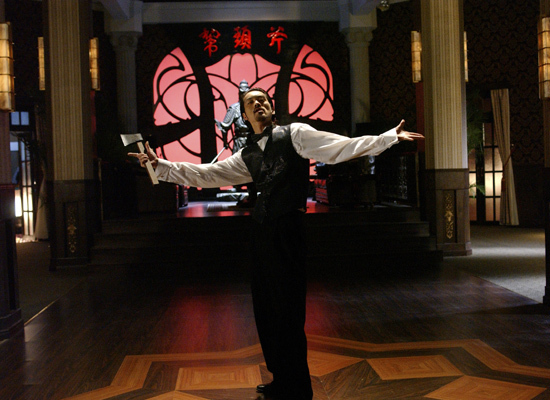
During the last act, the movie takes a predictable turn involved with something which has been hidden inside Sing for years (Is this a spoiler?), but it does not lose any of its bountiful sense of fun even at this point. In fact, it dials up the level of goofiness to the level of 11, as reflected by when a lot of real and CGI extras are hurled or kicked across the screen in the middle of its climatic action sequence. Of course, we later get a big duel of fate between two very powerful masters, and this eventually culminates to a literally impactful moment of sheer comic gusto.
Just like any other good comedy films, the film is often brimming with a lot of personality thanks to its broad but undeniably colorful characters surrounding Chow’s character, and he is supported well by a bunch of good supporting performers, many of whom are incidentally known as not only performers but also martial artists. While Danny Chan Kwok-Kwan and Leung Siu-lung are effective as the two main villain characters in the story, Yuen Qiu and Yuen Wah have a lot of fun as a bickering couple who has been the de facto leading figures of Pigsty Alley, and Xing Yu, Chiu Chi-ling, Dong Zhihua, and Lam Chi-chung are also solid in their respective supporting parts.
On the whole, “Kung Fu Hustle” is a breezy piece of entertainment which entertained and energized me enough when I watched the movie at a few hours ago. It is a shame that I was the only audience in the screening room at that time, but I could instantly forget that while getting amused and excited as much as I did when I watched it for the first time in 2006. This is surely a silly little comedy film as before, but its goofy charm and bouncing spirit are still irresistible, and I gladly recommend it even if you have already seen it.