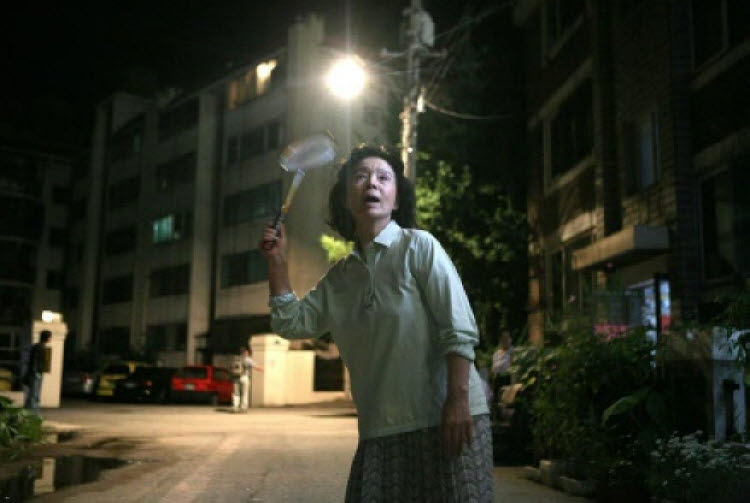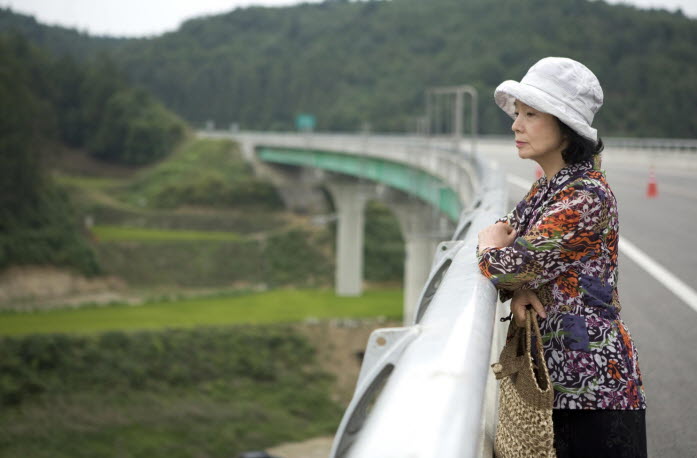
South Korean filmmaker Lee Chang-dong’s 2010 film “Poetry”, which was re-released in selected South Korean theaters in this week, is a somberly sublime character drama about poetry and morality. Leisurely and patiently following one plain senile old lady struggling to reach for poetry while also facing a difficult ethical situation, the movie lets us sense whatever her fading mind feels and thinks along the story, and it often shines with subtle poetic moments before she eventually makes a moral decision resulted from her little artistic journey.
After its quiet but ultimately disturbing opening scene, the movie introduces us to Mi-ja (Yoon Jeong-hee), a poor and meek 66-year-old woman who has lived her adolescent grandson since her daughter left for her second marriage some time ago. We see her visiting a local hospital for a minor physical problem, but then she turns out to have symptoms of the early state of Alzheimer’s disease. However, she keeps this bad news to herself, mainly because she needs to support herself and her grandson via working as a caregiver for some ailing old dude day by day.
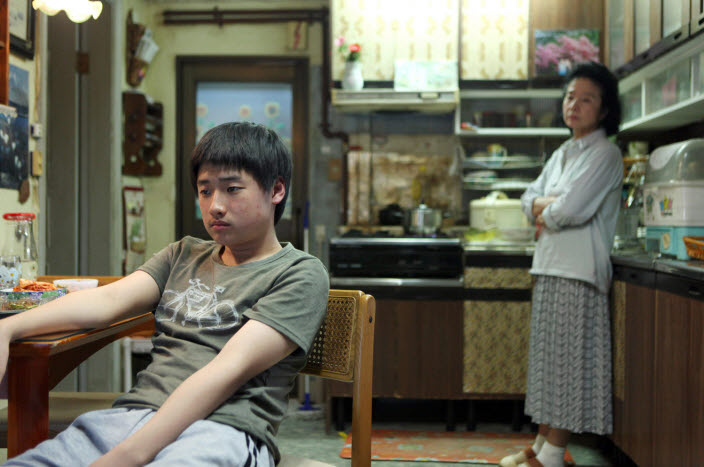
However, it is clear to us that there is not much love between Mi-ja and her grandson, who is your average disaffected teenage boy. Except when he has breakfast or dinner with his grandmother, he does not interact much with Mi-ja, and Mi-ja often feels quite frustrated even though she keeps trying to make more connection with him.
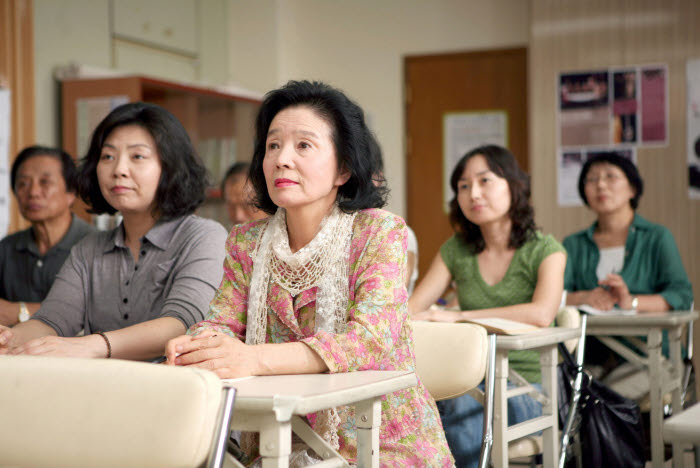
Meanwhile, Mi-ja begins to take a poetry class at a local community center, probably because that can help her in slowing down the inevitable deterioration of her mind. Although the class teacher, who is incidentally an active poet, generously lectures on where one can get any kind of poetic inspiration from daily life, Mi-ja cannot help but feel baffled and confused, and the movie becomes a bit humorous as she clumsily searches for any possibility of poetic inspiration here and there in her mundane daily life.
And then something starts to disrupt Mi-ja’s daily life. She later comes to learn that her grandson committed an atrocious sex crime along with his several schoolmates, and she soon finds herself being with the fathers of the other perpetrators besides her grandson. Despite the recent tragic death of the victim, everyone ranging from the school to the local police is willing to cover up the case as much as possible, and it seems that the victim’s family is willing to agree on an unofficial settlement via a fair amount of damage.
While Mi-ja certainly becomes more conflicted along the story, Lee’s screenplay does not overplay its heroine’s inherently melodramatic status at all, and it continues to pay attention to her gradual artistic journey. As she tries more for getting any kind of poetic inspiration, she attends a little local meeting for poetry recitation, and there is a little amusing moment when she is not so amused by some guy making some lewd jokes after his poetry recitation. He seems really sincere about poetry, but Mi-ja cannot help but feel displeased because she believes poetry should be about beauty and life.
However, things get only uglier in her daily life. When that ailing old man requests a sexual experience from her, Mi-ja is certainly repulsed, but she later agrees to provide that to him, and what happens next between them is pretty cheerless to say the least. In case of her grandson, he does not show much of guilt or regret even when Mi-ja does a sort of little test on his conscience at one point, and the fathers of the other perpetrators keep urging her to pay her part of that settlement money, though she is virtually penniless right now.
I will not go into detail on what happens next in the story, except that there are several unforgettable moments of subtle dramatic power. There is a crucial scene where Mi-ja tries to approach to a certain supporting character and then gradually senses more of how devastating her grandson and his friends’ crime really is on personal level, and this eventually leads to her own poetic inspiration as well as her important moral decision around the end of the story. Although the movie does not spell out anything at all, we somehow gather not only how she becomes artistically inspired but also how she also become more morally enlightened during that artistic process, and that is why the following finale lingers on our mind for a long time after the movie is over.
Yoon Jeong-hee, who came out of her longtime retirement for this movie, is very poignant in what turned out to be the last performance in her renowned movie acting career (She died in 2023 after struggling a lot with Alzheimer’s disease just like her character, by the way). Even though her character feels distant from us at times, Yoon’s unadorned natural acting keeps holding our attention to the end, and the delicate details of her performance effortlessly convey to us whatever is happening in her character’s increasingly fading mind.
In conclusion, “Poetry” is still a very impressive work which can engage and then touch us even at present, and it is surely one of Lee’s best works. Although I have some reservation on “Oasis” (2002) and “Burning” (2018), I agree with many others that he has been one of the best South Korean filmmakers for many years, and his latest film “Possible Love” (2026) shows us that he has not lost any of his talent yet. It is a shame that he has made only seven films during last 30 years, but it looks like he can still keep going despite being over 70 at present, and that is really fortunate for us.