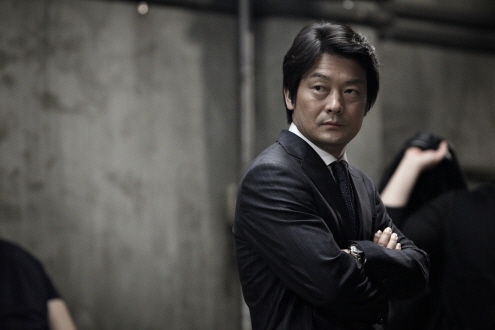
Uncle Boonmee Who Can Recall His Past Lives (2010) ☆☆☆(3/4) : That baffling world of death and reincarnation

 Apichatpong Weerasethakul’s latest movie “Uncle Boonmee Who Can Recall His Past Lives” scored some points from me at the beginning. After the enigmatic opening sequence featuring a cow and the jungle shrouded in strange atmosphere, the following sequence with a car going along some country road drew my attention. The land was different, the trees and plants surrounding the road were also different, and the climate was also different, but the mood was somehow familiar to me. It was not different from what I remember from our family’s occasional short journey to my grandmother’s country village. We also went there by a car, we also went along a paved country road, and I used to pensively look at the landscape outside car while a little bored in backseat.

 Why was my memory about a South Korean country stimulated by a Thai movie made in the area I have not known much about? Maybe, I think, the reason is that “Uncle Boonmee Who Can Recall His Past”(“Uncle Boonmee” in short) is a retrospective movie about memories. Beginning from a dying man who believes he can remember his past lives as the title suggests, the movie challenges us by throwing impressive visual fragments upon us while intriguing us with its odd styles. The result is rather a mixed bag, and it is not entirely successful as intended in my view, but it is an interesting artwork if we cannot call it “an interesting movie”.

 The movie reveals very little about the characters inside that car except that Uncle Boonmee(Thanapat Saisaymar) is dying due to kidney failure. After some time at the hospital, with two of his family members, he is going back to his home in the northeast region of Thailand. His place is in the area next to the border between Thailand and Laos. We see some people from Laos working under him later along with slight prejudice seen from Jen(Jenjira Pongpas), Boonmee’s sister-in-law.
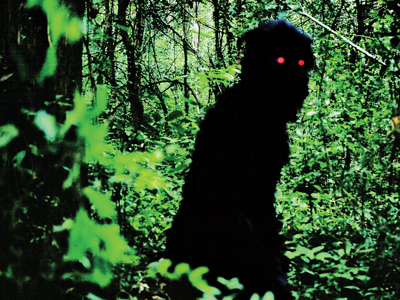
After arriving at the house in the afternoon, Boonmee and others have dinner in the dining room as the night descends on the house and the jungle nearby, and we have one of several effective scenes in the film. While they are having a mundane conversation with each other in gentle but monotonous tone(according to Weerasethakul, this flat delivery is the homage to old Thai TV dramas where lines were whispered to the actors and were flatly delivered by them), there is notable awkwardness about the empty space on the left side of their dining table. Then, something slowly appears in that space without much emphasis. The process is so natural and subtle that it took some seconds for me to notice that during my first viewing.

It is the ghost of Boonmee’s wife who died 19 years ago. Although a bit surprised by her visit, the living accept her and begin to talk with her as if she were an ordinary guest. If you think this is weird, here comes a weirder thing for you to behold. Boonmee’s dead son also comes to see them from the darkness, and he is a monkey man with red eyes(this is another convention from old Thai TV dramas; monsters usually had red eyes gleaming in the dark). I wish Weerasethakul would have that character to stay in the darkness. In the direct light, Boonmee’s dead son looks as silly as a talking Chubaka in this utterly serious situation. It may be intended to be humorous. I checked IMDB, and the movie is categorized as comedy and fantasy.

The rest of the movie is not easy to summarize for it freely floats in and out of Boonmee’s world while still being elusive to us. After that memorable night sequence, we see Boonmee and Jen interact with his employees on the next day. And then the film momentarily enters the world of folk tales with no reason. An ugly princess is bitter about her face at the pool with waterfall in the jungle, even though she has an admirer. Later, she has an intercourse in the water with a talking catfish who also has revered her. It sounds pretty silly(my mind went to that hilarious scene with an underage sheep in Woody Allen’s “Every Thing You Always Wanted to Know About Sex * But Were Afraid to Ask”), but it is done with restraint and style, and old-fashioned day for night technique adds more otherworldly quality to this scene.

 The film is inspired by the book “A Man Who Can Recall His Past Lives”, written by the abbot of Buddhist temple in Weerasethakul’s hometown. There was really a man named Boonmee and he claimed to the abbot that he could recall his past lives during meditation. Later in the movie, we see Boonmee and others go through that mystical jungle and enter the cave where his first life supposedly began. We are surrounded by ominous sounds. We hear him talking about one of his past lives, accompanied with the montage of photos showing soldiers and a tall man in gorilla suit(I’m not kidding).

 I learned later that “Uncle Boonmee” is a part of Weerasethakul’s video installation art project “Primitive”, which includes a short film “A Letter to Uncle Boonmee”. Using the book mentioned above as the starting point, Weerasethakul subtly integrates several elements from his project into the movie. One of the subjects in his project is a turbulent confliction between the Thai army and communist sympathizers in the northeast region of Thailand in 1965, and Boonmee briefly contemplates on whether his illness is karmic for killing many communists at that time in one scene. In addition, Weerasethakul also incorporates autobiographical aspects into his movie; for example, Boonmee’s dialysis tool in the movie is the one that had actually been used by his father, who was also afflicted with kidney failure.

 With “Uncle Boonmee”, I think, Weerasethakul tries to assemble and mix his philosophical and artistic ideas on death, reincarnation, spirituality, and movie along with historical, cultural, and personal aspects from himself and his country on the screen. There are several things I noticed during the second viewing after acquiring some helpful information from Internet, and I think there are still many things unnoticed by me in the movie.

 And that promoted me to think about some explanation on James Joyce’s “Finnegans Wake” I have come across years ago. In difficult that novel, H. C. Earwicker and his family are continuously transfigured throughout the story while embodying the vast knowledge on human history and cultures contained in the book whose last sentence at the end goes back to its first sentence at the beginning. H. C. Earwicker can be “Here Comes Everyone”, and so can Boonmee, probably. We are not sure about his past lives, but his previous lives can be anything shown in the jungle: human beings, animals, or plants, maybe. Considering it is the part of a commissioned art project, “Uncle Boonmee” might be the tip of Weerasethakul’s version of “Synecdoche, New York”; these “past lives” sometimes look like small fragments from an elusive bigger world of time and space.
 However, despite several interesting thoughts provoked by the movie, I do not think Weerasethaku completely succeeds with his experiment. He indeed provides us beautiful scenes we can appreciate, but the movie is too distant and meditative to be something else. There is little to hold on in case of story and characters while it focuses purposely on its space and atmosphere. The characters are presented in long or medium shots in most cases. We are consequently distant from them, even during brief moments when they are allowed to show feelings. The film firmly stays in its position. It never attempts to reach to us while confidently presenting its mystifying images to the audiences. The last sequence does not work for it does not add much to the cluster of images in the film. It has already perplexed us too much.

 As a whole, the movie is more like a piece of video installation art. It will not make any difference if you are drowsy while watching it. Or, you can walk into the movie at any point and you still can get the same impression. As a matter of fact, I even wondered whether there will be any difference if the movie is chopped into several coherent segments and then exhibited in modern art museum. All it needs is a guidebook they sell us at the entrance of art museums.

 In spite of these sarcastic reactions, I have enough admiration for this movie. And I agree with others that Weerasethakul is a very talented director. The movie is slow and evasive, and I do not wholeheartedly like it, but his exploration fascinated me as much as Godard’s early experiments in the 1960s. It tries something different; it tries the interesting extension of movie toward installation art. It made me curious about that mysterious jungle and its components while also making me run out of patience.

 The movie won Palme d’Or at the 2010 Cannes film festival in last year. Many critics, including our South Korean critics, chose this as one of best movies of last year.

 Well, I have lots of reservation about that. I remember my friend Wael Khairy quoting from Roger Ebert’s “Awake in the Dark” in one of his reviews: “A movie is not good because it arrives at conclusions you share, or bad because it does not. A movie is not about what it is about. It is about how it is about it: about the way it considers its subject matter, and about how its real subject may be quite different from the one it seems to provide.” I don’t think I wholly understand what “Uncle Boonmee” is about, but I can say I was distantly absorbed in how it is about. 

Posted in Movies | Tagged , , , , , , , | 4 Comments

Tron: Legacy (2010) ☆☆☆(3/4) : Unnecessary but it’s nice to look at anyway

 I still have some conflicts about whether “Tron: Legacy” is really necessary for us. “Tron”, its predecessor in 1982, showed the audience the initial potential of CGI with the world they had never seen before. The movie looks now quite dated after many years of rapid CGI techniques developments, but, while becoming the product of its own time, its special effects have that discreet charm of old special effects. Plus, the movie still retains the pioneer spirit of people behind the movie, who really wanted to create something new with their limited abilities and resources. That is why I find “Tron” a fun movie though I was not even born yet around when they were making it. I liked its world – giggling at its dated aspects was an extra fun.

 It is needless to say that maintaining its original looks of this unreal world is out of question, considering how much progress they have made in Hollywood after that. Things have changed during last 28 years, and even an independent filmmaker can work with his own computer for creating CGI on the screen nowadays, as shown in Gareth Edwards remarkable movie “Monsters”. If you have enough money, you can do almost anything on the screen.

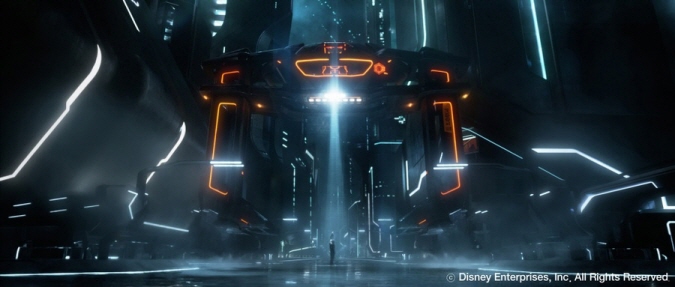
 Because “Tron: Legacy” is an expensive blockbuster movie made by a major Hollywood studio with a big budget, the world shown in the 1982 movie is now re-created and polished by the computers whose capacity exceeds those used in that time. The movie certainly looks fabulous on the screen. But we cannot help but ask this; is it as revolutionary as “Tron”? My answer is absolutely no, and the movie is not so remarkable in the standard of our time. In addition, its polished improvement only bares the main weakness inherent in its predecessor; it is no more than an expensive eye candy.

 The movie starts its story several years after Kevin Flynn(Jeff Bridges) became a new CEO of his company at the end of “Tron”. After his adventure in the world inside computer, Flynn had been busy for working on its potential even when he was not working at the company. That meant his only son Sam, who had lost his mother a few years ago, had to deal with his father’s absence although he was taken care of by his grandparents.

 One day, after another short but enthusiastic conversation with his son at night, Flynn was suddenly disappeared. More than 20 years has passed since his disappearance without any clues, and Sam(Garrett Hedlund) now becomes a young rebel who does not hesitate to do risky stunts for stealing the new OS program from his father’s company, whose leading major stock owner is none other than him, incidentally. Through Flynn’s co-worker Alan(Bruce Boxleitner, who reprises his roles), Sam gets an unexpected message from his father, and he soon finds himself transferred to the world his father used to talk about.

 His father has been very much alive in that world, but, before meeting him, Sam meets Clu, a program modeled after his father. Clu is also played by Jeff Bridges, but what we see on the screen is a younger version of Bridges created by CGI. Like CGI characters in Robert Zemeckis’ animations, a younger image of Bridges has a creepy and inhuman aspect, suitable for a character who comprises of computer codes. Clu has been a ruthless tyrant of his world after betraying and banishing Flynn, and, like any ambitious, megalomaniac dictators, he wants to conquer the world beyond his area – our world. He has been preparing for that plan for many years(or many cycles, shall I say), and only one step is remained for him – that is why Flynn and his son have to stop him as soon as possible.

 While not as groundbreaking as “Avatar”, “Tron: Legacy” is a nice visual treat. I enjoyed several objects and designs renovated while being faithful to the 1982 movie. I was personally amused to see the design of a big mirror-like touch screen desk utilized in the meeting room in a brief scene. It still looks as cool as before. The action scenes are sometimes disorienting and not so thrilling in many cases, but they are well-made and pretty good to look at. In case of 3D, this is one of the most comfortable 3D effects because, ironically, you are not conscious of it much while watching it. The real world scenes are shot in 2D, and the computer world scenes are shot in 3D – in the unreal world of light and darkness, the major weakness of 3D effect, dimness, is not much of a big problem. On the whole, the movie primarily focuses on its visuals without any distracting effect, and it admirably succeeds with the propulsive orchestral/electronic score by Daft Punk.

 Nevertheless, the story holding this world is too week and bland to be overlooked. Of course, the story was not exactly Academy Award material in case of the 1982 movie, but it was compensated by its unadulterated trial to break into the undiscovered world against many limits. But now, with boundless possibilities from advanced CGI technology, the story of “Tron: Legacy” has lots of possibilities to deal with its interesting ideas, rather than merely showing them on the screen.

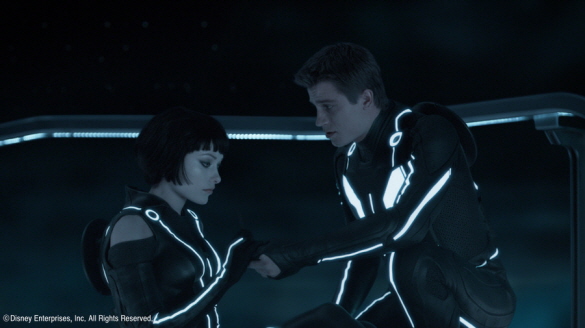
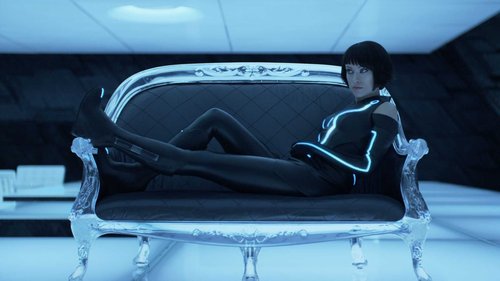
 Unfortunately, the movie does not do much besides dazzling us with its visuals. One of the lost potentials in the screen in the movie is Quora, a program who has assisted Flynn for a long time and comes to be emotionally(is it right expression?) involved with Sam. There is a touching scene where she asks him about the world outside, but the movie has ultimately wastes this character’s potentials. It also should be mentioned that the movie did a disservice to its title character, Tron, who appears not much in the movie.

 With bland story and characterization, it is necessary for the actors to fill the holes in the movie with their presences, and they all do good jobs. It is clear that Bridges is having fun with dual roles. His presence was a major asset in the 1982 movie, and he again holds the movie quite well. I especially like the way he makes Flynn look like a wiser, calmer version of Jeff “The Dude” Lebowski in “The Big Lebowski”(1998) – one of great characters in his career. Garrett Hedlund is a little too bland but it is not bad considering his weak character. Olivia Wilde is attractive while holding her place well, and Michael Sheen is flamboyant as the nightclub owner program.

  I have to remind you again that I don’t regard the movie as highly as “Tron”. The first one is an eye candy which also was something new, and it is still a landmark in the special effects history. While wonderful to look at as itself, “Tron: Legacy” is still more and less than an eye candy – with a cynical purpose of merchandising. I still think they should have a more developed story for what we can do now with CGI, but, what the hell, I looked at the screen with amusement and fascination. As a matter of fact, after enduring an abysmal movie  “The Last Godfather”, I was enlivened by the movie; I wanted to recommend it to kids rather than that dreadful comedy “intended for kids”. None the less, I will probably forget its images far sooner than those of “Tron”. I envy the audiences who saw “Tron” in 1982.

Posted in Movies | Tagged , , , | 1 Comment

The Last Godfather (2010) BOMB : A new kind of 3D – Dated, Dull, and Disgraceful

 I once said in one of my reviews for Korean movies that 2010 was a good year for South Korean movies because of those wonderful movies made by talented directors. And I also pointed out that we had a considerable amount of bad movies along with those good movies. First, there was a morally reprehensible film “No Mercy”, in which the women characters were no more than the objects for being raped, beaten, insulted, killed, hacked, and autopsied. In “Outlaw”, I cannot ever forget a naked woman crawling on the floor with a dog collar on her neck. In “Parallel Life” and “The Haunted House Project”, they did almost nothing except presenting the idea at the start. And “Natalie”, a 3D softcore movie, is something so ridiculous and inane that I could not help but have many unintentional laughs.

 “The Last Godfather”, released in this week in South Korean theaters, is not as horrible as some of thess garbages, but Shim Hyung-rae’s so-called “family comedy movie” adds the final insult to the list for the worst Korean movies of 2010. It is not just unfunny. It is embarrassingly unfunny and torturously boring. To be frank with you, I observed that some audiences laughed several times while I and they were watching the movies, but I want to ask you this: how much can you tolerate more than 100 minutes with an imbecile character keeping doing idiotic things for getting laughs without any story development or setup for a real big laugh? Can you call this a joyful experience? Do you think laughing at a idiot is a good comedy?

 I know most of my readers were not in South Korea during the 1980-90s, so I give you some background information about Shim Hyung-rae. He had been a very popular comedian on South Korean TV during that period, and some of his sketches on TV shows during his prime were funny indeed. One of his popular characters was “Young-gu”, an idiot with a good heart. I did not particularly liked that character. I remember watching the movies featuring that character, and I did not find them funny; I was far more entertained by Disney TV Cartoons and Sesame Street.

 After his weirdly and obscenely gigantic financial hit(or was it?) with “D-war”, the worst South Korean movie of that year, Shim Hyung-rae decided to make the movie based on Young-gu. In the interview, he confidently said he made the comedy that can be accepted worldwide, but I seriously want to ask him what he was thinking when he made “The Last Godfather”. He did absolutely nothing to provide flesh and bone to the caricature he has been proud of and many Koreans still endearingly remember. His characters and accompanying jokes and gags are not only badly dated but also seriously ineffective. Watching the movie is like observing a bad comedy based on a lame character created more than 20 years ago in Saturday Night Live.

 The screenplay, written by Shim Hyung-rea and other screenwriters purchased from Hollywood, has little plausibility or probability. I have lots of doubts about whether you can accept the premise in the story though you can do anything preposterous in the name of comedy. Can you believe that New York mob boss, played by Harvey Keitel(!), thinks his hidden illegimate son can be his successor while it is apparent to nearly everyone that he is indeed “a special child”?

 Let me go into details about how Harvey Keitel has a Korean son in the movie. The year is 1951, and Don Carini(Keitel) reveals to his men that he had a relationship with a Korean woman a long time ago when he hid in Korea for his safety. They had a son, and now he, named Young-gu, of course, becomes a young man who Carini thinks is ready for being boss. He is played by none other than Shim Hyung-rae, who is 52 now. Considering that Korea was suffering from the war in 1951, maybe his aged appearance is not a big stretch at all. War makes young man look aged, you know.

 The rest of the story, if such a thing exists in the movie, is the series of  lousy gags with the obligatory shootout finale between rival gangsters in the end(My god, is it really a family movie, Mr. Shim?). The movie tries many, many times, but it always fails with no laugh every time for only predictable things happen on the screen. They are mostly for pulling cheap, brief laughs from the audiences, and there is no effective build-up process in any scenes. I remember one scene where the characters are about to be attacked by a round bomb thrown by a villain hiding in the bushes nearby while they are playing with balls on the lawn. You won’t need much time to guess what will eventually happen.

 I am sick of telling this, but I have to say that Shim Hyung-rae proves again that he is seriously in the need of attending filmmaking class or re-attending comedy class. His movie shows a dire lack of story/character development as well as a clear deficiency of skills and styles. I could not ignore many notable editing problems. For instance, the scene inexplicably featuring South Korean pop singer group Wondergirls is a textbook example of lousy editing; are the girls and the characters really in the same place? And why do they sing the 21th century South Korean pop song when they have to be lounge singers in the 1950s? I am not against anachronism in the movie, but this is too jarring. What the hell, only two or three policemen seem to exist in the town in this movie, and I dully noted that this was the only movie I’ve ever watched a police chief driving a red convertible while on his duty.

  I do not want to waste much time on criticizing Shim Hyung-rae’s horrendous one-note performance, sheer embarrassment reminiscent of Simple Jack in “Tropic Thunder”. No matter how much he tried at the set, his character is not someone you can approach to with smile. It is one thing to laugh at an idiot for a moment, and it is the other thing to be forced to laugh at an idiot for more than an hour. I feel really sorry about the Hollywood actors surrounding him instead because they have nothing to do except reacting to or watching cheap slapsticks. I hope each of them got a nice, big paycheck for appearing in this criminally silly movie. I know the actors like John Polito or Jason Mewes have built solid acting careers before this movie; they will move on after this ordeal. In case of Joceline Donahue, who gets a very bland and thankless job as Young-gu’s love interest, I saw her talent in that nice little horror movie “The House of the Devil” in last year, so I hope a better future for her.

 And how did a respected actor like Harvey Keitel come to accept the role in this movie? Shim Hyung-rae said that Keitel wanted to be in the movie for his young son, but, Mr. Keitel, do you think the movie with the scene of two characters mistaken for having a rough sex in the car is really good for your kid, besides that shootout scene and gross gags? At least, he does not do anything damaging to his illustrious career of more than 40 years while phoning his performance in the movie.

 By the way, after watching his movie, I checked Keitel’s career at IMDB and found that his unofficial first movie was “Reflections in a Golden Eye”. Now, there is another connection between Robert Foster and Keitel. Both started their career with that movie, both got an Academy nomination for Best supporting actor in the 1990s, and now, because Foster played a crucial supporting role in “D-war”, both have worked with the South Korean counterpart of Uwe Ball. I heard that, before casting Keitel, Shim Hyung-rae initially attempted to insert CGI images of late Marlon Brando in his movie, who also appeared in “Reflections in a Golden Eye”. Does that mean he will get Elizabeth Talyor for his next movie?

 The movie has fearfully misguided belief that you will make a good movie even if you have nothing but money to hire actors and crews. Shim Hyung-rae says he is doing his best while making movies. Well, every director does his best for his/her movies. Many of them learn from failures or criticisms, but, mired in his pathetic egotism, he does not seem to learn anything from tons of criticisms he has gotten. He only makes excuses so lame that we cannot even start the discussion sensibly from the beginning. His tactic to draw people on his side sadly reminds me of that of people like Sarah Palin or Glenn Beck; by advertising his movie like a one giant footstep for all Koreans, he shamelessly exploited patriotism and nationalism for his own benefits. Because of that, “D-war” became No.1 box office hit in South Korea, while many critics were attacked on Internet for their negative opinions. And now he impertinently tries that disgusting tactic again. As usual, he tries to fool us that his movie will be a big international hit and we will be proud of it, and I think the movie will probably have some success in South Korea again.

 Mr. Shim, I have to say this, your movie hopelessly and truly sucks. I also want to point out that we already have internationally acclaimed South Korean directors; we don’t particularly need you at all. No, I correct that; it is almost inarguable that you are national disgrace. If you didn’t lie about yourself, then I guess you are very, very determined to conquer Hollywood with the quixotic mind resembling a living fossil, which makes you nothing but a laughingstock. No matter how much you “argue” against that, that will be still the truth unless you change your incorrigible view. To think that Uwe Ball was the worst director – I heard that Ball was improving on himself, by the way.

Footnote: My star rating system is a mix of Roger Ebert and Leonard Maltin. BOMB, which means 1 star, is for sheer incompetency and “The Last Godfather” is a prime example. Zero star is the place reserved for evil or despicable movies beyond star rating.

Posted in Movies | Tagged , , , | 20 Comments

10 movies of 2010 – and more: Part 3

And there are other movies I’d like to mention… Continue reading →

Posted in Movies | 6 Comments

10 movies of 2010 – and more: part 2

Here We start with No. 5 Continue reading →

Posted in Movies | 1 Comment

10 movies of 2010 – and more: Part 1

 Let’s begin with No.10 Continue reading →

Posted in Movies | 1 Comment

10 movies of 2010 – and more: Introduction

 Like 2009, 2010 has been a very bad year for my personal life while it has been a very good year for me as a constant moviegoer. After the banishment in late 2009, I was accepted again by my peers in early 2010, but now I cannot live at my comfortable dormitory anymore. I live in a very small one-room space. The heater is good and it is fairly comfortable, but I got “dorm-sickiness” sometimes. At the campus dormitory, there was nothing to worry about except your academic progress. Now I have several things I have to take care of as a lodger.

 In case of watching movies, well, it is still as constant as before except extra quality control, but it is quite different now because I promised them to work more sincerely in the lab. There was a time when I willingly hurled myself into any movies, but now I’m more judicial about what to watch. Unless it is truly bad, I stay myself from wasting my time with disappointing movies. None the less, there have lots of good movies I thought I had to watch. And there were few bad ones I wanted to watch and talk about.

 But the reviews have far fewer than before. For example, from last September to this March, I wrote more than 250 reviews in Korean for I had lots of time due to my banishment in the library. Now, I’ve only wrote 26 reviews in English after attending 2010 Ebertfest, one of the best years in my life. In case of the other movies, I just posted very short opinions through twitters. And I rarely talk about my extra activity to the others because I learned how it jeopardized my life. I put the moratorium on my Korean blog. I opened a new blog at WordPress, and I never give its address to anyone around me in South Korea. I always erase my traces and files associated with movies in my laptop when my work on them is done after posting my pieces; the files are saved somewhere instead. I wonder when my activity will be exposed due to my twittering, but I’ve always used English, and my followers are very few compared to most of twitter users.

Continue reading →

Posted in Movies | 3 Comments

The Yellow Sea (2010) ☆☆☆1/2(3.5/4) : Chased into the chaos and mayhems


 If you were left confused after watching “Inception” despite constant reminders and explanations in the story, I bet you will be also confused, or more confused, after watching Na Hong-jin’s ambitious noir thriller “The Yellow Sea”. It does not give a damn about explaining what’s going on while the story is convoluted with twists and troubles and mayhems. There are many gaps and coincidences, and I bet many of you will wonder about why or how all these things in the movie happen when the end credit begins. Even I needed some time to sort things out and sought some explanations for writing this review.

  But it was not a boring experience. The movie has enough power to carry such a big mess like this to its finale, and I admire that. Despite its long running time(156min), the movie tightly grips us during most of its running time. Even while distantly observing how things get messed up for almost everyone in the movie in the bloody ways that you can expect from those violent South Korean movies, I attentively looked at the chaos because, when we are disoriented as much as the characters, there are always feelings and moods under the control until everything goes out of control and spirals down to the nihilistic collapse of the final act. It eventually leads us into the finale rather anti-climatic compared to all those things happenings in the story, but, I think it fits into what the movie wants to show us – the world of vast grimness where everyone hopelessly struggles for his survival. In this world, even the most unstoppable guy is getting exhausted no matter how strong and determined he is.

 The movie opens in the place you might not have heard about before if you are not from South Korea. Goo-nam(Ha Jeong-woo) is a Chaoxianzu(Chinese of Korean descent) taxi driver living in Yenji, the capital city of Yanbian Korean Autonomous Prefecture. Mainly during the Japanese Occupation in the early 20th Century, lots of Koreans immigrated to this area, and they stayed even after the end of World War II. They still can speak Korean although the assimilation is being continued. Some of them cross the Yellow sea, the sea between China and the Korean peninsula, to earn money in South Korea, legally or illegally.

 Goo-nam’s wife went to South Korea for that purpose. She promised that she would send money to him, but there has been no money sent by her, let alone any news from her. Goo-nam misses her while tortured by the possibility of her infidelity in his dream, but that is not his only problem. He has lots of debts. He tries to solve his problem with gambling, but that makes his situation worse and worse. Even the debt collector sardonically points out to him that selling his organs will not solve his problem. In addition, he is fired from his job with some severance payment, most of which instantly  goes to the debt collector’s pocket. And he starts gambling again with what is left with him.

 One day, Goo-nam is noticed by a local Korean mob boss/dog seller Mr. Myeon(Kim Yoon-seok). Myeon has an offer Goo-nam cannot refuse: if he goes to Seoul and kills somebody, his debt problem will be solved. Under the instructions from Myeon, he illegally entered South Korea with other Korean Chinese, and we briefly see their rough journey across the sea. It reminds me that not only USA has the problem with desperate immigrants who want a better life.

 He arrives at some coastal area without much problem. He goes into Seoul while not being noticed by the law enforcement. He stays in a squalid motel room. He checks out the place where his target lives. He never killed a man before, but he is clever enough to devise a good plan while spying on the daily pattern of the target during the night, although I don’t think he has the ability to execute it.  He also goes around Seoul for getting any clues about the whereabouts of his wife. The deadline is coming, but he still cannot find her. The time is short, and he must do the job as demanded.

 The story is divided into four titled acts, and I described to you the synopsis of the first chapter and most of the second chapter. After that, as the trailer below my review suggests to you, the things keep happening not as the main characters intend or expect after the central incident happens, like any twisted plots of film noirs. After patiently establishing the situation and atmosphere in the first chapter, the director Na Hong-jin meticulously builds the tension surrounding the murder plan. One crucial scene is a very good example of Hitchcockian suspense. At the corner of a cold, quiet night alley, Goo-nam anxiously waits for his target to arrive at the building. And then, something unexpected happens in front of his eyes. He must decide whether to act right now or never.

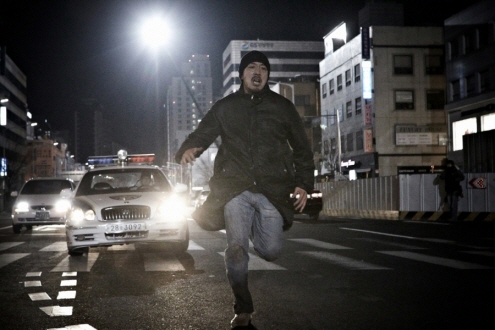
 That is when all hells start to break loose on poor Goo-nam. He is now chased by both the police and the mobs for what he does not commits. Not only he has to run fast on the alleys and streets of Seoul, but also he has to run around South Korea. He desperately tries to find a way out of this bad situation – and also tries to know who is behind his plight. However, he is no more than a timid pawn in this merciless world; it doles him out unlucky coincidences and lucky ones, equally and randomly.

 At least, the Bad guys who are after him are more or less uninformed than him. Later, it turns out a mob boss in Seoul, Tae-won(Cho Seong-ha), is involved with the incident. After seeing that the incident draws the attention of the police and the media far more than he has ever thought, he becomes panic. He attempts to solve his problem even before knowing what’s exactly going on. This is a very unwise move, especially when Myeon comes to South Korea after deciding to take care of the problem of him and Tae-won. Both want Goo-nam dead, but…

 You may expect that relentless urgency from the director/writer who made his debut with a grippingly savage thriller “The Chaser”, my best Korean movie of 2008, but “The Yellow Sea” is a different animal. In contrast to “The Chaser”, the director Na Hong-jin puts his story in more leisurely pace. The timeline of the former is around two days, but, in case of the latter, it is more than two weeks, at least. In the bigger space, the latter has more darkness and pessimism than the former with very few characters we can care about. There is little to make us feel sorry for these dirty guys, and the story collapses on itself along with the characters in the final act.

 Despite grim, stark hypereality of the crime world full of unlikable characters fighting for self-preservation, the movie crackles with energy and verisimilitude in the darkness. Although the characterization, especially in case of Myeon, is mostly broad, they come to life by the good performances from the cast. The movie was shot on the several locations including Yenji, and their harsh world is shown with painstaking details in the cold weather. Rarely do we see the warmth on its gray, gritty surface; it may will make you want a big cup of hot coffee when you walk out of the theater.

  Na Hong-jin skillfully plays with our expectations throughout the running time while moving his plot according to his plan. The plot is loose, but it is supported by the high tension level and punctuated by several excellent foot chase and car chase scenes. With the big budget he got thank to the previous success, he makes very impressive actions sequences. The camera is a little too shaky and the editing is a little too busy, and there is some awkwardness due to hectic post-production, but Na Hong-jin has a very good sense of space and time to make them felt considerably real. Like “The Chaser”, the characters are really running or struggling in the movie, and, my god, I am sure that lots of real vehicles really go through these fist-clenching moments without much help from CGI.


 There are lots of killings during the doomed, destructive fourth act. The violent moments in the movie are delivered in drier, more economical way than we expected although we still see considerable amount of blood on the screen. Kim Yoon-Seok, who chased after Ha Jeong-woo’s character in “The Chaser”, is again paired with him, but, this time, he is more evil and fearsome one of the pair. His main weapon is a small ax, but don’t underestimate what he can do with it along with knifes and those big animal bones(leftovers from a big dinner with his gangs, by the way).

  I think the movie bitterly laughs about how meaningless and pointless these violent acts turn out to be in the end, but it has a little heart, surrounded by barren nihilism, as the pivot we can hold on. Ha Jeong-woo, who was a chilling psychopath serial killer using chisel and hammer to kill women in “The Chaser”, gives a haunting, sympathetic lead performance as a flawed noir hero writhing in the chaos beyond his control. I have no idea about how he did that, but he immerses himself into his character very convincingly amidst these frantic chase scenes filled with lots of dangers. He might have really survived through them, perhaps.

   This is a darkly riveting work in spite of its unpleasant subject. It is mostly unkind to its characters(and us), but I think it secretly feels sorry for its hero’s fate while firmly holding its hard-boiled heartlessness even at the end. The movie is not perfect, and there are several flaws in the story including a rather shallow view on the female characters who mostly remains on the fringe, but I have to admit that the movie impressively drips with undeniable vigor and following immense exhaustion – that’s something to watch.

 Truffaut once said that he wanted a film expressing either the joy of making cinema or the agony of making cinema. “The Yellow Sea” is not a great movie and less satisfying than “The Chaser”, but, considering all those rumors about its troublesome production that exhausted the actors and crews under the control of its ambitious director for a long time, I think Truffaut would have liked to watch it. It does have what he wanted. 

Posted in Movies | Tagged , , | Leave a comment

Bad Santa (2003) ☆☆☆ (3/4) : A very naughty santa

  In my Korean review written in December 2008, I warned to my blog readers: “If you don’t want alcoholism, robbery, urination, lecherousness, R-rated words, Santa fetish, sex, homophobia, stalking, groin-kicking, blackmail, treachery, and some bizarre way of playing a pinball machine in the Christmas movies, I sincerely recommend you to stay away from this movie”.

 I was not kidding, and my warning about Terry Zwigoff’s dark cult comedy “Bad Santa” is still effective at present. This is still one of the meanest Christmas movies, and it is also one of those hilarious movies that make me laugh a lot while my eyes are rolling for the things happening in the story. The movie is uncompromising with its materials, and it pulls lots of laughs by sticking to that attitude from the beginning to the end. Even when it arrives at “happy ending”, it never loses any bit of its vicious sense of humor while literally giving us a middle finger. Don’t even talk about Christmas spirit. It has already completely mortgaged it and then thoroughly liquidated it.

 For some, Christmas is not so cheerful time, and Willie(Billy Bob Thornton) is one of them. What the hell, he is always morose and drunk all the time. He is such an unpleasant case study of the mixture of self-hate and self-destruction that you cannot help but look at him with awe and disgust. As he admits to us in the opening narration, he is nearly at the bottom physically and mentally. His sexholic/alcoholic mind has been in the swamp named self-hate. His body has been being damaged due to constant drinking and smoking. And most of what come out of his mouth are not nice things to hear. You probably feel sorrier for his poor liver than him.

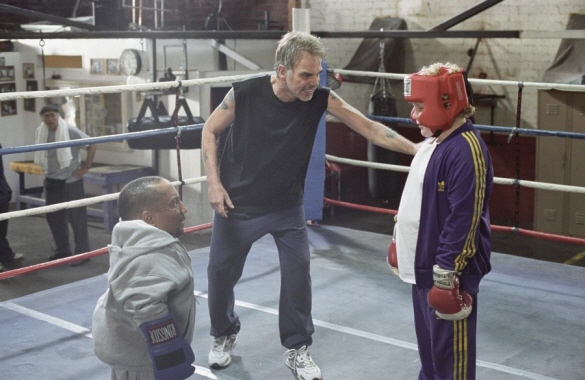
 He is depressed, and he considered suicide before. But he is always drawn to the work he cannot easily refuse. Whenever Christmas is coming, he works as a Santa Clause in the department store with his dwarf partner Marcus(Tony Cox). No, this is not his real job. He is in fact a good safe-cracker, and, when the holiday season is near over with lots of cash in the department store safe, he and Marcus rob the safe.

 Over many years, they have robbed many department stores in this way and managed to elude the police by selecting a new target every year. However, this time, maybe it is not a good time for Willie. He has reached to the new bottom while working as a Santa, and that exasperates Marcus, who is serious about their cover as well as their real job. Furthermore, his misdemeanors happen to draw the attention of a store investigator Gin(Bernie Mac), so the situation becomes more complicated. Plus, some overweight kid(Brett Kelly) also focuses on Willie for a different reason.

 That is just the start, and the story gets darker and meaner after that. But it gets funnier along with that. With the soundtrack playing familiar classic pieces that you might hear in the department stores around Christmas, the movie gives many cringe-inducing moments, and I think one of them is probably inspired by the scene from “Silent Night, Deadly Night”, a repellent slasher movie featuring another naughty(and murderous) Santa. It is indeed shocking, and the movie does not deny that, but I have to say it is one of the funniest scenes in the movie while effectively working as a good punchline.

 Terry Zwigoff’s movies(“Crumb” and “Ghost World”) are unconventional ones, and “Bad Santa” is no exception. The people surrounding Willie are not someone you expect from conventional Christmas movies. Marcus tries to be practical unlike his partner, but he is as foul-mouthed as Willie. In case of that kid who fixates on Willie, he is not an adorable little boy at all. He seems mentally abnormal. His obsession is as creepy as that of a stalker. The kid’s parents are absent for different reasons, and he lives only with his senile grandma(stiffly funny Cloris Leachman) in a big suburban house.

 Willie has no hesitation about using the kid’s obsession at first, but, while residing in the kid’s house, he begins to feel something he has never felt before in his heart for a long, long time. As a man with unhappy childhood, Willie feels sorry for the kid’s desperate loneliness. By “helping” the kid, he feels like he accomplishes something for the first time in his life. In case of his sex life, he begins relatively more meaningful relationship with a woman names Sue(Lauren Graham), who has a Santa fetish. Sue also likes the kid, and, under the same roof, they start to look like a warped alternative family.

 That does not mean the movie turns soft in the end, and neither does Billy Bob Thornton’s memorable performance. Thornton does not hesitate to unfold every repellent sides of his utterly unlikeable character in front of us while throwing himself into pure wretchedness. According to Zwigoff, Thornton was constantly drunk on the set, but Thornton did not lose the control, and the result is a comic equivalent of Harvey Keitel’s legendary performance in “Bad Lieutenant”. Both movies have a repellent hero who has given up the hope of rehabilitation, and chooses to go down further toward the abyss, and then is flabbergasted by the possibility of the redemption. “Bad Santa” is happier one of the pair because it is a comedy, but, as Roger Ebert wrote in his review, “the ending is happy in the same sense that a man’s doctors tell him he lost his legs but they were able to save his shoes.”

 Thornton is supported well by good supporting cast. Kelly is well-cast as a creepy kid. From his first appearance, you will immediately understand why Zwigoff insisted on casting him. Tony Cox does more than holding his place beside Thornton with his profanity-filled lines, and Graham provides a small, warm kindness despite the kinky aspect of her character. John Ritter, who died before the movie was released, is a department store manager who is very sensitive to political correctness. And Bernie Mac, who is sadly no longer with us now, is also funny as a greedy store investigator who wants some cut in Willie and Marcus’ robbery.

 “Bad Santa” is a truly twisted comedy. It may be too savage or weird or offensive to your taste. However, if you understand how it willingly charges into the dangerous territories for black comedy, I’m sure you will get a good amount of laughs from it. It goes without saying that this R-rated movie is definitely not for the kids, but, for the adults like us, it has malicious hilarity that can be savored during these dark, cold winter nights. Adding some high-level naughtiness to Christmas spirit with no syrup is never boring.

 Footnote:  This is the review based on the uncut version(99min), “Badder Santa”. The original version is 91min, and Director’s cut version released on Blu-ray along with the uncut version later is 88min. I believe “Less is more” in case of comedy, but the uncut version is good enough to make me laugh many times. I heard the director’s cut was more judicious and effective, and I’m looking forward to watching it someday.

Posted in Movies | Tagged , , , , , , , , , , | 3 Comments

Buried (2010) ☆☆☆1/2 : A sheer claustrophobic terror under the ground

“To be buried while alive is, beyond question, the most terrific of these extremes which has ever fallen to the lot of mere mortality.”

-From Edgar Allan Poe’s “The Premature Burial”

  When I saw several equipments devised for saving the people mistakenly buried alive during the 19th century in some big, encyclopedic book, I found them quite amusing, but being buried alive is not funny at all. Try to think about it for a moment. There is only the darkness before your open eyes. You soon become very, very uncomfortable because you cannot move much in the coffin. You know the oxygen in the air is being decreased even if there is no measurement tool. There is probably no one to hear your desperate cry. And that certain dreadful feeling creeps into your helpless mind.

 I have seen many moments of people buried alive in countless thrillers and horror movies. Some of them were quite frightening, but “Buried” reminded me how mercifully short most of them were for us. By choosing to concentrate wholly on its subject, the movie daringly forces the rigorous limits upon itself. It willingly does that right from the beginning. It even never attempts to get out of its rigid boundaries while firmly staying on its cramped area throughout its running time. Despite such burdensome constraints, the movie succeeds in not only achieving its goal but also deeply terrifying us.

 Let’s talk about its horrible premise. After going down with the ominous main title sequence, we immediately meet Paul Conroy(Ryan Reynolds) in the coffin buried under the ground. It is somewhere in Iraq in 2006. Paul is a truck driver employed by some contracter company, and he remembers that his truck was ambushed right before he lost his consciousness. Poor guy, he only went there to support his family and he knew well about how dangerous place Iraq is, but he had probably never expected such a terrible situation like this.

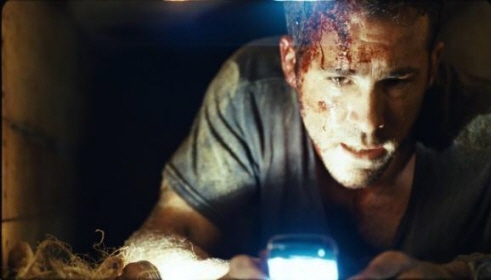
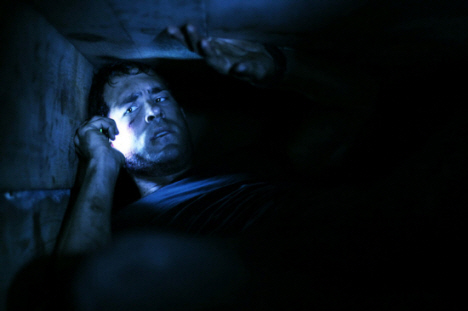
 Fortunately for him(and the audience), there are still time, space, and light sources, and, above all, the chances for his survival. Although it is quite limiting for his body movements, the coffin has some little extra space for Paul. That means there is enough oxygen to sustain him for at least several hours. His personal effects were mostly taken away from him, but he still has his lighter in the pocket. There are also a flashlight, a fluorescent lightsaver, a cellular phone, and a knife in the coffin.

 Who put them there? It is apparent that Paul is being held as a hostage. The demand for ransom is delivered through the cellular phone. Paul will be left buried forever if the money is not delivered till the deadline. At least he can use the cell phone freely, so he calls 911, and then his wife, his company, and the Pentagon. However, ironically, the phone conversations with others only make him more desperate and frustrated while his precious time is running out along with the oxygen and the phone battery charge. He still finds himself as helpless as Barbara Stanwyck in “Sorry, Wrong Number”(1948).

 By adamantly focusing on only one place, the director Rodrigo Cortés creatively maintains a high level of intensively dark, claustrophobic atmosphere. With several coffin sets and accompanying camera tricks and special effects, he only shows what happens in the coffin while never swaying from its straight and narrow path for any single moment. It is all about the experience with the utmost horror. There is no flashback in the movie. The people with whom Paul talks on the phone are not shown on the screen. We see and hear more and less than Paul can. We even cannot see what is happening directly above the coffin. And the effective use of widescreen emphasizes this extremely suffocating state.

With this setting and Chris Sparling’s smart script, Cortés makes his movie simultaneously gut-wrenching and compelling. I will not go into details about how he did it for not spoiling your experience. Let’s just say the movie mercilessly and realistically stacks up the dread on the screen a second by a second in the fashion of “The Pit and the Pendulum”, one of those short stories written by Edgar Allan Poe that scared me a lot during my childhood. If you remember those terrifying ordeals forced upon the hero step by step in that scary story, you will know what I mean.

 The movie is basically a one-man show that requires considerable talent from its actor, and Ryan Reynolds gives a credible performance that holds our attention from the beginning to the end. Despite being in the condition that is difficult for any capable actors, he convincingly carries the movie through every emotion imaginable in that trapped situation. It also should be mentioned that the actors providing the voices on the other end of the line are also important in supporting the drama and Reynolds’ performance.

 “Buried” is a gripping horror/thriller movie based. It sticks all the way with its simple premise to scare us, and, like any good horror movies, it works terrifyingly even when we do not see much from the screen because it lets our imagination to work by itself. To be frank with you, I had a memorable experience thanks to this movie. Several hours after watching the movie on this Wednesday night, I went to bed after turning the light out. It was all right at first, but then the images from the movie started to disturb my brain. Being buried alive is never, never, and never a funny thing to imagine.
Posted in Movies | Tagged , , , , , , | 3 Comments