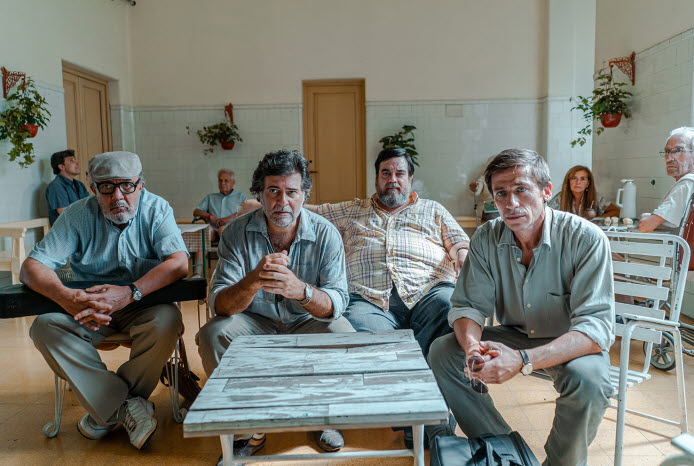
2023 Argentine film “Adiós Buenos Aires”, which belatedly came to South Korean theaters a few days ago, presents a little but charming story about several struggling musicians in Buenos Aires, Argentina in 2001. While their country is being turned upside down by a big economic crisis, they try to keep going with their artistic passion as much as possible, and the movie lightly bounces back and forth between humor and pathos while never overlooking how things are getting really worse for not only them but also many others in their country.
After the nice musical opening scene, the movie goes straight to the latest problem for Julio (Diego Cremonesi) and his three close friends/colleagues: Carlos (Carlos Portaluppi), Tito (Rafael Spregelburd), and Atilio (Manuel Vicente). Just like many other people in their country, their tango band singer recently decided to leave the country for better opportunities for his career, but they do not know where to get any other singer good enough for their band, and that makes Juilo have more doubt on his artistic career.
In fact, Julio has also been planning to leave the country, though he has not told anything to his colleagues yet. As his shoe store, which was incidentally inherited from his father, continues to go down in its business, he finally decides to sell the shoe store, and he is soon going to immigrate to Germany via the money from selling it.

And then there comes a little unexpected complication to him on one day. When he is driving his little old car which he is also going to sell sooner or later, he happens to have a serious accident due to a feisty female taxi driver named Mariela (Marina Bellati). At first, Mariela attempts to evade her responsibility, but, after Julio tracks her down to her taxi company, she proposes to pay for the cost of his car repair bit by bit. Although this will certainly delay his immigration plan to some degree, Juilo agrees on her payment condition, after seeing how much she struggles day by day for supporting herself and her little hearing-impaired son.
Meanwhile, Julio and his fellow band members come upon an unlikely change to revive their band. After hearing an old song performed by a singer who was once very famous and popular many years ago, they decide to locate that singer in question, and, what do you know, he turns out to be still alive and well. Although he is not so interested in reviving his old musician career, Ricardo (Mario Alarcón) eventually shows up during Juilo and his colleagues’ rehearsal, and it soon turns out that Ricardo can actually sing fairly well even though many years have passed since his glorious prime.
Needless to say, as the band becomes a bit more energized than before thanks to Richardo, Julio becomes gradually conflicted about his ongoing emigration plan. The situation seems irreversible once he finally sells his shoe store and then agrees to move out of his current residence along with his aging mother and his adolescent daughter sooner or later, but neither his mother nor his daughter is particularly excited about moving to Germany, and that makes him wonder more about whether his decision is really right.
In addition, he finds himself getting close to Mariela as she helps him and his fellow band members much more than expected. As shown from their little private moment in the middle of the story, Mariela also seems to like Julio a lot, but Julio hesitates due to his plan to leave for Germany, and that certainly frustrates her later in the story.

While not hurrying itself at all, the movie steadily builds up its story and characters via one episodic moment after another, and it also gives us some glimpses into the economic crisis in Argentina during that time. Whenever Juilo and others think it cannot possibly get worse, their country tumbles down into more trouble and chaos because of its incompetent government and those corrupt politicians, and, not so surprisingly, this worsening circumstance soon comes to jeopardize Julio’s plan a lot more than he expected at first.
The screenplay by director German Kral and his co-writers Stephan Puchner and Fernando Castets becomes a little contrived around the finale, but its several weak aspects besides that are thankfully compensated by not only the likable performances from its several main cast members but also a number of competent musical performance scenes in the film. Even if you do not know much about tango music (FULL Disclosure: Neither do I), you may find yourself swaying along with the breezy mood and rhythm of those musical performance scenes, and you will also be amused by a little humorous addition to the final one in the film.
In case of Diego Cremonesi, Carlos Portaluppi, Manuel Vicente, and Rafael Spregelburd, they instantly click well together right from the beginning besides looking quite convincing during their musical performance scenes in the film. Marina Bellati brings some lively charm and warmth to her several key scenes with Cremonesi, and Mario Alarcón is poignant when his character attempts to deal with his unresolved personal issues in the past.
On the whole, “Adiós Buenos Aires” is an enjoyable movie which accomplishes its modest goal as much as intended. It could bring some more depth to its story and characters (A subplot involved with Julio’s daughter is particularly under-developed in my trivial opinion), but its earnest storytelling coupled with good tango music engaged me enough during its rather short running time (93 minutes), so I will not grumble for a while.