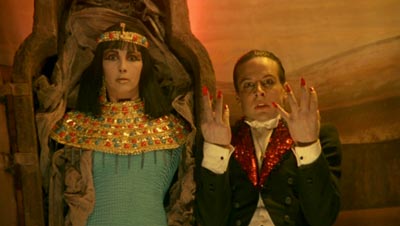
Santa Sangre (1989) ☆☆☆☆(4/4) : He’s his mother’s right arm – and also her left arm

 I have a small childhood memory indirectly associated with Alejandro Jodorowsky’s “Santa Sangre”(1989). I remember well about how it drew the attention of people when it was introduced in South Korea in 1994. One tagline was simple brutal honesty I still recall with smile: “This is the cult!” And here is another nice one that makes my eyeballs still rolling: “Today, You will be infected by the cult!”

 They were blatant enough to draw the attention from an 11-year-old boy, but the problems were that 1) I was too young to get the chance to watch it, and 2) my hometown was a local city far from Seoul. However, it was a blessing in disguise. They showed the audiences the butchered version with the considerable amount deleted due to the local censorship. In those days, bold, controversial films like “The Cook, The Thief, His Wife, & Her Lover” were never introduced to South Korean audiences unless they were heavily chopped. You probably think it is kind of weird considering some uncompromisingly violent South Korean movies made nowadays, but it did happen a lot when I was young.
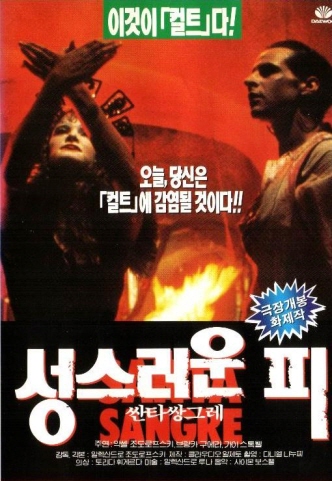
 Despite its big indirect impression, it took some time for the film to reach to me. After that year, the memory about it was moved into the oblivion area of my brain while I went around other more accessible movies. Several years had passed till it was awakened by the memorable encounter with Jodorowsky’s other works in 2007. I finally watched the movie three years ago, and I found it strange, funny, violent, and harrowing, and I still do think so after watching it again with the stellar Blu-ray edition released in this January. This is the macabre but fantastic parade of weird, ugly, horrible and perverse moments, and Jodorowsky is your nutty circus ringmaster to give you the hallucinatory joyride of horror with a tormented mind revealed at the center.

 At the start, we see a naked man perching atop a tree trunk in his cell in the mental institution. He acts as if he were a bird. When the doctor and the orderlies(one of them was played by Brontis Jodorowsky, Jodorowsky’s son and that naked boy in Jodorowsky’s “El Topo”(1970)) offer him the normal meal, he seems not to be interested much. However, when they offer raw fish instead, he comes down and devours it, so the orderlies get him to wear the patient uniform.

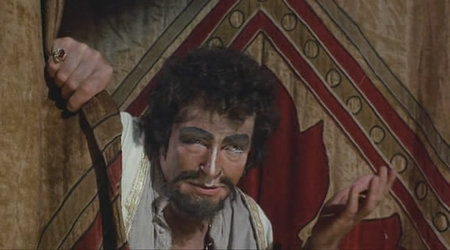
 His name is Fenix(played by Jodorowsky’s other two sons – Axel Jodorowsky as adult Fenix and Adan Jodorowsky as young Fenix), and the movie goes immediately back to his colorful but traumatic childhood, starting with the viewpoint of an eagle swooping across the city streets to the big circus tent where he performed as a young magician. His American father Orgo(Guy Stockwell) is a knifethrower who runs the troupe(“Circus del Gringo”), and he is also a lecherous obese man whose libido is not so much inhibited by the fervent obsession of his wife Concha(Blanca Guerra), a trapeze artist whose part time job is the leader of a religious cult called “Santa Sangre”.

 Sandwiched between such parents like them, young Fenix can be a good study case for Freudian psychoanalysis. While Orgo gives his son his symbols(a eagle tattoo on the chest and a gaudy cowboy costume) and says they will make him a man, Concha also pulls Fenix with her religious fanaticism apparently linked to sexual suppression. She and her followers wear red tunic with two crossed arms drawn on the chest part, the symbol of their worshipped saint – a raped girl who got her both arms cut off and was left died in the pool of her blood. They even have the pool of “holy blood” in their tacky temple, only to be pointed out by the local monsignor that it is just the pool of red paint, during the conflict between her followers and the demolition crews/the police. She and others get quite hysterical, claiming that it is holy blood no matter what. The temple is soon demolished by the bulldozers, with Concha zealously maintaining her stand inside the edifice.

 But it was not entirely a bad life for Fenix because he had some friends in the circus. There are clowns, and a dwarf named Aladin(Jesús Juárez), who sincerely stands by him. And there is a girl Fenix is very fond of – a deaf-mute mime named Alma(Faviola Elenka Tapia). She is the step-daughter of the Tattooed Woman (Thelma Tixou), a lusty woman who is literally the target of Orgo’s lust as well as his profession. Their practice is more like their foreplay, with lots of various tattoos on her skin adding more sensuality to their interactions.

 With such colorful characters and equally impressive use of colors, Jodorowsky creates the vibrant circus atmosphere mixed with oddness during this part. Within this strange, exuberant world, he creates the memorable moments, big or small. There is a lovely scene when Fenix played the music for Alma’s high wire act with the bottles, each containing different colored solutions. And there is that unforgettable funeral march sequence people still talk about after watching the movie. In the direct juxtaposition of sex and death, Fenix peeps at his parents having sex(next to a savage beast in the cage), and then, when they reach to the high point, the movie jumps to the shot showing a dying elephant’s trunk spewing blood with Fenix begging it not to die. Its funeral march is soon held in a tragicomic fashion by the circus crews. They arrive at the cliff, and that big, black coffin is slid down and fallen to the bottom of ravine, the junkyard where poor people immediately dash to the crashed coffin with cheers for scavenging the carcass.

 The film is, after all, a horror story, and, with its wild imagination and twisted black humor, it goes further into the violent and bloody area where manipulation, obsession, jealousy, perversity, and other dark sides of human psyche exist. During her performance, hung by her hairs in the air, Concha finds that her slimy husband is flirting with the Tattooed Woman. She follows them, and, when they are about to copulate, she pours sulfuric acid to her husband’s genital. In a savage irony to her religious belief, he swiftly cuts off her both arms with his knives before killing himself.

 Young Fenix witnessed this horrible incident, which traumatized him so much that he had been in the mental institution for a long time – until his dear mother appears in front of his eyes. He gets out of the institution, and he soon begins to work at the theater with his mother. In the bizarre performance based on one of the pantomime routines written by Jodorowsky when he worked with Marcel Marceau in Paris during the 1950s, they perform together with his arms acting as her arms.

 The near perfect synchronization between Axel Jodorowsky, who actually studied the pantomime under Marceau, and Blanca Guerra generates many uncanny moments in the second half of the movie. Even at their barren mansion, Fenix slips his arms into his mother’s sleeves and functions as her arms when she “plays” the piano or eats breakfast with her “hands”. He is so devoted to his mother that he deserves the Norman Bates award; as a matter of fact, he is a serial killer driven to kill the women he is drawn to, with his hands possessed by her.

 The movie was sort of a happy coincidence. Jodorowsky coincidently met the real-life serial killer that inspired his film at a bar. He was fascinated by how that man had led a normal life after getting out of the prison with the terrible past put behind him. And he was later approached by the producer Claudio Argento, who was well-known for producing his older brother’s horror films, and the co-writer Roberto Leoni for the movie about a serial killer. “I don’t understand why a serial killer always kills beautiful and sexy women.”, Jodorowsky said. “Why doesn’t he kill men? Or Ostriches? Or Dogs?” In another weird scene, Fenix brings in a big muscular female(or transsexual, maybe) wrestler for fighting off his mother’s control. The dubbing is usually awkward in Jodorowsky’s movies, and this scene is no exception, but that incongruous aspect adds extra weirdness to the screen.
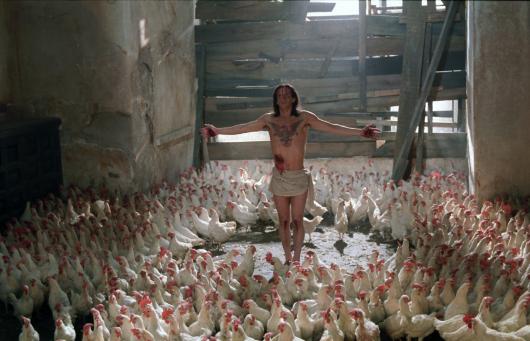
 Jodorowsky’s films are not easy to forget, regardless of whether you like them or not. Watching “El Topo” and “The Holy Mountain”(1973) at the small local theater in 2007 May was interesting experience to say the least. Thanks to the advertisement leaflet handed out to the audiences, I knew I was going to watch something very different from what I usually experienced at the theaters, but it was far more different than I expected. To be frank with you, I would have been at a loss if someone had asked me to write about these movies.

 Sure, they have many impressive moments that caught my attention, and it was wonderful time to watch them together, but what do I know for sure about these odd movies, besides the fact that lots of ideas and symbols are mixed together in a bold, uncompromising style on the screen to provoke and challenge me? “The Holy Mountain” is, I think, a big, stylish mystical joke(by the way, I burst out a laugh at the finale). In case of “El Topo”, well, the afternoon fatigue attacked me at that time, so I understood far less than others in sleepy mode, but it was not easy to forget a man in black clothes riding a horse with a naked boy behind his back in the desert. I recently revisited it, and that impression was same as before, but I admit that this incoherent mix of symbology, western film, and mysticism is something you can’t miss.

 Compared to them, “Santa Sangre” is more accessible film for it has a relatively discernable story. But, again, the story is mixed and spun together with lots of stuffs including psychology, surrealism, pantomime, classic horror movies, and many other compelling materials to create the bizarre kaleidoscope of indelible images. There are many questions and logic problems when you think about the plot, especially in case of how the characters appear timely and conveniently for the plot, but they are somehow plausible because of the film’s surreal atmosphere. I especially like the sequence where Fenix and his fellow mongoloid patients are led to the red light street by a pimp played by Jodorowsky’s another son Teo Jodorowsky. Jodorowsky hired real mongoloids, and the outcome has nightmarish quality mingled with cheerfulness. It is a seedy world drenched with ugliness, but mongoloids have a good time with others, anyway(and they actually did during the production).

 With its bizarre moments dominating the screen, the film could have been merely the weirdness for sake of being weird. But it has its hero’s shattered psyche as its emotional center. He is helplessly trapped between both parents’ influences from the past. He is compelled to behave like his father, but he is also driven to do the killings as ordered by his mother. He wants to be rather disappeared like the hero of “The Invisible Man”(1933), the movie he imitates in a silly way in his private place, but he has been condemned to be the hero of another old horror movie “The Hands of Orlac”(1935), where its hero cannot control his homicidal hands. To make the matters worse, the guilt resulted from his crimes keeps coming to him – especially in the chilling scene where his victims, painted white by him, rise from the burial ground at night.

 Besides victims’ whitened skin, there are a lot of common things between “Santa Sangre” and Tarsem Singh’s equally visionary movie “The Cell”(2000). In their own visual ways, both strikingly reveal the psychic horrors inside their serial killer characters. While throwing a series of weird images to us, they also make us understand the emotional state of the warped minds and feel some pity for them.
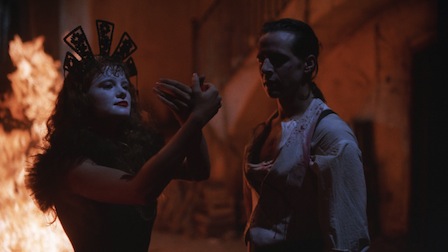
  And there is a “therapy” in each case. In case of “Santa Sangre”, its finale seems to be influenced by Jodorowsky’s own psychotherapy method, “Psychomagic”. He believes the performance of a certain symbolic act can directly affect the unconscious mind and release it from traumas. Through the help from Alma(now played by Sabrina Dennison as an adult) and the bright side of his past, Fenix performs an act that leads to his redemption while overcoming the evil forced on him at last. A small part of me still questions how it is physically possible, but, with the movie’s sheer power to drive us into the distorted world, anything is somehow acceptable in the movie – like magic realism. The ending is ironic indeed, but it is also very poignant, for we know well that it will be a lot better for Fenix no matter what will happen.

 “Santa Sangre” dazzles you with its unorthodox beauty fueled by the uninhibited imaginations from Jodorowsky, whose life is as fascinating as his movies. Born in Chile as the son of the Russian Jewish immigrants, he moved around a lot around the world while working as a playwright, a play director, a writer, and a comic book author whose works are much respected in France. Filmmaking is only a small part of his resume. He made a very few films in the last 40 years, but he made them because he wanted, and he is proud of them.

 After this movie, he has been relatively quiet in the movie business while diligently active in other fields, except when “El Topo” and “The Holy Mountain” were resurfaced a few years ago thanks to the end of conflict between him and the copyright holder Allen Klein(Now, he said, they are good friend). He is now 82, but he plans on making a new movie, a sequel to “El Topo”. On the leaflet given to me when I watched “El Topo” in 2007, the tagline was “Don’t you ever imagine anything!”. I don’t dare to hastily imagine anything about that.

 Footnote:  As I mentioned, the new edition of “Santa Sangre” is recently released on Blu-ray and DVD by Severin Films. I find the color is more muted than I recall from the first watching, but they say it is close to the original theatrical release. That aspect is still debatable, but I think the video quality is a lot better than before as a whole. In addition, the supplements are bountiful enough to this edition recommendable, including a new feature-length making-of-documentary “Forget Everything You Have Ever Seen: The World of Santa Sangre”(There is an interesting episode about how Axel Jodorowsky and Blanca Guerra worked together – their method did fit perfectly into the psychological context of the story), UK TV documentary made in 1990, Q & A session with Jodorowsky shot at 2002 London screening, and other goodies.

Posted in Movies | Tagged , , , , , , , , | 1 Comment

Black Swan (2010) ☆☆☆1/2(3.5/4) : A ballerina under Influence

 How far can she go for the perfection? Most of you probably have heard about how much the ballet dancers try for their performances. They practice diligently for every movement during long preparation process. They must dedicate their bodies and minds a lot to create that momentary beauty effortlessly on the stage. It is a very demanding work – especially in case of the lead performer, who is pressured a lot to show the audiences every talent the performer has.

 Darren Aronofsky’s new movie “Black Swan” cannot be more different from his previous work “The Wrestler”. Both deals with the tolls their characters have to pay for the performances in their respective jobs, but, unlike the stark realism of “The Wrestler”, “Black Swan” is an outright melodrama convulsing with tons of psychological tensions and terrors inside the heroine’s unstable mind. We are never sure about what really happens, but, once we accept the unreliability of her viewpoint, the movie dazzles us with lots of outlandishly phantasmagorical moments. It scares and tightens us as well as its heroine, and then it forcefully pushes her to the over-the-top grand finale while maintaining almost complete control and no-hold-barred confidence. It may sound contradictious, but it does work in that way.

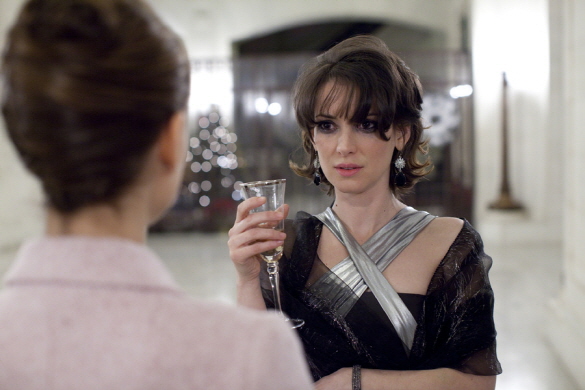
 The story is a generic backstage melodrama we are familiar with. After the disturbing opening dream sequence, we see Nina Sayers(Natalie Portman) beginning her daily life in the morning. She is a young hopeful ballerina in New York City company, and the new season is about to begin with a good chance to realize her big dream. For revitalizing his company, the company director Thomas Leroy(Vincent Cassel) decides to stage a newly interpreted version of Tchaikovsky’s classic work “Swan Lake” as the opening production, and he also decides to replace his prima ballerina Beth Macintyre(Winona Ryder), who is over 35 now, with someone young and fresh as new Swan Queen.

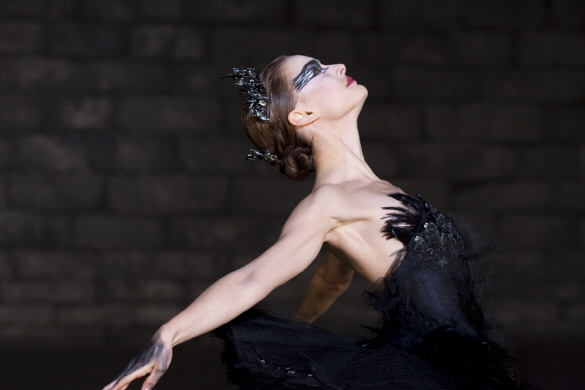
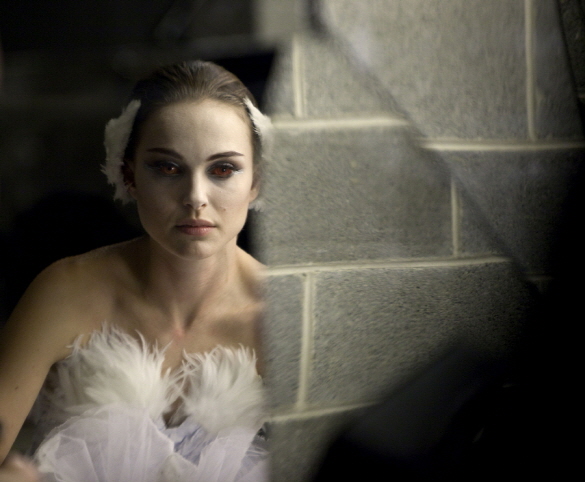
Nina wants that role wholeheartedly. She eventually gets the part, and she is joyous to hear the news at first, but she soon faces the problem inherent in herself while preparing for her dual roles during rehearsal. She has everything to play White Swan; she is a by-the-book perfectionist with grace, fragility, and innocence exuding out of her character. However, in contrast, she is everything Black Swan is not; she lacks sensuality, boldness, and depravity to embody White Swan’s evil twin.

 Thomas chides Nina for this weakness, and she becomes quite stressful. Well, her life has been always under the pressure. She has already been being pushed a lot by the overprotection of her devoted mom Erica(Barbara Hershey), who had to give up her own ballet career for her daughter. In their stuffy apartment that looks like a cocoon for both, Nina is still Erica’s “sweet little girl” in their close relationship. There is not much privacy for her at home, and, with these stuffed dolls, Nina’s pink room is not that different from a little girl’s bedroom. At one point, she said she had several relationships with boys and experiences, but I seriously doubt about that. To me, she is as sexually repressed as the heroine of Roman Polanski’s “Repulsion”, a story about another fragile girl psychologically pressured while living in her apartment with her sister.

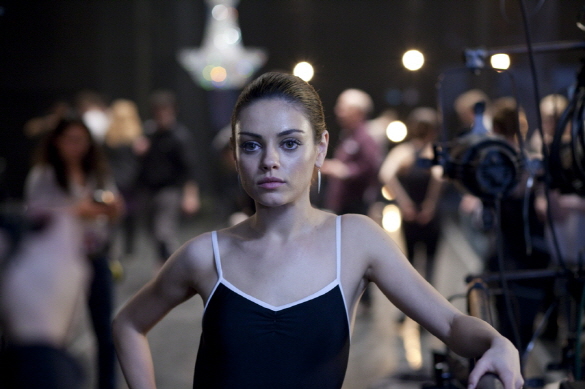
 The situation becomes more troublesome for Nina due to her potential rival, Lily(Mila Kunis). In contrast to Nina, this talented ballerina from San Francisco is perfect as Black Swan while being imperfect as White Swan. She is direct, bold, easy-going, and flexible – and she has even the tattoo on her back. Thomas considers Lily as an alternative, and that makes Nina’s extremely unstable mind more unstable than before. For her, there is no choice but trying to search for something that can boost her performance while strenuously perfecting her movements. Her mind is pushed nearer and nearer to the breaking point. The madness creeps on the screen step by step. She finds herself attracted to the dark side represented by Lily. And the weird moments begins to assault her, but is it real?

 The movie mercilessly sticks to Nina to emphasize her warped viewpoint. The cinematographer Matthew Libatique’s camera follows her and stays close to her throughout the movie. During the first half, when everything looks relatively normal, it observes the activities in the ballet company with the natural style reminiscent of Robert Altman’s “The Company”(recommendable if you want to take a rest after watching this movie), but, using frequent close-ups, its approach is far more tense with fastidious concentration on details including stitching of ballet shoes or bruised feet. We are getting more close to Nina’s heart and mind shot by shot; we are pulled into her obsession and mental crisis. As a result, even when we do not understand what the hell is happening, we exactly know what drives her and how she feels.

 Aronofsky has shown us the characters driven to the extreme conditions with uncompromising attitude in his films. In his debut “Pi”(1998), its mathematician hero is driven to paranoid and insanity while destructively obsessing on his study subject. In case of “Requiem for a Dream”(2000), it blisteringly looks at the addicts falling to the bottom with its intense style. In “The Wrestler”, we cringe at how hard its hero falls in the ring while sadly realizing that it is the only way of living for him. “Black Swan” is no exception, and Aronofsky stops at nothing to hurl his heroine into the dark psychological maelstrom full of bizarreness and shocks, amplified by Clint Mansell’s darkly nervous score that manipulates and tortures Tchaicovsky’s work.

 Overblown melodramas like this film always heavily depend on the lead performance, and Natalie Portman gives one of the superb performances in last year. Portman may not be a great actress, but she is a talented actress with her own strengths and weaknesses, both of which perfectly fit into her character. Not only she is physically believable on the screen(As we have heard many times, she prepared a lot for her role including several months of training), but also she is psychologically convincing every moment – she never loses her control even when her character’s psyche is overwhelmingly spun at full throttle toward the level of total breakdown. At this moment, it is quite clear that she will get an Oscar for her magnificent achievement few days later, and she deserves that.

 Many people wished that there are more about the supporting characters surrounding her, but the movie is solely about Nina’s state of mind; they are more or less than the reflected images in her disturbed mind. The actors revolving around Portman do good jobs while firmly supporting her performance. Mila Kunis, who is also believable as a ballerina on the screen, is engaging as the character who can be a warm friend or a seductive rival or both or whatever. Vincent Cassel is a smooth and arrogant director who gets what he wants from his ballerinas by any means necessary – he behaves like he is entitled to do that. Barbara Hershey is also impressive as the mother with suffocating love who is very, very determined to see her dream realized through her daughter. And Winona Ryder has a brief appearance as a washed-out ballet dancer, which sadly resonates with the recent downturn in her career.

The movie faithfully follows the formula of backstage melodrama, so we know that everything in the story will ultimately culminate into one big performance to remember in the finale. The camera swirls around, and every pain and every agony is sublimated beautifully and triumphantly on the stage – with the tragic overlap between art and reality. Although it has already been overheated a lot throughout the story, the movie further delves into the more outrageous situation, and, I guarantee you, you will be surprised by how far the movie willingly goes for that big moment with its sheer energy while never caring about whether the story does not make sense to us at all. It is amazing that the film still remains controlled as required while becoming overblown as demanded to the level of 11 for the mind-blowing tour-de-force finale that will make lots of audiences feel numb or enthralled.

 “Black Swan” is exhausting experience that you won’t forget easily regardless of how you think about it. Like Nina, both Aronofsky and Portman do an exceptional job of vividly presenting both White Swan and Black Swan, and the movie is definitely something to behold. Not wholly perfect, not wholly logical, but, what the hell, the movie daringly tries to something big and preposterous, and its twisted surreal beauty is something we cannot see everyday.

Posted in Movies | Tagged , , , , , | 3 Comments

My prediction on the 83rd Annual Academy Awards

  Now the Academy awards ceremony is near again. Many people have made their predictions on the results that will be revealed on the next Sunday, February 27, and, as usual, they agrees on some categories while disagreeing on others. Although I did not watch all of the nominees, I saw all of the major contenders, so here is my prediction on the 83rd Annual Academy award.

 Don’t bet on me, by the way. After getting slapped by “Crash” in 2006(Am I only one who thinks it deserves Best Picture award besides Roger Ebert?), I checked every nominee and possibility as far as I could, but, like many of you, I have never guessed the result correctly yet. As a matter of fact, I submitted my prediction to Roger Ebert’s site, but I do not expect much – it was just for a fun, folks.

Best Motion Picture of the Year

127 Hours (2010): Christian Colson, Danny Boyle, John Smithson

Black Swan (2010): Mike Medavoy, Brian Oliver, Scott Franklin

The Fighter (2010): David Hoberman, Todd Lieberman, Mark Wahlberg

Inception (2010): Christopher Nolan, Emma Thomas

The Kids Are All Right (2010): Gary Gilbert, Jeffrey Levy-Hinte, Celine Rattray

The King’s Speech (2010): Iain Canning, Emile Sherman, Gareth Unwin

The Social network (2010): Scott Rudin, Dana Brunetti, Michael De Luca, Ceán Chaffin

Toy Story 3 (2010): Darla K. Anderson

True Grit (2010): Ethan Coen, Joel Coen, Scott Rudin

Winter’s Bone (2010): Anne Rosellini, Alix Madigan

 Let’s erase five nominees that did not get Best Director nomination: “127 Hours”, “Inception”, “The Kids Are All Right”, “Toy Story 3”, and “Winter’s Bone”. “The Fighter” has little chance for it is supporting actors’ movie. “Black Swan” will get Best Actress award as its sole reward. “True Grit” scored 10 nominations, but it is not nominated for Best Editing – not a good sign for its chance to win.

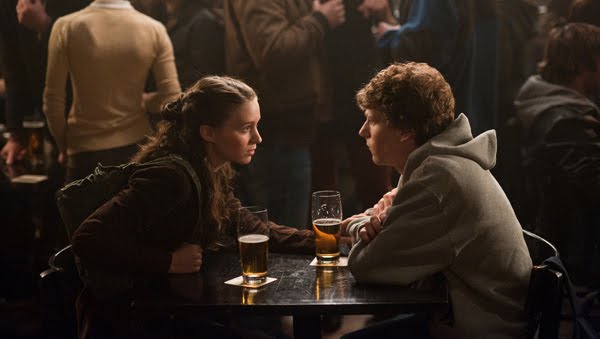
 So we have “The King’s Speech” and “The Social Network”. The latter is certainly the best film of 2010. Its electrifying drama fascinates us with how our society is being changed due to the human relationships adapted into the electronic communication network by the nerds like Mark Zuckerberg, who, ironically, does not understand much about the human relationships(Never mind about how real-life Zuckerberg is different from the movie’s version). Will this rapid change be good or bad for us? I am not sure, and neither are the writer Aaron Sorkin and the director David Fincher. At least, I know the Internet can make lots of difference in our world nowadays than before – as shown in Egypt.

 But I think Best Picture award will go to “The King’s Speech”. With the story about one historic figure who overcomes his disability with the help from others, you can say that this period drama is made for Academy Awards. And it is a very powerful movie that seems to touch many people’s heart in Hollywood; it won SAG, PGA, DGA. With this result, there is a little chance for upset by “The Social Network”.

Prediction : The King’s Speech

Preference : The Social Network


Best Performance by an Actor in a Leading Role

Javier Bardem for Biutiful (2010)

Jeff Bridges for True Grit (2010)

Jesse Eisenberg for The Social Network (2010)

Colin Firth for The King’s Speech (2010)

James Franco for 127 Hours (2010)

 Considering the performances themselves, this is a heavy competition. I have not seen “Bitiful” yet, but many agree that it has Bardem’s best performance – but it is clear that his nomination itself is the reward. Bridges has won the award in last year, so he also does not have much possibility. Both Eisenberg and Franco give terrific performances, but the time has come for Colin Firth, who gives a very moving performance as King George Ⅵ in “The King’s Speech”.

Prediction : Colin Firth

Preference : Colin Firth


Best Performance by an Actress in a Leading Role

Annette Bening for The Kids Are All Right (2010)

Nicole Kidman for Rabbit Hole (2010)

Jennifer Lawrence for Winter’s Bone (2010)

Natalie Portman for Black Swan (2010)

Michelle Williams for Blue Valentine (2010)

 This is another heavy competition – all actresses are very good in their respective movies. First, Kidman and Williams will be content with their nominations, and so does Lawrence. Maybe some voters think it is time to give Bening the award, but, Portman is overwhelmingly favored at present for her dynamic performance in “Black Swan”. And she has already won Golden Globe, SAG, BAFTA, and many critics award. If she beats Bening at the Independent Spirit Awards on next Saturday, there will be no more questions about her win.

Prediction : Natalie Portman

Preference : Natalie Portman


Best Performance by an Actor in a Supporting Role

Christian Bale for The Fighter (2010)

John Hawkes for Winter’s Bone (2010)

Jeremy Renner for The Town (2010)

Mark Ruffalo for The Kids Are All Right (2010)

Geoffrey Rush for The King’s Speech (2010)

 With SAG and Golden Globe awards, I think Bale will win an award. As a character the movie should have focused on instead of its bland hero, he was fantastic. It is possible that Rush, who recently won BAFTA award for his witty performance, will make an upset due to the popularity of “The King’s Speech”. The other three nominees – Hawkes, Renner, and Ruffalo – will take a backseat. I’d like to see Hawkes to win for his nuanced performance as a criminal uncle capable of showing ruthlessness as well as compassion to his desperate niece in “Winter’s Bone”.

Prediction : Christian Bale

Preference : John Hawkes


Best Performance by an Actress in a Supporting Role

Amy Adams for The Fighter (2010)

Helena Bonham Carter for The King’s Speech (2010)

Melissa Leo for The Fighter (2010)

Hailee Steinfeld for True Grit (2010)

Jacki Weaver for Animal Kingdom (2010)

 Like many times before, this category is quite unpredictable. It seems that Leo is the front runner with Golden Globe and SAG wins, but Steinfield is a strong competitor with her exceptional performance. Adams and Weaver have almost no chance in this race, and, in case of Carter, she might win the award considering her recent BAFTA win. I have stuck with Steinfeld since I watched “True Grit” – but I also want to recognize the chilling performance by Weaver, who plays a ruthless, manipulative matriarch in “Animal Kingdom”

Prediction : Melissa Leo

Preference : Hailee Steinfeld – or Jackie Weaver


Best Achievement in Directing

Darren Aronofsky for Black Swan (2010)

Ethan Coen, Joel Coen for True Grit (2010)

David Fincher for The Social Network (2010)

Tom Hooper for The King’s Speech (2010)

David O. Russell for The Fighter (2010)

 There is lots of chance that Hooper, who won DGA award, will win the award, but I will stick with Fincher, who made one of the best movies in his career. I am sure Academy members will recognize his achievement… about 55%.

Prediction : David Fincher

Preference : David Fincher

  Continue reading →

Posted in Movies | Tagged | 5 Comments

127 Hours (2010) ☆☆☆1/2(3.5/4) : A vibrant movie between a rock and a hard place

 Striding freely for new risky adventures in the wilderness is, I guess, liberating to some people like Aron Ralston. They are willing to dash into their goals while appreciating the vast beauty of nature surrounding them, and, in the end, they earn the sense of accomplishment – if they are lucky. Most of them clearly know of the dangers inherent in their activities, but the nature is a merciless opponent. Even though they are careful and confident, accidents happen to everyone randomly and equally, and we hear about their unfortunate incidents from time to time.

 The same thing can be said about Ralston, an experienced mountain climber who went alone into one canyon in the Canyonlands National Park, Utah in April 2003. At one point, he thought he could climb down easily along the walls of canyon, so he began the descent, and then, oops, he happened to dislodge a boulder wedged between the walls. He fell to near the bottom, but he was all right – except that his right hand was wedged between the boulder and the canyon. No one could help him for he did not notify others about where he had gone and he did not have a cell phone. When you are alone in the wilderness, nobody, except wild animals, can hear you shout in most cases.

 Unlike Danny Boyle’s previous movie “Slumdog Millionaire”, which briskly runs amid many various aspects of India with its hero, his new movie “127 Hours” is about a man who cannot move from the place where he is stuck – and how he is led to make a certain tough choice in this grim reality. It is definitely not something you can watch comfortably, but Boyle tackles this challenging subject in an exceptional way, and it is a visually and emotionally gripping work as a result. The movie shows from the beginning that it is based on the book “Between a Rock and a Hard Place” written by Ralston himself, so you know what will eventually happen in the end even if you have not heard about his story, but the movie is a compelling experience nonetheless; it is about the situation rather than the plot. 

 After the lively prologue sequence involving Ralston’s brief encounter with two girls, their fun time in the underground pool, and the following accident, the film closely observes on how Ralston, played by James Franco, deals with his trouble. He desperately tries to move the boulder at first, but it becomes clear to him that he cannot move it for himself. He assesses his limited resources including a bottle of water, a digital video camera, ropes, and a multipurpose tool with a relatively dull knife, and he tries to solve his problems with them. One fortunate thing for him is that he can manage to rest or sleep. It could have been far worse if the boulder had him dangled above the bottom of the canyon.

 No matter how much Ralston tries, his chance for survival gets decreased second by second. He is still stuck at the bottom of the canyon while facing the dangers including dehydration and hypothermia. He manages to deal with these problems for a while, but it becomes harder and harder for him to maintain the situation as the time goes by. He has accepted that no one can come to rescue him before it is too late, so one drastic solution to his matter begins to emerge in his mind. Surely it is so risky that he hesitates that at first, but it is the matter of a choice between a torturously long waiting for his death and an excruciatingly painful trial with lots of, and lots of, fatal possibilities. After all, it goes without saying that his right hand cannot be saved even at the best condition, so….

 With its trapped hero, the movie reminds me of Rodrigo Cortés’ “Buried”(2010), another movie about similar premise. It was a very interesting experience for me to watch two movies during a short period. Both have the premise that seems to be not so compelling enough to make into a feature movie, but both achieve their respective goals admiringly in their own ways. And they remind us how it will be terrifying for us to be alone and helpless while stuck with the possibility of imminent death.

 The difference is, in contrast to that insidiously immovable dark power of “Buried”, “127 Hours” is brimming with its vibrant kinetic energy while recognizing denial, anger, frustration, and acceptance in its hopeless state. Boyle and his crews do their best to make their movie, shall I say, a very watchable one, and they really have done it. Thanks to the vividly impressive cinematography by Anthony Dod Mantle and Enrique Chediak and skillful editing by Jon Harris, the movie stays very closely with Ralston, his mind, and his circumstances. With lots of time in the trapped state, Ralston’s perception on the surroundings becomes keener – he notices a raven flying over the sky every day at exactly the same time in the morning. His mind goes freely into the memories with his family and friends. He also experiences some hallucinations coupled with the introspection about his life. The movie always makes us conscious of his physical state; the landscape still looks beautiful, he is still trapped in the canyon, and he still has to make a hard choice sooner or later.

 There have been lots of talks about that mutilation sequence in the climax which shocked some audiences a lot during the screenings. I have to admit that it was hard for me to watch this sequence on the screen, but it is shown with skills while supported by our empathy built on its hero. James Franco recently got an Oscar nomination for this movie, and he deserves that for carrying the movie for himself during most of its running time. With the camera always near him, Franco does a credible job of presenting to us an ordinary young man who is capable of making such a hard choice to survive. Ralston does not lose his sense of humor as well as his will in his dire circumstances, and Franco shows some of his comic talent in one funny scene(but it’s not so funny if you are in his shoes, by the way).

 We see blood and some gory details with considerable medical accuracy in the climax sequence. The film effectively conveys to us how excruciating it was to Ralston with the suggestions created by the clever mix of sound effects, editing and cinematography. Driven by the aggressively dynamic score by A.R. Rahman, this sequence crackles with the barely bearable intensity that makes torture porn movies like “Saw” and its sequels ridiculous. While the bodies are mutilated as some sort of a twisted entertainment with no emotional connection from us in those movies, we have a believable and vulnerable human being we care about, and that is why this sequence is more striking, more painful and, I dare to say, more cathartic to us. As a biology major, I recognized that thin white sensitive tissue on the screen and winced even before the sound effect came in because I knew well about how it would be penetratingly painful for Ralston. He was quite lucky considering that he could have died for blood loss even with his makeshift tourniquet.

 In spite of grim situation and following grueling climax, “127 Hours” is ultimately an optimistic movie whose spirit is kicking and spinning in its stuffy space as much as Ralston. It reminds me that people are capable of doing anything at the right time and at the right place – that always both amuses and horrifies me. After surviving from his ordeal and giving a farewell to his right arm, Ralston is still active with his mountain climbing and canyoneering. Of course, the lesson that cost his right arm is not something easy to forget; he always leaves a note saying where he has gone.

Posted in Movies | Tagged , , , , | 1 Comment

True Grit (2010) ☆☆☆1/2(3.5/4) : After all, it’s her story

 How unpredictable the Coen brothers are – I have been always amused by their unpredictability in their career. When we became a little bit disappointed with playfully heartless puppet plays in their lesser movies for a while, they suddenly ambushed us with the greatness as shown in “Fargo” or “No Country for Old Men”. After getting three Oscars including Best Picture award for the latter, they immediately went to having a little cold fun with “Burn After Reading”, and then they stroke us again with “A Serious Man”, a sublime black comedy whose neurotic hero is punched repeatedly by the chaos in the life while he is desperately looking for an answer or an order in it. No matter what kind of film they make, the Coen brothers make it because they want to do it – and because they can do it. As they said, they are just same as when they made movies together at their home in adolescent years.

 That was why I was both surprised and not so surprised when I heard about the Coen brothers’ next project after “A Serious Man”: The remake of 1969 movie “True Grit”. Based on Charles Portis’ novel with the same name, the 1969 version is not a great movie, but it is still an enjoyable classic western film with an Oscar-winning performance by John Wayne. It is debatable whether that win was more for honoring his great career than for his performance, but it is, if not the best, one of his great performances, and that is one of the main reasons that make the movie still work at present.

 The most interesting thing about the Coen brother’s version is that, they made a surprisingly straightforward western film with little twists. Although they make some diversions from the original plot in the middle, this version is more faithful to Portis’ novel than the 1969 version, and it is actually an improved version in many aspects. As a matter of fact, Portis’s novel(Pardon my ignorance, I was really surprised to know that it was actually written in the 1960s) has a dry sense of humor along with its attitude as no-nonsense as its heroine, and it fits well with the Coen brothers’ style as much as Cormac MacCarthy’s “No Country for Old Men”.

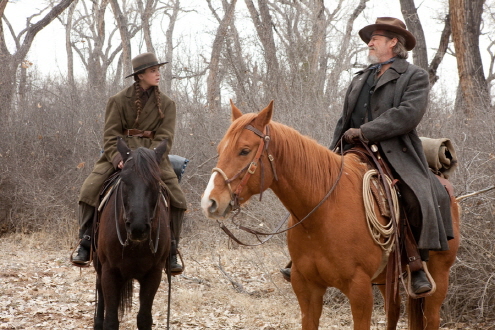
 The main accomplishment of the movie is that reminding us that, after all, the story belongs to Mattie Ross. Now a middle-aged spinster, Mattie tells us about how her hard journey in the past began through her opening narration. When she was a 14-year-old girl living with her family in their farm in Arkansas, her father went to Fort Smith for his business matter with one of his temporary employees Tom Chaney(Josh Brolin), who killed him when Mattie’s father tried to solve the dispute between Chaney and others over a card came at the bar. Chaney ran away from the town with her father’s gold pieces and horse, but none of the law enforcement officials in the town particularly cares about that because they already have lots of outlaws to deal with besides this petty criminal.

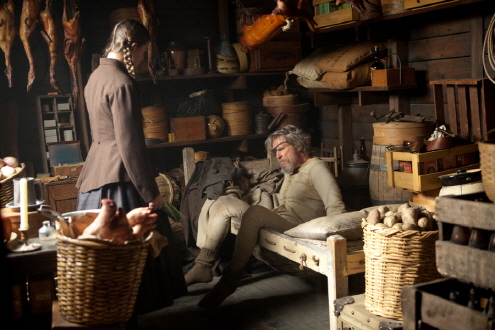
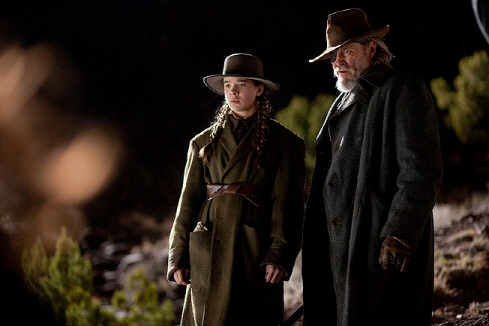
 Instead of her fragile mom, Mattie, played by Hailee Steinfeld, comes to Fort Smith to sort out the family business. She is young and small, but she has worked as a bookkeeper for her father, and she has a shrewd business mind as well as indomitable determination based on her strong religious faith. She firmly takes care of her business matter with the horse merchant who makes a serious mistake of underestimating her from her appearance. Also, for immediately bringing justice to Chaney, she chooses to hire a Deputy US marshal known as the most ruthless one among her options – Rooster Cogburn(Jeff Bridges). When we and she sees him for the first time, he is testifying at the witness stand during the trial for the latest criminal apprehended by him. It seems that the arrest was not a wholly clean process, but the ends usually justify the means in this gritty world in the 19th century.

 While accepting her offer, Cogburn does not like the idea of her going with him. He rather prefers to go with Laboeuf(Matt Damon), a Texas Ranger who is also interested in capturing Chaney for a different matter, to track down him in the Choctaw Indian territory where he hides along with the robbery gang led by “Lucky” Ned Pepper(Barry Pepper). However, Mattie is very determined about seeing their contract executed as promised and written, and Cogburn eventually accepts her, and they and Laboeuf begin their journey into the wilderness with potential dangers lurking in it. During this rough journey coupled with the conflicts between them, they begin to recognize each other while reaching for their common goal.

 Comparing the Coen brothers’ version and the 1969 version, you will see how much the western films have changed during more than 40 years. The 1969 version can be considered as an old-fashioned entertainment even with the standard of its era due to the rise of the revisionist western movies including the great movies such as “The Wild Bunch”, which incidentally came out in the same year. After going through temporary depression in the 1970s-80s and following recent rejuvenation, the western films nowadays have a different flavor; their world is harsher, grittier, and more realistic than before. Although less shocking and bloody than Coen brothers’ twisted thrillers, “True Grit” also has a fair amount of violence while showing the time when the survival sometimes is the first priority above all else and the mercy cannot be easily afforded(“Ground’s too hard. Them men wanted a decent burial, they should have got themselves killed in summer.”)

 The Coen brothers are masterful storytellers. With their economical storytelling, they provide tense moments along with some humorous interludes like Rooster and Mattie’s encounter with the man wearing bearskin. They have been always good at setting the impeccably realistic backgrounds as the genres they handle require, and they excel at that again. Though the director Henry Hathaway did a good job in the 1969 version, Fort Smith and the wilderness depicted in that movie looks like the theme park on a sunny day compared to the realistic visuals of the remake version. For example, compare the shack sequence in the 1969 version with that of 2010 version. The latter is more violent, darker, and colder in its looks(it happens at night instead of under daylight). We get the sense that people really get hurt in its harsh world, and and the Coen brothers have some twisted fun with that.

  The movie is quite impressive with its excellent production design and costumes, Carter Burwell’s memorable score mainly based on many traditional hymns including “Leaning on the Everlasting Arms”(too bad they do not have Best adapted score category at the Oscar any more), and the beautiful cinematography by Roger Dickens, who will probably, and finally, win an Oscar. It is almost crime that this great cinematographer has never won an Oscar while constantly getting nominated(he has been Oscar-nominated five times for the collaborations with the Coen brothers out of his nine nominations), and, for this time, he has a very good chance.

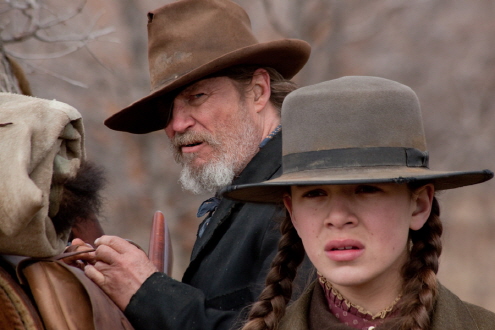
 The actors are uniformly good or excellent. Jeff Bridges was Oscar-nominated again for his role after his Oscar win for “Crazy Heart” in last year, and he definitely deserves that. While Wayne assimilated Rooster Cogburn into his quintessential star performance, Bridges, another kind of star actor, unassumingly immerses himself into Rooster Cogburn. With mumbling voice and shaggy appearance and potbelly, you cannot help but think of Jeff “The Dude” Lebowski on western mod. Nobody can replace The Duke, but, what the hell, The Dude also can be cool by shouting to the bad guys bravely: “Fill your hands, you son-of-bitch!”.

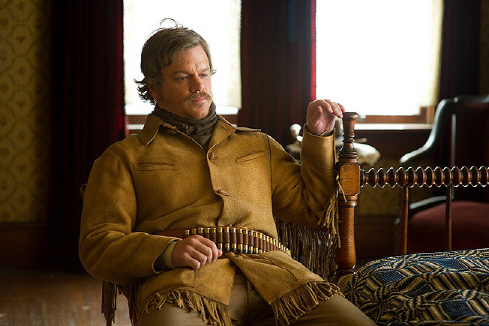
 The supporting actors are mostly better than their counterparts in the 1969 version. Matt Damon is curiously more restrained than Glen Campbell, but he ably supports his co-workers while taciturnly holding his place. Josh Brolin is both menacing and equally pathetic as a small-time outlaw. Barry Pepper is also good as a gang leader whose ragged face clearly shows the history of hard survival, while channeling some characteristics from Robert Duvall’s performance in the 1969 version.

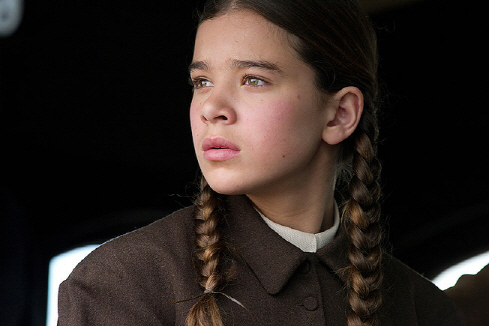
 And Hailee Steinfeld’s breakthrough performance is one of the best performances in last year. Although she was rewarded with Oscar nomination as a supporting actress, the movie belongs to her as much as Bridges. While surrounded by veteran actors, Steinfeld firmly holds the center and goes forward with confidence. Her acting is quite remarkable considering that the movie is her first feature movie(she was picked out of around 15000 applicants). In one scene, with her unflappable manner and no-nonsense mind, Mattie relentlessly corners the merchant with the common sense and logics and legal knowledge until he surrenders to her with no condition, and Steinfeld deftly delivers her lines while capturing wry, droll humor from her character’s prim attitude. Kim Darby was excellent in the 1969 version in spite of herself being around 20, but Steinfeld, as a child actor who is really 14, is far better and far more convincing as a strong-willed little girl who will not stop at nothing to see the justice done. She sees she is vulnerable in her world in the end, but she knows the lesson(“Nothing is free except the God’s grace”), and she never steps back with her strong belief. That is what Cogburn and Labeouf begin to respect, and, in exchange, she admits she initially misjudged them.

 The Coen brothers score big again, and I am sure they will come back from the horizon again – with another surprise, maybe. They are never boring. Along with the biggest box office success in their career, “True Grit” is welcomed quite well by the Academy awards, nominated in 10 categories including Best Picture(Thanks to its success, it will probably be released in South Korea in late February or early March). I am a little hesitant about calling it as one of their best films, but the movie has everything we demand from an excellent western film, and I have no complaint about that – this is the remake/western film of the year. The Coen brothers make a better adaptation than the 1969 version, and, unlike its predecessor, it stays true to the original novel with a bitter, haunting poignancy in its ending; this is the story alive in Mattie’s memory while everything is gone into the past. This time, you will remember Mattie more than before along with Rooster and others.

Posted in Movies | Tagged , , | 3 Comments

The Dresser (1983) ☆☆☆1/2(3.5/4) : About one backstage relationship

 It is always difficult to put a play on the stage. Actors and crews work hard amid many setbacks that can happen on and behind the stage. If they are lucky, they will survive today’s performance with descending curtain and some fulfillment. And then, they will have to struggle for another performance tomorrow with today’s performance faded into yesterday. It sounds gloomy, but people in “The Dresser”(1983) stick together and try to go on while believing they are accomplishing something in spite of their mundane reality in and out of theater. At one moment, one character confides to the other about her life spent on theater business: “No, I haven’t been happy. Yes, it’s been worth it.”

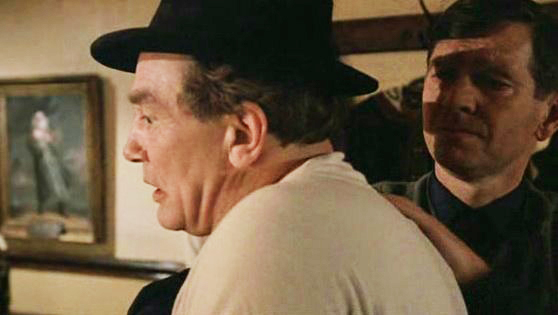
 Norman, played by Tom Courtenay, can also say like that if asked. It has been more than 15 years that he has worked as a devoted dresser for the manager/actor of some touring company. While attending on him, Norman is accustomed to do the multi-tasks including assisting his employer to prepare today’s performance. If his employer feels insecure and nervous before the performance, Norman is the one who cajoles and galvanizes him. Then, after the performance, he is ready with a glass of beer and bath for his employer. Like many enablers behind the enabled, Norman lives through his employer’s performance on the stage, and he privately prides himself on being the most helpful person to his employer as he endures every whim and anger from him. He is as loyal to his employer as Sam to Frodo or Smithers to Mr. Burns.

 The name of his employer, played by Albert Finney, is never identified throughout the story, but he is “Sir” to everyone in his touring company, and that name is even written on the plate on his dressing room door. It seems Sir was a respectable Shakespearean actor with the glorious past, considering a memorial plate for his Hamlet performance in the dressing room. We are not so sure about whether he really received a knighthood as his name suggests, but that is just a trivial matter. He has his company firmly under his control while leading his people around the provinces, and no one questions about his authority.

 But now his mind as well as his world is crumbling. It is the Britain during World War Ⅱ. The news about the air raids is heard from the radio. We hear later that one theater was actually destroyed during air raid. Most of young people are drafted to the army, so all actors Sir has are mostly aged performers. He frequently complains about their performances, but Sir himself is a big old ham, and, to make the matters worse, he is losing grips on reality with deteriorating health. The fact that Sir now has to play King Lear for the 227th times is quite ironic. Maybe he was too young to play King Lear before, but now he may be too real to play him – he is already living through that role with Norman as his Fool. He tears away his clothes and shouts aloud on the streets outside. He confuses with the roles to play tonight. He has trouble with remembering the first line. It becomes clear to others surrounding him that his remaining days are not so many.

 In spite of his problems, Sir is insistent about appearing on the stage for the show must go on. While others, including his wife and the stage manageress, have some reservation, Norman absolutely agrees with Sir. As usual, Norman supports him, motivates him, and indulges him while Sir’s temper unpredictably goes back and forth between pompousness and helplessness. As this dynamic interaction between them goes on, the things get started in and out of Sir’s dressing room. The other actors are preparing for their roles. The crews are checking the stage and props under the stage manageress’ supervision. The seats are being ready for the audiences to come. The show time has come at last, and everything is ready for Sir, but is he all right for coming out on the stage?

 The movie is based on a well-known stage play with the same name written by Ronald Harwood, who adapted his play for the film. Before his playwriter career, he worked as a dresser for the Shakespearean actor Sir Donald Wolfit(1902-1968), and his story was based on his experience during that period. Like the character inspired by him, Wolfit managed his touring company, which performed in London during World War 2, and he was also famous for his performances in Shakespeare plays, especially King Lear.

 According to some legends, Wolfit was not that different from Sir. While he was a good actor(He was memorable as Laurence Harvey’s possible future father-in-law in “Room at the Top”(1959)), he was also a tempestuous and tyrannical boss to others. Disliking being outshone by supporting actors, he always hired mediocre actors, and he drew criticisms for that and other several other reasons. Although he is regarded as one of the notable British stage actors during his time, some of his peers including Sir John Gielgud did not think highly of him(Gielgud: “We always regarded him as something of a joke.”). None the less, comparing Wolfit to Sir is more or less than comparing Anna Wintour to Miranda Priestly, and “The Dresser” was by no means Harwood’s roman à clef a la “The Devil Wears Prada”.

 Harwood’s story is an insightful drama about people revolving around the stage and their small, shabby world. Sometimes what happen backstage are far more interesting than what the audiences see on the stage, no matter how lousy or good the performance is. There are the human problems involved with vanity, insecurity, discontent, enmity, and so on. There is always nervousness among people before the curtain rises. They often quickly have to adjust to sudden changes or problems by such means like extemporization, while facing the grim possibility of something worse than a lousy performance. Amidst all these difficulties, they sometimes rise to the occasion, and it is really exhilarating to watch such a moment like when Norman and others work exhaustingly and exultantly together like “Band of Brothers” for creating the storm effect for Sir playing King Lear on the stage.

 Like many notable movies based on the stage play, the success of “The Dresser” depends on the performances, and the film is driven by a fabulous duo performance by Courtenay and Finney(they were Oscar-nominated for Best Actor). They look so different from each other on the screen that, while watching it, it is sometimes hard to believe that both actors started their respective movie careers as the members of promising young British actors during the 1960s. Finney began his career with a fiery performance as a young working class hero in “Saturday Night and Sunday Morning”(1960); Courtenay gave an unforgettable performance as a juvenile delinquent defiant to the authorities in “The Loneliness of The Long Distance Runner”(1962)(And both movies, coincidentally, were adapted from Alan Sillitoe’s works).

 Although he was around 40 at that time, Finney looks convincingly far more aged as a fascinating shell staggering on the line between vulnerability and arrogance. He is your average egomaniac artist who makes the lives of others hard and takes what he gets from others for granted. He is capable of showing some gratefulness, but that is only after he is overwhelmed by a sudden introspection triggered by his performance. Despite all these selfish and petty behaviors, we understand that Sir really needs help and we feel sorry for that. However, this stocky old ham has not lost all of his sound and fury yet, and Finney’s vigor goes at full throttle whenever it is required. There is a terrific scene at the train station where he shouts at a train that dares to leave without him with his loud, commanding voice: “STOP… THAT…. TRAIN!”

 Courtenay, who played Norman in the original play, complements Finney’s bravado with his typical sullen intensity coupled with nervous mannerism and quiet desperation. His performance is sometimes a little too dated and stereotypical at present, but it is still heartbreaking because, inside his exaggerated gestures, we eventually see a sad man who cannot imagine the life without his employer. Outside the theater, it is hard for Norman to live with his homosexuality, which is accepted in his world without mentioned much. Around that period, homosexuality was regarded as a criminal activity, and, even when actors gossip about their fellow actor recently jailed for that, they do not directly mention it.

  The director Peter Yates, who passed away in last month, is widely known for his other notable works like “Bullitt” and “Breaking Away”. The film is an actor’s movie belonged to Courtenay and Finney, but it should be mentioned that Yates provides the appropriate space and atmosphere for the story in an unobtrusive approach(he was rewarded with two Oscar nominations as director/producer). Faithful to its origin by focusing on the main background, the movie rarely feels stagy or stuffy. We are pulled into its small world while observing small details like wigs, makeup, and that funny superstition associated with “The Scottish Play”. The supporting actors surrounding Courtenay and Finney including Eileen Atkins, Edward Fox, and Michael Gough are also good as the people of this world. Unlike his bombastic score for “Krull”, a disastrous SF movie directed by Yates in the same year, James Horner composed a sparse, somber score right for the film’s gloomy mood(On sidenote: during the makeup scene, his music interestingly foreshadows the quiet part of his classic score for “Apollo 13”).

 “The Dresser” is a very good stage play adaptation with a sad, poignant story about one symbiotic relationship between two miserable characters. It is funny because it honestly reveals how pathetic and silly they are; it is also moving because it sincerely shows how serious and desperate they struggle. Poor Norman. He knows about how their relationship works, but he has been blind to why it works. When the moment of truth inevitably comes upon him, alas, it is already too late for him. “What about me!?”

Posted in Movies | Tagged , , , , | 1 Comment

2011/02/03

Photos taken on Chinese New Year Day.

I went to the neighbourhood that I lived during 1991-1993. Things has changed a lot except few things such as the mosque I used to see from the distance.

Posted in Photos | Tagged | Leave a comment

The Town (2010) ☆☆☆ (3/4) : A good crime drama in their rough town

 On the whole, “The Town” works effectively as a crime drama despite some weaknesses. Although the movie turns out to be less successful than it wants to be, it works in most parts because the characters and their world are interesting enough to hold our attention. Actually, they are interesting enough to make the action sequences more like obligatory chapters – or showy wrapping papers for a good standard product of its genre. I do not think drama and action are meshed well in the film, but the movie is engaging when it focuses on its characters.

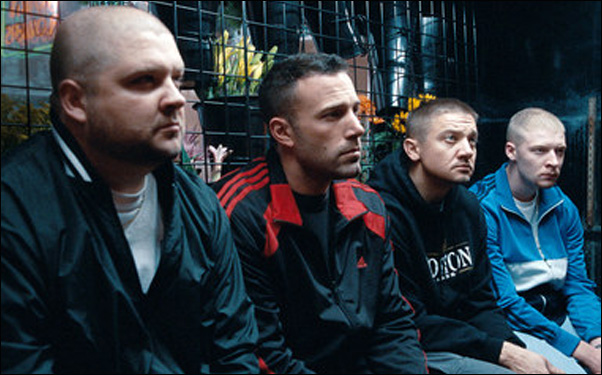
  Ben Affleck plays Doug MacRay, a professional criminal living in blue-collar Boston neighborhood named Charlestown, which, according to the movie, “has produced more bank robbers and armored car thieves than anywhere in the world”(I heard that this area has been much more gentrified now than before). The criminal trades are frequently handed over from fathers to sons, and Doug is no exception; Doug’s father, now incarcerated in the state prison, was a bank robber, and Doug also robs banks or attacks armored trucks with his accomplices. With his meticulous plan, they quickly finish their business and run away immediately without leaving their traces.

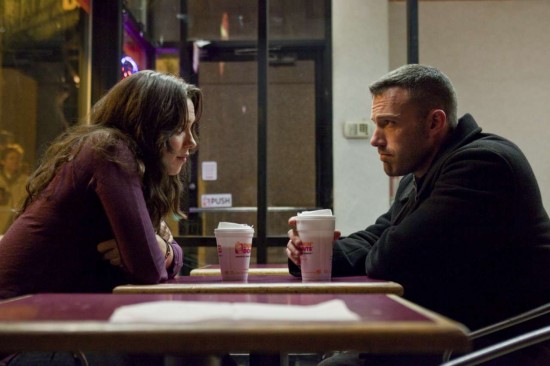
 In the opening sequence, an unexpected trouble happens during their efficient execution of bank robbery. The silent alarm is activated earlier than they predicted, and, on their hasty escape, they take a hostage – a young assistant manager named Claire(Rebecca Hall). Fortunately for her and them, there is no further trouble after that, and she is soon released without knowing anything substantial about her captors except one trivial thing(She was blindfolded). However, after knowing that she lives in their neighborhood, they have reasonable worry about her. So, for checking any possibility of danger to him and others, Doug approaches to her while hiding his identity.

 While getting intimated with Claire, Doug confirms that she is not a dangerous witness to them, but the situation gets more complicated due to their growing relationship. Traumatized by her experience, Claire sees him as someone she can lean on. Having been tired of his criminal life, Doug sees her as someone with whom he wants to get out of his criminal world. However, if you are familiar with crime movies, you know that things will not go easily for them. On one side, there is an FBI agent Adam Frawley(John Hamm) who recently grasps on Doug’s crew and are determined to catch them on the spot. He also keeps in touch with Claire, so it is a matter of time before he discovers the relationship between Claire and Doug. On the other side, there are Doug’s volatile friend/accomplice Jem(Jeremy Renner) and their boss Fergie(late Pete Postlethwaite), who do not welcome Doug’s desire to quit from his profession. And new jobs for Doug’s crew are coming.

 With the screenplay adapted from Chuck Hogan’s novel “Prince of Thieves” by him and others, Affleck proves again that he is a competent director. Considering his previous work “Gone Baby Gone”, it is not so surprising that the movie has authentic presentation of Boston neighbourhood; he is familiar and comfortable with the setting he deals with. There are several action sequences in the film, and they are assuredly handled well with enough tension and urgency.

 However, there is the lack of synergy between drama and action. The characters are compelling enough to carry a familiar plot alone, but, interrupted by actions, their story is developed in hurried pace as a result. Although I admit that the action sequences are exciting, I also find that they do not fit well with the realistic environment built on the screen; they would have looked more natural if they had been in a standard action movie. In addition, I seriously have some doubt about the proportion between the number of shootings and that of casualties in the movie.

 None the less, the movie does not entirely fail with what it intends to do. Although the movie brings nothing new to its genre, Affleck deals with its melodramatic story in dry, calm approach, and that mostly works. While the movie could have shown more about it, Charlestown is still an interesting background in the film – it becomes its own character. The drama between characters is the film’s strongest point, and that is why the most effective scene in the film does not involve with shootings or car chases. It has three people who must not be together in one place, and the suspense is subtly increased below the screen while only one of them is aware of possible danger.

Affleck has the cast as good as he can get. He gives an adequate lead performance while maintaining a warm, laid-back chemistry with Rebecca Hall. Jon Hamm is as dashingly persuasive as Don Draper, and he has nice scenes with Blake Lively, who plays Jem’s sister Krista. Pete Postlethwaite and Chris Cooper(he plays Doug’s father) make big impression in their brief appearances. Finally, there is Jeremy Renner who was recently Oscar-nominated for his volatile performance. Right after his breakthrough performance in “The Hurt Locker”, Renner plays another intense character addicted to what he is good at, and, thanks to Renner’s intensity, you instantly know his compulsive character is always looking for the chance to do something violent and dangerous. This is someone you don’t want to be near, but, unfortunately for Doug, Jem clings to him in the name of friendship.

 The movie is overrated by some, and it is also unfairly underrated by South Korean critics when it was released in last month. Although I do not think the movie is one of best films in 2010 as some argues, I enjoyed the film and its several good aspects. The movie certainly does not reach to the level of Michael Mann’s “Heat”, but Affleck does a skillful job with his material. In spite of flawed mix between drama and action, it respects the characters at least and I liked that.

 Footnote: I recently saw Director’s cut, 28 minutes longer than the theatrical version, and, while added 28 minutes does not make much difference, the movie is a little better than before. Thanks to extended or inserted scenes, the characters are given more space, and their developments are progressed in more leisured pace. But I also found the Director’s cut a little too long. In conclusion, I think you will not lose much if you decide to stick to the theatrical version.

Posted in Movies | Tagged , , , , | 1 Comment

I Am Love (2009) ☆☆☆1/2(3.5/4) : When she discovers her desire to be happy


 “I Am Love” tells us the story we have heard countless times from many tales – from literature books to your average trashy soap drama on TV. After having been living as someone more or less than a component of her comfortable world, she suddenly finds something she passionately wants – something that is acceptable to some degrees but is not inappropriate to be revealed to the people she has lived with for a long time. Maybe she has some second thought about it after her realization, but, folks, have you ever heard of anyone who can stop his/her heart when it truly wants to be happy?

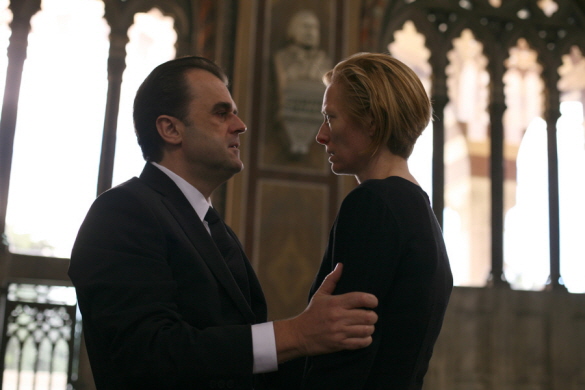
 When we first meet Emma Recchi, played by Tilda Swinton, it is quite apparent to us that she is an outsider among her people because of her Russian accent. A long time ago, she met her Italian husband Tancredi Recchi(Pippo Delbono) through her father, a restoration expert, in Russia, and, after his proposal and following wedding, she came to Milan with Tancredi and has lived there since without going back to her country.

 Although the relationship between Emma and her blunt, aesthetic husband is based on formality rather than love, the life in his house has been not bad to her. She has three children who love her. The other family members have accepted her as one of them. And all of them live without any particular trouble from outside while immersed in the sumptuousness reminiscent of Luchino Visconti’s exquisite movies. Thanks to their family business, a very respectable textile company well known even outside Italy, they live in quite a comfortable and expensive modern manor while wearing the nice-looking costumes by Antonella Cannarozzi, who is recently Oscar-nominated for this movie. As many critics have pointed out, it must not be a coincidence that the name of Emma’s husband is Tancredi, one of central characters in Visconti’s great movie “The Leopard”.

 That unforgettably elegiac masterpiece is about the transition between generations coupled with inevitable deteriorations and changes, and so is “I Am Love”. After the beautiful opening scene showing the quiet streets of Milan on one winter day with agitatedly repeated rhythms of John Adams’ score, we see the family meeting being prepared in the manor. It is the birthday dinner for her father-in-law, and, as a hostess, Emma checks several things including the table arrangement while going around the house.

 Her father-in-law, Edoardo Sr.(Gabriele Ferzetti), has run the family business for many years. He hopes the empire he has built to reign forever, and, knowing that his time is near, he announces his decision at the middle of the birthday dinner. He will retire from his work and will soon hand over his position to his son. And Edoardo Jr.(Flavio Parenti), his grandson and Emma’s first son, will be No.2 of the company. Few months after, as he wishes, the company is run by Tancredi and Edoardo after Edoardo Sr.’s death.

 But the future of his company and the Recchis will be not as he has wanted – or he has ever imagined. Tancredi has different ideas about how to take care of the family business. Edoardo does not like it because he knows his grandfather would not have approved it, but he is more interested in the restaurant business he is planning with his chef friend. In case of Elisabetta(Alba Rohrwacher), Emma’s lovely daughter, she finds that she is a lesbian while attending an art school in London. Emma discovers her daughter’s sexuality by accident, and her daughter comes out to her mother without much hesitation. From her daughter who actively pursues for her own happiness, Emma begins to see the desire for happiness inside her. Confined in a comfortable world with little to complain about, she has been content with her role in the Recchis, but now, the desire is awakened and begins to grow. 

  Not long after that, the fate finds a right object for her yearning, and it is none other than Antonio(Edoardo Gabbriellini), Edoardo’s chef friend whose excellent professional skill gives us one of the most electrifying scenes associated with certain sensory neurons I have seen recently. Except background dialogues, there is almost no word, but what Emma feels is evidently conveyed to us. It is quite enthralling, and you’ve got to see it for yourself. You will be wholly convinced that it must be like heaven for her.

 Emma finds herself drawn to Antonio after that epiphanic moment. One day, when she goes to Sanremo to see her daughter, she sees him while walking around the streets. Soon, she hesitatingly follows him without noticed by him. Eventually, she goes to his restaurant outside the city with him. It is the quiet, bucolic country on a sunny day, and they are alone, and….

  I don’t have to tell you what happens next or what consequences will be waiting for them and the people surrounding them for the story is quite familiar from the beginning. The director/co-writer Luca Guadagnino fills this typical story with arrestingly beautiful moments with delicate precision, and the movie is great to look at. While courteously following that sumptuous style of Visconti’s movies, Guadagnino infuses his own sensitive style into his film. There several scenes where what characters feels or realizes are captured and delivered accurately to our eyes even without many dialogues. In addition, the characters are not only nicely dressed but also very interesting characters with intriguing interactions between them. Tancredi is not a lousy husband, but his attitude to his wife is as loving as his feeling to the artworks he collects. It is implied but never said that Edoardo has certain personal motives for pushing his private business with his friend, and that complicates the situation more later. And we also have distant but generous mother-in-law(Marisa Berenson), and a middle-aged maid named Ida(Maria Paiato), who turns out to be more devoted than we thought.

 And everything is supported by Tilda Swinton’s another knockout performance which is sadly not Oscar-nominated for Best Actress in this year. Swinton has been continuously an interesting actress, and, even after winning the Academy Award for her neurotic supporting turn in “Michael Clayton”(2007), she keeps giving us stellar performances from challenging roles. For example, in “Julia”(2008), she dashed into a very unlikable character many actresses would have hesitated to accept, and she succeeded with one of best performances in her career.

 “I Am Love” provides another challenging role to Swinton, and, again, her performance is nearly flawless in many aspects. She masterfully plays the character who has been assimilated into the world that was foreign to her at first time, and her delivery of Italian dialogues with Russian accent is so natural that it draws our attention as little as the characters’ in the movie. Swinton is also very good at embodying thoughts and emotions without showing them off. We always know what she feels throughout the movie while guided by John Adams’ wonderful score, which is mostly based on his previous works.

  The movie is a fabulous visual experience with terrific lead performance by Swinton as its heart. A stylishly and melodramatically overblown finale with equally bombastic music never feels out of place because of that. And beneath its impressive style and atmosphere, it understands the inner working of human hearts. Even when they are conscious of what is going on inside themselves, people are helplessly swept by what they feel for their heart like to be happy. Well, who can stop that? It’s as unstoppable as the nature.

  Footnote: The film was released in South Korea in last weekend. I heard that the video quality was quite crude due to the local distribution company’s blunder. I saw the movie in HD last year, so I know how damaging that problem will be for enjoying it. As one of critics said, let’s hope they will release the movie on Blu-ray.

Posted in Movies | Tagged , , , | 2 Comments

Winter’s Bone (2010) ☆☆☆1/2(3.5/4) : Her desperate determination in cold, harsh world

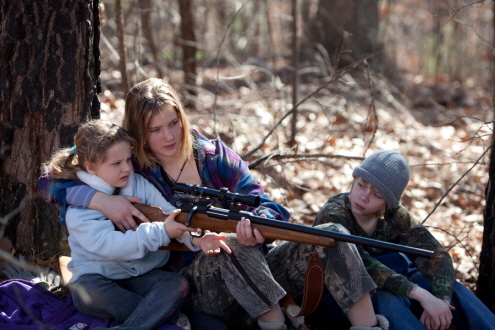
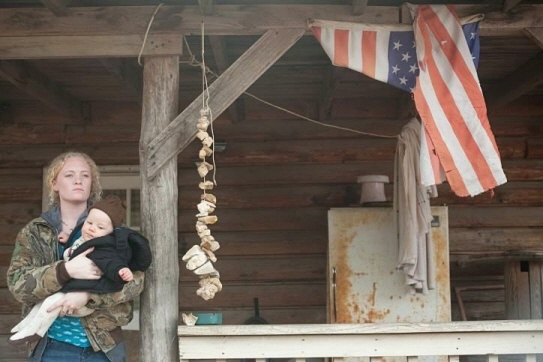
 Although its story is driven by a mystery surrounding certain missing person, the mystery only serves as a trigger for something far more than itself in “Winter’s Bone”. While we follow its heroine’s plight and wait for the answer to that mystery to come out, a harsh world that frustrates its heroine relentlessly for many reasons is unfolded in front of our eyes along with her desperate but strong determination against this despairing world. Despite its slow pace, the movie has the atmosphere shrouded in subtle tension with good performances to engage us into the story, and, when the tension is no longer at atmospheric level at certain moments, we find ourselves fear for her.

 A 17-year-old-girl Ree Dolly(Jennifer Lawrence) lives in some rural town in the Ozark mountains of southern Missouri. She has already been leading hard daily life when her latest trouble appears. Her mother is ill, and her younger sister and brother are still too young and innocent to take care of themselves, so she has been laboriously taking care of her family instead of her absent father Jessup, who has been known a lot around the neighbourhood for his criminal activities including cooking methamphetamine. It is not a big deal to her or others because, like her father, many of her neighbors are involved in crimes in one way or others.

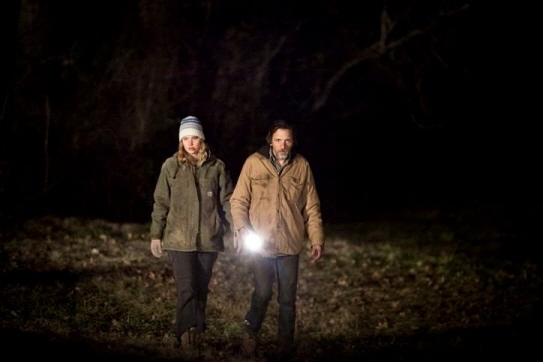
 One day, the town sheriff visits Ree’s house and he gives her a bad news. Her father recently put their house at collateral bail to get out of jail, and it seems he will probably not show up at the court date. After a week, Ree’s family will be evicted out of their house with nowhere else to live if her father does not turn himself in. Ree goes around asking people who may know or have clues about his whereabouts, but there is little success. As time goes by, it is getting apparent that her father is possibly dead, but, if that so, she still needs to find him for keeping their house. The time is getting short, and she is desperate, and people who probably can help her, including her drug-addicted uncle Teardrop(John Hawkes), does not seem to be willing to do that for their personal reasons. She mostly gets unkind responses from them with hostility.

 Through her journey, a small, tightly-knitted community where everybody is somebody’s cousin is shown to us. If you do or say something, the words can be spread out quickly in this neighbourhood. Some characters in the movie likely know about the answer Ree seeks, but they do not trust her even though she is related to them. Although they may understand she needs help, they are more concerned about their circumstances and family loyalty. As one character says offscreen, “talking just causes the witnesses”, and they do not want to risk their unstable position due to illegal activities. And they are willing to do anything for protecting their standings; that puts Ree in a very precarious situation as warned by her uncle and others.

 The movie was first shown at the Sundance Film Festival in last January(it got two awards including Grand Jury prize), and then it was shown later in US theaters in last June. Like many other countries, overseas independent motion pictures usually arrive late in South Korea(For example, “Junebug” took two years to get released here, and “Frozen River” is still not released except in several local film festivals), so I did not particularly expect “Winter’s Bone” to be released soon in South Korea. However, my prediction turned out to be wrong delightfully. Maybe because of recent Oscar buzz surrounding the film along with US critics’ enthusiastic responses, the movie is released in South Korean theaters in this weekend – limited release as I predicted, but quite earlier than I had expected.

 And what a good timing it is. Our South Korean audiences experienced the bleak world of “The Road”, an excellent gloomy film based on Cormac McCarthy’s novel in last January, and now, after a year in the same month with colder winter weather, we get another movie filled with bleak beauty evocative of that movie. Shot on the real locations, the film has authentic mood. I was not familiar with the Ozarks, but, like any good movies that transport us into the real worlds alien to us, I could instinctively sense that the movie showed a real world to me.

 There is a certain sense of familiar hopelessness pervading its scenes. I am sure it is the 21th century (or near it) in the story, but this place looks like having unaffected by the influences from outside. They have cars, electricity, and a school, and a police station, but it is hard to find any sign of modern technology. Under the cold, gloomy weather, the woods around the town are shown from time to time to accentuate the desolate condition of this place. Useless objects are scattered around here and there with no one to use them. And it is hard for Ree’s family to get the food. Because it is not season for deers, Ree shot a couple of squirrels instead and later we see her teaching her younger brother and sister how to skin them.

 While learning how to remove guts from her, her brother asks, “Do we have to eat it?” Ree plainly replies: “Not yet”. Based on Daniel Woodrell’s novel, the director Debra Granik and the co-writer Anne Rosellini create a sad, honest story with no ostentation. Like Ree’s reply mentioned above, the characters’ situations, thoughts and feelings are conveyed through short, plain words. Despite tons of hardships and following desperation burdened on its heroine, there is no such a thing like showy melodramatic moment in the movie. Even in the most perilous situation, there is only her exhausting will talking quietly to others who have even thought about killing her for poking around them.

 While the relationships between characters are not clearly explained and it is sometimes a little confusing to describe them, Granik and Rosellini compensate that flaw by filling their story with vivid characterization. Thanks to the wonderful cast, you can instantly accept that people in the movie have been through hardships for years and years while living there from tired, wrinkled faces. In their world, kindness is not something they can accomodate easily.

 Already nominated for Best Actress award at Golden Globe awards and Screen Actors Guild awards of this year with lots of praises from critics and bright future in her career, it is almost certain that Jennifer Lawrence will be Oscar-nominated for Best Actress for her breakthrough performance in this movie. She is very realistically convincing as a ordinary but remarkable teenager girl who struggles to keep her and her family’s life going in her bleak world. She rarely raises her voice, and she says not much, but her overflowing desperation and exhaustion can be glimpsed inside her calm face. None the less, Ree has lost none of her will – and her belief in the basic decency of people surrounding her. At one point, she says to her brother, “Never ask for what ought to be offered.” That is how she gets help from others while keeping basic dignity.

 The supporting actors are as good as Lawrence. John Hawkes, who can be a surprise Oscar nominee on next Tuesday, is excellent as a conflicted man capable of showing both heartlessness and compassion to his niece. I fondly remember Dale Dickey as one of hilarious caricatures in TV series “My Name Is Earl”, but she shows quite different side to me with her realistic performance in this movie. Her character can be quite ruthless when she thinks she has to do something to deal with the situation, but she also can be compassionate. There are some unanswered questions, and one of them is whether she makes a certain decision for herself or is allowed to do that.

 After watching the film, I wondered whether cold, sad, lonely independent movies about desperate people were becoming a genre of their own, or cliche of their own. But I won’t mind as long as they have good stories to tell with good characters, and “Winter’s Bone” is one of them. We know that Ree will eventually get what she wants to know for it is a familiar story to us, but the movie holds our attentions with calm tension, and we attentively observe her struggling through difficult situation. The world surrounding her is dangerous and hostile, and she knows that well, but she persistently tries even if there is little she can do. In the end, there are some unsolved things left in the story, but that does not matter to us for the movie works as something more than thriller while being a functional thriller. And we are certain that she will go on – no matter what happens next after another frustrating chapter of her difficult life.

Posted in Movies | Tagged , , , , , , | 4 Comments