Leaves of Grass (2009) ☆☆☆(3/4) : Crime and Philosophy – and also Marijuana

 As far as I know, “a mixed bad” is a negative expression, but I think that is an appropriately positive one in case of “Leaves of Grass”(2009) for its seemingly disjointed combination of crime story and philosophy. The movie throws such discrepant stuffs into its plot that they can actually make a good shopping list: Latin, marijuana, Socrates, crossbow, poetry, bong, Heidegger, family, catfish, Whitman, parallel lines, menorah, swastika, murder, and so on.

 It sounds like a mess, but the film manages to mix them together, and the end product is somehow eclectic in an offbeat way. Sometimes there are profound moments to intrigue us, and then there are absurd ones to tickle us, and then there are sudden bursts of violence that jolt us. The movie freely goes between them as it wants. Some of you may be flabbergasted by its frequent shift of tones along its wacky plot.

 My initial response was not so different from that when I watched it in last year. I found it charming none the less, and, when I revisited it later, I found it still weirdly charming. The plot is dopey, and sometimes jarring, but the movie follows it rather well. It is balanced nicely between seriousness and goofiness, and, from its well-defined characters, it generates small, enjoyable moments I come to cherish mildly now. Even its hurried conclusion in the third act has an amusing irony considering how the trouble is initiated for one of its two heroes.

 

 His name is Bill Kincaid(Edward Norton), an Ivy League classical philosophy professor teaching at Brown university in Providence, Rhode Island. He is near the highpoint in his career as a scholar. His lecture is popular among students at the campus. Some female student is so smitten with him that she is willing to offer the pleasure to him carnally as well as intellectually to his dismay. People at the Harvard law school also like him very much. They even consider establishing the new department to recruit him. In addition, his recent paper is published in the American Philosophy Journal.

 And then past he put behind a long time ago suddenly calls upon him. He was from Little Dixie, Oklahoma, and he has been estranged from his “eccentric” family since he left his hometown. As the twin brother of Brady(he is also played by Norton), Bill takes a plane to Oklahoma immediately after the urgent message about Brady is delivered to him.

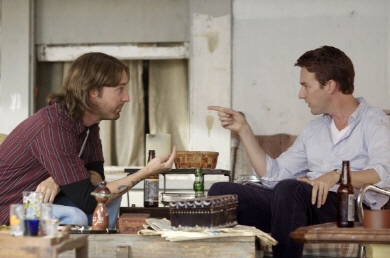
 However, that message is the first step of his ex-con brother’s shaky scheme to solve the current problem of his. Brady is a illegal marijuana cultivator, and he needs his brother’s little help for resolving the conflict between him and the local drug dealer Pug Rothbaum(Richard Dreyfuss). Brady’s girlfriend Colleen(Melanie Lynskey) will soon have a baby, so he wants to get out of this inconvenient situation as soon as possible. All he asks Bill to do is that Bill acts as Brady for some time while Brady and his friend/accomplice Bolger(Tim Blake Nelson) visits Pug in Tucson for settlement.
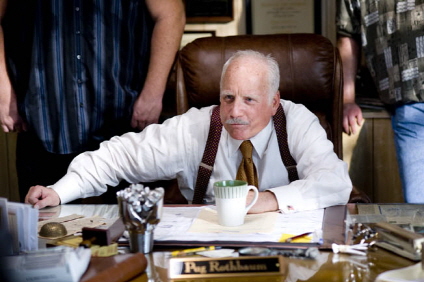
 

Because the film is a crime comedy reminiscent of the Coen brother’s convoluted comic plots, it is easy for us to predict that this plan will not work as they hope. The things get complicated with shocks and absurdities, but the movie takes its time in a relaxed mode. Several interesting moments between the characters come along the plot. They reveal more about not only Bill and Brady but also other colorful supporting characters surrounding them.

 Above all, Brady is a lot more than what he seems to be on the surface. As his brother says later, he is indeed a “colossal f*ckup” who is frequently incorrect with grammars and needs the Webster dictionary to understand what his brother writes, but he is as clever as brother. Not only he does a first-class plant breeding for his illegal product, he also devises and builds an impressive hydroponic system for the greenhouse. And he has some artistic taste in case of decorating his bedroom, although it is not for everyone(including me).


 Personally, I find the one scene particularly amusing. In that scene, the brothers have some short talk about one of Bill’s papers. While admitting he does not understand all, Brady makes a coarse but succinctly insightful comment: “You all hardly ever write about topics. You write about what some other fella wrote about the topic.” When I once took Philosophy 101 during sophomore year, a young unorthodox lecturer told us about such an aspect of South Korean philosophy academia. I guess that tendency is universal around the world.

 But the movie also respects Bill, though many laughs come from his reactions to the incidents happening around him. While growing up with his brother under the parents who immersed themselves in the counterculture in the 1960s, Bill desired the guidance for his life unlike his brother. That is probably why he chose to study philosophy – to find the way to live with a purposeful measure of control amid the randomness of the world. He also chose to distance himself from the family. He changed his accent for being assimilated into his academic world.

 He says in his lecture that the balance needed for a happy life is illusionary. He emphasizes to his students that the life can be screwed suddenly. But he experiences his knowledge in a hard way. Once he thinks his life is in control, the things keep getting out of his control. He can’t believe his eyes when the man he incidentally met before suddenly comes into already complicated situation later. Even when he tries to apply a good advice to the real world, the result is far from what he expects.
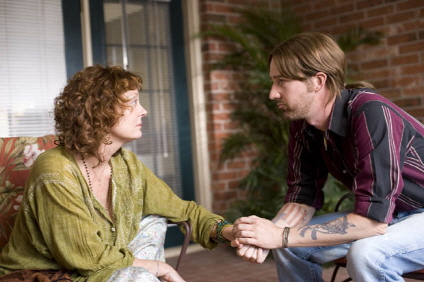
 As the twins that cannot be more different from each other, Edward Norton gives terrific duo performances. It is relatively easy to put two characters played by one actor together on the screen in these days, but the success ultimately depends on the characterization and synergy, and Norton neatly accomplishes his task. While creating the distinctive characters, he also reminds us that they are biologically based on the same genetic makeup. The chemistry between his performances is entertaining enough to forget to detect several techniques for having them together on the screen.

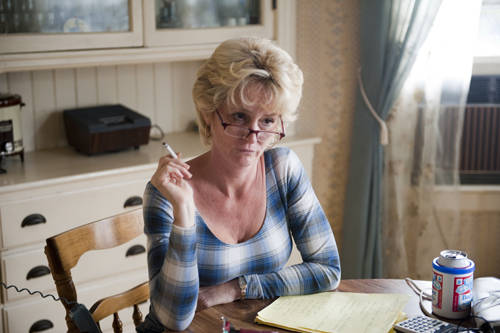
 The supporting actors including the director/writer Tim Blake Nelson are the other factors that contribute to the film’s quirky charm. Keri Russell is warm as a high school teacher/poet to whom Bill is quickly closer within a day, and so is Melanie Lynskey. Her role is small, but you can understand what Brady sees from her. Richard Dreyfuss obnoxiously but effectively chews his single scene as a pugnacious dealer, and Susan Sarandon gives a short but juicy performance as Bill and Brady’s mom who enjoys the life at retirement home in spite of being at least 12 years younger than other occupants. She seems to smoke marijuana as before, but she is a non-nonsense mom to her grown-up sons in spite of that.

 

 Nelson is more familiar to most of us as a reliable supporting actor, but he is also a good director and playwright. While active in his acting career, he has made few but good films, including “O”(2001), an interesting hybrid of Shakespeare tragedy and modern American high school drama, and “The Grey Zone”(2001), a chilling World War II drama about the people forced to deal with the impossible situation for a very slight chance of survival at the Auschwitz concentration camp.

“Leaves of Grass”, his fourth movie, is more lighthearted than his previous works. Nelson was born and raised in Oklahoma, and the movie’s background has considerable authenticity. He also incorporated the small Jewish community of Oklahoma as a crucial part of the story; that makes his movie look like a distant Okie cousin of the Coen Brothers’ “A Serious Man”(2009), another funny story about the university professor who suddenly finds himself in deep trouble.

The film reaches to seriousness from time to time in surprising ways. Bill’s lecture at the opening scene is quite engaging to hear even if you are not familiar with the metaphysical knowledge. Although I am a guy who is a lot closer to its formal opposite, physical science(When someone says a movie has philosophies, I usually ask what the hell it means), I can say we rarely come across such a lecture like that in the movies – it is really about something.

 Later in the story, Bill visits Rabbi Zimmerman(Maggie Siff) for some important matter. When he expresses his confusion, she succinctly points out to him the main cause of the problems in our world. We are intelligent organisms, but we are far from being perfect. We are still biologically animals, and, while trying to solve our problems, we overlook that fact sometimes. Like some characters desperately attempting to solve their own problems in the film, we mess up matters and ultimately contribute to the chaos in the world. We naturally want to find some orders or rules to be relied on, but the chaos continues to reign thanks to us. Maybe it is better to accept the randomness in the world because you cannot prevent it no matter how you try to prepare and control. And help repair the world with others, above all.

 “Leaves of Grass” is a good film with smart sides to interest us. I have to admit that it is probably an acquired taste for some audiences, but it is worthwhile to try it at least once. In the middle of movie, there is the conversation between two characters in the car. It is just a casual talk, but it is interesting enough to induce some thoughts. Good philosophical conversation is never hard to understand even though you cannot completely get it.
Posted in Movies | Tagged , , , , , , , , , , , , , , | 3 Comments

Jane Eyre (2011) ☆☆☆(3/4) : Another nice adaptation of a classic gothic romance

 The sky is gray with darkened clouds. The forest is shrouded in creepy fog. The wind is mercilessly blowing on the barren moor. And there is a huge, ominous mansion owned by the unpleasant man who has the equally unpleasant secret hidden inside somewhere in the house. And our young heroine comes to this brooding mansion to find herself attracted to her employer who is definitely someone who must be approached with a certain degree of tactfulness.

 Charlotte Brontë’s classic gothic novel has been loved by many, has been imitated by many including that pathetically cheap imitation called “Twilight”, and, above all, has been adapted for many, many movies and TV miniseries since the 1910s according to IMDB. In the advertizing leaflet printed in South Korea, they say “Jane Eyre” (2011), the latest version directed by Cary Fukunaga, is the 21th adaptation, but IMDB say it’s the 20th adaptation. With so many versions, such a mistake can be forgiven.

 Like its many predecessors we have seen before, the latest version follows the basic plot of the novel except some notable changes(To be frank with you, I have seen only two versions: 1943 version starring Orson Welles and Joan Fontaine and the 1996 version starring William Hurt and Charlotte Gainsbourg). As an orphan, young Jane Eyre(Amelia Clarkson) had a hard time at the house of her mean aunt(Sally Hawkins). Her aunt hated her, and so did Jane. She was sent to the harsh boarding school worthy of a Dickens novel, where she would spend most of her childhood and adolescence under the sadistic supervision by Mr. Brocklehurst(Simon McBurney), who did not like Jane’s defiant attitude from the first time they met each other.

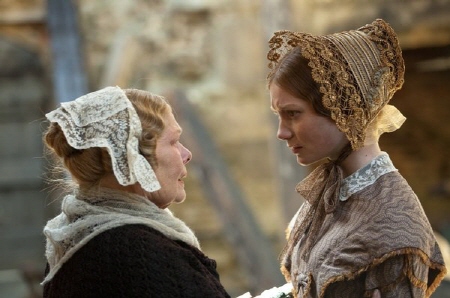
Soon we meet adult Jane, now played by Mia Wasikowska. Although she is alone in the world outside the school as before, she is willing to lead her life despite her inexperience. She is hired as a governess at Thornfield Hall, the huge mansion where she teaches a young French girl named Adele(Romy Settbon Moore). The house environment is not exactly sunny, but Adele is a likable girl, and the housekeeper Mrs. Fairfax(Judy Dench) is kind to Jane.

 She does not meet her employer, Mr. Rochester(Michael Fassbender), on her first day at Thornfield Hall, for he is usually not in his house. Some time later, he returns to his house, and, after their accidental meeting in the foggy forest and the following formal meeting at his brooding private place, the mutual feelings are generated in the hearts of both. However, bound by the customs and conventions of that time, both hesitate to reveal their feelings. In addition, strange things happen at night. There is something disturbing hidden in the mansion – something so shameful that Rochester chooses to do the wrong thing to Jane for maintaining his position as a gentleman rather than reveals his secret to her.

 The screenplay writer Moira Buffini makes some deletions and changes in her adaptation. Her modifications work well in most cases. One of the notable changes in the film compared to other versions is that Jane’s childhood is more condensed through flashback. As a result, the film has relatively less power compared to other versions in that part(for instance, 1996 version, regarded by many as one of the weaker versions, was memorable with Anna Paquin as Young Jane), but it proceeds more quickly into the main plot instead, while pointing out well how hypocritically sadistic some people were at that time.

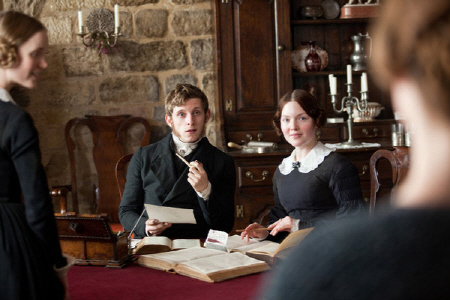
 And there is notable improvement with Jane’s story with the pastor named St. John Rivers(Jamie Bell), who saves her in the opening scene where she wanders around the forest and the moor against harsh weather in quite a distressed state. St. John Rivers part has been always like the baggage that must be dealt with for the adapters, but Buffini uses Rivers as a tool to emphasize the feministic point Brontë indirectly made in her novel. In the movie, Rivers is a kind man, but his views on women and marriage is as conservative as the conventions at that time, and Jane will not agree to his opinion as a woman who wants to lead her life independently. If she marries someone, that is because she chooses him, not because she follows him.

 The director Cary Fukunaga’s previous work(and also his first work) was “Sin Nombre”, a sad, gritty drama about the illegal immigrants who try to cross US-Mexico border at all costs. The world and the characters are much, much different in “Jane Eyre”, but Fukunaga knows about the hidden emotions causing the characters drawn to each other, as shown in his previous movie. And he is a talented director. In rather restrained approach, he lets the good production design, the good costumes, and the good actors to tell the story while maintaining that familiar atmosphere of gothic romance. Even when warm spring comes to Thornfield Hall with sunshine and clear sky, there is always grayness in the screen.

 Again, some of you probably complain that Mia Wasikowska’s Jane Eyre is not as plain as described in the books, but, what the hell, has Jane Eyre ever been that plain on the screen and TV? Quite different from her previous appearance in “Alice in the Wonderland” and “The Kids Are All Right” in last year, Waskiowska, 21 at present, is natural as a young, intelligent woman on the verge of adulthood. She makes the maturation of her character very believable, and the chemistry between her and Michael Fassbender is low-key but appropriate for the film’s atmosphere.

 Fassbender is as handsome as the other versions of Mr. Rochester we have seen, but he is brooding and callous enough to be a sullen man who is, in objective view, a liar and cad who deeply hurts Jane’s heart(we get a pretty much good idea about who Adele is in one scene, by the way). As Mrs. Fairfax advises to Jane, it is rather wise to maintain some distance from such a man. Judy Dench is also good as a prudent housekeeper; she does not say everything, but we know she knows everything happening in the house.

 Will there be more Jane Eyre movies? I think so, for Fukunaga’s version is not an ultimate version due to several flaws deemed to be inevitable in the adaptation process. Sometimes the movie feels like a summarized version of the book from time to time, and you will be a little disappointed if you expect it to be a passionate melodrama. None the less, this is surely one of the better end products we can get from the classic gothic romance novel.

Posted in Movies | Tagged , , , , | Leave a comment

Hanna (2011) ☆☆☆(3/4) : Her first field trip in the world

  Rarely do I come across the action movies that work as something else while working well as a well-made one. When I realize that I am watching such a movie, I get more interested in it than those bland, tasteless ones papered with crashes and bangs. “Hanna” is certainly not the first movie that juxtaposes the plot of standard action thriller movies with the fairy tale elements(Wayne Kramer’s “Running Scared”(2006) first comes to my mind), but this slick movie has the style and confidence to engage us into its storyline, and it is supported by the strong lead performance along with several good moments.

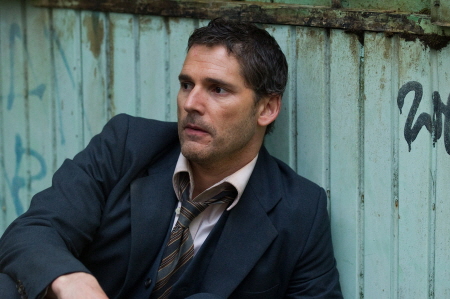
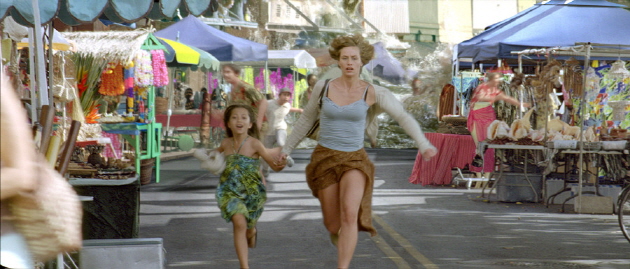
 When we meet Hanna(Saoirse Ronana) at the opening sequence, we can quickly see that she is not a normal 16-year-old girl at all. In some cold winter field covered with snow in Finland, she hunts a big deer for meat for herself with her bow, and then, after killing a deer, she is ambushed from behind and, and starts a fast, tough fight with the man who holds her at a gunpoint. It turns out the man is her father Eric(Eric Bana), and, like her hunt, the fight is the part of her daily training.

 She has lived together with her father in the hut in the middle of the forest for a long time. Eric is an ex-CIA agent and he has trained her for being an efficient killer. Along with how to fight and kill, she has learned various foreign languages, and she memorizes almost everything from a big encyclopedia like a bright girl eager to impress her father. Father constantly tests his daughter; she shows him she is a good student.

 She has been pretty much content with their lifestyle, but now she is more interested in the world outside than before. Eric knows that. He gives her choice with some transmitter device, which can be activated immediately when she turns the switch on. He warns her there will be no going back once she turns it on. Their enemies will instantly know where they are, so he will have to leave, and, for meeting him again at the certain place, she will have to go through the real world she has never encountered before.

 Like any fairy tale heroines, she chooses the perilous path. After the transmitter is turned on, CIA quickly detects where they are, and that is how the CIA agent Marissa(Cate Blanchett) comes into the plot as the wicked witch. Despite some reservations from above, Marissa is very insistent about eliminating Eric and Hanna, and she is willing to accomplish her personal mission by any means necessary. As soon as Eric departed from the hut, Hanna is captured and then locked in CIA secret base under Marissa’s direction. She escapes, and, pursued by Marissa and her henchmen, she now faces the real test as a trained killer after years of intensive home education.

 The director Joe Wright is mainly known for excellent literature adaptations like “Pride and Prejudice”(2005) and “Atonement”(2007), which are far different from this movie. As shown in his previous works, Wright is a skillful director with the good visual sense of space and atmosphere, and he makes a solid action movie this time. Each of various locations in the film are presented on the screen with distinctive feelings as the chapters of Hanna’s journey, and, in the end, the story arrives in some shabby amusement park amusingly mixed with fairy tale elements including big bad wolf.

  The actions scenes are fewer and smaller than expected, but they are not only effective but also visually interesting. Hanna’s escape sequence is precisely handled with efficiency in the vast structure while propelled by the Chemical Brothers’ aggressive electronic score. There is the underground fight sequence stylishly shown in smooth a long take shot, and then there is a captivating chase sequence where the character runs between the trailers and then jumps over them. Wright clearly knows how to make good action scenes – be real and steady as much as possible.

 And the story and the characters come first in his film. The screenplay written by Seth Lochhead and David Farr is shaky at times, but it is serious about the characters with some sense of humor. Although she has been trained as a killing machine, Hanna is still an innocent child in the alien world. She has surely learned about the world outside a lot, but this is her first field trip, and she approaches the world and people with curiosity and detachment that remind me of artificial intelligence.

 The movie goes a little deeper into her through her encounter with some British family on vacation, who find Hanna a little strange but likable enough to be accepted as a fellow traveler. Although being a stranger to them at first, she soon gets close to them. She has the chance to observe the normal family life she has never experienced. She finds some respite while being with them, but they also reminds her that she is an outsider different from others. She can be a nice pretty girl, but her instinct is always waiting to jump out from her inside; it does not matter whether it is ignited by Marissa’s henchmen or a naive approach. I’m sure she will get a lot of advices from the Bride in “Kill Bill”.

 As the lead, Saoirse Ronan handles the challenging role quite convincingly, confirming her exceptional talent previously shown in “Atonement”. On the opposite, Cate Blanchett is equally effective as her cold, rigid foe. In objective view, she could have saved her from lots of troubles(and also could have saved some tax money from American citizens considering how much resources she spends) if she had just ignored Eric and Hanna, but never mind. Blanchett is single-mindedly ruthless to everyone including her gums, and you can’t question about that. The special mention goes to Tom Hollander as one of Marissa’s henchmen; he flaunts with cheerful creepiness worthy of Brothers Grimm tales.

 I have no idea whether it is karmic or not, but “Hanna” is released in South Korea in the same weekend when “Kick-Ass”(2010) was released in last year. The comparison is inevitable for both have a young heroine trained to be a ruthless killer by her father. I respect that “Kick-Ass” has the style to deal with its subject, but its irreverent, unstable mix of silliness and extreme violence bothered me. That is why I prefer “Hanna” more; it is serious enough for its disturbing aspect while handled with enough style. And it works as sort of a coming-of-age story. As some character in the movie says, kids grow up, don’t they?

Posted in Movies | Tagged , , , | Leave a comment

Never Let Me Go (2010) ☆☆☆(3/4) : Life is too short for them

 While more direct and clearer about its themes than the novel it is based on, “Never Let Me Go” is a subtle and sensitive movie. It is quite easy to recognize what is going on in their world, but, like the novel, the movie is not about the society but about people limited by its unsaid rules. They try, but they eventually accept what will happen to them, and, despite some flaws due to adaptation process, the movie has that harrowing feeling generated at the end of the novel. While quietly observing their life, I felt the sadness accumulated behind the screen minute by minute.

 When Michael Bay’s SF action blockbuster movie “The Island”(2005) came out several years ago, Gazuo Ishiguro’s beautiful novel was immediately compared to it by Roger Ebert and others due to the similar premise of the novel(I really thanked Ebert for introducing the novel to me through his review on Bay’s movie – it was one of the best books I read in last year). In the alternative world technically more advanced than our world, there was a scientific breakthrough in the middle of the 20th century. Around the 1980s, they can cure most of incurable diseases in our world with their much developed technique, and the lifespan of human beings is extended to more than 100 years.

 But there is the cost for this brave new world. Maybe it is a little bit spoiler to you if you have never heard about the film or Ishiguro’s novel, but I think you can easily guess what that breakthrough is within 10 minutes. In this world, the human cloning is easily possible; clones are grown in group, and, when the certain time comes, they are ready to donate their organs. Sometimes they survive from two or three operations, but there is the limit, and, when they are “completed”, they will give everything they have.

The familiar questions naturally arise from this premise. Can they be treated like human beings? Can they feel and think like us? Do they have the right for their life? The teachers at the Hailsham School try to be progressive on these topics. At first, the school looks like any idyllic British boarding schools we have encountered in countless books and movies. But there is always the unseen, and unspoken, gap between them and students. Some of teachers feel pity to these young clones, but they cannot change the society that does not want to go back to its medical dark age. Although teachers try to treat them as the students full of possibility, they also remind them to maintain their valuable bodies as well as possible. The children they teach are ultimately more or less than the young livestock grown in the relatively humane environment.

 We observe the life of three students in Hailsham: Kathy, Ruth, and Tommy. The relationship between them was forged around the early years, and, even after they grow up to leave the school, the bond between them still remains as strong as before. They care about each other. They want to live with each other as long as possible. But as “the donor” or “the carer” who will be “the donor” when the time comes, all of them are aware of the inevitable fate awaiting for them. They try to ignore it, but the remaining time is getting shorter and shorter.

 So they are drawn to the certain rumor roaming among clones. According to that rumor, if two clones can prove that they are in really love, they can be allowed to live a few more years. It merely means postponing the end a little even if the rumor is really true, but even a few years are precious to them now. Like the terminal patients, they are willing to try anything for more time.

 However, they are stuck inside the boundary their society draws for its purpose. Although many details about human cloning are quite vague(How are they given birth to? Does a clone serve for only one receiver?), Ishiguro’s novel is the story about social human condition rather than the cautionary tale on the ramification caused by technological advance. Although they are relatively grown well compared to others outside their school, they are ultimately educated as the “special” parts of their society. From the childhood, they accept their roles, and they follow the rules without question like many clones before – they are bound to be limited in their social roles. Their story can be compared to the hero of Ishiguro’s another famous novel “Remains of the Days”, who tragically loses the only chance of happiness in his life for being dutiful to his role throughout his life.

 Alex Garland’s adaptation is not perfect but mostly satisfying as a whole. The story loses some subtlety from the novel on the screen, but perhaps it cannot be avoided because of the differences between mediums. The original plot is condensed into the movie less than 2 hours. Several small good moments in the early part of the novel are deleted or shortened with diminished effect(the crucial song in the novel is not utilized well in the film), and some visible gaps in the story cannot be easily ignored.

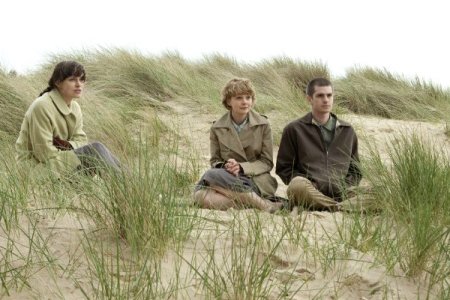
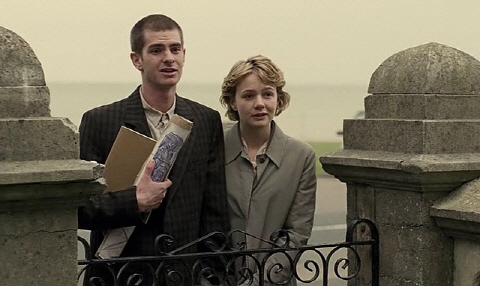
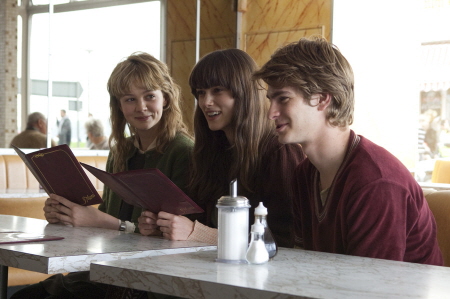
 In spite of these flaws, the film retains the essence of the novel and expresses it with the gray atmosphere and accompanying subdued performances. The child actors are good enough to hold our attention at the start, and they are convincingly connected to the adult actors(Cary Mulligan, Andrew Garfield, and Keira Knightley) later. The director Mark Romanek handles the story in restrained approach with melancholic beauty as shown in the beach scene, and he knows when it is right time to uncover emotions hidden behind characters.

 Although it is a little too ambiguous to be categorized as SF, “Never Let Me Go” is an intelligent movie with poignant story about the characters who has to deal with their determined path. We see them grow, we see them aware of sex and love, and we see them in fear of being “completed”. We come to accept them as the human beings with feelings and intelligence. But their society will probably not recognize that for a long time – until it does not need them anymore due to further scientific advance. As one of South Korean critics points out in the review, we are relatively lucky to live in the society where people have already discussed about the ethics on the techniques of the future to come.

Posted in Movies | Tagged , , , , | 1 Comment

Barfly (1987) ☆☆☆1/2(3.5/4) : And here goes their another day with bottles

 In the biochemistry class during my naive undergraduate years, the professor jokingly said the capability of metabolizing alcohol depends on our genetic makeup. Thanks to the variations in the genes, some people can produce more enzymes or more active enzymes to take care of alcohol in their body. They can be heavy drinkers, or the ones less susceptible to the hazards caused by alcoholism than their fellow drunks.

 That may explain the existence of Charles Bukowski(1920-1994), a “laureate of American lowlifes” who lived a relatively long life despite many days and nights of bottles and women at the bars. As Stephen King says in his insightful book “On Writing”, writing usually has no business with drinking(“Hemingway and Fitzgerald didn’t drink because they were creative, alienated, or morally weak. They drank because it’s what alkies are wired up to do.”), but sometime there are few exceptions like Bukowski. Drinking and writing always came together to him, and he had no problem with that.

 Based on the semi-autobiographical screenplay written by Bukowski, Barbet Schroeder’s “Barfly”(1987) is a love story intertwined with drinking and writing. Throughout the movie, he and others drink whenever they get the chance. Nothing is changed much at the end of story except few things, and we know he will challenge against another day of bottles. It looks self-destructive to outsiders like us, but we come to accept this is how he wants to live; he is content, if not happy, with this seedy lifestyle as long as he has some time to write – and drink, of course.

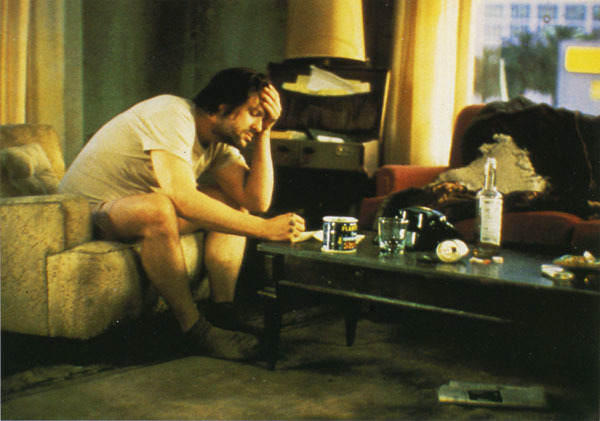
 The daily life of Henry Chinaski(Mickey Rourke) in LA is pretty much simple. At night, he drinks a lot at his regular bar, The Golden Horn. During day, he does some errands like delivering sandwiches for earning daytime drinks. Daytime bartender Jim(J.C. Quinn) is sympathetic to him, but nighttime bartender Eddie(Frankie Stallone) hates his guts, and Henry does not like him, either. After looking around the bars on the night streets of LA at the beginning, the camera glides into the bar, and then we see them at fistfight at the alley behind the bar. Between all these activities, he somehow finds some time to write short stories or poetry on the papers while listening to the classic music on radio.

On one day, when he is forced to go into other bar for another fistfight with resulting bruised face and knuckles, he comes across Wanda(Faye Dunaway) at that place. He approaches to “the goddess of distress” sitting at the other side, and they casually talk with each other.

Wanda: “I can’t stand people. I hate people.”

Henry: “Oh Yeah?”

Wanda: “You hate them?”

Henry: “No, but I seem to feel better when they are not around.”

 As fellow drunks, their alcoholic bond is instantly formed. They go to her apartment, with the green corns they stole. They begin living together. As drinking mates, they are frank about what they are: “I don’t ever want to fall in love.” – “Don’t worry. Nobody has ever loved me yet.”

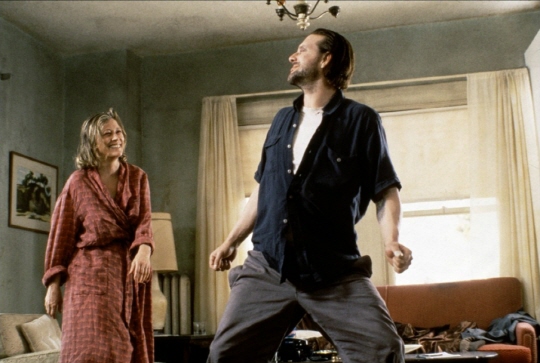
 But it was the love at the first glass from the beginning. They are warmed up to each other – while drinking continuously as usual. And then, the situation becomes a little complicated when a wealthy publisher named Tully(Alice Krige) is interested in Henry as well as his works. Henry does not mind Tully coming in his life, but, to Wanda, she is someone who must go away.

 I try to describe the plot, but I do not think I describe well about the film itself because the plot does not matter much in “Barfly”. When I watched it at 2010 Ebertfest, I was a little surprised by how the movie was far simpler and more straightforward than I remembered from the first watching in 2003. It is simply about the daily routines of drunks; it is same hangover, same day for them in the morning, and then it is same bar, same people, and same drink(and occasional bar brawl) in the evening.

 This sounds quite gloomy, but the life is not always grim for them. They are unpleasant, but they are interesting people to liven up their bar, and, at least in Bukowski and Henry’s view, it is not so bad to spend some time with them. There is a sullen middle aged woman who usually sits at the same spot; she does not have anything nice to say about others. There is an old timer who has problem with those familiar shaky hands; he solves it in an inventive way. There is an old street walker who frequents men’s room with her customers; she seems to be popular despite her age. And there are other colorful people in the bar; the more I think about them, the funnier they are.

 The movie is also peppered with several humorous moments, such as when the paramedics are called twice on one day to the same apartment(they are called again on the next day). Believe or not, according to the director Schroeder, that hilarious situation and the other happenings in the movie were really based on what happened in Bukowski’s life. The dialogues between the characters are enjoyable to listen. Without being sentimental, that is the last thing you expect from Bukowski, they are terse, effective both in dramatic and poetic sense.

 As a consequence, we have constant fun from the interactions between Rourke and Dunaway. With the precise mannerism with swagger and low, slurred speech, Rourke is terrific as a writer/boozer with shabby but stubborn dignity who prefers to stay in Skid Row rather than live affluently. Bukowski was certainly not the nicest person in the world(just check YouTube site and you’ll find how mean he can be), and neither is Henry. But, like Bukowski, Henry is at least honest about what he is, and Rourke had that decadent charm of a young misfit, one of reasons that make his performance more natural and compelling. You probably don’t want to live with him for lifetime, but you may like him, and probably admire him for his integrity.

 In case of Dunaway, her career was falling down from the prime during the 1960-1970s. It was not her fault, but the her choices had been pretty bad around the time she starred in the movie(I dearly remember watching her chewing the scenes in “Supergirl”(1984) on TV during my childhood). “Barfly” was one of few bright spots in her late career where she got the chance to fully utilize her talent. While showing some tenderness inside Wanda in the scenes with Rourke, Dunaway does not hesitate to show her abrasive side. When she says, “If I find the one you went to the bed with, I’ll rip all her pants off.”, she really means it, and she sticks to her words.

 With the help from the cinematographer Robbie Müller, frequent collaborator of Wim Wenders, the director Barbet Schroeder creates vivid, naturalistic atmosphere to give the specific physical sense of time and space. Although Bukowski’s story is based on his experience during the 1960s, Schroeder wanted the feeling of timelessness(If there isn’t any significant evolutional change in the human race in the future, the drunks will be always drunks, won’t they?), and he decided to set the story in the contemporary background. His film was wholly shot in the real bars and other authentic locations in LA, and the extras were played by real barflies who lived in the hotel above the bar shown in the movie. It was not intentional, but the apartment building where Wanda lives turned out to be the one where Bukowski and his lover, the real-life counterpart of Wanda, actually lived. The soundtrack entirely consists of source music played on radio or jukebox instead of score, and that approach more accentuates the realism in the film.

 Schroeder was very determined to make this film for a long time(in Q & A session after screening, he told us it took 7 years to initiate the production; the shooting took only 30 days). Maybe you have heard about that, but there is the infamous story about how he prevented its production from getting halted by the Cannon Company, the studio which was supposed to finance the film. He visited the company office with a battery-powered portable chainsaw. He threatened to cut off one of his fingers, and, from what I have heard from others, he went to the point of turning the chainsaw on.

  When I met him at Ebertfest 2010, all of his ten fingers were all right like his film. I’ll never forget him for giving me a wrong clue about the name of the movie he could not remember. I calmly pointed out to him that it is “Basic Instinct”, not “Fatal Attraction”, that was made by the director who made that awful film set in Las Vegas.

 “Barfly” holds its place well among the memorable movies from the 1980s. With its sincere, unpretentious view on its hero, it ultimately comes to us as something optimistic in its own, shall I say, alcoholic way. Many films about alcoholism have depressing sides, but, for some people like Henry or Wanda, being at the bottom with bottles is not as miserable as we think. In spite of having some bad days frequently, they will happily go through endless cycles like we see in the movie. The film made me feel a lot better when I was quite exhausted during the last night of Ebertfest 2010, and, after rediscovering this small gem, I lost myself a bit among people at the night party – with a cup of gin tonic.

Posted in Movies | Tagged , , | 1 Comment

Hereafter (2010) ☆☆☆(3/4) : It matters to them even if you can’t believe it

As the creatures recognizing the uncertainty and finality of life, we human beings have been trying to get some glimpse into something we will probably be never sure about unless we come into it for ourselves. In case of future, you will surely know what will happen, but it won’t be future to you then. In case of hereafter, you will indeed get the answer you want, but then it will no longer matter to you because you will be not in our world any more around that time you cross the line.

 Clint Eastwood’s new film “Hereafter” neither accepts nor denies the life after death, and that is a wise choice. Despite the supernatural elements in the story, the movie does not attempt to force us to believe what its characters believe. By dealing with its sensitive subject in a calm, honest, and thoughtful way, it sincerely shows us how their lives influenced by death are led by what they feel and believe. There are some questions and doubts left when the movie is over, but who can answer them?

 My first question: is Geroge Lonegan(Matt Damon) really a psychic, who can see and communicate with the dead associated with the people he touches? Maybe he is just as instinctively talented as your average psychics you have come across in your life. But he looks pretty much convincing when he reluctantly shows his gift to others. He does believe his gift, but it can be said that what he sees and hears is just the aftereffect on his nervous system after the surgery in his childhood. But he is too correct to disbelieve. What he says to them really affects them emotionally in each case, but does it really come from the dead and their world?

 Anyway, his gift is more like the curse to him, and he has been tired of “the life full of death”. He once made some money through his gift, but now he gives it up, and he try to lead a quiet life alone in the city. But the life is still not so comfortable to him. There are people who want his service, and his brother tries to convince him to start their supernatural business again. He begins to like the girl he meets at the cooking class, but soon she becomes curious about his gift – a bad sign for their relationship.

 We are also not so sure about what a French TV anchor Marie Lelay(Cécile De France) experiences during her vacation in Thailand when the tsunami devastatingly sweeps everything in the shore region along with her. In her near-death experience, she indeed saw something, but is it just a temporal vision created by her brain, based on what she(and we) often heard about? Still shaken by that experience when she comes back to Paris, she decides to quit her job and, for a book she’s going to write, she delves more into what interests her after that experience.

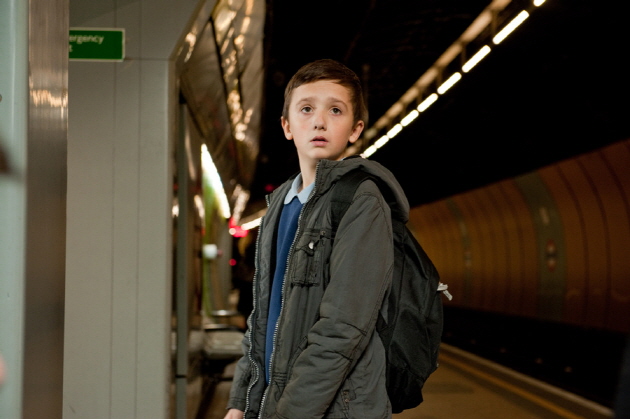
 In London, the third main character is also trying to find the similar answer. He is a young boy named Marcus, who recently loses his twin brother Jason(Both are played by twin child actors Frankie and George McLaren). Jason has been more than a big brother to Marcus at their problematic household, and, now in foster care, Marcus desperately wants to find a way to contact with his diseased brother for he somehow feels the unseen presence of his brother nearby him – but it may be caused by his grief.

 Needless to say, their paths are bound to converge at some point, but the screenplay writer Peter Morgan handles their storylines in rather effortless way. Their journeys for the answer are more important than the unobtainable answer itself in his story, and its dramatic power plainly comes from how they struggle in their respective lives. Although he was inspired by the book “Before I Say Goodbye” to write his original screenplay, as he admitted in the interviews, Morgan does not believe in hereafter; he firmly maintains his skeptic view on the subject with the amusing but sad sequence where Marcus is quietly frustrated by a series of “experts”.

 Clint Eastwood is the last director you can imagine for this film(I know it’s cliche, but, when I read the synopsis, I instantly thought of M. Night Shyamalan). As the director drawn by the producer Steven Spielberg, with whom he worked before in “Flags of Our Fathers” and “Letters from Iwo Jima”, Eastwood does as little as possible in the movie with his restrained, succinct storytelling style. Like Morgan, he adheres to the objective view on the matter while respecting the characters in the movie. There is a crucial scene near the ending when George’s gift is used again, but you are not even sure about whether it is, if it exists, really used. Eastwood only observes them, not answering that for us.

 The casting is excellent. Matt Damon is good as an introverted man haunted and exhausted by the gift he does not want at all. He holds our attention immediately due to his star status, but, with his engagingly understated performance, he provides the space for other lesser-known performers, who are also as low-key and emotionally effective as him.

 As you might guess from my questions sprinkled throughout the review, I am as skeptical as Morgan and Eastwood about their subject, as a biology major. My view may be far colder than theirs; I sometimes think we are no more than the machines organically made of flesh and bones that can be maintained for around 100 years in the best conditions. Death is probably nothing more than the switch getting turned off. I will probably ask and rebut the characters a lot, but “Hereafter” is a thoughtful and heartfelt movie that makes me understand them and care about them. That’s what good movies usually do to me and other audiences.

 Sidenote: The movie was surprisingly nominated for Oscar for its special effects in this year, but please don’t expect anything spectacular. It is effective as shown in the tsunami sequence, but that is only a small part of the movie. Recently, the movie was pulled down from the theaters in Japan for the understandable reason, and that sequence reminded me that, as one of my friends said, the real disasters look quite messier compared to the ones depicted in the movies.

Posted in Movies | Tagged , , , , , | 4 Comments

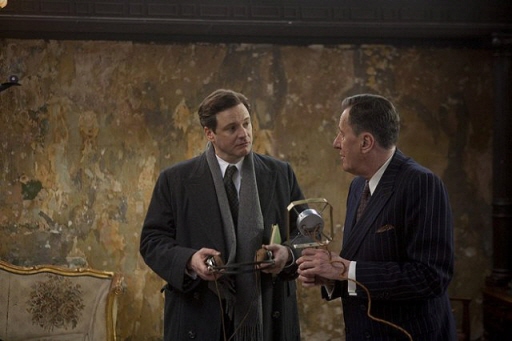
The King’s Speech (2010) ☆☆☆1/2(3.5/4) : The King and His speech therapist

 While watching movies, I sometimes come across the strong emphatic moments because I understand well how the characters feel in their situations. One of recent examples was from “The Hurt Locker”. Although its hero was someone quite different from me, when I saw him at a loss in the market scene near the end, I immediately understood his trouble for I knew how it had been difficult for me in similar situations.

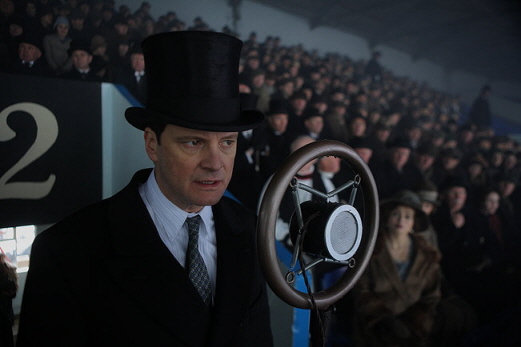
  “The King’s Speech” starts with such a scene like that. It is 1925, and The Prince Albert(Colin Firth), the Duke of York and the second son of King George V, is about to give the closing speech for the British Empire Exhibition at Wembley Stadium. His father and his older brother have already made their first public speech for radio broadcast, and now it is his turn. Everything is ready for him, but there is a big problem. In addition to being very nervous, he struggles with stammer right from the beginning of his speech, and he has to endure painful shame while trying to hide it in front of people. While watching this scene, I reflected on how disastrous my presentations had been due to my nervousness and stutters in front of others at my department. Some even said they were something they would not forget.

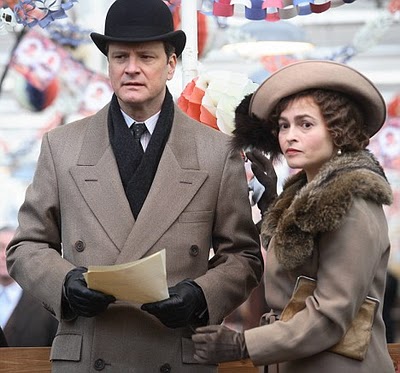
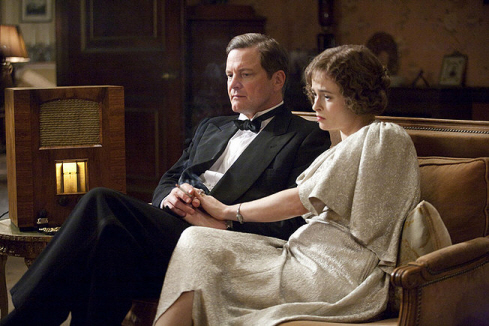
 He and his wife Elizabeth(Helena Bonham Carter) try to find a way to cure his problem. They tried several treatments, but there is no visible success, so The Prince chooses not to meet another doctor anymore. However, as a wife who sincerely cares about her husband’s problem and pains resulted from that, Elizabeth goes to some unorthodox speech therapist on one foggy day of London in 1934.

 His name is Lionel Logue(Geoffrey Rush), an Australian actor whose second job almost becomes his main job(But he still tries to get the part in the audition for a Shakespeare play). From the first time he meets Elizabeth, and then the Prince, Logue insists on his own conditions and rules. The therapy sessions have to be held in his workplace only with him and the Prince. Also, as a therapist and a client, they have to talk with each other in a casual way. Even when Logue learns that “Mrs. Johnson” is not an ordinary housewife, he does not change his position, so he becomes only common man who can call the Duke of York “Bertie”, a nickname exclusively used by his royal family.

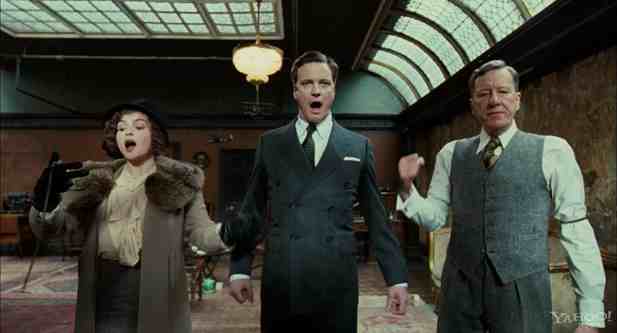
 It looked unconventional at that time, but Logue’s method is pretty much conventional to us in the 21th century. While externally helping his client in several physical ways for vocalization enhancement through a funny montage sequence, Logue also internally approaches to the Prince’s problem. As he admits, he is not a doctor with the degree, let alone the certification, but he is a well-experienced professional. He knows the importance of the mutual trust without formality between him and the Prince, and he tries to talk like a friend to the Prince. The Prince is hesitant about this at first, but, with Logue’s stimulation, he begins to talk about his inner bruises he has to cover as the King’s son, and they get close to each other.

 The movie basically tells a familiar tale about the friendship, the love, and the personal triumph from overcoming obstacle, all mixed dramatically in the historical context. Although being dutiful as the members of the royal family, Prince Albert and his wife have little interest in being public figures, but the roles far more burdensome than they have ever imagined come to them. After his father’s death, his older brother Edward becomes the new king, King Edward VIII, but he is too irresponsible as the King of Britain while the crisis is coming to Europe and Britain. Furthermore, he wants to marry that infamous Mrs. Simpson, an American divorcee whom he is not allowed to marry according to the constitutional law.

 Fortunately for Britain, he eventually decides to abdicate the crown to marry her, and now that heavy duty(and heavy crown as well) is handed to Prince Albert. As King George VI, he soon has to face the national crisis as the symbol of the British Empire. He knows he must do his duty in spite of his agony and reluctance, and the support from his wife and Logue is more valuable than before.

 David Seidler’s clever screenplay presents the characters as ordinary people whom we can easily identify with. The relationships between them are depicted warmly while being handled with intelligence and wits, and Seidler effectively overlaps their intimate drama with historical incidents that place them in the crucial part of the 20th Century history. The film also amusingly points out the change modern technology brought to its society at that time. As King George V grudgingly tells to his son, thanks to modern technology, their family becomes “the lowest beasts of the creatures” who has to do more than posing as the royal family – now they have to be the performers to ingratiate themselves with their people. The trend has never been changed, and, while watching young Elizabeth II, George VI’s daughter, in the movie, I recall how she reluctantly had to perform a certain act as her people demand later, as shown in Stephen Frears’ “The Queen”(2006).

 As widely known, Seidler actually conceived the idea for this movie in more than 30 years ago. But the Queen mother asked him not to write about her husband in her lifetime, so he gave it up for a while. But, after all, it turned out to be the reversal of fortune. After her death, his story met right people to make this movie, and, in the end, he got an Oscar in last month.

 Three main actors grace the movie with their wonderful performances, and they do deserve Oscar nominations they respectively receive. Colin Firth’s career has been relatively quiet after TV series “Pride and Prejudice” in spite of constant appearances in the films, but he has been diligently ascending with good performances, including a restrained but deeply sorrowful Oscar-nominated performance in “A Single Man”(2009). Like Helen Mirren in “The Queen”, he gets the role perfectly made for him in this movie, and he won an Oscar for one of the exceptional performances in 2010. In one scene, when his character realizes the relationship with his loving daughters is not the same as before due to his changed status, Firth subtly conveys his little sadness to us.

 Considering the theatrical bravado of his character, Geoffrey Rush is an ideal choice for playing His majesty’s therapist(No wonder they broke some rules for sending him the script). His witty performance is heartfelt as the half of the special friendship in the story, and the dynamic between him and Firth on the screen is always captivating – whether it is the conversation between them or the climax sequence where they have to go through the crucial moment together. Quite unlike mean Red Queen we saw earlier in “Alice in Wonderland”, Helena Bonham Carter comes to us as a gentle, no-nonsense Queen with her warm performance. In the opening scene, you instantly know from her face that she is deeply saddened by her husband’s humiliation, although she does not say anything. There are also many notable actors in supporting roles, including Michael Gambon and Claire Bloom as King George V and his wife, Guy Pierce as selfish King Edward VIII, Timothy Spall as Winston Churchill, and Jennifer Ehle, who co-played with Firth in TV series “Pride and Prejudice”, as Logue’s wife.

 The story was probably quite familiar to the director Tom Hooper, whose first theatrical movie, “The Damned United”(2009), was also about a rocky friendship between two characters based on real-life figures. Although “The King’s Speech” is his second theatrical movie, Hooper is an experienced director who has worked in TV dramas, and he focuses on the story and the characters with several notable technical choices. Using wider than normal lens, he accentuates the constricted emotional state of his hero as well as the narrow, vertical, and overwhelming feelings generated from the sets. The film is a British period drama, but, it is the 1930s after the depression, so the sets and the costumes, while faithful to the period, are relatively economic and plain compared to other period dramas.

 Despite its small scale, “The King’s Speech” is a moving drama with lots of dramatic power. Its climax mostly depends on two characters and a microphone in a small place, but the film marvelously creates the powerful moment when a small personal triumph is amplified into a public one all over the world. The movie is good enough to capture Academy voters’ hearts, and, as a result, it won four Oscars including Best Picture. We will still talk about the greatness of “The Social Network” years later, but I am sure that “The King’s Speech” will also still remain as a likable movie to the next generation. 

Posted in Movies | Tagged , , , , , , | 2 Comments

Notebaert Museum (Chicago, IL) (04/12/10)

These photos were taken on 04/12/10

Posted in Chicago, Photos | Tagged , , | Leave a comment

Another Year (2010) ☆☆☆1/2 : A year of a happy middle-aged couple

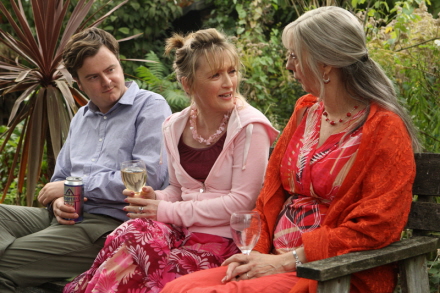
 They are an ordinary middle-aged couple living in the comfort from each other’s love. They do not need to tell that to each other. You can see that right from when they are together in their house. You know that they have lived like that, and that they will continue their lifestyle a year by a year. In the end, a small part of their happy life is passed, and they start to be ready for another year in the field where they grow vegetables.

 My description of these two people in Mike Leigh’s “Another Year” may bore you, but they are not boring people at all. Leigh has provided very interesting characters in his wonderful movies, and they are hard to forget. They are ordinary people, but they are also real people from whom we can feel a lot of empathy. The interactions between them are shown objectively, but, below the mundane surface, there is humor and compassion from Leigh himself. Through his view, we see that they are not so different from us. And we begin to think about ourselves and our life through them.

 Tom(Jim Broadbent) and Gerri(Ruth Sheen) are like the manifestations of Leigh’s gentle approach. They are people sensible enough to know how to listen to others, and how to handle difficult situations of others, while never lecturing their opinions and thoughts on them. Yes, their names sound funny, but they have been accustomed to that for a long time and it is now merely a small fact in their daily life.

 At first, we see them at work, respectively. Tom works as a geologist, and Gerri is a counselor in the hospital. They have a son named Joe(Oliver Maltman), who is around 30 and lives apart from his parents. Like Tom and Gerri(okay, I now admit to myself that their name is funny), Joe is also dedicated to his job as a legal advisor, and he is also as a caring person as his parents.

 Such warmth like that usually attracts the unhappy people who want to be happy like them, and some of Tom and Gerri’s friends are sad examples. Mary(Lesley Manville), who works as a secretary in Gerri’s hospital, is a lonely and needy woman with drinking problem. The dinner with Tom and Gerri is probably the brightest part in her daily life, but the desperation deep down inside her cannot be easily hidden from her friends no matter how much she tries. She knows that, and so do Tom and Gerri. They worry about her, but they do not cross their line while trying to help her in tactful ways.

Mary tries to find the way to change her life and to become happy, but she always becomes disappointed with herself. Nothing is changed in her life when the year is nearly over, and she still drinks too much. Meanwhile, Tom and Gerri’s another friend Ken(Peter Wight), who is as unhappy as her with his imminent retirement, senses her loneliness not so different from his, and he tries to approach to her kindly. But she is not interested in him, and she wants the affection from Joe, who listens to her as attentively and tactfully as his parents. There is a painful scene in the car where Ken, in the backseat, has to watch Mary trying to engage Joe in the conversation while she is driving. Wright says not much, but he quietly exudes the hurt and frustration inside his character behind the other performers.

 While observing the lives of Tom and Gerri and others over the course of four seasons in one year, Leigh lets the story develop organically in its frame by his characters and the small incidents in their life. He has a keen sight on the awkward situations that sometimes happen between people, and the good example is shown when Tom and Gerri, along with their son, attend the family member’s funeral along. There is a grudge due to some unspecified reason in the past between a helpless widower, Tom’s older brother, and his hostile son, and Tom and Gerri has to modulate the situation in front of others.

 Leigh presents his characters as what exactly they are, and he never does anything more than that while maintaining his objective attitude. Like in our real life, there is no cheap, easy solution for their problems. Sometimes lonely, desperate people can help each other, but that does not happen as frequently as we think, as shown from Mary and Ken, or in the quiet but intense sequence when Mary visits Tom and Gerri’s home in an inappropriate time. A year is near over, and the life will go on in another year. There will be still problems for Ken and Mary, and Tom and Gerri will be remain as happy husband and wife, while still being their friends’ unofficial counselors.

 As widely known, Leigh works closely with actors from the beginning of the production, and, as some of the talented British actors, they always give excellent performances in his movies while embodying someone we are likely to meet in our life. This movie is no exception. Jim Broadbent and Ruth Sheen comfortably slip into their characters as the main anchor of the movie; you can immediately believe that they have been together for a long time.

 They are surrounded by equally natural performances from other actors, and, as their miserable friend Mary, Lesley Manville gives the standout performance. Her character is relatively showy could have been a caricature, but, with her carefully measured acting, Manville never allows Mary to be less than a human being who really needs help. Mary believes she can get the happiness from where she can’t, and she is devastated as a result. She cannot do anything except accepting her situation, and that makes the ending more sorrowful.

 Right before watching this film at my place, I unfortunately subjected myself to “Battle: Los Angeles” at the local theater. With all those loud crashes and bangs constantly harassing the nerves of the audiences, I was quickly bored within 20 minutes, and I had no interest about what would happen to its cardboard people as inconsequential as CGI aliens. In contrast, in case of “Another Year”, I was soon absorbed in the characters’ quiet mundane life soon after the movie started, for they came to me as real people with deeply touching or sad moments. It was quite refreshing to me, you know.

Posted in Movies | Tagged , , , | 1 Comment

The Fighter (2010) ☆☆1/2(2.5/3) : Maybe it should have been titled “The Fighters”

Although there are good things I like, there is something unbalanced in “The Fighter” bothers me, and that is why I am not so sure about whether I like it or not. It is definitely a well-made drama with the good performances, but, as an underdog sports drama, it strangely does not put much weight on its title character, who should have been the center that holds all these good things in the movie. In fact, he is the weakest and the least interesting factor in the story. He says to the others surrounding later in the story, “I’m the one who’s fighting. Not you, not you, and not you.” Sure, he fights in the ring, but does he fight in his story? Well, it is hard for me to answer that.

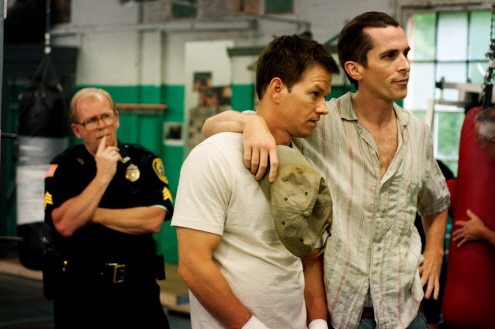
 The movie is based on the real-life story of Micky Ward(Mark Wahlberg), a welterweight boxing champion from Lowell, Massachusetts, and his people, including his half-brother Dicky Eklund(Christian Bale). Dicky was also a professional boxer, but, after his match with Sugar Ray Leonard, his career went down, and he becomes a crack addict who still thinks he is the pride of Lowell. He frequently brags about how he knocked down Sugar Lay in that match, but you cannot easily believe what a crack addict says about himself.

 The movie has a vibrant, interesting opening with these two brothers accompanied by the crews from HBO, who come to Lowell for making a documentary. Dicky is very enthusiastic about this. He believes the documentary is about his imminent comeback to professional boxing, and he rambunctiously goes around his town and his people with the crews following him behind. Though it is later pointed out in front him that the documentary is about crack addition, he still believes it will make him famous. Indeed, there was an HBO documentary “High on the Crack Street: Lost Lives in Lowell” made at that time, and the director David O. Russell adds some authenticity to his movie by casting Richard Farrell as a camera man, who actually made that documentary at that time.

  Micky has a talented boxer, but he has never gotten a good chance. His family support him, but they are the ones who have hampered his career. Dicky is a constant troublemaker. Although it can be said that he is a good trainer who knows well about how his brother should fight in the ring, like many addicts to their families, he keeps disappointing Micky as well as his family. Usually high on the crack, he is late for his brother’s training. He does not show up when everybody else is ready for going to the match important for Micky.

 Their mother Alice(Melissa Leo) is not much helpful as Micky’s manager, either. While she is a good proof that sometimes mothers do not love their children equally, she is also a lousy manager that pushes her son into the disadvantageous matches, such as the one in which he has to fight with a boxer far heavier than him. However, the things begin to change after Micky meets a young bartender girl Charlene(Amy Adams), who pushes to him into the other direction away from his family, especially after the incident that could ruin his career completely.

 As a result, Micky’s career ascends, but there is the conflict between his family and Charlene, with Micky in the middle of tumult. He wants everybody get along with each other, but what does he really do in this situation? Although Mark Wahlberg gives a decent performance, but his character is still more or less than the object in this dramatic conflict, not the participant. He is so humble and passive as an underdog that he usually hesitates to say about his thoughts and opinions to his people, while others have lots of things to say about him and themselves He prefers to stay behind these noisy people and, by them, the show is almost stolen from him in the story. In one scene, when he belatedly arrives on the scene, the conflict between other characters is already resolved for him, and he has little thing to do or say.

 He does fight in the several boxing match scenes, but how David O. Russell presents them on the screen is curiously conventional, and it is also little out of focus. Some critics compared this movie to Martin Scorsese’s “Raging Bull”, but, in my view, there is nothing in “The Fighter” equal to the savage power in that great movie. No, I do not mean that they are made in a lousy way – they are good, but they are just as much as we can get from TV during the 1990s. Interestingly, the movie announces these scenes to us through the subtitle even before they gets started, as if they were merely the obligatory chapters in the story – and they actually are.

 Despite this odd approach to its central subject, the movie is energetic when it is about the lives outside the ring, and I think it ultimately far more cares about them rather than its hero. They are dim, selfish, and sometimes mean, but they are interesting flawed human beings, who come to senses when they realize it is necessary to do that. The supporting ensemble brings considerable vividness to their roles; they certainly deserve the awards they have received.

 With Wahlberg as their ring in which they fight with each other, Bale, Leo, and Adams give the stellar performances that overshadow Wahlberg’s neutral performance from time to time. Considering many extreme roles in his career, the fact that Bale lost his weight for this movie is not so surprising news to us now, but Bale has been always fabulous with his fierce dedication. The more I think about his electrifying Oscar-winning performance, the more I am convinced that the movie could have been more interesting if it had focused on his character instead of his decent but relatively boring brother. Maybe we can make another interesting movie about Dicky Eklund, who overcame his obstacle, remains as a town legend in the end, and recently has the honor to see Bale getting lots of awards including an Oscar. Isn’t that more dramatic than the movie?

 Leo and Adams also got the Oscar nominations for their equally good performances. Adams is cast against the type, and she shows the different side of her talent as a tough girl who will not step back from the domineering force of Alice and Alice’s seven daughters. Leo won an Oscar for her brash turn as the selfish mother who hates not being near her son’s success more than anything in the world. There is a touching scene between Alice and Dicky in the car where they are conscious of their problems as well as their bond, and Leo and Bale deftly shows the human side of their mostly unlikable characters. By the way, in case of that suffocating presence of Alice’s seven loser sisters, they uncannily took me back to my childhood surrounded by the female cousins from the mother’s side. My mom was a queen, and they were her ladies-in-waiting, and no one could stop them. At least, they were not losers like Micky’s sisters; most of them were hard working moms with their own careers and lots of hearts.

 James Berardinelli, one of the leading web movie critics I have respected, once said that deciding between 2.5 stars and 3 stars was difficult for him, and I also have the same difficulty with this movie. It is certainly not a bad movie, and I enjoyed some parts of it, but I still have my own reservation. The dynamic generated by good supporting performances compensates its weakness a lot, but the conflict between them is resolved in a rather unsatisfying way, although they say it is not so different from the real-life story. And it is still deficient in the center despite the energy from the fringes. Maybe, I could give it 3 stars if the movie were titled “The Fighters” instead.

Posted in Movies | Tagged , , , , | Leave a comment