Fresh (1994) ☆☆☆1/2(3.5/4) : A dangerous game between him and his world

  In the middle of Boaz Yakin’s “Fresh”(1994), there is the crucial scene that gives us the insight into its hero’s plan. While playing chess with his father, he learns a lesson. And then, he applies its logic to the real world for his own purpose. However, in this case, the game is not a simple matter of win or lose. A small false move can result in not a mere checkmate but a dour outcome for him. And, this is one of the most interesting aspects of the film, he is only a 12-year-old kid. He can do it, and we know that, but can he endure to the end?

Yakin’s film is a riveting story that looks at the grim reality of the urban ghetto area through the disillusioned eyes of that kid. With calm, steady attitude, it presents us the harsh environment that has influenced him. There is little hope inside him for a better life, but that seems more like a small, temporary consolation in his frustrating life. The violence can burst out anytime, and, even though he is a jaded worker in the crime world, he is dumbstruck to see what suddenly happens right in front of his eyes. While following him, we eventually see the reasons behind his scheme to retaliate on this world causing him lots of pain, anger, and frustration. It is gripping to see how he manipulates others for his ultimate goal – and it is also harrowing to observe what he has to sacrifice for that.

Starting from the opening sequence where background details are filled up one by one in the open space, the movie depicts the daily life of Michael(Sean Nelson), nicknamed “Fresh” by the people close to him. The life is not easy, but it could have been worse for him. Because he was separated from his parents for some unclear reasons(he is not allowed to meet his father, and his mother probably died in the past considering the conversation between them), he could have been sent to group home. Fortunately, he has a benevolent aunt(Cheryl Freeman) who can take care of him as well as his 11 cousins at her small but relatively neat apartment in the public housing project in Brooklyn. The home is crowded with the cousins who are mostly indifferent to him unless their welfare is concerned, but it is certainly a lot better than the group home nobody wants to go at any chance.

At school, he has several friends at his age he can hang around with. His best friend is Chuckie(Luis Lantigua), whose careless loquaciousness contrasts with Fresh’s reticence. One day, Fresh notices one of the schoolgirls, and she notices him, too. Their interaction with a wire fence between them is one of few small warm moments in the story.

But he is far less naive than others. He works a runner/pusher for the drug lords in the neighborhood. He is sometimes late for school while delivering drugs in the morning, but he has managed to hide his criminal activity from others except his  friends. He is clever; he knows it is prudent to be quiet and honest in front of the people he works for, and the drug lords trust him and favor him because of that. When they are with him, they are like the seniors cordially recognizing a young junior who may follow their footsteps and “be the man”. One of them, Esteban(Giancarlo Esposito), regards Fresh as his protégé; he personally promises him the future in his business.

Fresh has other thoughts. Above all, he has yearned for getting out of his neighbourhood. In fact, he has saved considerable amount of money hidden in his private place. But his life is still stuck in where he has been all along. In addition, his sister Nicole(N’Bushe Wright), one of few people he cares about, is mired in drug addiction with low self-esteem. She gives herself up to anyone who provides the drug for her.

The director Boris Yakin, who also wrote the screenplay for his first movie, moves his story at leisurely pace during the first half for establishing the relationships between his characters. Sometimes we do not know all about their relationships or their past, but they are interesting characters, and it is compelling enough to observe them. Even when they say nothing, we can see what is happening between them. With the help from the cinematographer Adam Holender(“Midnight Cowboy”), Yakin gives his film the authentic atmosphere with some occasional realistic beauty, such as when Fresh spends his time in his private place while looking at the city beyond the railroads.

After everything is placed on the board, Yakin puts them into the thriller formula with an apt metaphor for what happens next. After witnessing a tragedy caused by senseless violence, Fresh decides to do something as retribution. He gets a main idea from his alcoholic father Sam(Samuel L. Jackson), whom he occasionally visits in the park.
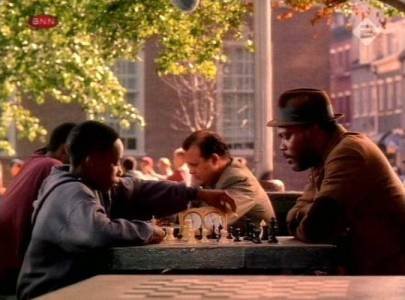
Sam spends most of his days in the park while earning the money for his beer with speed chess. He is an intelligent man, and he has taught his son speed chess while also giving him some life lessons through his teaching. In that crucial scene mentioned above, while playing chess with his son as usual, he imparts a lesson to him; “You’re playing each piece like losing it hurts. They ain’t checkers. You want my king. You got to come get my king. All these other pieces are just the means to do it.” (A small trivia: Bruce Pandolfini, who is mentioned by Sam along with several famous chess players, was a technical advisor in this film. He was played by Ben Kingsley in “Searching for Bobby Fisher”(1993), another movie about a smart kid good at chess play).

That lesson is literally adapted to Fresh’s strategy. He sets the board, places the pieces on it, and starts the play. It is not a fancy behavior at all. He gains the detachment necessary for executing his scheme, determined to use anything or anyone. For now, they are no more than the pieces on the board. He manipulates others into the situations prepared by him, and then he watches the outcomes with caution while holding himself for the next move.

Now this sounds like those simple thriller movies in which a clever good guy outsmarts and eliminates bad guys with the ending waiting for him. No, I do not criticize them because some of them are entertaining on their own, but, while maintaining unhurried pace with equally calm Stewart Copeland’s orchestral score, “Fresh” goes far deeper to reach to the level of complex thrillers driven by characters. Though most of what he does are manipulations and lies, Fresh actually plays a dangerous survival game using others near him. In one case, he exploits one of them without that character’s knowledge. As a consequence, though it was not in his plan, he leaves him to get shot because he has to move on by any means necessary. One brief scene later tells us he loses more than one relationship as a result.

But he has to harden himself further, for the vulnerability is something fatal on his mean street. On his DVD commentary, Yakin says that he insisted on keeping that painful scene involved with a fighting dog Fresh cares about in spite of the objection from the producers. While the other violent scenes are handled with restraint while focusing on their aftermath on the characters, this painful scene feels like gratuitous violence in comparison, and many people in fact asked Yakin the reasons behind it after watching the movie. At first, I thought Fresh has a good reason to kill the dog. He found it on the street, and he does not like when it is put into a dogfight. But does he really have to do it so cruelly? Now, after listening to Yakin’s short explanation, I begin to discern the motives behind his deed. Considering what happened to him before that scene, and what he will do next after that, it is a logical step to him.

Sean Nelson’s electrifying performance is both the key and the lock to his character. Although he was around 13 years old during the production, he did a marvelous job; he masterfully balances his character between toughness and innocence while revealing little from his detached face. On the streets, he can be a pragmatic pusher who coldly responds with contempt to a desperate addict without money. At school, he is a normal elementary school kid who tries to draw the cheerleader girls’ attention with his friends in a funny way. He usually keeps his thoughts to himself amid criminals, and that attitude becomes more essential while executing his plot. But he is still a child, and he observes the penultimate step of his scheme played out from the distance with objectivity and a candy bar, as if he were watching some violent play staged by him. Nelson has diligently continued his acting career after this movie. He held his place between Dustin Hoffman and Dennis Franz in “American Buffalo”(1996), and gave a good performance in HBO TV mini-series “The Corner”(2000).

Among the good supporting performers in the film, it is easy to recognize Samuel L. Jackson, who was then recognized more widely than before by the audiences thanks to the success of “Pulp Fiction”. Though he is less prominent in the movie than its DVD cover design suggests, he imbues every scene he appears with that familiar authority; you can sense how much Fresh needs Sam as his mentor, if not his father. On the opposite, Giancarlo Esposito gives a nice performance as another mentor figure in Fresh’s life. Esteban has sleazy side, but he is not entirely a bad man, and he gives Fresh some advices including the ways to survive in his business.

One of the reasons why “Fresh” still feels timeless is that, sadly, the reality reflected through Fresh and his story has not been changed much. While watching the film, I was reminded of HBO TV series “The Wire”, whose fourth season devastatingly shows how the lives of the school kids around Fresh’s age are shaped by the crimes in their slum neighbourhood. And I remember the article written by the Chicago Sun-times reporter Frank Main, who recently won a Pulitzer Prize in this year. It was about a shooting incident in Chicago neighborhoods. It said that, not so surprisingly, nobody wanted to help solve the case – not even a dying victim himself.

The movie is a terrific thriller guiding us into the reality such as that. It tells us how it hurts Fresh. It also suggests how fighting back against it equally hurts him. The powerful final scene reveals everything that has been accumulated inside him throughout the story. He does not say anything, but, from his face, we see what he has lost while going through the perilous situations even the adults cannot easily get away from without the cost. His father told him that anything lost can be found again except the time wasted, but Michael now knows that there are also other things that cannot be found again. And he is only a 12-year-old kid.

Posted in Movies | Tagged , , , , | Leave a comment

Cats on the first day of summer (06/01/11)

Summer begins – Cats and their kittens are resting inside bushes.

Posted in Photos | Tagged , , | Leave a comment

Inside Job (2010) ☆☆☆1/2(3.5/4) : Here’s what happened

  Regardless of how much you know about the global financial crisis in September 2008, you will be outraged while watching “Inside Job”, Charles Ferguson’s incisive documentary which explains in detail why and how this complex incident happened. It was not a bad luck at all. US finance industry had already been destined to that enormous disaster for a long, long time, and the people who could prevent it had neglected it while getting the profits for themselves. Even after the global economy as well as US economy was severely damaged as a result, nothing is changed much in the system, and, this is quite frightening, it still keeps going on as before.

Like his previous work “No End in Sight”(2007), an equally sharp-edged documentary about how the George W. Bush administration disastrously ruined Iraq from the beginning, Ferguson gives us the calm, penetrating presentation on how US finance industry has systemically ruined the economy it has fed on. The film only presents us the interviews with the various financial experts and others along with the helpful explanations and data showing how the system “works”, but the message behind them is quite clear to us. The crisis happened due to the lack of proper regulations of the companies, and US really needs the regulations for preventing the next possible crisis, which might be more catastrophic than the recent one.

The documentary tells us about the long history of mutual relationships between Washington and American finance industry. The deregulation of finance industry has been favored since the Reagan administration in the 1980s, and this policy has never been changed during last three decades. Wall Street people got the big chance to earn lots of money thanks to that. One interviewee recalled that one of his friends, a stock trader working at Merrill Lynch during the 1970s, had to do an extra part-time job for supporting his family. In the 1980s, that guy’s annual income became more than six figures.

With such a boom like that, the crash was bound to happen, and it did happen in the late 1980s with many American people losing their precious savings. However, the stock traders and the executives of Wall Street did not learn any lesson from that. While similar financial disasters kept occurring, they have continued to push the US government to more deregulation for more money. The billions of dollars from Wall Street have been put into Washington to block any attempt to reform the financial system. Both Republicans and Democrats get the money in their respective pockets. The former executives or board members of the leading financial companies get the new jobs at the Department of Treasury or several federal committees that are supposed to supervise and regulate their industry. They even have corrupted the academic integrity. Several leading economists are paid well for supporting deregulation through their writings and consults – and their universities are also paid well, too. Some of these scholars agreed to be interviewed by Ferguson, but they cannot give him nice answers when facing the hard questions thrown by him.

The business became more cancerous as the time went by. With merger and acquirement, the banks got bigger and more influential than before – and they got greedier. With the rise of computer technology, they introduced a new financial instrument called “derivative”, which, unlike what they said, caused more harm to the market. In addition, as another part of deregulation policy, they made the government lift the limit on the leverage of the banks, which meant they could lend money far more than they actually had.

The film gives us a very lucid picture of how this malignantly unregulated system, so called “Securitization Food Chain”, was operated at full force for maximizing the profits while the things were accelerated toward the catastrophe. The banks wanted to lend more money to the debtors most of whom were not so eligible for the mortgage, so they borrowed more money from the investment banks like Goldman Sachs. The investment banks then packaged the debts into Collaborated Debt Obligation(CDO), which was then sold to their investors as the products, which were, by the way, rated ‘AAA’ by the rating agencies such as Moody’s(they said later that they were not responsible for their “opinions”, by the way). And then there was credit default swap; the investment banks bought the insurances for their lousy CDOs from the insurance companies including that infamous AIG. The insurance companies knew they insured the bad products, but they did not care because the money was coming anyway. Plus, it was possible to insure one CDO in multiple directions – another very good chance for them to earn more profit. When AIG was turned out to be unreliable, my god, the banks even insured against AIG’s collapse.

The system was literally out of control, and so were people in it, who, intoxicated with the ecstasy from profits, carelessly spent their money for living in obscene luxury. Richard Fuld, the CEO of that notorious Lehman Brothers, flaunted his vast wealth quite arrogantly before the crisis. Private jets were more like the toys to him; he had six along with one helicopter. There was a private elevator only for himself in his company building; when his driver called, the elevator was ready for bringing him straight up to his office on the 31st floor. And he did not give damn much about how his people worked below.

Gambling, drugs, strip clubs, and prostitutes were abounding among the people of Wall Street, and they were taken for granted. Kristin Davis, who ran a high class prostitution ring for them near Wall Street (at least $1000 for an hour), reveals us a lot about how irresponsible they were, and her words are supported by other interviewees. It is sort of amazing that they managed to work in their companies in the next morning after such hedonistic excess during night.

In the end, as many experts had foreseen, all hell broke loose not only to them but also to us. AIG and Lehman Brothers were collapsed along with many finance companies. The stock price plummeted. The money from thousands of investors was vaporized. The debt of US government was doubled, and the American society became far bleaker than before with increased unemployment rate. The global economy had lost trillions of dollars as a consequence, and lots of people around the world also lost their jobs.

In spite of all these damages, the history will probably repeat itself sooner than we think if we are not careful. Many people called for the financial reform after the crisis, but even the Obama administration did little for that. The same kinds of people from Wall Street were hired in the government again, and, as many of you know, the US government gave these rotten finance companies the huge amount of tax money for bailout. As Ferguson said in his Oscar acceptance speech several months ago, none of executives responsible for the crisis were indicted for what they did; they instead got the huge bonus as usual.

“Inside Job” is a detached but angry documentary demanding the changes with the good arguments based on facts and data. As it bitterly admits through Matt Damon’s narration, the changes will not happen easily due to the obstacles alarmingly grown out of proportion – but there must be changes no matter what. As French Finance Minister Christine Lagarde says in the film, the financial industry is a service industry; it should serve others before it serves itself. Otherwise, it will be no more than money-sucking cancer.

Posted in Movies | Tagged , , , , | Leave a comment

The China Syndrome (1979) ☆☆☆1/2(3.5/4) : It can happen – and we know that

 While I heard the alarming reports keeping coming from the Fukushima I nuclear power plant, that unforgettably intense sequence from “The China Syndrome”(1979) immediately came to my mind. The earthquake occurs without warning. The power plant is automatically shut down. They get a problem with the level of the coolant. The plant is on the verge of nuclear meltdown. The catastrophe of epic proportions may happen as a consequence.

 The term “China Syndrome” metaphorically refers to the dangerous consequence resulted from such containment failure. Because of its hot temperature due to the radioactive heat emitted from fission products, the nuclear fuel can rupture its metal case even when the power plant is shut down. If it cannot be cooled even after that, in the worst scenario, they cannot stop the molten fuel from penetrating several levels of the containment system. Hypothetically, once it gets out of the system, it will continue to melt through the earth crust and core; it will eventually reach to the other side of the earth opposite to US – China(However, geographically, it is the Indian Ocean, not China). Actually, that is impossible, but, once the molten fuel is leaked out of the system, the radioactive materials will be inevitably spread around in the air and on the ground; that will cause huge damage to the environment around the plant.

 While effective as a cautious story about the inherent danger in one of main energy sources for our civilization, the film is a superb thriller that has lost none of its strength to tighten us. The tension comes from the main characters as real as us watching them, and it keeps mounted as we grasps the urgency of the situation in which they struggle as much as they can do. We become nervous about the possible danger they try to uncover – and we come to really care about what will happen to them for we know that their careers, and perhaps their lives, are at the stake.

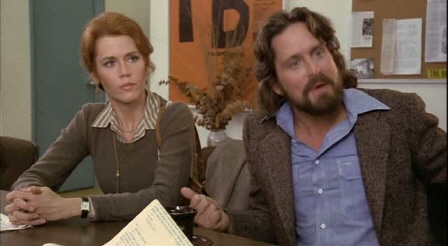
 They are just doing their jobs like any other days when they come across the incident. To a local TV reporter Kimberly Wells(Jane Fonda), the nuclear power plant seemed like a mere deviation from her usual subjects such as how to celebrate birthday or animals in zoo. She arrives at the Ventana nuclear power plant, meets a PR guy, and does the routine news coverage with her friend and cameraman Richard Adams(Michael Douglas). While they look around the plant, they also have a nice opportunity to observe how people work in the control room from the observation gallery.

 And that is when the incident begins. After trembled by a sudden earthquake, the plant quickly goes into the emergency mode. The shift supervisor Jack Godell(Jack Lemmon) calmly handles the situation. It seems everything will be all right at first, but he and his colleagues soon realize they have just made a big mistake. Because the needle in the panel indicating the coolant level in the reactor was stuck above, they thought the coolant level should be lowered. Now the level is dangerously too low, and the meltdown will happen if they don’t do something. It may sound preposterous, but I learned later that such a case really occurred in the past.

 This sequence is handled with disturbing stillness that effectively conveys the possible dour outcome they may have to face if they are not lucky. Most of what we see is mainly comprised of the panels monitoring this perilous situation, but the wordless nervousness among the people in the control room is palpable. While watching this moment, I thought about how people at the Fukushima plant tried desperately to control their disastrous situation. The outcome was far worse, but they did the best they could do.

While told that nothing serious is happening by a PR guy, Kimberly senses that something serious is going on in the room though she can hear nothing, and so does Richard. He surreptitiously turns on his camera and films the whole incident with her tacit approval. She has wanted to make a her big break with this(although she is popular, she is tired of meandering around ‘soft news’), but her plan is soon blocked by her superiors, who are afraid that they will be sued for violating the law. Kimberly follows their decision, but Richard decides to do something, and that causes the headache to Kimberly and others. However, all of them soon realize they have big news they cannot easily throw away.

 Meanwhile, on the other side, Jack Godell begins to face another difficult situation. While Jack Lemmon can be your funniest man as shown in his collaborations with Billy Wilder and other comedies, he can also be a conflicted everyman you cannot easily forget in the movies such as “Save the Tiger”(1973) and “Glengarry Glen Ross”(1992). In one of the best performances in his illustrious career, Lemmon presents us a man who has devoted to his work for most of his life. When he says he cares about his power plant, there is genuine sincerity. He has the firm belief in the system he belongs to. When he accidently come across Kimberly at the bar, he emphasizes to her how the nuclear plants is meticulously designed and thoroughly tested and maintained,

 But he does not tell her everything. There could have been the catastrophe to affect whole Southern California, but the danger was prevented under his supervision. In his view, nobody needs to be disturbed by the incident for nobody got hurt. The system works, so it is better to move on while learning an important lesson from the error he and others committed.

 However, as a dedicated professional, he cannot ignore the second vibration that he felt some seconds after the earthquake. The investigation committee concludes there is nothing wrong with the plant, but his suspicion turns out to be right. He finds the leak from the pump. He also finds that the X-rays showing the welds of the pipes are all copied from a single X-ray picture. He is convinced that the plant is unsafe and needs the examination. But his colleagues and superiors turn a blind eye to the problem for it will jeopardize the company management.

 From this point, the film shifts its gear into more suspenseful mode. Godell is visited by Kimberly and Richard, and he reluctantly becomes their whistle blower to provide the evidences. There are some people who are not so pleased about this, and they will do anything to stop them. There is a particular moment that reminded me of the doubtful circumstance surrounding the death of Karen Silkwood, whose real-life story later inspired Mike Nichols’ Silkwood(1983), another good movie about a whistle blower who tries to expose the safety problems in the nuclear power plant.

 Directed by James Bridges, the movie has lots of verisimilitude thanks to his approach reminiscent of the naturalistic style of Sidney Lumet’s films. From the opening sequence showing the work process at the broadcasting station, it puts us right in the story. The circumstances and places are depicted as real as possible. The absence of score intensifies the acute reality shown on the screen(they initially had the original score composed by Michael Small, but they wisely chose not to use it). Maybe I am overpraising it, but I can say “The China Syndrome” is one of the best Sidney Lumet movies not directed by him.

 The film’s unobtrusive style serves Lemmon and other talented actors well. Jane Fonda was Oscar-nominated along with Lemmon for one of her strong performances in the 1970s. Like Lemmon, she convincingly depicts her character’s transformation along the plot, and the scene where she cannot help but lose her objectivity as the reporter in front of camera is heartbreaking. Michael Douglas, who also produced the movie, competently plays the character different from what we usually associate with him now. As Godell’s close friend and assistant Ted Spindler, Wilford Brimley gives a subdued but impressive acting that started his long supporting actor career. Although he cares about his friend, Spindler does not want to get himself in trouble and chooses to go along with others – but there is a breaking point where he decides that enough is enough.

  There are some dated aspects in the film due to social changes and technological advancements during last 32 years, but it still effectively raises the question on the safety of nuclear power. It is one of well-known movie trivia that the Three Mile Island nuclear accident happened less than two weeks after the movie was released in US. But there had been several accidents more serious than that, and, as we know, there also have been other big and small cases after that – including the Fukushima I nuclear accident, which is considered be the second largest nuclear accident after Chernobyl.

 It is possible that many things can go wrong even with best efforts and intentions. There are the factors beyond our control like the earthquake and tsunami, and, as the movie points out, there are also human errors. Can we live with that risk? Whether you like it or not, the nuclear power will be one of main energy source options after we run out of oil, and that question will not be easy to answer.

 Overall, “The China Syndrome” is a terrific thriller that not only makes you think about its subject but also makes you agitated a lot with the chilling possibility in its subject. Rarely do movies activate an alarm in my head with pure gut-chilling effect, and this is one of few ones capable of that. It can happen; and we know that too well.

Posted in Movies | Tagged , , , | 3 Comments

Certified Copy (2010) ☆☆☆1/2(3.5/4) : Are they copying a relationship?

 What are they doing? After watching the interactions between two characters for a while, you will be bound to have that question at the certain point in “Certified Copy”. While being deceptively simple, the movie shows us the ambiguous but curious dynamic between two strangers(or were they?), whose inscrutable sides are intriguing enough to lead us to some thoughts on the reality shown on the screen.

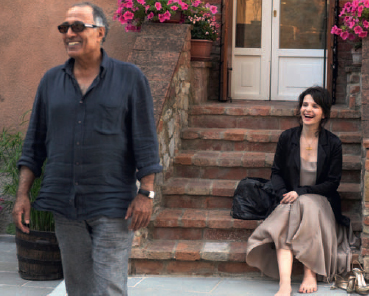
 At first, it can be accepted that they are strangers to each other. A British art historian James Miller(William Shimell) is visiting Italy for promoting his latest book “Certified Copy”, which delves into the matter of the original and copies. In the opening scene, he talks about his book and the motive behind it to the audiences including a French woman(Juliette Binoche), who comes to the lecture later than him. While her son gives little annoyance to her, she talks something to Miller’s Italian translator in his ear, gives him a note, and leaves the place.

 Later, Miller visits the antique shop run by that unnamed woman(according to IMDB, her name is Elle but her name is never mentioned in the film). After having some conversation with her, he accepts her offer, and they spend the afternoon together. They go to a nearby town by her car. They visit the museum in that town. They drop by some cafe. They walk around the town. They continue to talk and discuss about his book and its theme. And the relationship between them seems to be transformed into more intimate than we thought at first.

 The turning point of this subtle process comes around during the cafe scene. While Miller gets out of the cafe for answering his cell phone, she is approached by the cafe owner, a middle-aged lady, who assumes she and Miller are a wife and a husband. She does not correct the misunderstanding while complaining about her husband’s indifference to the cafe owner. She tells Miller about this amusing misunderstanding when he comes back. After leaving the cafe, she behaves as if he were her husband. He goes along with that. As the time goes by, they begin to resemble a married couple.

 While observing their role-playing, we begin to ask ourselves: were they a couple from the beginning? I do not think so due to several reasons shown during the first half of the film. But, even if we settle on that matter, we still cannot be entirely sure about what they feel or think throughout the movie. Their role-playing can be more or less than the flirtation to both of them, but there is always something enigmatic about their interactions, and the film does not have any explanation for that.

 Both Juliette Binoche(she won Best Actress award at Cannes Film Festival for this movie in last year) and William Shimell, are engaging enough to hold our attention while never giving us any clues that might ruin the tantalizingly elusive side of their relationship. Binoche shows her versatility in going through several different, contradicting modes without awkwardness. Shimell, who has no previous acting experience before this movie, ably supports her with his calm performance. Their nuanced performances always show one thing while suggesting the other things, even when their situation goes a little more melodramatic when they talk about the problems in their, uh, past.

 The movie sometimes feels a little bit heavy-handed whenever emphasizing its theme through the characters, but the director Abbas Kiarostami’s effortless approach compensates for its weakness. Through careful long takes and close-ups, he subtly increases our intimacy to his characters. Even we are wondering about who they really are, we are still close to them none the less.

 Some of Kiarostami’s notable works were introduced to South Korea around the time I got interested in movies. One interesting thing about “Through the Olive Trees”(1994) is that, as a movie about making movie, it is fictionally framed into his another movie “And Life Goes On,..”(1992), which is fictionally connected to his another work “Where is My Friend’s Home?”(1987). While they can be appreciated individually, they also make the interesting picture of the reality and the fiction as the copy of the former.

 That aspect is extended to the difference between original and copy questioned in “Certified Copy”. In the middle of the movie, the characters see the painting in the museum which turned out to be not the original but has been valued as its copy. That ignites another discussion between them: can copy be as good as original? Miller thinks so; he argues that with Leonardo DaVinci’s “Mona Lisa” as the example. In his view, “Mona Lisa” is basically the copy of some woman that existed in the past, but people value it anyway. And, in biological view, that woman was the complex copy of human genomic materials mixed with some variations. If so, can it be said that there is no original in the world, after all? And are we watching the copies of one relationship in this movie?

 It throws these questions and others to us without providing answers for them, while confounding us with the amorphous relationship that can be interpreted in more than one way. With its vagueness, “Certified Copy” could have been a distant intellectual exercise, but it is a fascinating movie with good performances and subtle direction to draw our interest to its enigma and thoughts surrounding it. I am still not so sure about who they are, but this is a well-made copy that made me very curious about what I saw on the screen.

Posted in Movies | Tagged , , , , , , | 3 Comments

05/08/11 – A Cat, Geese and ducks, and flowers

Photos taken at my campus on 05/08/11

The sun is shining. The sky is blue. The Avian gangs are still terrible. And the flowers are everywere.

Posted in Photos | Tagged , , , | Leave a comment

Source Code (2011) ☆☆☆1/2(3.5/4) : Clever SF thriller within repeated 8 minutes

 Above all, “Source Code” is something I welcome without hesitation: a smart SF thriller with efficiency and skills. Its scientific settings are a little too shaky and ambiguous, and, to be frank with you, I had to operate some parallel thinking process in my brain while following the simple storyline because of that reason, but the movie confidently, and repeatedly, moves with clear direction. It is compelling enough to hold our attention, and we accept several preposterous aspects in the story, and its relatively short running time seems shorter that it actually is.

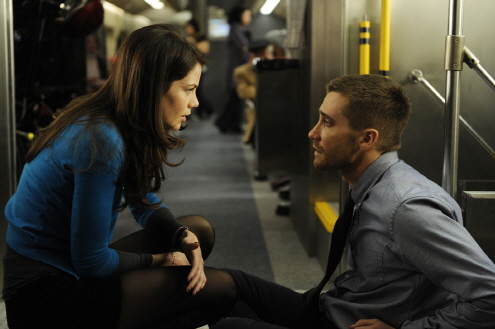
 Colter Stevens(Jake Gyllenhaal) suddenly faces the disorienting situation. As far as he remembers, he, as an American Army helicopter pilot, is doing his duty in Afghanistan. But now, strangely, he wakes up to find himself on a commuter train heading to Chicago. He sits opposite to the woman he has never met before in his life, but she talks to him as if they had been acquainted with each other. Moreover, he discovers that he is currently not occupying his own body. He is Stevens played by Gyllenhaal in our view, but he is seen as someone else in the view of others on the train.

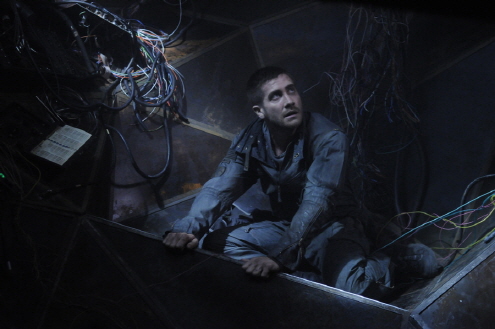
 What is happening to him? He soon gets the answer. Few minutes after the train passes the last station before Chicago, the bomb somewhere in the train explodes. Everyone dies as a result, and then he wakes up in a far different situation. He is confined alone inside the place resembling the spacecraft module. And he still cannot remember why he ends up in such a dark, solitary place like that.

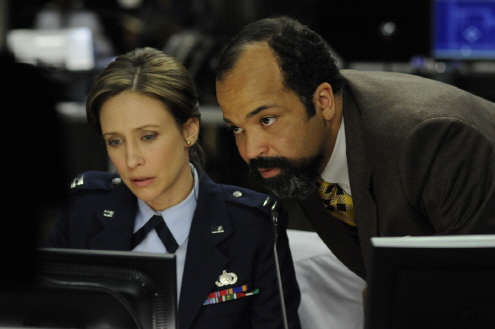
 He begins to grasp his current reality through the communication line linked to the world outside. According to Colleen Goodwin(Vera Farmiga) and Dr. Rutledge(Jeffrey Wright), Stevens is in some special government facility where medical technology, computer technology, and quantum physics are combined together to develop the cutting-edge technique for sending the subject to a certain point of the past. There was a bombing incident on that train, and, utilizing the brain from one of the victims, some history teacher named Sean Fentress, they can send Stevens to the 8 minutes before the incidents(that’s the limit) again and again. It is his job to find the bomber whose terror is merely a prelude for the bigger plan targeting Chicago downtown(by the way, where do they get the information about that?).

 Several questions naturally arise from this shaky premise. At first, Source Code, their software program for sending Stevens to “the past”, looks like the virtual reality based on the remaining information from Fentress’ brain, but it seems more like parallel worlds discussed in quantum physics(A voice cameo by Scott Bakula from “Quantum Leap” is one of small nice touches in the film). Stevens can freely do whatever he wants in limited time, so it may be possible to create alternative timelines.

 But don’t he and others on the train exist only in the electronic world inside supercomputer? As the scientist supervising the project, Jeffrey Wright lends some believability to the story although its science is still hiding behind some scientific mumbo-jumbos. I have no idea about how it will be useful or how it will be applied to other kinds of situations, but his character is utmost serious. He is willing to get the success while knowing its cost, which, incidentally, he can ignore without much problem.

 Nevertheless, the movie is very enjoyable for Ben Ripley’s screenplay does not lazily depend on the main mystery of its mechanistic plot. As many people have already pointed out, it is a thriller version of “Groundhog Day”(1993), and it does a lot more things inside the limits it sets on its story. While trying to find the bomb and the bomber amid repeated 8 minutes, Stevens also gets intimated with the woman with whom his mission always resumes. In addition, like us, he begins to be suspicious about his confounding state. He eventually learns of his limits, and he chooses to exert his free will in the limited range.

 In the end, like the movie, he does lots of things in 8 minutes. I have some doubts about how it is possible, but I can say Jake Gyllenhaal is convincing as the hero going through lots of tandem repeats and accompanying developments. As the woman whom he comes to care about, Michelle Monaghan gets a basically thankless job, but she follows his steps nicely. We believe the feelings growing between them along the cycling plot. Vera Farmiga gives a subtle balanced performance as the officer who may know more than what she tells to Stevens and us; the movie leaves behind certain possibility behind her character to provoke another interesting thought.

 The director Duncan Jones previously made an impressive debut with a very good SF movie “Moon”(2009), and he makes another good SF movie again. If you have watched “Moon” before, you will surely notice lots of common aspects shared by both movies, including the hero alone with repetitive assigned mission to do in the limited space, and serious questions on the individual rights and freedom in the system.

 “Source Code” is a lean, clever, and efficient thriller skillfully handled by people who knows what they deal with, and I found it very entertaining in spite of several visible faults in the story. While enjoying it, my mind went back to one of the interesting moments I experienced during my tour in Chicago in last year. One day, I was fortunate to observe the actors and crews of “Source Code” making one scene for their movie in the Millennium Park. Although only few minutes are included into the movie, it took more than one hour for them to prepare and shoot the scene. They tried several ways – different camera positions or various camera movements(I immediately sensed from the camera movements that the movie was not a urban romantic comedy) or some alternative scenes that I will probably come across through DVD(or blu-ray).

 In retrospect, it was fascinating, but, at that time, I was frequently bored. While sitting on the bench and waiting for capturing Gyllenhaal and Monaghan on my camera, I spent my time with some curious articles in Chicago Sun-times along with new reviews from Roger Ebert. While watching the movie at the theater on this Thursday, I could ask myself a variation of that famous question said by Mr. Ebert’s dear friend and former colleague Gene Siskel: “Is the movie I am watching as interesting as watching the actors and crews working together for more than one hour?” I can easily answer that right now. Yes, and it is more interesting.


P.S.

1. Some renowned South Korean critic felt sorry about that history teacher Sean Fentress. So do I. Rest in peace, Mr. Fentress, although you can’t, partially.

2. I go to the downtown by commuter train during my tour in Chicago. While watching the commuter train on the screen, I learned 32 million dollars budget makes a lot of difference; the interior looks more polished and comfortable than in real life.

Posted in Movies | Tagged , , , , | Leave a comment

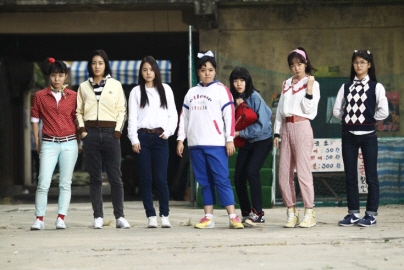
Sunny (2011) ☆☆☆1/2(3.5/4) : Seven Girls – Now and Then

 Probably my dreadfully gregarious older cousin sisters can identify with the characters in “Sunny” far more than me because most of them were high school girls around the 1980s. Even though it was one of turbulent chapters in South Korean history, they sometimes have some private time for reminiscing about their adolescence with nostalgia, smile, and, finally, little bit of bitterness generated from the gap between hopeful past and pragmatic present.

 In case of me and other audiences, we may not be the most ideal audiences for this film. I think some of jokes probably eluded me while watching it. But, what the hell, “Sunny” is as funny as it can be to average audiences, and it is one of the funniest South Korean comedies of this year. While there are some weaknesses such as the running time a little bit too long, the movie is a feel-good movie stuffed with small and big laughs, and it does not thankfully resort to cheap tears in the mandatory third act melodrama.

 The movie has seven main characters, and one of them is Na-mi(Yoo Ho-jeong). She is a conventional South Korean mom, and her family live in some nice apartment building that probably costs around half million dollars. She prepares the breakfast for her husband and her high school daughter in early morning. After they leave the house, she maintains the house alone just like every other day. Her life is affluent thanks to her husband, and the bond between her and her family is not that distant, but she can help but feel like weariness in her life.

 It sounds pretty much cliché, doesn’t it? Well, the fresh air imbued to her mundane life is also another cliché in the story, too. When she visits her mother in the hospital, she comes across one of her old high school friends, Choon-hwa(Jin Hee-Kyeong), who was the leader of the sisterhood circle named “Sunny”. Choon-hwa is a terminal patient with few months to live, so, by hiring the private detective agency, Na-mi decides to find their other friends for reunion, whom she has not met for quite a long time. While she meets them one by one, the movie looks at the memorable episodes in their past one by one. They were all young, hopeful, and confident in those days, but now, as realistic middle-ages ladies, they have to live with various degrees of disappointments and frustrations in their lives.

 The outcome is already is set from such a setting like this, but the director Kang Hyeong-cheol knows how to make an effective comedy out of this familiar premise. The surprise is one of the crucial factors in making us laugh, and he constantly ambushes us with funny moments, which spring from the screen here and there for 2 hours. Kang is deft in both big and small laughs. While my personal favorite is its making a small fun of trashy South Korean TV dramas, one of the biggest laughs comes from the big street demonstration sequence, where Na-mi and her friends have a big showdown with their rival circle in an unexpected background they do not care about much – until the things get a little bit more serious.

 We South Koreans audiences all know the 1980s was a very violent time due to dictatorship as shown in several recent South Korean movies including “Memories of Murder”(2003). The film indeed reminds us that fact through one of supporting characters, and one of our famous dictators on TV, but its approach to our past is indirect and lighthearted. For example, in one scene, the riot police waiting for the command in the night alley function as the cheerleaders for young Na-mi’s romantic moment with a lad she has a crush on. You can say that the movie ignores the darkness of that period, but, don’t we all remember our past, if not all of it, in rather rosy way? And I have to point out that demonstration scene is, like other good scenes, so funny that the screening room was instantly filled with healthy laughter even though most of them knew how hard that time was.

 Furthermore, the movie also works as a drama about the strong bond between these seven ladies. By re-awakening their past, their mundane, or miserable in some cases, lives begin to be enlivened. That change results in another funny sequence in the public park where they are determined to recreate their good old tough time. Their behavior is silly in their age, of course, but we understand they have never felt so good like that for many years, so we smile with them. Because one of the characters is dying, the story is logically shifted to the area of melodrama in the third act, but the movie earns the tear for we come to care about them while having big laughs – and it does not forget making us laugh and smile even at the end.

 Kang Hyeong-cheol’s previous(and his first) movie was a hit comedy “Speedy Scandal”(2008), a funny comedy which I gave 2.5 stars for resorting to end the story with cheap melodrama and an “Idiot plot” based on misunderstandings that can be solved only with few words. Nevertheless, while disappointed a lot, I pointed out how its first one hour made me laugh a lot in my Korean review. Amidst lots of lousy South Korean comedy movies that attempts comedy in pathetic ways, it was quite refreshing to see the work of the director who really knows about essentials of comedy: performances, music, pace, and so on. He did not do anything groundbreaking, but he came to me as a fresh talent in South Korean comedy.

 And, boy, he is defter in his second movie. The most remarkable thing about the screenplay co-written by him is that, besides being a very hilarious story, it successfully juggles not only seven main characters but also their younger counterparts and the supporting characters surrounding them. The characterization is broad, but each of main characters is given distinctive features. Though you forget their names while following the story, it is very easy to tell apart each of them from others. While occupying the relatively small places in the fringe, the supporting characters are well-organized for the comedy and drama in the story. Brimming with liveliness, they sometimes are more than what they seem to be. Although Na-mi and her daughter look like estranged mother and daughter, we can infer that they are connected to each other more closely than we thought. The film never explains, but it implies the interesting things possibly lurking behind the story and the characters, as exemplified the delinquent girl who torments young Na-mi and causes the grimmest moment later in the story.

 Under Kang’s competent direction, the movie fluidly goes back and forth between the past and the present. The obligatory transitions never feel awkward, and I was amused by how corny the 1980s was compared to our time(but I am sure the younger generation in the 2010s will regard my generation in the 1990s in the same way). The soundtrack, mainly consists of the popular songs in South Korea during the 1980s, serves the story and emotions inside it precisely. The adult performers are matched well with the young performers. Their ensemble performance is simply fantastic; all of fourteen actresses are uniformly good, and we can sense that they are really having a good time.

 “Sunny” is a immensely loveable comedy. Released in this weekend, the film is being loved by both critics and audiences in South Korea at present. Though I am afraid some of you cannot understand some parts due to its inherent cultural gap, its typical story and storytelling device can be common enough to draw you inside the past the characters joyously shared and wistfully remember(heck, I can name at least half a dozen ‘now and then’ movies made in Hollywood right now). It is generic, but it does its hefty job far better than I initially expected. Folks, this is the most delightful energizer I’ve seen from South Korean movies in these days.

Posted in Movies | Tagged , , | 5 Comments

Cave of Forgotten Dreams (2010) ☆☆☆1/2(3.5/4) : Into the artworks from the Stone Age

 There are several reasons why Werner Herzog’s documentaries are usually interesting. One of the reasons is that, while being one of the most entertaining directors in the world, he is also one of the most amusing documentary narrators. He is dead serious while deeply musing on his subjects. His narration sometimes swerves into unexpected directions, and we get some deadpan moments to savor later. In “The Encounter at the End of the World”(2008), one of the most memorable moments is when he asks an expert about “gay penguin”.

 Also, he gives us wonderful moments to remember in his works, and he did it again with his latest documentary “Cave of Forgotten Dreams”. From the famous cave that has been nearly inaccessible because of preservation, he vividly captured the uncanny atmosphere of its interior along with the beautiful artworks created by the nature and men. The movie immerses us into this amazing world, and I think the movie is worth my 1-hr bus ride to Jeonju International Film Festival in this weekend.

 In 1994, a cave was discovered on the limestone cliff by three speleologists in southern France. It turned out that Chauvet Cave, named after one of the speleologists, Jean-Marie Chauvet, was like a big time capsule from the Paleolithic age. Although many caves were found and known for their archaeological value around that area, Chauvet Cave surpasses them all in many aspects. Besides lots of cave paintings drawn on its walls long time ago, there are many other valuable traces from the Paleolithic era including fossilized animal bones. Furthermore, because the entrance of the cave had been blocked by a rock for more than 20,000 years, they had been preserved in a nearly perfect condition for quite a long time. Based on the radiocarbon dating, it is accepted by most scientists that the cave has the oldest cave painting. It also has the oldest human footprint from around 25000 years ago, which belongs to some child.

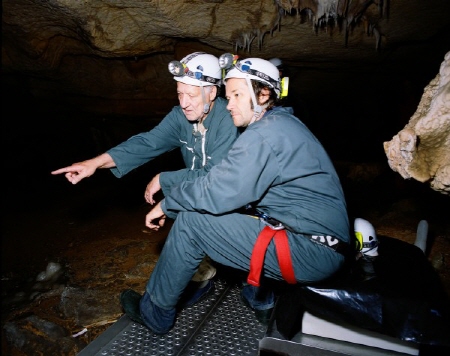
 Since its discovery, the general public has been not allowed to enter, and few people got the access to the cave for academic reasons. In case of Herzog, he got the special endorsement from the French minister of Culture, but the rules were strict. The shooting time per one day was limited to only several hours. The crews only consisted of Herzog and three peoples including the cinematographer Peter Zeitlinger. They had to wear special shoes and clothes for not damaging the preserved environment inside. They always remained in the established path while shooting, and there were some areas they were not allowed to enter due to the high concentration of carbon dioxide in the air, which is very toxic to human body.

 In spite of these limits, the sights captured on the camera are awe-inspiring. There are various kinds of animals from the ancient times depicted on the walls, including horses, rhinoceros, bears, and mammoths. Some of the paintings provide very helpful information to paleontologists. For example, they were not so sure about whether male cave lions, one of the extinct species, had mane, but, thanks to one of the paintings in Chauvet Cave, now they know the answer.

 The cave paintings are not just valuable as artifacts; they are also valuable as artworks. The paintings shown in the film are the good evidences that our species found the creative way to communicate visually with others during the early chapter of human history. Not only they have information, but also they have styles and feelings and characters. The depictions of moving animals in the paintings are remarkable; some of them might be the first early step of the path leading to the moving pictures – or movies. There are red hand prints on the cave surface. You can see that they all belong to the same man because of the distinct feature of his little finger. In addition, the nature has silently decorated the cave with plenty of calcites, stalactites, stalagmites, and other exquisite mineral structures. Along with the remains suggesting some religious rituals, they create the elusively mythical mood in the cave.

 Compared to that dreadful 3D cave adventure movie “Sanctum”, the film gives a much better 3D experience inside cave. Although he does not like 3D much, Herzog decided to use 3D technique for he thought it was effective way of capturing how the painters used the bulges and contours of the walls in their works. 3D effect still has its own distracting aspects in his film, especially in the scenes outside the cave, but it works successfully in the cave as much as he intended. Through 3D effect, we can fully appreciate the surfaces in the cave as well as the 3D map of Chauvet cave made by the computer. The light sources were limited due to regulation, but Herzog creatively used that limitation to convey us how the paintings looked to the ancient painters who only had torches at their time.

 There are some funny moments in the film, and, while I watched the movie in the screening room full of audiences, and they frequently laughed because of his offbeat questions and remarks. The first laugh came from the former occupation of one of scientists interviewed in the film. We were tickled by Herzog’s droll comment when one expert clumsily tried to reproduce the primitive hunting method. By the way, I have never thought “Baywatch” can be used for the comparison with the ancient artworks, but, come to think of it, we have always been motivated by sexuality from the beginning, haven’t we?

 And then there is an interesting closing chapter waiting for us at the end of this engaging experience. It seems redundant(it is titled “postscript”) but I have to say it is as quirky as those iguanas in his previous movie “The Bad Lieutenant: Port of Call – New Orleans”(2009). I don’t know why Herzog added it to the movie, but I can say it is a nice footnote to the marvelous images from the special cave rarely shown to us.

Posted in Movies | Tagged , , , | 2 Comments

Near South (Chicago,IL) (04/09/10)

 
These photographs were taken in Near South area of Chicago,IL on April 9th, 2010.
Posted in Chicago, Photos | Tagged , | Leave a comment