Kent Jones’ new film “Late Fame” is a somber but engaging character drama about an old ex-poet suddenly getting some little but unexpected attention. Although it is not entirely satisfying due to its several under-developed aspects, the movie works thanks to its low-key humor and realistic urban atmosphere, and it is also supported well by the presence and talent of one of the most interesting movie actors of our time.
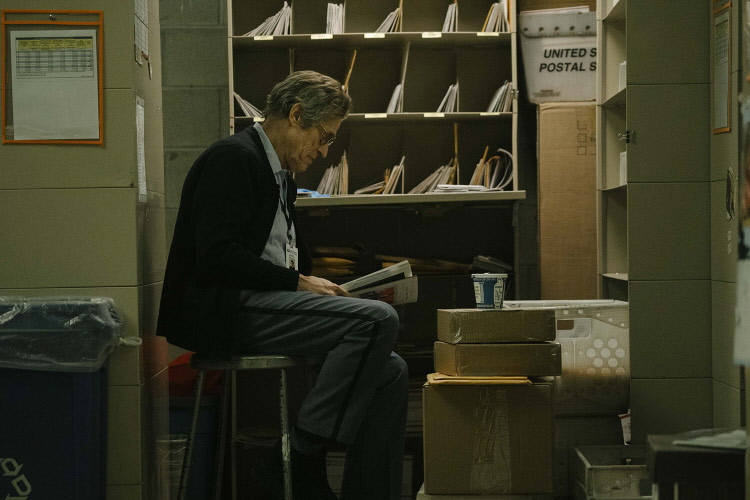
Willem Dafoe, who effectively dials down himself here as he did in his Oscar-nominated supporting turn in “The Florida Project” (2017), plays Ed Saxberger, an old single man who has modestly earning his living via working in a local post office in New York City. Around 50 years ago, he was a young aspiring poet drawn to the bohemian art scene in the city, but he did not have any significant artistic success besides publishing one little poet collection book of his, and now he is just content with going through his mundane daily life day by day.
On one day, Saxberger is approached by someone when he returns to his little apartment in the city. He is a lad named Wilson Meyers (Edmund Donovan), and he is quite interested in getting to know Saxberger after coming across that obscure poet collection book of his. While he is not so interested at first, Saxberger eventually agrees to meet a group of aspiring young writers led by Meyers, and they are all eager to get to know and learn more from him, though he does not have much to tell because his brief artistic career is a distant old past to him now.

Nevertheless, Meyers remains willing to revive Saxberger’s artistic career. He encourages Saxberger to write any new poem, and he even introduces Saxberger to an acquaintance of his who may help Saxberger a bit in restarting his artistic career. As days go by, Saxberger gradually becomes a fixture in Meyers’ group, and he also happens to draw the attention of Gloria (Greta Lee), a young actress who often hangs around with Meyers and his colleagues just for fun.
However, it does not take much time for Saxberger to sense more of the distance between him and his sudden young admirers. Most of them are from wealthy families, and it goes without saying that they are not that serious or desperate about whatever they are trying to achieve someday. They often regard young online influencers with a lot of disgust and annoyance, but they still let some young online influencers stay around them in their little private place because, well, they also crave for any attention or recognition on whatever they are doing together.
Clearly discerning who they are, Saxberger did not expect much from these superficial young people from the beginning, but he also cannot help but be more delighted by their growing attention. He does not have any particularly good advice for their creative process, but he tries his best in helping them a bit anyway, while continuing to enjoy their company.
And he finds himself more fascinated about Gloria, who seems to be actually interested in getting closer to Saxberger but still puts some distance between them as before. In contrast to Meyers and his colleagues, Gloria does not tell much about herself at all, and this surely makes Saxberger all the more curious about her, but she still prefers to be away from his reach even after they have a little intimate moment between them.

While it eventually takes a number of predictable narrative turns later, the screenplay by Samy Burch, which is based on the novella of the same name by Arthur Schnitzler, takes its time as before as serving us more character details to observe and reflect on. Things become a bit more humorous as Meyers and his colleagues try to prepare for a little promotional event, and we are often amused by their seriousness. As Saxberger struggles to write something new to present at that event, the mood becomes a bit pensive for a while, and we get a brief but wonderful moment as he tries to grasp any possible way to develop one small poetic idea.
Although it stumbles more than once around its last act (A subplot involved with Saxberger’s family issue feels rather artificial, for example), the movie did a fairly good job of presenting the story and characters with considerable realism. The urban mood and background surrounding Saxberger and the other characters in the film are vivid and palpable, and Dafoe and several other cast members in the film are believable in their respective roles. Dafoe’s understated acting steadily holds the center as required, and he is particularly good whenever his wrinkled but expressive face silently conveys to us his character’s inner thoughts and feelings. Greta Lee and Edmund Donovan have some juicy moments along the story, and Lee plays her flamboyantly theatrical character with enough charm and gusto to hold our attention.
In conclusion, “Late Fame” is fairly enjoyable thanks to not only its talented cast members but also Kent’s thoughtful direction. While being mostly known for his film criticism career, he also directed documentary film “Hitchcock/Truffaut” (2015), and then there came his first feature film “Diane” (2018). Although it is not better than “Diane”, “Late Fame” still has enough stuffs to admire, so I recommend you to give it a chance someday.