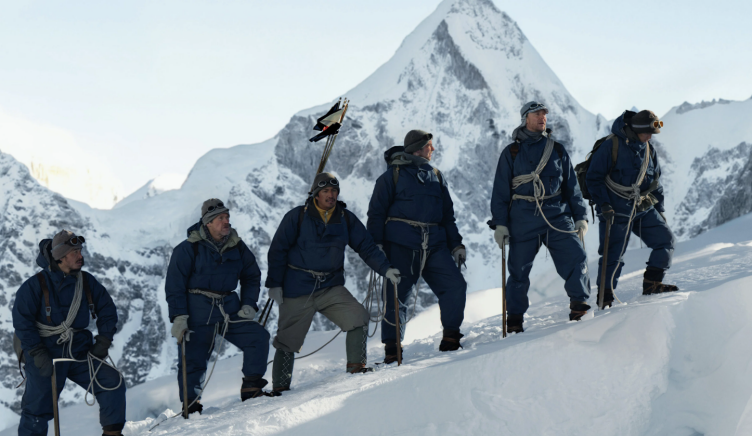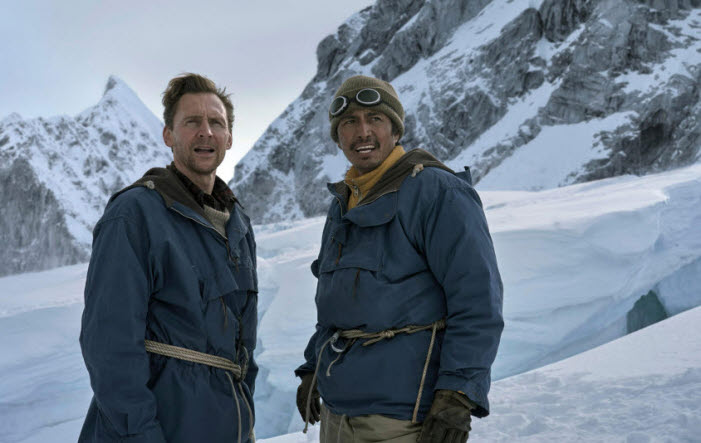
“Tenzing”, which was released on Apple TV on last Friday, is a solid biographical drama about Tenzing Norgay, a famous Sherpa who succeeded with Sir Edmund Hilary in their 1953 ascent of Mount Everest. While this is your average clean-cut biopic, it handles its main human subject with enough sincerity and respect, and we come to have more understanding on the considerable efforts of its hero behind that historical feat.
The screenplay by co-producer Luke Davies, which is developed from the story written by Davies and director/co-producer Jennifer Peedom, opens the story with a rather clichéd moment. We see how Tenzing (Genden Phuntsok) came to aspire to climb onto the top of Mount Everest someday when he was just a little boy in the early 1920s, and then the movie flashes forward to 1953. After many years of following his aspiration, Tenzing becomes a well-experienced Sherpa, and he was almost successful in climbing onto the top of Mount Everest during the Swiss expedition in the previous year.
When he is later requested to join the upcoming British expedition, Tenzing is hesitant mainly because he promised to his family that he will not risk his life again, but, after having a heartfelt private conversation with one of his children, he eventually decides to join the British expedition on one very important condition. He demands that he should join the expedition as one of the team members, and John Hunt (Willem Dafoe), who is the leader of the British expedition, cannot say no because Tenzing is undeniably one of the best professionals in the area.
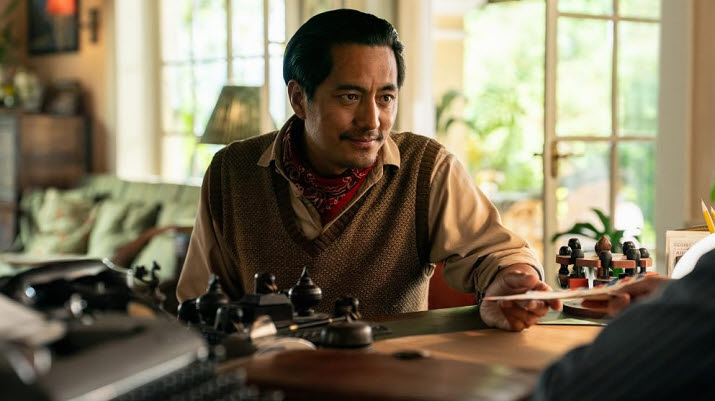
Nevertheless, Tenzing faces some discrimination from not only Hunt and his expedition team right but also some of his fellow Sherpas. While Hunt and his white team members sleep inside a big house, Tenzing’s fellow Sherpas have to sleep in a stable instead, and Tenzing chooses to stick to his fellow Sherpas even though he is not regarded well by some of them just because of his different ethnic background. As shown from a series of flashback scenes along the story, he and his family moved to Nepal from their hometown in Tibet when he was young, and he already experienced a fair share of discrimination even at that time.
Anyway, Tenzing keeps focusing on doing his job as a team member who is also in the charge of the other Sherpas in the team, and we see how the expedition team makes progress step by step. During their first several days, the weather is warm and sunny as you can expect from springtime, but it gets colder and harsher when they arrive at the foot of Mount Everest and then set their base camp there. Because they have only a few weeks before the weather gets much worse, they must be as fast and efficient as possible, but, of course, there are a number of obstacles including the mountain itself.
While showing more of his bravery and resourcefulness, Tenzing comes to get more respect and recognition from Hunt and the expedition team members, though we still see the distance between them and Tenzing. In addition, his fellow Sherpas are worried about whether they will lose their main source of income if the expedition turns out to be successful, and this naturally causes some conflict between them and Tenzing.
At least, Tenzing gets unexpected support from Hilary (Tom Hiddleston). As a New Zealander, Hilary understands a bit of how Tenzing is often disregarded and discriminated by the others in the team, and he and Tenzing come to bond more with each other once they agree to become a team together at the last stage of their ongoing expedition.
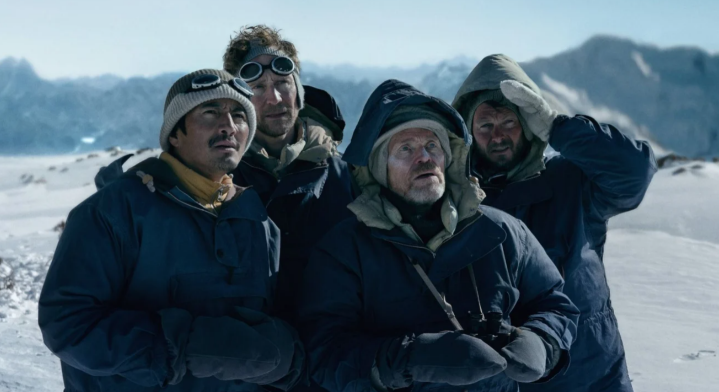
While these two guys and several other team members go through one risky obstacle after another, the movie doles out a series of vivid and realistic moments to chill or amaze you. The cinematography by Stefan Duscio is often stunning for its coldly crisp landscape shots, and the performers in the film look believable as their characters handle their numerous obstacles on their way, though I am sure that they performed under much safer conditions.
Around the point where Tenzing and Hilary are about to go through the last stage of their historical ascent (Is this a spoiler?), the mood becomes a bit melodramatic as Tenzing cannot help but become haunted by the memories of his recently diseased wife, but the movie sticks to its understated mood as steadily focusing on how Tenzing and Hilary depend more on each other for their common goal. Regardless of which one actually climbed onto the top of Mount Everest first, they came to have more respect toward each other as sticking together more, and it is no surprise that they really became lifelong friends after getting their mission accomplished.
The main cast members of the film are well-cast on the whole. Genden Phuntsok, a Chinese actor of Tibet descent, holds the center well with his earnest performance, and his solid acting is also connected well with Samdrup Dorje Lama and Tenzin Dalha, who respectively play younger Tenzing in several flashback scenes in the film. In case of Tom Hiddleston, Willem Dafoe, and Caitríona Balfe, they dutifully fill each own place without overshadowing Phuntsok, and Hiddleston subtly supports Phuntsok during several key scenes of theirs in the movie.
In conclusion, “Tenzing” is more or less than your typical standard biopic, but it is still worthwhile to watch thanks to its respectful storytelling coupled with considerable realism and several good performances. After watching the movie, you may be interested in learning more about who Tenzing Norgay was, and I think the movie accomplishes that mission fairly well.