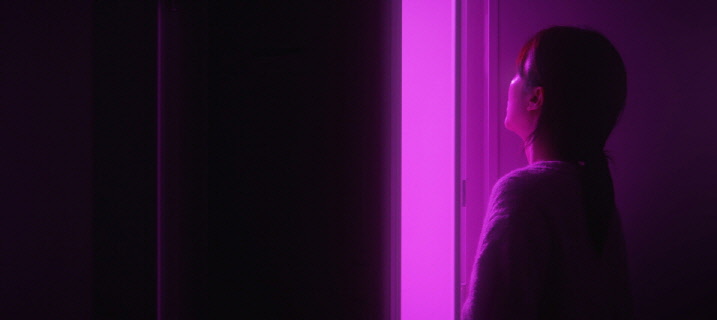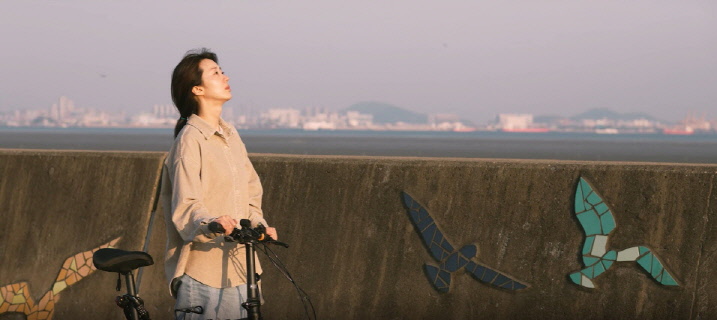
South Korean independent film “Purple Swallow” often feels like closely and patiently watching someone struggling a lot to concoct and then develop a rather vague story idea again and again. At first, it simply observes the artistic frustration of its plain young heroine, but then it begins to blur the line between reality and fiction as casually hopping from one different part to another. As a result, you may find yourself becoming more baffled about its increasingly multi-layered narrative.
The opening part of the film introduces us to its unnamed heroine, and we come to gather that she has been trying to make a literary debut during last several years. After receiving the news on a fellow female writer’s successful literary debut, she cannot help but feel bitter about her current writing status, and her only consolation comes from her supportive husband, who has incidentally been building up his own artistic career to a modest degree.
When her husband later says that he unexpectedly saw a purple swallow coming into the boiler room of their cozy apartment, she does not believe him that much. After all, the weather has been getting colder day by day as winter is coming, and most of swallows have already gone to the south. However, this somehow stimulates her artistic imagination, and she soon comes to have a little strange experience after hearing something from somewhere inside the apartment during the following night.
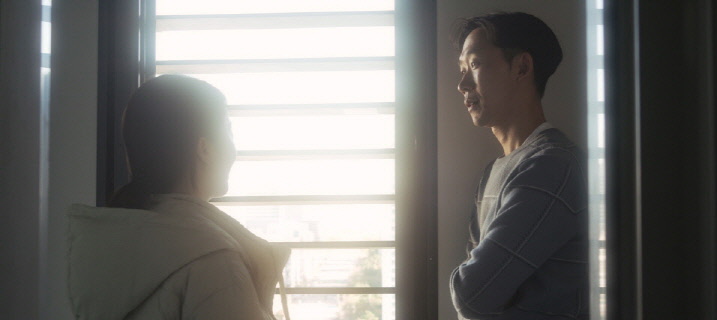
After that narrative point, the screenplay by director/writer Cho Young-geun, who also did the editing and cinematography for his movie, doles out a series of moments which look like the narrative variations based on whatever inspires its heroine. All of these narrative variations are basically two-handers driven by who are clearly the fictional versions of her and her husband, and we often feel like watching how she tries one thing after another for making her story more interesting.
While the first narration variation is rather flat as simply recreating her relationship with her husband, the second one becomes a bit more interesting as their fictional versions come to have a big conflict over her recent failure in making a literary debut. As they push and pull each other, the mood becomes a little more tense, but then the story gets fizzled as if the writer behind it did not know what to write next after that point.
In case of the third narrative variation, this is the most interesting part in the movie in my trivial opinion. This time, the heroine and her husband are turned into two total strangers who encounter each other for the first time when they come to some remote spot for photographing birds and landscapes. Not so surprisingly, we come to sense something mutual being developed between them as they come to spend more time together.
Just like the previous parts, this part merely dwells on its story idea and premise without going for more narrative development, but this weak aspect is mostly compensated by not only its solid black and white cinematography but also the effortless chemistry between its two lead performers. Although they have to play their roles on several different modes along the story, Im Yu-won and Jung Jae-yoon ably complement each other throughout the film, and they function well as the emotional anchor of the story even though their characters feel a bit too superficial at times.
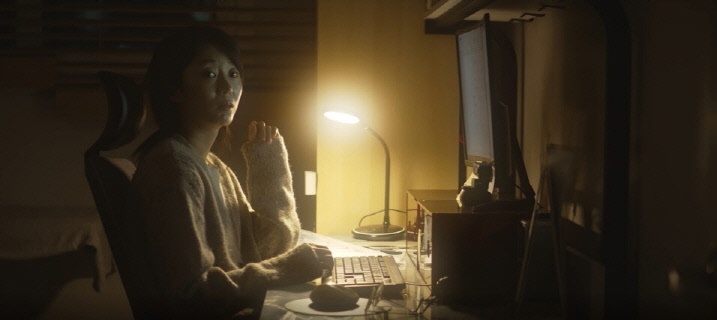
Around the last part, the movie becomes more symbolic than before, and that is where it stumbles more than once. This time, our heroine is a writer who has just completed a story which may help her in making a good literary debut, and you can easily guess the title of her story right now. After she is visited by a dude who is surely another variation of her husband, something odd occurs when he tries to fix the boiler of her apartment, and she cannot help but become more fixated on what he told her before leaving her apartment.
Not so surprised by the eventual symbolic moment at the end of the film, I observed more of its artificial aspects. While I came to accept it as a little storytelling experiment, it does not have enough emotional ground to hold my attention, and I also think it spells out its main themes too blatantly. Sure, I am glad to learn a bit about its main background, which is incidentally an island district near Inchon, South Korea (As reflected by one brief moment in the middle of the film, this area is not so far from Inchon International Airport, by the way). However, that does not resonate a lot with the main themes on the whole, and I only came to observe more of its rather vapid and opaque qualities. As a matter of fact, I often checked my watch as becoming more impatient and bored despite its short running time (65 minutes).
Overall, “Purple Swallow” is more or less than a test run which unfortunately does not result in something engaging enough for my attention. Yes, I did sense its points to some degree in the end, but it mildly disappointed me with rather empty impressions on the whole. Nevertheless, as far as I could observed during my viewing, Cho is a competent filmmaker who knows one or two things about how to interest us with mood and performance, and I can only hope that whatever may come next from him will be more substantial and engaging in terms of story and character.