Logan (2017) ☆☆☆1/2(3.5/4): Wolverine on gritty, elegiac mode

logan01

Besides being the best work in the X-men series, “Logan” is possibly the best superhero film since Christopher Nolan’s Batman Trilogy. While there are several top-notch action sequences in the film, story and characters always come first, and that is why it can do something rarely done in many other recent superhero movies: making us genuinely care about what will happen to its main characters in the end.

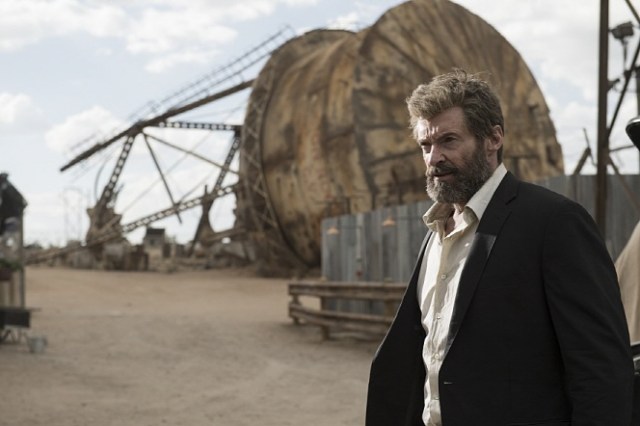
The story is set in the near future world where mutants have been almost eradicated mainly because of the absence of new mutants during last two decades, and the early scenes of the movie show Logan/Wolverine (Hugh Jackman) slowly going through his own decline. Currently working as a limousine driver around a border area of Texas, he still can pull out his shiny metal claws, but his aging body is not as strong as before, as shown from his accidental encounter with a bunch of hoods in the opening scene.

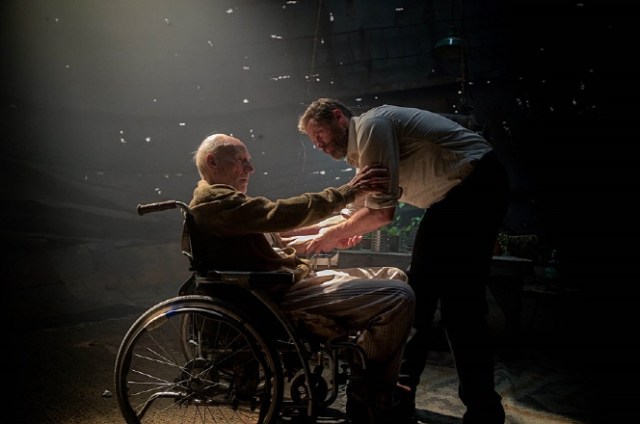
At least, he is not as senile as Charles Xavier/Professor X (Patrick Stewart), who constantly needs to be taken care of by Logan and their fellow mutant Caliban (Stephen Merchant) due to his deteriorating body and mind. Besides being heavily medicated, Xavier has been kept inside a big empty water tank in an abandoned factory for safety, and we see what danger he can inadvertently cause when his brain happens to have another seizure at one point.

While he goes through another working day as usual, Logan is approached by a Mexican woman named Gabriela (Elizabeth Rodriguez), who wants him to take a little young mutant girl accompanying her, named Laura (Dafne Keen), to some place in North Dakota. Logan initially rejects her, but he comes to agree to help Gabriela when she later offers him a considerable amount of cash, though he already knows well that he will get into a big trouble for that.

logan03

Of course, the trouble comes to Logan faster than expected, and he soon finds himself running away along with Xavier and Laura from a bunch of mercenaries chasing after them. While Boyd Holbrook is effectively villainous as the leader of those vicious goons, Richard E. Grant is slimy and shady as a big bad guy behind them, and their characters feel all the more loathsome to us when we later come to learn more about how cruel and ruthless they can be for covering up their heinous business associated with Laura.

Following its main characters’ perilous journey across the American continent, the screenplay by the director James Mangold and his co-writers Scott Frank and Michael Green attempts an interesting mix of western and road movie. With his dark, violent past, Logan can be regarded as a quintessential western movie hero who cannot get away from violence and guilt, and that aspect is clearly accentuated by the brief appearance of “Shane” (1953) in the middle of the film. His relationship with Laura is awkward and rocky at first, but he becomes a father figure to her during their journey, and she gradually comes to learn a few important things through Logan and Xavier.

The action sequences in the movie are quite gritty and brutal to say the least. While one very intense vehicle action sequence will definitely take you back to those impactful moments of Mad Max movies, the movie goes all the way for sheer verisimilitude in case of its physical action sequences. I found myself often cringing during many bloody, violent moments in the film which surely deserve R-rating, but I was also impressed by how these moments are handled well with enough amount of style, energy, and gravitas. We can really sense real dangers from characters’ actions, and we accordingly become more involved in what is at stake in the story. Although the expected climactic part may look modest in its scale, it works nonetheless as driven by story and characters, and that is definitely more impressive than usual CGI spectacles.
logan02

The two main performers in the movie comfortably embody their familiar roles as bringing more human aspects to their characters. Hugh Jackman, who will always be associated with Wolverine for the rest of his career, gives a solid performance as ably conveying his character’s growing vulnerability, and Patrick Stewart is poignant especially during the scenes where his character’s mind is more lucid than usual. They certainly know their characters to the bone, and we can always feel a long history between their characters even though they only mention their past briefly from time to time.

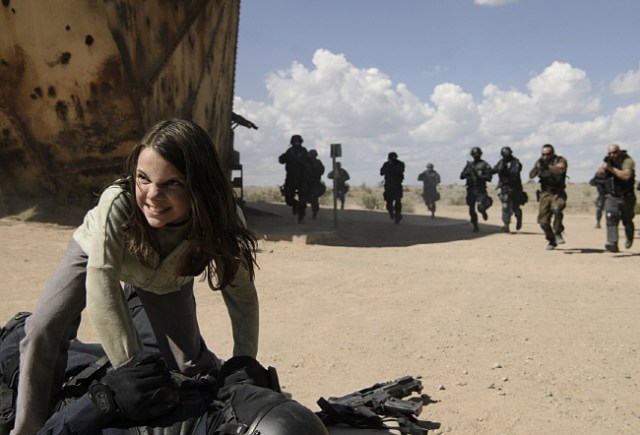
In case of young performer Dafne Keen, she holds her own place well between her two co-stars. I am still horrified by that little murderous superhero girl in “Kick-Ass” (2010), but Laura comes to us as a character as fascinating to watch as the young heroine of “Hanna” (2011) at least, and Keen effortlessly moves back and forth between innocence and ferocity while never softening her character at all.

Since it began with “X-Men” (2000), the X-men series has taken a long, convoluted road during last 17 years. After its first three films, the series went down with “X-Men Origins: Wolverine” (2009), but then it came to rebound with “X-Men: First Class” (2011), “The Wolverine” (2013), and “X-Men: Days of Future Past”, though that was soon followed by the bloated CGI spectacles of “X-Men: Apocalypse” (2016).

While it surely energizes the series, the elegiac tone of “Logan” seems to signify the end of a period like some notable western films during the 1960-70s did, and I somehow come to have more worry on its genre, which has felt like reaching to the level of exhaustion during recent years. I am still not so sure about what will happen next, but “Logan” shows some real possibility of significant change anyway, and we must appreciate that for now.
logan04

Posted in Movies | Tagged , , | 2 Comments

The Salesman (2016) ☆☆☆1/2(3.5/4): The trouble with their new place

thesalesman01

At first, Iranian film “The Salesman”, which recently won Best Foreign Language Film Oscar, intrigues us with a fascinating case of cultural juxtaposition. Its main title sequence shows us a theater stage in preparation, and we soon come to see that it is for the upcoming staging of Arthur Miller’s “Death of a Salesman”. The staging of a classic American play in Iran may sound unlikely to many of you, but, according to the review by movie critic Godfrey Cheshire, this is not an unusual thing at all in Iranian cities like Tehran, whose theater field has embraced many different western playwrights including Samuel Beckett, Eugène Ionesco, Harold Pinter, Tennessee Williams, Edward Albee and Sam Shepard besides its own old and new ones.

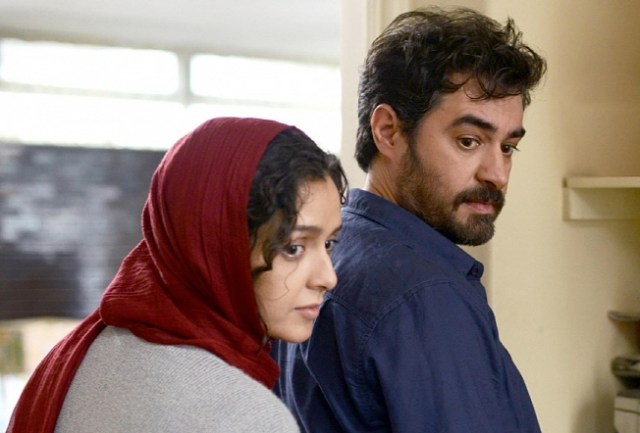
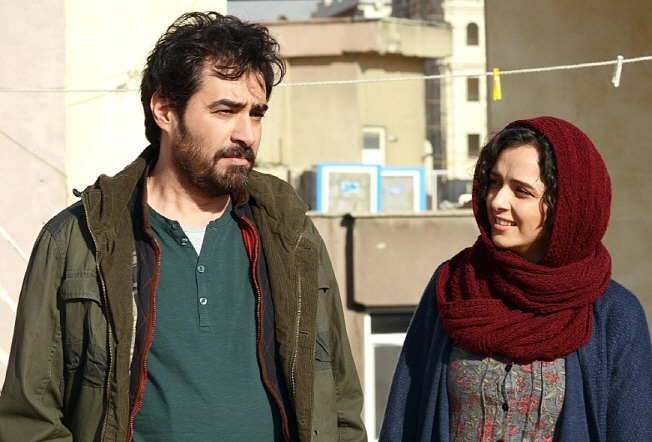
Anyway, its story revolves around two lead performers of that staging, Emad (Shahab Hosseini) and Rana (Taraneh Alidoosti). They are a middle-class married couple living in Tehran, and Emad also teaches drama at a school besides his acting work. During one scene, we see him teaching Gholam-Hossein Saedi’s classic Iranian play “The Cow” to his students, and we get one of the most humorous moments in the film as students are amused by its story (“How do people turn to cows?” – “Gradually!”).

After their apartment building is seriously damaged due to an unexpected incident, Emad and Rana have to find a new place to live as soon as possible, and there comes a good news from a friend/colleague of theirs. He shows them a recently vacated apartment which looks a bit shabby but mostly fine with two bedrooms, and it does not take a long time for Emad and Rana to decide to move into this place.

However, it turns out during their moving day that there is one annoying problem. Because the previous tenant, a woman who is the acquaintance of the aforementioned friend, has not gotten a new place to live yet, her belongings are still left inside one of two bedrooms in the apartment, and they eventually are put outside the apartment as she does not come back to retrieve them. While that woman never appears in the film, we get to know a few things about her; she has a child as reflected by the graffiti on the walls of that bedroom, and she is not so regarded well by the other tenants in the apartment building for some reason.

thesalesman02

Several days later, Rana and Emad successfully finish their first performance, and then Rana happens to go to the apartment first because Emad has to take care of some business before leaving the theater. When she is about to take a shower, the buzzer of the front gate of the apartment building rings. She naturally thinks it is her husband, so she unlocks the front door right before going into the bathroom, but then….

The movie immediately moves forward to the aftermath. Emad finally comes to the apartment, and then he hurriedly goes to a hospital as soon as he realizes something bad has happened to his wife. She is badly injured on her head, and it looks like she was attacked by some guy who entered the apartment at that very moment. Emad later learns from his neighbors that the previous tenant is in fact a prostitute; the guy in question is probably one of her clients, and he seemed to mistake Rana for the previous tenant.

While his wife struggles to recover from the incident, Emad becomes angry and frustrated, and that inevitably affects their stage work. Refusing to report her incident to the police for understandable reasons which indirectly reflect the socially repressive aspects of the Iranian society, Rana tries to continue her work, but then she is overwhelmed in the middle of a performance when she feels like being watched by the man responsible for the incident. As coping with his damaged male pride and then becoming obsessed with finding that guy, Emad comes to feel more anger and exasperation, and that accordingly leads to an intense moment when he goes a little too far on the stage.

thesalesman03

I will not go into details on how this increasingly strained situation around Emad and Rana is further developed, but I can tell you instead how deftly the director/writer Asghar Farhandi, who won the Best Screenplay award for his film at the Cannes Film festival in last year, handles his story and characters. At one point later in the movie, everything seems to be set up to proceed in one direction as Emad is approaching to a certain character, but then things begin to go in the other direction via an unexpected plot turn, and that is just the start of what will follow next.

The performers in the movie are convincing in their nuanced natural performance, which may look merely improvised on the surface but is actually the result of the careful rehearsal process among them and Farhandi. While Shahab Hosseini deservedly won the Best Actor award at the Cannes Film Festival for his superb performance, Taraneh Alidoosti is equally terrific as his main acting counterpart, and the supporting performers around them are also excellent on the whole as the human parts of the realistic background of the film.

While not reaching to the greatness of “A Separation” (2011), “The Salesman” aptly exemplifies Farhandi’s masterful storytelling skill like “The Past” (2013), and I was totally gripped by the dramatic intensity of its last 30 minutes. This is another fabulous work from Farhandi, and you will not be disappointed once you get involved in the specific but ultimately universal human matters of his characters.

thesalesman04

Posted in Movies | Tagged , , | 1 Comment

John Wick: Chapter 2 (2017) ☆☆☆(3/4): It’s so nice to see you again, Mr. Wick

johnwick01

In my review on “John Wick” (2014), I wrote, “While it is strewn with lots of dead or injured bodies, “John Wick” looks more like a stylish joke as I reflect more on its rather amusing aspects after watching it.” While this comment of mine can also apply to its sequel “John Wick: Chapter 2”, the movie is a bigger stylish joke with more fun and excitement, and I savored it as appreciating how it skillfully and exultantly delivers what was promised in the previous film.

The movie starts at the point not so far from where the story of the previous film ended. In the previous film, John Wick (Keanu Reeves) tried to leave behind his infamous assassin career and live a happy normal life with his wife, but his happiness was cut short due to her terminal illness, and then he found himself thrown into a deadly conflict with a powerful Russian mob organization after its boss’ reckless son stole Wick’s sports car and killed a dog left to him by his dead wife. As an angry man with nothing to lose, Wick went all the way to kill his targets, and the underworld of New York City was certainly shaken a lot thanks to him.

During the prologue sequence, we see Wick sneaking into a place where his stolen car has been kept. That place is owned by a Russian gangster named Abram Tarasov (Peter Stormare), so Wick has to fight against a bunch of Abram’s henchmen, but, not so surprisingly, he succeeds in not only retrieving his car but also getting an agreement on the end of the conflict from Abram, who surely sees that it is wise not to mess further with a guy who was once nicknamed ‘the Boogeyman’ during his active years.

johnwick02

After that, it seems Wick can go back to his retirement life along with a dog he happened to acquire around the end of the previous film, but, alas, his old underworld pulls him back again when he thinks it is over. Santino D’Antonio (Riccardo Scamarcio), a powerful Italian crime lord, comes to Wick’s house, and he wants Wick to assassinate someone as a part of their old deal. According to the rules of their world, Wick must do whatever D’Antonio demands, but Wick says no, and D’Antonio promptly shows that he is not someone who can accept rejection.

After realizing how serious the situation is, Wick goes to Winston (Ian McShane), the owner and manager of a very special hotel which functions as a neutral safety zone in the underworld of New York City. While this hotel looks like just your average luxurious NYC hotel on the surface, its clients are dangerous criminals as shown from the previous film, and I was amused again to see those shiny gold coins which are the common currency in their world.

After the private conversation with Winston, Wick sees that he has no choice but to keep an oath he made to D’Antonio at that time, so he goes to Rome, and the movie delights us as he gets a number of classy underworld services during his preparation process. As soon as he enters a similar hotel for criminals in Rome, he is greeted by its manager played by Franco Nero, and then he visits a number of places which can instantly provide what he needs for his assassination mission.

The most amusing place belongs to a guy called the Sommelier (Peter Serafinowicz). While his workplace is decorated with many bottles of wine as expected, it is also packed with various special firearms and other weapons, and we cannot help but chuckle as observing how courteously he recommends some of these weapons to Wick as if they were first-rate wines to be served during his ‘party’.

johnwick03

After serving us with such delicious moments like that as appetizers, the director Chad Stahelski moves onto the main course consisting of several superlative action sequences. Shrouded in shadows and lights, the assassination sequence pulsates with its striking noir atmosphere, and I like how it slowly builds up its momentum till a certain dramatic point and then swiftly shifts its gear to tense, visceral action mode. The subsequent sequences are equally impressive in terms of action and mood, and one of them is particularly memorable with the apparent homage to that famous climax sequence in Orson Welles’ “The Lady from Shanghai” (1947).

There are lots of physical actions especially after Wick later becomes targeted by numerous assassins, and they feel vivid and impactful because we can clearly see that the performers really put themselves into actions on the screen. While the result is often quite gritty and brutal with lots of killings, this is packaged with style and a bit of deadpan humor, and that is why I enjoy its violence a lot more than that relentlessly grim and blunt violence of “The Raid: Redemption” (2011).

And it surely helps that the performers in the film are convincing as much as the world inhabited by their characters. With his understated agility and gravitas, Keanu Reeves flawlessly inhabits his character, and Common and Ruby Rose are effective as Wick’s two different adversaries who are as lethal as him. While Riccardo Scamarcio is despicable as the big bad guy of the movie, Ian McShane, John Leguizamo, Peter Stormare, Lance Reddick, Franco Nero, and Peter Serafinowicz have a juicy fun with their respective colorful supporting characters, and the same thing can be said about Laurence Fishburne, whose appearance in the film will definitely take you back to when he appeared along with Reeves in the Matrix trilogy.

As the second part of the planned trilogy, “John Wick: Chapter 2” is thrilling and entertaining enough to make us wait for the final chapter. Like the previous film, this is a smart, efficient action film which cares about not only action but also style and mood, and I was alternatively thrilled and delighted during my viewing. It is so nice to see you again, Mr. Wick, and I hope you will come back soon.

johnwick04

Posted in Movies | Tagged , | Leave a comment

Split (2016) ☆☆☆(3/4): Shaymalan and McAvoy going way over the top

split03.jpg

Among a bunch of books I have kept since my elementary school years, Daniel Keyes’ nonfiction book “The Minds of Billy Milligan” is one of more notable ones I still remember quite well. Its real-life story of a man struggling with dissociative identity disorder is indeed a fascinating tale, and it is no wonder that Hollywood attempted to make his story into a movie several times after the publication of Keyes’ book in 1981, though none of those attempts led to actual production.

While its premise is partially inspired by that interesting real-life psychiatrical case, M. Night Shyamalan’s new movie “Split” is definitely not something which can be described as ‘realistic’ or ‘medically accurate’. This is a dark, twisted horror thriller film willing to go far crazier than you expect, and there are many preposterous things which will definitely require you a considerable degree of suspension of disbelief, but I like how it pushes its premise way over the top as a tense, loony exercise in genre.

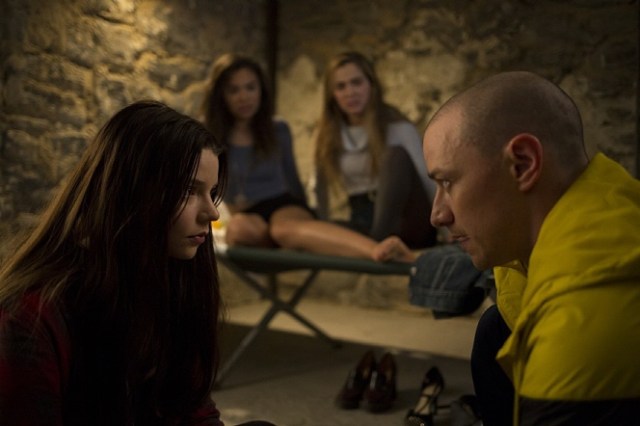
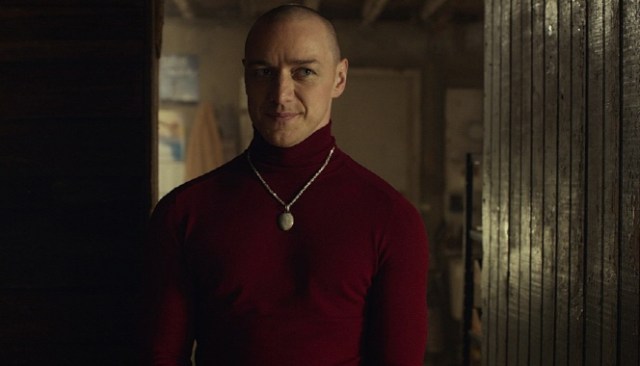
The movie opens with the kidnapping of three teenage girls, Casey (Anya Taylor-Joy), Claire (Haley Lu Richardson), and Marcia (Jessica Sula), by its deranged hero played by James McAvoy. When these girls are about to leave together after Claire’s birthday party, they are suddenly attacked by him, and then they find themselves locked up in a room when they regain their consciousness some time later. Naturally thrown into panic, Claire and Marcia try to think of any possible way to get out of the room, but they only see more of how helpless they are. Calmer and more composed in contrast, Casey thinks this uncertain circumstance of theirs can be worse than they imagine, and, unfortunately, it turns out she is right as they get to know more about their captor, who is not just sick but quite unstable due to his longtime mental illness.

split04

As already revealed in the trailer of the film, he has suffered from dissociative identity disorder, which is formerly known as multiple personality disorder, and the girls encounter some of his many different personalities. ‘Dennis’ is the one who kidnapped the girls, and he is intense and menacing while also quite fastidious due to his obsessive-compulsive disorder. ‘Patricia’ is more gentle and courteous in comparison, but she functions as Dennis’ accomplice, and so does ‘Hedwig’, a child-like personality who go long with Patricia and Dennis but may help the girls if he is cajoled enough.

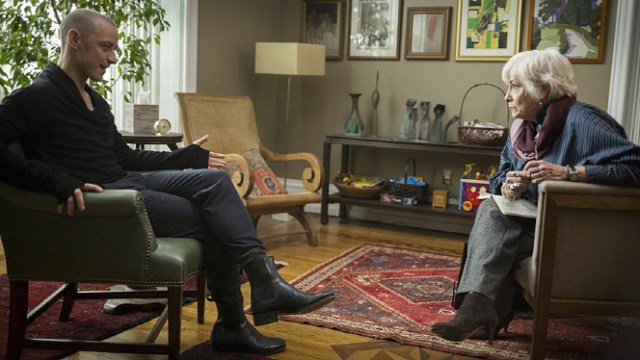
Meanwhile, his psychiatrist Dr. Fletcher (Betty Buckley) begins to sense something fishy behind the seemingly usual appearance of her most interesting patient although she has no idea on what is really going on behind his back, and the movie spends a considerable amount of time on her rather radical theory on dissociative identity disorder. After studying him and other dissociative identity disorder patients for a long time, Dr. Fletcher comes to believe that this mental disorder can affect not only mind but also body, and we see her seriously discussing with other experts via Skype. Her theory may sound outrageous, but it is delivered with dry conviction in the movie, and it accordingly generates both curiosity and amusement like that equally outrageous neurological theory presented in “Lucy” (2014).

However, even she is skeptical about the existence of a hidden personality somewhere inside her patient’s mind, which can be an ultimate proof of her theory. It is gradually revealed that Dennis kidnapped the girls for that personality in question, but we cannot help but wonder whether that personality really exists as Dennis and his accomplice personalities believe. Is it merely a piece of their common delusion? Or is it something real and truly fearsome as suggested?

split01

As Shyamalan’s notable films such as “The Sixth Sense” (1999) and “Signs” (2002), the movie steadily maintains its serious tone and mood even during the most deranged moments in the film, and that provides the solid ground for its lead performer’s committed performance. Reminiscent of John Lithgow’s similar multiple performances in Brian De Palma’s “Raising Cain” (1992), McAvoy has a fun with playing his various roles while smoothly shifting around them without any misstep, and he certainly dials up the manic intensity of his performance to the eleventh level when his character (or characters, shall we say) is driven into full madness mode later in the story.

While the movie is basically McAvoy’s show, Betty Buckley and Anya Taylor-Joy are also engaging in their respective supporting roles. Buckley, who played a small supporting character in “The Happening” (2008), has several good scenes with McAvoy, and I enjoyed the subtle tension in their scenes. Anya Taylor-Joy, who impressed us with her breakthrough performance in “The Witch” (2015) in last year, is convincing as a girl who comes to confront her dark, troubled past through her ghastly ordeal, and her strong performance compensates for the relatively flat, underdeveloped characterization of two other captive girls in the film, who often feel like the characters from a lesser movie.

With his recent success in “The Visit” (2015), Shyamalan bounced from a series of dismal failures including “The Last Airbender” (2010) and “After Earth” (2013), and “Split” fully confirms that he is back in his element. Considering its big box office success in US at present, he will soon move onto a film he is already planning to make, and, considering what is observed from “Split”, I think we can have some expectation on that.

split02.jpg

Posted in Movies | Tagged , , | Leave a comment

My prediction on the 89th Annual Academy Awards

lalaland02

The Oscar season is almost near the end now, and, as usual, we are quite sure about several things while feeling not so certain about other things. As I and others predicted from the beginning, “La La Land” has constantly been the dominant front runner in the Best Picture Oscar race, and now our attention is focused on how many awards it will actually garner during the evening of February 27th. In contrast, the Best Actor Oscar race has become quite tight between two front runner nominees, and it will be a huge upset if any nominee besides them walks onto the stage instead.

As I told you many times before, I have never been completely correct in my prediction, but I cannot simply resist the fun with guessing eventual winners or the excitement (or disappointment) experienced during the ceremony. Here is my prediction on the 89th Academy Awards, and let’s see how accurate or inaccurate it will turn out to be.

Continue reading →

Posted in Movies | Tagged | Leave a comment

The Red Turtle (2016) ☆☆☆(3/4): A wordless fable on the island

redturtle01

“The Red Turtle”, an animation feature film co-produced by Wild Bunch and Studio Ghibli, looks as simple as its allegoric fantasy fable. Wholly driven by images and sounds without any dialogue during its 80-minute running time, this is surely your typical arthouse animation film, but it is quite an enchanting film filled with vivid, beautiful visual moments, and it is also surprisingly poignant as it later turns out to be more than a familiar survival tale.

During the opening scene, we see its nameless hero being helplessly drifted alone in the middle of the stormy ocean, and the next scene shows him waking up in a remote deserted island. The situation looks hopeless for him at first, but, fortunately, the island turns out to be pretty bountiful. He can easily get fresh water and fruit besides fish, and there is also a big bamboo forest which can provide enough material for building a raft for his escape from the island.

Leisurely observing his actions around the island, the film takes its time in establishing its mood and background. The day scenes in the film are filled with vivid colors, and that aspect is particularly exemplified well by those tall, green bamboos in the forest or the scenes tinged with reddish sunset light. In contrast, the night scenes are shown in a black-and-white style, and they also contribute to the dreamy overall atmosphere of the film.

The island comes to get a sort of personality as we look around the island along with our hero. We get accustomed to not only its bamboo forest but also other spots including its rock mound and a spring located inside the forest. We also notice several different animals inhabiting in the island, and we are amused by a flock of crabs which provide some little laughs in the background from time to time.

redturtle03.jpgOnce our hero finishes building the raft, he immediately tries to sail away from the island, but then the raft is destroyed by something in the sea. It blocks him again when he tries again, and then he discovers during the third attempt that it is a big red turtle, which blocks him as before but does not attack him for some reason.

Their conflict reaches to another peak when he happens to spot the turtle crawling on the shore. Feeling angry about the turtle, he attacks it without any hesitation and then comes to regret his impulsive action, but then a strange thing happens. The turtle is transformed into a beautiful woman, and that is followed by a silent but moving moment of forgiveness and acceptance between them. Although nothing is particularly emphasized, you may discern from that moment a lesson on how one can be peaceful with nature rather than fighting against it.

The second half of the film depicts their subsequent life on the island. They come to have a son a few years later, and they are happy together with him as he grows up along the passage of time. There is a tender scene in which they teach him a bit about their island and the world beyond it via their drawings on the sands, and then we get an awe-inspiring moment when he swims in the sea along with a bunch of turtles, with which he has formed some special relationship since he learned how to swim.

The film keeps serving us with other impressive visual moments to admire. There is a frightening moment involved with the unforgiving side of the ocean, and we see several harrowing sights of its aftermath. A crucial narrative turn later in the story is accompanied with bittersweet feelings coupled with the sense of inevitability, and then there comes the poetic finale which will haunt your mind for a long time as you reflect on the whole story.

redturtle04

The film is directed by Michaël Dudok de Wit, an acclaimed Dutch filmmaker who previously made several short animation films including “Father and Daughter” (2000). That short animation film, which won an Oscar in 2001, is about a girl waiting for her absent father to return, and I admired how it gradually built up its emotional impact via simple, dialogue-free storytelling and succinct hand-drawn animation style.

In his first animation feature film, Dudok de Wit shows the same confident handling of story and style observed in “Father and Daughter”. While the main characters are broadly drawn, the wordless interactions between the main characters are depicted with clarity and directness thanks to the economic storytelling of the screenplay by Dudok de Wit and his co-writer Pascale Ferran. The background details of the film are constantly rich and colorful as you can expect from an animation film co-produced by Studio Ghibli, and the sound design of the film is commendable for the effective utilization of various sounds of nature, while complementing well the restrained but lyrical score by Laurent Perez Del Mar on the soundtrack.

“The Red Turtle”, which received the Special Jury Prize award in the Un Certain Regard section at the Cannes Film Festival in last year and then nominated for Best Animation Feature Film Oscar early in this year, may require some patience from you, but you will enjoy its visual goodies a lot if you go along with its slow narrative pacing. I think it will be appreciated more by adult audiences, but it is also accessible to young audiences, and it will give them a refreshing experience a lot different from those run-of-the-mill digital animation films.

redturtle05

Posted in Movies | Tagged , | 2 Comments

A Man Called Ove (2015) ☆☆☆1/2(3.5/4): A Grumpy Old Suicidal Man

amancalledove01

Swedish film “A Man Called Ove”, which was recently nominated for Best Foreign Language Film Oscar, looks typical at first. Here is a blunt, irascible curmudgeon who frequently gets annoyed by many things in his life, and it is not a spoiler at all to tell you that he is actually a selfless man of virtue and decency, but the movie presents his story via the endearing mixture of earnest poignancy and offbeat black humor. While he is still your average grumpy old dude even in the end, we come to understand him as getting to know more about him and his life, and we come to care about him as often chuckling over a number of darkly funny moments.

Ove (Rolf Lassgård) is a 59-year-old factory worker who recently lost his wife, and the opening scene shows a minor friction between him and a clerk in a local florist shop. He simply wants to buy a bouquet at a discounted price, but the clerk flatly reminds him that he must buy two bouquets, and he becomes piqued at this although he eventually buys two bouquets and takes them to his wife’s grave.

And that is just one of numerous things to frustrate and exasperate him. Although he is no longer the chairman of the board of his housing complex neighborhood, he is still fastidious about the regulations set by him and his estranged friend with whom he does not talk anymore. Whenever he does his routine check-up around the neighborhood, he always finds something against the rules, and that certainly does not give a good impression to many of his neighbors.

On one day, he is fired from his workplace, and he decides to kill himself because he has nothing to hold himself to his life now, but then his suicide attempt is interrupted by an unexpected happening. When he is about to hang himself in the living room, new residents have just arrived at a house located right across from his house, and Ove cannot possibly ignore a trouble they are causing in front of his house because, well, old habit never dies easily.

amancalledove03

They are an Iranian immigrant named Parvaneh (Bahar Pars), her Swedish husband, and their two little daughters, and Ove soon finds himself getting involved with them more than he wants as Parvaneh constantly approaches to him as a friendly neighbor. When she needs to learn how to drive a car, he declines to be her driving teacher at first, but he eventually comes to teach her in the end, and he soon becomes a sort of grandfather figure to her family as getting closer to them than before.

In the meantime, he keeps trying to kill himself, but his attempts always lead to hilarious failures as if he were kept being held by the hand of fate, and his life continues to give him more matters to deal with besides Parvaneh and her family. For example, he has to take care of a stray cat which comes to stay in his house after picked up by Parvaneh, and then he becomes concerned about his aforementioned friend, who is going to be taken away from his home and wife by heartless welfare workers.

While the movie has a morbid fun with Ove’s suicide attempts and the following failures, some of these macabre moments initiate the flashback sequences which shows us how his life frequently swung back and forth between happiness and sadness. We see Ove’s childhood time with his good-natured widower father, who passed down to his young son the personal attachment to a certain Swedish vehicle brand. We observe how Ove’s personality was shaped by his life experience. And we behold how Ove accidentally encountered his future wife Sonja (Ida Engvoll) and then instantly fell in love with her.

amancalledove02

The love story between Ove and Sonja is depicted with touching sincerity. Ove, played by Filip Berg at this point, does not express his feeling well in front of Sonja during their first dinner, but she easily sees through his heart, and she promptly makes a direct move when he hesitates. They become more inseparable from each other after they marry, and that does not change even when they are struck by a heartbreaking tragedy.

Smoothly moving back and forth between two main plotlines, the movie strikes a right balance between comedy and drama, and the director Hannes Holm, who also adapted the novel of the same name by Fredrik Backman, did a solid job of maintaining the dry but quirky tone of the story which is gradually counterbalanced by its emerging pathos. While generating plenty of laughs from Ove’s absurd circumstance, the movie never makes fun of the deep sadness inside him, and Ove eventually comes to us as a three-dimensional human character to respect and like.

As the comic center of the film, Rolf Lassgård is fabulous in his funny and moving performance, and Filip Berg is also excellent while seamlessly connected with Lassgård. While Bahar Pars brings lots of spirit into her gregarious supporting character, Ida Engvoll radiates with warmth and gentleness in her scenes with Berg, and the special mention goes to two Ragdoll cats which play that scene-stealing stray cat in the movie.

“A Man Called Ove” may be conventional in many aspects, but it distinguishes itself via its smart, sincere storytelling coupled with a naughty sense of humor, and I enjoyed it more than expected along with frequent chuckles. It is a shame that I did not watch it when it was released here early in 2016, but now I watched it, and I can gladly recommend it to you now.

amancalledove04

Posted in Movies | Tagged , | 1 Comment

The Long Excuse (2016) ☆☆☆1/2(3.5/4): As he ‘mourns’…

longexcuses04

As an intimate story about loss and grief, Japanese film “The Long Excuse” is sometimes surprisingly amusing with small precious moments of wry humor and keen observation. While never overlooking the dark, melancholic elements of its story, the movie deftly balances itself between drama and comedy, and it is alternatively funny and touching to observe how its rather unlikable hero comes to learn some valuable life lessons through his accidental emotional journey.

The movie opens with Sachio (Masahiro Motoki from “Departures” (2008)) getting a haircut from his hairstylist wife Natsuko (Eri Fukatsu) in their apartment, and we come to learn a few things about their life as listening to their private conversation. Natsuko took care of their living for many years while her husband kept concentrating on his writing, and now they are living a more affluent life than before thanks to Sachio’s modestly successful writing career, but the gap between him and his wife looks more apparent as Sachio shows more of his self-absorbed side during their conversation. Natsuko is going to have a brief winter trip with her old school friend, but Sachio does not care much about that mainly because he is going to have a meeting with his mistress once his wife leaves.

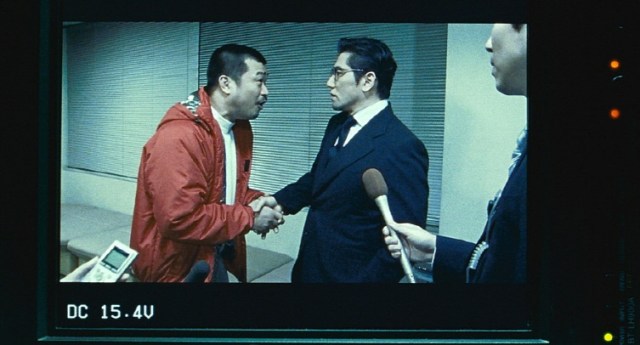
In the very next morning, there comes a terrible news. Not long after a devastating bus accident is reported on TV, Sachio is notified that Natsuko and her friend are among those ill-fated passengers in that bus, and he soon finds himself getting lots of attention from the media. Although he does not feel that sad, he knows well as a public figure that he should present himself nicely in front of cameras, and he does that job fairly well while appropriately looking sad and devastated as a husband mourning for his wife’s death. Through online search, he subsequently checks how much he draws public attention, and he certainly gets satisfying search results.

longexcuses02

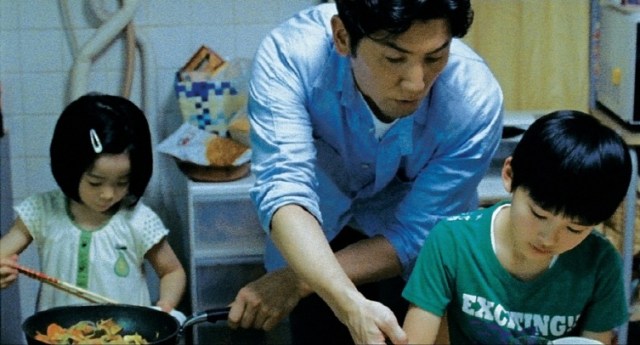
During the meeting for the victims’ families, Sachio is approached by a truck driver named Yoichi (Pistol Takehara), who is none other than the husband of Natsuko’s friend. Not long after their first encounter, Sachio invites Yoichi and Yoichi’s two children to a restaurant dinner, and then Sachio gets himself more involved with this family than expected thanks to an inadvertent incident associated with Yoichi’s little daughter Akari (Tamaki Shiratori). After spending some time at Yoichi’s small apartment along with Yoichi’s son Shinpei (Kenshin Fujita) while Yoichi and Akari are at a hospital, Sachio tells Yoichi that he can take care of Yoichi’s children whenever Yoichi is absent due to his work, and Yoichi gladly takes Yoichi’s offer.

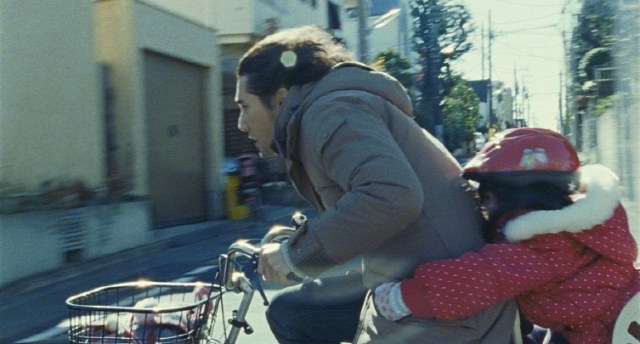
What does Sachio want from them? It is hard to say because the movie does not give any clear explanation on his motive, but the movie closely observes instead how he gradually comes to fill the void left by Yoichi’s wife. Besides being Akari’s babysitter, he also helps Shinpei’s study for the upcoming middle school entrance examination, and Akari and Shinpei are happy to have ‘Uncle Sachio’ around them. As time goes by, Sachio becomes another part of Yoichi’s family, and he even joins their summer vacation.

While depicting this part with gentle sensitivity, the movie has an acerbic fun with Sachio’s complicated emotional circumstance which even he does not seem to understand much. As spending more time with Yoichi and his family, he sees from them an opportunity to benefit him and does not hesitate to grab it, but he genuinely cares about them nonetheless, and his relationship with them makes him more aware of what a lousy husband he was to Natsuko. At one point, he willingly pretends to mourn for his dead wife when he visits the accident site along with TV program crew, but then he cannot help but be too emotional in front of the camera, and that leads to one of the most hilarious moments in the movie.

longexcuses03

The director/writer Miwa Nishikawa, who adapted her acclaimed novel of the same name, started her directing career with “Wild Berries” (2003) after working under Hirokazu Koreeda in “After Life” (1998), and “The Long Excuse” is her fifth work. While the influence from her mentor is evident from leisurely narrative pace and thoughtful storytelling, the movie is relatively cooler compared to Koreeda’s movies, but it is no less humane than them as steadily maintaining its objective attitude to its characters, and we are amused by its characters’ human flaws while also touched by their better sides.

The performers in the movie are all excellent in their well-rounded performances. While playing his character’s egoistic aspects without any excuse, Masahiro Motoki subtly conveys the gradual change inside his character, and Pistol Takehara is effective as a rambunctious counterpart to Motoki’s more reserved acting. Despite her brief appearance, Eri Fukatsu leaves enough impression to hover around the film, and young performers Tamaki Shiratori and Kenshin Fujita hold their own places well around their adult co-stars.

Calm, restrained, but ultimately compassionate, “The Long Excuse” is a delicate human drama to appreciate for its effortless mix of humor and pathos. I admire how it gracefully arrives at the ending which will definitely make you smile for good reasons, and I also like that plain but sublime moment of epiphany preceding the ending. Although I have not watched Nishikawa’s previous works, the movie surely shows that she is an interesting filmmaker to watch just like his mentor, and I think I can expect another delight from her in the future.
longexcuses01

Posted in Movies | Tagged , , | 1 Comment

Land of Mine (2015) ☆☆☆(3/4): A small, dark epilogue of the World War II

landofmine02

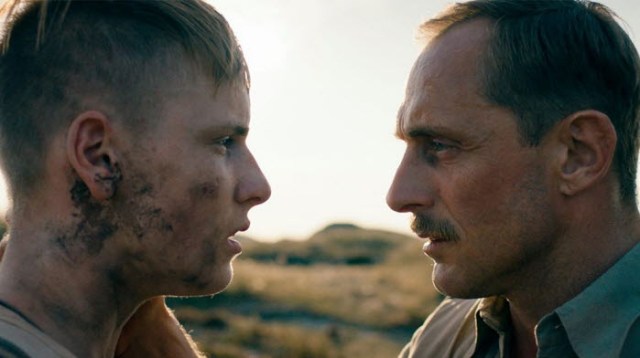
Through its fictional story, Danish film “Land of Mine” illuminates a small, dark epilogue of the World War II which has not been known well to most of us. Although it often feels heavy-handed especially during its third act, the movie mostly works thanks to its realistic storytelling approach and commendable performances, and we come to get a harrowing glimpse into what has been regarded as, according to the IMDB trivia, the worst case of war crimes ever conducted by the Danish state.

It is 1945 May, and the war is finally over with the surrender of Nazi Germany, but the subsequent liberation of Denmark does not seem to bring any peace or comfort to Sergeant Carl Rasmussen (Roland Møller), an aggressive guy still seething with anger and hostility as reflected by his heavy breathing heard at the beginning of the film. While he is driving by a long line of German soldiers, he becomes quite furious when he happens to spot a German solider carrying a Danish flag, and then he mercilessly beats that unfortunate soldier to a pulp before taking away that flag from him.

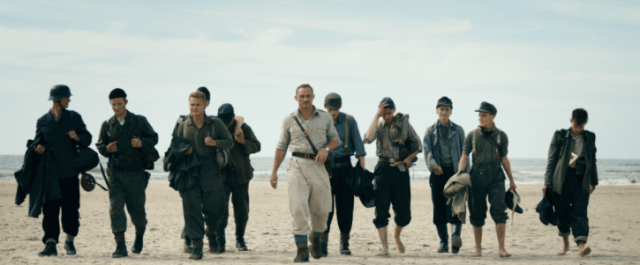
Like Rasmussen, the Danish Force has no mercy or compassion on German soldiers either, who are coerced to do a very dangerous job in the west coast areas of Denmark. As mentioned during one explanatory scene, around 2.2 million land mines were planted there by the German Force during the war because these areas were regarded as the potential spots which could be invaded by the Allied Forces, and the movie later informs us that more than 2,000 German soldiers were forced to remove all those buried mines after the war. That was a serious violation of the international treaties during that time as well as the Geneva Conventions of 1949, but those soldiers had no choice at all because they lost the war.

landofmine03

Many of them were adolescent boys enlisted in the army around the end of the war, and we meet some of such boys as they go through a brief training session for their minesweeping job. Although a very few of them have handled mines before, they are even instructed to defuse a real mine at one point, and that leads to a suspenseful moment when one of the boys becomes quite nervous in the middle of the process.

They are simply expendable as enemy soldiers, and we soon see how they work in a remote beach area to which they are assigned. Under Rasmussen’s strict supervision, they slowly crawl on their respective sections as poking sticks into the sands, and they become more aware of numerous mines hidden around them as they continue their highly risky work. If they are not very careful in each move, they can lose their limbs or life at any point, and some of those mines turn out to be quite trickier than they look.

Right from the first day, Rasmussen surely shows the boys that he is not a nice guy at all, and he harshly treats them while not giving a damn about their poor, hazardous work condition. When one of the boys tells him that they have not eaten anything since they arrived, he casually disregards that, and the boys come to resort to a desperate measure, which only makes their situation worse than before.

After a sad, tragic incident on the beach, Rasmussen begins to feel compassion toward the boys, and he soon finds himself caring about them more than expected. He brings some food to them, and he gradually becomes nicer to them as trusting them more. Around the time when two new boys are sent to the area, the mood around him and the boys feels sunnier than before, and it seems everything will be all right for them once their job is done.

landofmine01

However, there is still the harsh reality around them, and the movie pushes its characters into a number of rather blatant dramatic scenes for emphasizing that. A certain plot turn around the beginning of the third act is a little too abrupt, and the same thing can be said about how the following conflict is resolved later. The third act often feels jarring in terms of narrative as a result, and I think it arrives at the ending a bit too conveniently.

Nonetheless, the movie keeps engaging us via its strong elements. The director/writer Martin Zandliet and his cinematographer Camilla Hjelm Knudsen did a nice job of establishing the realistic period atmosphere on the screen, and the movie gives us several impressive moments of stark beauty as Knudsen’s camera calmly observes the wide, bleak landscapes in which the boys constantly struggle to work and survive. While Roland Møller, who previously played one of the crucial supporting characters in “A Hijacking” (2012), ably supports the film with his intense lead performance, the young performers around him are also believable in their respective roles, and Louis Hofmann and Joel Basman are particularly notable as two different key members of the group.

“Land of Mine”, which was nominated for Best Foreign Language Film Oscar in last month, is worthwhile to watch for not only its interesting historical subject which has never been widely discussed in public during last 72 years but also its calm but compassionate human drama. I recognized its noticeable flaws, but I was also gripped by its tense, powerful moments, so I recommend it with some reservation.

landofmine03

Posted in Movies | Tagged , | Leave a comment

Trolls (2016) ☆☆1/2(2.5/4): They sing, dance, and hug a lot….

trolls01

Animation feature film “Trolls” is as bright, fluffy, and chirpy as it can be during its 92-minute running time, and that is all. While it serves us with not only many colorful sequences which will exalt young audience but also frequent musical sequences which may delight you to some degrees, that does not wholly compensate for its predictable story and thin characterization, and the overall result is a mildly entertaining animation film which will soon be forgotten not long after you walk out of the screening room.

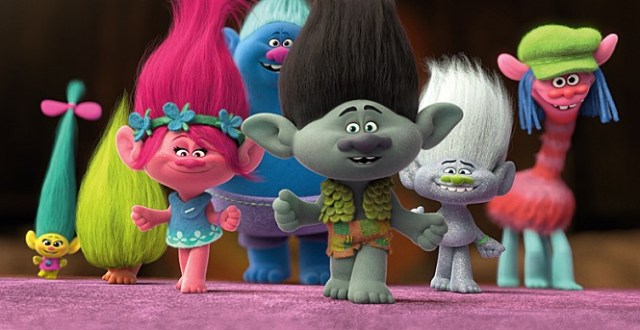
The setting of the story is pretty simple to say the least. Once upon a time, there were a bunch of Trolls living in some forest, and these tiny, furry creatures look quite cuter, prettier, chirpier compared to those big, ugly trolls from other fantasy tales. Looking variously colorful in their appearance, they love to sing, dance, and, above all, hug together, and everything looks happy and cheerful in their little world as Princess Poppy (voiced by Anna Kendrick) and other Trolls are eagerly waiting for their upcoming evening celebration party.

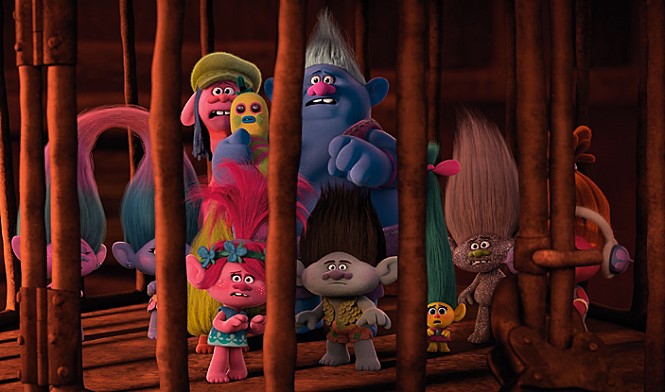
We learn that there was a dangerous time when they became prey to ugly, miserable creatures called the Bergens. Because eating the Trolls can make them feel happy, the Bergens captured and locked the Trolls together in a cage for eating them on a special day called ‘Trollstice’, but the Trolls managed to escape from the cage as led by their heroic king, and then they eventually found a remote safe spot in the forest where they have happily lived together for next 20 years.

While Poppy and others believe that they can continue their happy and joyful life as usual, Branch (voiced by Justin Timberlake) has been constantly concerned about the possible intrusion of the Bergens into their hidden place. Looking sullen, pessimistic in his gloomy appearance, he certainly looks far less bright and cheery than his fellow Trolls, and he does not care much about getting along with them as occupying himself with preparing for the worst situation. In fact, he does not even sing or dance, and he does not like hugging either.

trolls02

Unfortunately, Branch’s worry turns out to be right when Poppy and other trolls inadvertently draws the attention of Chef (voiced by Christine Baranski), a vicious Bergen who was once in the charge of preparing the Trolls for Trollstice in Bergen Town but was then banished due to the Trolls’ escape. After a number of Trolls are consequently taken away by Chef, Poppy decides to go to Bergen Town alone for rescuing those unfortunate Trolls, and Branch finds himself becoming her reluctant companion.

As they bounce along their journey together, the film keeps everything light and sweet. Besides the fluffy landscapes decorated with several weird creatures including big, furry spiders and a talking cloud, there is also a couple of musical scenes to lighten up the mood further, and Anna Kendrick brings considerable spirit and energy to her plucky character while Justin Timberlake is grumpy enough to be her good counterpoint.

The film also has some fun with how unhappy the Bergens are in their moody town, which makes a nice visual contrast to the bright, colorful world of the Bergens. Usually lurching like zombies, they look so glum and depressed in their perpetual unhappiness, and it is rather amazing that they have managed to live for years without committing suicide.

Not long after going inside the palace in Bergen Town, Poppy finds an unlikely ally in Bridget (voiced by Zooey Deschanel), a shy, introverted Bergen who has worked as a maid in the palace. When it turns out that Bridget has carried a torch for King Gristle Jr. (voiced by Christopher Mintz-Plasse) for a long time, Poppy decides to give some help to Bridget, and Bridget is glad to get an opportunity she never imagined before. With a little more colorful appearance to hide her real identity, she successfully approaches to the young king, but then there eventually comes a point when she has to go back to her plain position, and we accordingly get a blatant variation of that famous certain object in “Cinderella”.

trolls03While I was mostly entertained by all these things in the film, I was also disappointed with how safe and predictable it is especially during its climactic part. We already know that Bridget will make a right decision when Poppy and other Trolls are about to be served in front of Chef and other Bergens. We can clearly see from the beginning that Branch will be the one who will support and energize Poppy in the most hopeless moment, and we are not surprised at all when he finally sings in front of Poppy and other Trolls. After all, how can we possibly expect less than that from Timberlake?
Packaged with numerous songs, the soundtrack of the film is fairly good and Kendrick and Timberlake handle their respective songs well, but I must say the songs in the film are not as catchy as those wonderful songs in “La La Land” (2016). In case of “La La Land”, I have often hummed its songs for weeks since I watched it. In case of “Trolls”, I do not remember any of its songs particularly although I watched it during last night, and I do not even consider buying its soundtrack to bring back my memory of them.

“Trolls” is not entirely without charm and appeal, and I am sure that most kids will love its bright color and fluffy style, but it is not as memorable or distinctive as other recent animation films “Zootopia” (2016), “Moana” (2016), and “Kubo and the Two Strings” (2016), all of which I would wholeheartedly recommend instead. Believe me, you can have a more meaningful time with any of them.

trolls04

Posted in Movies | Tagged , , | Leave a comment