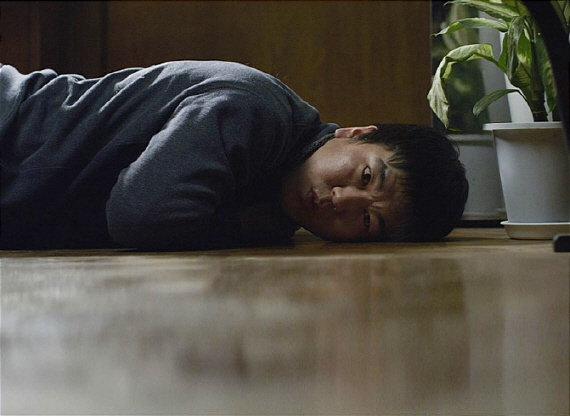
Project Nim (2011) ☆☆☆1/2(3.5/4) : A fascinating but cruel experiment on one chimp

 Can animals learn languages and communicate with us? Can the gap between human beings and animals can be narrower through that? One fascinating experiment at the center of an engrossing documentary “Project Nim” started with these curious questions, and it is interesting to watch this scientific research going through its ups and downs while it is also horrible to watch how the hubris and other human flaws of its participants ruining the life of its innocent subject.

The subject of this linguistic experiment was a young male chimpanzee named Nim Chimpsky, which was a joke on a famous linguist Noam Chomsky(he thought that the humanity is only species inherently equipped with language skills). Born in 1973 at the facility for primates in Oklahoma, Nim was taken from his mother not long after his birth for the experiment supervised by Dr. Herbert Terrace, a linguistic professor at the Columbia University in New York.

As Dr. Terrace ordered, Stephanie LaFarge, who was one of Dr. Terrace’s assistants at that time, took Nim to her home and treated him like one of her family members as a part of their research. As a small, cute baby chimpanzee, Nim quickly became a part of the LaFarges, though the research process was not so exemplary. LaFarge and her husband Wer were your average hippie couple in the 1970s, so Nim was taken care of with unconventional care and love. While she actually breast-fed Nim, LaFarge also introduced him drinks and marijuana. I am sure not many animals get such experiences like that while interacting with humans.

Anyway, Nim was happy to be at LaFarge’s home, but Dr. Terrace was not pleased about the inefficient teaching process of his research. Nim was again transferred to the other equally comfortable place just for a more efficient research. Terrace’s other assistants Laura-Ann Petitt, Bill Tynan, and Joyce Butlerand worked on him, and Nim quickly learned around 125 sign language words. In addition, he also learned how to use bathroom; in one documentary footage, we actually see him flushing down the toilet after defecation.

This looks fantastic at first, but there is an inevitable question: were his ‘words’ actually the language activities operated by intelligence or just the trained behaviors controlled by instinct? Some of you may already know the answer if you have some experience with pets, and that is exactly what Dr. Terrace’s research eventually arrived at with little fanfare. Sure, as one of the animal species closest to our human beings, chimpanzee is a clever animal who can use sign language words, but it is quite doubtful whether Nim really used them as language to communicate with his human handlers. In my opinion, he used sign language to get his rewards as much as the cats at my campus ingratiatingly meow to me to get a tuna can from me(I frequently succumb to their plea, by the way).

The director James Marsh, who won an Oscar for the documentary “Man on Wire”(2008), moves between documentary footage, interviews, and re-creation scenes to effectively tell this interesting story to us. He also gives equal chances to the people associated with Nim to tell the story in their respective views. While Nim himself only appears in the documentary footage part, his life story vividly comes to us through what they tell us. He was a special chimp even though the research did not result in anything remarkable; he made quite an impression on the people involved with him, and, while fondly remembering him, some of the interviewees are still bitter about what happened to him after the research was finished.

What happened to Nim uncannily resonates with “Rise of the Planet of the Apes”(2011), which happened to be released in the same year this documentary came out. When the research was over, Nim was sent to back to the facility where he was born. He was locked in cage just like other chimpanzees in the facility, and that was just a mere beginning of his long plight during which he was moved around several places. When he seemed to find a comfortable place at last, the owner did not know much about how to take care of him in spite of his good will.

Most of the people in Nim’s life were kind and patient, but they all disappointed him in the end. In case of Dr. Terrace, he becomes an arrogant and obnoxious guy who was the most responsible for Nim’s misery while he casually admits his faults and mistakes during and after the research. He did not spend time much with Nim except when it was really necessary for his research and its promotion, and, after he sent Nim back to the facility as soon as the project was over, he did not try to save Nim from being locked in cage even when he published a book about his research.

And there were the other problems due to Nim’s biological nature. When he was young and cute, it was pretty easy to accept him as a family member, but it became pretty hard to control him when he grew older and stronger along with increasingly aggressive animal instinct. He frequently bit his human handlers, and some of the interviewee in the documentary shows us the stitches in their arms and other parts at one point. In one bloody case, he bit one of them so savagely on her cheek that her cheek was literally punctuated. Nim did wrong things, but it was not his fault – he was just driven by his nature which was unwisely overlooked at the start of the project.

While it is a compelling scientific research story, “Project Nim” is a sad, tragic tale of one animal cruelly treated by the people who were supposed to take care of him. He trusted them, but he got nothing but long years of misery in exchange, and it is disheartening to see Nim in his later life when he was left alone and depressed in the cage. At least, his last five years were relatively happy and peaceful, but that’s a little consolation compared to his damaged life on the borderline between man and animal.

Posted in Movies | Tagged , , , | Leave a comment

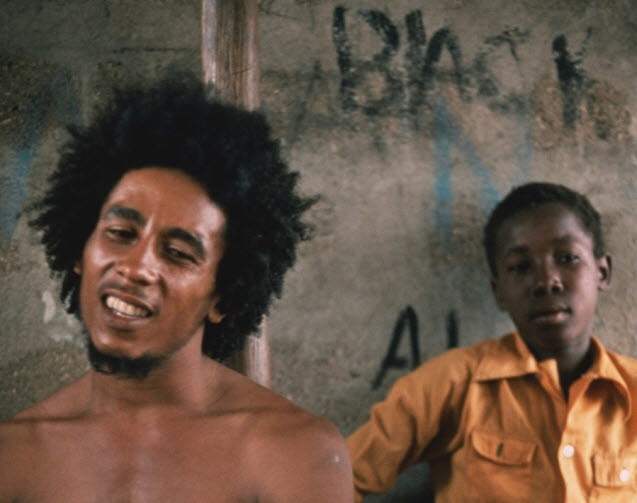
Marley (2012) ☆☆☆(3/4): A respectful tribute to a legendary musician


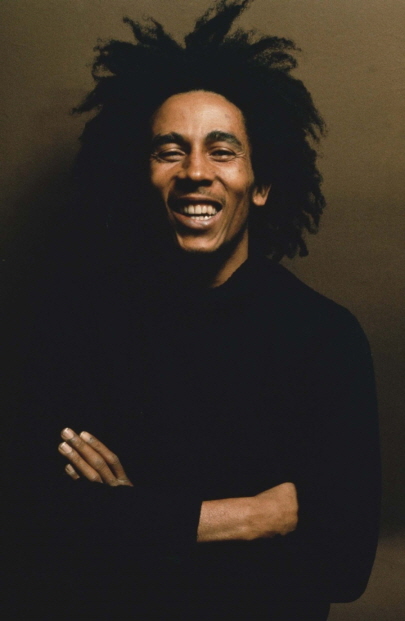
To the audiences like me who are not so familiar to Bob Marley, the director documentary “Marley” is an informative documentary which shows Marley as an influential musician and a wonderful human being who left our world too early. I did not know much about him and his music(I belatedly came to know about his works through an entertaining but forgettable SF film “I Am Legend”(2007)), but this documentary was a compelling and detailed presentation of its subject figure, and I learned a lot about him with more admiration in the end.

During the running time more than 140 minutes, the documentary looks around Marley’s short life from his childhood to his untimely death. He was born in Nine Miles in St. Ann Parish, Jamaica on February 6th, 1945. His father, Norval Marley, was a middle-aged British captain in the Royal Marines who married Marley’s mother Cedella Booker when she was only 18 years old at that time. Although he supported his wife and son financially, Marley rarely met his father, who died when Marley was 10 years old.

We are told about his early life through the interviews with the people who knew him, including his mother, his family members and his friends. Because he was born between a white father and a black mother, he was an outsider from the beginning, and that made his childhood harder, but he later found a way to deal with his racial identity through his religion, Rastafari, early in his career. With his religious belief, he approached to all people as a man who stood over race and politics, and that aspect is reflected well in his songs, through which his message and passion immediately came not only to the people in Jamaica but also to the people all over the world.

Through various photos and footage, we see how his career was initiated and developed to the level of international fame. Marley already showed his talent with music when he was at grade school. He left school when he was 14 and then recorded his first two singles in 1962. He formed a band with his musician friends during that time, which was later known as “The Wailers”. After his short stay in Wilmington, Delaware where his mother moved to, he returned to Jamaica and further advanced his career with The Wailers. He had no particular ambition, but Marley wanted his reggae music introduced to more people outside his country, and he luckily found the right chances and right people to help him. After the band’s album “Catch a Fire” was released worldwide in 1973, he and his band quickly rose to a far more popularity than before.

As shown in the documentary, Marley was an electrifying presence on the stage with his music. Around the time when he got international breakthrough in his career, Jamaica was embroiled with the tumultuous political conflict between two warring political parties, and bloody violence was usual news for the front page during that time. Two days before his concert for easing the tension in his country in 1975, Marley, his wife, and his manager were shot by an unknown guy at his home at 55 Hope Road, but he did not cancel his concert, and he bravely appeared in front of 80,000 audiences. Three years later, he had another peace concert in Jamaica, and he made a wonderful moment when two opposing leading politicians appeared on the stage together at his request and then shook hands with each other in front of the audiences.

We also get some glimpses into his private life with his family, which is mainly told through his wife Rita and children. He was not exactly a model dad and husband, but they all fondly remember their time with him. His wife, who was a singing partner in his band, knew well that he had relationships with other women(The Bob Marley official site acknowledges six other children of his besides three children from their marriage and two children from Rita’s previous marriage), but she also knew that he would not leave her even though he was a man who could not say no to the women approaching to him. They maintained a good marital relationship till his death, although their children said that their father’s affairs probably hurt her at times.


In 1977, Marley was diagnosed to have a malignant melanoma at one of his toes when an injury on his foot from a soccer game was examined. At the time of this discovery, his illness could have been treated quickly and then he could have had a longer musician career, but he unwisely refused to get the treatment. 3 years later, shortly after his final concert in 1980, his health became far more worsened, and they found that cancer had already spread throughout his body.

The last part of the documentary focuses on his losing battle with cancer. The doctors told him he was dying with few weeks left for his life, and his last attempt with the controversial cancer therapy at the hospital in Bavaria, Germany resulted in no success. His body got weakened day by day, but he kept his good spirit intact even during that time. He moved back Jamaica and then went to Florida, where he died at the age of 36 on the morning of May 11th, 1981.

The director Kevin Macdonald, who is well-known for his documentaries “One Day in September”(2000)(he won an Oscar for this) and “Touching the Void”(2003), made a respectful tribute to this inspiring musician. With the generous help and permission from Marley’s family members, the documentary effectively uses many of his songs while following Marley’s career, and we get a touching montage of his music shared by many different people around the world. On the whole, this documentary is a wonderful guide to Marley’s life and his music.

Posted in Movies | Tagged , | 1 Comment

Magic Mike (2012) ☆☆☆(3/4) : And their hot body show goes on…

With a standard backstage melodrama at its center, “Magic Mike” grips our attention to what happens onstage and backstage with its earnest and insightful approach to its hot subject – male striptease. The movie will definitely draw the interest of female audiences because of that and there are plenty of scenes to fulfill their expectation, but the movie is also interesting to male audiences like me. I looked at how they work with a certain level of curiosity, and my conclusion is that male striptease is not that different from female striptease; even lots of money can be earned, both jobs are not so good for self-esteem, considering that you let your body serve for the customers’ desire even though no sex is allowed.

Its hero, Magic Mike(Channing Tatum) works as a star stripper at some small male striptease club at Tampa, Florida. Because he does not want to be stuck in his current main occupation, he also works at a construction site to earn more money to realize his dream, and that is how he encounters Adam(Alex Pettyfer) on one day. Adam is a pretty lousy partner without much experience at the construction site(he is employed just because he is a cheap worker), but soon he finds a better job. In the same evening, he comes across Mike at some nightclub, and he helps Mike drawing potential customers to Mike’s club, and then he gets hired at the club.

At first, Adam is hired as a mere assistant to Mike and other male strippers, but he gets a chance to appear on the stage on the same night when someone has to appear as a replacement. Of course, he is pretty awkward and clumsy on the stage in front of lots of cheering female audiences while he tries to take off his clothes, but, as Mike instinctively guesses, his shy awkwardness works well on the stage, and the club’s impresario/manager Dallas(Matthew McConaughey) sees the potential inside Adam.

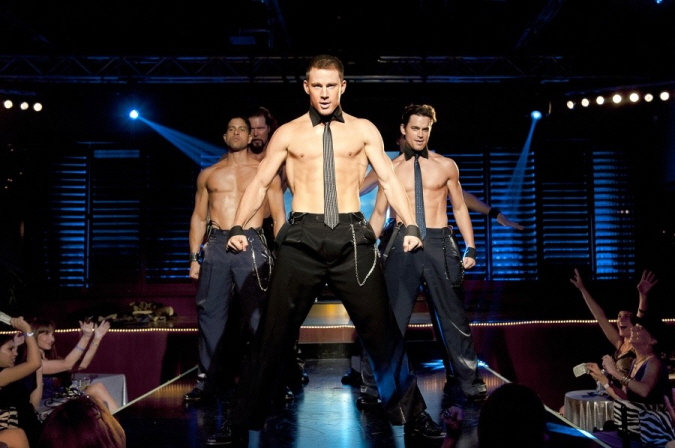
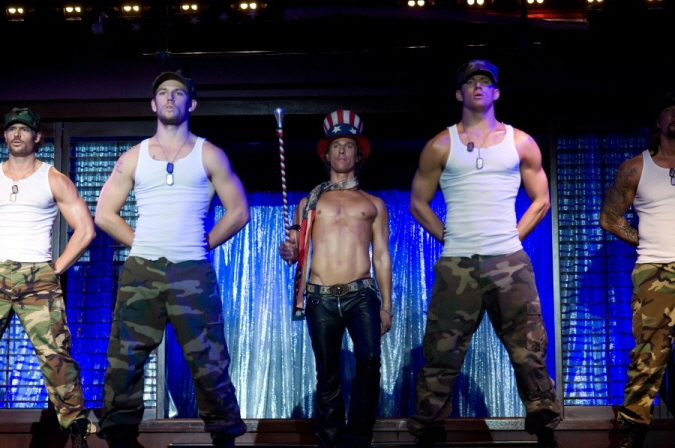
With Adam as a new member, we have many performances on the stage with various styles and themes, and it is sort of amusing to see their varieties including soldiers, firemen, trench coat, Ken doll, and Tarzan. The choreography and music are as excellent as they can be in this small place, and the director Steven Soderbergh’s stable camerawork captures his actors’ physical performances well while calmly observing their heated atmosphere at the club. Channing Tatum, who was actually a stripper for a short time before his acting career, and his co-actors on the stage look natural with their nice-looking bodies while convincingly inhabiting in their respective characters.

The movie has nice details on these characters and the other people behind the stage. I especially liked the moment when one of them gets a problem in his back on the stage; he manages to go behind the stage as tactfully as possible while not ruining the show in front of his audiences. And I found that the female audiences in the movie are a lot more cheerful than the male counterparts in other films. Sure, as customers, they surely demand nice bodies to look and the sexual illusions associated with them, but they are not rude at least.

Everything on the stage goes pretty smoothly under the direction of Dallas, and Matthew McConaughey, who is going through the second peak of his career at present, gives a wonderful performance as a cool business man who exactly knows what his customers want and how to handle it for their excitement. McConaughey is simply electrifying with the sleazy but charismatic charm, and that shows from the opening scene when he explains the rules to his wild customers. He restricts them while also tantalizing them, and McConaughey’s gestures and words are at the right spot well-balanced between them.

Meanwhile, we also see Mike trying to start his own business through his saved money. He wants to open a customized furniture shop(he is good at making them out of scraps), but it is hard to get a loan due to bad economy, and he finds himself still stuck in his job while he is not that young anymore. I noticed that one big guy in the club looked relatively old compared to others, and I found later that Kevin Nash, who plays him in the movie, is over 50. Of course, Nash’s physique is far better than me(I am an overweight guy approaching 30, by the way), but I wonder how long his character will go on while getting old. I noticed several times that he moves rather clumsily compared to his fellow strippers on the stage.

While gradually getting intimated with Adam’s kind sister Brooke(Cory Horn), Mike feels more need to leave his occupation, but it is not that easy. He argues at one point that his stripper job does not define him, but, as we know, our identity is usually defined by what we are doing, and Mike is more or less than a prisoner of his occupation and money.

While Mike experiences disillusion as an experienced employee, Adam falls through the problems associated with their show business as a young rookie. He drinks, and then he gets addicted to drugs while getting involved with drug dealing. Mike tries to take care of Adam’s problems as he promised to Brooke, but Adam eventually hits the bottom at one night, although it will probably not be the bottom to him in the future if he is not more careful.

Based on the screenplay by Reid Crolin, who also produced the film, Soderbergh made an enjoyable backstage melodrama which looks at the bright and dark sides of its subject in a clear view. There are more things to be enjoyed other than male striptease, and I appreciated the way Soderbergh makes us get interested in what’s going on in the background while focusing the conversation in front of the camera. By the way, as many people pointed out, one curious thing about the movie is its absence of gay characters in the story. I think gay people are also interested in looking at male body parts, but I guess they have their own favorite club somewhere outside the movie.

Posted in Movies | Tagged , , | 1 Comment

Rock of Ages (2012) ☆☆1/2(2.5/3) : It rocks – partially.

Watching the musical movie “Rock of Ages” was like dully observing a plain rock concert occasionally agitated by its more famous guest performers. I had a little interest in its main plot, but I and the other audiences at the screening room were delighted whenever its colorful supporting characters stole the show, and my disappointment with the film was a little bit lessened by the spirited performances from the actors playing them.

No, I do not mean that the young leads are bad actors. As far as I can see, they are nice singers as well as good actors, but, boy, their story is as corny as the flawed music movies from the era which “Rock of Ages” looks back with nostalgic affection. For instance, when it is around the end of its Act 1, the hero sees the girl he loves coming out of the room with a notorious rock star, so he thinks she has a sex with him. We all know that all he has to do is asking her what happened, but he instead treats her harshly and breaks up with her, just because the movie needs the conflict to be resolved around the end of Act 2.

That notorious rock star is Stacee Jaxx, played by Tom Cruise with mercilessly daring comic performance. Stacee recently announces the disassemble of his group for going solo, and he is going to have a farewell performance at the Bourbon Bar, a famous rock club on the Sunset Strip in LA. To its owner Dennis Dupress(Alec Baldwin with long hair) and his assistant Lonny(Russell Brand), this is a good opportunity for reviving their business, though they know Stacee is notorious for not appearing on the schedule despite the efforts of Stacee’s agent Paul Gill(Paul Giamatti with ponytail).

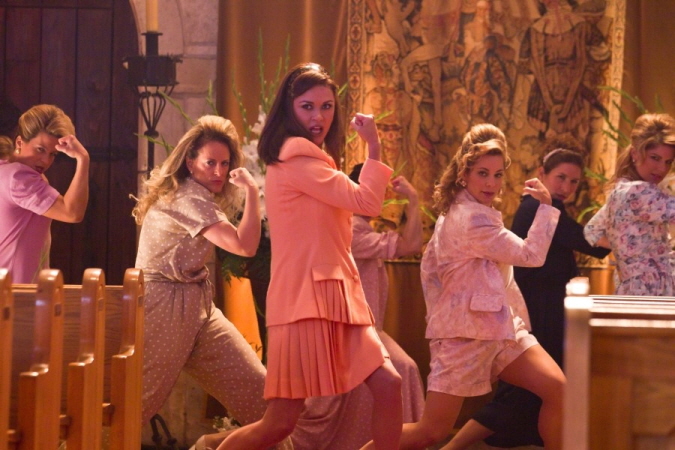
Meanwhile, there is a force threatening the Bourbon Bar outside, represented by Patricia Whitmore(Catherine Zeta-Jones). Her ineffectual husband Mike(Bryan Cranston) recently becomes the mayor of LA, and they are going to get rid of the Bourbon Bar for their major backer who wants the Sunset strip area for his business. Her plan: with the moral support from church-going ladies and other Christian groups, she labels rock music as a satanic influence to the society to put pressure on Dennis and others. With her personal agenda revealed later, she is very determined to smash rock music along with Stacee.

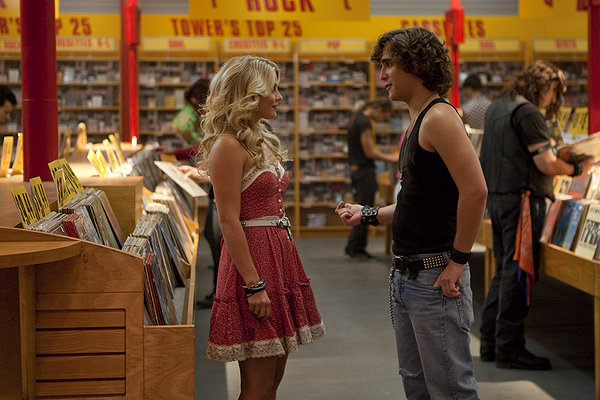
But the central story is about the relationship between Sherrie Christian(Julianne Hough) and Drew Boley(Diego Boneta). Sherri is a small town girl from Oklahoma, and she is full of optimism when she arrives to LA by bus with her plucky song, but she gets her suitcase robbed not so long after she gets off the bus. Fortunately, Drew is around there when she is robbed, and she is luckily hired by Dupree thanks to Drew’s kindness. While working together at Dupree’s club, they get close to each other, so we get a musical number between them at the Tower Record shop, where LPs and cassettes are sold instead of CDs(The background of the story is 1987, by the way).

Their romance goes through the route we have encountered countless time before in other films. Drew, an aspiring singer like Sherrie, has stage fright, but he manages to get a chance for his breakthrough during Stacee’s farewell concert while Sherrie is advised by her co-worker at the same time that she should not trust musician lover. When things like that are set up in the movie, seasoned audiences like me already see what kind of trouble will happen during the concert.

And the musical scenes in the movie curiously feel flat and distant except few moments. The director Adam Shankman’s previous film “Hairspray”(2007) had some static aspects, but that flaw was compensated by its bouncing energy. In case of this film, the music is nice, but the camerawork and editing are frequently devoid of energy, and I felt like being stuck in a small place during the musical sequences at the Bourbon Bar. The opening sequence does not look as excited as it should be, and I felt that Julianne Hough’s singing was frequently overwhelmed by background music.

As a consequence, I have to tell you that I was considerably bored even before Act I ended, but the supporting characters ultimately save me and the film from boredom. Alec Baldwin and Russell Brand are delightfully funny as the characters who have been blind to the bond between them, and they have a hilariously sweet musical number when they suddenly realize they care about each other more than they have thought. Catherine Zeta-Jones, who won Best Supporting Actress Oscar for the musical film “Chicago”(2002), clearly enjoys her own song and dance scene for brandishing the obnoxious side of her character(too bad Bryan Cranston does not sing with her), and Paul Giamatti also sings a little bit while having a fun with his character’s weary sleaziness.

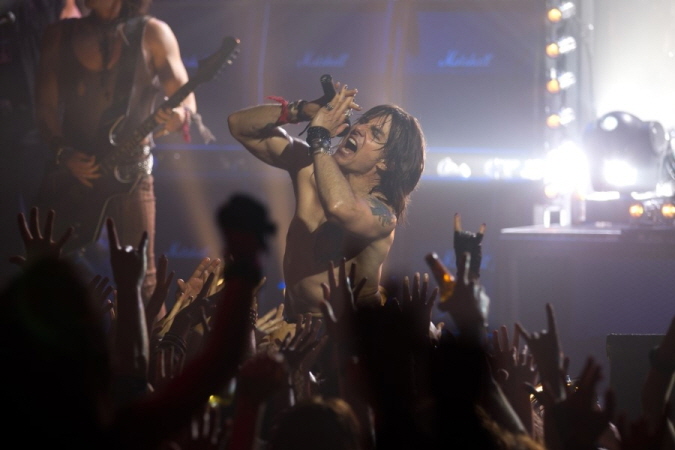
And there is Tom Cruise, who took a lot of chance with his wacky character for full comic effect. He is downright hilarious right from his first appearance with that outrageous accessory on his codpiece. The movie draws some humor from two big mountainous bodyguards and one monkey who usually accompany him, and Cruise does not mind at all about looking silly and weird; he even makes a savage fun of his image outside the movie. Later he has a raunchy musical scene with Malin Akerman, who plays a reporter from the Rolling Stones magazine coming to him for an exclusive interview; considering his status as a star actor, this certainly must have required lots of bravery as much as the stunt at the Burj Khalifa building.

Like “Hairspray”, “Rock of Ages” was originally a Broadway musical. On the stage, you can get away with many things including weak story or characters as long as you have good musical numbers and choreographs, but the circumstance is a lot different when the stage musical is transferred to the screen. The flaws in the story are no longer covered in most cases, “Rock of Ages” is no exception; I like some of its rock songs, but I was getting bored with the story, and the movie feels bland on the whole. Fortunately, the energy from the lively supporting characters prevented me from getting tired, and I enjoyed their fun performances in spite of my disappointments toward with the film. So, we can say that the movie rocks – partially.


Posted in Movies | Tagged , , , , | Leave a comment

Venus (2006) ☆☆☆(3/4) : The last great performance from Peter O’Toole – probably

Sometimes the actor’s face tells about his character so much that the movie does not have to waste its time for describing his character’s past to us. Roger Michell’s “Venus”(2006) does not tell us in details about how much famous its hero was as an actor, but that is not a problem at all because he is played by none other than Peter O’Toole, a living legend who gave us a bunch of memorable larger-than-life characters including Henry II of England, Eli Cross, the 14th Earl of Gurney, Alan Swann, and, above all, Lawrence of Arabia. When we look at him in the movie, we instantly remember how magnificent he was, and that aspect is naturally incorporated into his character.

O’Toole plays an aging actor named Maurice Russell, whose life and career are going through the final chapter when we meet him. He lives alone, but he has fellow actor friends with whom he spends time at the cafe nearby, and their usual routine is checking the obituary section to see who died recently among the actors of their generation – and how many columns he gets in the section.

Although the prime in his acting career has gone for many years and he is less famous than before, he is not entirely forgotten in his profession(he can get a limousine for taking him to a movie set if he makes a request through his agent). He can usually find the roles to play, though most of them are stereotype ones like dying old man or old mentor departing wisdom to young hero. While watching Maurice playing another dying character on hospital bed as usual, I remembered that the last time I saw O’Toole at the theater was “Stardust”(2007), a fantasy film where he played an old but devious king lying on his deathbed.

On one day, something he has never expected comes into his quiet life in twilight. His close friend Ian(Leslie Phillips) needs a caregiver because of his ill health, so his niece’s daughter Jessie(Jodie Whittaker) comes to stay in his apartment to take care of him. Ian is quickly horrified to find how terrible caregiver Jessie is. Besides that she does not do her job well, he is also quite upset by her brash attitude(she consumes all the drinks at his home much to Ian and his friends’ dismay, for example). Ian desperately wants to get rid of her, but he cannot find a way because his niece does not want her daughter either.

When Maurice meets Jessie for the first time, he becomes fascinated with this spunky young girl and then infatuated with her young nubile body. Because Ian asks him to handle the difficult situation with her, he spends some time with her, and he finds himself more attracted to her while discovering that his heart is not as old as he thought. Sex is out of question considering his current health condition(he is recently diagnosed to have prostate cancer and he is going to have a surgery), but, propelled by little libido remaining inside him, he tries to be closer to her.

This may be not a pretty sight to some of you, but “Venus” deals with its subject in an honest and sensitive approach while never romanticizing or vulgarizing the unusual relationship in its story. The director Roger Michell and the screenplay writer Hanif Kureishi are no strangers to such a relationship like that – they previously worked together in “The Mother”(2003), which was about a lonely middle-aged woman getting involved with her daughter’s lover.

The movie observes the nature of the relationship between Maurice and Jessie with no pretension about how it looks. It goes without saying that Maurice is a lecherous old man willing to smooch a young girl’s naked body if he gets a chance, and he does not hide that fact from her, but there is also sincere admiration in his lust as classy as Russ Meyer’s films. When Maurice takes Jessie to the National Gallery and shows her Diego Velázquez’s “The Toilet of Venus”, he tells her a woman’s body is the most beautiful thing to most men. She then asks him what is the most beautiful thing to a woman, and he gives her a truthful answer which seems to touch somewhere in her heart: her first child.

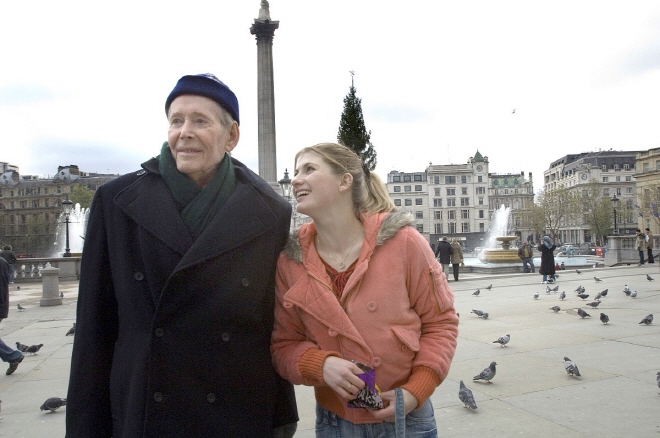
And Maurice is a fabulous dirty old man fun to hang out with. Whether he quotes the lines from Shakespeare play or utters profanities, O’Toole is always engaging to watch in the movie while effortlessly conveying us acerbic wit and mischievous libido inside a fragile but tough old codger who won’t make his exit quietly(well, can you expect anything normal from Peter O’Toole?). It is hard for an old guy like Maurice to start another day while reminded of his few remaining days, but he keeps moving on while his sharp sense of humor is rarely suppressed, and he does not hesitate to take a chance with the relationship which may be the last romance in his life. I must say that it is oddly amusing to watch O’Toole comfortably riding a limousine with Whittaker on the streets of London while a contemporary pop song is played on the soundtrack. Although he has been firmly fixed in the history of cinema since he appeared in “Lawrence of Arabia” and other classic films in the 20th century, this old legendary actor can be cool even in the 21th century.

Because the story is progressed mainly in Maurice’s viewpoint, Jessie is relatively a less-defined character in the story, but Jodie Whittaker, who made a debut with this film at that time, is convincing as a precarious girl who won’t allow her aging admirer to touch her easily. She is not born yesterday, and she knows her great-uncle’s friend takes a ‘theoretical interest’ in her body. She likes to be with him, but she sets her limits clearly to him; he can touch her necks or hands few times – but the others parts including her breasts are out of bounds.

While their relationship is awkward at first, there is something gradually growing between them despite a huge gap between them. O’Toole and Whittaker have a touching scene when Jessie takes a bath at Maurice’s home while he is waiting for her outside the bathroom as she demands. She confides a hurtful incident in her past to him, and he responds to her confession with a heartfelt recitation of one of Shakespeare’s sonnets, and that considerably affects her feelings toward him. Although she lets him down a lot later through her wrong choices, Jessie comes to care about Maurice more than before, and she eventually follows her better side brought out by their relationship when he really needs her.

While it is warmed up a bit by their story, the movie seldom overlooks the fact that their winter romance is merely a small kindling about to be extinguished in front of the approaching night in Maurice’s life. He and his friends jokingly talk about how many columns they will get in the obituary section when they are dead, but they are all aware of the grim fact of their lives; it won’t be long before they will be mentioned in the section.

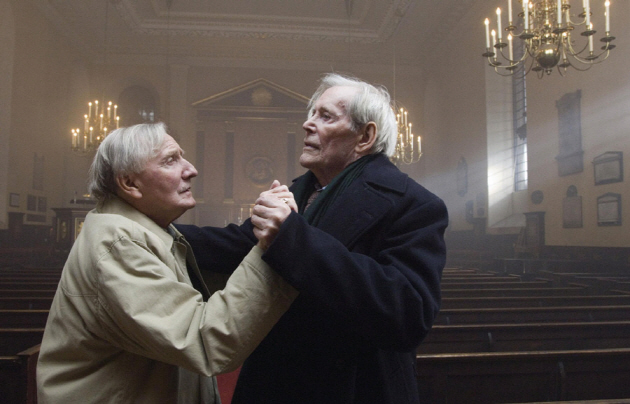
There is also the melancholic sense of loss hovering over them. The blank left by the people they knew in their life is getting bigger along the passage of time, and all they can do is wistfully reminiscing about the past which will never come back. Leslie Phillips, Richard Griffiths(he plays Maurice’s another close friend), and Vanessa Redgrave(she plays Maurice’s ex-wife) nicely support O’Toole as the people who have known Maurice for a long time while getting old along with him, and Phillips has a poignant moment with O’Toole when they look around the plaques of famous British actors at the Covent Garden’s Actors’ Church. They knew all these people including Boris Karloff, Robert Shaw, Richard Beckinsale(yes, he is Kate Beckinsale’s father), and Laurence Harvey, but they are all gone now, and that makes Maurice and Ian more painfully aware of their fading life. With Dvorák’s Slavonic Dance No. 2 played nearby by a practicing quartet, they promptly begin to dance for cheering them up, though they look like a dancing couple being left alone in the ballroom while everyone else has already left.

 Although its third act feels strained due to the choppy progress of the plot, “Venus” remains effective as a mournful human drama which handles its tricky subject well with care, respect, and a little humor. Through its sensitive depiction of the unlikely relationship between its two main characters, it tells us that some romantic relationship can be formed by something other than physical love, and we come to see that both of them get a lot from each other in the end. Jesse gets a better view of herself while moving forward in her life, and Maurice is satisfied with where he arrives at with her, though that matters to him little after that point.

And the movie makes us look back at Peter O’Toole’s illustrious career. When it was thought his career was going down around the 1970s due to his heavy drinking and medical complications, he bounced back with “The Stunt Man”(1980) and “My Favorite Year”(1982). After seven Oscar nominations without a win, he finally received an Honorary Oscar for his achievement in 2003, and we were glad to see him on the stage because we had thought he would have no chance of getting nominated again. But he said he was still in the game, and then he did surprise us with this film and got the 8th Oscar nomination in 2007(He could have won, but, unfortunately, it was the year when Forest Whitaker literally swept the award season with his thunderous performance in “The Last King of Scotland”(2006)).

Now O’Toole recently announced his retirement, so “Venus” will probably be remembered for his last great performance while being the fitting tribute to the actor himself at the end of his career. While Maurice walks alone to an empty open-air theater at one point, he gets immersed in bittersweet nostalgia filled with many voices from his works in the past. You may recognize that this sound montage actually includes O’Toole’s performances in the past, and you may find this scene more powerful because of that reason. When young Maurice’s photo, which is actually young O’Toole’s photo, appears around the ending, a minor character says, “God, he was gorgeous.” We can’t agree with her more.

Posted in Movies | Tagged , , , | 2 Comments

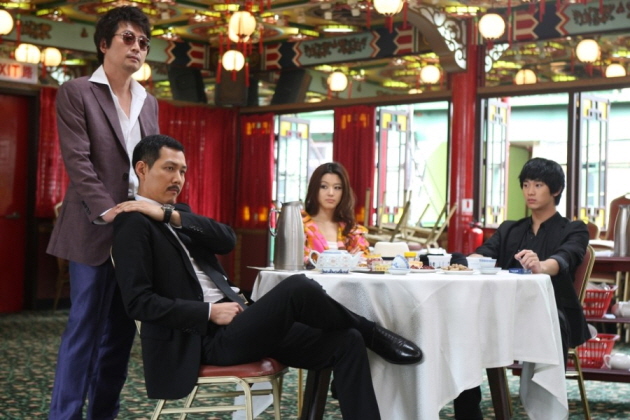
The Thieves (2012) ☆☆☆(3/4): A twisty heist movie with ten untrustworthy thieves

 As a slick heist film somewhere between “Ocean’s Eleven”(2001) and Guy Ritchie’s crime comedy films, South Korean movie “The Thieves” has expected things and unexpected things in its twisty story populated with ten untrustworthy criminals who gather for the same purpose with each own private agenda hidden from each other. While finding its plot a rather predictable due to its generic side, I enjoyed how the movie cheerfully juggles its familiar elements in the air while rarely losing its fun, and I also found that some of the unexpected things in the film were really interesting or exciting.

The set-up process is always required in heist films for establishing their characters at the beginning, and “The Thieves” is no exception. At the opening sequence, we see four criminal characters at work to steal an expensive artifact which is kept at the safe of some museum with high-tech security system. With their meticulous timing through teamwork, they have successfully done their job, and the police have only suspicions on them with no direct evidence to link them with the crime.

They are Anycall(Jeon Ji-hyeon), Popeye(Lee Jeong-jae), Chewing Gum(Kim Hae-sook), and Jampano(Kim Soo-hyeon) – I am sure that their parents did not give them such funny names. Right after finishing their latest job, they go to Hong Kong because Macao Park(Kim Yoon-seok) summons them for his big heist plan, and Pepsi(Kim Hye-soo), who was an ex-partner of Popeye and Macao Park, also goes with them after being released from prison although she seems to be not in Macao Park’s plan.

In Hong Kong, we also meet Macao Park’s Chinese associates Chen(Simon Yam) and his guys; Julie(Angelina Lee), Johnny(Derek Tsang), and Andrew(Oh Dal-soo). They do not trust their South Korean partners as much as their counterparts do not like them, but all of them are drawn by Macao Park’s plan; they are going to steal a big diamond called ‘Tear of the Sun’, which is currently owned by a powerful and ruthless crime boss/fence in Macao.

Although it has been being kept safely in the crime boss’ casino hotel in Macao while heavily guarded by the multiple security systems in the building, Macao Park has a clever plan to infiltrate into the place where the jewel is kept at, and he needs his accomplices’ assistance for that. As required by its genre, we see how they prepare for their D-day step by step, and the actors in the film have a nice fun together while their characters are interacting with each other in one way or other ways. They surely can work together as partners for a common goal, but can they trust each other?

Through several flashbacks, we gradually realize that most of the characters don’t trust each other while having each own scheme to be sprung sooner or later. For example, Pepsi apparently has some old scores to be settled because she believes Macao Park betrayed her in their botched job in the past(she was sent to jail because of that). Chen, who really knows how merciless their opponent can be as well as how untrustworthy Macao Park is, concocts his own plan with his guys just in case. Anycall, who uses her athletic skills even when she is not working, is getting some idea about what she can do for her benefit with her partners including Jampano, a naive young man who has been carrying a torch for her for a while.

There are many other things I will not reveal to you, but let’s say the director/co-writer Choi Dong-hoon, who previously made funny and enjoyable crime movies such as “The Big Swindle”(2003) and “The War of Flower”(2006), deftly handles not only his characters but also their motives and plans in his crowded story. The characters are simple enough to be described in few lines, but they are colorful figures of their underworld, and how they roll around the plot is fun to watch. Choi does a good job of using various locations including Macao and Hong Kong to engage us, and, while we get a well-made heist sequence as expected, we are also treated with an exhilarating action sequence where many characters simultaneously move around the inside and outside of one shabby high-rise apartment building. It begins with flying bullets and noisy explosions, which are sort of tiresome to me and others nowadays, but it gives us a clear idea about what the characters are doing or what they are going to do amidst busy actions, and then it surprised me with its perilous chase action on the wall of the apartment building. Unlike “Mission: Impossible – Ghost Protocol”(2011), they surely used stunt actors in many shots, but it felt real to me and I could believe the characters on the screen really were moving or jumping on the ledges of the building while precariously hung by their respective ropes.

 The actors are uniformly good while not overshadowing each other. While Kim Yoon-seok, who collaborates again with the director(it is their fourth collaboration), is dependable as usual at the center of the story, his co-performers have their own moments. Lee Jeong-jae, Kim Hye-soo, Kim Soo-hyeon and Oh Dal-soo give solid supporting performances, and Jeon Ji-hyeon is especially notable a plucky criminal who smoothly moves around others while looking for anything useful to her; she deserves to be compared with Anne Hathaway in “The Dark Knight Rises”(2012). The Chinese performers are also interesting to watch, and Simon Yam has a good chemistry with Kim Hae-sook when their characters are irresistibly drawn to each other while keeping their disguise in check. Along with the brief chapel scene between Macao Park and Pepsi, what Chewing Gum and Chen will get in the end is one of the nice melodramatic touches in the movie which are clearly influenced by the Hong Kong action noir films in the 1980s.

Although I think its second half is a little too long, “The Thieves” is a smart, entertaining movie with considerable amount of fun and excitement. I had a pretty good idea about where the story was going while watching it, and it worked as I expected, but it entertained me more than I initially thought while playing fair with me and the other audiences around me. This will be a nice counterprogram to “The Dark Knight Rises” on this weekend at South Korean theaters.

Posted in Movies | Tagged , , | 3 Comments

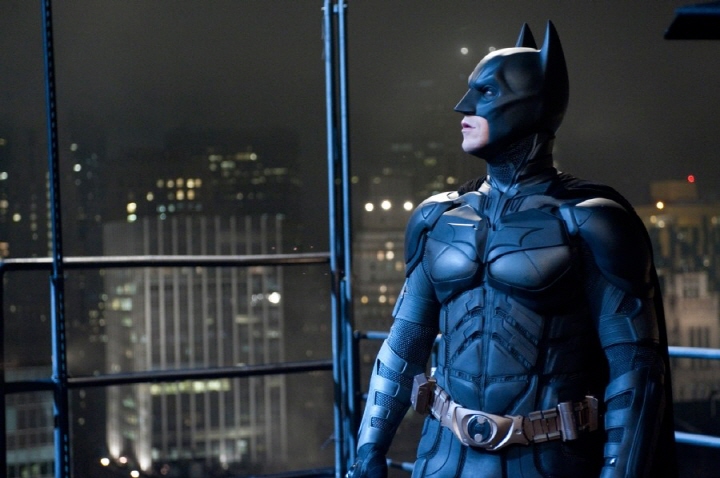
The Dark Knight Rises (2012) ☆☆☆(3/4) : An overpowering and ponderous final chapter

With his Batman series, Christopher Nolan has pushed the superhero genre to the undiscovered territory we have never expected from the genre before. Now with “The Dark Knight Rises”, a grim, overpowering final chapter of the trilogy, he pushes the genre more to the extreme to find out how much more it still can be pushed – and how much more its hero can still  give to the city he has been trying to protect. I do not think this attempt is entirely successful because of its hurried handling of overwrought plot which leaves many unclear points in the story, but the movie manages to drive us intensively to its climatic third act followed by the satisfying conclusion to its series.

In “Batman Begins”(2005), Nolan showed us how Bruce Wayne(Christian Bale) can be a lot more interesting than before as a brooding conflicted hero who comes to discover the way to deal with his childhood anger as the mysterious powerful vigilante dreaded by the criminals of Gotham city. It had inherent silliness as a superhero movie, but Nolan treated his story with absolute serious realism while subtly recognizing its inherent silliness, and then he went further with that approach to the towering success in “The Dark Knight”(2008), which remains as one of the great achievements in its genre during the last decade.

That movie was not only an exciting superhero movie but also a serious drama associated the problems we have faced in our real life during the post-9/11 era. It vividly shows us how much everyone including Batman is emotionally shaken and then cornered into impossible situations by the sheer chaos represented by Joker, played by late Heath Ledger who got a posthumous Oscar for his utterly unforgettable performance. Batman makes hard choices while coping with the unpredictable anarchy hurled at him and others, and, in the end, he ultimately sacrifices his reputation for making Gotham city into a better place where the people do not need Batman any more as he has wanted.

When we see Gotham city again in “The Dark Knight Rises”, it seems his sacrifice has helped help the city a lot during the last 8 years – at least on the surface. Because Batman took all the blames for the district attorney Harvey Dent’s crimes and death in the previous film, Dent becomes the fallen hero of Gotham city, and there is no more organized crime in Gotham city thanks to a newly legislated criminal law called Harvey Dent Act. The commissioner Jim Gordon(Gary Oldman), who was Batman’s closest ally, has been feeling guilty and regretful about the lie maintaining the law and order of his city, but he knows the cost of the truth, so he chooses to keep being silent about it.

Meanwhile, still feeling bitter about the death of Rachel Dawes 8 years ago, Wayne is no longer active as Batman, and he has no interest in playing a billionaire playboy either. Having recently lost a considerable part of his vast fortune due to the investment on the clean energy development project in his company, he becomes a depressed recluse living with many physical injuries from his tough night life in the past, and that saddens his loyal butler Alfred (Michael Caine), who has always wanted his master to lead a normal happy life out of his troubled personal crusade someday.

Wayne thinks he is at the bottom, but the storm is coming to Gotham city, and soon he discovers what the real bottom really is through the clash with his new adversary named Bane(almost unrecognizable Tom Hardy with bulked-up physique), a formidable mercenary always wearing a gas mask on his face providing the anesthetic to alleviate his severe chronic pain. With his robotic voice and masked face, Bane is far less colorful than the Joker, but Hardy does the best he can do in his limits to exude the palpable presence of the unstoppable brutal force singled-mindedly determined to pulverize Gotham city into ashes, although that makes his character less interesting than the Joker. In Joker’s view, Gotham city is a toy set to be terrified, tormented, and burned for his sadistic fun; in Bane’s view, Gotham city is a sin city to be intimidated, demolished, and ground for his fanatic belief. Guess which is more fun to watch and which is worse to Gotham city.

The movie starts to increase its tension level after Bane unleashes his ruthless brutality on Gotham city and its citizens as he has prepared with his henchmen below the city. He raids the stock trade market at the center of the city, and then he commits a spectacularly horrifying terror at the football stadium as the beginning of his reign of chaotic terror on the city. The movie has several interesting sights which will probably remind you of the French Revolution; the incarcerated criminals break out of their prison with weapons in their hand, and the upper class people are attacked by the angry mob and then dragged to a deranged kangaroo court presided by one familiar villain character in the series, where they are sentenced to death or exile(there is not much difference between them, by the way).

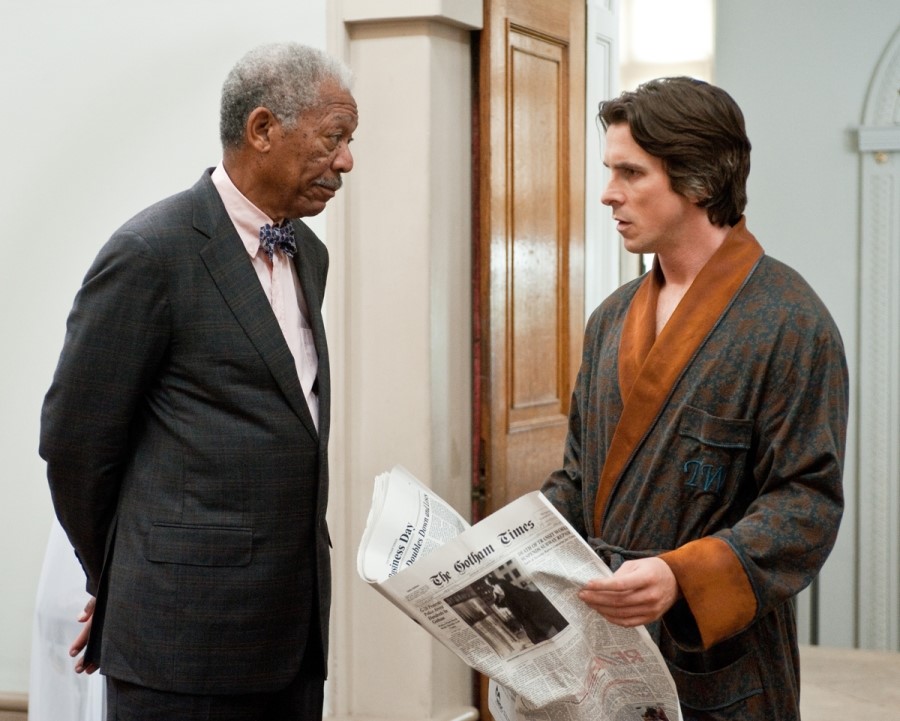
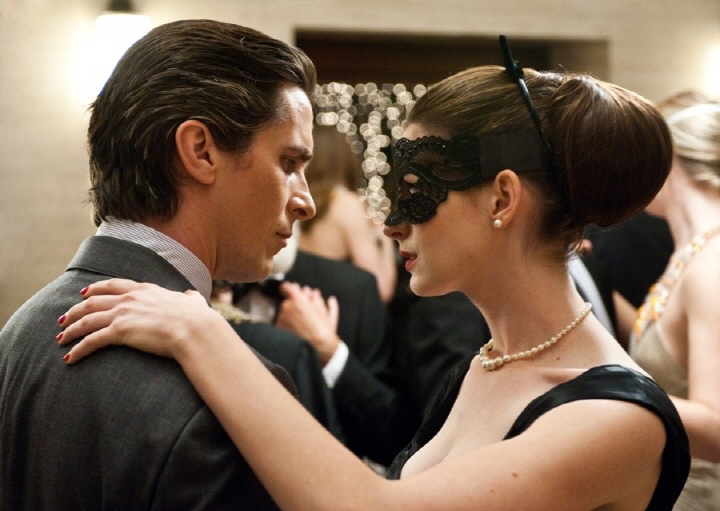
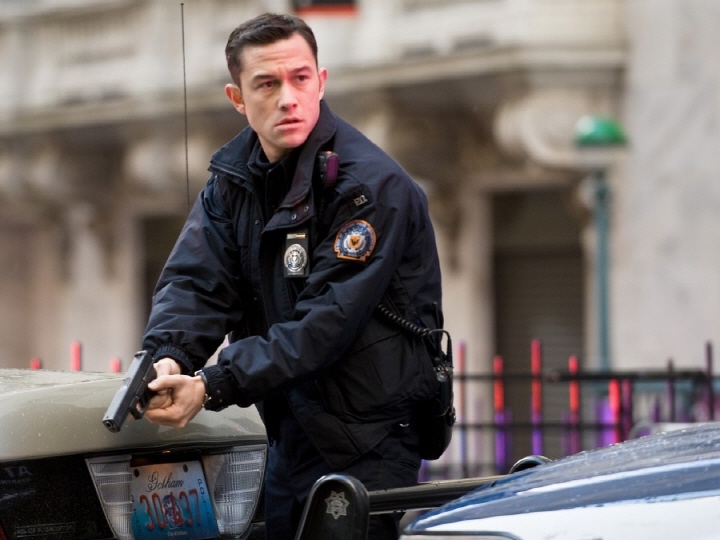
So many other things happen in the movie besides these happenings I describe above, and there are also many new characters moving around in the hectic story along with the familiar characters including Alfred, Gordon, and Lucius Fox(Morgan Freeman), who again provides Batman the new equipments for his battle. We have a young honest cop named John Blake(earnest Joseph Gordon-Levitt), and then there are two women entering Wayne’s lonely miserable life; Miranda Tate(Marion Cotillard) is a board member of Wayne’s company who wants to help him, and Selina Kyle(Anne Hathaway) is a cat bugler who attracts his attention after when she infiltrates into Wayne’s manor to steal one of his jewelries. While Tate benevolently approaches to a man who was once the most popular bachelor in Gotham city, Wayne is drawn to Kyle’s slick sexiness, which Hathaway gamely supplies while having a lively fun as a criminal yearning for a new start in her shabby life.

Overstuffed with many characters and lots of incidents, the movie feels ponderous at times, but it rarely slows its pace throughout its long running time. Though I was not bored at all because of its rapid pacing, but too many things quickly happen during 160 minutes, and the storyline and the motives of the characters are frequently murky or inconsistent as a result. As a matter fact, you will be quite disappointed if you expect Batman appearing more than before in this film, because Batman is on the verge of becoming a supporting character while others are hurled or swept into an epic social maelstrom swallowing the whole city. In the middle of the movie, we see Wayne helplessly locked in an ancient prison somewhere near Jodhpur, Rajasthan, India where no one except one guy has ever escaped from, and he has to endure the physical/mental punishment for interfering with Bane’s plan while Gordon and Blake and other policemen have to defend the city for themselves and others in the city without Batman.

On the whole, “The Dark Knight Rises” is not as impressive or exciting as the previous films because of its oppressive gloominess mercilessly pressuring on its characters and their world with little exhilaration, but I admire how Nolan tests his genre for its endurance for his serious realism. Except when it is really necessary to use CGI, Nolan makes the actions in his movie look as real as possible with his reliable crews, and we get several good action scenes including the sensational opening sequence where Bane escapes from a plane about to crash. While I was not that particularly excited and surprised for the most of its running time, I was entertained because the movie never loses its control even when it gets lost in its plot for a while, and its third act feels gritty, tense, and real enough for me to care about the story. Forcefully pushing itself to its endurance limits, the movie feels very close to our real world and the problems we are dealing with, though I must say that it does not succeed well in reaching to something equivalent to that thought-provoking ambiguity between good and evil in “The Dark Knight” while spending most of its time with the simple but imminent matter of survival and death.

Despite my heavy reservation toward it, I think “The Dark Knight Rises” is recommendable as a part of the series which has made most of the other superhero films look like frivolous forgettable entertainment. Nolan climbs down the peak where he climbed up, but he does it admirably with the fitting conclusion his hero deserves in the end, and his remarkable trilogy will remain as the golden standard for other comic book movies to come in the future.

Sidenote: The movie can be enhanced by more running time, but we all know Nolan is one of the last directors from whom you can expect the director’s cut.

Posted in Movies | Tagged | 1 Comment

Carnage (2011) ☆☆☆(3/4) : An afternoon meeting without manner

Solely focusing on one situation and four characters stuck in it, “Carnage” shows us their unpleasant sides through its vicious farce centered on one small incident. The characters in the film think or believe that they are sophisticated people with manners and they can handle their matter as civilized human beings, but, within a short period of time, they gradually reveal to us and themselves how petty and ugly they actually are beneath their superficial manners, and it is darkly funny to observe the series of their indecent behaviors revealing or digging more ugliness inside them as the time goes by.

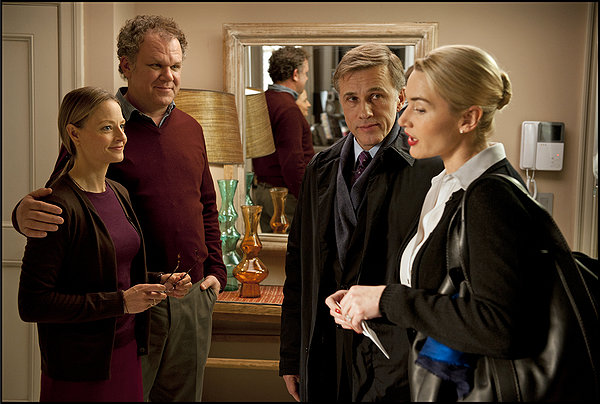
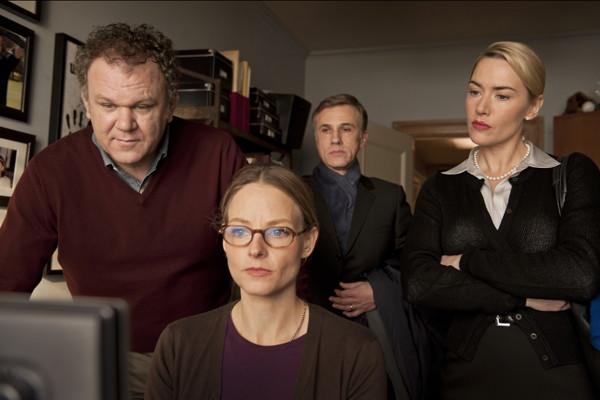
The premise of the movie is simple; two parents living in New York, Penelope and Michael Longstreet(Jodie Foster and John C. Reilly) and Nancy and Alan Cowan(Kate Winslet and Christoph Waltz), gather for the afternoon meeting held at the Longstreets’ apartment due to the incident between their children at the Brooklyn Bridge Park. Nancy and Alan’s son Zachary injured Penelope and Michael’s son Ethan with a stick during their confrontation at the park, and, while we do not know how exactly that happened, we can guess from the opening scene that the incident was probably one of those usual clashes between kids.

Because both kids go to the same school, the parents want to settle their children’s problem as smooth and quick as possible through their meeting, and the meeting seems to have been proceeded well as they wish. They are finishing drawing out the document for their mutual settlement when we meet them at the beginning, and both sides see no problem in the settlement. The injury is not very serious, and the Cowans are willing to pay the medical bill for that if it is necessary.

But their meeting is somehow extended through several coincidences along with little arguments on which kid should be blamed for the incident. One of the amusing things in the movie is that the Cowans are constantly drawn back to the Longstreets’s home whenever they are about to leave the place. Of course, either parents can end the meeting if they want, but they are always dragged by the words hurled at them at the last minute, and then another argument is initiated while they are still stuck in the living room.

And through these edgy interactions between them, their well-mannered veneer on the surface is shed from them step by step. They are all affluent middle-class people or the people between upper class and middle class(their kids’ school is some expensive private school in New York), but, through their conversations, the differences between them become apparent along with their respective flaws and pretensions. This leads to more arguments, and the living room is turned to the battleground for savage verbal warfare where boundaries and allegiances are kept changed or shifted according to the vicious mutual dynamic between these four people. In the messy circumstance like this, you will be not that surprised to see whiskey and cigar appearing on the screen later.

The movie is based on Yasmina Reza’s Tony award-winning play “God of Carnage”. While it has been put on the stage several times in South Korea(that is the reason why the movie will be released as “God of Carnage” in South Korean theaters), I have not got the chance to watch the play yet, but I could see that the director Roman Polanski, who adapted the play with Reza, makes a good movie while confined in the limited space of the original play. Like Alfred Hitchcock’s “Rope”(1948), the movie moves around only in the apartment except its opening scene and closing scene, and Polanski shot his film in real-time with his four performers.

While the limits in the movie become more apparent as the evening is approaching to the characters despite its short running time(it is less than 80 minutes), Polanski keeps the circumstance on the screen effectively spinning its wheel while also making it engaging with the precise timing of reaction shots and line deliveries from his performers. As shown in his early work like “Cul-de-Sac”(1966) or his later work “Bitter Moon”(1992), Polanski is good at mean black comedy about the characters mired in human vulgarity, and “Carnage” is another dark fun, which is advertised as “a new comedy of no manners”.

The four performers give a quartet performance entertaining enough to hold our attention even though we find them increasingly unlikable as their verbal battle starts from cobbler and coffee then goes down to whiskey and cigar. Jodie Foster and Kate Winslet is having a fun with the way the shallow facades of their characters get crumbled in the circumstance being filled with blames and accusations; they look composed and decent at first, and then they become as hypocoristic and pathetic as their husbands. John C. Reilly and Christoph Waltz also wield their comic skill while clashing with their co-actresses or each other; Reilly deftly reveals the boorish side of his character behind his likability, and Waltz is amusing as a sardonic lawyer who keeps getting a call from his cellular phone due to the recent emergent problem of his major client. He seems to be more concerned about his client’s problem while showing little interest to the matter in front of him and others, and that attitude naturally irritates others.

“Carnage” is essentially no more than one extended circumstance, and, not so surprisingly, it feels stagy from time to time due to its inherent constraints. But this is an enjoyable one-joke black comedy thanks to good direction and fun performances supporting its premise. While watching the film, I recalled how my mom treated a boy who broke my glasses and injured me in the face when I was 14(I still have a scar in my left cheek, though it is very small and faint now) She was not angry at him, and she later gave him a nice dinner at our home while trying to talk with him. I bet such an act of compassion never occurs to the characters in the movie; as a consequence, they find themselves far more childish than their own children in the end.

Posted in Movies | Tagged , | 2 Comments

Deranged (2012) ☆☆(2/4) : Do shouting and running solve anything?

 They shout or run a lot in South Korean thriller movie “Deranged”, just because they need to save the people they care about from the deadly parasite which controls human brain for its reproduction. As far as I remember, they don’t do anything besides these simple-minded behaviors to solve their emergent trouble, and I wonder whether there would be any difference in the story if their brains were infected with that lethal parasite.

You have probably heard about the parasite in question. It is Spinochordodes tellinii, which is also called nematomorph hairworm in English and called ‘Yeon-gasi’ in Korean. Check YouTube site, and you will find lots of video clips showing how this long, thread-like parasite cleverly exploits its host insect. It lives inside its host for a while, and, when it is the time for laying its eggs, it somehow controls the neuron system of its host, which goes to river or pond to drown itself as controlled. When the host dies in water, the worm comes out of the host and lays its eggs ready for another lethal life cycle.

“Deranged” actually begins from a nice idea for SF thriller movie. What if this worm infects human beings instead of its usual target hosts? What kind of chaos can be resulted if this parasite is spread on the national level? Then how will government and people react to this situation? With this idea, the movie could be as interesting as Steve Soderbergh’s recent film “Contagion”(2011), but, the movie unfortunately resorts to running and shouting coupled with the alarming idiocy of its main characters, and that is the reason why I was annoyed rather than engaged while watching it.

First, let’s talk about one notable stupid choice made in the movie. Suppose you get a very important chance for solving the national problem and revealing some secret behind it and you are one of very few people having that knowledge. Of course, you must immediately notify authorities of that information to save those unfortunate infected people as soon as possible, but do you know what the main characters of the movie do instead when they have such a chance? They don’t give that information to the police, and, to confirm that information, they just go alone with someone who can be their main witness to a certain remote place without telling anyone except one character. As a consequence, they further screw not only their situation but also other people’s situation thanks to their idiotic recklessness. I know the people in thriller movies can commit stupid things while they are busy and hurried, but, boy, this is too stupid to be overlooked.

Maybe you can argue that Jae-hyeok(Kim Myeong-min) is so desperate to save their family that he cannot afford to use his uninfected brain. Before the outbreak, he is already leading a hard life to support his dear family. He was once a college professor with bright future in front of him, but he recently lost lots of money due to an unwise stock investment recommended by his cop brother Jae-pil(Kim Dong-wan), so now he is busily working as a petty employee of some pharmaceutical company while not giving much attention to his wife Gyeong-soon(Moon Jeong-hee) and children.

Meanwhile, strange dead bodies are kept being found in rivers. It becomes quickly clear to Jae-pil and other cops that some disease is being spread around South Korea. Jae-pil’s girlfriend(and Jae-hyeock’s junior) Yeon-joo(Lee Honey) and other experts soon discover that the hairworm variant is causing this outbreak, so the infected people are quickly quarantined by South Korean government, but the number of the infected keeps increasing in spite of their efforts. The infected suddenly show increased appetite, and then they repeatedly drink lots of water, and then they desperately look for water to drown themselves like zombies reach for fresh human flesh. How the worms come out of human bodies is certainly not a pretty sight to watch.

Yeon-joo and others try to find a way to kill the worm, but nearly all of medicines for killing parasites do not work on infected people because they die due to side effects. Finally, one certain medicine product is found to be both safe and effective as the cure for the infected, but it turns out that there is a big problem associated with its availability, and that is why Jae-heyok runs a lot for saving his family throughout the story.

While its running time is less than two hours, lots of things rapidly happen in the movie, so it is not boring at least, but it is really annoying to see the movie pushing its characters to the series of stupid behaviors including the one I mentioned above for injecting more suspension and desperation in the story. It is revealed later that there may be some group responsible for this wide outbreak, but this mystery part, which could have been a lot more intriguing, is too easily resolved, and the movie gives no chance to Jae-heyok to use his expert knowledge at all except one moment before the finale. As you know, that is usually the point where the heroes in lesser thriller movies suddenly become a lot smarter than before after doing so many dumb things, and “Deranged” is another classic example.

The actors do whatever they can do with their characters, although their characters are mostly two-dimensional ones mainly designed for raising voice in their so-called dramatic tearful moments. I know well that Kim Myeong-min is a good, talented actor, but I am afraid he is letting himself caged in the stereotype roles frequently given to him nowadays. He surely looks as tense, hurried, and pressured as Nicolas Cage, but I have seen the same things from him too often before. While Moon Jeong-hee does not have many things to do except looking terrified or desperate or deranged along with her child co-actors, Kim Dong-wan and Lee Honey are stuck in the unconvincing relationship between their respective characters. If your boyfriend asks you to give money for another stock investment even after ruining his brother’s family, I think it is wise to consider leaving him, but Yeon-joo stays with Jae-pil, so she dramatically helps him and his brother in one perilous moment in a burning storage room.

“Deranged” has indeed some good moments including a group of infected people breaking out of the hospital building and running toward water, but it is ultimately hampered by the forced family melodrama and other serious flaws in the story, and I was not so terrified by it. With its nice idea coupled with the social criticism to its bad guys, it could have been a lot better, but, sadly, this movie is only shouting and running for water to infect us – without much success.

Posted in Movies | Tagged , , , , | 2 Comments

Dangerously Excited (2011) ☆☆☆(3/4) : A little disturbance in his nice life

I know how the hero of South Korean film “Dangerous Excited” initially feels about the disturbance he has to live with. During my undergraduate years, I always spent my time at the campus library in the evening after the lectures were over, and I frequently heard the noise from the basement level of the building right next to the library. We had one or two campus rock bands at that time(we still have, by the way), and they kept making lots of noise whenever they were practicing with their instruments. When I came out of the library to buy some snacks or drinks at the store on the first floor of that building, it was common to see the building vibrating with the noise from the below. I was sort of curious about what exactly they were doing on the basement level, but I did not want to go there because it was already quite loud enough to annoy my eardrums on the first floor.

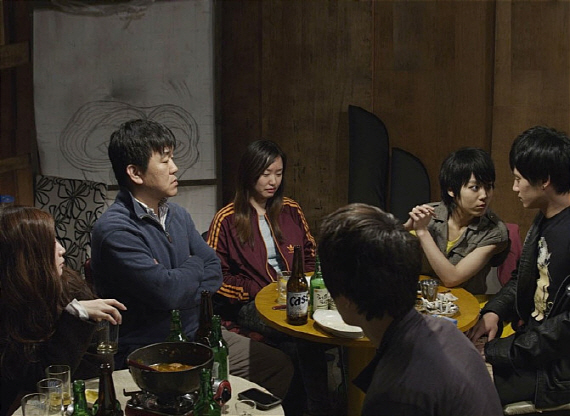
Han Dae-hee, deftly played by Yoon Je-moon, finds himself surrounded by such a noise problem like that after when he comes across the members of a college rock band named ‘3X3=9’(don’t ask me what that name means). At first, he comes to them as a public servant taking care of the petitions from neighbourhood due to the noise they make during their practice, and they look like just another work in his daily life. He notifies them that they are making too much noise and they can be evicted because of that, so they try to find another place for their practice.

However, they get swindled by a broker, and they come to Dae-hee for help, and he reluctantly lets them into their house. He soon finds that it is nearly impossible to sleep during night because of their constant practice in the storage room below his bedroom; even with the ear plugs in his ears, he can hear and feel the noises generated from their practice.

He is annoyed, but Dae-hee is a rare case of South Korean male – a man of calm, contented life style. In South Korean society, you can often come across many unpleasant sights of guys openly letting out their anger and stress to others, and Dae-hee and his co-workers sometimes encounter such people like them while working as public servants. Dae-hee always deals with them with courteous calmness, because he knows that it is a waste of time to be angered by these angry jerks. When one of them shouts at him on the phone, he quietly asks him to say less loudly(“When you lose your temper, you lose”, he says to us). In addition, he is a very good employee; he is very talented in preparing presentations with Microsoft Powerpoint program, and, as a graduate student who has to make a presentation for weekly lab meeting, I would be glad if he told me one or two valuable lessons on making a good presentation file.

His private life is nearly insulated from outside. His house is quiet and barren except few furnitures and some books for gaining trivial knowledges to impress his co-workers. But he is not that lonely, and he has been satisfied with his life style. He sometimes has a drink with his close friend who works in the same department, but he prefers to spend his free time at his house when the work time is over, and he usually enjoys watching TV shows in the living room, where only furnitures seem to be his big sofa and TV.

When his comfortable life is getting disrupted by the noise from his unwelcomed guests, Dae-hee tries to find a way to deal with it while maintaining his usual calmness. But the noise keep emanating from the below, and something is gradually excited somewhere in his mind. He studies rock music in his own way through those cheap encyclopedic books you can find at bookstores in South Korea, which can tell you many trivial things about Rolling Stones or Bob Dylan while not teaching you anything about music itself. He finds old rock music records owned by his younger brother in the attic and attentively listens to them. When the band is on the verge of being broken up, he becomes their unlikely supporter – and their bassist, though he knows nothing about how to play instrument.

As a man who finds the possibilities outside his daily life, Yoon Je-moon, who has been a supporting actor in several South Korean films including “Mother”(2009), gives a wonderfully nuanced performance at the center of the story. Dae-hee is an interesting character to observe because he has his own way of living along with a funny view on his society and its people, and I enjoyed the insightful observations in his narration. Yoon effectively conveys the small changes inside his character to us while rarely emphasizing them; his life is not changed a lot in the end, but we can sense that he is a little happier than before.

I must say the music in the film is not that impressive, but that is intended as another funny part in the movie. The band members may have passion toward their music, but, to be frank with you, they will probably be bound to be a second-rated rock band if they fail to improve themselves(Spinal Tap looks not so lousy compare to them). Some of them are hopelessly naive about their future, and others know how mediocre they are as a group. Dae-hee is no big help to them except helping them as a substitute bassist; he knows a lot about the famous rock singers thanks to his ‘study’, but he really has to learn how to play bass in an adequately presentable way in the concert they will participate in.

“Dangerously Excited”, which is released in South Korean theaters as “I am a Public Servant” on this weekend, is an amusing character drama supported by one of the most notable comic performances of this year. The story may be a little too flat and ordinary considering its colorful hero, and the supporting characters are less defined than its hero, but I liked its humorous moments including a hilariously dreamy moment when Dae-hee encounters one of the most famous singers in American rock music history. No, it is not that singer himself(well, how can that be possible in a small South Korean movie like this?), but it is funny enough to make me smile with acceptance.

Posted in Movies | Tagged , , , , | 2 Comments