 Watching Steven Spielberg’s “Minority Report” (2002) again through Blu-ray made me muse on how much my life with movies has changed during the last 10 years. When I watched it with my father at one of the big movie theaters in my hometown on one summer day of 2002 July, we were not yet familiar with multiplex theaters, and I watched movies mainly through VHS while infrequently going to theaters. DVD was slowly attracting my attention and I eventually bought a DVD-ROM drive for my computer in 2002 October. And I was not particularly interested in downloading movies from Internet; why do I have to watch movies in my small dorm room when I can enjoy them at big theaters?
Ten years have passed, and many things have changed. Most of my hometown theaters are now changed into multiplex theaters, and visiting the local theater near my campus is automatically included in my weekly schedule whenever interesting films are about to be released. While VHS has disappeared for years, several DVDs in my movie collection have been replaced by Blu-ray editions. And I know well that I can watch a movie through a high definition video file if I want; thanks to high-speed Internet, it takes less than an hour to obtain it even if a file is larger than 10Gb. I still prefer theaters, but it is better to watch movies through Internet in some cases. For instance, when I went to the local theater on last Friday to watching “The Cabin in the Woods” (2011), it was like watching a terribly dim 3D movie due to a bad converting job on digital film; I promised myself that I will watch it again in a proper condition once it is released on Blu-ray.
While my life with movies has changed a lot like that, I find “Minority Report” remains the same as before. Like Christopher Nolan’s “Inception” (2010), this is a rare multifaceted summer blockbuster film where actions and ideas co-exist together in an intriguing science fiction story. Propelled by its compelling mystery plot, it provides us memorable moments filled with suspense and thrill. Decorated with the fascinating technologies of its realistic future world, it might have looked like fantasy when it first came out, but now it looks uncannily prophetic because many of the technologies shown in the movie are developed or being developed at this point.
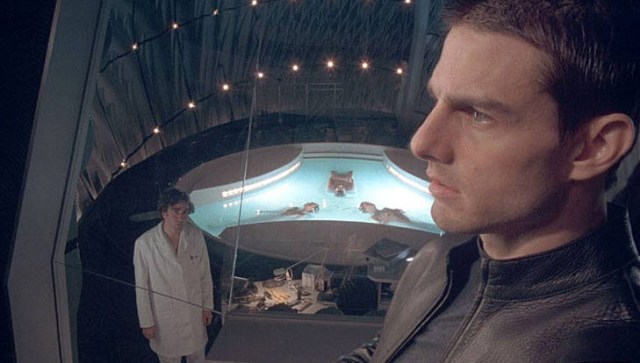
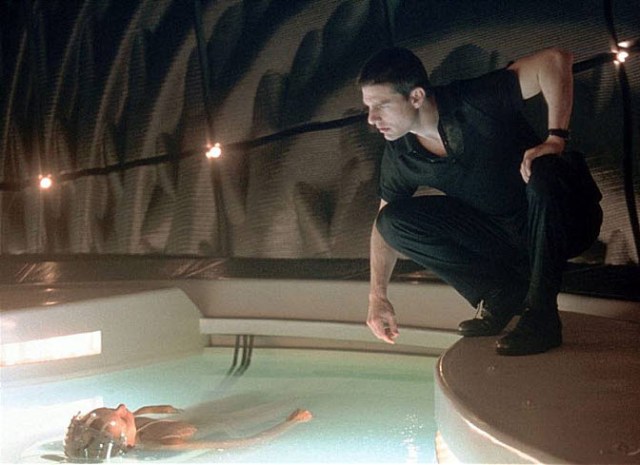 If I have to pick one aspect that is still unrealistic in the movie, it would be the base of the main system inside the Department of PreCrime, installed in 2048 in the District of Columbia. For the last six years, the police officers at PreCrime have successfully prevented murders through information about when and where they will happen, and they extract the information in advance from the visions seen by three precogs incubated in a milky photon pool, who are the unfortunate victims of a genetic mutation caused by a drug addiction of their parents. While it seems they can see other things in the future, their hive minds are especially sensitive to future murders, so Lamar Burgess (Max von Sydow) and Dr. Iris Hineman (Lois Smith) established PreCrime for using their talent to solve the increasing crime problem in six years ago.
I have always wondered about how their mutation affects the neuron system to bestow such a fantastic ability to them. It seems to be an inheritable mutation, so it is definitely involved with genes and their expression in the cell. I wonder whether disruption in the brain structure due to protein malfunction makes them see the future through a higher dimension, but this is just my silly cranky thought. As a matter of fact, neither the movie nor Philip K. Dick’s short story it is based on explains the biological aspect of their main premise in detail.
Nonetheless, their unreal premise provokes many interesting thoughts and questions. Can they arrest a future perpetrator, or a “pre-criminal,” for a murder even if he has not yet not committed a crime? Maybe he can be arrested for an attempt to murder (the opening sequence of the movie is a good example of that), but what if a perpetrator has no thought about murder at all when he is arrested? Can his trial be legal when it is already processed with an appointed judge and a prosecutor before their arrest? And, if a predicted murder is prevented, how can we say its prediction was right?
Philip K. Dick’s short story revolves around an amusing paradox generated from its premise. Because its hero John Anderton knows the future in advance as the head of PreCrime, he finds himself in a complex situation which can be explained by a basic quantum physics theory. You obtain the data about the future, but that act of measurement affects the future itself, so new data are obtained as a result, but the future is changed again. Knowing what will happen in the future can result in a really annoying problem, you know.
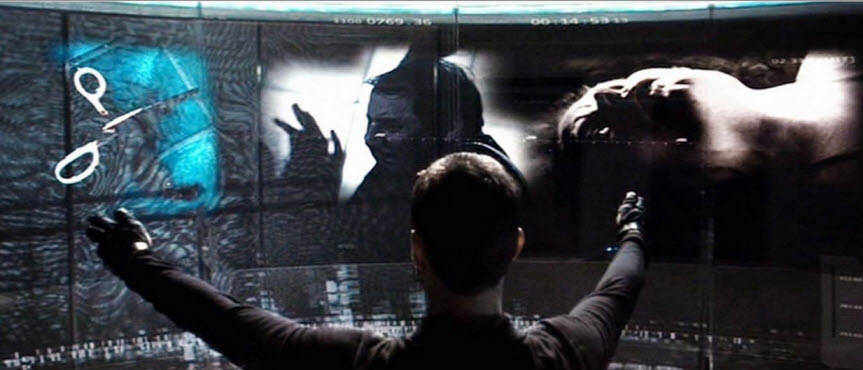
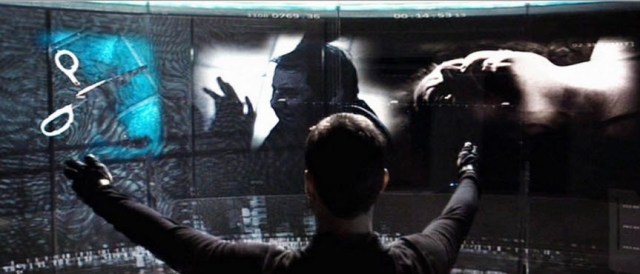 This intricate aspect of Dick’s story is replaced with a relatively less complex mystery plot in Jon Cohen and Scott Frank’s screenplay, but their mystery plot, expanded from the premise of Dick’s story, is fair, intelligent, and entertaining. In the opening sequence, John Anderton (Tom Cruise), who is the chief detective of PreCrime in the movie version, is handling case #1108. While the names of victims and a perpetrator are already identified along with the time of incident, he and his men need more information for locating them as soon as possible. It is Anderton’s job to extract clues from the visual puzzle pieces received from their three precogs– and how he manipulates them in a big transparent plastic panel through the gestures of his hands in midair is one of the defining moments in the film.
Not only he is able to enlarge, shrink, revolve or sweep them, but also he can reel them back and forth as he wants only with his hand movements. With Franz Schubert’s “The Unfinished Symphony” playing on the soundtrack (how ironic the title is), he looks like a symphony conductor, and the music accentuates the smooth, confident professionalism we have observed from Harry Caul in “The Conversation” (1974) and Jack Terry in “Blow Out” (1981).
PreCrime has been steadily gaining approval during its six years of trial in Washington D.C. The number of murder incidents is decreased to almost zero in the area, and now all of their recent cases are crime of passion represented by red ball (pre-meditated murder is represented by brown ball in contrast). We get a humorous line at one point: “Now, put the gun down. I don’t hear a red ball.”
 There will soon be a national ballot to determine the expansion of PreCrime to the federal level, and the Department of Justice wants to know whether there is any serious flaw in PreCrime – and, possibly, whether they can take it over. Anderton is not so pleased about Danny Witwer (Colin Farrell), a federal agent sent to evaluate the system, and neither is his boss/mentor Burgess, an old man who will not be happy to see the milestone of his long career taken away from him.
The thought-provoking conversation scene between Anderton and Witwer begins with a legal and logical dispute on whether a pre-criminal can be arrested even if there is no crime committed yet. Their conversation moves to the religious and socio-political area when Anderton shows Witwer the “Temple,” a big, quiet basement hall where precogs are protected from outside. A former seminarian, Witwer quickly notes that Anderton and his men are not different from priests protecting oracles in their temple, while also pointing out that the power lies not in oracles but priests. The system can be perfectly objective, but what about the people who have the authority to handle it? In Witwer’s view, there are always human flaws and they will lead to problems in the perfect system.
Because of his strong belief in the system, Anderton does not agree with Witwer, but he soon faces a dangerous possibility inside the system. The subject of case #1109 is none other than himself, and precogs predict that he is going to murder someone he has never heard about. Did somebody manipulate the system to frame him? Or, is this a mind-boggling case of predestination paradox? Eluding his former colleagues now chasing him, he tries to prove his innocence by any means necessary, but isn’t it possible that this very act of his will cause a predicted incident? There is also a possibility that he can undermine the whole system; if he does not commit a murder, then the system will be proven to be wrong, and that may trigger the end of the system.
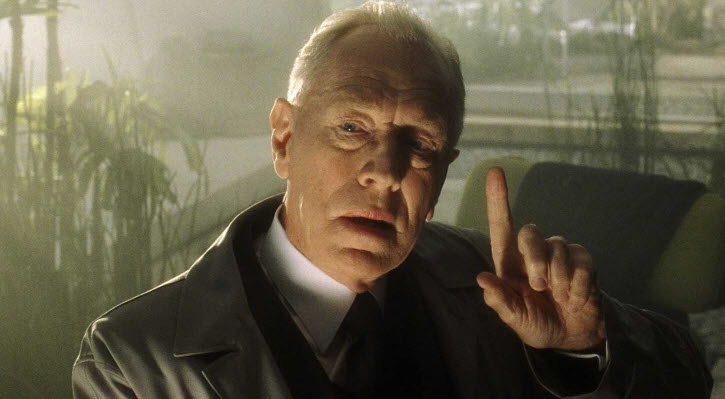
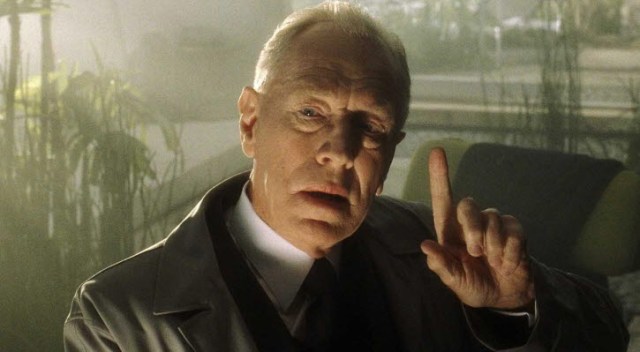
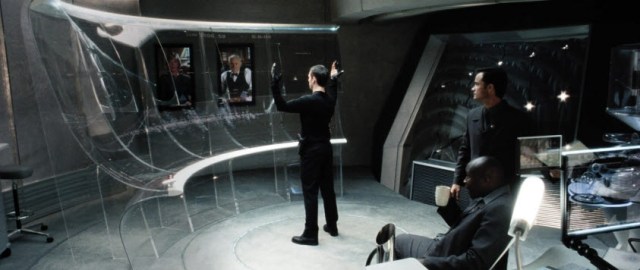 Through his meeting with Dr. Hineman at her wondrous greenhouse filled with various genetically modified plants, Anderton realizes that PreCrime is not as perfect as he thought. He learns of the existence of “minority reports,” which represent possible alternative futures but are discarded for the perfection of the system, and now he is determined to find his minority report to prove that he won’t kill anyone.
His situation is a classic case of the framed hero, exemplified by many Alfred Hitchcock’s thriller films including “North by Northwest” (1959). Using a minority report as a MacGuffin to drive his thriller plot, Spielberg serves us a number of stylish, exhilarating set pieces. There’s a long chase action sequence which furiously starts in a narrow alley and then leads to an auto factory nearby; how the action is continued on an assembly line may remind you of the car factory scene which was envisioned by Hitchcock but never realized when he was making “North by Northwest.”
Another very good sequence involves with Anderton and Agatha (Samantha Morton), one of precogs he takes away from PreCrime to get her help. This happens at a shopping mall they go into while running away from PreCrime officers. She is physically weak and helpless to walk by herself because she has been in an incubator for six years with her fellow precogs (they are respectively named Arthur and Dashiell, so we can see that Agatha Christie, Arthur Conan Doyle, and Dashiell Hammett are referenced in the of the story). Her psychic talent guides Anderton through their tricky moment while he is supporting her, and we get an exquisite moment shining with precise execution while she is instructing him on the next moves to evade their pursuers. Every move is beautifully fit into an elaborate strategy in the end, and this sequence has a nice homage to the umbrellas in Hitchcock’s “Foreign Correspondent” (1940) as its finishing touch.
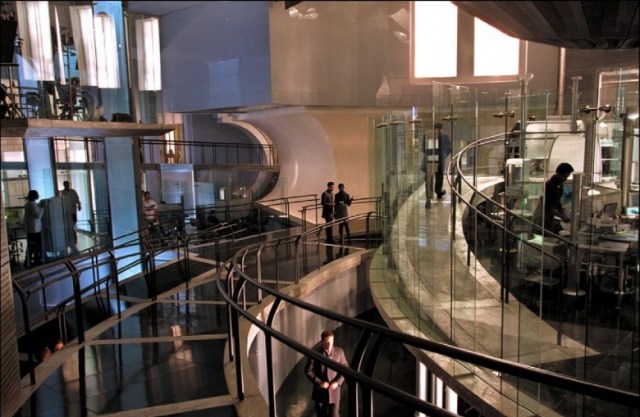
 The special effects are important factors, but they mostly serve the story and the characters as bountiful details of their vivid world–along with the terrific production design by Alex McDowell. The futuristic architecture and its amazing Maglev transportation system realistically exist in the Washington D.C. we are familiar with, and, considering how much time Spielberg and his crew spent with the experts and scientists from various fields during pre-production, this may be not that different from how Washington D.C. will really look like in 2054. After watching the movie, I thought about how the looks of my campus have been changed during the last 12 years; there are still tacky old buildings (we jokingly called them public bath houses), but they’re being gradually replaced or surrounded by modern architectures. The campus looks different now, but it is not entirely alien to us. I guess that’s the reason why Washington D.C. depicted in the movie feels more plausible to me than before.
Its future world looks more utopian compare to what we saw in another famous science fiction movie “Blade Runner” (1982), which is also based on a short story by Philip K. Dick, but there also exist dystopian sides in this bright world. There are retinal scanners everywhere in the city to locate you, and digital billboard commercials call your name whenever you pass them, and there are still dark, seedy corners somewhere in the city evoking the familiar atmosphere of film noir. In this underworld, there is a drug dealer who provides Anderton the drug to ease personal grief over his lost son, and there is also a doctor who can change your identification through his illegal optic operation in a shabby room; his girlfriend and assistant is the character closest to the definition of femme fatale in the story.
The movie is shrouded in a cold, metallic feeling thanks to the cinematography by Spielberg’s long-time collaborator Janusz Kaminski. With its desaturated color tone and muted hues, the movie approaches to the monochromatic mood of black-and-white noir film from time to time. John Williams’ score is moody and nervous, and the neurotic french horn performance accompanying the suspenseful sequence where tiny spider robots move around the apartment building for a retina scan is reminiscent of Bernard Herrmann’s brooding thriller scores. During this sequence, Kaminski’s camera deftly moves around the cross-section of the building while looking upon its tenants who are retina-scanned one by one by spider robots (I was surprised to learn that they actually built a very big real set for this scene), and this increasingly tense circumstance culminates to one spider robot sensing something strange when it and other robots are about to leave.
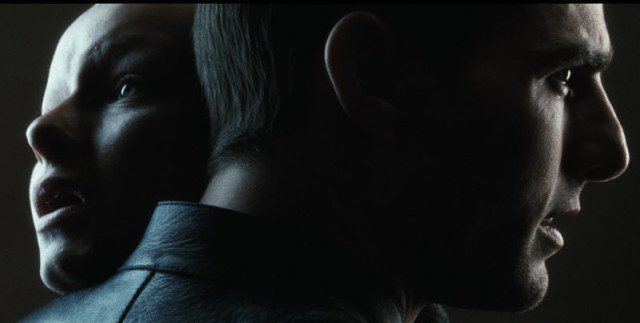 The best thing about the performances in the film is that the actors look convincing with the special effects on the screen. Now and then Tom Cruise has been an excellent action movie star, and his everyman quality helps us identify with his character. His direct, earnest performance may be a little too straight for a flawed noir hero haunted by the memories of his lost son, but Cruise never lets the human dimension of the story be lost from the screen even during fierce action sequences, and we come to realize that the story is not only about Anderton’s search for a changeable future but also his quest to find a way to deal with the painful past lingering inside his head. Colin Farrell, Max von Sydow, and Samantha Morton are all effective as the main supporting characters surrounding Cruise, and Morton is strikingly uncanny and poignant with her expressive face right from her first appearance. When Agatha and Anderton comes across a crucial moment I will not describe in detail, Kaminski’s camera masterfully captures a haunting shot representing two opposing wills inside them.
With “A.I. Artificial Intelligence” (2001), the movie shows us that Steven Spielberg has changed a lot compared to what he was during the era of “E.T.” (1982) and “Close Encounters of the Third Kind” (1977). While he is capable of making a lightweight comedy like “The Terminal” (2004) or an innocent adventure story like “The Adventures of Tintin” (2011) or an unabashedly sentimental drama like “War Horse” (2011), there are also the sheer chaotic terror in the first half of “War of the Worlds” (2005) and the gray espionage of “Munich” (2005). “A.I.”, which has been steadily gaining its status as an underrated work since it was released, was initially criticized for its sentimental finale by many people, but they seemed to overlook how sad and gloomy that finale actually is. Imagine how unbearably dire it would have been for David if he had been a real human being instead of a humanoid robot. In the case of “Minority Report,” there are some sentimental moments which do not mesh well with the other elements in the film, but its overall tone remains cold, dark, and hostile with an edgy sense of black humor in spite of the tentative optimism in the ending (I still love that gross refrigerator scene, though I cringe every time I see it).
“Minority Report” is a captivating neo-noir science fiction film filled with style, substance, and ideas. The movie dazzles me with its abundance of details, and it is constantly interesting even when it relatively drags during its last act. We get most of the answers before its finale, so there is not much mystery at that point, but now suspense dramatically builds on a circumstance similar to the one at the end of Philip K. Dick’s story, with the fate of some characters as well as the fate of PreCrime at stake. It may be freer to live without PreCrime, but what will happen next?
One fascinating thing about the movie is that our world has been approaching its world step by step in many aspects since the movie came out in 2002. At present, multi-touch interfaces like the one shown in the film are not the technology of the future anymore, and now I frequently see people operating iPads with their hands at my campus, including my beloved advisor professor. When I came across an article about the development of E-paper, I instantly thought about the subway scene featuring the people getting the latest new from their electronic newspaper or magazine (my personal question; how do they recycle it?). Spider robots in the movie may come true someday, like drone planes, because US military is currently developing them and I can imagine these tiny little robots reconnoitering to detect enemies hiding somewhere.
While the world of “2001: A Space Odyssey” (1968) may be still too far from our world, the world of “Minority Report” may be closer than we think considering the rapid speed of current technology advancement. As a matter of fact, we will probably have a PreCrime of our own someday. No, there are no mutant psychics, but I read an informative science article from the Guardian that one researcher actually built a system which can tell you the likelihood of your house being broken into. In addition, an internal document from the US Department of Homeland Security revealed that they actually tested a program to predict criminal intent on civilians. Well, isn’t it nice that we can at least think and discuss in advance our brave new world to come, through good science fiction like this movie?

 Two impressive things in new South Korean horror film “Two Moons” are the title itself and the image represented by the title. It is a very dark and creepy night in the forest in some remote area, and we have a haunted house where some ominous force seems to be working against the people in the house. And then we see the two moons in the sky, which are identical in shape but look a little different in color. Something is very wrong, isn’t it?
 However, the house does not look like a safe place to them. They frequently hear some strange sounds in the house. They see something moving in dark corners. They feel the malevolent presence of someone else besides them. Furthermore, it is possible that one of them is not what he or she seems to be – naturally, they become more suspicious of each other than before. Why is So-hee(Park Han-byeol), a young novelist, so particularly interested in who her fellows are and when they were born? Why is the hand of In-jeong(Park Jin-Joo), a whiny high school girl, smeared with blood when she wakes up with others in the basement room? And can what Seok-ho(Kim Ji-seok) remembers about himself really be trusted?
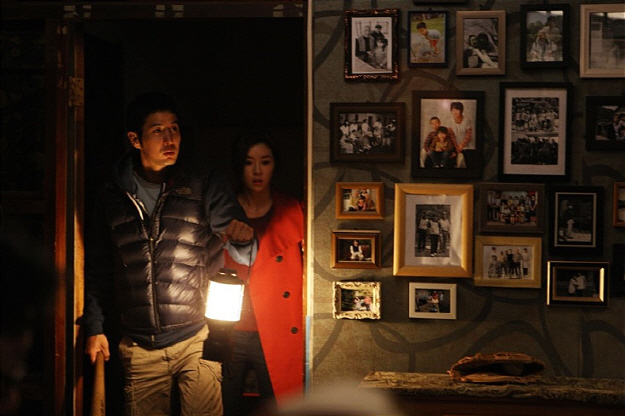
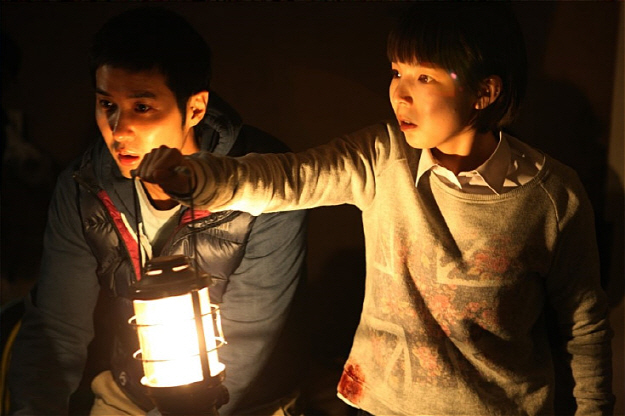 There are indeed some good scary moments in the film. As I said above, I like that impressive scene revealing two moons hovering over the house in the dark of the night, and the movie does a nice moment which reminded me of that famous deleted scene of “The Exorcist”(1973). This is a low budget film, but the spooky atmosphere surrounding the house is well maintained throughout its short running time(86min) even when the characters are in a bright space. When they are moving around the house while only depending on a lantern or a cellular phone, you know something can suddenly appear out of the darkness at any moment.