The Amazing Spider-man (2012) ☆☆☆(3/4) : A darker retelling of the same story

After watching “The Amazing Spider-man” during the last evening, I remembered a little comment from the twitter account of one South Korean movie critic. While not so specific about whether it was good or not, the critic said the movie was pretty much like meeting a darker cousin of a boy we met before and then going with him around the familiar places we have been to.

I guess that comment aptly summarizes how both good and redundant this early reboot of one of the popular Marvel superhero movie series is. The movie tries to be different from Sam Raimi’s Spider-man trilogy and it certainly looks like a darker retelling of the origin of its superhero. Though I had a feeling that I was being served with a variation of the same story I’ve heard before, I enjoyed it at certain levels, and I think it works better than “Spider-Man”(2002) as the first movie of the rebooted series.

The movie tells the story which is already very familiar to most of us; how an introverted high school boy named Peter Parker(Andrew Garfield) gets his superpower by accident and how he gradually accepts his new identity as a superhero. He happens to be bitten by a genetically engineered spider when he looks around the high-tech biological laboratory managed by Dr. Curt Connors(Rhys Ifans), and he soon realizes that he attains the amazing abilities through this incident. He becomes stronger and faster, and he can also climbs up wall like a spider, and his hands become stickier than before(that change causes several funny troubles in his daily life, of course). He cannot make or shoot spiderweb, but this clever kid makes the special device for that.

Meanwhile, he also starts to wonder about what happened to his parents, who suddenly disappeared when he was very young. Since his parents’ disappearance, he has been living with Uncle Ben(Martin Sheen) and Aunt May(Sally Field), they are naturally concerned about their young nephew when it looks like he is hiding something from them. Uncle Ben gives Parker a sound advice his nephew will remember forever – but it is not “With great power comes great responsibility“, by the way.

The screenplay by James Vanderbilt, Alvin Sergeant, and Steve Kloves puts a dark, serious tone on the story through a tragic incident following that advice, which makes Parker turned into a vigilante on the streets. He just wears a mask and a hood at first, but he later made that familiar costume, and he is quickly known as Spider-man to New York citizens.

NYPD does not welcome Spider-man because he is disrupting the police work in their view, and Captain Stacy(Dennis Leary) is determined to arrest him, while not knowing that her daughter Gwen(Emma Stone) is close to the guy he is chasing after. She comes to know that her classmate/boyfriend is Spider-man, and that makes their relationship a little more exciting than before. Parker is a quiet, likable kid before, and now he is a quiet, likable kid with the top secret he cannot tell to anyone except her. With her cop dad, her circumstance will instantly remind you of the Twilight series – but I have to say Andrew Garfield and Emma Stone are a lot more interesting to look than Edward Cullen and Bella Swan.

Meanwhile, what Parker discovers from an old briefcase left by his scientist dad causes a serious danger. The origin story of superhero always needs a villain antagonizing against its hero, and, this time, we have Dr. Connors, who was once a colleague of Parker’s dad and is now a leading expert in the field which will make many of my colleagues at the biological science department have lots of giggles. After using the valuable information for his project given to him by Parker, Dr. Connors makes a crucial advance in his research, but, when he tests the serum on himself, he gets transformed into a giant lizard monster who wrecks havoc in New York. His idealistic dream is now turned into the biologically hazardous plan threatening the genomic identity of New Yorkers, and Parker has to stop him before it is too late.

The action scenes have good CGIs accompanied with excitement and thrill, but I have to admit that the story becomes relatively less interesting than before in that process. Rhys Ifans is nice as a good scientist turned into a brutal supervillain, but the dark side of his character is mostly represented by a CGI creature, and that reminds me of why Alfred Molina’s performance as Doctor Octopus is important in the success of “Spider-man 2”(2004). His robot limbs are surely CGIs, but they serve for Molina’s performance as the parts of his character, not overshadowing his acting.

The director Marc Webb, who previously made a witty romantic comedy “(500) Days of Summer”(2009), does a good job of making an entertaining blockbuster film. The mood and atmosphere are notably darker compared to Raimi’s films, and Garfield’s performance is strong enough to support them; his performance is effective even during the action scenes because we are aware of his character’s vulnerability. Stone is lovely and lively as a smart girl who is not afraid of an imminent danger approaching to her when she has to help her boyfriend at the urgent moment, and Sheen and Field give warm performances as Parker’s loving uncle and aunt.

While I am bothered a little by its inherent redundancy, I do not think I wasted my money and time while watching “The Amazing Spider-man” because it is a little better than its cousin made in ten years ago in several aspects. Though it may be a little too early to reboot the series, this is a competent reboot which can be followed by a good sequel. I wonder whether it will be as good as “Spider-man 2”, but I think we’ll see about that soon.

Sidenote: I watched it in 2D. Unlike Ridley Scott’s recent film “Prometheus”(2012), I did not feel any need about its 3D effect while watching this movie. So please save your money.

Posted in Movies | Tagged , , , , , | Leave a comment

Recent photos of the campus avian gang(06/24/12)

                               
New members of the campus avian gang grow up a lot – I wonder what their seniors think about them…
Posted in Photos | Tagged , | 3 Comments

Everything Must Go (2010) ☆☆☆(3/4) : A man stuck in his front lawn


“Everything Must Go” is a story with the simple premise both absurd and sad. He does not exactly hit the bottom, but his life, which has been stuck with lots of things while going nowhere, hits the spot near the bottom recently, and it looks like the worst day of his life. He seems to have no idea about what to do next while surrounded by the objects representing his life on his front lawn; the first thing to do is buying cans of beer and drinking it as the time goes by.

Nick Halsey(Will Ferrell) is an alcoholic who has caused lots of troubles in his life and his company. Except his alcoholism, he is a good employee to his company(he is a regional Vice president), so he has been tolerated for a long time, but his latest relapse causes a big trouble in the company. He is fired now with a small gift from his bosses as the sign of gratitude to his service, and that makes a good excuse for his another relapse, and that leads to another stupid act fueled by alcohol.

When he arrives at his suburban home, there is another bad news waiting for him; he finds himself evicted from his house along with his belongings by his wife who wants divorce(She never appears in the movie, by the way). Before leaving the house, she changes the locks, so he cannot enter his house even though he is a legal owner. His bank account is frozen, and his cellular phone service is also stopped. He has nowhere to go, so he chooses to stay on the front lawn strewn with his belongings; he sleeps on his sofa and then wakes up in the morning when the sprinkler is activated on time. And he drinks again.

At least, the situation is not entirely dire to him. Thanks to his AA sponsor Frank(Michael Peña), who is a local cop, Nick is allowed to live on his front lawn for a while on the condition that he is having a ‘yard sale’. A young boy named Kevin(Christopher Jordan Wallace) hangs around him because he has nothing else to do while his mother is taking care of a patient living nearby. A young pregnant woman named Samantha(Rebecca Hall) has recently moved to the house across the street, and she and Nick spend their time together as the lonely people alone in their neighbourhood.

The movie is inspired by Raymond Carver’s short story “Why Don’t You Dance?”. The director/screenplay writer Dan Rush expands the basic idea of that short story for his first film, and, while this is not always successful because it results in diluting the power inside the concise and poetic style of Carver’s short story, the outcome is a nice intimate character drama with low-key humor. The pace is slow, but it resembles the rhythm of daily life, and its warm mood slowly comes out from the characters and their sunny environment in spite of the gloomy side of the story.

Although he has mainly been known to the audiences as a popular comedy actor, Will Ferrell has successfully shown us the serious side of his talent from time to time through several notable films including “Winter Passing”(2005) and “Stranger than Fiction”(2006). In “Winter Passing”, he was painfully shy and awkward as an idiosyncratic man living with Ed Harris’ writer character. In “Stranger than Fiction”, he showed us that he could play an ordinary man facing a preposterous circumstance which is certainly weirder than fiction.

While his usual boisterous side is dialed down to the lowest level, Ferrell gives a fine performance as a flawed hero facing a dead end in his life. Nick is a nice guy, but his problem with alcohol keeps placing him in the conflicts or clashes with others around him. He knows he must do something to get out of his trouble, but alcohol comes first in the mind of an alcoholic, and he is still stuck in his sofa while watching the time pass in front of his house with a beer can in his hand.

But he is slowly moved to the path to a new start through the small interactions with the people who come into his messy situation, and Ferrell is supported well by the good supporting cast who gives us the characters far from the clichés expected from such a story like this. Michael Peña is a sympathetic sponsor who will not get the AA sponsor of the year award, and Rebecca Hall brings warmth to her conversation scenes with Ferrell. Samantha lives alone in her house while her husband is absent due to his work, and I think Nick probably see his wife’s past from Samantha. What he says to Samantha while he is suffering from the withdrawal syndromes during one terrible night is harsh, but, though he apologizes to her later, she admits that he told her an inconvenient truth about her life – and then she does what should be done for her life.

Christopher Jordan Wallace is also good as the kid somehow walking into Nick’s stalled life by accident. Kevin is not your typical cute chubby kid; Wallace’s performance is quiet and thoughtful, and he and Ferrell make the growing friendship/partnership between them both subtle and convincing. Kevin gets interested in salesmanship, and Nick gradually learns that he is not as useless as he thought while giving several useful lessons to Kevin. Although she appears in only one scene, Laura Dern is excellent as an old high school friend of Nick. Rummaging around his belongings, Nick finds his high school graduation album, and he suddenly decides to visit a girl he liked at that time, but he only learns that the life is a one-way road. Ferrell and Dern imply lots of unsaid things below their seemingly cordial conversation; he behaves like normal but she senses there is something he wishes to say but cannot say.

“Everything Must Go” is not the best film based on Raymond Carver’s work(that honor still belongs to Robert Altman‘s “Short Cuts”(1993), which was a powerfully humane tapestry consisting of Carver’s ten works), but it is a good movie which goes deep inside Will Ferrell’s talent. He is entirely believable as a sad, depressed man struggling with his problems, and the movie works mainly thanks to his surprisingly restrained performance. I think we will able to see more from his serious side in the future while enjoying his comedy films.

Posted in Movies | Tagged , , , , | 1 Comment

I Wish (2011) ☆☆☆1/2(3.5/4) : Two little brothers reaching for miracle


“I Wish” is a gentle, funny, poignant, sensitive, insightful and optimistic story about two little brothers reaching for miracle. Although I missed the chance to watch it when it was released at South Korean theaters around the end of the last year, I have kept hearing from others about how good it is, and now I know how wonderful it is, and I cannot help but smile whenever I think about these little brothers in the film who are wise as well as innocent like some kids we come across in our daily life.

They are Koichi and Ryunoske, played by Koki Maeda and Ohshirô Maeda. The chemistry between these two kids, who are actually brothers, is infectious to say the least. They are lively and joyous, and they never run out of their exuberant energy which always fills the space surrounding them. They are separated during the first half of the story, but you can feel how inseparable they are from each other when you see them having a conversation through their cellular phones.

They have not met each other for the last six months since their parents divorced. Koichi moved with his mother to her hometown Kagoshima. He and his mother now live in her parents’ house, and he has been accustomed to his new home except an active volcano near the city(it’s Mt. Sakurajima, by the way). He thinks that it is strange to live near the volcano which frequently sprays ashes on the city during its constant eruptions, but the people of Kagoshima have actually lived like that with the possibility of disaster right next to them. This looks dangerous to you, but it may not look dangerous to South Korean audiences; after all, South Korea has the world’s second largest metropolitan area right below one of the most lunatic and dangerous countries in the world.

Ryunoske, usually called Ryu in short, moved with his father to Fukuoka. His father still pursuits his dream through his independent rock band, and he is more childish than his young son, but he is not a bad dad and they have been living together pretty well. Ryunoske sometimes have a fun time with his dad’s friends, and, like his brother, he has friends to play with at his school, and they usually spend their free time at the town swimming pool. I was not so interested in physical education class when I was in elementary school, but I liked swimming(and I still do), and Ryunoske and his friends reminded me that the swimming pool at my neighbourhood was one of the best memories of summer days during my childhood.

Koichi and Ryunoske are not unhappy about their respective changed lives, and they are constantly in contact with each other thanks to the advance of modern communication technology, but they wish to be together again with their parents. On one day, they get one preposterous idea for making their wish come true. The new high-speed train line will soon be opened between Kagoshima and Fukuoka, and they and their friends believe some sort of energy field is generated when the trains pass each other at the speed of 250-km. They believe the miracle will happen as they want if they say their wishes loud and clear to the trains at that moment,

You will find their belief quite silly, but these innocent kids are very serious about it, and it is warmly funny to watch how they prepare for their mission. They are naive, but they are also smart. They find the ways to finance their mission. They also find the exact point where the two trains will meet each other. They also plan how to skip the school for their journey. How their plan is executed is another warm funny moment in the film.

While calmly observing these kids with affection, the movie also looks around the adults near them. They are nice people; Grandpa helps Koichi’s plan to skip the school, and the teachers turn out to be a lot more understanding than we thought at first. There is also a touching sequence when the kids unintentionally come into the house of an old couple. The kids get a place to sleep through deception, but an old couple is happy to have their house filled again with children. Whether they really believe one of the kids is their granddaughter does not matter because what happens between this couple and the kids is something they will never forget.

I came to know about the director/writer Hirokazu Kore-eda through “After Life”(1998). I did not expect much about that movie, but I was quickly absorbed into its story about the dead people who are about to move to the next world with one single precious memory in their previous lives. “Nobody Knows”(2004) was a sad story about four children who have to take care of themselves when their mother virtually abandons them. “Still Walking”(2008), a humane family drama about the increasing distance between parents and children, made me think about what I had observed from the relationship between my grandmother and my father for 20 years.

Kore-eda has been regarded as the successor to Yasujirō Ozu, and the influences from Ozu’s films are clearly shown again in this movie. Reminiscent of Ozu’s ‘dadami shot’, the camera is usually static while observant of its characters and their interactions. I particularly remember one scene between Ryunosuke’s friend, who wants to go to Tokyo to be an actress, and her mother, who once aspired to be a successful actress in the past. Their conversation about her aspiration is quiet, but what they feel is palpable. The mother understands her daughter’s wish, but she sincerely doubts whether her daughter really has a will to pursuit her career, and her daughter understands that.

“I Wish” was actually intended as a promotional film for the high-speed train line shown in the movie, but, thanks to Kore-eada’s thoughtful and sensitive direction, you will never realize that while watching it. This is an absorbing human drama filled with genuine optimism, and the Maeda brothers and other child performers give the natural performances as good as the ones in François Truffaut’s great film “Small Change”(1976). It also should be mentioned that the adult supporting actors are very good as the characters filled with each own life; I especially like the subtle touches in the relationship between Koichi and his grandpa, who considers selling his rice bean cake again and then tries to make it while his grandson watches him.

The kids finally arrive at their destination, and, this is not a spoiler at all, they will eventually see the trains passing each other. This sounds indeed predictable, but what they learn from this moment and their journey in the end is more moving that you expect. They grow up a little, but they are still running with that unstoppable energy of theirs. Every day in our life is miracle – and they do know now.

Posted in Movies | Tagged , , , | 1 Comment

The Thing (2011) ☆☆1/2(2.5/4) : Same situation, same freak show

I am curious about the alien creature in “The Thing”(2011). I do not know whether it has intelligence or not, but its ability to imitate any organism it absorbs is marvelous enough to induce a serious discussion about its exceptional cellular mechanism. Considering how elaborate the structure and mechanism of cell is, I really want to know how many evolution steps it went through to acquire such an amazing ability or how it imitates organisms in such a short time as shown in the movie. Does it use assimilated DNAs and proteins for its imitations? Does it have consciousness even when it exists as a bunch of cells waiting for the chance to encroach upon us?

Never mind. The movie is not interested much in my thoughts, and neither is that alien creature. I suppose it traveled a lot around the space with its vehicle, and it had probably seen or learned or absorbed lots of things for many, many years, but it instead gives us lots of surprises with claws, teeth, tentacles, and other weird and sticky body parts. Maybe it just loves a surprise show like I do, I guess.

The movie is virtually the remake version of “The Thing”(1982) directed by John Carpenter. That movie was also the remake of “The Thing from Another Space”(1951), and it was more faithful than the 1951 version to the premise of John Campbell Jr.‘s classic short story “Who Goes There?”. The premise is simple and intriguing; the people at an Antarctic base are threatened by the alien creature which may already imitate some of them, and its high-level suspense comes from the paranoid surrounding the characters who cannot trust each other due to that possibility. Hey, dude, do I really look like your friend?

While the 1951 version, which cannot frighten the audiences a lot nowadays, has its own place among the other famous SF films made during the 1950s, John Carpenter’s darker version has been building its cult status despite its commercial failure at the box office and the mixed response from critics. I do not think it is a great film as some people argue, but its dark, uncomfortable, and sticky feeling was not easy to forget when I watched it for the first time during the cold winter days of 1996. I was not particularly scared, but the movie is considerably suspenseful while the paranoia among the characters reigns over their closed space, and Rob Bottin’s special effects still look terrific and disturbing with the various freakish moments to make us cringe. Like the special effects in “King Kong”(1933), Bottin’s special effects have a certain quality which never can be attained through CGI. They do not look as smooth as CGI, but they look more real and they really exist in front of the camera.

I said the 2011 film is like a remake version, but, in a strict sense, this is a prequel to the 1982 version. Before fully realizing what kind of the trouble they get themselves into, the characters in the 1982 version come to know that the alien’s spaceship was initially discovered by the people at the Norwegian base, and it is implied in the movie that they also went through a similar situation after they found the alien creature frozen in the ice.

The 2011 film tells us what happened at that place. The spaceship is accidentally found during their research on the vast glacial field of the Antarctic, and paleontologist Dr. Kate Lloyd(Mary Elizabeth Winstead) is quickly brought to the site by Dr. Sander Halvorson(Ulrich Thomsen). They and other people at the Norwegian base are all excited by their groundbreaking discovery at first, but, as we know, they soon realize that it was a big mistake to bring the frozen alien in the ice to their base for sampling. The ice starts to be melted, and then…


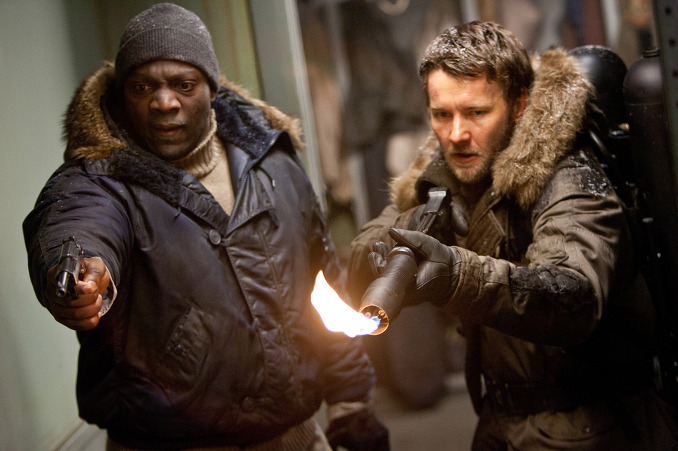
I do not have to describe what happens next if you watched the 1982 version, because it is a pretty much same plot. A scary incident happens. They come to know about what the alien creature can do. They begin to mistrust each other while good old flamethrowers are ready to be used by them. And, though there are better and smarter strategies to conquer the Earth, the alien creature keeps attacking them with the surprises coming from the inside of some characters. In short, the movie is basically the same situation and the same freak show.

But it is not as bad as you think. While respecting the 1982 version through several references including Ennio Morricone’s electronic score, the director Matthijs van Heijningen Jr. does a nice job of maintaining the cold, isolated atmosphere in his film. While most of the actors in the film have to play the stock characters who can be turned into a monstrous jack-in-the-box at any moment, Mary Elizabeth Winstead is nice as a resourceful heroine fighting against the threat from the outer space, though I suspect that the main purpose of her character in the story is making her Scandinavian co-actors speak English rather than Norwegian.

In case of special effects, the movie is helped a lot by the advance of CGI during the last 30 years. It has more freedom than the 1982 version, so the alien in this version can do a lot more things with its grotesque body parts than before, and we get the horrific scenes like a hand turning into some sort of lobster or two bodies disgustingly melded together. However, while these special effects are effective, they lack that vividly sticky side of Rob Bottins’ special effects in the 1982 version, and they sometimes looks its pale imitation.

“The Thing”(2011) is not a bad remake at all, and you may enjoy the comparison between this movie and the 1982 version. But the more I compare it with John Carpenter’s film, the more it looks unnecessary. I must say the spaceship and the Antarctic looks more fabulous than before, but our spaceship owner remains same as before its usual back of disgusting tricks.

Posted in Movies | Tagged , , , , , , | 1 Comment

Haywire (2011) ☆☆☆(3/4) : Don’t mess with her…


“Haywire” is an entertaining film based on a seemingly bland premise of spy action movie. Although its plot is a little shaky(I do not exactly understand what the bad guys gain through their scheme though their motive is explained later), the movie efficiently moves along the various places while providing us several nice realistic action scenes, and they are better than what we usually get from those bland blockbuster action films.

And it also has a good action movie character who is not only attractive as required but also tough as demanded. We have recently been witnessing the notable appearances of strong, brave, and clever female characters including Katniss Everdeen in “The Hunger Games”(2012), Lisbeth Salander in “The Girl with the Dragon Tattoo”(2011), and Dr. Elizabeth Shaw in “Prometheus”(2012), and Mallory Kane, played by a newcomer actress Gina Carano, is as engaging and tough as these memorable female characters. We do not know much about her, but Kane is very skillful at her job, and it is always interesting to see a good professional at work.

Mallory Kane has been working as a special agent for some private contract company connected with the US government. She is not exactly a government employee, but she and other employees are more or less than the unofficial agents hired by the US government through their company, and the high-ranking officials in Washington need Kane and other agents for the dirty or risky missions which they do not want to get directly associated with,

After one violent encounter with one of her fellow agents at the cafe, the movie goes back to several days ago through flashback while Kane tells her story to one young man while driving his car. As her direct boss ordered, Kane was dispatched to Barcelona for the mission to rescue a hostage held in some building, and, though there were several problems during the mission, the hostage was safely rescued and then handed to her guys at the airport in the end. Through precise and concise editing and camerawork, the director Steven Soderbergh makes this process look smooth and compelling. Even when it is just one character chasing after the other character along the streets, it is more exciting than you think because we can see that they are really running on the screen while the camera are capturing their movements from several viewpoints.

While she was considering quitting the company, Kane was quickly assigned to another mission right after her job at Barcelona. All she had to do was pretending to be the other agent’s wife at the manor outside Dublin, but she was suspicious about this mission from the start. As expected, she quickly realized that she was betrayed by someone in her company, and now she is running away from her enemies as well as the police.

Gina Carano, ex-mixed martial arts player, is believable as an action movie heroine who can use her brain and body quick and fast for her survival. She has a little acting experience before this film, and I think she was cast for her physical ability rather than her acting talent like Sasha Grey in Soderbergh’s previous work “The Girlfriend Experience”(2009), but all of us can agree that she does have the potential of an action movie star. While her performance is sometimes flat, but her presence is engaging from the opening scene, and she looks great when she wears dress – maybe she can appear in James Bond movie someday.

The actions in the film are impressive because it looks like Carano and her co-performers really throw themselves into the actions. Without choppy editing style or exciting score, the fight scenes between the characters are depicted with the considerable degrees of realism; they use every possible way to suppress each other through their bodies and space, and their violent struggles are vividly presented through the sound effects from them and the other objects near them.

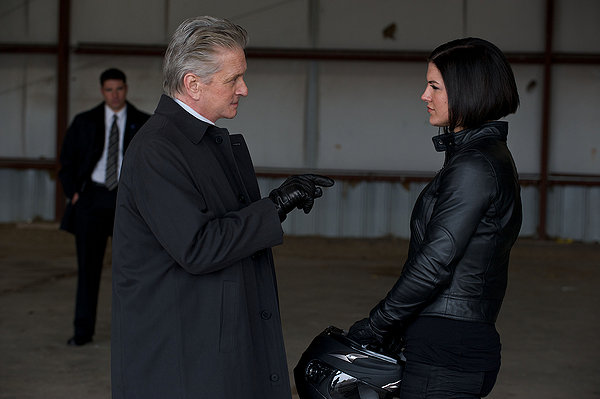
The screenplay written by Lem Dobbs is a standard action film plot which mainly works as a coat hanger for the actions in the movie, but it has its own small amusement while not trying to be too serious about its story. The characters are mostly two-dimensional to say the least, but, thanks to Soderbergh’s reputation, we see well-known actors like Channing Tatum, Ewan McGregor, Antonio Banderas, Michael Fassbender, Bill Paxton, and Michael Douglas surrounding Carano, and they ably fill their respective positions while supporting her well. Maybe she is not a talented actress, but Carano clicks well with her co-actors while firmly holding the center of the story, and some of them have a pretty tough time with her in the movie.

While watching “Haywire”, I began to think about “The Raid: Redemption”(2011), the other recent martial arts action film I watched in the last month. I sort of admired the relentless energy behind its ruthless execution of realistic action scenes, but the absence of a good story and good characters made me ultimately distant toward what was happening on the screen, and I also got increasingly bothered by its bloody mayhem which cared nothing except its body count.

Of course, the plot of “Haywire” is as thin as the premise of “The Raid: Redemption”, and it also has the moments of brutal violence, but there are differences between them. The former has a good character who is a lot more interesting and fascinating than the colorless hero of the latter, and its actions are presented with a far more style and wit under Soderbergh’s deft and economic direction, and Carano is competent as a strong heroine you don’t want to mess with while you are alive. Seriously, how do they come to think they can frame and then eliminate her?

Posted in Movies | Tagged , , , | 1 Comment

The Concubine (2012) ☆☆☆(3/4) : A deadly power game in the palace

Lust, malice, intrigue, sex, and blood dominate over a deadly power struggle in South Korean period drama “The Concubine”. There are the players who will do anything for their desire or survival, and their vicious struggles in the closed world are not so pretty to look at. Their life is defined by big, sumptuous places around the palace, but the palace also has a dark place below it where some of them may be tumbled into immediately if they are not cautious enough about their words and behaviors.

Unlike the recent South Korean period dramas, the movie has a notable anachronistic feeling. It seems its background is the Joseon dynasty(1392-1910) considering the design of architectures in the film, but there is also the influences from the Goryeo dynasty(918-1392) in the characters’ costumes and other details. They behave like the people living during the Joseon dynasty, but, as far as I know, there was not any incident during that period which can possibly inspire the lurid story of the film, and I have never heard about the king’s mother presiding over the copulation ritual of her son and daughter-in-law in the next room.

But, despite its fictional world, the ruthless pursuit of power in the palace is a familiar story you have encountered in other stories. The king is dead due to an unidentified cause, and the king’s mother(Park Ji-yeong), who is actually his stepmother, now holds the power to decide who will be the next king. She quickly puts her own son, Prince Seong-won(Kim Dong-wuk), on the throne, and she also swiftly eliminates her opponents including the previous king’s father-in-law.

In such a circumstance like that, the previous king’s wife, Hwa-yeon(Cho Yeo-jeong), naturally has lots of worry about not only her future and but also her young son’s future. He is just a child at present, but this innocent kid is already deemed as a potential threat to the kingship, and he can be killed at any time if the king’s mother and her followers have a chance to get a good reason for that. Some of South Korean audiences have never heard of Lady MacBeth or Richard III, but they will be reminded of several bloody incidents during the Joseon dynasty or other dynasties preceding that. King Danjong of the Joseon dynasty was dethroned by his uncle, who became the next king, and then this young boy was killed later when he was thought to be too much of trouble(believe or not, it was said that this horrific decision was strongly supported by his great uncle). In case of Prince Young-Chang, he was murdered by King Gwanghaegun of the Joseon dynasty just because he was a more legitimate heir to the throne than the king himself. Anything could be committed for absolute power in those days, you know.

Unlike his ruthless mother, Prince Seong-won has other thoughts about his sister-in-law, and we know why. While he was merely a prince, he met her in her father’s house, and he has been obsessed with her since then. His mother already sets him up with the other woman as his queen when he becomes the king, but he still wants Hwa-yeon in spite of his mother’s warning. It may be not that bad to sleep with the deceased brother’s wife(well, he is the king, isn’t he?), but it can be fatal to sleep with someone who can threaten the power.

The situation becomes more complicated after another player of this dangerous game of palace intrigue appears in the palace. His name is Kwon-yoo(Kim Dong-wuk), who was Hwa-yeon’s former lover in the past. When he tried to elope with Hwa-yeon before she was sent to the place as the previous king’s new wife, he was captured and castrated by Hwa-yeon’s father, and now he enters the palace as one of new eunuchs. While he is quickly promoted enough to be near the king, he becomes also a little closer to Hwa-yeon though he lacks a certain body part crucial for rekindling their feelings in the past. Can she trust him as a close ally? And does she really have some feelings for him as he guesses?

You never can be sure about them because of the understated but competent performances by Jo Yeo-jeong and Kim Min-joon. Revealing real feelings in the palace can be a fatal blow to your fate, and they must hide their emotions and thoughts as much as possible to survive. Jo Yeo-jeong is good as a woman who gradually becomes as ruthless and cunning as her enemies through her need to survive. When she comes to know that the king wants her, she see it as an opportunity to win the game, and she is determined to manipulate him to turn against her devious mother-in-law.

Meanwhile, clueless and reckless Guem-ok(Cho Eun-ji), a maid who has served for Hwa-yeon, finds herself in a serious situation way over her head. She is forced to copulate with the king when he is very frustrated over his desire toward Hwa-yeon, and we can say that she is virtually raped, but, what do you know, she feels a lot better to see her changed position as one of the king’s concubines. Unfortunately, while intoxicated with her newly gained power, she does not have the slightest idea about how dangerous the power game can be between the women in the palace.

The king’s mother is the most powerful and dangerous player in this perilous game, and Park Ji-young gives a juicy villainous performance which ably supplies grand gestures whenever they are required. The king’s mother has probably done many terrible things for protecting his son and making the throne ready for him, but it is not easy for her to resist the power behind the throne – and now her dear son is becoming one of the major blocks in her grand plan.

While Kim Dong-wuk is not charismatic enough to be accepted as the king, he is adequate as a simple man who hates to be manipulated but cannot escape from being manipulated by the two women surrounding him. As widely advertised, Kim Dong-wuk has several explicit sex scenes with some of his co-actresses, but these scenes are disturbing rather than stimulating because we can see the dark, obsessive desire pulsating inside naked bodies.

The movie is an overblown but ultimately cold drama with the characters most of whom we do not care about much. But, despite its several flaws in its narrative, the story is compelling due to the heated interactions between characters. Its handsome production design is impressive, and it has engaging performances to hold our attention. When the final victor is revealed at last, we are not relieved at all; we are rather chilled by how much ruthless and heartless the victor becomes more than before. But that is usually what is required for getting the power in your hand.

Posted in Movies | Tagged , , , , , , , | 6 Comments

Rosemary’s Baby (1968) ☆☆☆☆(4/4) : Pray for her baby…

You may find disturbing to see the audiences laughing while watching “The Exorcist”(1973), but you will probably not see any problem in having some laugh with “Rosemary’s Baby”(1968). It goes without saying that they are two of the most chilling modern horror films, but, while the former unsettles us with its utmost solemnness parodied many times since it came out, the latter has a spooky sense of humor immune to parodies. How can you make an effective parody to undermine a horror film if it already has a devilish tongue slyly placed on its dark cheek?

But we also see that “Rosemary’s Baby” works as a first-class thriller which lures us into its ordinary background at first and then drives us into one hell of macabre circumstance. You may find its premise quite preposterous after watching it, but it makes you absolutely believe the diabolical possibility in the story with conviction when you’re watching, and you fear for its unfortunate heroine approaching to an awful truth hidden behind her neighbors.

After the main title sequence in which the camera slowly looks around the skyline of New York and then looks down on one gothic apartment building located in the Upper West Side area of Manhattan, we see a young married couple entering the building with their real estate agent(Elisha Cook Jr. – you probably remember him as one of the supporting characters in “The Maltese Falcon”(1941)). Rosemary Woodhouse(Mia Farrow) and her husband Guy(John Cassavetes) come to look around an apartment luckily available to them due to the recent death of its previous tenant. Guy is reluctant because of a little too expensive rent, but Rosemary loves the apartment, so they decide to move into that place. Although Rosemary’s close friend Hutch(Maurice Evans – he was Dr. Zauis in “Planet of the Apes”(1968)) tells them about the unpleasant history surrounding the building, but they do not mind about that much. After all, they are not moving into a haunted house in remote place, and they are not alone in the building located in the middle of New York, are they?
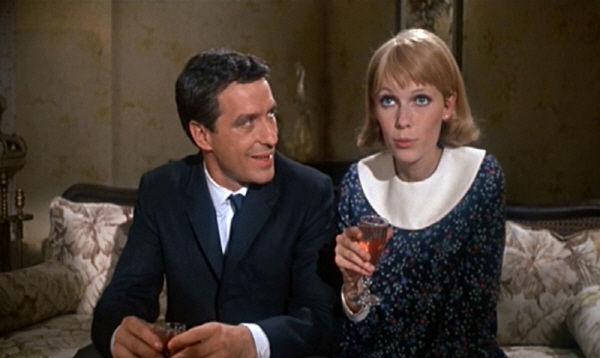
Life at their new home goes on with the pace of mundane daily routine except for several strange incidents. On one day, Rosemary comes across a young woman named Terri (Angela Dorian – a small joke on her real name in the movie probably escapes from the audiences’ notice nowadays), who has been living with an elderly couple in the apartment next to Rosemary’s. They grow close to each other during their first encounter at the laundry room on the basement level, but their relationship does not last long because of a tragic incident which happens shortly after their meeting.

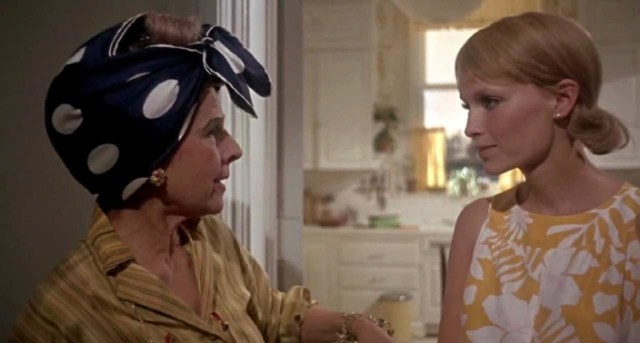
That is how Rosemary and Guy come to know more about their neighbour on the next door – Minnie and Roman Castevet(Ruth Gordon and Sidney Blackmer). On the next day, Minnie comes to Rosemary’s home and invites her and her husband to dinner. Rosemary and Guy reluctantly accept their dinner invitation, and, after that dinner, Mr. and Mrs. Castevet quickly become a part of their daily life they cannot easily throw away. Roman and Minnie keep interfering in their life, and they are sometimes annoying, but how can you be harsh toward these kind old people? Guy begins to spend more time with them, and Rosemary gets to know the other neighbours in the building through them. When Guy and Rosemary decide to have a baby and then she gets pregnant, Minnie and Roman are the first people congratulating them.

They are really supportive; they recommend their close friend Dr. Abe Sapirstein(Ralph Bellamy) as a good obstetrician to be relied on, and they take care of Rosemary’s daily diet including a cup of milkshake containing various herbal elements, I suppose, good for her baby. They also give her an amulet with pungent smell as a good luck charm, and everything goes pretty well for Guy and Rosemary. Guy’s acting career gets a big breakthrough after one unfortunate happening. Rosemary goes through a really hard time due to the inexplicable chronic pain during the early stage of her pregnancy, but the pain is eventually gone to her big relief. Now, with her baby about to come out into the world, Rosemary cannot possibly be happier than this.
However, we know something terrible is going to happen to her. The ominous undertone of the movie is set by Krzysztof Komeda’s score right from the beginning. While a soft, gentle lullaby tune is played on the soundtrack, there also exists an unsettling feeling below it, and we sense that her road to motherhood will not be as pink as the main title suggests.

The movie is based on a well-known novel written by Ira Levin. Stephen King once called Levin “the Swiss watchmaker of suspense novels”, and he was not kidding. His first novel “A Kiss Before Dying” was a gripping crime novel about a young, ambitious, and murderous man who will literally do anything for his financial gain, and Levin’s storytelling was so meticulous and thrilling that I rapidly read the novel from the first page to the last one during one Saturday afternoon while paying no attention to anything else. In “Rosemary’s Baby”, Levin carefully constructs and furnishes his plot with the realistic details from the average middle-class New Yorker life in 1966, and then the table is suddenly turned, and everything looks a lot different from what they initially seems to be on the surface. Inconsequential things may be very consequential, and the coincidences can be no coincidence at all, and Rosemary find herself deeply mired in the paranoia centered on some insidious conspiracy against her and, possibly, her baby. Do the people around her really care about her and her baby as she thought? Or….

The movie could have been directed by Williams Castle, the master of B-horror films with infamous cheap gimmicks, but he was thankfully dissuaded from directing it by Paramount Pictures, and he worked as its producer instead while making a cameo appearance in the film. Robert Evans, the head of Paramount during that time, exactly knew who was a right director for Levin’s novel – Roman Polanski.

The combination of Polanski and Levin was as ideal as the one of Cormac McCarthy and the Coen Brothers in “No Country for Old Men”(2007). Not only both of them are very good at making taut thrillers, but also they share a similar sense of dry black humor which makes their respective works satirical and cheerful at times. In addition, Polanski made “Repulsion”(1965) around that time, a nightmarish psychological thriller about a mentally unhinged woman pressured by her inner fear while being stuck in her apartment. After “Rosemary’s Baby”, he made “The Tenant”(1976), another story about being driven to paranoia by an ominous apartment building and its unpleasant people, and these three moody thrillers are now regarded together as ‘Apartment Trilogy’ due to the common themes shared by them.

Polanski’s adapted screenplay for the movie is remarkably faithful to Levin’s novel. That was a wise choice, because Levin’s plot is as elaborate and fragile as a house of cards and even a tiny change can ruin the whole plot. In fact, the movie is so faithful to the novel that you do not have to read the novel if you watched the movie. If you read the novel before watching the movie, then you will appreciate how much efforts Polanski took for bringing the story to the screen as intact as possible. The set design and costumes are nearly same as described in the novel, and many small details in the novel such as that infamous Time Magazine cover(“Is God Dead?”) and the shirts advertisement in the New Yorker Magazine were taken into consideration during its pre-production(When Polanski asked Levin where he could find that advertisement, Levin replied he made it up). Using Polanski’s sketches, the supporting performers were cast according to the descriptions in the novel, and the familiar old veteran actors like Ralph Bellamy are crucial in providing the intimacy which is later fearfully turned into the sinister benevolence threatening Rosemary(“We’re your friends, Rosemary. There’s nothing to be scared about. Honest and truly there isn’t!”).

While being quite faithful to Levin’s story, Polanski also does a wonderful job of vividly bringing what’s between lines on the page to the screen. The movie gets slowly shrouded with uneasy tension crawling over the space while the due date is coming. After Rosemary notices something weird in a sudden close-up, the ominous presence of evil in the apartment building becomes more palpable than ever. Polanski trusts our intelligence and lets us to deduce what is happening around her. We come to see that a normal dinner invitation is actually a job interview with horrible intentions. We can see that there is something really strange about the chest somehow moved to block the closet behind it with no apparent purpose.

While we get a pretty good idea about what’s going on behind Rosemary’s back through these observations and others, we can only guess about what really happened to the previous owner of Rosemary’s apartment or that poor young woman taken care of by the Castevets. And what is written in the last chapter of a disturbing book delivered to Rosemary from her friend, who died under a mysterious circumstance? The movie does not tell, but we instead have a quiet moment of chilly revelation when Rosemary finally discovers the duplicity of her neighbours through scrabble pieces and one small hint given to her.

Because the movie sticks with Rosemary’s viewpoint throughout its running time, there is some doubt about her viewpoint while she becomes increasingly frantic. Is it possible that it is just a temporary paranoia induced by her prepartum stress? And is it possible that what she experiences during the climax is actually a postpartum delusion? While openly and clearly showing us everything happening around her, the movie toys with that possibility to some degrees, and that makes her plight more nightmarish.

The movie is also humorous at times. When Rosemary has a strange dream during the night when she gets pregnant, her dream is absurdly mixed with random images before she is taken to the strange ritual attended by her neighbours. There is also a nice scene where her visual memories from the days of Catholic school and the audible conversation heard from behind the wall are overlapped, and we later realize how weirdly funny it is as a juxtaposition of two antagonizing religions.

One of the amusing things about the story is that it can be interpreted as an ironic tale about faith regained. Rosemary has been away from religion after leaving behind her days of Catholic school, but now she sees that God does exist thanks to her evil neighbours, and there is a far bigger irony in her shocking discovery during the finale. Polanski wisely does not show us what she discovers, because a shot of her horrified face is more than enough to scare us even though we don’t see it. Furthermore, it would have considerably lessened its dramatic effect due to its inherent ridiculousness if it had been shown on the screen; do you know how silly the hero of the certain superhero films directed by Guillermo del Toro looks at times?

Although she is famous for her collaborations with Woody Allen, Mia Farrow has been always linked with “Rosemary’s Baby”, and many of us were particularly amused by her appearance in the remake version of other famous occult film involved with Satan few years ago. Farrow is completely believable here as an ordinary woman who gradually finds herself trapped in the bizarre situation she may not escape from. We can identify with her, and we can understand why she cannot see through her circumstance even when it is apparent that there is something wrong about her pregnancy. Still being a naive country girl from Omaha, Rosemary trusts people a little too much; even when she learns that no one can be trusted in her situation, she misguidingly thinks that one character can help her. Though he turns out to be not one of them, he lets her down by doing what any sensible person will do after hearing her rather fantastic story.

As Rosemary’s charming but self-centered actor husband, John Cassavetes does a good job, although I think Robert Redford, who was an initial choice, could have been more perfect for this role. Compared to Redford, Cassavetes may be not plausible enough to be accepted as a future Broadway star, but he looks plausible enough to look like a man willing to make an unspeakable deal with the devil worshippers on the next door to be a future Broadway star.

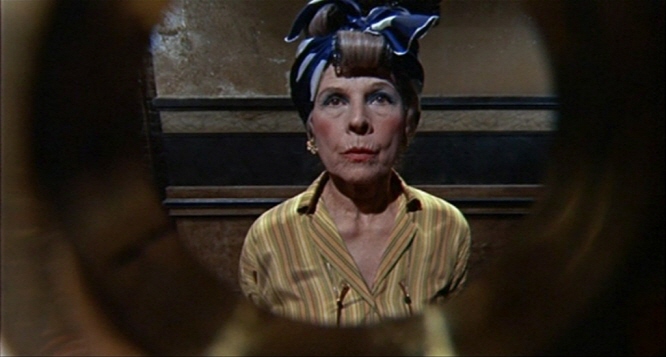
As the eccentric neighbors with dark secrets hidden behind their kind veneer, Sidney Blackmer and Ruth Gordon have lots of fun with their plum roles. Blackmer exudes smooth sinisterness through his courteous manner and piercing eyes, and Gordon deservedly won an Oscar for her wry, colorful performance as your typical busybody neighbour. They really look like an old couple you may come across when you move into a luxurious apartment building in Manhattan, and I have to confess that they actually reminded me of one rich elderly couple living next to my family apartment – but I must assure you that they were Catholics who really loved their neighbours including my parents.

“Rosemary’s Baby” has been steadily gaining its reputation as one of great horror films since it came out and opened the door for other occult horror films. There have been lots of words about its shocking finale, but its undeniable power mainly comes from its exemplar handling of its story, mood, and performances, and it tells us a lot about the value of suspense over shock. Too many horror movies only know about shocking the audiences nowadays, but, at least, we are sometimes treated with the good ones knowing how to tantalize us and then scare the hell out of us like this eerie masterpiece does.

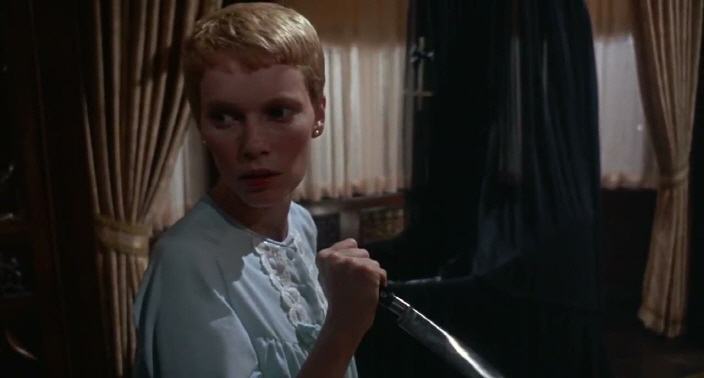
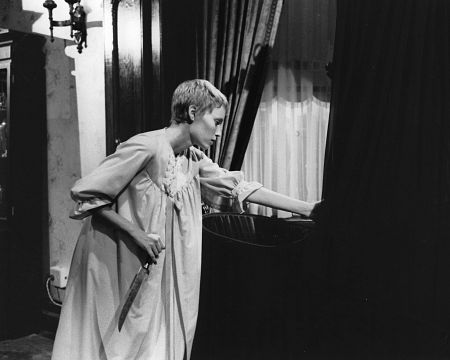
Poor Rosemary, she thinks she will fear no evil when she bravely walks through the corridor of the shadow of conspiracy with a carving knife, but she does not know that she should be careful of what she wishes for when she looks into that black cradle. Oh, yes, she will get it in the end – with her soothing lullaby.

Posted in Movies | Tagged , , , , | 5 Comments

Madagascar 3: Europe’s Most Wanted (2012) ☆☆☆(3/4) : Their colorful Europe adventure with circus

“Madagascar 3: Europe’s Most Wanted” is a fast and funny animation which is also the most enjoyable one in the series. The series is a curious case considering its progress; “Madagascar”(2005) was a mild disappointment with some amusement, and “Madagascar: Escape 2 Africa” (2008) was an improvement over the previous one, and now here comes the third one which invests a lot more energy and humor into itself. The story is pretty thin, but one good thing about animation is that it can sometimes get away with that flaw, and “Madagascar 3” fortunately has a vibrant colorful style with a small heart inside for doing that job.

Just in case you have not watched two previous animation films, I will explain to you the background story in short. In “Madagascar”, four animals from Central Park Zoo in New York happened to get out of their zoo, and got themselves in trouble, and then were sent to Madagascar after the series of happenings. They are Alex the lion(voiced by Ben Stiller), Marty the zebra(voiced by Chris Rock), Melman the giraffe(voiced by David Schimmer), and Gloria the hippo(voiced by Jade Pincket Smith). In the second film, they tried to go back to New York after having some fun in the island, but their plane crashed into the safari area of Africa which happened to be their original home, so they had another adventure while the resourceful penguins from the first feature were dealing with their own trouble.

“Madagascar 3” begins at the point not so long after the ending of the previous installment. They have thought about going back to New York, but the penguins, who promised them that they would return from Monte Carlo after earning enough money for getting the plane to New York, have not come back yet. Tired of waiting for them, Alex and his friends decide to go to Monte Carlo to find the penguins. They somehow go across the Africa continent, and swim across the Mediterranean Sea, and then arrive in Monte Carlo with the lemur king Julian(voiced by Sacha Baron Cohen) and his long-suffering assistants Maurice(voiced by Cedric the Entertainer) and Mort(voiced by Andy Richter). Not so surprisingly, chaos and panic ensue right after they accidentally crash into casino despite their cautions, and Alex and his friends are soon chased by French policemen on the street.

The chase scene on the streets of Monte Carlo is rapid and exciting, and it is helped a lot by the formidable presence of a ruthless villain. French Animal Control officer Captain DuBois, voiced by Frances McDormand in a full-blown badass dominatrix mode, zealously wants to catch Alex for adding another new stuffed animal head to her frightening collection on the wall, which is filled with the heads of animals caught by her. With her exceptional ability to smell the traces like bloodhounds, she is determined to follow and capture Alex and his friends by any means necessary, and nothing can stop her. When Captain Dubois has to galvanize her severely wounded men in the hospital, McDormand has a hilarious showstopper moment with one of Edith Piaf’s famous songs.

Meanwhile, after managing to get away from the pursuit of Captain DuBois for a while, Alex and his friends find a temporary shelter in the circus company train after lying to the circus animals that they are from an American circus company. Vitaly(voiced by Bryan Cranston), a Siberian tiger who was once the star of the company thanks to his literally unbelievable talent to pass through very, very small rings(I am not kidding), does not like the new passengers much, but Gia the Jaguar(voiced by Jessica Chastain) and Stefano the seal(voiced by goofy Martin Short) warmly welcome them as new friends.

Alex finds that the circus company is in a very serious trouble, but he has a nice idea for all of them. They are going to manage the company for themselves(our clever penguin gangs have already taken care of human business matters, by the way), and Alex and his friends will help bring new, fresh changes to the circus. If they can impress potential promoters with their new show enough, they will be financed to go to New York for the next show.

How they create and manage and prepare for their fantastic show leaves a lot of interesting questions and holes in the plot, but anything is acceptable in the world of animation(well, what do you expect from an animation featuring talking animals?), and the makers of “Madagascar 3” imbues a lot of energetic fun to its main circus show sequence with the exuberant use of bright colors and kinetic acrobatic movements across the screen.

While talking animals in the animation usually ignite our curiosity about their relationship on the food chain in their world, the movie induces some interesting thought about interspecies romance. In previous film, we see Melman and Gloria confirmed their mutual love to each other, and we now get two interspecies relationships blossoming along the plot. While the love growing between Alex and Gia are generic at their upstairs place(after all, both are cats in a broad sense, aren’t they?), I and the other audiences got a lot of laughs from Julien’s downstairs romance with a big bear on tricycle. It was love at first sight, and they have a really good time in Rome as a romantic mismatched couple.

Although its plot is pretty predictable, I found that “Madagascar 3” is a fun animation with lots of enjoyable things for adults as well as children. The characters are lovable, and we like them as we did before, and the scene before the climax has a little poignancy when they come to see how much their view has been changed during their long journey. It is still an animation on average level a little better than previous ones, but it is a lot more entertaining than I thought.

Posted in Movies | Tagged , , , | Leave a comment

Prometheus (2012) ☆☆☆(3/4) : Somebody can hear you scream this time

 There are several moments in Ridley Scott’s new film “Prometheus” which arrested my gaze completely at last night. While watching them, I was reminded of the sense of awe and mystery I have experienced in other great SF films like “2001: A Space Odyssey”(1968) or “Alien”(1979). Sadly, they look so good and ambitious that what happens after them is really a letdown compared to what I saw before.

The movie is a long-waited return for Ridley Scott, who made “Alien” 33 years ago. With that memorably terrifying film, he chillingly reminded us that nobody can hear you scream in the space while introducing us one of the most famous(and the most horrible) monsters in the movie history. Its big commercial success was followed by several sequels, and, except James Cameron’s explosive “Aliens”(1986), none of them were particularly good; as you know, we were recently treated with such horrible garbages like “Alien Vs. Predator”(2004) and its equally horrid sequel.

“Prometheus” has been advertised as if it were a prequel to the series, but the answer is yes and no. There are apparent links to the series observed here and there throughout the film, and you will see the familiar elements from the series including that unforgettable creature design by H.R. Giger. But the movie also has its own story to tell, and its ending implies that it may continue the story in its possible sequels.

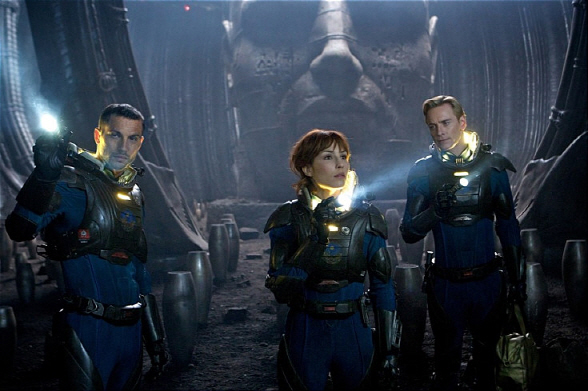
The premise of the movie is based on one of those illogical preposterous opinions you have heard about before. It is 2089, and two archaeologists, Dr. Elizabeth Shaw(Noomi Rapace) and her lover/colleague Dr. Charlie Holloway(Logan Marshal-Green), have just found an cave with interesting murals in one isle near Iceland, and it seems they discover an important clue to the origin, or the creation in the view of some of you, of mankind. The movie instantly moves forward to 2093, and we see them and other people in a spaceship named Prometheus, which has been managed by the main computer and an android robot named David(Michael Fassbender) while the human crews are sleeping in their hibernating chambers.

The movie does not explain well about the technology advance in their world, but it seems they have made a huge progress in space industry as well as other fields during the late 21th century. Though it takes around 2 years to get to their destination, they have journeyed more than 10 trillion kilometers in the space; according to one character, the powerful company backing this project invested one trillion dollar. It’s 2012 now, but “2001: A Space Odyssey” still looks far more futuristic. Maybe our children or their children will also find this movie too fantastic at the end of this century.

The CEO of the company is Peter Weyland(Guy Pierce in unrecognizable heavy make-up). In the hologram message made during his last days, he explains the motive behind the project to the crew and, of course, the audiences. From the murals from the ancient cultures all over the world including the one discovered by Dr. Shaw and Dr. Holloway, the certain pattern was found, and it was concluded that this pattern is a sort of the invitation to mankind from the alien species who, uh, contributed to the origin of Homo sapiens. How happy the defenders of Intellectual Design will be to see that their argument is proved to be right.

But wait, how did the hell our ancestors get that clue when their creators were already gone? Was that knowledge imprinted on the pieces of DNA somewhere on our 46 chromosomes then somehow stored in our collective consciousness to inspire us draw these murals? I must say I and one of my colleagues, biological majors, could not help but amused by the opening scene where the pieces of alien DNA floating in the water are shown like fragments of ramen noodles instead of our usual molecular models. I know it’s an artistic choice, but both of us were too knowledgeable to ignore its artistic silliness.

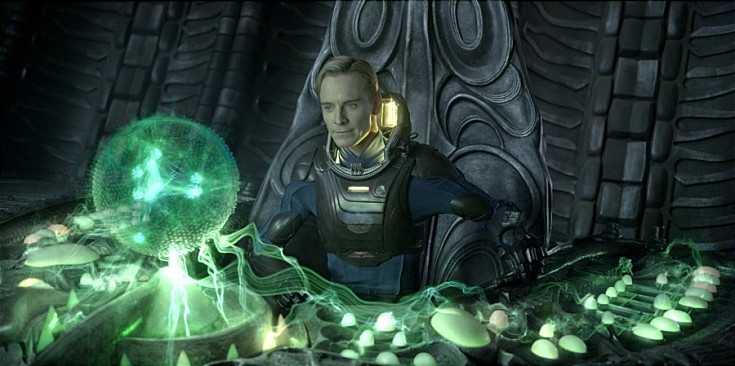
Anyway, I have to admit that the movie looks terrific with its excellent visuals. Right from its National Geographic opening sequence, it presents the series of spectacular scenes to be appreciated. The movie has several good shots of its vast backgrounds filled with wonder, which remind us how much special effects have been developed since the time of “Alien”. I liked the looks of the planet the character arrives in(It’s LV-223 – don’t confuse it with LV-426), and there is a wondrous scene when David discovers a crucial place for his secret mission in the huge underground space where something insidious may lurk in.

I forgot to tell you about what they encounter on the planet. They find several big architectures made by the aliens, nicknamed “Engineers”, and they soon go inside one of these buildings, which turns out to be your typical haunted house. The characters usually move around the dark, ominous corridors, and we know something terrible can happen at any time. We come to know more about the aliens and what they created, and this time, somebody can hear them scream because they can breathe in the atmosphere of the building.

Compared to this set-up, the second part of this movie is rather disappointing. It goes into a messy situation not that far from “Alien”, and we get lots of familiar sights seen from its trailers and the other movies in the series. The movie discards most of the intriguing ideas about God and the existence of mankind it toyed with at first while going into that action/horror mode, and the characters mostly remain as the objects ready to be dispatched as required by its predictable plot. It is not wise to attempt to touch an alien creature even when you think it is small and cute, but one of the characters commits such a stupid act(for heaven’s sake, are you really a biologist?), and we surely get what is predicted.

Most of the actors assembled for the movie are wasted due to the poor characterization in the film. Guy Pierce’s best moment is not in the film but in one of the promotional trailers, and Charlize Theron tries her coldest with her one-dimensional company executive while being underutilized, and Idris Elba does a competent job as the captain of Prometheus who does care about his job and duty.

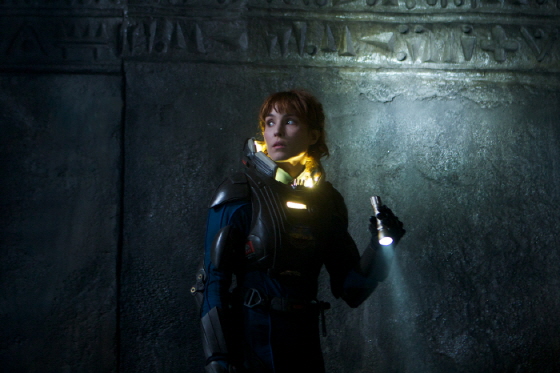
Thankfully, Noomi Rapace, who recently got a career breakthrough as Lisbeth Salander in “The Girl with the Dragon Tattoo”(2009) and its two sequels, gives a strong performance as the brave, resourceful heroine of the film. I was particularly impressed by a frantic scene when her character is determined to take care of her imminent problem for herself using a high-tech surgery machine equipped with many tools including a laser scalpel. Even right after such a dreadful ordeal, Dr. Shaw moves on while maintaining her strength to fight against a giant creature(it reminded me that they still sell squid snack at South Korean theaters), and Rapace makes us to believe that as a part of her character.

With the appearance reminiscent of young Peter O’Toole in “Lawrence of Arabia”(1962), which incidentally appears in the film as his character’s favorite film, Michael Fassbender is also very good as a courteous android robot with a hidden purpose. David is the most fascinating character in the film, and there is an amusing irony in his encounter with the entity responsible for the creation of his master; imagine HAL 9000 at the end of the ultimate journey in “2001: A Space Odyssey”, and you will get the idea. And I have never expected that Fassbender will weirdly evoke my memory with “Re-Animator”(1985) around the story’s ending.

“Prometheus” is a well-made SF movie stuffed with the sights to dazzle you at big theater. Although its thin story is deficient in several aspects including human elements while its one foot is stuck in the Alien series, I enjoyed its visuals on the big screen, and I was also engaged by its two good lead performances. I won’t deny that I had a good time with it, but, to be frank with you, I prefer to see “Alien” at the same theater I went to at last night.

Sidenote: I saw it in 2D. There are several scenes in the film that can be visually enhanced by 3D, and I know Ridley Scott is one of the directors who know how to use 3D. None the less, I did not see any problem with enjoying the movie while watching it in 2D – but I think the big scenes in the film are definitely helped by IMAX.

Posted in Movies | Tagged , , , , , , | 1 Comment