Ex Machina (2015) ☆☆☆1/2(3.5/4) : A Turing Test gone haywire

exmachina02 How will we react to artificial intelligence if that becomes possible through technological advance? There have been many science fiction tales fascinated with that question which is alternatively intriguing and disturbing for good reasons, and “Ex Machina” gives us something memorably opposite to Spike Jonze’s “Her” (2013). Like “Her”, “Ex Machina” also explores the possibility of emotional exchanges between human and artificial intelligence, but it goes into a dark, disturbing territory of deceit, obsession, and manipulation, and its chilly chamber drama is thoroughly compelling thanks to its clever handling of a familiar but ever-interesting science fiction premise.

The story is mainly viewed through a young hero who happens to get a chance of his lifetime on one day. Caleb (Domhnall Gleeson) is a young computer programmer working in a very influential Internet search engine company named Bluebook, and the opening scene shows this shy lad getting a sudden message which notifies him that he is luckily selected as an employee to spend the whole week alone with his company’s famous CEO.

Still dazed by such a fortunate opportunity unexpectedly coming to him, Caleb is soon taken to a remote place in the middle of mountains and forests where Nathan (Oscar Isaac) has been leading a reclusive life in his big, glassy modern residence equipped with heavy high-tech security system. It looks like a nice, comfortable place for vacation at first, but it begins to feel more like a secret research facility as we look around its cold, abstract interior design including Jackson Pollock’s painting, and Nathan has no one in this solitary residence except his silent assistant/maid Kyoko (Sonoya Mizuno), who does whatever her employer demands while not complaining much about that.

exmachina04After persuading Caleb to sign a non-disclosure agreement document, Nathan reveals something which really surprises Caleb. Nathan is almost near the final stage of his development of artificial intelligence, and he wants Caleb to do a sort of advanced form of the Turing Test, a famous standard test which was devised by Alan Turing for determining whether a computer is smart enough to convincingly imitate a human being during its communication with a human judge and be subsequently recognized as artificial intelligence. In the original Turing test, a human judge is supposed to interact directly with neither a computer to be tested nor a human subject to function as the control, but Nathan, a brash scientific genius with the domineering alpha-male masculinity represented by his athletic body and bushy beard, is going to let Caleb meet his creation face-to-face during the upcoming sessions, and he seems to really want to know what will happen as a result.

When Caleb meets Nathan’s creation during their first meeting, he cannot help but be curious about Ava (Alicia Vikander), a robot not only being equipped with the state-of-the-art artificial intelligence but also carrying the beguiling quality reminiscent of her senior female android robots in other SF films including Fake Maria in “Metropolis” (1927) and Rachel in “Blade Runner” (1982). Their first conversation is awkward to say the least, but Caleb finds himself slowly drawn to this sexy robot even though he is well aware of her nature from the beginning, and it seems Ava also likes him – at least on the surface.

As going through their next sessions to follow, the screenplay by the director Alex Garland, who wrote the screenplays for “28 Days Later…” (2002) and “Never Let Me Go” (2010), deftly mixes interesting ideas into the dense drama unfolded within its closed space. The dialogues in the film sometimes feel like long intellectual discussions, but they are interesting enough to make us muse on its through-provoking subjects and the following questions, and I especially enjoyed Caleb and Nathan’s amusing conversation on Ava’s female aspects (Seriously, is there any science fiction movie featuring a hunky male robot created by scientist heroine?)

exmachina01Not so surprisingly, it is gradually revealed that there is a hidden intention behind Nathan’s plan, and the mood becomes all the more nervous and suspenseful while the story reveals itself as a dystopian hybrid of Frankenstein and Pygmalion. The ambient score by Ben Salisbury and Geoff Barrow brings more ominous feeling into the screen along with the cool, clinical ambience provided by Ron Hardy’s crisp cinematography, and there is even a bizarre moment when drunken Nathan crazily dances with Kyoto in front of baffled Caleb (and that is just the beginning, by the way).

Because it is basically a small chamber drama driven by its few main characters, “Ex Machina” depends a lot on its actors’ performances, and they are all terrific in their respective roles. While Domhnall Gleeson is believable as our normal guy stuck in an unusual situation which can be way over his head, Oscar Issac is captivating as a charismatic and caddish creator both exalted and depressed by what will be his greatest achievement, and Sonoya Mizuno is also effective in her small wordless role.

And Alicia Vikander, who incidentally co-starred with Gleeson in “Anna Karenina” (2012), gives a memorable performance of uncanny beauty and ambiguous grace as an elusive artificial intelligence character whose unlikely existence both touches and unnerves us. We surely feel sorry for her circumstance like Caleb, but we cannot help but wonder whether her ‘emotions’ are real, and the movie throws a serious question on what can possibly happen if artificial intelligence is introduced into our world. As Dr. Stephen Hawking recently warned us, should we be wary of this technological advance which can seriously affect our existence on the Earth? Or should we embrace it with optimism rather than showing negative responses to its uncertain possibilities?

“Ex Machina” is a very good science fiction film which made me think about its story and themes for a while after the screening, and I also admire how it carefully and thoughtfully builds its narrative with familiar materials until it eventually arrives at the finale. Its setting often feels contrived in several aspects (I am sure my neighbors in the College of Information Science & Technology of KAIST will be more amused than me if they watch it), and it is supported well by its mood and performances, and its inevitable logical conclusion may be appreciated by artificial intelligence if it comes into reality someday. I really wonder – what will artificial intelligence think of how we have imagined them?

exmachina05

Posted in Movies | Tagged , , , , | Leave a comment

John Wick (2014) ☆☆☆(3/4) : Yep, they touched a wrong guy

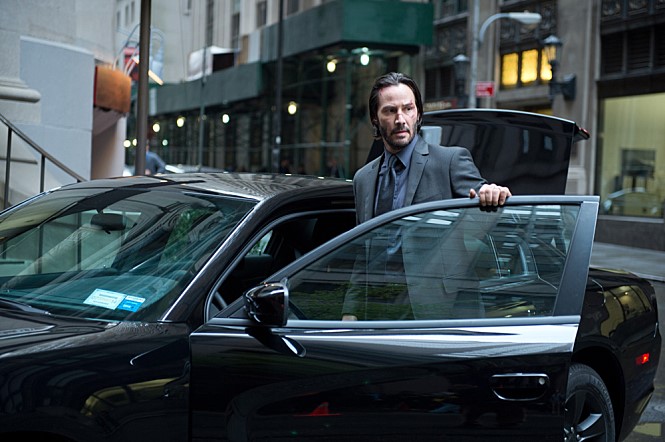
johnwick01 While it is strewn with lots of dead or injured bodies, “John Wick” looks more like a stylish joke as I reflect more on its rather amusing aspects after watching it. You may laugh as one of laboratory colleagues did when I describe its plot to you, but the movie maintains its serious attitude with impressive visual style and well-made action scenes, and you will likely be entertained even when its body count is approaching to 100 (according to the IMDB trivia, the exact number is 119).

When we meet John Wick (Keenu Reeves) at the beginning, he is at the bottom of sorrow and despair after his days of happiness were suddenly aborted. His dear wife Helen (Bridge Moynahan), who represented the hope for his new life, recently died not long after diagnosed of some terminal disease, and this stoic guy looks lost and devastated as being left alone in his slick, expensive modern house after her funeral on a gloomy day.

Still haunted by the memories of their short but blissful married life, Wick becomes brightened up a bit when he learns that his thoughtful wife left him a little dog as something to take care of after her death, but he is soon struck by another bad incident. When he goes out for driving his fancy sports car with his dog in the passenger seat, he comes across three Russian thugs at a local gas station, and these nasty guys break into Wick’s house later. Besides beating him hard and stealing his sports car, they also kill his precious dog with no hesitation, and their very cruel act ignites something inside Wick which he buried literally below him during his normal life with Helen.

johnwick03 When he is informed of what his spoiled son Iosef (Alfie Allen) has done, Viggo Tarasov (Michael Nyqvist), a powerful Russian mob boss in the underworld of New York, becomes angry and alarmed for a good reason. It turns out that Wick once worked for Tarasov in the past, and, as a guy who rose to the top thanks to Wick’s many brutal services, Tarasov knows too well what kind of disaster can happen because of his son’s thoughtless deed. As Tarasov correctly predicts, Wick immediately prepares for his revenge, and there is nothing more dangerous than a man who has nothing to lose – especially if he is an ex-professional killer who was called ‘the Boogeyman’ by the criminals who knew him during his former career.

 Because he is obliged to protect his son, Tarasov tries to be reasonable with this situation, but Wick is adamant about killing Iosef by any means necessary, so that is the beginning of a violent and bloody conflict between Wick and Tarasov’s gang organization. Tarasov attempts to eliminate Wick using every resource available to him, but Wick is nearly unstoppable in his pursuit for vengeance, and he will certainly maim or kill anyone who dares to stand on his way.

This is indeed a very typical revenge movie plot we have seen from other countless action films (the latest example was “Falcon Rising” (2014), which I incidentally watched early in this month), but the director Chad Stahelski and the producer David Leitch, who unofficially directed and produced this film together, put lots of admirable efforts into their film. As John Wick is pulled into his good old underworld which he naively thought he got away from, the cinematographer Jonathan Sela provides visually striking moments of lights and shadows for the moody inner world where everyone is involved with crime in one way or another, and the screenplay by Derek Kolstad has a wry fun as filling this stylized world with numerous details of several criminal service business operations which only accept certain gold coins as their common currency.

One of the most amusing things in the film is an exclusive hotel located in the middle of Manhattan, where its ominous manager courteously and knowingly greets his questionable guests while always ready to provide them some unusual services with his employees. Because this hotel functions as a neutral zone for the criminals in the city, it is strictly forbidden to do anything criminal to disturb its accorded peace, but somebody is bound to be tempted when Wick comes to stay at the hotel with Tarasov’s big bounty on his head.

johnwick06 As Wick attempts to track down and kill Iosef, lots of fights and shootings happen as a result, and they are handled with efficiency and impact to excite and engage us. Stahelski and Leitch have considerable experiences as stunt performers/coordinators who have worked in many notable films such as “Matrix” (1999) and “V for Vendetta” (2005), and they really know how to make physical actions scenes look exciting and impactful. Their action scenes are thankfully free of that dizzy camerawork and choppy editing I had to endure during the screening of “Taken 3” (2015), and we can always sense the actors going through real physical movements on the screen thanks to Stahelski and Leitch’s competent direction and good stunt choreography, and that is a lot more engaging to watch than those mind-numbing CGI actions in Transformers movies.

Although he may be limited in his acting range, Keanu Reeves can easily slip into action movies as shown in “Speed” (1994) and the Matrix Trilogy, and it goes without saying that “John Wick” gives him a suitable role to play. While giving his most hilariously deadpan action hero performance since that unintentionally ludicrous flop “Constantine” (2005) in his usual low-key mode, Reeves looks convincingly shady as a lethal tough guy like Liam Neeson in these days, and it certainly helps that this 50-year-old actor did most of stunts in his action scenes.

Reeves is also surrounded by a bunch of colorful supporting actors who play various criminal characters Wick encounters. As the main villain of the story, Michael Nyqvist is suave as a crime boss who can be very ruthless whenever it is necessary, and Alfie Allen is simply pathetic and despicable as his loathsome son, and Willem Dafoe is dependable as Wick’s old colleague who happens to be hired to kill Wick. Dean Winters, Adrianne Palicki, Ian McShane, John Leguizamo, and Lance Reddick also have each own juicy moment during their brief appearances, and McShane is especially fun as a sinister man who may help Wick through his web of information.

Although its plot is outrageous at times with usual clichés and heaps of bodies, “John Wick” keeps moving forward while maintaining its face straight and tight along with Reeves till the end. It is basically a nonsense especially when you think about the final scene which may be a joke on itself, but the movie is decorated well with style, action, and a little dose of humor, and Stahelski and Leitch make an impressive debut as good action movie directors. It is still preposterous, but, what the hell, so are some of good action movies I saw.

johnwick05

Posted in Movies | Tagged , , | Leave a comment

Big Hero 6 (2014) ☆☆☆(3/4) : Isn’t it huggable?

bighero601  While it lacks novelty because of those ubiquitous superhero blockbuster films during recent years, Disney animation feature film “Big Hero 6” has enough style and substance to distinguish itself from other superhero films. While it is basically a familiar origin tale about how its main characters come to acquire their superhero identities, it mostly works as an amiable story of friendship at its core, and it is also equipped well with a charming style and the most huggable robot character since “Wall-E” (2008).

The main background of “Big Hero 6” is San Fransokyo, a futuristic city which is virtually a cultural/architectural fusion of San Francisco and Tokyo. While it geographically looks like the former along with the Golden Gate Bridge and those steep streets, many places in this amusing fusion city are decorated with lots of notable Japanese elements, and they will look familiar to you if you have ever walked around those busy streets and alleys of Tokyo.

Despite his apparent talent in robot engineering, our smart young hero Hiro (voiced by Ryan Potter) usually spends his time with illegal robot matches held in the corners of his city because it is fun and profitable for him, and his older brother Tadashi (voiced by Daniel Henney) is naturally concerned to see his little brother wasting his potential into such an illegal activity which may cause bigger troubles someday. Although Hiro does not take Tadashi’s advice seriously, Tadashi has been always a good brother to lean on for Hiro, and they have been living happily together with their aunt Cass (voiced by Maya Rudolph), who has taken care of the boys since their parents died.

On one day, Tadashi takes his brother to an engineering laboratory in his university where he works with Professor Callaghan (voiced by James Cromwell), and Hiro’s interest is quickly ignited when he realizes that there are far more awesome things beyond robot match. He decides to follow his brother’s footstep, and he soon gets a chance for his first step into the academia after he makes a successful demonstration of his simple but impressive invention in front of Professor Callaghan and others at the university exhibition.

bighero602 However, when Hiro and Tadashi and others are about to celebrate Hiro’s big success, a fire accident suddenly happens, and Tadashi is killed along with Professor Callaghan after going inside a burning building for saving his mentor. Devastated by the loss of his dear brother, Hiro struggles with the resulting grief inside him, and Tadashi’s absence feels more palpable to him every day as he becomes more withdrawn from others.

And then, when he happens to activate Tadashi’s latest invention, he encounters someone ready to comfort him. Baymax (voiced by Scott Adsit, who was one of the main supporting characters in TV comedy series “30 Rock”), a white, plump, and fluffy robot who looks like a balloon figure somewhere between the Michelin Man and the Stay Puft Marshmallow Man, is designed and programmed to diagnose and help anyone in the need of medical help as Tadashi envisioned at the initial step of development, and it is willing to do anything for making Hiro feel better besides hugging him.

But then Hiro comes across a mysterious masked man who is probably associated with that fire accident and is also about to execute a big plan for some reason. Hiro persuades Baymax to help him catching this guy, and Baymax sees no problem in following Hiro’s request after it logically deduces that it will bring some stability to Hiro’s mind.

In addition, Hiro gets more help from Tadashi’s lab colleagues, and so we see how they prepare themselves as a team of nerdy superheroes while colorfully equipping themselves with each own powersuit. T.J. Miller, Jamie Chung, Damon Wayans Jr., and Genesis Rodriguez imbue ample amount of humor and spirit into their caricature characters, and you will certainly be tickled by their outrageous nicknames such as Go Go or Wasabi (I am fully expecting Marmite or Chutney in the possible sequels).

bighero603  The rest of the story follows an easily recognizable narrative route which culminates to the quintessential third act containing 1) the revelation of villain’s identity and plan, 2) the following conflict between its main characters, and, of course, 3) a busy, massive action finale, but the directors Don Hall and Chris Williams keep their story bouncing even during this predictable part while never losing the sense of fun on the screen. The main characters’ various actions are deftly coordinated during the climax sequence during which they must stop their opponent’s destructive plan before it is too late, and I also like its visual surprise around the end of this sequence.

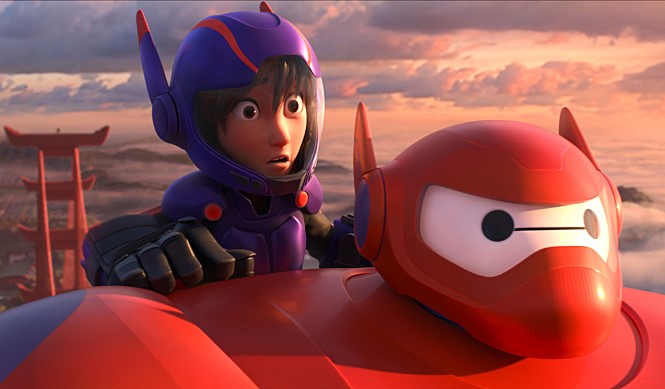
And the development of friendship between the boy hero and his friendly robot remains as the big heart of “Big Hero 6”. Scott Adsit and Ryan Potter convey well the bond between their characters which is sometimes poignant to watch, and Adsit is alternatively funny and touching in his deadpan voice performance which becomes more endearing even when his character is almost hidden in that big red powersuit introduced later in the story. While helped and comforted by Baymax and his other new friends, Hiro begins to find a way to deal with his loss and grief, and there is the sense of liberation during one exciting scene when he and Baymax test the flying ability of Baymax’s powersuit. When they briefly takes some rest in the sky at the end of this scene, we are allowed to have a short but lovely moment of gentle beauty as they look around the sky and the city below it, and that is one of the memorable moments in the film.

“Big Hero 6” is not exactly fresh due to its several notable borrowed elements, and I was not that surprised to know that it was inspired by another Marvel Comics characters. As an animation film about a team of superheroes, it is not better than “The Incredibles” (2004), but this is an enjoyable animation film with nice goodies including its obligatory cameo appearance which turns out to be funnier than usual (please stay in your seat during the end credits), and I must say I am willing to hug its lovable robot despite my cranky tendency to hug as little as possible.

 Sidenote: Oscar-nominated short animation film “Feast” is shown before the beginning of the screening. It is a funny and heartfelt story about a long relationship between one little dog and its owner who is mostly not shown on the screen.

bighero604

Posted in Movies | Tagged , , , , , | Leave a comment

The Imitation Game (2014) ☆☆☆1/2(3.5/4) : A life of codes and secrets

theimitationgame02  Alan Turing (1912-1954) was a brilliant mathematician who was also an early pioneer of computer science, and his enormous contribution to computer science is still influencing our world even at this point. His concept of automatic computing machine, called Turing Machine, has been an important theoretical model for many computer science researches since he conceived it in 1936, and he even devised that famous artificial intelligence test for determining whether a computer can perfectly imitate human communication (no computer has ever succeeded in passing it yet, by the way).

Mainly focusing on one dramatic point in his research career, “The Imitation Game” gives us a compelling human portrayal of Alan Turing, and it is simultaneously exciting and poignant as observing not only Turing’s genius but also his lonely life story. He was one of key members behind the secret government project for breaking a military code which was thought to be unbreakable by many people during the World War II, and he helped his country win the war through his significant success in that project, but he was still remained to be an outsider with a personal secret which ultimately caused an irreversible downturn during his later years.

When the World War II has just started during late 1939, Alan Turing (Benedict Cumberbatch), who has already been recognized as a mathematical prodigy in his young age, is recruited to the Government Code and Cypher School at Bletchley Park. His interview with Commander Denniston (Charles Dance) does not go smoothly mainly due to Turing’s awkward anti-social attitude, but Denniston decides to hire Turing in the end in spite of that.

With Commander Denniston as their supervisor, Turing and other recruited guys soon participate in a covert government project which must be kept as a top-secret to anyone outside the project. Nazi Germany has used an electronic cyphering/decyphering device called Enigma for its military operations, and the British government has not yet found a way to break the complex code generated by this machine although they managed to acquire an Enigma machines through Poland. Many codebreakers have tried to break this code, but Enigma machine can freely change its setting among at least 1.59 x 10^20 different settings through its complex mechanism, and, to make the matters all the more daunting, the German military change their setting every day for security reason.

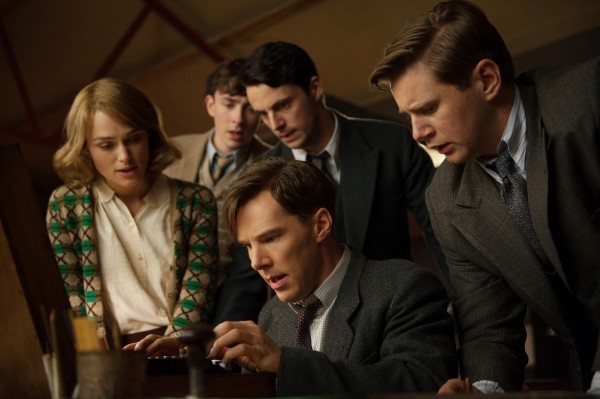
theimitationgame01  Breaking the Enigma code looks like an impossible task for this overwhelming reason, but Turing has one good idea which he is ready to push it already. He believes machine can do that daunting job instead through faster calculation process, and he instantly begins to work on the development of his computing machine to defeat Enigma machine. Although he does not get along with other colleagues including Hugh Alexander (Matthew Goode) during their first days, Joan Clarke (Keira Knightley), a new member who is later recruited by Turing, helps him finding a way to get a little closer to his colleagues, and Alexander and other guys in the project slowly come to recognize Turing’s immense talent as supporting him for their common goal.

While often emphasizing their urgent circumstance through the war which is being continued outside day by day, the movie is mainly driven by Turing’s personality and his relentless pursuit for a breakthrough in his project, and Benedict Cumberbatch, who was recently Oscar-nominated for his superb performance in this film, is perfectly cast as an aloof genius who is more comfortable with his scientific research than human interactions. As a very smart guy, Turing can surely learn how to be more social with others, but he still looks awkward and clumsy as before, and we get a small humorous scene when Turing baffles his colleagues with his naive attempt to be a little nicer than usual.

And we come to see more of his human side through his relationship with Clarke, who understands Turing’s solitary position better than anyone as a very smart female mathematician whose talent has been underrated and ignored by others just because she is, well, a woman. While she has more social disadvantages than Turing as she says to him at one point (“I’m a woman in a man’s job. I don’t have the luxury of being an ass.”), she willingly supports him from the beginning, and, as getting closer to each other through their work, Turing and Clarke begin to feel more attraction between their brilliant minds although he has never considered marriage because of a personal reason he has been hiding from others for many years.

Benedict Cumberbatch as Turing with Keira Knightley as Joan Clarke in The Imitation Game.   As following the progress of Turing and others’ secret project with accumulating tension inside and outside the screen, the screenplay by Graham Moore, which is based on Andrew Hodges’ non-fiction book “Alan Turing: The Enigma”, frequently switches back and forth between the wartime and Turing’s early years and later years, and this non-linear narrative approach works effectively as the screenplay delves deeper into Turing’s personal life step by step like a decoding process for secret information. While the flashback scenes poignantly shows young Turing’s close relationship with one of his schoolmates who encouraged his friend’s interest in cryptology, the opening scene begins with the police investigation of a mysterious incident at Turing’s house in 1951, and it is devastating to see how this incident eventually causes his public disgrace – and the bitter end of his life in 1954.

The movie is directed by Morten Tydlum, a Norwegian director who previously directed “Headhunters” (2011). That movie was one of the finest thriller films I watched during 2012, and I especially enjoyed how it kept surprising me in many unexpected ways. While we know well how the story will end in “The Imitation Game” in contrast (Seriously, is there anyone who does not know how the World War II ended?), Tydlum did a skillful job of maintaining enough level of suspense and interest as Turing and his colleagues race against time to get their mission accomplished. Accompanied with Alexandre Desplat’s delicately pulsating score, the melancholic atmosphere of England during the wartime functions as a fabulously moody background, and Turing later finds himself in that gray moral territory of espionage through Stewart Menzies (Mark Strong), a wily head of MI6 who has been doing his own imitation game behind his back (it was said that “M” in Ian Fleming’s James Bond stories was inspired by this real-life spymaster).

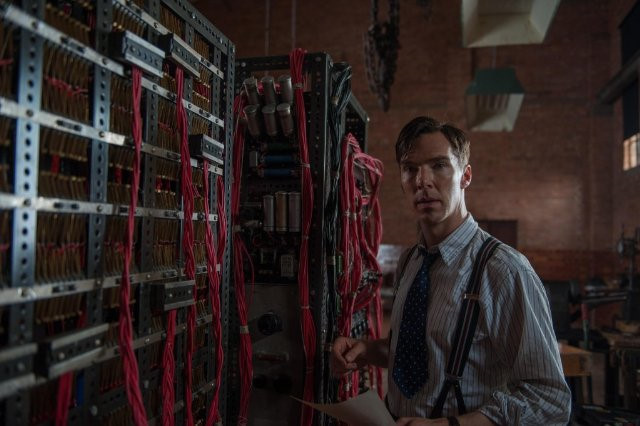
And it is also fascinating to watch Turing’s codebreaker machine recreated on the screen. Even when this big machine literally looks like spinning its wheels for long hours, we cannot help but be amazed by its intricate mechanism represented by many spinning cylinders and countless wires – and how far our computer technology has moved forward from that elementary stage initiated by Turing and other leading pioneers.

theimitationgame04  Unfortunately, despite his invaluable achievement which not only shortened the war but also possibly saved many lives during that time, Turing’s work at the Bletchley Park was remained classified for many years, and he did not live long enough to see the rapid development of computer science during the late 20th century. There is a particularly sad scene when Turing becomes more morose to see that his mind and body are no longer functional as before due to a very cruel treatment forced upon him during his later years, and Cumberbatch is heart-wrenching in this gloomy barren state of his tragically broken character.

The actors surrounding Cumberbatch are solid in their supporting jobs. Matthew Goode, Allan Leech, Mark Strong, and Charles Dance are fun to watch as their characters react to Turing in different ways along the story, and Keira Knightley, who received an Oscar nomination along with Cumberbatch, is especially wonderful when Clarke shows how much this resilient woman is determined to fulfill her professional ambition in the world of men – even when she feels hurt by a man she truly cares about as a soul mate.

As an entertaining period drama film, “The Imitation Game” powerfully illuminates the life and achievement of its ill-fated hero who belatedly received a royal pardon from Queen Elizabeth II in 2013. While feeling sad about how unfairly he was treated just because he was ‘different’, we are also reminded of how much he achieved during his short life, and its most memorable line sounds more meaningful to us in the end even though it initially sounds a bit corny: “Sometimes it is the people who no one imagines anything of who do the things no one can imagine.”

2014, THE IMITATION GAME

Posted in Movies | Leave a comment

The Judge (2014) ☆☆1/2(2.5/4) : A prodigal lawyer son returning to his hometown

thejudge01  Some movies are so predictable and transparent in their handling of story and characters that I sometimes shake my head as observing their glaring clumsiness on the screen. Although it is not a lousy film, I shook my head several times while watching “The Judge” mainly because of its uneven, ham-fisted storytelling, and I became more conscious of that rather than getting involved in the story. While its narrative momentum is constantly disrupted by blatant plot turns and many other unnecessary things, most of its characters feel thin and uninteresting despite the actors’ good efforts, and we do not know much about them except their exterior qualities. As a result, we only watch their situation from the distance, and the story becomes more contrived and jumbled as it trudges for nearly 2 hours to arrive at the expected moment of dramatic confrontation.

When we meet Hank Palmer (Robert Downey Jr.) during the opening scene, it does not take much time for us to see that he is not a nice guy. As a successful lawyer working in Chicago for years, he is currently working on a major criminal case, and this brash, cynical guy does not give a damn at all about whether his rich client is guilty or not. He will do his legal service as much as paid, and that is all he cares about besides his another win to be attained at the courtroom. In case of his family life, he has recently been divorced from his wife while not so close to his young daughter, and he has also been quite distant from his parents and brothers for many years.

And then he gets a sudden news from his hometown in Indiana. His mother died, and that means he has to go back to the town where he is going to face the remains of the past he left behind a long time ago. While his two brothers, Glen (Vincent D’Onofrio) and Dale (Jeremy Strong), are happy to see Hank again, their father Joseph (Robert Duvall) is not very friendly to his son who returns to attend his dear wife’s funeral, and the estrangement between him and Hank is clearly visible when they come across each other at their family house.

thejudge02 Joseph is already over 70, but this old codger is still active as a town judge who has presided over many small and big cases for more than 40 years. Although he is not that popular with some town folks due to his stern rulings at the town court, he has been respected by many people in the town as an authoritative town elder, and even his own children sometimes call him ‘judge’ instead of ‘dad’ or ‘father’.

After confirmed again of the estrangement and resentment between him and his father, Hank feels no regret about leaving his hometown on the next day after his mother’s funeral, but then he is notified that Joseph is charged with the killing of an ex-con who was sent to the prison by Joseph 20 years ago and then was recently released. Hank goes back to the town as a dutiful son, and, not so surprisingly, he comes to take care of this family matter for himself when it becomes apparent that his father really needs his legal help.

But his father is not a very helpful client. Although a number of major evidences clearly suggest that something must have happened between him and that ex-con guy during that night after his wife’s funeral, Joseph keeps insisting that he does not remember much about that night for some reason, and the situation become more serious as Prosecutor Dwight Dickham (Billy Bob Thornton in an unusually plain, straight role) is quite determined to get Joseph convicted of first degree murder at most.

Of course, there will be a number of moments of revelations along the plot as Hank and Joseph conflict with each other (is that a spoiler?), but the screenplay by Nick Shenk and Bill Dubuque frequently stumbles as making its mechanical moves we can easily predict in advance. Its main mystery, which mostly depends on what really happened during that fateful night, is not interesting enough to hold our attention due to many of its predictable aspects, and it is also hampered by not only thin characterization but also overwrought dramatic moments including a certain scene unfolded on one dark, stormy day. That scene could have been effective as intended, but we can see the strings pulled behind it right from its very beginning, and the way its mood is switched between different modes among the characters is awkward to say the least.

JUDGE, THE While trying to make a more serious film compared to his previous works such as “Wedding Crashers” (2005) and The Change-up (2011), the director David Dobkin tries to inject some humor into his story at times, but not many of his attempts are successful. For example, we do not have to be reminded again and again of the incompetence of Joseph’s other lawyer through the repeated shots which more look like a redundant running gag, and it seems Dale’s only function in the story is saying unsuitable things at inappropriate moments as your average dim-witted brother, besides providing sentimental home movie clips to be incorporated into the film.

At least, the movie has the actors rightly cast in their respective roles. Robert Downey Jr. is amusing whenever he is allowed to wield his sardonic wit from time to time, and he is also convincing when his character becomes more serious than usual. In case of Robert Duvall, who recently received his 7th Oscar nomination for this film, he fills the role with his own presence as expected, and he and Downey are often an engaging duo on the screen even though they are not helped a lot by the weak screenplay of the film. While the other actors in the movie are mostly wasted in their thankless roles, Vincent D’Onofrio is solid as a gentle brother who had a fair share of disappointment in his life but is not resentful about that in contrast to his father and younger brother, and Vera Farmiga brings warmth to her scenes as a practical woman who has actively moved on with her own life since breaking up with Hank when they were young.

Mainly thanks to its talented actors, “The Judge” is not without entertainment values, but it still feels bland even when it becomes quite mawkish around its ending. I felt more unsatisfied as keeping noticing its visible problems in story and characters, and I was also reminded of more interesting films about father and son relationship. I recently happened to watch a small character drama film called “I Never Sang for My Father” (1970), and I was quite surprised to find that it remains as a powerful, well-acted drama about father and son relationship even after 45 years it was made. That sad, moving film feels a lot more real and insightful than “The Judge”, and I think you will have a better time with that small gem which deserves more attention.

thejudge04

Posted in Movies | Tagged , , , , | 1 Comment

Chronicle of a Blood Merchant (2015) ☆☆1/2(2.5/4) : The matter of Blood and Family

achronicleofbloodmerchant05 South Korean film “Chronicle of a Blood Merchant” is funny and lightweight at first, and I enjoyed its comic moments with smile and amusement. Unfortunately, its plot becomes clunky after taking a sudden melodramatic turn around its third act, and that is where the level of interest is considerably decreased until the story finally arrives at its obligatory ending for the audiences. This does not entirely ruin its overall impression, but it is still disappointing for me considering how nicely it handles its good elements during its lighter parts.

Ha Jeong-woo, who also directed the film, plays Heo Sam-gwan, a young, earnest laborer who has worked hard to rebuild his life in a local city while the Korean War is approaching to the end in 1953. Every able-bodied guy in the town is ready to take any job for earning money while the city is going through a reconstruction period, and, as going through another working day with his colleagues as usual, Sam-gwan hopes that he will get married and have his own family someday.

There is a girl he wishes to marry, but she looks like someone out of his league. While being a pretty girl who draws many guys’ attention whenever she walks along the streets, Ok-ran (Ha Ji-won) is in the relationship with some affluent prick in the town, and she has no particular interest in any other guys at present. They say money cannot buy happiness, but money surely means a lot during that hard time, and Ok-ran is eager to get married as soon as possible although her current boyfriend is not a good guy at all.

But Sam-gwan’s will is not deterred despite this obstacle. When he happens to learn through his friends that he can get paid a lot through selling his blood, he quickly takes action and then obtains enough money for his plan. He manages to have a date with Ok-ran although it is not exactly satisfying for him, and then he tries to win the approval from Ok-ran’s father, who is gradually persuaded by Sam-gwan and then eventually decides that Sam-gwan is a better suitor for Ok-ran in spite of his less prominent social/economic status.

achronicleofbloodmerchant02 Ok-ran is not enthusiastic about her marriage with Sam-gwan, but she gives what her groom wants anyway once they get married with the blessing from her dad and others. After 11 years, she becomes a housewife who looks a little plainer than before, and now she and her husband have three sons: Il-rak (No Kang-min), Ee-rak (Nam Da-reum) and Sam-rack (Cheon Hyeon-seok).

They and their children have been happy together in their shabby little house, but then a certain gossip spread around his neighborhood begins to bother Sam-gawn. As his first son Il-rak grows up, many town people notice that Il-rak resembles Ok-ran’s former boyfriend more than Sam-gwan, and they start wondering whether Il-rak is really Sam-gwan’s son. Sam-gwan tries not to believe that rumor at first, but he cannot help but think about that possibility, so he decides to seek for a definite answer which will put out the rumor once for all.

He soon gets the answer thanks to a blood test, but, what do you know, Il-rak turns out to be not his biological son as everyone has guessed. Shocked by this undeniable fact and then humiliated by his wife’s confession, Sam-gwan finds himself in a difficult situation; he wants to stay away from Il-rak, but that does not change the fact that he and his wife have raised Il-rak for 11 years, and his wife is not very pleased about her husband’s petty behaviors on Il-rak, who is still their son to her as much as the other two sons.

“Chronicle of a Blood Merchant”, which is based on a novel written by Chinese author Yu Hua, is the second feature film by Ha Jeong-woo, and it shows notable improvements compared to his previous work “Fasten Your Seatbelt” (2013), a weirdly frustrating comedy which kept spinning its wheels all the time within its one-joke comic situation. While the period background of the film is established well through its good production design, Ha Jeong-woo and a bunch of notable South Korean actors have a fun with their broad characters during many humorous scenes in the movie, and Ha Jeong-woo keeps things floated under his competent direction as capturing the humor well inside his character’s silly circumstance.

achronicleofbloodmerchant03 As carrying the story through his likable lead performance, he also gives enough space for his co-performers. Ha Ji-won, who unfortunately appeared in that dreadful South Korean film “Sector 7” (2011), is well-cast although her role does not demand much to her, and Joo Jin-mo, Seong Dong-il, Lee Kyeong-young, Jeong Man-sik, Cho Jin-woong, and Kim Seong-gyoon provide good supporting performances on the fringe of the story. Young actors No Kang-min, Nam Da-reum, and Cheon Hyeon-seok look lively and natural on the screen as the boys who have grown up together for years, and No Kang-min has a couple of nice scenes as Il-rak tries to deal with a sudden change in his relationship with his father.

“Chronicle of a Blood Merchant” serves us with good laughs as also finding warmth inside its story and characters during its first two acts, but it is ultimately marred by a couple of contrived melodramatic turns during its third act, and this awkward tonal shift leaves a jarring impression on the whole. There are indeed moments of desperation experienced by its characters, but the movie does not have enough emotional ground for these moments, and its tearful finale feels hollow even though it is accompanied with swelling music on the soundtrack.

After getting my attention through his chilling performance in “The Chaser” (2008), Ha Jeong-woo has steadily advanced as one of the leading South Korean movie actors, and “Chronicle of a Blood Merchant” hints to us that his another career may be as interesting as his acting career someday. I am not satisfied with his final result, but it shows more control and confidence than before, and I guess we can hope for more progress to be shown from him.

achronicleofbloodmerchant04

Posted in Movies | Tagged , , , , | Leave a comment

American Sniper (2014) ☆☆☆(3/4) : A Sniper’s Story

americansniper02  As a war film, “American Sniper” is gritty and thought-provoking as steadily maintaining its unadorned and respectful attitude to its subject. While it is uncomfortable to watch at times due to its hero’s narrow viewpoint, the story feels direct and earnest under its thoughtful direction, and the movie slowly reveals itself as an intense drama about the horror of war and its long shadow on its hero and others, which, as reflected by its ending, he could never get away from even in the end.

The movie is based on the life of Chris Kyle, a real-life US Navy SEAL sniper who was called “Legend” by American soldiers and was also nicknamed “Devil of Ramandi” by Iraqi insurgents as serving his four tours during the Iraq War. On the official records, he killed at least 160 men during his missions, and that reputation made him into one of No.1 targets by his enemies, who put a heavy bounty on his head while he was on duty.

As shown during the scenes depicting his early life, Kyle was bound to become a tough guy with the sense of duty and dedication. Born into a conservative family in Texas, he began to learn shooting through his father even when he was very young, and we also see his stern father’s influence on him especially during a family meal scene in which his father emphasizes to young Kyle and Kyle’s little brother on what kind of people they must grow to become.

After pursuing a rodeo rider career for a while, Kyle, played by Bradley Cooper in a bulkier appearance, decides to join the Army in 1998 after watching the TV news on the US embassy building bombings in Kenya and Tanzania. He goes through a physically demanding training to become a US Navy SEAL, and he also happen to meet Taya Renae (Sienna Miller) in the meantime. When Kyle and Taya come across each other at a bar where he happen to spend some free time with other trainees, they are quickly drawn to each other despite their first awkward minutes, and then they get married not long after 9/11

americansniper03  However, their wedding day is interrupted by the news of the deployment of him and his fellow soldiers to Iraq. As soon as he and others arrive in Iraq, Kyle shows his peerless skill as an expert marksman, and he receives more respect and gratitude from other soldiers as he continues to protect them during their dangerous missions on the barren streets where they can be suddenly attacked at any point if they are not very careful.

There are a number of tense sequences reminiscent of other Iraq War films such as Kathryn Bigelow’s “The Hurt Locker” (2008), and the director Clint Eastwood skillfully handles them with an ample amount of suspense for us. At one point, Kyle must think and act quickly when some local woman and her little son come into his range with a strong possibility of ambush, and it becomes very clear to us what may happen if he is not careful in his judgment. It later turns out that there is an equally skillful sniper on the enemy’s side, and he and Kyle become more aware of each other as their paths are crossed over several times, and Kyle accordingly becomes more determined to defeat his opponent (I must tell you that this sniper character is a nearly fictional one for a story arc in Jason Hall’s screenplay, which is based on the book written by Chris Kyle and his co-authors Scott McEwen and Jim DeFelice).

Kyle often calls local people ‘savages’, and how bluntly he and other soldiers handle local people is unpleasant to watch, but we also observe Kyle and other soldiers’ gloomy situation getting worse every day with more threats and dangers. The movie does not look away from the savageries fueled by war, and there are a couple of gut-wrenching moments which chillingly exemplify how human beings can be cruel and ruthless to others during war.

americansniper01  Watching his comrades emotionally or physically affected by the war, Kyle tries to look all right in front of his family while he is at home between his tours, but the symptoms of his post-traumatic stress disorder (PTSD) become more evident whenever he returns to his homeland, and that consequently generates the distance between him and his wife and children. While always glad to see her husband coming back alive from Iraq, Taya becomes more frustrated with the visible changes inside a man she loves, and Chris finds himself increasingly awkward at his comfortable home which is completely different from a dangerous world he survived through. Like the hero of “The Hurt Locker”, he becomes more accustomed to the danger in Iraq than the comfort at his home, and he wants to go back to the war even though he may be killed because of that.

While he stumbled in his previous film “Jersey Boys”, Eastwood finds a story more suitable for him in “American Sniper”, and his unobtrusive approach to Hall’s screenplay compensates for several questionable aspects in the screenplay. Some scenes in the film feel a little too blatant, but Eastwood stays on a neutral mode while letting the story to speak for itself through its hero’s viewpoint, and he wisely does not push emotions to us as showing Kyle’s struggles with PTSD and the resulting conflicts between him and his family.

Effective in his against-the-type role, Bradley Cooper, who also produced the film, is convincingly transformed into his character through lots of efforts (besides military training, he also bulked up his body around 40 pounds (18-kg)), and his gritty drama performance ably carries the film as its big hurt locker. His co-star Sienna Miller, who incidentally appeared as another real-life character’s wife in “Foxcatcher” (2014), brings life to what could have been a thankless role, and she does far more than holding the phone during her phone conversation scenes with Cooper.

Probably because I am a non-American audience, I have some reserved feelings toward “American Sniper”, but I also admire its thoughtful storytelling and its strong points including the solid performances by Cooper and Miller. I got an impression during my viewing that I would disagree a lot on many things with Chris Kyle, but I could sense Eastwood’s respect toward his hero, and I understand that while appreciating the humble gesture at the end of the film.

americansniper04

Posted in Movies | Tagged , , , , | 1 Comment

Birdman (2014) ☆☆☆1/2 (3.5/4): A quirky backstage comedy of existential crisis

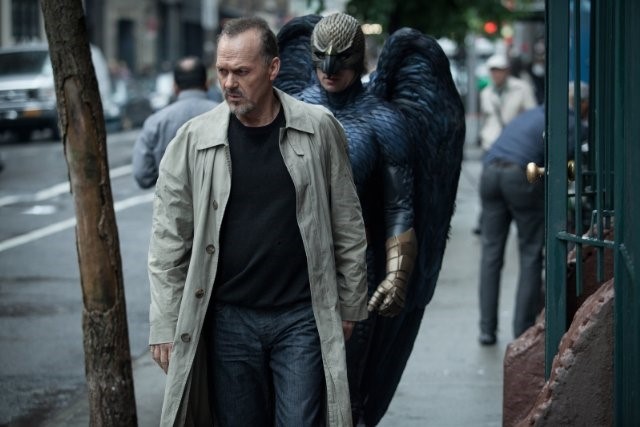
birdman01 As a quirky backstage comedy of existential crisis, “Birdman” flies with style while also being grounded in substance. Presenting its interesting story of life and performance in a technically challenging way we have never encountered before, it attempts a risky visual/narrative stunt to intrigue and engage us, and the result is a rich, memorable work which freely moves around laughs and pathos as gradually focusing on its hero’s desperate reach for recognition and redemption.

When we see Riggan Thomson (Michael Keaton) alone in his dressing room, it is apparent that his rather unstable mind is on the thin line between reality and illusion. He is trying to calm his mind through meditation, but the camera shows him being floated above the floor, and then we hear a deep ominous voice whispering to Riggan as if it were his hidden superego.

Riggan knows it is the voice of Birdman, a comic book superhero he once played in several films. That character gave him lots of fame and money during the prime of his Hollywood career, but that was a long time ago, and this washed-up actor has struggled in his sinking acting career since he left the franchise in 1992. If you are familiar with Keaton’s real-life acting career, you will be surely amused by the fact that Keaton also became more famous through “Batman” (1989) and then left the series after “Batman Returns” (1992), though he has steadily worked for years in contrast to his character (according to Keaton himself, Riggan is a character who is the most dissimilar to him in his entire career).

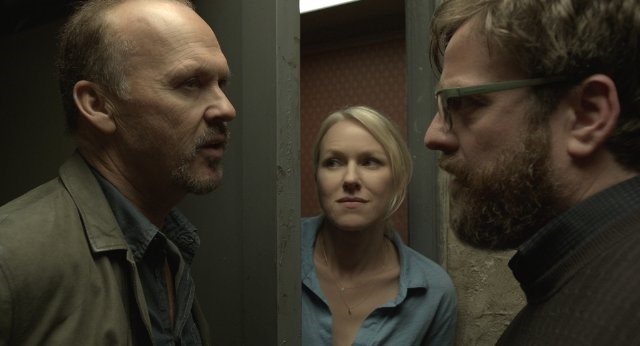
While people on the streets still recognize him as the star of the Birdman series, Riggan wants to be recognized as a serious artist, and that is why he is trying to make a Broadway debut through his stage play “What We Talk About When We Talk About Love”, which is based on Raymond Carver’s short story with the same name. With the help of his friend/lawyer Jake (Zach Galifianakis), he puts a lot of money and efforts to this personal project as its director/writer/lead actor, and he hopes his play will be critically and commercially successful enough to re-energize his acting career.

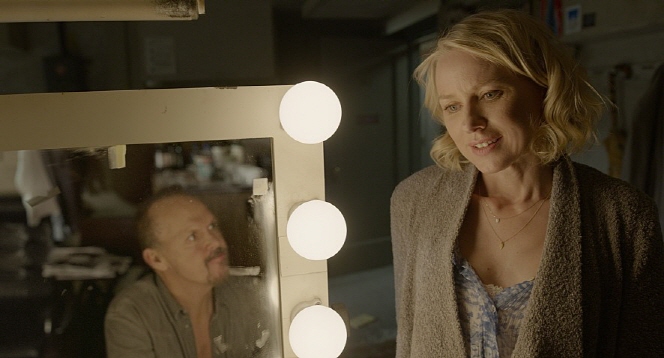
birdman03 But, as we saw from many other backstage comedy films, things are not going well at present. Although he and others are almost ready for the upcoming previews at the St. James Theater (I and my brother went there once for watching the musical “The Producers” starring Nathan Lane and Matthew Broderick), Riggan is still not so sure about whether he can pull it off or not, and then he gets a major headache when one of his cast members is replaced by Mike Shiner (Edward Norton), a famous Broadway actor who has some reputation for being both talented and difficult. While Riggan was initially glad to see a lesser actor being replaced by Mike, he soon sees the dreadful possibility of being upstaged by Mike inside and outside the theater, and Lesely (Naomi Watts), Mike’s current girlfriend who is also one of the cast members in the play, also gets her share of problems as Mike becomes too serious about his performance on the stage. In addition, the theater critics of Broadway are ready to blast any flaw in Riggan’s play, and Tabitha Dickinson (Lindsay Duncan), one of the leading critics in the town, does not hesitate to show her harsh contempt toward Riggan during their encounter at a nearby bar.

And Riggan’s personal life is not in a good situation either although it is not exactly at the bottom at least. His daughter Sam (Emma Stone), who works as her father’s personal assistant, has recently gone through a rehabilitation period, but she is not fully recovered from her drug problem while her current relationship with Riggan is strained as usual. She is not oblivious to how pathetic her father looks in his attempt to revive his career, and neither is Sylvia (Amy Ryan), Riggan’s no-nonsense ex-wife who understands her ex-husband better than anyone.

The screenplay by the director Alejandro González Iñárritu, Nicolás Giacobone, Alexander Dinelaris, Jr., and Armando Bo gives us playful or serious moments generated from the various interactions between its characters, and it also makes a satiric fun of various things including the ongoing trend of Hollywood blockbusters and the celebrity status fueled by the Internet. When the characters in the film mention several real-life actors currently playing comic book characters, we cannot help but be tickled by the fact that Keaton, Norton, and Stone had previous experiences with comic book blockbuster films, and then we get a very hilarious situation in which Riggan happens to be locked out of the theater while also being nearly naked. He has no choice but to do something for going back inside the theater because he must return to the stage right now, and that embarrassing moment goes viral on the Internet later thanks to many cellular phones on the scene.

small_birdman07 Through the cinematographer Emmanuel Lubezki’s stunningly fluid camerawork, all these happenings and many other ones in the film except the prologue and epilogue scenes are virtually presented as one very long visual flow without any visible cut to interrupt it. Lubezki’s astounding technical achievement in the film, which will certainly get an Oscar nomination, is simply marvelous to watch; his handheld camera moves freely here and there not only around every corner and corridor of the St. James Theater but also around the streets of New York, and you may be more surprised to see how this approach seldom draws attentions to itself as effortlessly moving from one scene to another (I was caught off guard several times during my viewing). You may notice some of its subtle transition jobs between scenes at times, but Lubezki’s camera keeps surprising us as effectively serving the story as an immersive tool of storytelling, and there are a number of terrific visual moments to be admired for how Iñárritu, Lubezki, and other crew members of the film rose to the challenges and then superbly succeeded with great dramatic effects.

The actors, who had to handle lots of dialogues while following carefully choreographed movements in front of the camera during their many longtake scenes, look as spontaneous as demanded on the screen, and some of them add humorous touches to their fun performances as skewing their public images. Like his character, Edward Norton has been known to be difficult to work with due to his professional dedication, and he willingly makes a fun of his image as an unorthodox method actor who is dedicated to his craft a little too much. He has a particularly absurd scene when Mike tries to act more realistically with Lesley right in front of the audiences, and you may be further amused by the fact that Norton previously played with Watts as a couple in “The Painted Veil” (2006).

As a frustrated actress wishing for more respect and recognition, Naomi Watts sometimes reflects her own early struggling years in real-life (do you remember the time when this Australian actress was once regarded as a less fortunate version of her friend Nicole Kidman?), and she also has a humorously tantalizing scene with Andrea Riseborough (she plays Riggan’s actress girlfriend who is also another cast member in the play). Emma Stone, who shows quite a different side of her talent here in this film, has her own moment when Sam tells a harsh truth to her father at one point, and she plays well with Norton as their characters toy with the mutual feelings between them on the rooftop of the St. James Theater. Amy Ryan and Lindsay Duncan are also good in their small but crucial roles, and Zach Galifianakis looks surprisingly down-to-earth as one of more normal characters in the film.

birdman05 And Michael Keaton, who will soon be Oscar-nominated along with Norton and Stone as predicted, slowly takes the center as the hero of the film. Besides that he is perfectly fit into his character, Keaton embodies his character right from the beginning, and we come to understand more of Riggan’s love/hate relationship with Birdman through Keaton’s unpretentious depiction of his character’s growing insecurity and conflict along the story. Riggan hates this symbol of his former fame as trying to make the new start as a serious actor, but then he sees more illusions of superpower as facing both his old desire to be famous again and his gnawing fear of another career failure which can be his doom, and Keaton’s performance firmly holds the ground during the final act as his character becomes more insecure – and more delusional.

Alejandro González Iñárritu has mainly been known through his sad, daunting films such as “Amores perros” (2000), “21 Grams” (2003) “Babel” (2006), and “Biutiful” (2010), and “Birdman” is a refreshing change of pace. While it has a fair share of deep sadness coming from its hero’s desperation, it also finds humor as honestly observing how silly and pathetic he really is, and it somehow finds a way to dance dazzlingly between reverent drama and irreverent comedy as accompanied with Antonio Sánchez’s percussive score.

The subtitle of the movie is “The Unexpected Virtue of Ignorance”, and this baffling subtitle is aptly used during the epilogue scene which ends with an ambiguous note. I do not know how to interpret its last shot, but “Birdman” is a very satisfying experience packed with style and substance, and Michael Keaton gives a performance to be remembered as one of the best moments in his career.

birdman02

Posted in Movies | Tagged , , , , | 1 Comment

Whiplash (2014) ☆☆☆☆(4/4) : Driven and played with blood, tear, and sweat

small_whiplash01 Intense and stupefying as mercilessly and powerfully playing our heart like those poor drums on the screen, “Whiplash” knocks us out with its tremendous energy coming from the tumultuous battle of two clashing will powers which is not only unpredictable enough to make our teeth clenched but also complex enough to made us think more about its themes. Is it necessary to be pushed harder and harder to go beyond your boundaries? Are all those pains and sweats acceptable just for that sublime moment of artistic elevation? And how can you know whether you really have the right stuff for enduring that long, torturous road to greatness, besides your big hope and ambition?

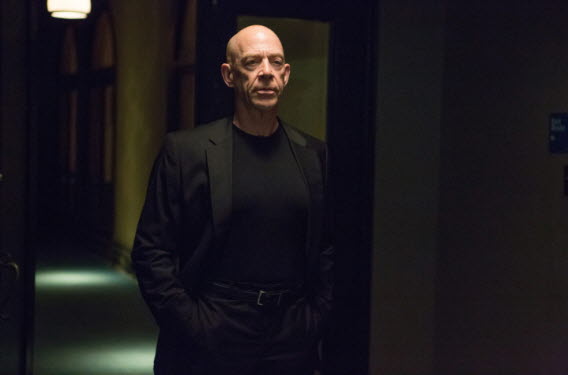
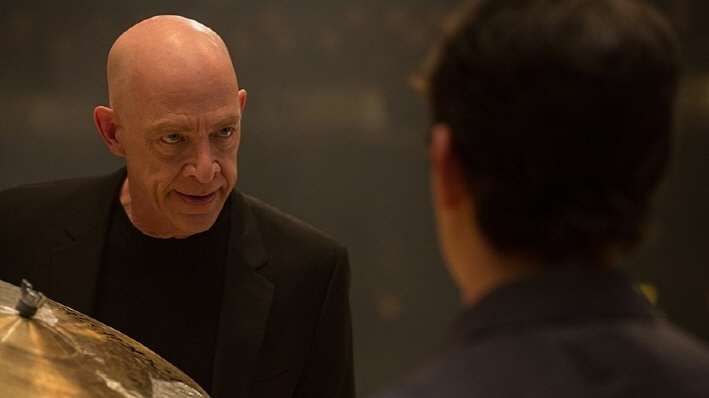
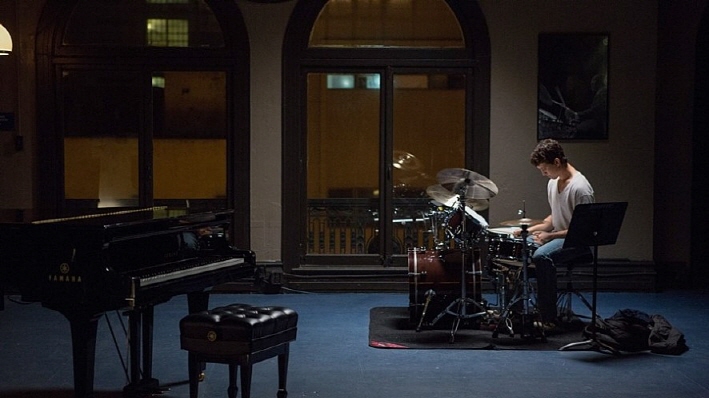
In case of Andrew Neiman (Miles Teller), a 19-year-old student of the Shaffer Conservatory in New York, he is ready to follow his aspiration to be a great jazz drummer like Buddy Rich, and the opening scene of the film shows him going through his usual night practice at the school. As the camera looks closer to his ongoing practice, it is revealed that someone is watching him while not noticed by him, and it turns out to be none other than Mr. Terence Fletcher (J.K. Simmons), the most notorious music teacher at the Shaffer Conservatory who is very infamous for his fearful perfectionism and his barbaric treatment of students.

Despite that notoriety of his, every student in the school is eager to be selected by Fletcher someday mainly because his recognition will mean a lot to them as well as their future career, and Andrew gets that coveted chance on the next day when Fletcher suddenly walks into the middle of Andrew’ current class and then, after briefly evaluating Andrew’s performance again, instructs Andrew to attend his class as a new alternative drummer in the next morning.

Whiplash-2667.cr2 While it looks wonderful to Andrew at the beginning, he is soon shaken by how ruthlessly intimidating his new teacher can be, right from his first hour in Fletcher’s class where every student is always on the edge as dreading what kind of disaster can possibly happen during the class. Fletcher treats Andrew rather mildly at first, but then he is quickly turned into something equivalent of a wrathful Marine drill instructor as soon as he notices some imperfections during his students’ performance. Besides pressuring his students to perfectly follow every instruction of his, he casually throws cruel, vicious verbal abuses at his students every time they make any mistake, and we see how he mercilessly drives an unfortunate student to tears at one point.

The mood in his classroom is always tense whenever Andrew and others try their best in front of their hellish teacher who is constantly keen on detecting any wrong note or tempo. He simply stops performance with his authoritative gesture at times, but then he throws a chair with his furious anger when he can no longer tolerate any sloppiness, and I must say it is rather amazing that such a tempestuous guy like him has managed to stay in his teaching position despite all these verbal/physical abuses which would surely lead lawsuits in reality (However, as a guy who had some experiences with a number of very difficult professors during my 15 years at the campus I can tell you that you can get away with many things as long as you are on the top of your field).

He does not make any exception on Andrew either, and Andrew comes to get his moment of abuse and humiliation from Fletcher during a very painful moment, but he becomes more determined to be recognized by Fletcher. He tries to meet his teacher’s tough demands, and he concentrates more and more on his practice. As one point, he practices so long and hard with his drumsticks that his hands are soon covered with scars and band aids, and we even get one cringe-inducing shot showing his bleeding hand getting soaked in a big glass of ice water.

small_whiplash03 “Whiplash” was originally an 18-minute short film directed by the director/writer Damirn Chazelle, who wrote the screenplay based on his own experience with a jazz band during his high school years (according to him, Fletcher was partially inspired by his former band instructor). When his short film was shown at the Sundance Film Festival in 2013, it received positive responses along with the sufficient financial investment for making the feature-length version as Chazelle intended from the start, and the final result, which was shot with the modest budget of 3.3 million dollar during 19 days, is a superlative achievement which deserves all the acclaims it has received since its big success at the Sundance Film Festival early in last year (the movie received not only the Audience Award but also the Grand Jury Prize).

As the main subject of the film, music is certainly one of its important ingredients, and the music performance scenes are handled well while also functioning as the crucial narrative points in the plot. Justin Hurwitz’s jazzy score is mixed along well with a number of standard jazz numbers including Hank Levy’s “Whiplash” and Juan Tizol and Duke Ellington’s “Caravan”, and the cinematography by Sharone Meir is slick and well-lighted as effectively establishing the urban mood on the screen, and the editing by Tom Cross, which deserves an Oscar nomination for its breathtaking precision and deftness, is superlative especially when the movie is palpably brimming over with high dramatic stakes.

And there lies a high-octane acting synergy crackling at the center of the movie, which is fueled by two talented actors fully committed to an unpredictable psychological tug-of-war between their contrasting characters. J.K. Simmons, a veteran actor who has mostly been known as irascible J. Jonah Jameson in Sam Raimi’s Spider-man trilogy, has the role of lifetime here in this film, and he gives a superb performance full of vigor and intensity which brought him onto the very top of the list of potential Best Supporting Actor Oscar nominees even before the award season began. The beauty of his performance is that he lets us understand his character’s professional passion and dedication even though we still hates his guts a lot even in the end; Fletcher can be very heartless, manipulative, and vicious if that suits him well, and he certainly amazes us more as a very unlikable human being, but then we sometimes feel a bit sorry for him as observing him as a miserable prisoner of his own ambition who keeps making more misery for himself as well as others around him.

small_whiplash02 The principle of his Spartan teaching is reflected well by an anecdote he often emphasizes to Andrew. When Charlie Parker gave a lousy performance during his early years, Jo Jones humiliated Parker through throwing a cymbal at him, and, rather than giving up his career, disgraced Parker drove himself more through many hard practices, and he eventually became “Bird” as he has been known. Fletcher firmly believes any raw talent needs to be pushed harder for something great to be achieved, and he is willing to do anything just for getting what he has yearned for many years – and he never regrets about his tough teaching method which can seriously damage his students.

On the opposite, Miles Teller, a young actor who initially drew my attention through his likable performance in “The Spectacular Now” (2013), gives an equally commendable performance as Simmons’ worthy match on the screen. While looking believable during his drum performance scenes thanks to many hours of his strenuous practice, Teller is also very compelling in his dynamic portrayal of Andrew’s gradual transformation along the story, and we come to see that his character is not wholly innocent in his circumstance. Andrew really aspires to be the best, so he willingly endures Fletcher’s draconian treatments as letting himself driven by Fletcher’s belief, so he becomes more aggressive and single-minded in his pursuit of perfection. His possible romance with Nicole (Melissa Benoist) is consequently affected as he comes to care a lot more about improving his talent day by day, and the tension between him and Fletcher is increased further along with Andrew’s artistic ego and brash confidence fueled by his growing talent and ambition.

Around the second act of the film, there is a frantic moment of pure madness when Andrew desperately tries to keep his position during a rather unlikely situation pressing him all the way to his limits physically and psychologically. You may think this part is too unrealistic compared to its realistic background, but it somehow works in the context of the story which always finds a way to strike us and its hero hard in its free-flowing narrative surpassing many usual genre conventions, and everything in the story is eventually culminated into the point whose indelible complexity I let you discover for yourself. Chazelle’s screenplay agrees with neither Fletcher’s view nor Andrew’s, but it shows instead what they have common between them despite all those hard feelings between them in the end, and I was certainly not surprised to hear from others about how enraptured the audiences were during the screenings of the film.

“Whiplash” is a small powerhouse movie equipped with confident filmmaking and astonishing power, and this great music film gave me an overwhelming but electrifying emotional ride still remained vividly in my mind. Like its hero, it pushes and drives itself hard with blood, tear, and sweat on its performing hands, and I must confess that I was frequently swept by its heart-pounding emotional effects on the screen during my viewing. Fletcher says “There are no two words in the English language more harmful than good job.”, but, what the hell, I will say the director Damirn Chazelle and his actors and crew did a damn good job.

small_whiplash04

Posted in Movies | Tagged , | Leave a comment

Still Alice (2014) ☆☆☆(3/4) : Fading away from others – and herself

stillalice01 When we meet the heroine of “Still Alice” at first, she looks satisfied with her life which has been fairly good to her. She is an academic researcher on the top of her field, and she has a husband who loves and understands her while also being a prominent researcher in his field, and she is also very happy to see their three children growing up pretty well and starting each own life. She and her family are all happy and joyous as celebrating her another birthday at a fancy restaurant in New York, and they wish all will be well for her in next years to follow.

But then Dr. Alice Howland (Julianne Moore) begins to notice small but disconcerting aberrations in her daily life. In the middle of her presentation at a conference held in LA, she stumbles when a word does not come immediately into her mind, and then she gets lost and confused during her routine afternoon jogging even though she is in the middle of the Columbia University where she has worked as a linguistic professor/researcher for years.

Disturbed by such baffling experiences, she goes to her doctor, and then she receives a very bad news. Although she is only around 50, all of her symptoms clearly suggest a very rare case of Alzheimer’s disease, and she and her husband Dr. John Howland (Alec Baldwin) are naturally shocked when the worst possibility comes true after several medical tests. They consider keeping this fact to themselves for a while, but they eventually decide to tell it to their children because such a rare case like Alice’s is caused by a genetic mutation which some of their children may inherit from her.

small_stillalice04 Alice and John try to live with the ongoing progress of her disease, but, not so surprisingly, they gradually face more of its sad, devastating effects on her. Alice becomes more frequently confused about many things including their daily schedule and her college lecture, and then there comes a point when she faces an undeniable fact that she is no longer brilliant as before in her work. She faces more difficulties in remembering words, and that comes to us as quite a sad irony considering her respected expertise on languages.

While this is basically a ‘disease of the week’ movie, “Still Alice”, which is based on Lisa Genova’s novel, is sincere and honest in the sensitive handling of its subject, and the directors/screenplay writers Richard Glatzer and Wash Westmoreland do not let their story become too sappy and sentimental even while their heroine’s circumstance inevitably becomes more melodramatic along the irreversible progress of her disease. One scene involved with Alice’s private video message to herself, particularly feels contrived in its execution, but that is just a few missteps in the story, and Westmoreland and Glatzer bring out real feelings as focusing on Alice and the state of her fading mind with care and respect (In fact, Glatzer has suffered from Amyotrophic lateral sclerosis (ALS) in real life, and he worked on the set as communicating with others mainly through iPad).

And Julianne Moore, who will soon be Oscar-nominated for this film as the front runner of this award season, gives another good performance which reminds us again of why she is one of the best American actresses at present. Regardless of whether her movies are good or bad, she has always been capable of giving something to watch and appreciate, and her solid performance in “Still Alice” elevates a bit what could have been no more than a passable melodrama film. While Alice is a typical movie character with terminal illness, she is presented a as real character with humanity and dignity through Moore’s thoughtful attention to her character, and Moore is also effective in the depiction of her character’s physical deterioration and the resulting personal pain and fear. Alice hopes that things will not get worse for her than predicted, but then she is reminded again and again of her worsening condition, and we occasionally see her mind wandering away from herself and her concerned family.

stillalice03 At least, there are sometimes good days when her mind is more functional than usual. Although it becomes harder to write for her, Alice manages to give a heartfelt speech for the Alzheimer’s disease foundation, and she has also more meaningful moments with her children. It goes without saying that her speech scene is a classic Oscar moment, but Moore delivers it with grace and class, and, as a South Korean critic once said, any Oscar season performance deserves to be praised if it is done well.

The movie is essentially Moore’s show, and the other performers in the movie ably support Moore as modestly standing by her performance. While Alec Baldwin is appropriately subdued as a husband who also faces his own difficulty as trying to support his wife, Kate Bosworth, Shane McRae, Hunter Parish, and Kristen Stewart appear as the rest of Alice’s family members, and Stewart, who has been on the steady recovery from the Twilight series, has a couple of good scenes with Moore as an actress daughter who is not exactly on good terms with her mother despite their mutual endearment.

In my mind, “Still Alice” was instantly compared to other notable drama films associated with Alzheimer’s disease, and I must say it is less powerful than Sarah Polley’s gracefully insightful film “Away from Her” (2006) or that haunting Japanese film “Memories of Tomorrow” (2006), which was also about a tragically early onset of Alzheimer’s disease. Like “Iris” (2001), “Still Alice” is a plain Alzheimer’s disease melodrama which happens to be supported by good performances, and it feels a little too unremarkable despite its earnest intentions, but you may give it a chance just for Julianne Moore’s admirable job in this film.

stillalice02

Posted in Movies | Tagged , , , | 3 Comments