The night was cool, and the geese and ducks went around.
The day was still hot, and the cats were idling.
The day was still hot, and the cats were idling.
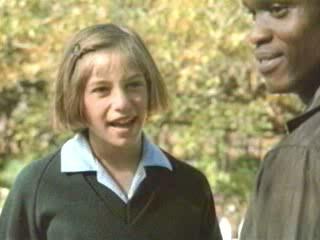 Sometimes people learn a hard life lesson about their world when they are young and innocent. Molly, a young white South African girl in “A World Apart”(1988), learns it in a way far more hurtful than usual. She wants her normal comfortable life to resume again, but her world is Johannesburg in the 1960s. She begins to grasp lots of injustices in her world, even while confused and hurt a lot by her parents as well as what happens to her and her family.
The undesirable change in her life commences with the sudden departure of her father at one summer night of 1963. Gus(Jeroen Krabbѐ) comes to his daughter’s bedroom, and he explains to her that he has to leave the country for a while. He promises her she will hear from him later. Molly(Jodhi May) accepts that without much trouble, and, on the next day, her life goes on as usual with the ballet lesson, her best friend, and her mother Diana(Barbara Hershey), the left-wing journalist/activist who is a prominent figure in the anti-Apartheid movement like her husband, who had to flee out of the country before getting arrested and jailed for subversion.
Their life is not changed much at first. Though Diana is mostly occupied with her political activity and Molly consequently feels alienated from her mother, she and her younger sisters happily live in their affluent middle-class neighbourhood. Though they are well aware of Gus and Diana’s activity and the people they are associated with, the neighbors are not that heartless to Molly. She is taunted by other students at her school because of her father, but her best friend stands by her, and the principle cares about her trouble, while asking her whether she heard any news about her father.
The situation is getting worse for Molly and her sisters as the time goes by. The resistance to Apartheid has kept growing since Apartheid began in 1948, and the South African government has responded with harsher repression including police brutality and several absurdly unjust laws. One of them is the 90-day detention law, which allows the government to detain anyone on the suspicion for a 90-day-period even if they have no concrete evidence against him or her at all. The detainees are not allowed to contact with their lawyers or families, and they are not allowed to write or read anything in their solitary cells. This sounds like the foolishness a long time ago, but I heard that the Blair administration had actually tried to pass a similar act a few years ago. Sure, they said it only applied to terrorists, but just think about how easy it is for the government organizations to label a common individual as a subversive.
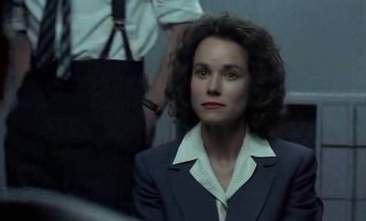 The 90-day detention law is soon applied to Diana. She is swiftly arrested and locked in the prison, where she is completely disconnected from her family. Even after she realizes the law applied to her is far more sadistically than she imagined, she does not bend her principles with the firm, defiant attitude. Her interrogator, played by strict but courteous David Suchet, actually respects her. As a man who is just doing his job, he tries to make their situation progress as smoothly as possible. Of course, he is frustrated by her stubbornness in the end, but, unlike his vicious colleagues who bully her, he shows some kindness to her as much as allowed in the system he belongs to.
So far, the movie seems to be not so different from other notable political drama movies about Apartheid made during the 1980-90s, but what distinguishes this film from others is that it mainly looks at Apartheid through Molly’s view. She has already been frustrated because her mother does not give enough attention to her school life while busying herself with her political activity. Now she is more frustrated than ever because days of heaven in their house are over for her and her sisters after their mother’s arrest. Her young sisters initially recover from a sudden change and regain their cheeriness while taken care of by their grandmother, but they also come to sense the distress hovering over the household.
Her world is not suddenly turned into hell on earth, and the movie wisely does not overplay her plight, but Molly’s changed daily life is like an endless purgatory to her. She has to keep enduring more scorns from others around her. At some point, she has to leave her house and board at her school, and she hates that. Furthermore, she learns that she is even ostracized by her best friend. To a young girl like Molly, this is quite a dreadful thing – and the parents to stand beside her are not available to her in this difficult time.
It is a little weird to say that her feeling of being alone and rejected matters to her more than the people deprived of the basic human rights outside, but that is true in case of any ordinary girls at her age. Molly goes with Diana to the protest march not because she is interested in the social injustices, but because she wants to be near her mom. When she coincidentally witnesses a black man left injured on the street by a white hit-and-run driver, that incident is merely a small thing to tell to her mother.
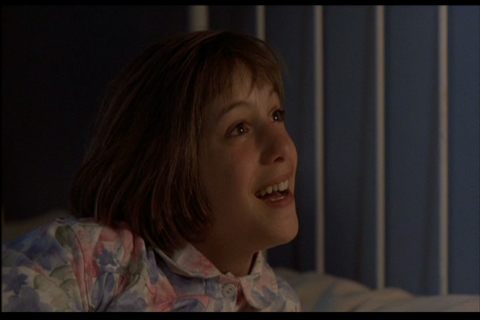 The movie is frank about Molly’s limited view as well as her and her mother’s position in their world. Compared to her mother, Molly is not in the worst situation for she at least can be with other family members at her house. And compared to the other countless black activists brutalized by the South African police, we can say that Diana is relatively treated mildly for she is a well-known white woman despite being labeled as the traitor of the state.
It can be said that, due to its main characters, the movie has that much-discussed awkwardness prevalent in the more well-known Apartheid movies like “Cry Freedom”(1987), which starts as the story about the black activist Stephen Biko and then ultimately becomes the story about the white journalist who escaped the country to write about him. “A Dry White Season“(1989) is a better one which powerfully depicts a lot more of what is glimpsed in “A World Apart”, but its climax culminates on, again, whether the white hero played by Donald Sutherland can get the important article printed on the newspaper.
However, compared to other movies, “A World Apart” has far less awkwardness, for the story starts and ends with Molly while recognizing the limits in her viewpoint. By concentrating on Molly’s world with the details, the movie gives us the reality with a specific time and space; it pulls us inside her world, it makes us identify with her and understand her view, and it lets us see more than what she sees in her world. While South African goes into the more turbulent period, she starts being more conscious of what is happening around her, especially through the housemaid Elsie(Linda Mvusi), whose activist brother is arrested and abused by the police. But still, like her parents, she is someone from different world to Elsie and other black people, and that fact is succinctly conveyed to us during her visit to Elsie’s family living in a slum area.
“A World Apart” was the directorial debut of Chris Menges, who is more familiar to us as a cinematographer. While working as the cinematographer for the movies such as “The Killing Field”(1984) and “Mission”(1986), he also made few films, and this movie is the best accomplishment in his short directing career. With his cinematographer Peter Biziou, Menges does an excellent job of vividly presenting the world with the brutality hidden beneath the surface, where you can live without troubles as long as you do not cross the lines to become someone to be watched.
 The movie was well-received at the Cannes Film Festival in 1988. It got two awards, and one of them was Best Actress award for Hershey, May, and Mvusi. Barbara Hershey gives a strong performance as a mother who loves her daughters but definitely will not be nominated for “the Mother of the year”. She probably agree with her interrogator when he points out that she is putting her kids into suffering while sticking to her belief. However, as someone born to be an activist, she cannot stand back and rather pay the price for that. Jodhi May, who debuted with this film and has continued her acting career, is equally impressive with her wide eyes, the windows through which you can see a lot of things inside her including the pain of growing up in the world turned hostile and alien to her. Linda Mvusi has small, intimate moments with May – you usually learn that something is wrong in the world when unjust things happen to the people close to you.
You can feel lots of real personal feelings inside the story, which is based on the screenplay writer Shawn Slovo’s difficult years of growing up in South Africa. Like their fictional counterparts, her parents, Joe Slovo and Ruth First, actively participated in the anti-Apartheid movement, and they were certainly not welcomed by some people in their country. As depicted in the movie, Joe Slovo became an exile while continuing his activity associated with the African National Congress(that part is briefly depicted in “Catch a Fire”(2006), also written by Shawn Slovo), and Ruth First was subsequently detained in the prison for a long period. She also got out of South Africa later, but she was killed by the parcel bomb in 1982.
Apartheid has become the part of the 20th century history along with its relatively peaceful ending. It is the 21th century now, and, while South Africa is dealing with other problems, we amusingly watch all South African people become hostile together to the aliens in SF movie “District 9″(2009). While effective as the movie showing the inhumane world that did exist in the past, “A World Apart” is also a touching drama about a mother and a daughter whose lives are shaken by that world. The movie basically says “Mommy, you screwed my childhood.”, but it cries that out with endearment and respect as well as resentment and pain. Even after eventually letting out their feelings to each other, Diana and Molly will still be not so close to each other; mother will continue her work, and daughter will not know a lot about what her mom does. However, at the moving finale, they are together for a while – with the people who are different from them but pursuit the same thing. We know that their wish finally came true in the end.
 Sidenote: The score was composed by Hans Zimmer, and it was a small but important stepping stone for his career. He was unknown at that time, but his work in this film impressed Barry Levinson’s wife, and she recommended her husband to hire him as the composer for his movie, “Rain Man”(1988). The rest is, as many of you know, the history.
 Few hours after watching “Bridesmaids”, which is funnier and sweeter than I thought, I had some small talk with a female bartender. Because I do not know well about women and the ways of their thinking, I briefly explained her about the synopsis of the movie and asked them whether such a competition like that in the movie exists in the real life. Her answer was, amusingly, yes. She told me about how sensitive the girls about the relationship with their best female friend, or BFF. They become insecure when there is some shift in the equilibrium, and the relationship is subsequently strained, but they soon become closer again as before. Yes, the girls know better than our boys.
Though it is ultimately about women getting the men they want just like any romantic comdies made nowadays, the movie works because it has a sweet heart caring about its female characters, who are hurled into, or run into, the series of social embarrassments accompanied with the raunchiness equivalent to that of the recent male comedies like “The Hangover”(2009). This movie certainly proves that the ladies are as capable as the gentlemen in case of doing dirty comedies, and it tickled me and other audiences in big or small ways.
For Annie, played by the co-writer Kristen Wiig, her life is frustratingly going nowhere at present. Her bakery was closed due to the recent recession, her boyfriend left her, and she is now stuck with some odd British brother and sister in her apartment. She wants a man in her life, but she has continued the shallow carnal relationship with some guy named Ted(uncredited Jon Hamm in dashingly obnoxious mode) though she does not like him much.
At least, she is relatively brightened up when she talks with her best friend Lillian(Maya Rudolph). As close friends, they frankly talk about everything including the bedroom activity. Wiig and Rudolph are good comedians; the breakfast conversation scene between them at the diner is both funny and intimate while freely going into the regions I am not so willing to discuss about.
 Now Lillian is going to marry, and Annie will be the lead bridesmaid of Lillian’s wedding. However, it will not be easy for Annie for being the lead bridesmaid who will manage the preparation process including the bridal shower. When Annie attends Lillian’s engagement announcement party, she meets other bridesmaids, and one of them is Helen(Rose Byrne), the young wife of the boss of Lillian’s fiancé. With Annie’s insecurity about her position as Lillian’s best friend and Helen’s tendency to control the show, the competition between Helen and Annie is instantly sparked from their first encounter, followed by the funny scene of the two girls competing for getting the last word for congratulating Lillian’s engagement in front of other confounded guests.
And that is just the start. The movie does a good job of drawing the laughs constantly from the various troubles ensued along their bumpy preparation process. In one of the funniest scene, Annie and other girls go to an elegant dress shop for the dresses for the wedding after having a lunch at some Brazilian restaurant recommended by Annie. Unfortunately for them(and the dress shop owner), they suddenly have to take care of a certain embarrassing biological problem. Fortunately for us, we are saved from the graphic details while getting lots of laughs from its slow start to its frantic(and sweaty) payoff.
While making her character an understandable walking trouble, Kritsten Wiig, a former SNL comedian, does a lot of funny things. Watching the behavior of the drunken character is not usually as funny as you think(If you have ever been to the bars, you know what I mean), but Wiig succeeds at being both very embarrassing and very hilarious when Annie, influenced by alcohol and drug, makes a big fuss on the plane to Las Vegas. Annie’s romance with the cop(Chris O’Dowd) who stops her car for a broken taillight is an obligatory side dish in the story, but it also has the moment for Wiig’s talent to shine.
 Meanwhile, Wiig and co-writer Annie Mumolo allow other actresses besides Wigg, Rudolph, and Byrne to have a fun with their respective characters. The standout is Melissa McCarthy as Lillian’s brash future sister-in-law. If she wants something, this chubby girl goes all the way to get it, as shown by her funny interaction with a man who happen to sit next to herl(he is played by her real-life husband Ben Falcone). As other bridesmaids, Ellie Kemper and Wendi McLendon-Covey are not relatively utilized well, but they have a good scene as a jaded housewife saddled with her ruthless kids and a naive wife having just started her married life. And the movie is the last film of late Jill Clayburgh, who plays Annie’s mom who loves to go to the AA meetings though she is not an addict.
The movie is produced by Judd Apatow, who has produced/directed several raunchy male comedies with lovable sides. He and others applied the romantic comedy formula to the guys’ story, so we are now familiar to that term ‘bromance’ thanks to them. And now the circle seems to be completed with this movie, where the bromance formula is applied to the girls’ story. The movie diligently follows the formula, and you are pretty sure about what will happen during its third act, which is a little too long, but that comes with laughs and warmth while everything is fine for these ladies again.
By the way, the movie is coincidentally released on this weekend in South Korea along with the other notable raunchy comedy of this year, “The Hangover: Part II”. Unlike that hilarious previous movie, “The Hangover: Part II” is mostly cringe-inducing rather than funny. “Bridesmaids” has surely its own cringe-inducing scenes, but it is definitely funnier than that lazy, unpleasant comedy, and the audience response was more positive. So, at least in my view, we can say that the ladies win this time.



The House with dangerous secret has been one of the most common subjects in horror movies. Its interior is usually decorated with lots of horror clichѐs we have encountered for at least hundred times. Regardless of whether the house looks good or bad, there is always that familiar sinister feeling beneath the surface. If you don’t get it, the music or the cinematography will kindly tell you that this is indeed the bad place to live. However, for the movie has to scare us throughout the running time, the characters unwisely stay there and the darkness creeps on them day by day.
But I am not sniggering on this kind of horror movies. When I come across the good one like “Don’t Be Afraid of the Dark”, I enjoyed it with the satisfaction of being served well. It knows the mood is more important than the shock; the big house in the movie is shrouded in the ominous creepiness thanks to its gothic production design, dark cinematography, and nervous score. This build-up process is so good that the fatal secret revealed on the screen is relatively weak compared to that, though it is well-handled enough to scare us.
And the movie has a nice heroine to be terrorized by what she sees at this bad place. A young girl named Sally(Bailee Madison) is sent by her divorced mom to her father Alex(Guy Pearce) and his girlfriend Kim(Katie Holmes), who work and live in the Blackwood manor in the Rhode Island countryside. Alex recently buys the house at a cheap price; he seems to have not thought about why this big house is not so expensive. He is renovating the Blackwood manor, and he thinks he will be able to sell it with a higher price later. Even though he is not aware of being in a horror movie, I would say he is too optimistic considering the current situation in US real estate business. But it’s only a movie, isn’t it?
He has been doing good jobs with his employees at this place. The house has a grand hall restored with mahogany panels, it has a big, old-fashioned library I’d love to own, and it also has a cozy bedroom with a big bed for Sally. Sally is not that enthusiastic about living here. She is a troubled kid struggling to adjust to her new environment, and she does not get along well with her father or Kim, a nice person who will probably be not bad as a stepmother but does not know what to do with her.
 Anyway, Sally is still a kid, and she curious about her new place to live. Naturally, she roams around the house, and then she discovers the basement that has been hidden for years. Even without the frightening opening sequence about what happened to the owner of the house at that place a long time ago, it is apparent to us that the basement is dangerous for her. There is a ‘furnace’, which seems to have been sealed for years, and she hears the small, insidious voices beckoning her to play with them.
What will happen next is pretty much like what you can expect from a dark fairy/horror tale. “Don’t Be Afraid of Dark” is the remake of the 1973 TV movie starring Kim Darby. The producer/co-writer Guillermo del Toro liked that movie, and he produces his own version which substitutes the adult heroine played by Darby with the young girl played by Madison. Considering that he made a great fantasy movie “Pan’s Labyrinth”(2006), which is also about a girl who encounters a dark hidden world and solely faces lots of danger inside that world, it is a not surprising change.
I have not watched the original version, but I can say the remake version is a nice horror movie with something horrible lurks behind the darkness. While maintaining the desperately suspenseful situation well, the director Troy Nixey punctuates the mood with several good scary scenes. Some of them is involved with sharp objects, and that made me wince several times(Although its heroine is a kid, this is a R-rated movie and it does not pull its violent punches). While watching the movie, I noted that this was the second time when I watched the character’s eye in the danger during last three months – the previous one was “The Eyes of Julia(2010), which was also produced by del Toro.
 Maybe you can guess it easily from that opening scene that the secret beneath the house is sort of freakish version of a certain fantasy creature familiar to some of you. These creatures are tiny but they are very vicious ones who has been craving for what they want from Sally. I think the movie shows them a little too much; in case of the creatures preying on the characters, less is more. As a matter of fact, their most striking moment in the movie is when their silhouettes are reflected on the bathroom curtain.
Poor Sally, who has enough troubles of her own, has to defend herself alone from these creatures alone in most of its running time, and nobody around her believes what she sees. Surrounded by her co-starring adult actors, Bailee Madison is as good as we can want from a little girl trapped in a bad place; we brace ourselves along with her while she is approaching to the danger over there. Jack Thompson is an old caretaker who knows a lot about the house, and Guy Pearce and Katie Holmes are adequate as the adult characters who do not realize what is really happening in their house. In case of Pierce’s character, he is more or less than a plot device for making his daughter stay in the house she wants to leave – but let’s say such a foolish negligence can happen before the disasters that could be prevented.
Though it has several flaws in the story(I wondered how they take care of the aftermath of several incidents in the movie, which cannot be easily ignored by the police in real world), “Don’t Be Afraid of the Dark” came to me as a nice surprise during these few remaining summer days. Every time we are frustrated by the endless shocks and bangs of the recent horror movies, there are always some horror movies which know the value of suspense before giving a really good shock to us – this is one of them, if not the best of them.

“‘Will you walk into my parlor?’ said the Spider to the Fly.”
– from the poem “The Spider and the Fly” by Mary Howitt
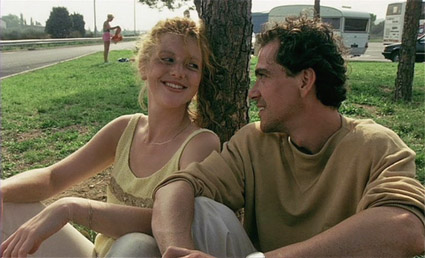
The crucial moment in George Sluizer’s chilling psychological thriller “The Vanishing”(1988) can be summarized with that quote. The Fly cannot resist the offer, simply because of his intense desire to know. The Spider cannot resist making an offer, only because of his cold curiosity about the result. He has a solid prediction based on his careful calculation, but he wants to know the result in his cruel experiment, like he previously tested himself before.
Quite frank about its mystery except one crucial piece of puzzle to be revealed at the finale, “The Vanishing” is about more than discovering what happened on that day. While following the plot which seemingly has nothing to hide from us, we come to see that two dark obsessions approaching to each other with fatal possibility. We observe them with the mounting dread, because they are inevitably going to reach to some point together. Do you remember Hitchcock’s definition of suspense? This time, the hero knows there is a ticking bomb under the table just like us, but he is helplessly driven to stay there.
At first, that fateful day was an ordinary summer day for Rex(Gene Bervoets) and Saskia(Johnna ter Steege), a young Dutch couple who were enjoying their summer vacation in France. When we see them in their car in the opening scene, they are happy together while entertaining each other with word game. Like any other couples, they have the moment when their relationship is put to the test. They have a quarrel, but they soon have a gentle moment of reconciliation at the gas station. After they confirm their love to each other, Saskia excuses herself for a moment for buying drinks for them when they are about to leave. He happily waits for her to come in the meantime. Everything seems to be all right; the radio news, a usual harbinger of something bad about to happen in thriller movies, is busy with the Tour de France while the sky is blue and the sun is shining.
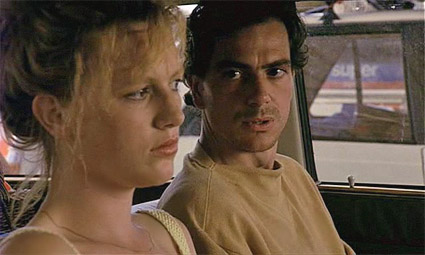 But Saskia does not come back. Rex continues to wait, but she still does not return. He looks around the gas station, but there is no trace of her. He asks around, but, though some people remember seeing her, she still cannot be found. He has a faint proof that she was really at the gas station, but that does not help him much to find the clues for her whereabouts. She is pretty much like vanished into the air.
This could be a nice premise for an action thriller movie centered on the hero’s search for hid loved one(Jonathan Mostow’s “Breakdown”(1997) is a good example), but Sluizer’s screenplay, based on his co-writer Tom Krabbѐ’s novella “The Golden Egg”, takes a more interesting route. The movie lets us know far more about the mystery than Rex; we see some guy waiting for something at the gas station at which Rex and Saskia arrives, and it does not take more than 10 seconds for us to guess that he is the one who kidnaps her.
The movie goes further with this man, Raymond Lemorne(Bernard-Pierre Donnadieu). In the flashbacks, we see his meticulous preparation. He prepares the place ideal for his plan. He checks whether the place is as remote as he thinks, while not drawing the attentions from others. He practices his tactic for drawing his future prey into his car. He is a perfectionist; he carefully checks his pulse rate during his mock trials.
On the surface, he is a chemistry teacher with his loving family. His family seems to feel there is something odd about him, but they have never imagined what he is up to. In their affluent middle-class environment, they only think he bought the house in the countryside for having an affair with someone. Of course, he assures them, with all his gentle honesty, that is not true.(“I’m the last French man who can be proud of having known only one woman in his life.”).
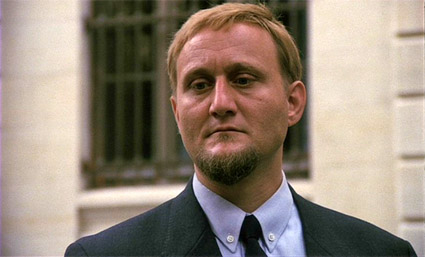 The icy but humorous performance by Bernard-Pierre Donnadieu, whom you probably remember for a small but crucial supporting character in “The Return of Martin Guerre”(1982), is fascinating insidiousness. Despite his sociopathic side he casually admits, he is capable of doing right things, but that makes him very, very curious about himself. If he can do something good, then can he also commit something the most horrific ever imagined by him? I would reply to him that people are capable of doing anything at the right time and at the right place, but he really wants to confirm his ability for himself, and that sets him into the motion. At one point, he indirectly tells about his obsession to his daughter. “You start with an idea in your head. Soon, you realize you’re up to your neck in something intense, but that doesn’t matter. You keep at if for the sheer pleasure for it. For the pure satisfaction it might bring to you. And that, my dear, that can’t measured in miles.”
And now his focus is directed to Rex, who has grown his own obsession since Saskia’s missing. Nearly three years have passed, and he is still looking for the clues. While recognizing that there are lots of possibilities that Saskia was dead, he is dying to know what really happened to her, and, as shown in his apartment, his daily life is entirely devoted to that single aim.
His troubling state has made his current girlfriend quite exhausted. Lieneke, played by Gwen Eckhaus, is not angry about Rex’s incorrigible behaviors. She wants to help him – but she can’t. Bervoets and Echhaus have a sad quiet scene with few dialogues. While watching the video tape of his interview on TV, they silently admit their relationship is beyond the repair. Rex cares about her, but he cannot help himself. As Lieneke dryly points out, between her and Rex, there has always been the woman who probably does not exist anymore. You can easily compare Lieneke with Barbara Bel Geddes’ character in Alfred Hitchcock’s “Vertigo”(1958); both are down-to-earth women who care about and are frustrated about the men obsessed on the mesmerizing ladies who disappeared from their sights.
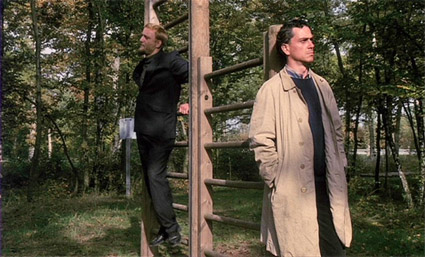
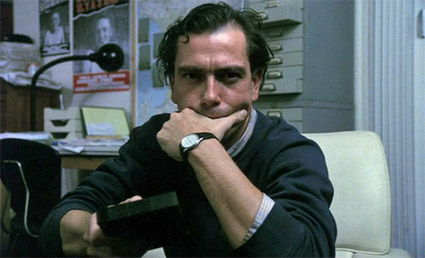 Rex’s life continues to proceed into the downward spiral, and then Raymond suddenly appears in front of him. Very candid about what he did, Raymond has an offer with twisted kindness. If Rex accepts his conditions, he will give Rex the answer he has been desperately yearning for. Or, with more misery, Rex will lose the only chance to know what happened to Saskia.
I like the way how the movie keeps maintaining its calm approach during its predicted third act. It focuses on the compelling interactions between its characters who finally encounter with each other, and this is not a simple confrontation between good and evil. You may admire Rex’ perseverance, but his obsession has isolated him from the world while lots of things – money or personal relationships – were sacrificed in the meantime. In one disturbing scene, he penetratingly stares at the computer screen on which his former lover’s name keeps appearing. Besides his psychotic side, we can say Raymond is honest and kind in his limits, though he still holds his deadly cards behind his back.
The movie is the most well-known film in the director Geroge Sluizer’s career. The uneasy atmosphere is subtly accumulated with small foreshadowing and hints in the mundane settings. There is some morbid humor inside the story. The movie has a wry fun with Raymond’s trials, which exemplifies “Easier planned than done”. At one moment, he tries to lure one woman into his car, but she turns out to be one of his acquaintances, who unknowingly gives him a valuable advice for his plan. And there is the amusing interlude between Raymond and Rex before they eventually arrive at the certain point where an important decision must be made. Echoing the word game between Rex and Saskia in the opening scene, this scene makes us sense that we are following them through the familiar path – and we begin to get some dreadful idea about what will happen in the end.
 With his film, Sluizer had a breakthrough in his career which started in the 1960s, but, unfortunately, he later made the biggest mistake in his career; he directed the American version of his film which ruined the original plot. The actors including Jeff Bridges, Keefer Sutherland, Nancy Travis, and Sandra Bullock were not bad as the main characters, but the revised script changed the third act, so we got what we usually expect from the average mediocre thrillers made in Hollywood – “Third Act Syndrome”. The cunning villain delves into stupidity while the other characters become smarter than before with lots of unbelievable contrivances, just because, in some people’s view, a certain type of ending is more marketable than the original ending in US market. Were they afraid that the audiences might feel depressed due to the original ending? Come on, folks, as Roger Ebert said before, only bad movies make us depressed, not good movies.
Frankly, I have no idea why Sluizer chose to direct that lousy movie. Probably, like Hitchcock, who made two versions of “The Man Who Knew Too Much”, Sluizer thought he could try another direction in his story, but “The Vanishing” is a claustrophobic thriller which logically narrows down step by step to the only ending possible for its story, and that ending is absolutely required for the gut-wrenching effect in the finale. To be frank with you, I was one of the victims who unluckily watched that forgettable remake version first(the original version has not been officially introduced in South Korea yet), so I was not that shocked, but, when I finally watched the original version, I was very glad to see the story served in a right way.
By the way, during my second watching, I noticed that both opening sequence and closing sequence feature an insect. The one is a stick insect, and the other one is a mantis. Are they representing the cold ruthlessness camouflaged behind Raymond’s gentle appearance? Or, do they tell us that how insignificant we are in the world, which can go around regardless of our existence? The last shot of the film reminds me of that dour truth in Hitchcock’s “Psycho”(1960). We may be trapped in one way or other, and we may never get out of our private golden egg – even at the end of our life.

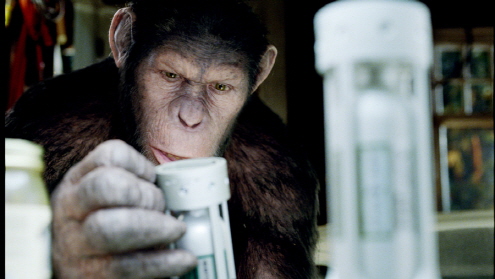 Because of two things, “Rise of the Planet of the Apes” exceeds our low expectations. First, as a summer blockbuster movie, the movie is the technical improvement which shows us how far CGI technology has been advanced in these years. Second, as a drama about the dawn of the evolutionary revolution, the technology used in the movie allows us to be engaged in the story of its character who struggles through his plight to eventually find his place in the new order of the nature to come. Though we can see that (this is not a spoiler) the end of the human civilization is about to come, we do not feel bad about that much, and that is one of the main achievements of this surprisingly entertaining movie.
As many of you know, the movie is the reboot of the famous SF series started with “Planet of the Apes”(1968), which was followed by four lesser sequels, and then remaked in 2001 by Tim Burton with a dissatisfying result. While there are several amusing small connections between the movie and the previous movies, “Rise of the Planet of the Apes” is an almost completely new story about how the apes come to revolt against the human society. There is a lot of the possibilities about the sequels in the end, and, if so, they will probably continue their story of their own.
How do the apes evolve enough to fight against humanity? The reason is something I and my colleagues in the biological science department will have lots, lots of amusement(and laugh) after watching this movie. The biologist Will Rodman(James Franco) is trying to find the cure for the Alzheimer’s disease his father is suffering from. With his latest genetically engineered virus injected to chimpanzees, he seems to have a major breakthrough. However, his chimpanzee, which has gotten a lot smarter than before, becomes suddenly frantic due to a good reason and runs amuck in the laboratory building. Animal instinct is hard to control even with intelligence; we human beings know that too well.
 At the same time, unfortunately, Will is doing the presentation for the board meeting which will judge whether his project should be continued or not, and this incident leaves a pretty bad impression on the board members, who are shocked by a sudden attack by his test animal. His boss immediately orders to terminate Will’s project and kill every test animal. Will decides to keep a baby chimpanzee born in his laboratory and raise it at his house where he lives with his ailing father, while continuing his study in private.
The chimpanzee, named Ceaser, is played by Andy Serkis. Unlike the actors in the previous movies, Serkis does not wear make-up this time. Thanks to Weta Digital, Serkis’ terrific performance is rendered into the CGI character on the screen, and it is marvelous to look at how his performance is effectively expressed through the performance capture technology which has been improved with more freedom than before. Serkis is no stranger to the performance capture technology; he already played the memorable CGI characters such as Gollum in The Lord of the Rings trilogy and that unforgettable giant ape in “King King”(2005). His performance in the movie deserves to be added to his belt as another impressive acting juxtaposed with the special effects – too bad his performance is not eligible yet for the Academy Award.
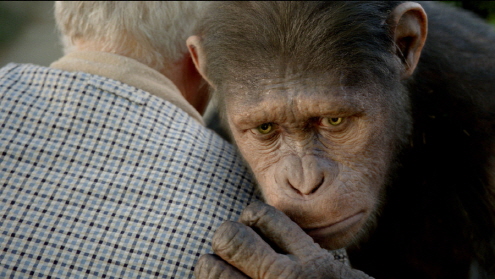
While keeping impressing Will with his rapidly growing intelligence, Ceaser has a happy time at Will’s home with the occasional visits to the redwood forest outside San Francisco. Soon he recognizes his lonely position as the outsider between the human beings and the apes. In Will’s household, he is an equal family member, but he is still regarded as an animal with sharp teeth to the people outside. Because of the unfortunate incident between Will’s father and the aggressive neighbor in next door, Ceaser is sent to the facility where he is abused by the sadistic guards and ostracized by the other apes who instinctively sense that he is different from them.
With Serkis and his fellow actors transformed into the apes, the movie does a very good job of giving us a bunch of vivid CGI characters to be led by Ceaser. Some of them are actually given distinctive qualities as the crucial supporting characters. I especially liked a gentle Orangutan named Maurice, who is wiser than others(except Ceaser, of course) and naturally becomes a confidant to Ceaser through sign language. His name is probably the tribute to Maurice Evans, who played an Orangutan character in “Planet of the Apes”. As a matter of fact, there are some references from that movie, including that famous line shouted by Charlton Heston.
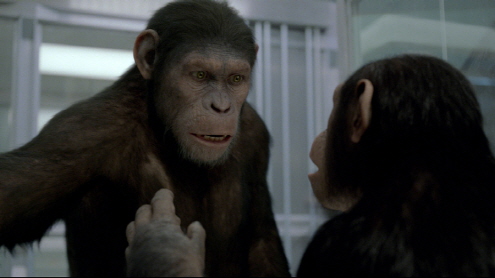 While he endures the abusive treatment, Ceaser’s story follows that of the leader who leads the uprising to shake the order of his oppressive world, so the third act of the movie is about their battle unfolded in the streets of San Francisco and, later, on the Golden Gate Bridge. Unlike that dreadful “Transformers 3″, it is exciting to watch the apes do lots of actions for their survival, because there is the story driving the apes to that showdown and we have accepted them as the real characters. In addition, they are a lot cleverer than mindless CGIs we have encountered in these days. It is kind of touching to see that CGI character keeps his decency while busy with fighting for his right – maybe the Earth taken by him and his fellow apes is not a bad thing after all.
While enjoying Ceaser and his comrades, I found the weakness of the movie is a little too transparent to be ignored. The human characters played by the good actors including James Franco, Freida Pinto, John Lithgow, Brian Cox, Tom Felton, and David Oyelowo. They do their jobs as required, and they share the scenes with CGIs without any awkwardness, but their characters are mostly more or less than the plot devices or the obligatory bystanders. Lithgow has some poignancy as a senile father who gets temporary joy and happiness in his last remaining years, but he is limited by his character like others. Pinto, a lovely actress, is wasted as a veterinarian who becomes close to Will and Ceaser.
But the apes save the day, and “Rise of the Planet of the Apes” is the best summer blockbuster movie of this year along with “Harry Potter 7: Part 2”. I admire how the movie made me care about the apes revolting against us with its good story, and I do have some expectations for the sequels. It is really nice to see that not all action blockbuster movies have to be brainless assaults on our neuron system.
When I watched “Exit Through the Gift Shop” in last November, I also wanted to ask the question many reviewers had already asked. We have heard about Banksy; although he has not revealed his identity yet, he is a well-known street artist who directed this funny documentary. But who is Thierry Guetta, the subject of Banksy’s documentary? After watching his documentary, some people thought it was a fake documentary intended as a prank, so there were some talks about whether it was about a true story or not.
Because the story in Banksy’s documentary is a lot more outrageous than fiction, I also could not completely believe it, but it seems the documentary is about a true story. According to Wikipedia, Thierry Guetta, a.k.a. Mr. Brainwash, indeed had his first exhibition show in 2008 at the former complex building of CBS in LA. In addition, as shown in the documentary, his exhibition show was really well-publicized by LA weekly, and it resulted in the long queue of people waiting outside the building to see his artworks.
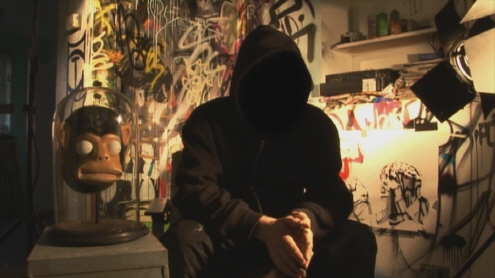
Banksy, still hidden in the darkness in front of his camera, tells us how Thierry Guetta started to occupy his own place in the world of street art. Born in France, Guetta moved to LA later and became the proprietor of a clothes shop in LA. One day, his fascination with video camera began, and he recorded everything in his sight with his toy while hanging around LA. I still have some little doubt about his existence, but he is a funny guy whom you can listen to for hours with amusement on his unabashed enthusiasm, whether he is a hoax or not.
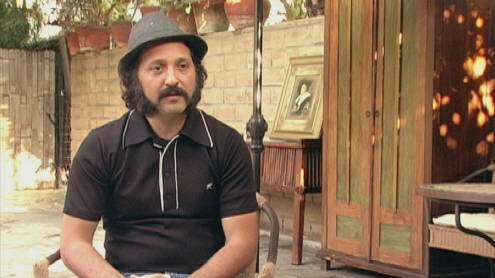 With his camera, he found a new target of his obsession. Through his cousin living in Paris, a street artist name Space Invader, he encountered the street art for the first time. His fascination with these guerrilla artists was instantly germinated. He soon started to shoot the work processes of every street artist he could approach to. Whether you approve of what these underground artists do in public with their graffiti, posters, and others(some are nice; the others are, well, let’s say they deserve to be removed, though I am not against their artistic freedom), you may agree that Guetta’s video footage gives us an interesting presentation of how these artists express themselves through their work. There is some guy who draws the outline of shadows on the road with paint at night. In case of Space Invader, he sticks his works, made of those small square plates from Rubik’s Cubes, on the walls around the cities.
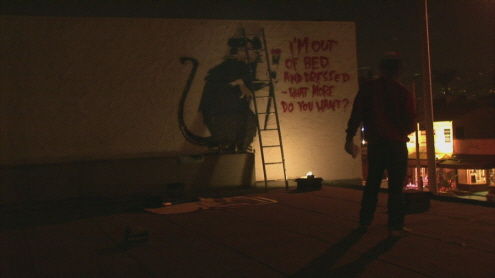
While the stacks of his video tapes were being accumulated, Guetta had not been satisfied yet because he had not met one of the most famous street artists – Banksy. Fortunately, Guetta had been accepted as a good helper in Banksy’ field, so Banksy approached to him, and Guetta proved to him that he could be trusted while recording the people’s response to Banksy’s provocative installation artworks.
Meanwhile, Banksy’s popularity continued to rise. Banksy had his first exhibition show in LA and that boosted his fame further. Now his works were far pricier than before. When they auctioned one of his works, a distorted telephone booth, they started with $ 100,000. While I like his creativity, I do not know whether it deserves to be expensive like that. I can say it is as impressive as the modern artworks I appreciated in the Art Institute of Chicago, which were simply profound or profoundly simple.
 Banksy thought it was the time to make a documentary about street art, and he asked Guetta to make a documentary assembled from Guetta’s vast amount of video tapes. The result, “Life Remote Control”, is something hilariously abysmal you have to watch for yourself. It looks like an avant-garde hybrid of Ed Wood Jr. and Michael Bay; Jean Luc-Godard’s “Film Socialism” is nothing compared to Guetta’s brainless obscurity. It seems to really have existed; its trailer was available on YouTube in 2006 – or was it a part of well-planned hoax?
Anyway, that was why, at least according to himself, Banksy decided to step in for stopping Guetta and made this documentary for himself. However, at that time, he gave quite a regrettable advice to Guetta, and, as a consequence, the second part of Banksy’s documentary becomes funnier than the first part which is already quite funny. Now the connoisseur of street art decides to become a street artist by himself, and he tries in a clumsy way to make you giggle in several moments. With the help of his artist friends including Banksy, his status is risen up with the publicity in the meantime.
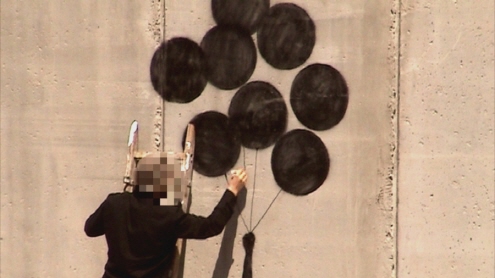 Guetta surely has innocent enthusiasm, but does he really know about art as an artist? I know every artist is influenced by other artists in the past, but, in my view, Guetta, or Mr. Brainwash if you want, is like an artificial intelligence who absorbs other artists’ styles and mixes them to create his, uh, artistic vision. Although he is sincere about what he does, you will probably agree to the opinion of his employees in the documentary that he is an idiot as an artist. The documentary does not show much of Guetta working on his works; he usually has his assistants to do the jobs, or, if necessary, he randomly paints his works with spray paints.
Meanwhile, his pet project is blown out of the proportion in the former CBS building. In another hilarious moment, he goes through the stage every artist struggles through while preparing his/her first exhibition. He becomes less sure about himself, and he still cannot make decisions for himself while the time is running out. Even when the people are waiting outside of the building on the opening day, he has not decided yet about how to arrange his works in the building – the assistants eventually decide to put them as they like.
“Exit Through the Gift Shop” is one of the funniest documentaries I have seen in recent years. Whether Guetta can be called an artist or not, Banksy makes a good point about the weird dynamics in the world of the art. Maybe all you need to succeed as an artist is good promotion rather than real talent. If the concoction is right, they will accept you as an artist and buy your works at expensive price; Guetta proves that with big, preposterous result which confounds everyone around him. At the epilogue of the documentary, Banksy said he will not help make a documentary about street art any more. No wonder.

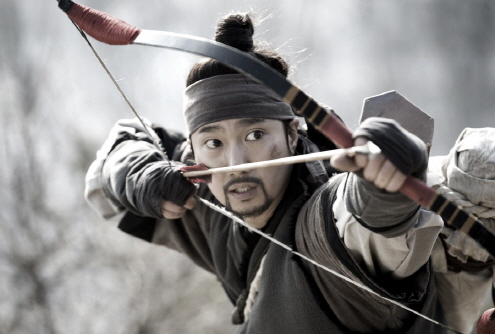
Shooting an arrow is not as simple as it looks. Anyone can shoot an arrow after the basic lesson, but hitting right in the target requires a lot more. Besides having a good bow, arrows, and skills, the archer also has to consider the external factors such as the direction of the wind while looking for the best timing to shoot an arrow.
I know nearly nothing about archery, but I can say South Korean action/period drama “War of the Arrows” shows us that the archery is as delicate as the marksmanship we frequently come across in modern action movies. While it may be not as powerful as the subtitle exaggerated, a bow and arrows can be strong weapon in the hands of the skilled professionals, and the movie draws lots of excitement from the relentless chases and accompanying constant battles of wits between two stubborn main characters. They are good matches to each other as the archers, and they are equally clever enough to be able to outwit each other, so it eventually boils down to the duel on the wide field between them. Imagine the duels in the western movies and substitute the gun with a bow and an arrow, and you will get the idea.
Its simple story is unfolded in Korea of the 17th century, the mid-period of the Chosun Dynasty. In 1623, Kwanghaegun was dethroned by the Injo revolt and immediately replaced by his cousin King Injo. Young Nam-i’s father, a military officer, was killed being labeled as a traitor, and, as ordered by his father before his death, Nam-i managed to escape with his younger sister at the last minute. They went to their father’s friend living outside the capital, who took a great risk by raising them as the part of his household while hiding their identities.
13 years have passed. Both Nam-i(Park Hae-il) and Ja-in(Moon Chae-won) are now grown-ups. Although still protected well, Nam-i has virtually no future except enjoying the hunt with his servants or polishing his archery skills, for it is impossible for him to enter the government due to his background. Meanwhile, Ja-in is happily going to marry Seo Goon(Kim Moo-yeol), the only son of their protector who has liked her since they were young, and Nam-i is happy for his sister.
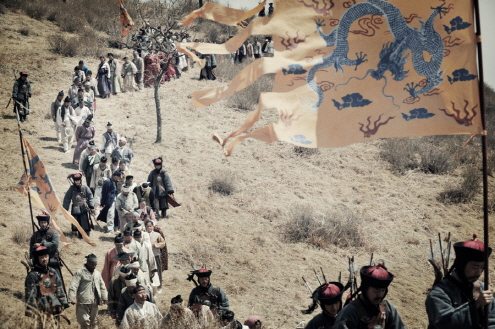 However, in the middle of their wedding, the vast army of Qing suddenly invades their town. Unlike King Kwanghae-gun, King Injo made an unwise diplomatic choice of disregarding the rising power of the Qing Dynasty which would soon replace the Ming Dynasty in China. He paid a hefty price for underestimating Qing; he had to personally surrender to the Emperor in legendary humiliation while many of his people were taken to Qing as the prisoners/hostages. Ja-in and her groom are among them, and it is Nam-i’s mission to rescue them from the Qing army and take them back to their country. He is willing to eliminate anyone standing on his way with his bow, but it won’t be easy. While he is mostly alone, there is the elite force led by the Qing general Jyu Sinta(Ryoo Seung-yong), who notices Nam-i’s uncanny talent right from their first encounter and recognizes him as a worthy opponent to him and his men.
The film relatively lags while establishing the characters and their situations during the first half, but, once everything is set and ready, it kicks into high gear to the full speed. You may find the use of shaky cam in period drama distracting, but it is right approach because it is necessary for the characters to move fast and think fast like Jason Bourne for their survival and win. While rarely losing the sense of the direction, the movie is filled with energy to tighten our attention to what is going on the screen. Being real is always important for this kind of action movies, and the director Kim Han-min and his crews do deserve the praise for their accomplishment. You can see the people in the movie are really running in the mountain forests, or, in one gripping scene, jumping over the cliff to reach to the other side across a ravine.
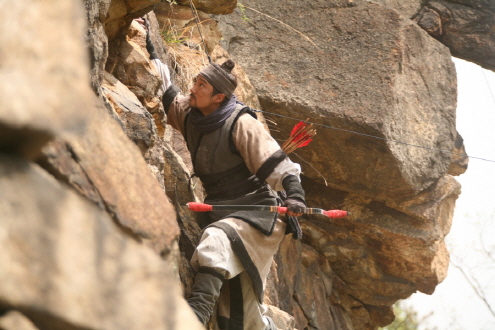 And I was very amused by how the arrows were used in the film. The arrows are more flexible than bullets, so some seemingly impossible trajectories are possible at least in the movie. While I believe the arrows on the screen are CGIs in many cases like the bullets in “Wanted”(2008), these arrows look real and destructive, and they are not shot mindlessly. The characters usually shoot their arrows based on quick calculations and their instincts – that makes the confrontations between them look like a deadly chess game between the expert snipers with rifles.
The characterization is broad, but the performers have strong presence to pull us into the plot. Although it is the national conflict at first, the story ultimately becomes the personal conflict between the characters determined to stop each other with their all hearts and brains, and we become involved in it. Park Hae-il is a believable action movie hero of the 17th century; you can sense he will even descend to the bottom of hell to save his sister and his friend. Moon Chae-won is also good as the bride who is as resourceful as her groom. In the action movies made in these days, the female characters no longer stand back from guys’ actions, and Ja-in does not disappoint us with her quiet but defiant attitude to her enemies.
 The villain is always one of the crucial factors determining the success of the action movies, and Ryoo Seung-yong, who was impressive as the leader of North Korean military unit in recent South Korean movie “The Front Line”(2011), gives a forceful performance with his penetrating eyes and steely will behind them. He and other non-Chinese actors are pretty much believable with their Manchurian dialogues at least in my view(Machurian has been almost a dead language since the Qing Dynasty engulfed China and then assimilated itself into the Han Chinese culture, so few will find faults in the movie). I find it interesting how the movie allows them to have some human sides. They are not vicious monsters, and they have an understandable reason for being a lot furious about Nam-i and others who meddle with their business. Though they are quite determined to kill our hero, you may feel a little sorry for them.
“War of the Arrows” has a good tool for its actions – and it has the story to use it for good dramatic effects. While it is not entirely satisfying in story level or technical level(for instance, there is a CGI creature which does not fit well with the realistic actions), but the movie is more entertaining than I expected, and I like its pulsating energy. Unlike bullets, the arrows can be recycled or adapted to the other bow, and, in one case, the character pulls the arrow from his wound and then uses it for his purpose – can you imagine that if they fight with guns?
Sidenote: As some South Korean critic pointed out, there is a major historical error in the movie with Qing prince Dorgon, who is depicted as the character more or less than a petty bad guy. Unlike his fictional counterpart, he lived longer and did lots of thing to solidify the Qing Dynasty as the regent prince. That does not spoil the entertainment, but I think it is not bad to know about such a historical fact before watching the movie.

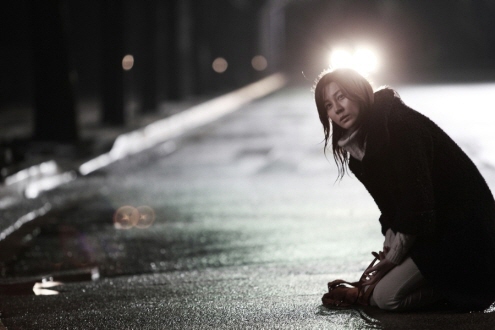 A blind woman is in danger. A psychotic killer wants to kill her. She finds herself being nearly alone with him in the house at dark, rainy night. She must do something to increase her chance of survival while being careful, or she will be killed by him within minutes. So, she must depend on her remaining senses more than ever for saving herself. As the first step, she cuts the electricity to get the lights turned off.
It sounds familiar, doesn’t it? “Blind”, a South Korean thriller movie released in South Korean theaters in this weekend, is apparently inspired by that famous shocker movie “Wait Until Dark”(1967), whose climax in the darkness is still one of the most scariest moments in the history of thriller movies. It is not wholly original in case of its climax sequence, but “Blind” has its own thrilling moments along with a good mystery plot and, above all, vulnerable but resourceful heroine who has to deal with her handicap while also depending herself from the murderous menace approaching to her.
Our young heroine Soo-ah(Kim Ha-neul) lost her sense of sight after the tragic accident in the opening sequence. She was a police academy student, and, several years later, she is trying to go back to her school for completing her education process, but she is blocked by the prejudices against the disabled prevalent in South Korean society. It is really hard for the people like Soo-ah to do the simple thing like crossing the street, and, for me, it is bitter to see her plight in one painful scene and admit that South Korean society is no country for the weak.
 At one night, after visiting the orphanage outside Seoul her mother manages, she waits at the bus station for the taxi she calls for. After waiting for a while, she is alone, and a car comes to her. She gets in the car, but there is something strange about the car and its driver, who offers to her a bottle of coffee kindly and then suspiciously. Furthermore, she smells disinfectant or something else in the seat.
Thanks to TV news briefly seen in an earlier scene(A lesson: in thriller movies, the bad news on media is usually the prelude for something bad which is about to happen), we can easily guess who the driver is. He is a serial kidnapper/killer the police are looking for, and now he preys on Soo-ah. However, occupied on trying to make Soo-ah drink the coffee, he accidentally hits a woman crossing the road. He tries to fool Soo-ah by saying he hit an animal, but she cannot be fooled due to what she hears and feels. Eventually, Soo-ah is left behind on the road while being unconscious, and the killer rides away with his new victim in the trunk.
Because she is only witness to ‘see’ what happened at that night, the detective Cho(Cho Hee-bong) was at a loss about how to deal with Soo-ah at first. However, he begins to be marveled by her for not only giving almost every detail about the incident and its surrounding situation except visual information but also for intelligently gathering the clues from her memory. The story becomes more interesting when another witness, a young delivery boy, testifies that the car was not a taxi but an imported car. Soo-ah firmly believes it was a taxi and he was lying for the reward. We cannot easily trust him either, but it turns out the killer also preys on him as well as her. It seems he really saw something important even if he really lies.
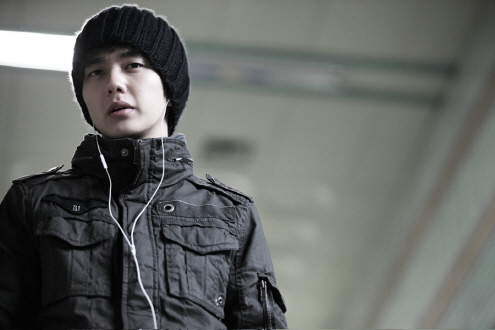 Though it reveals the killer’s identity quite early in the story, the movie does a good job as a tight thriller. In one thrilling sequence, Soo-ah has to depend on the help from the other character through her cell phone which can do as much as your average cell phone. The movie slowly builds the tension and then explodes with desperate urgency. After clearly realizing her peril, Soo-ah must run for her life with her beloved guide dog from the killer’s scalpel alone in the bright corridors of subway station. Because of her disadvantage, she really has to be both careful and quick, and the movie generates considerable suspense from her desperate situation, especially when she happens to lose the direction while the killer is running toward her.
It helps that the movie has a plucky heroine we can identify with and care about. Kim Ha-neul does a nice job as the woman whose everyday is struggle and adjustment. Visually showing us how she “sees” the world surrounding her based on her remaining senses is one of its nice touches; we can feel more empathy toward her rather than pity. And she is a clever girl. Though she is not always correct with the clues given to her, Soo-ah has the right stuff as a good detective, and that is what Detective Cho admires and respects. Even when facing the fatal situation, she does not lose her sense; she knows what she has to do first and she does exactly what should be done in most cases.
 The supporting actors surrounding Kim Ha-neul are less than perfect, but let’s say they are as good as they can. The best supporting performance in the film comes from Soo-ah’s guide dog, which holds its place among the human actors. I know that it is not from acting but from training, but I found myself deeply caring about her loyal, dutiful companion. Yoo Seung-ho, whom I jockingly called South Korean version of Robert Pattinson, gives a strained performance as a cocky rebellious lad, but the mellow chemistry between his character and Soo-ah, who sees her lost younger brother in him, is not bad to watch. As a comic relief, Jo Hee-bong is likable as the clumsy detective who happens to get the major case of lifetime, and Yang Yeong-jo is menacing as a twisted man who harbors his sadistic side in his basement. South Korean thrillers usually takes a cutthroat approach to depict the violence on the screen, but “Blind” chooses a rather restrained way, and you will probably get more comfortable watching experience than “Oldboy” or “The Chaser”.
I have to point out that there are some contrivances and flaws in the story. I do not think it is a wise move to bring the prime witnesses to the remote place with only one detective on surveillance, who reminds me that there must be some special department for such detectives in thriller movies, who are usually expendable in the thrillers about mad killer. The movie is frequently on the verge of being a little too melodramatic sometimes even at the most urgent moment, and, as usual, the killer seems invincible no matter how much he was injured, along with that famous “jack-in-the-box” cliché.
However, the characters in “Blind” usually follow the common sense and their sufficient intelligence, and that is the main reason why the movie works as a good thriller. After enjoying its gripping moments on last Wednesday night, I and the audiences walked out of the screening room after the credit rolled, and then, suddenly, the lights were turned off and we were surrounded by the darkness except few lights. It was not so surprising for we knew it was the last screening of that day, but I have to say, for us, it was quite a memorable way to end the day with this movie.