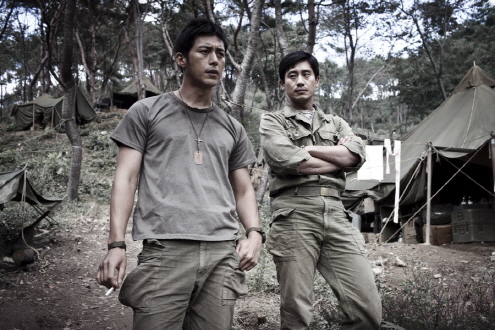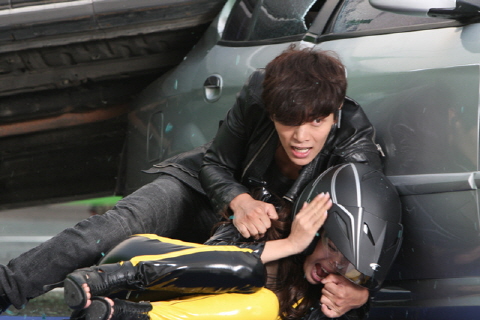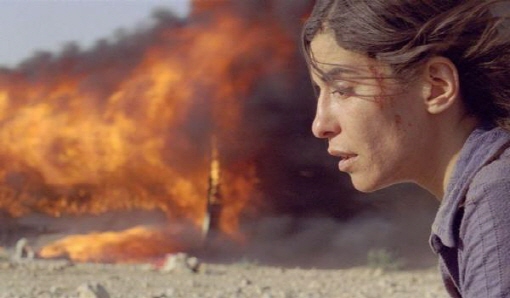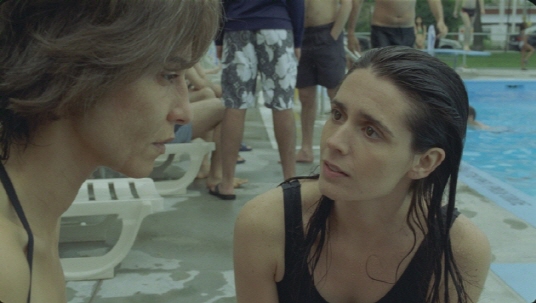
Sector 7 (2011) ☆1/2(1.5/4) : Aren’t they too tasteless for its dinner?

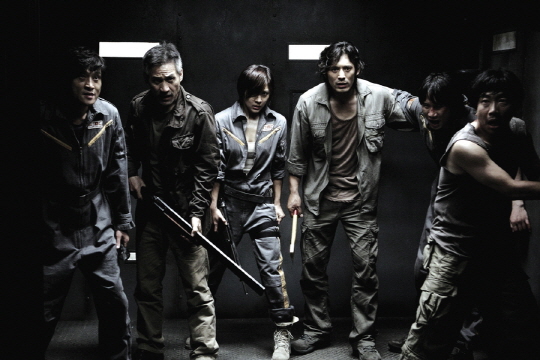
As a movie about some sea monster driven to kill everyone for a heavy dinner in its stuffy playground, “Sector 7” does not break any new ground. Heck, it does not even know where the old grounds to drill are. The filmmakers do not seem to have any idea about why other exemplary ‘monster in a closed space’ movies work. They fail to build the ground for the story, the characters, and, above all, the monster they promised us to present. They do not even know how to thrill us even at its so-called climax. I can accept that time-honored cliché named “self-destruction device”(why does an oil rig need such a device?), but the movie is far less conscious of that device than me. There is no urgency on the screen while the clock is supposed to be ticking somewhere, and all we get are those bland actions with CGI monster rampaging around the ship to kill the heroine.

The filmmakers do not have any interest in its subject at all, as shown by one idiotic scene. One character, a scientist, explains about the new organism they have recently discovered from the deep sea below them. She says to others that these tiny organisms are from chemotrophic ecology existing in that dark, cold space, but all she does to explain the term ‘chemotrophic ecology’ is unbelievably simple. Draw a circle above the line – that’s phototrophic ecology; draw a circle below the line – that’s chemotrophic ecology; that’s all, folks – that’s the end of the lecture, Ha-ha.

What the hell, this could have not been a serious matter at all. As a biology major, I have frequently found the science in the monster movies preposterous, but I accepted their outrageous premises with amusement if they were entertaining. Although I made much fun of its science during the conversation with my colleagues after watching “Leviathan”(1989), another sea monster movie, it believes in its premise and, at least in my view, the movie has enough things to enjoy with sufficient thrills.

However, “Sector 7” has little explanation for its creature, let alone curiosity toward it. Come one, if the movie has a creature whose body fluid is so combustible that it will probably solve the energy problem in the future, shouldn’t it care about explaining its origin or its nature in a way at least plausible during the running time? Or, shouldn’t it be curious about how that tiny organism grows(or evolves) into something big, hideous, and slimy with tentacles in a short period? Or, shouldn’t it be interested in what it is really doing in its sticky private place?

Let’s talk about its bare-bone plot. Before the creature appears, we are introduced to the characters working at the oil flatform named Eclipse, situated at the Sector 7 in the middle of the sea south of Jeju-do. Despite so many trials, there has not been much success, so, as the company orders, the remaining crews will leave Eclipse soon, which is usually a bad sign for the characters in the monster movies. Hae-joon, played by Ha Ji-won with one-note sharp look, is so determined to find the oil that she cannot accept that, so, when Jeong-man(Ahn Seong-gi), a friend of her deceased father, arrives at Eclipse, she asks him to extend her and other’s stay. After starting their work again, they find the oil in few days, but they also become the main targets for the monster from the below.

The screenplay, written by Yoon Je-Kyoon, the director of the disaster movie “Heaundea”(2009), is pretty much horrible to begin with. Devoid of any characterization, the characters are mostly unlikable cardboards. They mainly exist for two things – 1) doing silly(and sometimes offensive) things for lousy gags in the first part, and 2) getting killed and (possibly) devoured by the monster in the second part. We do not care at all about whether they will die or not, and, actually, I was a little sorry for the monster having such bland, brainless, and tastless human beings as the main course. But every animal has to eat anything edible in its sight(or hearing range, perhaps – I am not sure whether it has eyes or not) when it is the matter of the hunger, isn’t it?

The dialogues, usually for filling the blank pages in the script, are stiff or awful, and you can see some talented actors struggling in the predicament they do not deserve. Even Ahn Seong-gi, one of the most respected and reliable actors in South Korea, looks like being at a loss while mindlessly wielded around with others. Though it is not entirely her faults, Ha Ji-won gives one of the worst performances of this year. I heard she did her stunts for herself, but I want to point out that the action heroine cannot be solely based on posing like a tough guy. There is almost nothing interesting about her character to draw us to the story. She always, raising her voice, emphasizes that they will find the oil no matter what happens, but, come on, as a professional technician, isn’t she supposed to have any clear plan for her ambitious goal?

At least, when the monster appears, the things get better – a little. I can say CGI was nice, but, to me, the monster pretty much looks like an overgrown tumor with tentacles and legs and teeth. It is as clever as run-of-the-mill CGI creatures; it moves fast, it hides fast, and it jumps fast. No wonder it looks exhausted near the end. In addition, the movie uses every cliché we have encountered in countless monster movies(“Aliens”! “Jaws”! “Deep Rising”! “Leviathan”!) while disappointing us a lot. Thanks to its transparent scene composition, we know every time when the creature suddenly appears before it reveals glorious ugliness to its victims. And you can see when the certain character will die within minutes, if you are a seasoned audience. The characters frequently make unwise choices of being alone, or walking along the dark, narrow corridors where they get lost; seriously, have they really worked for a long time at this place?

Along with the rampage of the creature, there are lots of bangs and crashes during the last 30 minutes, but the actions scenes as well as their backgrounds are as uncharacteristic as the characters. As a matter of fact, they are so unreal that you can see that the actors doing their jobs in front of the green screen. I bet the footage showing them working is more interesting than what I saw on the screen.

The director Kim Ji-hoon’s previous work was “May 18″(2007), which is about Kwang-ju Democratization Movement during the 1980s. It had lots of potentials, but, with cheap gags, unnecessary comic characters, and heavy-handed melodrama, it failed in presenting absorbing characters and story to us. Quite disappointed by its mediocre treatment of one of the tragic chapters in South Korean modern history, I joked that he made a disaster movie instead of a history drama. And then, two years later, what do you know, Yoon Je-kyoon made his aforementioned disaster movie in a pretty much same way. I do not think their approach works; I find it annoying and distracting. I am not against the humor mixed with serious drama, but their humors are mostly crude and infantile, and they do not fit well with the story they are supposed to tell.

But they earned a lot of money with their respective movies, and they probably believed they could make another big hit as long as they stuck to their guns no matter how lousy their story was without any improvement, so now here comes their disastrously collaborative work filled with unsincereness quite insulting to our intelligence. It is only one year after that horrible disaster at the Gulf of Mexico, and we all know it is important to focus on the alternative energy sources, but, as the final insult to its lousiness, this tepid monster movie sanctimoniously cries to the audiences in the end in the spirit of “Drill, Baby, Drill!”.

Oh, by the way, I heard the director frankly said at the press screening that he was not interested in monster movies. Excuse me, Sir, then why the hell were you at the movie set from the beginning, besides for getting a big fat profit?

Sidenotes:

1. The movie was shot in 3D. I watched it in 2D, but, as usual, there is nothing problematic with 2D. Besides, according to my acquaintance, 3D is totally unnecessary; this is another sorry case of wasting money on a pointless gimmick.

2. The running time was originally 112 minutes, but, after the bad responses from the screenings, it was shortened to 105 minutes. How sweet of you, but, folks, it could have been shorter for relieving our depression.

3. And there is already a much better monster movie from South Korea – Bong Joon-ho’s “The Host”(2006).

Posted in Movies | Tagged , , , | 2 Comments

Cats in KAIST (07/31/11)

 It was Sunday evening, and they came out of the bush and begged for food. Unfortunately, I did not have any food to give them.
Posted in Photos | Tagged , | 1 Comment

Matinee (1993) ☆☆☆(3/4) : A premiere to remember

When I went to Jeonju International Film Festival in this April, I was reminded again that the old theaters at the downtown of my hometown were gone. Most of them are now replaced by a bunch of multiplex theaters, but I cannot say they were better than their replacements. While there were the big theaters where I could enjoy the movies like “Independence Day” or “Starship Troopers”, I remember too well how shabby several theaters were in early 1990s compared to the current standard; I am quite happy with the comfortable seat, nice bathrooms, and agreeable viewing condition in multiplex theaters.

None the less, these theaters have a place in my memory. Thanks to my frugal mother, I and my little brother learned that it was much cheaper to bring snacks rather than buy them at the theaters, but some snacks like dried squid were irresistible to us. When I watched “Face-Off” with my father, I learned that the movies rated ’18’ were not always forbidden to teenagers like me. I laughed frequently while watching “Bean”, and then, when the end credit rolled, I was embarrassed to find the neighbor family near my seat. So far, my brother has never ridiculed me for being asleep during the showing of “Entrapment” in spite of Catherine Zeta-Jones.

In case of young characters in Joe Dante’s cheery comedy “Matinee”(1993), they get the experience to be cherished for the rest of their lives at their town theater while the people on the earth as well as them are facing the dour possibility for the end of the civilization. It is November 1962, and Cuban Missile Crisis has just officially begun with the special announcement from President Kennedy on TV. Their town, Key West, Florida, is close to Cuba, and the tension is more palpable to the town people. The part of comedy in the film comes from how silly and hysterical people were at that time, but the world was quite close to the end at that time, and the situation was really serious to them. In case of Gene(Simon Fenton), one of the boys we meet at the beginning, his father is a navy officer on board in one of the ships in the blockade.

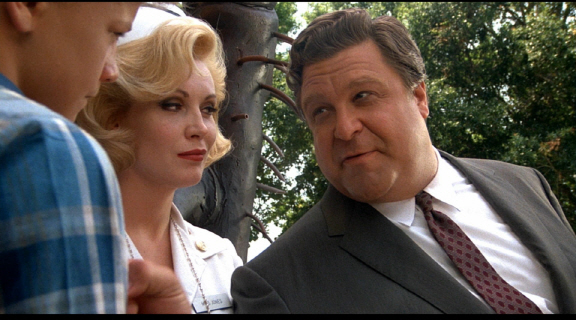
To an exploitation filmmaker Lawrence Woolsey(John Goodman), this situation is too perfect to miss for the promotion of his latest horror movie which, like many monster B-movies made during that time, exploits on the fear about atomic bombs and World War III. After arriving at the town with his girlfriend/leading actress(Cathy Moriarty), he does everything he can do to draw the people to the premiere showing on Saturday, including sparking fake controversy to draw their attentions(Here is a good lesson for some people: protesting against movies is akin to giving them free publicity).

Woolsey’s visit to town is fantastic news to Gene. As shown in his bedroom he shared with his little brother, he loves monster movies – especially the ones made by Woolsey. Gene approaches to him when Woolsey persuades people to watch his movie in front of the theater. They soon become close, and Woolsey generously shows his young fan how his plan will work at the theater. In one nice small scene featuring a simple animation based on their mutual imagination, Woolsey sincerely explains to Gene about his job. He makes cheap movies, but he knows what good horror movies are – the ones that scare the audiences a lot while entertaining them and then relieve them when the lights are turned on.

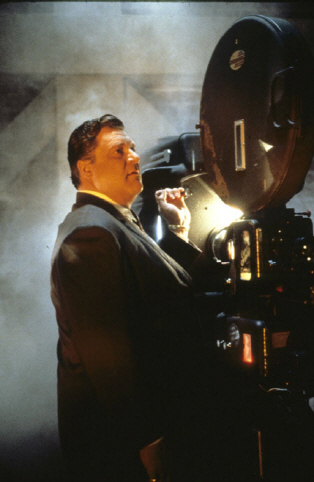
With his pleasant performance, John Goodman presents us an avuncular dreamer with ever-present optimism and jolliness. He is a movie business man belonging to the lower strata of Hollywood, but he tries to sell his films with imagination and passion. Plus, he is a good salesman with skillful showmanship; he will eventually talk you into watching his movies even if you know his movies are more or less than average B-movies.

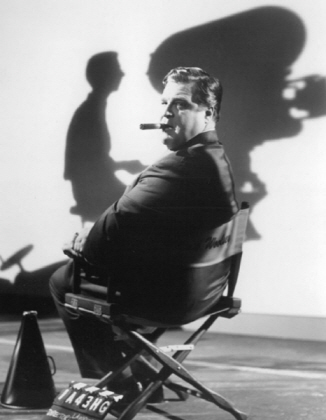
As widely known, Goodman’s character is mainly based on the legendary B-movie producer/director William Castle. Like his fictional counterpart in the film, Castle did try to promote his films by any means necessary. For instance, a glowing skeleton was floated over the audiences in case of “House on Hunted Hill”(1959), and the seats were equipped with the buzzers to induce the audiences to scream in case of “The Tingler”(1959). When “Macabre”(1958) was shown at the theaters, the life insurance policy was given to the audiences in case they should die of fright during the film; he even had nurses stationed at the lobby and hearse parked outside the theater. When I talked briefly about Castle to an undergraduate student a few days ago, he asked me, with disbelief, whether he really did such things like those.

I do not think his tactics, as gimmicky as 3-D, enhanced his movies much(I personally think the best thing he did in his career was letting Roman Polanski direct “Rosemary’s Baby”(1968) instead of directing it for himself), but he certainly gave something to be remembered with smile, and that is endearingly reflected in Dante’s film. Before the premiere showing, Woolsey’s girlfriend, wearing nurse uniform, demands the audiences to sign the medical consent form in case they die while watching the movie, the electronic buzzers are wired to the seats for giving a jolt to the audiences, the smoke is fumed from time to time in front of the screen, the theater gets trembled thanks to “Rumble-Rama”, and a guy hired by Woolsey wearing a big rubber suit(guess what does it look like?) walks around the aisle to ‘scare’ the audiences.

While it is hilarious to watch the audience reacting to these outrageous tactics, there is more fun during the premiere sequence while things get complicated inside the theater. Gene’s friend Stan(Omri Katz) recently begins the relationship with a schoolgirl he likes, but he is soon threatened by her ex-boyfriend who has just gotten out of a reform school. Stan lies to her that he does not have time to meet her on Saturday, but, unfortunately, when he goes to the theater with his friends, he soon comes across her. Furthermore, a guy hired by Woolsey is none other than her ex-boyfriend – you can see a big trouble coming to Stan.

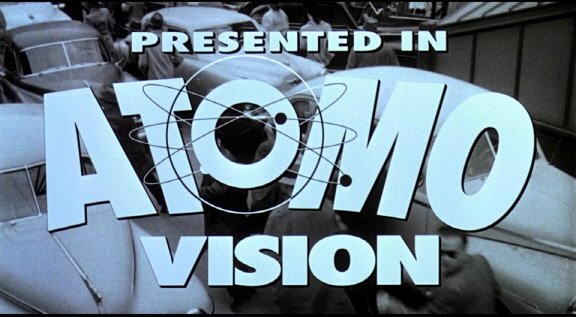
Woolsey’s movie, “Mant”, adds extra hilarity to this uproarious situation. Like many awful B-horror movies from that era, it is fun to watch it due to its utmost serious attitude to a ridiculous story(“Young lady, human-insect mutation is far from an exact science.”). People in these movies are horrified at the sight of the huge monsters, and the audiences were probably scared at that time, but they now look as menacing as teletubbies to us. I sometimes watch the trailers for these movies posted on YouTube, and they have never failed to tickle me yet.

As the mix between “The Fly”(1958) and “Them!”(1954), “Mant” is made with lots of care as the homage to that era. The several music cues from the B-horror movies made during the 1950s including “It Came from Outer Space”(1953) and “Tarantula”(1955) were used for authenticity. Some of actors in “Mant” actually appeared in the science-fiction movies during that era, and Cathy Moriarty’s character, Ruth Corday, is the tribute to the B horror-movie actress Mara Corday. And there are also goofy dialogues to amuse us(My favourite line: “What in creation do you call that thing?” – “Bill.”).

 The story must have come close to the director Joe Dante, whose career started with low-budget movies. After working as an editor for Roger Corman, he debuted as a director with “Pirahna”(1978), a goofy horror movie which was a cheerful parody of “Jaws”(it was followed by the horrible sequel which was incidentally the first movie directed by James Cameron, who also worked under Corman). He was later recruited by Steven Spielberg to direct “Gremlins”(1984), which is still his biggest commercial success, but his sensibility grounded on B-movies seemed not to get along well with Hollywood. Though he made some enjoyable movies including “Innerspace”(1987), his career descended along with several commercial failures including “Gremlins 2″(1990), the wackiest and the most anarchic film made by Amblin Entertainment.

 Filled with his affection to B-horror movies and likable characters, “Matinee” is the sunniest work in Dante’s career. Like the audiences beholding the star celebrity, young characters in the movie are naturally less flashy than Woolsey, but they are engaging as the part of the world depicted with nostalgia. As the girlfriend with weary no-nonsense attitude, Cathy Moriarty nicely complements Goodman’s buoyant character. She is usually sarcastic about his business, and she grudgingly does what he tells her to do, but it turns out their relationship is solider than we think at first. She will always remind him the reality while standing by her man.

 In the end, as we know, the crisis is over, and the people are relieved to see another day of their lives, and Woolsey moves to his next attraction to come with lots of hope as usual. However, as the last shot of the film implies to us, the most turbulent part of the American history will soon begin – and their world will never be the same as a consequence.

 “Matinee” is a charming movie with sweet nostalgia. Though it is about an era very distant to me, it is lovable enough to make me to reminiscence my relatively less innocent experience with the horror movies during my childhood years. Like Gene was fascinated with monster movies, I was drawn to those old VHS tapes at the corners of the rental shops. There were freakish monster movies, disgusting zombie movies, spooky occult movies, and, above all, dead teenagers movies. I watched some of them; they were mostly not as good as I imagined from their VHS cover designs, which are, anyway, the loving part of my childhood memory. To be frank with you, I was a lot interested in “Friday the 13th” series movies and memorized the synopses printed on VHS covers, but, boy, how much I was disappointed with them when I finally watched two of them on TV. I was not entertained at all – and I could not understand why some big guy wearing a hockey mask(or bag) tried to kill the boys and girls older than me when they seemed to have a good time at the camp.

At least, we all can agree that my childhood was more innocent compared to the age of “Saw” and “Hostel”, can’t we?

Posted in Movies | Tagged , , , , , | 1 Comment

The Front Line (2011) ☆☆☆(3/4) : Waiting for the truce

  There is always the lagging phase in wars unless they end quickly. The soldiers on the both sides are tired and exhausted day by day. They doubt whether they can eventually survive or not. And it seems their hardship will last forever. Even so, when the fateful moment comes to them again, they have no choice; they do what their survival instinct drives them to do, and there are another scar and pain to be stored in their hurt lockers.

South Korean war movie “The Front Line” presents us the last chapter of Korean war, which was less dramatic than its major events but was far more frustrating to the people on the battlefield. When North Korea invaded on the 25th of June in 1950, North Koreans were confident that they would win within a month. However, the situation was soon reversed when the allied force of South Korea, US, and UN pushed the North Korean army to near North Korea-China border. And then China participated in the war in January 1951, so the allied force retreated to the south, and then they counterattacked again to push North Korea and China to the north. Soon, both sides arrived at stalemate with the front line that divided the country half as before the war.

That situation lasted for nearly two years until they finally signed a truce agreement in July 1953. While the top brasses were negotiating for a truce in Panmunjum, ironically, the soldiers on the front line kept fighting to defend or recapture the areas as if they were in endless extension game. In one amusing montage in the film, North Korean soldiers take over a hill on one day, and then they are chased away by South Korean soldiers on the other day, and then North Koreans take it over again. That has happened so many times that one character cynically says he even cannot remember how many times they took over the hill, which is becoming more like a mass mound.

Its name is Aerok hill, and the Alligator Company of South Korean army has fought with the opponent over that hill at all cost. Recently, the company commander dies in a rather suspicious circumstance(he was shot by a gun from his company – don’t ask me how they came to know that in that busy situation), and Eun-pyo(Sin Ha-gyoon), a lieutenant from the counter-intelligence department, is assigned to surreptitiously investigate this incident. Besides this suspicious death, somebody is sending the letters from North Korean soldiers to their family in South Korea, so his superior thinks there must be a spy(or spies) in the company.

Before arriving with the new company commander and a young private, Eun-pyo comes to know that his friend/comrade, Soo-hyeok(Ko Soo), who was taken by North Koreans when they fought together at the start of the war, is alive well in the company. While it is never explained well about what Soo-hyeok had to go through to return to his army, Ko Soo ably suggests the transformation process inflicted on his character with the intense performance.

While not so surprised to see that his friend is changed, Eun-pyo senses there is something awkward about the soldiers of the Alligator Company. The company is led by Il-young(Lee Je-hoon), a boyish captain who is an experienced soldier but is far younger than the soldiers under his command. It can be said that the real leader is Soo-hyeok, but he and others really respect Il-young’s commanding position and there are apparent comradeship among them. None the less, there exist the things they do not want to openly talk about in the air – is it possible that their secrets are connected to the death of their former commander?

But, even before the half of the running time is passed, we come to realize is that question is sort of MacGuffin to pull us to something deeper than ‘murder mystery’. There are indeed secrets, but they are revealed earlier than we expected, and they give us the insights on the extraordinary human conditions caused by war. The soldiers on both sides fight like hell when they have to, but, while conflicting with each other for a long time, they form the strange, complex relationship only possible in war. Even after so much violence between them, there is enough humanity left in them to show some mercy to each other indirectly they can afford – while never forgetting their duty.

The screenplay is written by Park Sang-yeon, who wrote the novel “DMZ”, which Park Chan-wook’s “Joint Security Area”(2000) was based on. It is also about an unlikely relationship between South and North Koreans soldiers in Panmunjom, and, in that case, the story is milder and more sentimental – probably because, despite everything that has happened during last 60 years, North and South Korea have learned a contradictory way of getting along with each other while still conflicting with each other. Lately, we have another headache due to North Korea, but, again, after the tension was considerably increased, the situation is getting less tight now.

The director Jang Hoon successfully makes a solid war movie. The battlefield scenes are dirty, bloody, chaotic, exhausting, and dynamic while holding our attentions on the ground. At first, with quick cuts and handheld camera, the movie gives the typically disorienting atmosphere of battlefield we have been accustomed to since “Saving Private Ryan“(1998), and then it begins to look at the battle scenes with smooth, steady camera move with the confident direction as if we ourselves were getting used to what’s happening around the characters. Jang Hoon does not lose human dimensions amidst lots of explosions; reminiscent of that famous battlefield sequence in “Path of Glory”(1957), every step forward is really hard for the soldiers shown on the screen.

The people in the film are the standard stock characters we have met countless times before in war movies, but Jang Hoon has the wonderful cast to make these clichés, as a group, the life force of the story. The murder mystery gets less important as the plot progresses – their daily struggles are more compelling element to drive the plot.

As the lead performers, Sin Ha-gyoon and Ko Soo admirably carry the film while complementing each other. The best thing they do in their movie is that they allow lots of space for the superb supporting ensemble. While we have such reliable veterans like Ryoo Seung-Soo, Ko Chang-seok, and Ryoo Seung-young, it is also terrific to watch young actors like Lee Je-hoon or Kim Da-wit(He was Yun Jung-hee’s reckless grandson in Lee Chang-dong’s “Poetry”(2010)) hold their place among their seniors. When these actors and others are together as the company soldiers, the bond between them is palpable – you instantly accept them as the band of brothers right from the beginning.

All are uniformly good. Lee Je-hoon, who was memorable as one of the teenager characters in “Bleak Night”(2010) in this year, gives the best performance as the young captain who rigidly hides the memory of an impossible situation in his past. What he chose to do was quite horrible as shown in the flashback sequence, but who can blame him? The survival is always more important than anything else in war, and he did what should be done for saving him and others – but not all of them. Ko Chang-seok, who appeared in two previous works by Jane Hoon, steals the show again with his likability as an old-timer who has accepted war as the part of his life for quite a long time. Ryoo Seung-young and other performers accompanying him bring the human side to their North Korean characters, and Kim Ok-bin, who plays only crucial female character in the story, also gives a short but impressive supporting performance.

With so many good things in its bag, “The Front Line” could have been one of the best South Korean movies of this year, but it is unfortunately marred by its third act which is too long and unnecessarily preaches to the choir. Though 1) it is not a fatal flaw, 2) the movie does not entirely lose its grip on us, and 3) it has a point about how horrifically and absurdly meaningless it was to push the soldiers to the certain death only for pushing the military demarcation forward a little more even when war will officially end within less than 24 hours, I cannot deny that the movie lags significantly compared to its first 1.5 hour at this point.

I agree with several South Korean critics that it could have been a lot better if its lagging third act had been trimmed a bit. However, the movie is still powerful enough to be recommended; I give it 3 stars due to my trivial reservation at this point, but it may be the best Korean War movie among the ones we’ve seen in the last decade. War is surely hell or hellish purgatory, and here is a good war movie which really shows that universal truth without ostentation from the painful chapter of South Korean modern history.

Posted in Movies | Tagged , , | 2 Comments

Quick (2011) ☆☆(2/4) : Slow delivery of bombs, actions, and cheap gags

The most interesting part of “Quick”, the latest South Korean action movie, is the behind-the-scene footage shown to us at the end credit. I understood they tried to make good action scenes, I saw how much the stunt men and the other crew members did their jobs, and I learned that a stunt guy was actually injured during the production. At the end of the footage, others visit him while he is recuperating at the hospital, and, in front of the camera, all of them hope that their movie will turn out to be good.

It could be a nice footnote to their work if the movie was as good as, or half as good as, they hoped so, for the end product is surprisingly tepid with little tension despite its thrilling premise. I can accept for a moment that familiar premise which will invite lots of loopholes in the story, but the movie does not seem to care about how to handle it to engage us. Its disjointed narrative drags as the time goes by with shallow characterization and blatant cheap gags, and these unlikable caricatures shout to each other in the movie so frequently that I suspected someone mistook for shouting as the character development – or am I out of touch with the new trend?

6 years after the big traffic accident in the opening scene, Gi-soo, a former leader of motorcycle gang, is now working as a delivery man who rides his motorcycle as fast as before to deliver the packages in a short time. One day, he delivers the small package to an office, and, right after he comes out of the building, the bomb blows up the office to shock him and others on the street outside. Even after such a shocking incident, he seems not so affected by it much – he immediately goes back to his work while ready for the next job. Does he have any idea about what he has possibly done?

Don’t worry – he soon realizes what situation he gets himself into. His next job is taking a female singer of some popular singer group, which turns out be his ex-girlfriend. As soon as Ah-rom(Kang Ye-woo) puts on his helmet for the safety, they find themselves trapped in the plot of some unseen villain, who installs the bomb in his helmet. If she takes off, the bomb will explode. If they try to get help from the others including the police, the bomb will explode. If they are separated from each other more than 10 meters, the bomb will explode. If they fail to do the each of the delivery jobs demanded from the other side of the phone within 30 minutes, the bomb will explode. Oh, by the way, did I tell you about the timer conveniently installed on the visor of helmet to notify the remaining time to them and us?

In such setting, speeding against the time comes with the territory. They speed along the streets and alleys of Seoul to deliver the packages in time while avoiding the subsequent explosions and the police chasing them. There is a cop(played by Ko Chang-seok), and there is a policeman(Kim In-kwon) who is a reformed motorcycle gang; he was Gi-soo’s rival and still carry a torch for Ah-rom. After learning that Gi-soo is somehow connected with the series of bombings that shake the citizens of Seoul, both are determined to arrest them(and both were near the accident in the opening sequence, by the way).

The movie has several action sequences, but the outcome is sort of mixed bag. In some scenes, it more or less spins its wheel without the effects intended. For instance, when Gi-soo and Ah-rom are chased by others along the narrow alleys of Myoung-dong area, the scene is devoid of any clear sense of space or direction while decorated with lots of crashes that keep happening around them. On the other hand, there is a good scene when all of them face a sudden accident on the highway with the propane gas tanks tumbling toward them.

I did not feel them as something real that really happened to them. While watching that footage at the end credit, I was quite surprised to learn that one particular scene involved with one of the bomb explosions was actually shot with the real actors running from the explosion. But, on the screen, with cheap special effects, I did not believe much that they were running from the real danger. They more looked like moving their bodies in front of the green screen.

And the movie loses its urgency frequently; this is like a kiss of death to this type of action thriller. At some point in the story, the plot gets stalled when Gi-soo and Ah-rom are ordered to go to some beach town for the reason I found hard to accept. This is supposed to be an action movie with rapid progression along with time limit – and they are allowed to have ‘romantic interlude’ to re-build their relationship just because the villain does not need them for a while?

By the way, even when they have some break, these characters do not try much to figure why the villain chooses them for the plot even though it is clear to us that their ordeal is sort of punishment to them for the misdemeanor they committed in the past. The mystery surrounding villain in the movie is revealed later unsatisfyingly, and it only reminds us that Gi-soo and Ah-rom really deserve the punishment. I have to point out that they don’t feel guilty about what they did at all even after the villain tells them his motif. This makes them more unlikeable than they initially were; they care more about their trivial personal matters than the enormous damages they caused to the public in the opening scene and the following action scenes. I sometimes wonder whether they are worse than the villain.

Along with them, the characters in the movie are puppets at the whim of the screenwriters who want to jerk out the emotions and laughs from us every time they can – or they can’t. What the performers do on the screen is simple: throughout the story, they a)shout or b) whine or c) become melodramatically hysterical(“I’m going to die!!” – with tears streaming on their faces) or 4) do several silly things for sake of comedy. It is possible to draw any kind of humor from the serious situations with urgency, but the movie is so self-conscious that, when it has to build the tension, it instead reminds us every 5 or 10 minutes that it is doing comedy along with action, and most of its attempts result in misfire or short laughs for a second.

If you know that Yoon Je-kyoon, the director of “Haeundea”(or “Tidal Wave”, 2009), is involved in the production of the movie, you will probably not be surprised by what you get. In fact, three actors from that movie also appear in the movie, and “Quick” tries to entertain us in a pretty much same way that disaster movie did. There is a borrowed formula(its finale reminds me of “Speed”(1994), a far more thrilling movie worthy of repeated viewing), there are cardboard characters, there are actions, there is cheap tear-jerking melodrama with silly comedy, and they are mixed incoherently together. Maybe you will like this kind of jumbled mix more than I do, but let’s admit this: it is not a good delivery service, let alone a quick one. You had better to call other better services like “Speed”.

Posted in Movies | Tagged , , , , | Leave a comment

Incendies (2010) ☆☆☆1/2(3.5/4) : She was a woman full of Han

“Incendies” has a familiar plot used in many mystery fictions. The odd instructions are delivered to the characters with no explanation. The journey begins eventually, and the mystery is peeled away step by step. While following their path, we begin to sense that there will be the unexpected answer at the end of journey.

With this storytelling device, the movie reveals the sad, painful personal past scorched by the civil conflict in some unidentified country in the Middle East. If you have watched the movies such as “Waltz with Bashir”(2008), it is easy for you to deduce that the country shown in the film is the fictionalized version of Lebanon, but that is not important because the senseless cycle of violence between conflicting people has always resulted in the same consequences; pain, sorrow, and hatred entangled together in the human hearts. The movie shows such emotional scars in a quiet but devastating way, and it also calmly presents the way of overcoming them to cut off the thread of hatred.

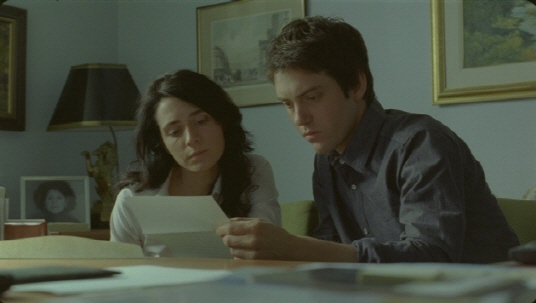
Shortly after the death of their mother Nawal(Lubna Azabal), twin brother and sister, Jeanne(Mélissa Désormeaux-Poulin) and Simon(Maxim Gaudettte), meet the notary Lebel(Rémy Girard), for whom Nawal has worked as his secretary for about 20 years. The request in her will surprises her children with her hidden past. Before dying in the hospital after suddenly fallen into some catatonic state, she left two letters. The one is for the twin’s father; Jeanne is instructed to find him and deliver it to him. The other one is for the twin’s hidden brother; Simon is instructed to do the same thing like her sister. Until their missions are accomplished, Nawal’s body will remain buried without coffin or tombstone.

Jeanne and Simon are confounded by this revelation. While living a new life with them in Canada for a long time, Nawal seldom mentioned about her past to them(the twins thought their father was dead during the war in their mother’s homeland). Angry and confused for this, Simon refuses the request. In contrast, although she has been distant from her mother for a while, Jeanne decides to go to her mother’s homeland to find their father after advised by her advisor professor in her graduate school not to ignore this matter.

The movie goes back and forth between Jeanne’s journey and Nawal’s long, hurtful journey. When she was young, Nawal fell in love with a Muslim guy, and she got pregnant by him. Her Christian family certainly did not approve of that; after their failed attempt to run away, her lover was shot by her brothers for the family’s honor, and she had to leave behind her baby right after she bore him. Before separated from him, she promised to him she would find him again.

However, several years later, when she studied in the university, the sectarian conflict between Christians and Muslims got more intensified, and her hometown became a war zone. None the less, Nawal was determined to find her son for keeping her promise. Though well aware of the dangers, she went back to her hometown, and that was the start of a long ordeal she had to struggle through – it was impossible for her to stay in the middle in this conflict.

There are several striking moments to depict the horrors of war in the film. The director Denis Villeneuve, whose screenplay based on the acclaimed play by Wajdi Mouawad, handles the brutality in his movie with restraint and conciseness, as shown in the gut-wrenching scene where Nawal is forced to save herself in a shameful way from sudden brutal mass killing by a militia group. In the opening sequence crucial in the story, Radiohead’s “You and Whose Army?” is effectively used in the soundtrack against what is shown on the screen, and this memorable moment is chillingly connected to the scene where the boys are attacked by a sniper not so older than them.

Villeneuve deftly moves the story between the past and present. Compared to the violent past, Nawal’s homeland at present is relatively peaceful, but there is still the conflict, and there are still the shadows of the past which people do not like to talk about. Nawal’s family members do not forget what she did even after so many years have passed. When Jeanne meets the former prison guard who knew her mother as prisoner, he is very reluctant to tell her what happened to her mother, while emphasizing that he has been a school janitor.

Later in the story, Simon finally joins her sister with Lebel. Their search is continued, and, in the end, there is the shocking truth waiting for them. Of course, I will not tell you what it is, but I have to say this; I already guessed what would be revealed based on some storytelling logics, but it was really devastating to see how the movie silently reveals that horrible secret to the characters with the emotionally shattering effect.

By the way, while watching the last scene, I wondered about the plausibility of the story because I was a little bothered by some small calculation based on the one tiny detail shown in that scene(Maybe I was wrong about that, but I cannot go into the details due to spoiler problems). In addition, the story relies on the coincidences a little too much. For instance, Jeanne and Simon’s journey could be aborted with the dead end by any chance. Come to think of it, it is very lucky that there are enough surviving people and documents to lead them to the arriving point. I know it would have been really hard for Nawal to tell the truth, but could she just leave one letter to her children for explaining everything?

Nevertheless, the story works well on the emotional level with the haunting performance by Lubna Azabal, who is convincing both as Young Nawal and Old Nawal. Mélissa Désormeaux-Poulin and Maxim Gaudettte are also good as the other half of the story, and Remy Girard gives an interesting performance as a kind, courteous man with the strong professional ethics he firmly sticks to.

I remember I was at a loss to explain the Korean word “Han” to my Far-flung correspondent friend Grace Wang during Ebertfest 2010. I checked Wikipeida later and discovered that it can be defined as “feeling of unresolved resentment against injustices suffered, a sense of helplessness because of the overwhelming odds against one, a feeling of acute pain in one’s guts and bowels, making the whole body writhe and squirm, and an obstinate urge to take revenge and to right the wrong—all these combined.” Nawal can be described as a woman full of this complex feeling. Her heart was burned by so many pains and sorrows in her past – and her fate was as cruel to her as the Greek tragedy.

Posted in Movies | Tagged , , , , , , , | 1 Comment

Harry Potter and the Deathly Hallows: Part 2 (2011) ☆☆☆1/2(3.5/4) : It ends well with a bang

Finally, after nearly 10 years, we arrive at the point where the story ends. With the stage for a big finale established in Part 1 in last winter, “Harry Potter and the Deathly Hallows: Part 2” does an excellent job as the climatic half of the finishing chapter of the series that has been entertaining us. Our expectation is fulfilled with lots of things including the final confrontation between its hero and his evil arch-nemesis. The movie shines with nice special effects and good performances. And it is time to say goodbye to Harry Potter and other memorable characters – and a very good fantasy series that has exceptionally kept its momentum over 8 films.

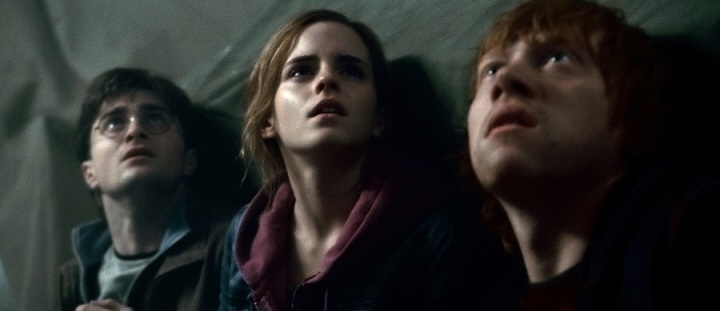
Part 2 starts with the last scene from the Part 1, so, to understand what is going on, you have to watch Part 1 before watching Part 2. In previous movie, Lord Voldemort(Ralph Fiennes), the powerful evil wizard, takes the control over Ministry of Magic after the death of Professor Dumbledore(Michael Gambon), the mentor of Harry Potter(Daniel Radcliffe) and his friends, Ron(Rupert Grint) and Hermione(Emma Watson). They cannot go to Hogwarts School this time, and, while avoiding Voldemort’s followers and accompanying dangers, they try to find and destroy Voldemort’s horcruxes, the fragments of his souls that makes him near immortal. Their situation becomes darker and more desperate while they try to defend themselves. Furthermore, Voldemort gets a very powerful weapon; with that, he can possibly do what he has yearned for a long time – killing Harry Potter.

Because the movie is entirely about how the series ends, explaining what happens in Part 2 may a spoiler to you, unless you have read all of J.K. Rowling’s books(I read them all, by the way). Let’s say Part 2 is basically the climax that relentlessly drives you for about 2 hours. Many things happen during less than two days on the screen; Harry and his friends have to go through another series of perilous adventures, the final conflict soon starts at Hogwarts School, everyone gets very busy, and the hidden secrets are revealed and explained to Harry and us.

We do not get lost in its rapid progress. The pacing is appropriate, and the urgency is seldom absent – even during the obligatory flashback/explanation scenes. The finale in the book is changed a little for more dramatic effect. Several elements of the book, including Dumbledore’s hidden past, are omitted or condensed in the adaptation process, but these changes do not hurt the story much. The screenplay writer Steve Kloves, who adapted all of Rowling’s books except the one, succeeds again in satisfying both Harry Potter fans and average moviegoers, and he deserves the praises for completing the hefty job of adapting Rowling’s books.

  The series went around several talented directors like Chris Columbus, Alfonso Cuarón, and Mike Newell, and then it has settled on the director  David Yates since “Harry Potter and the Order of the Phoenix”(2007). With the dependable cast and crews accustomed to the series, Yates makes the movie as competent as his previous works. Thanks to the cinematographer Eduardo Serra,  the dark atmosphere surrounding Hogwart School is impressive along with the first-rate production design. CGI is very good while functioning as the part of the story; it never overshadows the characters in the apocalyptic battlefield between the good and the evil.

As the series gets darker in the later entries, there have been casualties and damages. While the wonder of their world is now less enchanting and more familiar than before, we still care about them and their world, and we understand what they try to do at their great risk. While the Hogwarts becomes the last stand against Voldemort and his followers, lots of things are smashed and exploded around them. This is quite a tough growth process for these kids.

The three main performers, Radcliffe, Grint, and Watson, have also walked down a long, hard way since the beginning. Their presence in the movie reminded me how much they have been changed while we have watched them growing up on the screen. They were kids when we met them in the first Harry Potter movie. The start was a little awkward at first, but they have been comfortable with their respective roles for years, and they are now adults who will probably move on to the next step in their lifes after this series.

And they are surrounded by many wonderful British actors who consistently steal the show. Harry Potter series has been the encyclopedia of the talented British actors, and, regardless of whether the roles are big or small, they have a good time with their supporting roles. In this movie, we meet again Helena Bonham Carter, Jim Broadbent, Robbie Coltrane, Ralph Fiennes, John Hurt, Jason Isaacs, Michael Gambon, Gary Oldman, Alan Rickman, David Thewlis, Maggie Smith, Julie Walters, and many others. Not so surprisingly, the dark characters are the most amusing to watch. Carter has a brief but funny scene when Hermione has to disguise herself as Carter’s evil witch, and Fiennes is superbly menacing as Harry’s arch-nemesis; he relishes when his character threatens the students and teachers at the Hogwarts. As the professor Snape, one of the most interesting characters in Harry Potter series, Rickman has his moments with the personal secrets behind his cold demeanors which overwhelm the young students of Hogwarts School.

The notable flaw of the movie is that it is not wholly complete as a movie, but that is just a minor complaint about its inherent flaw when you look at the series as a whole. Like other movies in the series, this one works well as a part of the series – it does a solid finishing job. It is sort of amazing that they have maintained the production quality for a long time; all eight films are well-made and enjoyable, and none of them are particularly weak or bad. It ends well, and all is well.

I remember what the great filmmusic composer Bernard Herrmann said about his working experience with “Obsession”(1976): “After so many weeks those two characters – Cliff Robertson and Geneviève Bujold – were no longer celluloid fantasies but real people. It was like saying goodbye to two of my closest friends.” I felt the same while watching the last scene of Harry Potter series. Goodbye, Harry Potter, it has been entertaining to watch your and others’ adventure. And I sincerely hope they will not ruin this wonderful series for earning more money. Have they already earned enough, haven’t they?

Sidenote: I watched 2D version, so I cannot tell you about 3D. But I assure you, but I did not lose anything while watching 2D version. Plus, it is a dark film; you do not have to make it dimmer with the 3D glasses.

Posted in Movies | Tagged , , , | 1 Comment

Bound (1996) ☆☆☆1/2(3.5/4) : A steamy film noir with two lesbian partners in crime

Is it love at first sight? At least, it is lust at first sight between them in the beginning. Something clicks inside them when we see them together at first. They soon begin their secret affair, and then, motivated by their common desire to escape from the world they are stuck in, they hatch a scheme to solve their problems once for all. They have a good plan. They can succeed if they carefully tiptoe along the thin line they draw. However, in the world of film noir, it is usually easier said than done.

While looking back at how its story works flawlessly in the Wachowski brothers’ terrific crime thriller “Bound”(1996), I recall what the arsonist played by Mickey Rourke said to William Hurt’s character in “Body Heat”(1981): “Any time you try a decent crime, you got fifty ways you’re gonna fuck up. If you think of twenty-five of them, then you’re a genius.” Indeed, there are many possible ways for how the things can go wrong for the characters in the movie, and it binds us tightly to its elaborate plot along with the characters, while cunningly toying with these fatal possibilities till its finale. The result is one of the most enjoyable neo-noir movies made during the 1990s.

Before capturing our attention in its grip completely, it lures us first with the relationship relatively unorthodox compared to other criminally dangerous liaisons we have encountered. While its two characters are as passionate as other memorable couples in film noir movies, there is an obvious difference in them that gives the film a unique quality. This time, they are lesbians – and both of them are well-qualified as femme fatales.

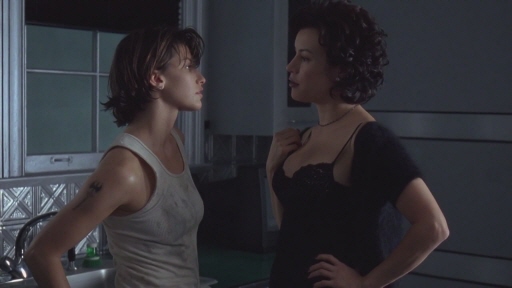
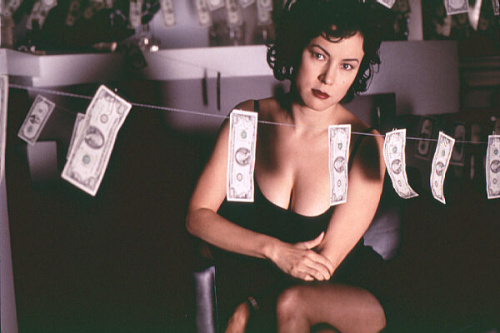
Some of our amusement with the movie comes from how it playfully utilizes the typical build-up process which has been mainly reserved for the heterosexual affairs. When they happen to be together in the elevator of the apartment building, Violet(Jennifer Tilly), taking off her sunglasses, sets her eyes on Corky(Gina Gershon), who recognizes her attention. Corky is an ex-con who has recently been released from the prison. She tries to adjust to a new way of life while doing the repair jobs including plumbing and painting at the apartment next to the one where Violet and her boyfriend Caeser(Joe Pantoliano) live. The wall between apartments is thin, and Corky sometime hears the sounds from the other side.

Exemplarily following the footsteps of her senior femme fatales in the film noir history, Violet makes her first move. The first encounter is accompanied with two cups of coffee from her(“I guessed you were straight black.”). The second encounter is due to a small plumbing problem with her earring ‘accidentally’ fallen into the sinkhole. Corky comes to Violet’s apartment; she fixes the problem in a short time. Violet offers a bottle of beer to her; she says she likes one of Corky’s tattoos. She asks Corky whether she wants to see her tattoos. You can guess what will happen next if you have some experience with adult materials.

The movie delivers what it promised to us while handling its sensational subject in a tasteful approach. For the realistic depiction of the lesbian relationship in their movie, the Wachowski brothers recruited a sex educator Susie Bright as their consultant, who briefly appears in the lesbian bar scene. With the shady atmosphere provided by the cinematographer Bill Pope, the sex scenes are presented to us as something hot, wet, steamy and naked – with, above all, a bit of mystery to tantalize us. The love scenes in movies are usually more interesting they are not naked, but this case is a good exception in which the main play can be as interesting as the foreplay, if not more interesting than that.

  But sex is actually its foreplay. The movie starts to entertain us more than we expected when another thing to spice up their relationship comes handy to them: crime. While watching Violet and Corky beginning to confer the plot together, I remember how compelling it was to observe the couple in Billy Wilder’s “Double Indemnity”(1944) plot and prepare for their crime during their secret meetings in the open space while not noticed by others.  Like “Brokeback Mountain” works as a universal love story approachable to us, “Bound” works as a universal crime story absorbing to us. As a very flexible style still on the evolution progress, film noir knows no boundary – I am glad that it embraces every dangerous couple.

Neither of them is a fool, so Violet and Corky are well aware of one crucial logical question which comes naturally along with their plot: can they trust each other? Corky points that out succinctly. “For me, stealing’s always been a lot like sex. Two people who want the same thing: they get in a room, they talk about it. They start to plan. It’s kind of like flirting. It’s kind of like… foreplay, ’cause the more they talk about it, the wetter they get. The only difference is, I can fuck someone I’ve just met. But to steal? I need to know someone like I know myself.”

Do they know each other as much as they know themselves? Even if they put that question aside, they will have to take lots of risks in their plan; they are going to steal the money from some Mafia family Caeser works for as a money launderer. Recently, Caeser happens to keep the money retrieved from the guy who dares to skim about 2 million dollars from their business. Corky and Violet will snatch the money in Caeser’s custody before it is handed to his associates, and Caeser will be their patsy to be framed; once he finds the money is gone, he will flee in fear of his life, and his associates will think he run away with the money.

His people are definitely not the guys you can mess with. In one particularly cringe-inducing scene at the bathroom of Caeser’s apartment, they ruthlessly beat that guy who stole the money from them and threaten to sever his fingers one by one if he does not tell them where he stashes the money. Though the movie tactfully saves us from the gruesome details, with the drops of blood dripped into the water in the toilet, this scene is one of the strikingly violent scenes in the film.

This is surely a violent movie which can you make wince, but it is also very amusing to see how this ‘chamber crime drama’ functions like a clever comedy. Once there is no turning back for the characters, the movie becomes more devious with its plot continuously twisted in the limited space and time. Most of the main incidents revolve around two neighboring apartments in a short span of time, except for one brief scene where the characters go to a certain place. The more desperate they are, the more claustrophobic the mood becomes, and the more limited their options are. Lots of things keep happening to them, so they have to do lots of things, including, for example, hiding the incriminating traces from the visiting policemen, who may find something fishy inside the apartment.

They become quite busy as the clockwork plot gets thickened and twisted with precise timing worthy of a classic screwball comedy, and, as a result, the film looks like a kinky hybrid between the Marx Brothers and the Coen brothers. For every move, there is a consequence that complicates the characters’ situation, and they have to deal with it along with previous ones. Amid the series of improvisations concocted by them, the plot seems like unpredictable at first, but we realize later everything that happens on the screen is inevitably directed toward the brief scene shown at the start, which is also logically progressed into the finale. The Wachowski brothers’ screenplay deserves to be cited in screenplay writing lectures as an excellent case of making the inevitable unpredictable. They learned how to play notes efficiently from others including the Coen brothers, and they knew the music, and their homework deserves A+.

  Along with slick hard-boiled lines(“I’m not apologizing for what I did. I’m apologizing for what I didn’t do.”), their screenplay has sly tongue-in-cheek humor to tickle us. While emphasizing the potential grave danger Corky and Violet will face, the Wachowski brothers do not miss the chances to draw the black humor from the violent situations(“Caesar, I’m leaving.” – “What? Oh, come on, I didn’t use one of the good towels.”). In one of the funniest scenes in the movie, Caeser is so serious about his work to do that we cannot help but amused by a surreal sight of hundred-dollar bills handled in a way that will remind you the inherent meaning of money laundering. You can probably guess what I mean, but Caeser is far more serious in his work than what you imagine – that is why it is so hilarious to watch.

Jennifer Tilly and Gina Gershon are simply fabulous as the unconventional partners in crime. They are seductive as required, they are strong as demanded, and their chemistry sparks the movie every minute. Jennifer Tilly had already played a gun moll in Woody Allen’s “Bullets Over Broadway”(1994), but she is far different from that spectacularly empty-headed character in Allen’s movie. Violet is a manipulative woman with brain, and she knows how to handle women as well as men(Tilly subtly reveals her different strategies for them with her breathy voice). There is her strong will, and there is always her way she is looking for even during her most desperate minutes.

Recently, I finally watched Paul Verhoben’s infamous film “Showgirls”(1995), one of the most enjoyable bad movies in the 1990s, for the first time, and I was entertained by how Gina Gershon, as one of few good things in the movie, had a campy fun among all those non-CGI body parts. In case of “Bound”, Gershon got the right story for her talent. Basically, her character can be substituted with a male character, but Gershon’s solid performance makes her character distinct with sexy toughness equal to Tilly’s willy seductiveness.

As the Wachowski brothers’ ace in the hole, Joe Pantolian is the combustible fuel to the spark generated by Tilly and Gershon. Caeser is not bright enough to see what is going on between with his girl and the plumber on the next door, but, albeit in a misguided direction, he is smart enough to try to find a way out of his impending doom to come. The more cornered he is, the more dangerous he is, and the more unpredictable the situation is. None the less, even when he is near mental breakdown, his brain knows one plus one is two, and, in one heart-stopping moment, our attention is fixed on what he can infer from one small miscalculation; it only requires the redial button on the telephone.

“Bound” was the Wachowski brothers’ first movie. They wrote their first screenplay for Richard Donner’s “Assassins”(1995), and they were not happy about the end product(and neither were we), so they decided to direct the movie for themselves with their second screenplay, which turned out be far better than their previous one. With the tight budget brought by late Dino De Laurentiis, they succeeded in making a skillful noir thriller to be remembered; it was good enough  to be not only a breakthrough but also the stepping stone for the next big step in their career – the huge financial success with “Matrix”(1999) and the following two sequels.

While working mainly as the producers/writers after that success, the Wachowski brothers’ directing career has been relatively quiet except that disastrous flop “Speed Racer”(2008), and many people will probably remember them as the directors of “Matrix”. I hope they will be surprised and delighted someday by this small dark film which remains as their best work to date. It’s a good crime story, and we have a fun and thrill with its compelling criminal heroines. They are clever girls – who can say they can’t get away with their crime?

Posted in Movies | Tagged , , , , , , | 1 Comment

Cats in my campus – 07/07/11

 It was rainy in the morning,and the cats came out of the bushes. I had to pay five sausages for these photos, by the way.
Posted in Photos | Tagged , , | Leave a comment

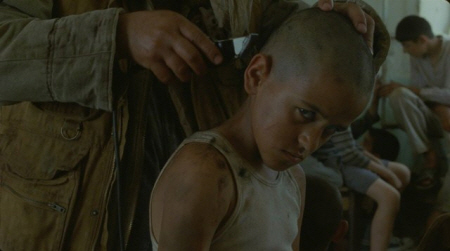
Dooman River (2010) ☆☆☆1/2(3.5/4) : Bleak sorrow on a frozen river

The cold, white bleakness dominates over South Korean art house movie “Dooman River”. With its simple storytelling, it presents us an austere view on the world which is alien even to the South Korean audiences. While observing its people, this sad film does not say much, but it eventually shows us the deep emotions below its frozen surface.

I recently watched “Poongsan”(2011), a South Korean movie about a man who can cross the border between South Korea and North Korea in quite an unrealistic way.  “Dooman River” is another South Korean movie about another border, but, this time, it is far more realistic. The border is Dooman River between China and North Korea; during cold winter days, the river is frozen enough for North Koreans to use it as an escape route to China. Some of them are lucky to avoid the Chinese soldiers patrolling around the border; others are captured by them and sent back to their country. The movie does not tell you, but I have to tell you this; when they fail to escape, there will be literally hell to pay.

The border area on Chinese side is mainly occupied by Chinese people of Korean descent(They are called Chaoxianzu or Joseonjok). Lots of Koreans left their country during the Japanese occupation in the 20th century, and they chose to stay in that area even after Korea was liberated. While watching the film, you may find it interesting to observe that they use Korean and Chinese both in private and public – the police station briefly seen in one scene with Chinese and Korean nameplates is a good example.

The movie opens with an impressive long take scene with one of its main characters, Chang-ho(Jian Cui), laid on the frozen surface of Dooman River. He is a young boy who lives with his grandfather(Jin-Long Lin) and his mute sister Soon-Hee(Lan Yin). His father died a long time ago, and his mother went to South Korea for earning money for her family(sometimes they get a call from her). It is not so easy to earn money in South Korea as immigrant workers, but people want to go there while waiting for the visa to come. Their quiet town next to Dooman River is not a bad place, but it is drained of hope or new possibility for them.

And the North Koreans keep coming from over the river, usually for the defection. Some kids cross over the river for getting food(You have probably heard about a severe famine in North Korea). Chang-ho and his friends give them food in a rather patronizing way, but the friendship emerges between Chang-ho and one of North Korean kids, Jeong-jin(Jinglin Li). It turns out that Jeong-jin is a good soccer player, and, to win the upcoming soccer game with the other town, Chang-ho tries to persuade him to join his soccer team.

Watching their relationship growing, you will probably expect those typical stories about the friendship over the barrier. However, while it is crucial in the story, the link between these two boys is only one of several small things happening around Chang-ho’s town in the movie. It is cold and difficult for everyone, especially for North Koreans over the river. In one calm scene with unflinching gaze, North Korean kids find their sick friend collapsed and dead, but they just leave behind the dead body. They cannot afford to take care of the body in their hard position.

Although they are not affluent, there is enough compassion among the town people to show warm kindness to their miserable neighbors. One of the town people actually helps North Korean defectors smuggle in China with his truck. At one night, a gunshot is heard, and a desperate North Korean knocks on the door of Chang-ho’s house, and he begs for help to Chang-ho’s grandfather, who gives him a temporary shelter and some food. And Jeong-jin is becoming a more frequent visitor to Chang-ho’s home.

It could be nice if such a relationship between North Koreans and the town people continues like that, but the harsh reality soon emerges like a cold slap in the face.  All people in the need of help are not always good people, and, in one painful scene, an act of generosity is paid back with rape. While this uncomfortable scene blatantly points out the cause of North Korean people’s misery, it is handled well with restraint. Meanwhile, several incidents also happen, and the town people are not pleased about that. The mood of the town soon seeps into the children, and, when Chang-ho learns a certain awful fact, the relationship between Chang-ho and Jeong-jin goes into rocky phase.

The director/writer Zhang Lu, whose other works I have not unfortunately watched yet despite considerable praises from our local critics, does not hurry his story in predictable direction. Its ending is somewhat inevitable, but it surprises us with an unexpected tragic turn along with the erupting emotions that have been accumulated behind the screen. It is more haunting because, even at that time, the film firmly holds itself at the distance.

As a Chinese of Korean descent born in Jilin, Zhang Lu knows well about the world he wants to capture on his camera. While quietly watching his actors, he creates a vivid, authentic atmosphere for their cold daily life, which is another interesting thing to observe. There many beautiful moments when the camera shows the frozen river and its surrounding environment covered with snow, and their bleak beauty reflects well the desolation surrounding the characters while functioning as the cover hiding their feelings, like their cold faces.

The actors’ performances are so understated that some can think they are stiff, but they have a certain realistic quality that cannot be ignored. Consisting of professional actors and non-professional ones, they are uniformly good(it’s not easy to tell them apart). The standout is Lan Yin, who deftly handles the emotional state of her character without dialogues. Soon-hee’s impossible situation could be depicted sentimentally, but the movie never allows that; she eventually does what she has to do. By the way, although the main language is Korean, this is the first Korean movie I really needed the subtitle due to their dialect. Now I think I can understand how American audiences feel about the British films with heavy accent.

“Dooman River”, one of the best South Korean movies of this year, arrived late to South Korean theaters. Though it was made in 2009, but it took some time to gain attentions while shown around the film festivals including Pusan international film festival and Berlin international film festival(it won a special award at the latter), and it finally got limited release here in this March. Maybe this is a little too slow, reticent movie to you, but good movies are never too slow, and it conveys us a lot about the people on the border as well as the sorrows hovering around one cold, frozen river. This is a lot more rewarding than “Transformers 3” – as many critics say, real people are more engaging than messy CGIs.

Posted in Movies | Tagged , , , , , | 5 Comments