The Master (2012) ☆☆☆(3/4) : What do you see from them?

themaster01 Paul Thomas Anderson’s “The Master” has every potential for greatness it can get. However, while it seems to reach for something great and sublime, this ambitious film is oddly distant and enigmatic. Its every element comprising itself is fascinating and compelling, and my curiosity was always held by its austere confidence till its ‘resolution’, but, frankly, I do not have much to talk about what it really tries to tell to us even though I can say about how much it intrigued me during my viewing

Anyway, the movie has two very interesting characters at the center of its story, who may deserve a story less opaque than the movie. First, we are introduced to Freddie Quell(Joaquin Phoenix), a navy man who is clearly a deeply troubled man struggling with his personal demons inside him. It is almost near the end of World War II, and how he spends his last days in service on the Pacific Ocean is bizarre to say the least. When the end of the War is announced, he quickly goes down to the bottom of the ship, and he drains fuel from the torpedoes for making his special cocktail. It looks harmful to drink, but I guess it tastes good for him and, probably, his fellow sailors. He also seems to be a man with sexual perversion, and we see him doing some weird masturbatory act with a sand sculpture of a naked woman made by his shipmates on the beach at one point.

Was he twisted like that from the beginning, or was he damaged by his experience during the war? The movie has no answer, and we come to know that Quell is not a reliable person in case of telling the facts about himself, but Joaquin Phoenix’s remarkably committed performance makes Quell an intriguing guy to observe. With his hunched back and awkward mannerisms including a lopsided smile, Phoenix transforms his caricature character into a darkly fascinating walking mess who keeps asking for troubles as being fueled by his dark nature.

themaster07After returning to his country, Quell works for a while as a clerk in a department store and then, after being fired due to a violent incident with one customer, we see him working with immigrant workers on some cabbage field in California. He keeps experimenting with his special cocktails, and he even uses paint thinner at one point. I have no idea about what constitutes his latest brand of cocktail, but it causes a serious trouble when one immigrant worker gets very sick because of that, so he has to run away for not getting caught.

That is how he meets Lancaster Dodd(Philip Seymour Hoffman), the leader of the religious group called ‘The Cause’. When Quell is found as a stowaway in Dodd’s ship which departs from San Francisco and will arrive in New York, Dodd takes a special interest in Quell – and Quell’s intoxicating cocktail. Persuaded by Dodd, Quell goes along with Dodd and Dodd’s family and supporters, and he gets slowly acquainted with the religious activities of the Cause including the hypnosis sessions and the personal interviews for his followers.

What does Dodd believe? And what exactly does he preaches to his followers? Some said Dodd’s religion and philosophy are the fictional counterpart of L. Ron Hubbard’s Scientology, but I doubt whether I will discover new things from the scenes involving the Cause through some basic knowledge about Scientology. Although it is engrossing to observe them, the purposes behind their rituals are not explained much in the film. We see Dodd talking about some vague concepts of reincarnation in our space, but the movie does not go deep into what he ‘believes’.

themaster05That is why Philip Seymour Hoffman’s subtle but magnetic performance is as crucial as his co-actor’s performance in the movie. Behind Dodd’s gentle and civil behaviors occasionally disrupted by sudden outbursts, Hoffman ably suggests the persuasive power of a charismatic cult leader(his introduction to Quell: “I am a writer, a doctor, a nuclear physicist and a theoretical philosopher. But above all, I am a man, a hopelessly inquisitive man, just like you.”). Regardless of whether he really puts his own faith in what he concocted, Dodd is very good at selling his concocted belief to his followers – and his family. His sunny but firm wife(Amy Adams, who is Oscar-nominated for her icy performance in this film) always stands by her husband as his second-in-command or something more than that. While his son Val(Jesse Plemons) is cynical about his father’s religious practice, their daughter and her new husband willingly believe what he says, and so do his devout followers including a rich supporter like Helen Sullivan(Laura Dern). It can be said that they will stick to their religious belief even if it is no good to them just like Quell sticks to his possibly harmful cocktails.

But can I argue that that’s the main point of the movie? I do not think so, because the movie makes no particular point about Dodd’s religion – or how Quell and Dodd affect each other. It sometimes looks like the movie does nothing more than merely putting its two protagonists together within its plot; sure, it seems they are drawn to each other like two sides of coin, but there is no clear explanation for their attraction. Is it a homosexual attraction? Or is it just a psychological attraction between a man in the search for direction and salvation and a man in the need of challenge and satisfaction? Or is it the attraction not that different from the one we observed from J.J. Hunsecker and Sidney Falco in “Sweet Smell of Success”(1957)? All I can know is, their attraction eventually turns out to be not as strong as we assumed at first.

The performances and the technical aspects in the movie remain absorbing in spite of many unanswered questions rising from its austere elusiveness. Although there is less synergy between them on the screen than expected, Phoenix and Hoffman deservedly received Oscar-nominations for their terrific performances, and they won the Best Actor award together at the Venice Film Festival in the last year(the movie also received the Best Director award for Anderson). How they dynamically interact during one memorable scene involving the special interview termed “The Processing” is nothing short of gripping; although the camera mostly focuses on Phoenix’s face from behind Hoffman’s back, two talented actors does a masterful job of suggesting something beneath their interactions which look mundane and casual at first but become increasingly intense.

themaster02The director/writer Paul Thomas Anderson, who shot this movie in 65mm film with his cinematographer Mihai Malaimare Jr., keeps providing us impressive moments to talk about. Its precise symmetric scene composition and its slow pace are reminiscent of Stanley Kubrick’s later films, and the production design by David Crank and Jack Fisk is a vivid recreation of the American society during the post-World war II era, and Jonny Greenwood’s score adds another layer of ambiguity and disturbance on the screen.

So, what is the movie about? I still cannot answer well, and that is where my reservation toward this film comes from. Anderson’s previous film “There Will Be Blood”(2007) also has its own enigma at its center, but it is a character study forcefully driven by Daniel Day-Lewis’ overpowering performance until it directly declares its end after drinking all the milkshake it can pump up from its story, and we get some considerable insights on its unlikable but miserable hero who might have been destined to his harrowing journey of greed and ambition from the very beginning.

In case of “The Master”, I was involved as observing the behaviors of its two interesting characters, but I remained baffled about them and other things because it looked like nothing much was changed in the end in spite of all the struggles between them. There are surely clashes, and there are also reconciliations, but what do these two guys learn or get from getting along with each other for a while?

themaster03People have talked a lot about the scene in which Dodd and Quell and others go to some desert plain in Arizona. Dodd rides a motorcycle at high speed across the desert to some point around the horizon and then he comes back. And he says it is Quell’s turn, so Quell rides the motorcycle to the opposite point but he does not return, so Dodd and others tries to find him without any faintest idea about where Quell is. This vast scene is surely wonderful to look on the big screen, but please don’t ask me about the meaning behind this seemingly meaningless moment.

Despite my grumbles, my admiration for Anderson continued to grow even when my head tried to grasp what “The Master” was about. I do not agree with others who thought the movie is a masterpiece, but this is a baffling but interesting cinematic Rorschach test worthy of discussions and re-evaluation, and, at least, it is not a tedious experience even though the sum of its brilliant parts seems to be less equal than its whole part.

Anderson quickly established his exceptional career with his first three movies(“Hard Eight”(1996), “Boogie Nights”(1997), and “Magnolia”(1999)), and what he accomplished in these three films and following quirky romantic comedy “Punch-Drunk Love”(2002) was pretty enough to call him a master director, if not a great director. With “There Will Be Blood” and “The Master”, Anderson shows more ambition, confidence, and control for the next stage he is determined to take, and now here comes another question I cannot answer either: what will be the next step for him?

themaster06

Posted in Movies | Tagged , , , | Leave a comment

Anna Karenina (2012) ☆☆1/2(2.5/4) : Their life is theater, after all

small_annakarenina01Being famous as one of the great works in Russian literature, Leo Tolstoy’s classic novel “Anna Karenina” has been adapted into movies and TV miniseries so many times since 1910 that I am sure most of you are already familiar with its basic storyline even if you have not read it. To be frank with you, I finally read the book during my recent Chinese New Year holiday, and, though I read it a little too quickly during one day, I was glad to learn that the book was far more than a depressing melodrama about a doomed romantic affair between two gorgeous people; it is really a good, thoughtful human story to read if you have lots of free time to spend.

While it will not be regarded as the definite movie version of Tolstoy’s novel(has such a thing ever existed?), Joe Wright’s “Anna Karenina” attempts an interesting approach to its source. While Tom Stoppard’s screenplay omits or condenses many parts of the novel through its adaptation process just like many other movie versions did, the movie presents the story as a sort of virtual play in the big theater where the characters move around the stage and the other places as being carried along with their dramas. After all, the life in the high society of European countries during the 19th century was the theatrical show for its members, wasn’t it?
There are strict rules in this superficial play of theirs to maintain their façades, and Anna Karenina(Keira Knightley) unwisely breaks those rules for following that unstoppable desire inside her heart. Her luxurious life with her cold, bureaucratic husband Karenin(Jude Law) is not that bad for several reasons including her adorable young son, but, when she comes to Moscow for persuading her sister-in-law Dolly(Kelly Macdonald) not to leave her philandering brother Oblonsky(Matthew Macfadyen – channeling Kevin Kline on blowhard mode), she coincidentally encounters a young, handsome military officer Count Vronsky(Aaron Taylor-Johnson), and, as reflected by an ominous accident at the train station, her fate is sealed instantly when their eyes meet.

kinopoisk.ru
Even before they finally hurl themselves into their mutual heedless passion, everybody around them senses what is going on between them. Karenin, who is concerned about her reputation as well as his, sternly warns her of what will happen if she is not careful. It is one thing to have an affair behind his back, but it is the other thing to reveal her infidelity right in front of others. Karenin has usually been portrayed as heartless bastard in many movie versions(I particularly remember well Basil Rathbone’s mean performance in the 1935 version starring Greta Garbo), but Karenin in this version comes to us as an unloving but pragmatic man who tries to take care of his difficult matter as sensibly as possible while following the rules he firmly sticks to.

As following Anna’s rise and fall in her romance with Vronsky, the movie also gives some space to another major plot in Tolstoy’s novel, which has been usually discarded or contracted in its film adaptations. Oblonsky’s close friend Levin(Domhnall Gleeson), a young landowner as idealistic as Tolstoy himself, comes to Moscow for proposing to a girl he has been carrying a torch for, but he is devastated to realize that Kitty(Alicia Vikander) is infatuated with Vronsky. Kitty also feels hurt by discovering the bond between Vronsky and Anna, but it does not take that long for these two brokenhearted young people to find their true feelings remaining intact.

All these things are presented to us mostly within the limited space of the movie as it lightly moves the story with its enjoyable theatrical style, and the movie provides several good moments as the cinematographer Seamus McGarvey’s camera fluidly moves here and there around the theater. We are constantly reminded of its stylized environment through the backstage scenes or the scenes on the rafter(we even get a horse race scene as the stage expands to the whole theater), and the characters frequently behave like the actors on the stage as they enter or exit their scenes. I was especially amused by the mechanical rhythmic movements of Oblonsky’s clerks in his workplace; they make the scene almost look like a stage musical scene as accompanied with Dario Marianelli’s score, and Marianelli’s excellent score also makes a significant contribution to the ballroom sequence which pushes its theatrical aspects almost to fantasy level for capturing the swirling emotions inside it.

small_annakarenina05But I felt distant about its content while excited by its surface. Anna and Vronsky become more unsympathetic and self-absorbed especially when their relationship is going down toward that famous tragic ending, and the artificial aspect of the movie makes us feel more distant to what is happening to them and their relationship. We are supposed to feel pity for Anna and, to the extent, Vronsky as a couple who unfortunately fails to control their hearts, but they more look like a foolish couple who deserves their social punishment for their unwise choice.

Keira Knightley is a good choice for a tragic melodramatic heroine like Anna, but her Anna is not someone we can easily identify with. As surrounded by the busy background and going through many turbulent emotions, her performance is unevenly maintained on high-tone levels, and we do not have many chances to get intimated with Anna’s mind in the movie as a result. We do not feel enough pity for her wretched state later in the story, and, because there is not much chemistry between Knightley and Taylor-Johnson, we cannot even care a lot about their characters’ doomed romance, although it goes without saying that the end of their romance is sad and tragic.

annakarenina06In contrast, I cared more about the supporting characters. Jude Law, who could have been a good Vronsky when he was younger, gives a sympathetic performance as a cuckolded husband who has only led his life as his brain says; Karenin may be uncaring, but he is not a cruel man, and we gradually see his heart as wounded as his pride behind Law’s seemingly monotonous appearance. Although they have a few scenes together, Domhnall Gleeson and Alicia Vikander are good as a more engaging and sympathetic couple in the movie, and there is a poignant scene when they tentatively approach to each other’s heart during their private moment.

On the technical level, “Anna Karenina” is impressively theatrical, but, on the emotional level, it is distantly shallow. Like the director Joe Wright’s previously films “Pride and Prejudice”(2005) and “Atonement”(2007), the movie is a gorgeous literature adaptation, and its visual sensitivity is mixed well with its excellent production design and costumes which surely deserve the recent Oscar nominations(The movie is Oscar-nominated for Best Cinematography, Best Score, Best Production Design, and Best Costume), but I don’t think this is a successful adaptation. Anyway, despite its problems, this is an interesting attempt to be distinguished amid the other versions which came before it and the future ones which will definitely come after it.

small_annakarenina03

Posted in Movies | Tagged , , , , , | Leave a comment

Run to the South (2013) ☆☆1/2(2.5/4) : Going his way to the South

small_runtothesouth01Although you cannot wholly agree with what he thinks and believes, the hero of South Korean comedy movie “Run to the South” is an interesting man to observe. He just wants to live his life in his own way, but he always gets himself into troubles because of his stubborn defiance. No matter what happens, he firmly sticks to his belief in the world he does not fit into, and his family stand by him as he keeps clashing with the world.

Although his past is mostly vague except few details, we can clearly see that Hae-gap(Kim Yoon-seok) is someone not so welcomed by any government in the world. He thinks the government is unnecessary because it only exists for ruling the people and confining them in the system, and he openly expresses his libertarian thoughts around the neighbourhood while causing big and small troubles in his daily life. Not so surprisingly, he is a frequent guest of the police station, and he does not even have to tell his name to the policemen because they have met before many, many times.

Although he recently made a social documentary which is shown at some ‘international documentary festival’, he is more or less than a jobless man at his home, and it is mostly his wife’s job to support the family. While he and his wife Bong-hee(Oh Yeon-soo) and their three children live in the upstairs, she runs a cafe at the downstairs, and she manages her business pretty well. The place is usually empty(as far as I can remember, only two customers are shown in the movie), but it is a nice and cozy place for having a cup of tea or coffee, and their home also feels comfortable, if not affluent. I really want to know about how she earns the money enough for providing such a good-looking environment for her customers and her family despite their hard financial situation.

small_runtothesouth02The movie draws small laughs mainly from Hae-gap’s casual anti-establishment behaviors during its first half. Due to his family members associated with North Korea and his left-wing activity in the past, the National Intelligence Service has been watching on him for years, so we get several funny moments involving a duo of bumbling agents on their surveillance job. Hae-gap seems to sense who they are when he has a close encounter with them, but I bet he won’t give a damn about them even if they directly reveal themselves to him.

Anyway, another trouble comes to his life through his old friend Man-deok(Kim Seong-gyoon). Man-deok’s hometown is about to be redeveloped into an expensive resort area by a greedy member of parliament, and he desperately wants to stop it. After Man-deok fails in his clumsy attempt to stop the process and then is arrested by the police, Hae-gap decides to move to Man-deok’s island with his family, who, except the eldest daughter, follows him to the south as the family members.

Their new house, which originally belongs to Man-deok, is a shabby place in the need of lots of repairs, but it is soon turned into a plain but adequate spot for spending your average summer holiday. Though they actually used the three islands during the production, the fictional island in the movie looks convincing as a small place in the middle of the sea, and I enjoyed its peaceful atmosphere coupled with natural beauty on the screen even when the story becomes languid during its second part. They do not have much money, but Hae-gap is a guy who really knows how to be self-sufficient, so the island quickly becomes their new home to Hae-gap’s family.

But their pastoral happiness does not last long, and the second part of the story centers around Hae-gap’s efforts to protect not only the house but also the island from the aforementioned politician and his business associates. While still being stubborn as usual, he is not a fool at all, and he has some plans for stopping their attempt to remove him and others from the island. It starts with a non-violent protest at first, but it becomes more serious as Hae-gap shows them how much he is determined to block their plan.

small_runtothesouth03
Although Kim Yoon-seok’s good performance keeps the story moving forward, the movie is disappointingly mild and lackluster when it deals with its major conflict in the story. Even though there is a big explosion, the movie does not have enough tension and humor for this part, and it eventually fizzles with no lasting impression in the finale.

I do not know whether this problem was caused by the reported troubles during its problematic production, but the director Lim Soon-rye, who previously made “Forever the Moment”(2007) and “Riding Home with a Bull”(2010), does a fairly competent job here despite glaring flaws shown here and there in the movie. While Kim Yoon-seok is fun to watch as a guy who will not bend his principles even when he comes to face a threatening situation, the good cast surrounding him is regrettably underutilized in many cases due to the underdeveloped relationships between Hae-gap and their characters in the screenplay. I’d like to know more about the long-lasting relationship between Hae-gap and his wife, who has been loyal to him since their youthful years, and I’d also like to see how his children, who managed to grow up quite well despite his eccentricity, feel about their radical father. Hae-gap is not a bad father/husband, but it must take more than family love to live with such a difficult guy like him.

I came to learn that the movie is based on the Japanese novel written by Hideo Okuta, and my Internet acquaintances said the novel is better for many reasons. “Run to the South” is not boring, and there are indeed some enjoyable things in this unsatisfying comedy, but I am also disappointed because it does not fully utilize its interesting hero and the comic potential in him and others. It happily sails further to the South in the end, but I don’t care enough about it.

small_runtothesouth04

Posted in Movies | Tagged , , , | Leave a comment

The Berlin File (2013) ☆☆☆(3/4) : A Cold War espionage in the 21th century

small_theberlinfile04

“The Berlin File”, a gritty action film from South Korea, is a respectful homage to those cold, gray espionage films made during the 1960-70s. With its melancholic mood reminiscent of John le Carré’s novels(one of his books briefly appears in the movie as a small sign of recognition), this gloomy tale of international espionage works as an engaging drama about the people struggling in their uncertain world, and its thriller plot is packed with the impressive action sequences fueled by the raw physical vitality we do not encounter often in those standard Hollywood action films.

The conflict between South and North Korea, which has been continuing since the Korean War, has literally been asking for the 21th century Cold War espionage story like this film. I have no knowledge associated with the story the movie tries to tell, but, as far as I heard indirectly from others, it seems the conflict between South and North Korea is not entirely confined to the demarcation line between these two countries, so it can be easily imagined that there are many unhappy people doing their difficult, depressing, and dangerous jobs somewhere in the Cold.

The story opens with a secret arms deal gone wrong in Berlin. Pyo Jong-seong(Ha Jeong-woo), a North Korean agent who has not yet been detected by other agencies including South Korea’s National Intelligence Service(such an agent is called ‘ghost’, which is a valuable asset to any agency), is negotiating with a Russian arms dealer and his Arab associate in one hotel room, and it gradually turns out that there are many eyes and ears watching and listening to their conversation besides his North Korean colleagues.

small_theberlinfile05Jeong Jin-soo(Han Seok-kyu), a South Korean agent leading the surveillance operation on them, and his people are ready to capture Jong-seong with others, but they fail to capture them due to a sudden complication in the situation. Their failure is accompanied with the considerable damages they will have to deal with at their offices, and we come to see that they are plain public servants far, far different from James Bond. They do shoot or fight sometimes, but their boss does not welcome the resulting noises which can cause serious diplomatic problems to the government they work for, so this failed mission causes lots of headaches to Jin-soo and the others at the local headquarter. Furious about a mysterious North agent who escaped right in front of his eyes, Jin-soo is determined to get him and find the reason behind his failed mission, so he starts gathering the clues for his investigation officially and unofficially.

Meanwhile, Jong-seong and other North Korean agents at the embassy in Berlin also have lots of things to worry about because it seems the failed deal causes the suspicion from the high-ranking officials and generals in Pyongyang, who have been pretty uneasy about their new domestic political situation after the recent death of Kim Jong-il and the following succession of his son Kim Jung-eun. It looks like somebody leaked the information in advance, so that is how Dong Myeong-soo(Ryoo Seung-beom, the director Ryoo Seung-wan’s brother) comes into the picture from Pyongyang for investigation. Besides being a good undercover agent, he is also a ruthless killer, and he shows us during one brief scene that a pen is indeed mightier than a knife.

Jong-seong’s circumstance becomes more precarious because Myeong-soo is suspicious about Ryeon Jeong-hee(Jeon Ji-hyeon), the ambassador’s translator who is also Jong-seong’s wife. As he senses more danger being accumulating around him, Jong-seong realizes that he must do something for confirming himself as a royal servant of his party as soon as possible – or his career and life may be finished along with hers.

small_theberlinfile01What we get here is a typical espionage story full of intrigues and suspicions which can be succinctly summarized in one phrase: trust no one. Jong-seong quietly wonders whether his wife is someone who betrayed him, and the barren relationship between them in their grey apartment feels drier and bleaker than usual as both flatly regard each other as their respective cards held behind their backs. The more Jong-seong realizes something big is going on behind his back, the more his belief and loyalty is shaken under this situation – and Jin-soo is approaching to him step by step from the other side.

The scope of the story gets bigger as it introduces other shadowy figures in Berlin besides North Koreans and South Koreans, and the director/writer Ryoo Seung-wan forcefully pushes his story forward on the surface even when it gets murkier about what is going on behind its cover. The atmosphere of the movie is exemplary; it is always drenched with that familiar pessimistic ambience from the espionage movies in the 1960-70s, and the actors are good as the simple hard-boiled characters who do not reveal themselves a lot to the others around him. Some details on the screen are enjoyable to watch, and you may be amused by a briefing room which looks pretty shabby despite some high-tech equipments in the room. Spying is not a glamorous job, you know.

The movie also provides several ferocious action sequences during the second half of the story, and their sheer intensity is fueled by dynamic physical fights as well as guns and explosions. They certainly used stunt doubles in some shots, but it is both real and exciting to watch none the less because we can believe the characters are really hurled into actions. They may do actions at any time as required, but they are not invincible to pains and torments, and that is what makes the actions in this film more involving with the realistic sound effects on the soundtrack. I must say I was particularly impressed by one busy action sequence in which one character manages to survive from the fall from a high place in the end. I don’t think that is possible in reality, but the sequence is handled with conviction and skills, and I was amazed rather than left in disbelief.

small_theberlinfile03As the hero going through most of the actions in the film, Ha Jeong-woo is as convincing as, say, Matt Damon in the Bourne trilogy. Previously appearing in “The Chaser”(2008) and “The Yellow Sea”(2010), Ha Jeong-woo is no stranger to gritty actions, and he reticently holds the center of the story amidst the actions as a spy getting disillusioned about what he has believed. I have no idea about how his character can keep going on in spite of what he has gone through, but Ha Jeong-woo never loses the human vulnerability of his character with the scars and bruises on his body, and I accepted his character as a real character.

On the opposite, Han Seok-Kyu plays well with his seasoned character’s weary sleaziness; Jin-soo is not a likable guy, but Han Seok-kyu gradually shows through his gruff performance that, as a fellow professional in their shadowy world, Jin-soo somehow begins to get some sympathy and respect toward a man he abhors. Ryoo Seung-beom, who previously gave a wonderful over-the-top performance as a corrupted prosecutor in his brother’s previous film “The Unjust”(2010), does not waste any opportunity to have a juicy fun in his lethal character; Myeong-soo may look like a cocky guy who may deserve some spankings, but that does not change the fact that he is a deadly professional you cannot mess with. As a sole substantial female character in the story, Jeon Ji-hyeon holds her own place among her co-actors with her jaded beauty, and we eventually care about what will happen to her regardless of what she is really hiding from her husband.

small_theberlinfile02While technically excellent as an exciting action movie and a bleak espionage thriller, “The Berlin File” has several weak points. Above all, its ambitious attempt to present us the world of international espionage is not entirely successful for many reasons. The delivery of English dialogues among the actors is a bit awkward and strained to say the least, and the lack of details about the minor supporting characters including a CIA agent and a Mossad agent who are crucial to the plot is too apparent to ignore on the screen. Furthermore, I do not think I understood everything in its story because of the several holes left in the plot. Although there are some required moments for explanations along the story, the actors’ North Korean dialect is not perfect, and I did not wholly understand what exactly they said at times.

Nevertheless, on the whole, the movie remains as a satisfying action thriller I can recommend. Its story and characters may be a little too typical, but it is made by the director and his crew who do know about how to make a good one, and I was entertained by their final result enough to overlook its shortcomings. It could have been more than a competent homage, but, like recent films like “Tinker Tailor Soldier Spy”(2011) or “Zero Darky Thirty”(2012), “The Berlin File” reminds us that there still rich materials for good storytellers to be found in the Cold.

theberlinfile06

Posted in Movies | Tagged , , , , , | Leave a comment

Miracle in Cell No.7 (2013) ☆☆(2/4) : I am Yong-goo

small_miracleincellno7-02After 20 minutes it began, I concluded that I was not a good target audience for South Korean comedy film “Miracle in Cell No.7”. I understood what it intended to be, but I kept annoyed by its blatant comic/melodramatic approach to the subject during the screening, and I felt saddened to watch a group of good talents trapped inside this manipulative movie which clumsily tried to squeeze tears from the audiences every 5 or 10 minutes.

But I must report to you that this cheap tactic worked well with the audiences as far as I observed at last night. Many audiences laughed frequently, and they also responded with tears exactly when the movie wanted to make them weep for its unfortunate hero who does not deserved to be abused and mistreated as depicted in the movie. While I kept being grouchy about it, they wholeheartedly embraced its shameless sentimentality to the end, and I felt like being alone amid a big collective emotion I could not follow.

But I will not deny that its melodrama and comedy work to some degrees in spite of its dark, serious social subject inside its story. This is not an incompetent film, and it has several good things I admire, and maybe you can like it unlike me while forgiving its many weaknesses. So let’s talk about several reasons why I think this is not a good film, and I’ll let you decide for yourself whether you are going to watch it or not later.

1) Unrealistic elements too many for one story. I respect its intention to be a crowd-pleasing weepy movie, but its story are sugarcoated with too many synthetic elements beyond the reality, and you can discern that problematic aspect right from its very premise. Despite his mental deficiency, our dim but innocent hero Yong-goo(Ryoo Seung-ryong) rarely loses his child-like sunny attitude, and everyone including a strict and severe prison officer(Jeong Jin-young) finds their hearts quickly melt by Yong-goo’s everlasting goodness hidden inside his idiotic behaviors, so his cellmates even allow him to freely spend some time with his cute little daughter Ye-seung(adorable Gal So-won) in their prison. The prison in the movie does not look like a real prison at all(after all, they shot the movie in a prison set near my hometown Jeon-ju), and, while hidden from the guards for a while, our cute little girl never sees the harsh side of the life of her poor father and her ‘uncles’ – and neither do we.

small_miracleincellno7-052) The crime only existing for pushing its hero into a grim situation which guarantees more cries and tears later. I forgot to tell to you how Yong-goo ends up being incarcerated in the prison, so let me describe that unfortunate circumstance briefly. Yong-gu happens to be seen near a dead girl as young as Ye-seung, and then everything is swiftly processed as he is arrested and then immediately sent to the trial. He is innocent(well, what do you expect?), but never mind, because that dead girl’s father is none other than the Police Commissioner and this angry father is very determined to get what he wants as a one-dimensional villain of the story. It is always infuriating to see an innocent man unjustly treated by the legal system, but shouldn’t the movie provide a better story to induce us to think more about the real legal injustices observed in our reality and the fair treatment of the mentally disabled?

3) A talented actor wasted by a not-so-good screenplay. The screenplay by the director Lee Hwan-gyeong seriously needs lots of improvement especially in case of characterization. Our Yong-goo is just simply defined as a good-hearted simpleton by his childish behaviors in his first scene, and that is all for the rest of the film. Ryoo Seung-ryong, who has recently become one of the most dependable South Korean supporting actors through the series of good performances in “War of the Arrows”(2011) and “Masquerade”(2012), tries everything he can do for playing his one-note character and his performance is far from being awful, but, like Seen Penn in “I Am Sam”(2001), he is not supported well by a flawed screenplay which keeps driving him to the ‘fully retard’ mode throughout its story.

4) The good supporting actors equally wasted by the screenplay. The more I think about it, the more I am convinced that the movie is mainly driven by its lively supporting actors who do their jobs nicely even though they are stuck with their caricature roles. Oh Dal-soo has several funny scenes as a gang member who is the leader of the prison cell No.7 where Yong-goo and his cellmates are incarcerated in, and we also have the reliable actors like Jeong Man-sik, Kim Jeong-tae, Kim Gi-cheon, and Park Won-sang as Yong-goo’s cellmates. Like Ryoo Seung-ryong, they are not bad in the movie, but I have seen better performances from them in their previous films, and I was not that pleased about watching them mainly utilized for silly gags or cheap tears.

small_miracleincellno7-015) Another manipulative use of a good child actor. Whether it is a comedy or a drama or a thriller, melodrama comes with the territory in South Korean films, and there is nothing better than a crying child to draw every tear you can shed from your lachrymal glands. I appreciated Gal So-won’s radiant cuteness among her adult co-performers, but, alas, her assigned job is being cute or tearful whenever it is necessary for the movie to bring warmth into the audiences’ heart or squeeze the emotions from their heart.

6) Its continual dose of sentimental sappiness approaching to an unbelievable fantasy. Maybe you can tolerate the unrealistic aspects of the story at the beginning, but there are more ‘fantasy’ elements to come along the story, and you may find some of them very unbelievable to accept. For example, we have a feel-good moment involving an escape plan later in the story, and I could not believe my eyes at one point for what was happening on the screen. Seriously, it could not have been more preposterous even if they had got a helicopter ready for Yong-goo and his daughter.

small_miracleincellno7-047) The prologue and epilogue scene framing the story for extra sappiness. Everything is told through a mock trial for law students, the adult Ye-seung(Park Shin-hye) acts as a defense lawyer for her father’s case while he is absent(you can guess the reason within few minutes), and she pours every feeling inside her to the courtroom to touch everyone – and us. I heard that the law students are very serious and passionate during their mock trial even though it has no legal effect, but our Ye-seung is so serious and so involved that she even invades into the past scenes to protest as her tears are flowing down her cheek. She will surely win(is that a spoiler?), but I wonder whether that feel-good ending with a yellow balloon in the sky can make any difference in the story except for another sappy moment for us.

While these are the reasons I did not respond well the movie, I must point out to you again that this is not a lousy film. It is a well-made commercial product supported by good talents on the screen, and Ryoo Seung-ryong proves his capability as a lead actor in this movie although this is not his most interesting work. I am glad that he gives a fairly decent performance while not making a fool of himself, but, folks, I saw no point in observing him on the full retard mode for two hours, and he and his co-performers really deserve better than this.

small_miracleincellno7-03

Posted in Movies | Tagged , , , , , , | Leave a comment

The Hunt (2012) ☆☆☆1/2(3.5/4) : An unjust ordeal caused by an innocent lie

thehunt02 It was just one small innocent lie, but, once people start to believe it, it topples one man’s life upside down, and his life becomes a living purgatory as a result. Through the unjust ordeal of its ordinary hero, Danish movie “The Hunt” delves into a dark side of human nature involving misguided conviction and savage mob mentality, and its story is both maddening and engrossing to observe. Being accused of a heinous crime he did not commit, he becomes the target of malice and hostility from his friends and his neighbours, and he comes to learn in a hard way that the mark does not go away easily from their sight even though the accusation against him has no solid base at all.

The life of Lucas(Mads Mikkelsen) has been nice and comfortable before that happens. He is a kindergarten teacher who recently moves back to his hometown after his divorce, and, except that he is in a minor conflict with his ex-wife on the custody of his teenager son Marcus(Lasse Fogelstrøm), everything is pretty fine to him. He always has his friends and his family members near him, and we see them enjoying their deer hunt season together at the beginning. In the kindergarten where he works, he is popular with his boys, and he is also close to one of the employees, Nadja(Alexandra Rapaport).

The trouble in question begins with an innocent misbehavior of a girl in the kindergarten, Klara(Annika Wedderkopp). It is apparent that this little girl has a crush on Lucas, but Lucas only treats her as his close friend’s daughter while oblivious to her feeling. After her little expression of affection is ‘rejected’ by Lucas, she impulsively tells a lie about Lucas to the principal out of pique, and the principal is naturally disturbed by Klara’s lie, which accuses Lucas of sexual molestation.

small_thehunt05As a consequence, the things we usually expect from such a circumstance quickly follow. The counselor is called, and the principal and the counselor ask Klara whether what she said is true or not. The principal, more convinced about Lucas’ guilt after that private interview, notifies the parents of the possibility of more sexual abuses. The kids start talking about what Lucas did to them, and he is eventually fired as being investigated by the local police, and his neighbours and friends become not friendly to him any more.

While it is clear that Lucas is wrongfully accused, the movie also shows the understandable human reactions from the town people angry about him. As we recently witnessed from the Jerry Sandusky scandal, the sexual molestation on minor is serious felony which damages not only the victim but also the victim’s family, and the complex reaction of Theo(Thomas Bo Larsen), Lucas’ friend and Klara’s father, during one scene is exactly how any father will react as a dad shocked and confused and angered by what he hears from others. He wants to believe his friend, but he cannot possibly ignore a dreadful possibility of his dear daughter sexually abused by a man who has been his friend.

Nevertheless, what Theo and others in the town do to Lucas is pretty cruel and foolish to say the least. Focusing on the human behaviors surrounding the case rather than its investigation(we only hear about the progress indirectly from the characters from time to time), the director Thomas Vinterberg and his co-writer Tobias Lindholm show us how much our minds can be susceptible to suggestion and blindfolded by resulting bias. Gradually grasping what damage she unintentionally causes to her teacher, Klara later tells what she previously described never happened, but the adults, already fully convinced by their conclusion only based on what she and other kids said, do not believe her(they think her trauma causes memory loss). Even when the legal investigation reveals that the accusations against Lucas are unreliable for many reasons, they firmly believe that children always tell the truth, while overlooking another important fact about children; in some circumstances, they also can lie just like us and they can do it quite well.

small_thehunt04How this misguided view of the town people wrecks Lucas’ daily life is depicted with realistic approach in the film, and it is really chilling to see how the community savagely stomps on its marked man’s spirit. While they are not turned into a lynch mob eager to burn him alive, Lucas’s daily life becomes increasingly difficult as he becomes an unwelcomed pariah to the people he has known. At least his affluent family can support him legally and financially during this very difficult time, but he still has to face the thinly covered hostility in his town whenever he goes out. Feeling isolated and ostracized and terrorized day by day, he feels more frustrated and angered as a wronged man, but he knows well that there is nothing he can do except enduring it.

For his stoic but harrowing portrayal of a tormented man struggling against a wrong accusation, Mads Mikkelsen deservedly received Best Actor award at the Cannes Film Festival early in the last year. Although being outraged by the injustice hurled at him, Lucas tries to endure it while maintaining his calm attitude, but he only finds his frustration continuously accumulating as the time goes by, so we eventually get an emotionally intense scene during the town church meeting on Christmas Eve. There are many painful moments in the movie besides that memorable scene, and Mikkelsen’s powerful performance delivers more than what is demanded during these scenes to effectively convey us pains and torments behind his cool reticent face.

small_thehunt01The supporting actors deftly support Mikkelsen with their believable realistic performances. Lasse Fogelstrøm is Lucas’ son Marcus, who also experiences what his father is going through for being near him and rightfully becomes infuriated by that. Thomas Bo Larsen is a man getting conflicted because of conscience and friendship, and his wordless exchanges with Mikkelsen during one crucial moment eventually result in a small but important turn in the story. As a young girl who causes everything in the story, Annika Wedderkopp is impressive with her well-rounded performance as a three-dimensional child character, and she is especially good during an early scene where her character is very confused and nervous about what to tell in front of two adult characters.

While showing one of our worst sides through its insightful human drama, “The Hunt” also shows us that we are capable of doing right things when the time comes, but that looks like a small consolation compared to what has been done to a man who should have been presumed to be innocent until everything would become clear. Through his ordeal, Lucas comes to learn a lot about what his people are capable of, and that is something he will not forget easily even if he chooses to ignore it. He is still a marked man, and there is always somebody willing to remind him of that.

small_thehunt07

Posted in Movies | Tagged , , , , , , | 2 Comments

Mama (2013) ☆☆☆(3/4) : It’s a tough supernatural custody battle

mama06 “Mama” is a little scary horror movie ready to scare you and then shock you from the very beginning, and it does its job well even when we can instantly see through its shock and awe tactics. There are many typical ‘boo!’ moments lurking around its plot, but these shocks are packaged well in its ominous atmosphere filled with your average bad omens, and its story is supported by the solid performances we can care about.

The movie begins with a grim prologue sequence. Jeffrey(Nikolaj Coster-Waldau), an executive in some financial company, suddenly becomes deranged during the financial crisis in 2008. Not long after killing his two co-workers and his wife with his gun, he leaves his house with his two little daughters to somewhere, and nobody has seen him or his daughters since then.

This terrible incident is gradually forgotten as the time goes by, but Jeffrey’s brother Lucas(also played by Nikolaj Coster-Waldau) has kept searching for Jeffrey and Jeffrey’s daughters for five years. He has already spent nearly all of the money left by his missing brother on this personal search, but he still hopes to get any information about their disappearance even though he recognizes the hopelessness in the search.

Eventually, he happens to get what he has wished for. His nieces are finally found, but they are not exactly in good condition. Having spent five years at an abandoned house in some forest without their father, they are turned into wild children, and they look more like little beasts when they are discovered. While Victoria(Megan Charpentier) does not have any serious problem with going back to the civilization through their recovery process at the facility for children, her younger sister Lilly(Isabelle Nélisse), who was quite young at the time of their disappearance, still behaves like a little animal although she shows lots of progress in her recovery.

small_mama03You see, they do not look like the ideal girls you can take to your home, but Lucas wants to take care of them as their uncle despite the reluctance of his girlfriend Annabel(Jessica Chastain), who does not look like a model mom at all – and does not intend to be. When she privately checks herself in the bathroom with a pregnancy test kit, she is relieved to know that she is not pregnant yet.

Compared to the girls’ grandaunt Jean(Jane Moffat), who also wants to take care of the them as much as Lucas, Lucas and Annabel are certainly not the model foster parents for these two girls(he is a painter – and she is a rock band member), but Dr. Dreyfuss(Daniel Kash), a child psychiatrist who has lots of intellectual interest in their mysterious survival, gives Lucas an irresistible offer; if Lucas moves to a big, cozy house owned by Dr. Dreyfuss’ institution and allows the girls to be interviewed periodically, he will help Lucas get the custody.

The house looks good on the surface, and Lucas and Annabel are happy to live with the girls in the house for a while, but they begin to sense something weird is going on in their new place. Strange sounds are heard during night, and disturbing things keep happening around the girls, and someone besides them seems to be inside the house. Annabel, still awkward about her new role, is increasingly getting nervous every night, and she begins to sense the presence of a mysterious entity which the girls call ‘Mama’ – especially when she is alone with the girls in the house.

small_mama05It will not be much of a spoiler to tell you that Mama really exists, because 1) the movie does not hide that much in its trailer, and 2) this is a horror film drenched with supernatural undertone, and 3) it shows you in advance how Mama comes to take care of the girls during the opening sequence. It cannot be denied that this diminishes the mystery of the story considerably, but the movie instead fills its space with that dark ambience of dread and fear. There are always dark corners in the house even when the lights are turned on, and they are full of insidiousness, and we get scared whenever somebody is approaching closer and closer to the spot of possible danger for.

The director Andrés Muschietti, who wrote the screenplay with Neil Cross and his sister Barbara Muschietti, keeps the level of suspense and dread mostly intact while frequently providing effective moments of scaring the audiences. Frightening the audiences with sudden sounds or appearances can be pretty monotonous and tiresome, but the movie has several good ideas for scaring us, and I must say I began to enjoy its shock variations like thrill ride while appreciating the skills and talents behind it. The movie is inspired by Muschietti’s 3-minute short film made in 2008, and the circumstance depicted in that short film is adapted into one suspenseful moment in the movie.

small_mama02Good horror movies depend not only on atmosphere but also on performances, and the cast of “Mama” do not disappoint us. Megan Charpentier and Isabelle Nélisse are good as a creepy mix of innocence and darkness, and Jessica Chastain, who looks a lot different from her recent Oscar-nominated turn in “Zero Dark Thirty”(2012) in this film, does a credible job as a horror film heroine menaced and tormented by an unknown dark force full of malevolence. The drama between her character and the girls are convincing thanks to Chastain and her young co-actresses, and that is the major reason why the melodramatic third act of the story manages to work as a tough supernatural custody battle despite its several hiccups.

“Mama” is not perfect – especially compared to that fabulous short film inspiring it. That short film was plain but succinct horror solely based on one simple circumstance, and the movie version inevitably loses that intriguing simplicity through its adaptation process. I do not mind about the explanation about ‘Mama’, that fearful creature in question, and I can forgive some narrative flaws, but I must point out that Mama’s horrifying presence loses some of its power when it is fully revealed on the screen as a monster with a horrible but understandable motive during the third act. Anyway, it is still a competent horror film with a scary horror figure, and I will not deny that I was scared and involved along with the other audiences at last night.

small_mama01

Posted in Movies | Tagged , , , , , | 1 Comment

ParaNorman (2012) ☆☆☆(3/4) : He can see dead people…

paranorman01 “ParaNorman” is a moody but cheerful stop-motion animation film nicely packed with the familiar elements from horror movies. As a horror/comedy involving ghosts and zombies, it has good spooky moments coupled with its dark but lightweight humor, and I enjoyed its fine, painstaking details more during my second viewing of this nice animation film. It gets a little too grotesque or intense for the young audiences at times, but, considering that kids are not easily scared nowadays, they will enjoy it as much as they have a fun with scary Halloween stories.

After the amusing opening scene which is a tongue-in-cheek homage to B-horror movies, we are introduced to Norman Babcock(voiced by Kodi Smit-McPhee), who initially seems to be an ordinary kid who are just very enthusiastic about horror movies. He especially likes zombie flicks, and, observing his room decorated with many zombie movie posters and horror action figures, I recollected my innocently morbid curiosity with Friday the 13th movies during my childhood years; you have no idea about how much I was disappointed to discover that these cheap slasher films were far shabbier than my imagination stimulated by their posters and still cuts printed on their VHS cases.

We soon come to know that Norman is no ordinary boy due to his special talent; he can see the dead and he can also communicate with them. Because only he can see dead people(and dead animals), he has been labeled as a weird kid around his neighborhood, and that aspect naturally makes him an easy target of ridicules at his school. While he is accustomed to seeing dead people here and there in his sight, his school days are always depressing and miserable to him thanks to a big bully Alvin(voiced by Christopher Mintz-Plasse) and other mean kids.

At least, the things start getting a little better for Norman recently. While he goes through another hard day at the school, Norman comes across Neil(voiced by Tucker Albrizzi), a chubby kid who also has been alienated because of his plump appearance and dim behaviors. He is not that bright, but Neil sincerely believes what Norman sees unlike others, so the friendship is easily formed between them as Neil is having a happy time with his dead puppy thanks to Norman.

paranorman02Meanwhile, Norman learns that he is not the only one who can see dead people in his town Blithe Hallow(Its promotional slogan: “A Nice Place to Hang”) when his eccentric reclusive uncle Mr. Prenderghast(voiced by John Goodman) suddenly appears in front of him. Mr. Prederghast also can see ghosts just like Norman, and, before his spirit goes into the other side, he tells his nephew about a secret family duty associated with the town legend. Norman comes to realize that the safety of his town now depends on him – but he or others have no clue about what to do with the approaching crisis.

Although it is less dark and less disturbing than “Coraline”(2009), another dark stop-motion animation film previously produced by its production company Laika, the movie has its share of dark moments. There is a spooky scene when the damned rise from their graves, and they certainly do not look pretty in their grey and withered appearances. It is later revealed that there was a sad, grim tragedy behind the town legend, and the deep hostile resentment caused by it dominates over the dark, malicious forest during the climax part while Norman tries to bring the peace to not only his town but also someone he identified with as a fellow loner.

But the movie is also a fun comedy, and there are various comic moments which frequently lighten up its moody tone. The living dead in question are not as menacing as they initially look, so we get an amusing moment which can be described as ‘culture shock’ when they come into the town which has changed a lot since their time. There are several humorous references on horror films throughout the movie which can be recognized by the adult audiences, and, as a guy who fondly remember Friday 13th movies despite their lousiness, I was particularly amused by the cameo appearance of that infamous object from the series.

paranorman05Directed by Chris Butler(he also wrote the story) and Sam Fell, “ParaNorman” is a well-made stop-motion animation film. Thanks to technological advancement, it even has an exciting action sequence in the middle of the story, and everything looks very smooth and natural on the surface along with necessary GCI effects while retaining that distinctive feeling of stop-motion animation. It actually took lots of efforts and time for the directors and their crews to complete this film using their big miniature sets and those delicate puppets, and you will be marveled at how one of their puppets was meticulously constructed step by step while watching a short clip shown after the end credits.

I did not like the movie much during my first watching due to its uneven narrative progress during its first half. However, it looked better during my second viewing while I focused more on its style and atmosphere, and I changed my initial opinion on the movie a bit after the second viewing. The story, which gives young audiences a nice lesson about the tolerance and understanding, is generic to say the least, but I cared about the story while enjoying its visual, and I appreciated a little nice comic touch with Neil’s equally dim brother Mitch(voiced by Casey Affleck), who is more affectionate to his vehicle than Norman’s cheerleader sister Courtney(voiced by Anna Kendrick). Some will say it is too much for young audiences to understand, but isn’t it wonderful to see a PG-rated animation reflecting a certain social change through its small comic gesture?

paranorman03

Posted in Movies | Tagged , , , , | 1 Comment

Silver Linings Playbook (2012) ☆☆☆1/2(3.5/4) : A conventional but offbeat rom-com

small_silverliningsplaybook01 I have heard from many people that “Silver Linings Playbook” is a conventional romantic comedy. They are right about that, but, as they also pointed out in their praises, the movie is a conventional romantic comedy stuffed with offbeat charms to please you. Sure, it dances with its predictable moves at many pre-determined points, and I exactly knew where it would eventually arrive in the end during my viewing, but it brings lots of freshness and oddness to its genre conventions mainly through its rather dark subject and the palpable chemistry between its lead performers. The result is immensely lovable and genuinely optimistic, and the movie certainly deserves its place as the best romantic comedy of 2012.

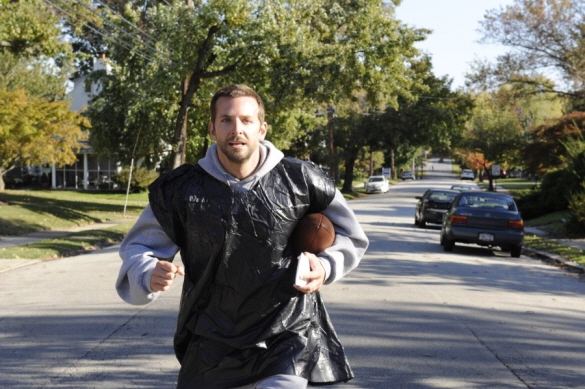
Like many romantic comedy movies, the movie begins its story with an unhappy hero, but Pat Solitano Jr.(Bradley Cooper) is quite an unhappy guy to observe. He has been suffering from bipolar disorder, and he even did not know about his mental problem until he totally screwed up his marriage. Due to a very violent incident involving his wife’s affair, his wife divorced him, and he lost his house and his job as a consequence, and now he has been in the mental health facility in Baltimore for 8 months.

Nevertheless, Pat tries to be optimistic with ‘positive thinking’ in spite of his uncertain future. Even before being released from the facility to live with his parents, he has become obsessed with regaining his wife back although the restraining order against him is still effective. He believes he can have his former happiness again through attaining this personal goal, and he even does not take drugs prescribed to him just because they always make his mind foggy and he believes he can live without them.

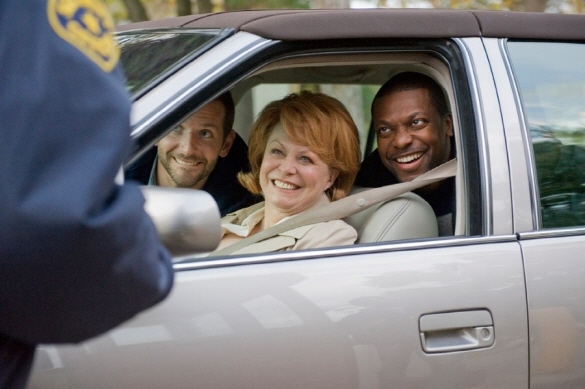
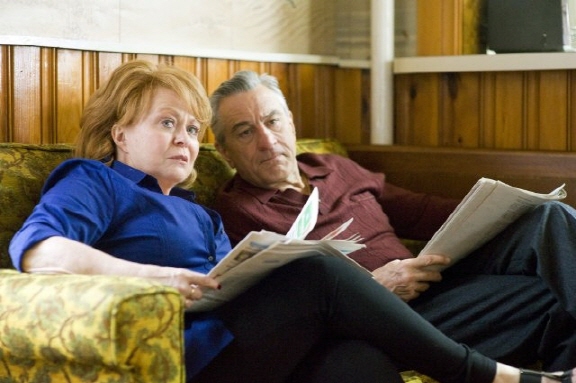
small_silverliningsplaybook06 While maintaining its lighthearted comical tone, the movie does not sugarcoat the reality of mental illness at all, and we come to see how insufferable Pat can be at times as he unintentionally disrupts his parents’ daily life many times. Madness may look romantic in some books and movies, but mental illness is not something you can easily live with every day, and you will probably come to admire how patient and understanding Pat’s parents are to their problematic son. Pat’s father Pat Sr.(Robert De Niro) also has his own obsession problem involving his favorite football team, and I really have no idea about how much his loving wife Dolores(Jacki Weaver) has tolerated her husband’s typical behaviors associated with obsessive–compulsive disorder.

On one day, Pat comes to meet Tiffany(Jennifer Lawrence), a sister-in-law of his close friend Ronnie(John Ortiz). Like him, Tiffany has her own mental problem; she became too promiscuous in her former workplace after suddenly losing her young husband, so she got fired and has been unemployed as a result. Not so surprisingly, Pat and Tiffany go through a Meet Cute/Meet Crazy moment while not realizing that they are attracted to each other during their first encounter at Ronnie’s house, and we get a very amusing moment as they share their experiences with prescribed drugs on the dinner table.

Their first meeting awkwardly ends, but their relationship begins to grow through their common problem. Tiffany actively approaches to Pat, and she gives an offer Pat cannot resist; if he practices with her as her dance partner for the upcoming dance competition, she will become a messenger between him and his wife for a while. Though initially reluctant about it, Pat eventually accepts this deal, so they begins to practice together at her house as the dance competition day is approaching.

small_silverliningsplaybook02

Now you have some pretty good idea about what will happen next. The movie mostly stays in its genre conventions as expected, but the director/screenplay writer David O. Russell takes a fresh approach to the conventions through his flawed but likable oddball characters, and it is fun to watch how the movie cleverly handles its offbeat elements in the confines of the conventions. Even the minor supporting characters like Pat’s psychiatrist(Anupam Kher) or Pat’s fellow patient Danny(Chris Tucker in a controlled comic mode) are colorful and lively as interesting characters, and they provide extra comedy at the fringe of the story while revolving around Pat and Tiffany. The dialogues in Russell’s screenplay based on the novel written by Matthew Quick are smart and earnest, and they are delivered with good comic timing by his talented actors.

As he did in his previous film “The Fighter”(2010), Russell draws uniformly good performances from his cast, and it is no wonder that “Silver Linings Playbook” became the first film which got Oscar-nominated in all four acting categories since “Reds”(1981). I must confess that I have never thought highly of Bradley Copper although recognizing his fairly good talent as a comedy actor, but he gives an excellent nuanced performance through deftly balancing his character on the line between humor and pathos. You may not want to live with Pat even at the ending, but Cooper presents his character as a nice man who cannot help himself sometimes in the struggle with his mental illness, and we come to care about Pat even though we cannot wholly like him.

The chemistry between the lead performers is always required for the success of romantic comedy movie, and Jennifer Lawrence’s spunky performance generates lots of chemistry through its effortless interactions with Cooper’s quirky performance on the screen. Since her breakthrough in “Winter’s Bone”(2010), Lawrence has been impressively advancing her promising career while appearing the blockbuster films such as “The Hunger Games”(2012), and now she pleasantly brandishes her comic talents as an unstable but plucky girl with lots of hearts. Lawrence and Cooper are pleasure to watch as a likable (and good-looking) couple, and she has a wonderful scene where Tiffany convinces Pat’s Dad with his own logics involving some ridiculous superstitions we have seen from hardcore sports fan from time to time.

small_silverliningsplaybook03 As Pat’s obsessive dad, Robert De Niro, who has been rather disappointing during recent years, shows us that he has lost none of his talent as a great actor despite several awful movies he appeared in. Pat Sr. is so enthusiastic and fanatic about his favorite football team that he does not miss any match on TV(he has been banned from coming to the stadium for years due to his violent outburst in the past, by the way), and the way he tries to get a chance to start his own business through bookmaking makes an interesting parallel to Pat’s attempt to regain his wife; both of them try to be happy through their respective crazy ways fueled by their madness, and how their respective attempts are paid off in a way they never imagined is another amusement added to the story.

With Jacki Weaver, who deserves her surprise Oscar nomination as her small but crucial supporting performance, De Niro makes their scenes warm and sincere. Just like his son, Pat Sr. does not see his own problems while clearly observing the problems from his son, but he tries to connect with his son through sharing his enthusiasm with him, and his advice to Pat around the finale rings true even though we are not so surprised about what he says. Completely different from her diabolical performance in “Animal Kingdom”(2010), Weaver is less showy than her co-performers, but she is important in the story as the practical voice of sanity amid other characters’ craziness. As a long-suffering wife and mother, Dolores knows it is always hard to persuade her husband and her son to do something a little more sensible, but she keeps trying, and she gradually reveals herself as a solid ground supporting her incorrigible family.

small_silverliningsplaybook04 Like “Little Miss Sunshine”(2006), another popular comedy about dysfunctional family, “Silver Linings Playbook” shows how a familiar story can be freshened up a lot by distinctive elements for good comedy. As a matter of fact, I was really glad to see the movie sidestepping one of the most tedious conventions in romantic comedy at one point. There is a classic moment of misunderstanding we have seen from other countless romantic comedy movies, but the movie does not get trapped into such a cliché like that because its characters are the brutally honest people who immediately follow their heart as soon as they decide.

On the whole the movie is an engaging romantic comedy about human eccentricity(or insanity, perhaps). Even when it arrives at its expected ending, the movie reminds us that they are still have problems and will probably face the other troubles as their life goes on, but there is a silver lining inside their last scene; they become a little more optimistic about their life than before. This is nothing new, but the movie knows how to deliver it with deep empathy and good laughs as dutifully following its plot, and that is why it is one of the sweetest and wittiest comedies I encountered recently.

BRADLEY COOPER stars in SILVER LININGS PLAYBOOK

Posted in Movies | Tagged , , , , , , | Leave a comment

The Impossible (2012) ☆☆☆1/2(3.5/4) : A devastating and hurtful disaster drama

NAOMI WATTS and TOM HOLLAND star in THE IMPOSSIBLEI have seen many disaster films, but few ones were as devastating and hurtful as “The Impossible”. Inspired by a real-life story inside the most disastrous Tsunami incident in the human history, the movie reminded me of how little I knew about this huge catastrophe – and its chaotic aftermath which the characters in the movie painfully and desperately struggle through. Although its view on the disaster is notably biased, there are genuine emotions swelling in the movie through its rather subjective but intimate view, and that makes the movie a very powerful human drama we rarely encounter in its genre.

After its prologue subtitle, the movie instantly focuses on the Bennetts, an Australian family who has been living in Japan for years. They are about to have their Christmas vacation, and they are expecting to have a good time at their vacation place in Thailand. Henry(Ewan McGregor), a father of three boys, has some worry about his job in Japan, and the room they wanted is not reserved for them, but they come to spend a wonderful time with other guests on Christmas Eve – and we soon see them having a nice rest around the pool in the morning of that fateful day, December 26th, 2004.

The Indian Ocean Tsunami, which was previously shown in Clint Eastwood’s film “Hereafter”(2010) with striking effect during its beginning, is presented here with dramatic power to chill your nerve. Even before the people fully realize what is happening and run into safe places, everything is quickly engulfed and swept by the speedy and destructive wall of water, and this is a really terrifying moment to watch. When I saw the Tsunami indirectly on TV, it just looked like a wave merely advancing on the land, but, through the views of the characters in the movie, I got a gut-chilling feeling as watching the Tsunami ruthlessly sweeping everything in front of it; I would be as stunned as them if I were in their circumstance.

theimpossible05When the immediate danger is over, Henry’s wife Maria(Naomi Watts) luckily survives with her son Lucas(Tom Holland), but their ordeal is far from being over. Maria is badly injured, so it is Lucas’ job to support her while they are desperately looking for help. They fortunately arrive at the hospital, but the place has already become busy and chaotic with the increasing number of the injured. Lucas is nearly helpless in front of his mother’s suffering, but he does as much as he can do for helping her – and the others in the hospital.

Along with the Tsunami sequence, the part depicting their grueling ordeal is the best part of the film, and Naomi Watts, who was recently Oscar-nominated for this film, gives a strong physical performance which can reach to your nerve ends even when her character gradually becomes immobile on her bed due to her worsening health condition; every time Maria tries to move, we can feel how much hard and painful it is for her to do that, and Watts is devastating to watch as her character is weakened hour by hour.

As her confused son affected by the disaster as much as her, a young newcomer Tom Holland movingly holds the center during the second part of the story while delivering a performance which deserves to be mentioned along with Quvenzhané Wallis in “Beasts of the Southern Wild”(2012), Suraj Sharma in “Life of Pi(2012), and Kara Hayward and Jared Gilman in “Moonrise Kingdom”(2012). While feeling very awkward and burdened about becoming his mother’s only and equal partner during their quest for survival, this adolescent boy also sees a grave possibility of losing his mother and being left alone by himself, and his inner torment amid confusion is vividly conveyed to us through Holland’s harrowing performance.

Ewan McGregor, who is technically the lead actor in the credit, is also convincing as a normal family man during his scenes with other main performers, and his difficult search for his wife and eldest son is an effective dramatic parallel to the main plot. I heard that the family in the real-life story was actually Spanish(you can see their family photo before the end credit), but it is an understandable change considering that McGregor and Watts are more widely known actors who can draw more audiences. After all, the movie was made by the Spanish director and his Spanish crews, so I respect their choice.

small_theimpossible04Although the plot is pretty simple, the director Juan Antonio Bayona keeps holding our attraction through the real pains and desperation of his characters while establishing the bright but desolate atmosphere through the wide, bleak sights shown after the Tsunami. Even though I learned later that Watts and Holland were actually in a big water tank while they shot the Tsunami sequence, CGIs in the film look so believable that I could believe their characters were right in the middle of the ongoing disaster.

If there is a problem with the story, it is its biased view on the disaster itself. I noticed that, while tightly concentrating on its main characters’ physical and psychological pains, the movie does not focus much on the local people in Thailand, who were far more devastated in real life compared to the foreign visitors like the Bennett family(Around 230,000 people lost their lives in several South Asian nations at that time, and most of them were the local people). The Thai people in the movie are mostly depicted as the bystanders speaking a language incomprehensible to the main characters except few minor characters who can speak English, but at least they are shown in a positive view as the kind people willingly helping their injured visitors in spite of their own damages.

Despite its flaws, the emotional intensity in the movie is well accomplished by its one-sided but focused approach, and “The Impossible” succeeds in pulling strong emotions from its direct and earnest presentation of a story about ordinary people suddenly swept by a catastrophe beyond their imagination. Even though it gets a little too manipulative around the finale and you can clearly see that the movie is trying to pull strings behind the screen, it works thanks to the solid performances and straightforward storytelling. The movie does something different from many disaster dramas, and I think its undeniable results compensate a lot for its weak points.

small_theimpossible03

Posted in Movies | Tagged , , , | Leave a comment