Beyond the Hills (2012) ☆☆☆1/2(3.5/4) : A devastating clash between two values

beyondthehills01 Loosely based on a shocking real-life incident, Romanian film “Beyond the Hills” presents us a slow but compelling drama about two young women entangled in a simple but difficult circumstance caused by two conflicting values. While not taking sides with any of its characters in its objective and unobtrusive view except a few moments in its long running time, the movie calmly observes how they come to be cornered by misguided religious belief and other factors step by step, and we cannot help but be maddened about how their circumstance is developed into a devastating outcome by themselves and, above all, others surrounding and influencing them.

The story begins with Alina(Cristina Flutur) returning to her hometown in Romania from Germany, where she has worked for several years. The main purpose of her return is meeting Voichita(Cosmina Stratan), who has been her best friend since they grew up together in their orphanage. As soon as Alina sees Voichita at the train station, she immediately hugs her friend quite tightly, and the movie indirectly implies that they are probably a lot more than BFFs.

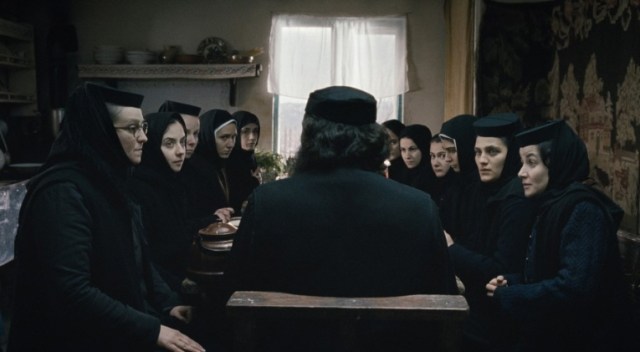
Alina wants to go back to Germany with Voichita for their life together, but she finds that Voichita cannot be persuaded easily because Voichita has been in an Orthodox covent for years as being under the heavy influence from her priest(Valeriu Andriuta) and Mother Superior(Dana Tapalaga), who have been literally daddy and mommy to her. Now becoming a nun devoted to the love of God, Voichita does not want to leave her convent even though she dearly loves her friend as before. Alina is determined to persuade her during her temporary stay in the convent, but it is not that easy under the stern rules of this small community unwelcoming to infidels. During their dinnertime, the Priest frankly talks about his opinions on the modern world outside, and Alina clearly sees whom his words aim at.
small_beyondthehills05The time passes along with the daily routine at the convent as Alina is frustrated about no particular advance in persuading her friend to change her mind. Although the convent is located in a remote place outside the town and it does not even have electricity(but they have a charged cellular phone for emergency), Voichita and others sometimes go outside with their maintenance man’s old car for getting groceries or visiting the orphanage where Alina and Voichita grew up. We also see Alicia’s older brother, who seems to be mentally retarded and later gets a job at the convent.

And then, suddenly, Alicia begins to show disturbing behaviors for some reasons. The Priest and the nuns do what any sensible people will do in such a circumstance; they take her to the hospital, and she spends several days of medication and observation at the hospital. She seems to be recovered, and she is sent to the convent for further recovery, but she becomes more erratic, disturbed, and violent. Alicia becomes distressed because she worries about her friend’s worsening condition and that threatens her position in the convent. Disturbed not only by Alica but also by the ‘signs’ they see, the Priest and nuns come to believe that Alica is possessed – so they decide do something about her illness.

The director/the writer Cristian Mungiu’s previous work was “4 Months, 3 Weeks and 2 Days”(2007), one of the best films I saw in 2008, and its transparent but engrossing approach is also applied well here in this film. While his camera steadily follows the characters in many long takes like an unseen observer, Mungiu effectively establishes and builds emotions and tensions on the screen as he subtly unfolds his story in the characters’ claustrophobic environment, and the movie feels rarely tedious although it becomes repetitious at times in the middle of the story.

small_beyondthehills07The movie holds its opinions behind its back throughout the story in its detached observation, but it is apparent to us that Alina is an unfortunate victim of absurd superstitions and old-fashioned religious belief, although she is not entirely clean in her situation. While we can be sympathetic to her desperate attempt to retrieve only friend she can depend on, she becomes more distant to us as becoming a more problematic presence to the people at the convent(at her most zealous moments, she reminded me of the disturbed heroine of “The Story of Adele H”(1975)). The Priest, who is not an unmerciful tyrant in spite of his stubborn narrow-minded religious view, actually tries to deal with her mental illness nicely at first, but, when they think they cannot get any other help from outside(the hospital cannot afford her and neither can her adapted family), he and others eventually turn to a brutal exorcism ritual which can be regarded as a medieval form of shock therapy.

The movie wisely avoids being sensational or exploitative through its phlegmatic tone and restrained realistic depiction during their exorcism scenes, which consist of tying Alina on the ‘cross’ and reading the bible to her continuously for days. They commit such a cruelty like that out of their firm belief that they are doing a right thing for her, and that makes these moments more horrifying. The performances are entirely believable and natural, and the lead actresses Cosmina Stratan and Cristina Flutur deservedly received the Best Actress award for their convincing duo performance at the Cannes Film Festival early in this year(The movie also received Best Screenplay award for Mungiu).

“Beyond the Hills”, Romania’s official submission to the Best Foreign Language Film of 2013 Oscar, is inspired by two non-fiction books by Tatiana Niculescu Bran, which were about the real-life case of a young member of a monastery who died after an exorcism ritual in 2005. The movie almost keeps its neutral attitude straight even when it eventually faces the tragic consequence in the finale, but, whatever you think about what happen in the movie and the responsibility associated it, one thing was pretty clear to me during its lingering last scene; even after facing the consequence, they have little idea about what they have done to that poor girl. How pathetic and ignorant they are – and how horrible and oppressing we can be just because of a mere religious belief.

small_beyondthehills06

Posted in Movies | Tagged , , , , , , , , | Leave a comment

Wreck-It Ralph (2012) ☆☆☆(3/4) : He wants to be a good guy this time

wreckitralph05 Disney’s new digital animation film “Wreck-It Ralph” reaches to my nostalgia with a handful of video games I played during my childhood and adolescent years. I had little interest on playing video games unlike my schoolmates, but I was drawn to a few lighthearted ones such as Packman or Bubble Bobble, and I enjoyed them a lot as I tried to pass each level with buttons and sticks.

And I might have been interested in playing “Fix-it Felix Jr.”, one of the arcade games in the story of “Wreck-It Ralph”. The setting is pretty simple but this arcade game is as fun as it can be as a 30-year-old game which has occupied the same place at Litwak’s Arcade for a long time. Whenever a new level is started, its villain Ralph breaks everything in his sights as programmed, and it is Felix’s(and the player’s) job to fix everything quickly with his magic hammer for finishing each level and getting a gold medal in the end.

If Ralph(voiced by John C. Reilly) was merely a figure consisting of digital codes, he could not feel boredom at all, but he is a game figure residing in his arcade game with other figures, and he has been tired of his role as a bad guy. The people of his game always praise Felix(voiced by cheerful Jack McBrayer from TV series “30 Rocks”), but they never care about Ralph, and he lives alone in a dump site next to an apartment building where Felix and others live together as a happy community.

wreckitralph01 It has been a small consolation to Ralph that his world is not limited to his home and workplace. Whenever the arcade is closed at night, the video game characters can freely go around through the interconnecting electronic circuits between their games until the place is opened in the next morning, and they even have the main terminal where we can see several familiar video game characters walking around. As a matter of fact, Ralph recently starts to attend a support group meeting for the video game antagonists, “Bad-Anon”, and you may recognize some of them with some smile and amusement(their motto: One game at a time).

Anyway, Ralph finally decides not to play a bad guy anymore. He becomes determined to get a gold medal for the acceptance he has yearned for, so, when he accidentally encounters a chance to go inside the other games, he seizes it without hesitation, but he has no idea about what games he goes into – or what kind of crisis he causes through his reckless actions.

It is a little disappointing that “Wreck-it Ralph” directly handles only few video games in its story, but it is instead equipped with good-looking animation, likable characters we can care about, and many humorous and smart touches sprinkled throughout its video game worlds. Though this is an digital animated film, the movements of the characters in Ralph’s game amusingly reflect the mannerisms of your average 8-bit video game characters, and I and the audiences were especially amused by how sincerely Sergeant Calhoun(voiced by Jane Lynch with gusto), a brash no-nonsense leader of the latest high-definition arcade game named Hero’s Duty, reacts to her, uh, programmed past. Hero’s Duty is one of those games where you shoot any digital enemy on your sight in the apocalyptic background not so different from Resident Evil, and Calhoun is your lady to depend on whenever the coins are inserted.

The story mainly revolves around another arcade game called Sugar Rush, whose very, very sweet world may make your blood sugar level increased quickly even with a few seconds of glance. Its ruler is King Candy(Alan Tudyk), and many of his people are various kinds of sweet carbohydrate products like candies or doughnuts, and its landscapes include many colorful sights such as candy trees or a caramel swamp.

small_wreckitralph02 In such a sweet new world unfolded before him, Ralph gets acquainted with another lonely game character named Vanellope(voiced by Sarah Silverman), who has been ostracized by other game characters of Sugar Rush due to her ‘glitch’. Ralph and Vanellope quickly become a typical mismatched duo as they try to attain their respective goals, and John C. Reilly and Sarah Silverman interact with each well as a lovable big guy with soft sides and a tiny plucky girl full of boundless optimism.

How their story is resolved and what they learn through their adventure are pretty conventional to say the least, but the director/co-writer Rich Moore and his crews made an entertaining animated film filled with humor and excitement. There is not anything particularly new during the action-packed climax involving speedy car race during its third act, but it keeps finding something for good laughs even when its pace becomes a little too hurried.

“Wreck-It Ralph” is a sweet enjoyable animation recently nominated for Best Animated Feature film at the Golden Globe awards, and it will probably be Oscar-nominated later in next January considering that there is no particularly strong candidate among the notable animated films of this year. When I came to the screening room in this evening, the place was packed with young audiences as well as older audiences, and it seemed the latter had more fun because of their personal memories. In case of young audiences, well, how could they resist a bright, colorful, and speedy fun? They certainly did not need 3D glasses for appreciating that.

Sidenote: The movie is preceded by an animated short film “Paper Man”, a melancholic but warm comic romance whose surreal moment reminded me of one bizarre moment involving a bunch of papers in “Brazil”(1985).

small_wreckitralph04

Posted in Movies | Tagged , , , | Leave a comment

Les Misérables (2012) ☆☆☆(3/4) : A musical with all substance and no style

small_lesmiserables02“Les Misérables” is a curious musical film with all substance and no style. Inside its epic story, there lies the emotional power to grip you and then sweep you to the finale as the movie struggles through its 2 1/2 hours of running time, and its almost relentless parade of melodramatic songs keeps penetrating through the emotional barricade at your eardrums even when you surrender to it, but the movie is also hampered by its questionable visual approach to the source material as well as its inherent narrative flaws apparently shown here and there in the screenplay. Fortunately, the substance compensates for the flawed(or absent) style to some degrees through its undeniable power, but I also recognize that there are good reasons why some critics do not like it.

Unlike many of you, I am not very familiar with the musical play adapted from Victor Hugo’s 1862 classic novel with the same name, although I have heard about lots of good words about it while never having the chance to listen to its recordings or watch it on the stage. After the first performance in Paris in 1980, the original French musical play was later successfully adapted into the English version for the West End and Broadway productions, and it was one of the famous smash hits in the 1980s along with “Cats”, “Miss Saigon”, and “The Phantom of the Opera”. Though more than 30 years have passed since its original performance, it remains as a popular musical play thanks to good music and memorable songs, and, as far as I remember, they have also put it on the stage in South Korea several times recently.

Despite its popularity, “Les Misérables” was not adapted into a film version for quite a long time mainly because it is a dense sung-through musical play packed with more than 40 songs from the prologue to the finale. While that aspect makes it pretty hard to adapt it into a coherent and faithful film version, the musical also has its own adaptation problems including its choppy narrative. After all, they tried to condense Hugo’s magnum opus into one single musical play, didn’t they?

Rather than dealing with these problems and others in his story, the director Tom Hopper, who won an Oscar for his previous film “The King’s Speech”(2010), stuck to the wall-to-wall musical narrative just like Alan Parker did in “Evita”(1996). As soon as one song is over, here comes another song immediately, and this pattern rapidly goes on and on with no particular change, and the movie never looks back until it arrives at the rousing closing song performed by full company.

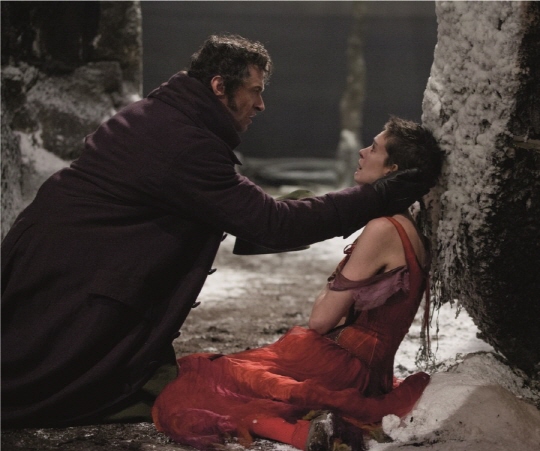
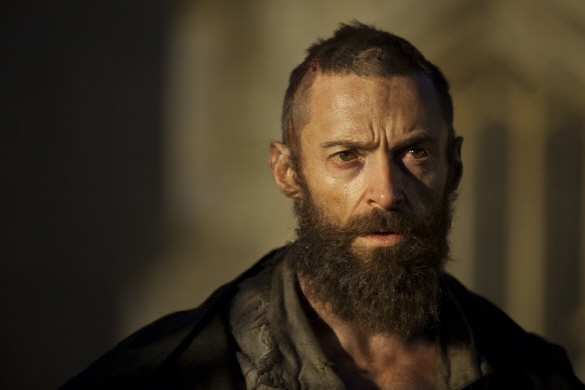
small_lesmiserables03 A very good example is shown right from its beginning, where everything is delivered quickly within around 15 minutes to show how Jean Valjean(Hugh Jackman) decides to lead a new life and leave behind his dark past. During the big opening number(“Work Song”), Valjean is finally released under the supervision of a severe policeman Javert(Russell Crowe) after enduring 19 years of labor sentence just because he stole bread for his starving family and subsequently tried to escape. The quick progression of musical montage shows how harshly Valjean is treated by others as an ex-convict until he arrives at the residence of a kind bishop(played by Colm Wilkinson, who played Valjean in the West End and Broadway productions), whose merciful act inspires Valjean to search for redemption and, of course, sing another song(“What Have I Done?”).

This relentless musical narrative could have been very successful, but the movie simultaneously succeeds and fails as it forcefully marches on its plot with firm conviction like the French army in the film. Except when the camera makes its obligatory sweeping movement on the screen, the camerawork in the film feels static and, sometimes, quite suffocating. Especially when Jackman and his co-performers are singing, the movie mostly looks only at the actors, not the backgrounds, so I felt the constant urge to see what’s outside the screen even though I was entertained by the songs. I must say its production design and costumes are excellent as demanded, and they will probably be Oscar-nominated in the next year, but I doubt whether they will be able to win Oscar, considering that its problematic editing and cinematography leave little space for appreciating the crew’s efforts.

However, even when the movie is bound by these flaws, the dramatic power from the music and songs somehow keeps its rickety story rolling as the movie hurriedly juggles the songs and the characters. Even though he tries to become a new man, Valjean cannot possibly escape from the watchful eyes of Javert thanks to the endless coincidences observed in the 19th European novels, and he continues to hide along with Cosette(Isabelle Allen), a young girl who comes to be taken care of by him after the tragic demise of her poor mother Fantine(Anne Hathaway). Hathaway appears briefly in this big movie, but she makes her character’s downward plight hauntingly heartbreaking and delivers her sad songs as well as she can do during her short appearance.

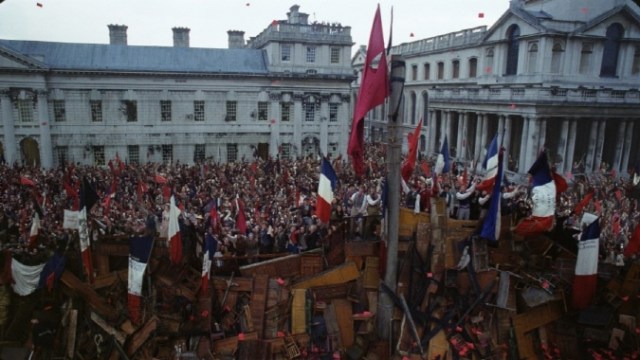
small_lesmiserables04 Many years have quickly passed while so many things happen along with so many songs, and Cosette, now played by Amanda Seyfried, becomes a young Parisian girl attracted to a young idealistic revolutionary Marius(Eddie Redmayne). Marius and his comrades later attempt a revolution against the French government, and the movie manages to generate excitement and passion as most of the characters including Valjean are being swept by a big historical event.

While the movie becomes messy and choppy frequently, the actors in the film seldom lose their positions. They were tasked with a difficult job of establishing their characters while singing well enough to engage us right in front of the camera, and most of them are more than adequate. Hugh Jackman is a dependable leading man for musical film, and Anne Hathaway deserves to run in the current Oscar race because of her showstopper moment with “I Dreamed Dream”. Sacha Baron Cohen and Helena Bonham Carter are fun as a nasty comic relief duo who have no qualm about exploiting not only Fantine and Cosette but also others in their sight, and Samantha Barks is poignant as their ill-fated daughter Éponine, a low-life girl who has carried a torch for Marius but has to admit sorrowfully that he will never be her man. While Amanda Seyfried and Eddie Redmayne look less distinctive compared to others as a young innocent couple in love(it’s not their fault), Russell Crowe seriously lacks the menace and obsession of his character in his singing despite his tough guy persona, but at least he is not as disastrous as Pierce Brosnan in “Momma Mia!”(2008).
small_lesmiserables06It goes without saying that “Les Misérables” is not a successful musical film in visual aspects, but it is one of more heartfelt versions among many, many adaptations of Victor Hugo’s novel(there have been at least 24 adaptations since 1913). Many memorable moments in Hugo’s novel usually come from the internal struggles and conflicts inside Valjean and others, and the songs in the musical play are the effective tools to draw up their agonies and dilemmas inside their hearts and then powerfully amplify them in front of our eyes and ears, and the movie partially works because of that strength.

Nevertheless, though my heart was stimulated by its content more than I expected, my logical brain still reminds me that it could be more visually engrossing or visceral on its surface if it had been handled by a more experienced director like, say, Alan Parker. Now I feel as conflicted as Javert before his exit, but I don’t think I will have to throw myself into the Seine River just because I give the movie 3 star instead of 2.5 stars.

small_lesmiserables05

Posted in Movies | Tagged , , , | 2 Comments

Photos from one snowy day(12/09/12)

                  
Snow was being accumulated during this day…
Posted in Photos | Tagged , | 1 Comment

The Hobbit: An Unexpected Journey (2012) ☆☆1/2(2.5/4) : It’s a long, long start….

small_Thehobbitpt101In 2000, I read J.R.R. Tolkein’s “The Lord of the Rings” for the first time after hearing the news about Peter Jackson’s ambitious plan for making that epic trilogy into three films. Although the translated version I read was not very good(they divided the whole story into five books, and I mistook Meriadoc Brandybuck for a girl), I had a nice time with Tolkein’s bountiful fantasy world, and I became curious about his previous work “The Hobbit” as soon as I finished reading “The Lord of the Rings”.

Like I did in that year, Peter Jackson went back to the origin of his massive technical achievement which got him 3 Oscars, and “The Hobbit: An Unexpected Journey” delivers as much as it promised, but it has several crucial problems. While it is nice to see the Middle Earth again on the big screen, this beautiful fantasy world in this film does not reach to the level of wonder and enchantment experienced in Jackson’s trilogy films, and what we get here is one of the expensive standard products which have kept coming out since the breakout success of Jackson’s trilogy films and the Harry Potter series.

In addition, as many of you heard, Jackson bloated Tolkien’s small book, which is far shorter than its sequel, into a fantasy action story on an epic scale, and he even divided the book into three films. I think the whole plot of “The Hobbit: An Unexpected Journey” can be succinctly reduced to at least 40 minutes, but the movie already consumes around 40 minutes at Bilbo Baggins’ house even before his unexpected journey actually starts, and that is just the first taste of this overstuffed production. While lots of things happen during the next two hours, the characters are still at the beginning of their journey when the end credit rolls(this is not a spoiler at all), and we know that there will be another two films probably longer than 160 minutes. As far as I remember, reading “The Hobbit” did not take so long like that.

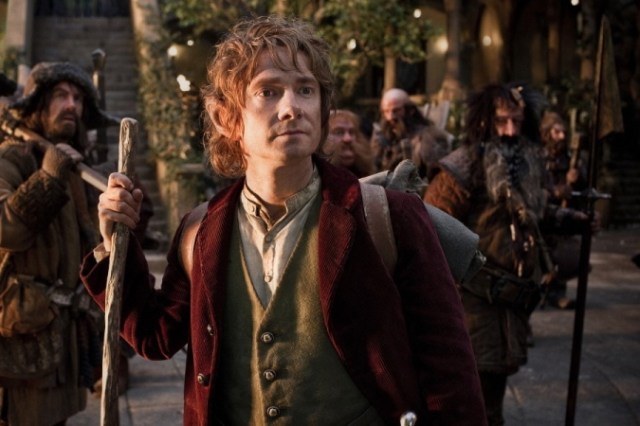
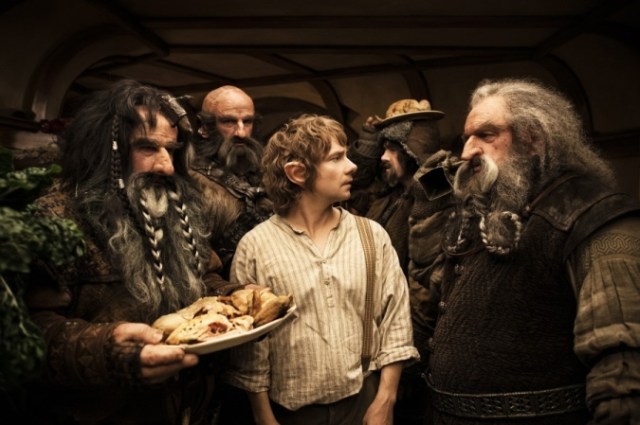
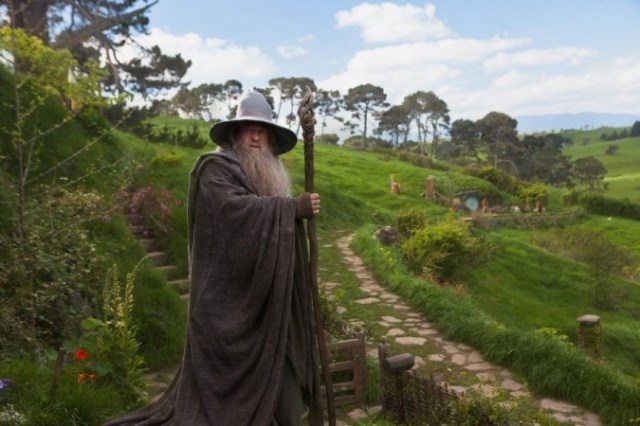
small_Thehobbitpt102After the long prologue sequence which introduces us two familiar characters along with the background story which can be told within few minutes rather than presented through big CGI action scenes, we meet young hobbit Bilbo Baggins(Martin Freeman) enjoying another uneventful day at his home Bag End in Hobbiton, a pastoral town which looks as greenish as it appeared in front of us for the first time in 2001. Bilbo wants to continue his leisurely lifestyle as long as he can live, but his quiet time in the afternoon is interrupted by a sudden visit of the great wizard Gandalf(Ian McKellen), and, thanks to Gandalf’s subtle and wily manipulation, he soon finds himself serving a bunch of dwarfs led by Thorin Oakenshield(Richard Armitage) as their host in the evening. On the next day, Bilbo eventually comes to join the dwarfs’ quest as their 14th member, and he and others go through many perilous moments involving trolls, orcs, goblins, rock giants, and, of course, Gollum(Andy Serkis).

The purpose of the dwarfs’ quest is killing a vicious dragon named Smaug and recapturing the Lonely Mountain, which is also called Erebor, along with the heaps of treasure inside that place. After losing their place to Smaug, the dwarfs have been wandering around for many years, and now Thorin decides it is time to regain the glory of their lost kingdom. He is accompanied with his loyal twelve dwarfs, and I must say I admire Gandalf’s sharp skill to check every dwarf at once without any confusion. They do not look entirely indistinguishable from each other, but can you tell me who is Bifur and who is Bofur?

As Bilbo and Gandalf and the dwarfs plod along their way, the movie throws lots and lots of stuffs into the screen, and it is excessive at times. The screenplay by Peter Jackson, Guillermo del Toro, and Jackson’s usual collaborators Fran Walsh and Philippa Boyens is not an awful adaptation, but it is problematic because everything in the book is expanded or bloated in the film. That aspect frequently hurts the pace of the story as the movie keeps loitering on its way with several supporting characters including another wizard Radagast(Sylvester McCoy) and their side stories which could have been handled more briefly. The action scenes are handled well in most cases, but they feel like the echoes from the excitements we had long time ago, and there is the constant feeling of déjà vu as we watch the characters are hurled into the actions in the movie.

small_Thehobbitpt106And there is a serious problem with its high frame rate 3D. Photographed at 48 frames per second, the movie looks indeed clear and distinct, but, ironically, the hfr 3D version looks pretty awkward on the screen due to its high quality, and I thought about how awkward it was to watch one of my DVDs when I accidentally set my PowerDVD blu-ray player program in the forced high definition mode. The movements of the characters feel a little too rapid and strange many times, and the special effects and set designs surrounding characters feel more unreal. I was not looking at a believable fantasy world; I was looking at the studio sets decorated with special effects.

But I must point out that the movie was not an unpleasant experience at least, if a distracting one. Even though the movie is unnecessarily long, I think I will be able to enjoy the movie a little more if I watch its plain 2D version. I was entertained a bit by a thrilling action sequence with rocky giants, and I appreciated few humorous moments in the movie such a funny scene with three stooge trolls, and I was sort of glad to see several familiar places and familiar faces. Ian McKellen is fun to watch, and Martin Freeman is a little likable hero who rises to the occasion in the end, and it is nice to watch Cate Blanchett, Hugo Weaving, Ian Holm, Elijah Wood, and Christopher Lee reprising their respective roles from Jackson’s trilogy films. The special mention must go to Andy Serkis, who steals the show again through reprising his under-appreciated motion capture performance as Gollum, a loathsome but pitiful creature who gets the best moment of the movie during Bilbo’s fateful encounter with Gollum and his “precious” in his dark, lonely, and miserable subterranean lair.

“The Hobbit: An Unexpected Journey” is not a terrible movie at all, and it has some good things to be appreciated, but I do not think such a long movie is necessary for telling a small part of the story which is already small enough to be handled in one 3-hour movie. The Lord of the Rings trilogy is a serious epic story which is able to accomodate more than 9 hours, but “The Hobbit” is a lightweight adventure story with no burden, and the strains due to its ponderous adaptation process are apparently shown in this first installment of the planned trilogy. I believe Jackson and his actors and crews will maintain the technical quality in the next two films to come, but, boy, it’s a long, long start for a far longer journey.

small_Thehobbitpt103

Posted in Movies | Tagged , | 2 Comments

Margin Call (2011) ☆☆☆(3/4) : A group of people facing a big financial disaster

JD in black slip as white trash“Margin Call” can be categorized as disaster movie. The people in the film have overlooked the risk which has existed from the very beginning, and now they face a grim disaster on the horizon which is soon going to engulf not only them but also the whole world outside. For their survival, they must do something – regardless of whether they like it or not.

Though the movie is entirely a fiction, the disaster not directly shown in the film is not a fiction at all. Thanks to the irresponsible and risky speculations by the big financial companies of Wall Street during the 2000s, the global economy was eventually hit hard by the huge financial crisis in 2008, and that resulted in the massive loss of money and jobs around the world which is still affecting our reality.

The movie mainly focuses on the two long days of 2008 at one of big financial companies in New York, which is probably based on that notorious Lehman Brothers Holdings Inc. The heat in their market is now starting to decrease, so the executives of the company choose a drastic measure for keeping their company intact. Several people suddenly come into the office, and many employees are summoned one by one, and the people in the building all know what’s going on around them.

One of the fired people is Eric Dale(Stanley Tucci), a senior member of the risk management department. Although he is working on something important, he is promptly cut off from the company along with an adequate severance package, so he hands his data to one of the junior employees in the company right after he works out of his office. Peter Sullivan(Zachary Quinto) does not grasp the meaning behind what Dale tells him when he received a USB card, but, as he checks Dale’s data after office hour, a scary truth dawns on him; having been mired in very profitable but highly risky investments for years, the company is literally on the verge of bankruptcy, and its debts turn out to be far bigger than its assets.

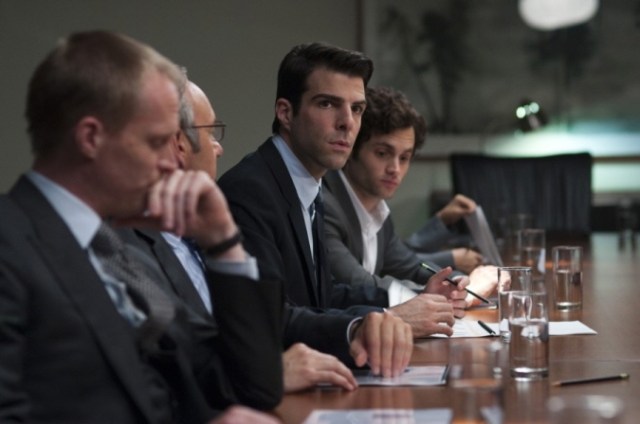
JD in black slip as white trashWe see how the emergent meeting is quickly prepared and held while this dire news is spread around few high-ranking employees and the executives and board members of the company. Sullivan tells what he has discovered to his co-worker Seth Bregman(Penn Badgley), who brings in their boss Will Emerson(Paul Bettany), who then calls his boss Sam Rogers(Kevin Spacey). Two executives, Jared Cohen(Simon Baker) and Sarah Robertson(Demi Moore), and others immediately come to the meeting, and, finally, John Tuld(Jeremy Irons), the CEO of the company, arrives to decide what they will do for getting out of this imminent disaster with minimal damages before others discover.

The movie mostly consists of the long conversation scenes between characters in the offices, but the director/writer J.C. Chandor, who was Oscar-nominated for his screenplay early in this year, made an engaging drama about desperate people facing a difficult situation with no clean solution available to them. You may not understand every word they say, but the pressure and panic among them feel as palpable as the crisis which is about to come upon them; unless they do something, they will be just swept along with others, and they certainly do not want that happen.

What is ultimately decided in the meeting and subsequently executed can be called a “fair trade”, but, just like the Wall Street people did before the crisis in 2008, they virtually sell their worthless assets to their clients even though they are well aware of that they discharge toxic garbage into the stock market. Some of them, including Rogers, concern about its possible consequence which will last for years, but Tuld does not mind about that. He will survive by any means necessary, and the market will come back to normalcy for him and other ‘winners’ just like it has many times in the financial history, and they will always be the ones who get the money no matter what happens to others. You probably remember that the executives in Wall Street responsible for the crisis managed to get away with what they had done while getting more money as their companies were sinking to the bottom like Titanic.

small_margincall04The movie has a wonderful ensemble presenting us a group of various people occupying their respective positions in the spectrum of morality/ethics of their business world. As the gray moral center of the story, Kevin Spacey shines especially when he pushes his men to do the job he does not privately approve of; he knows it is a wrong thing to do, but he accepts that it will be done regardless of whether he will do it or not. Paul Bettany is a cynical but caring man in love/hate relationship with his lucrative occupation, and Stanley Tucci has a small nice scene later in the story when his character talks about when he was more helpful to the society in his opinion. Simon Baker and Demi Moore are also good as the executives struggling to find a way to survive in their crisis, and, as an arrogant CEO, Jeremy Irons is fun to watch in his juiciest role in recent years. He has a very amusing line when Sullivan tries to explain the situation to Tuld, and that tells a lot about his character and his occupation: “Maybe you could tell me what is going on. And please, speak as you might to a young child. Or a golden retriever. It wasn’t brains that brought me here; I assure you that.”

“Margin Call” is a smart and compelling drama which tells a lot about the recent global financial crisis through its fiction just like the Oscar-winning documentary “Inside Job”(2010) did through its facts and data. Though the consequence of the characters’ decision is not shown in the movie, we all know what will happen after their ‘fire sale’, and we also know that it may happen again sooner or later because the people in Wall Street do not seem to learn much from their recent crisis. Well, as the movie bitingly points out at one point, neither do we.

JD in black slip as white trash

Posted in Movies | Tagged , , , | Leave a comment

Dredd 3D (2012) ☆☆1/2(2.5/4) : A judge’s rough day with a psychic rookie

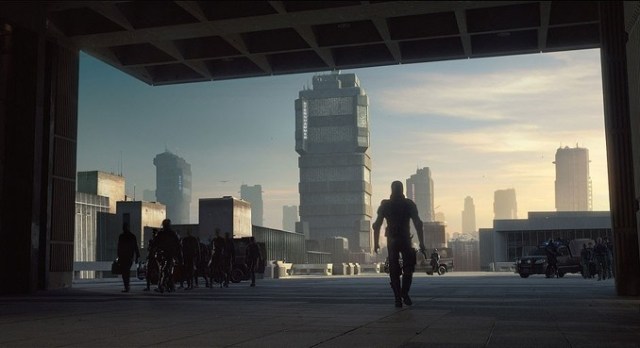
dredd3D01 Here is a good news; “Dredd 3D” is better and more enjoyable than that forgettable 1995 film based on the same British comic book by John Wagner and Carlos Ezquerra. While we have seen its dystopian world countless times before and the movie does not bring anything new or fresh much to its rather simple plot, it has some distinctions as a competent SF action film, and I was sort of entertained while lots of bad guys were kept being killed and the main characters remained nearly uninjured amid so many bullets and explosions on the screen.

At the beginning, we are introduced to a typical gloomy futuristic world where the Earth and the human race are at the near bottom. Most of American land is turned to radioactive poisoned wasteland, and surviving people are now living together in a huge metropolis which covers from Washington D.C. to Boston. You may think this is not so small, but imagine around 800 million people being crammed into this region while protected by the big walls surrounding the city from radioactivity – that’s definitely not something which can be called a good life.

Lots of people live in very big skyscraper buildings in the city as they struggle with poverty, and crimes naturally happen quite a lot in such a poor environment like that. As a draconian solution for this problem, there are the army of ‘judges’ who can be police, judge, and, in some cases, executioner, and one of the most famous judges is Dredd, but you cannot distinguish him easily from other judges because the lead actor Karl Urban always wears his protection helmet in the movie. If you thought Tom Hardy in “The Dark Knight Rises”(2012) was stuck in a thankless role, then reconsider your opinion after watching Urban delivering the lines as blandly as it is required with only his mouth and chin being shown throughout the film.

small_dredd3D04A good thing is, Dredd has recently gotten an identifiable character to interact with after dealing with another bunch of badass criminals as usual during the opening action sequence. Her name is Anderson(Olivia Thirbly), and she does not want to wear helmet just because it impedes her mind-reading ability. In the world where criminals are willing to fight and shoot rather than surrender themselves to judges to be sent to jail, that does not look like a wise choice, but at least she can know whether they are really determined to shoot her or not, can’t she?

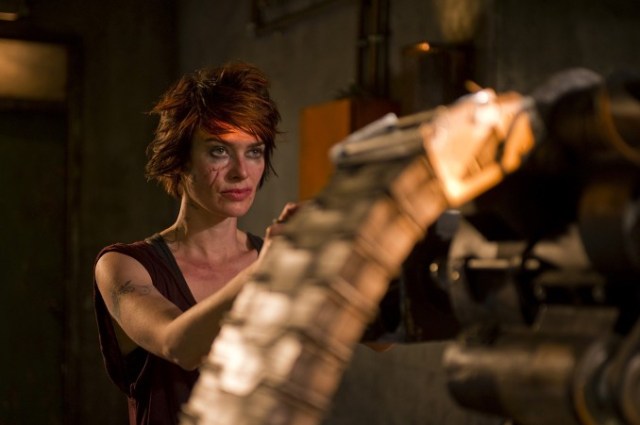
Because Dredd’s direct boss considers accepting her due to her psychic ability in spite of several good reasons for disqualification, Dredd reluctantly takes this young rookie to his field service for checking her competence as a judge, and, like any main characters in buddy cop movies, they come across a very big danger as soon as they start their patrol. When they decide to dig deeper into a simple case of gruesome multiple killings at one of those skyscraper buildings, a powerful crime lord named Mama(Lena Headey) is not so pleased about that – especially when Dredd and Anderson arrest Key(Wood Harris), who can tell a lot about her gang organization as one of her main henchmen.

Thanks to Mama’s prompt action, Dredd and Anderson soon find themselves in the circumstance not that different from the one shown in a recent Indonesian action film “Raid: Redemption”(2011). The building is completely blocked from the outside as Mama takes the full control of the building at her lair which happens to be at the top of the building, and then she coldly announces the killing time for her thugs. Dredd and Anderson realize there is really no one to help them in the building, and they must find a way to get out of the building with their arrested criminal for themselves.

dredd3D06I have no idea about whether the movie is influenced by “Raid: Redemption” or not, but the movie provides its entertainment amid lots of shootings and explosions in its vast closed space. Its dark and shabby corridors inside the building are good background for actions, and the cinematographer Anthony Dod Mentle, who won an Oscar for “Slumdog Millionaire”(2008), does a nice job of providing enough gritty feeling to the action scenes, but I think the movie could use less slow motion effects, which are usually used for describing the effect of new drug produced by Mama’s organization. Most of them exist mainly for 3D glasses, and, even if you do not wear 3D glasses, the intent is clearly shown whenever things such droplets of blood are flying across the screen.

The director Pete Travis, who did not make much impression on me with his previous work “Vantage Point”(2008), did a better job here. Although the premise is pretty simple, he keeps the actions in the film crackling throughout its short running time(95 minutes including the end credits). Urban does not have many things to do with his character, but he delivers an adequate performance within the limits forced upon him, and Olivia Thirlby supports him well as someone we can identify with more than Dredd. While the bad guys in the film are mostly cardboards to be shot or thrown to the ground floor, Lena Headey is a little more interesting as a ruthless boss who can pull more strings than we expect. As a woman who has climbed up to her current position in very hard ways, Mama will not give up her business easily, and we know she will protect it by any means necessary.

Overall, “Dread 3D” is a well-made violent SF action film which is more comfortable to enjoy than “Raid: Redemption”. It is less intense and less relentless, but it is also less mindless, and the movie has few nice little things besides its violent actions. As a competent pilot, the movie certainly has the potentials for the next stories to follow, and I heard that they are planning to make two sequels despite its modest failure at US box office; maybe we can expect better things later.

dredd3D02

Posted in Movies | Tagged , , , , | Leave a comment

Amour (2012) ☆☆☆1/2(3.5/4) : Scenes from their dying marriage

small_amour02 Our life is bound to be sad and depressing because of aging and subsequent death, and Michael Haneke’s new movie “Amour” shows that undeniable truth to us through an unsentimental but deeply harrowing observation of an aging couple who begin to directly face their mortality as well as the end of their loving relationship. Uncompromisingly and penetratingly looking at their losing daily struggles, the movie ultimately comes to us as one of the most honest and sincere dramas about a human condition at the end of our life, and it is difficult to watch at times for its unflinching attitude toward its grim reality.

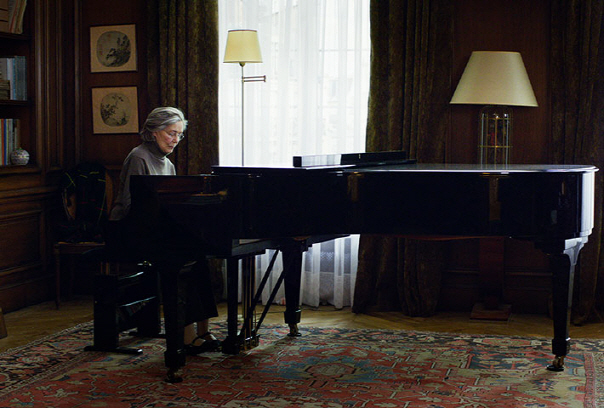
When we meet Georges and Anne(Jean-Louis Trintignant and Emmanuelle Riva) for the first time in the scene which strangely reminded me of that unforgettable closing shot in Haneke’s previous work “The White Ribbon”(2009), they are attending the piano concert of her former pupil. After they and other audiences have nice time with his performance, they return to their apartment where they have led an affluent and comfortable life for more than 50 years, and we sense how much they have been close to each other through their mundane conversation on the concert.

We come to learn more about them. Both of them are retired piano teachers, and the cozy environment at their home reflects well their cultural sophistication and professional success. They have a daughter named Eva(Isabelle Huppert, who is fabulous as usual even in a small role), and, though she cannot visit them often because she has been living abroad for years, Eva cares about their welfare, and they know that.

On one day, a small but disturbing incident happens. When Anne and Georges start another day in their kitchen, Anne suddenly falls into some sort of a comatose trance, which naturally disturbs George a lot. Fortunately, she comes back into a normal state in a short time while he looks for help, but Anne says she does not remember anything unusual. Georges becomes concerned about her, but Anne behaves as if nothing serious happened, although she seems to vaguely sense that something is not quite right somewhere inside her brain. The movie looks at this subtly ominous situation while maintaining that cool, calm approach we have seen from Haneke’s works, and that makes the incident on the screen feel as shattering and resonating as a single stroke of piano key in a very quiet concert hall.

small_amour03It turns out that she has a medical problem which can be easily fixed by surgery, but there is some serious problem during surgery, and now we see Anne coming back from hospital in her wheelchair. She can move, but a part of her body is paralyzed, so it is Georges’ job to take her to the bathroom or change her clothes when a hired nurse is not around. Although she is considerably weakened, she has not lost her wit yet, so we get an amusing moment where George tells her about the funeral of an old friend he has just attended. They are aware of their mortality more than ever, and they try to live with that, but that is not that easy for them, as shown in the moment when her former pupil visits them privately.

And the test they are put into is far more difficult than they expect. Anne suffers a stroke, and then she gets worsened as the time goes by. Georges tries hard as a devoted husband, but he becomes more helpless and desperate about the deterioration of her health condition. They sometimes have good days, but Georges cannot deny that the woman he has deeply loved is being perished right in front of his eyes, and even his love and understanding are almost useless as his wife and the words from her mouth become more and more incomprehensible – and he cannot take her to hospital because she made him promise that he will not send her to hospital or center for aging people.

Their story now sounds pretty much like an ideal material for weepy melodrama, but that is the last thing you can expect from the director/writer Michael Haneke, who has kept exciting us with the series of stunning works during the last decade. “The Piano Teacher”(2001) was a compelling enigmatic character study on one twisted piano teacher, and “Caché”(2005) and “The White Ribbon” were terrific films which endlessly fascinates us with their icy enigmas beneath surface even when they seemingly look at their stories straight and clear under Haneke’s austere direction.

small_amour05While it is a film with a far simpler story, “Amour” is no exception: confining his movie within Georges and Anne’s apartment, Haneke firmly focuses on the inevitable sad decline in their daily life as their world is slowly and grimly being closed upon them, and the realistic and intimate details shown on the screen are sometimes quite hurtful to watch. Even when she is losing herself, Anne is terribly well aware of her failing health condition, and there is a small but emotionally striking moment when her will and his opposing will clash with each other. She cannot stand her unbearable predicament any more, but he cannot possibly imagine of letting her go, and he eventually slaps her hard out of impatience and frustration. As some of you know, we are mad about the people we love because we care about them.

As the emotional anchor of the story, Jean-Louis Trintignant and Emmanuelle Riva give a masterful duo performance which is immensely helped by their illustrious film careers as well as their invaluable experiences with aging. Jean-Louis Trintignant, who was an unflappable prosecutor in Costa-Gabras’s “Z”(1969) and made a first big impression on me as a detached retired judge in Krzysztof Kieslowski’s “Three Colors: Red”(1994), is going to have his 82nd birthday early in this month, and Emmanuelle Riva, who was the heroine of Alain Resnais’ “Hiroshima, mon amour”(1959), is 85 years old at present, and their old, wrinkled faces quickly establish their characters from the beginning. Riva is especially heartbreaking in one scene where Anne keeps saying one word to her husband, and Trintignant responds to her in a touching way which makes this scene devastatingly powerful.

“Amour” received Palme d’Or award at the Cannes Film Festival early in this year, and it currently begins to garner several critic awards in US while being regarded as a strong contender for Best Foreign Language Film Oscar in the next year(The main language of the film is French, but it is the official entry of Austria for the category). Supported by two graceful twilight performances and handled with top-notch direction, the movie penetrates deep into its subject with remarkably brutal honesty and almost painful intimacy as it never withdraws itself from its uncomfortable moments, and the result is one of the most memorable movie experiences in 2012.

small_amour01

Posted in Movies | Tagged , , , , , | 1 Comment

A Royal Affair (2012) ☆☆☆(3/4) : An affair behind the throne

small_aroyalaffair01As a historical drama about a dangerous liaison and surrounding intrigues at the royal court, “A Royal Affair” nicely fulfills its genre requirements. It looks gorgeous as much as it is required for our eyes, and it also has an involving story about the complicated human relationships between three people who brought significant social changes into their country during the Age of Enlightenment.

It is 1766, and Caroline Mathild(Alice Vikander), a younger sister of George III of Great Britain, has been engaged to the King of Denmark since she was very young. She is not that unhappy about herself being locked in an engagement of political reasons, and she is ready to be a dutiful queen to His Majesty, but, unfortunately, Christian VII of Denmark(Mikkel Boe Følsgaard) turns out to be not a normal guy she can love. It is apparent from their first encounter that he is a mentally disturbed lad who acts like a horny paranoid child, and he quickly becomes the last person she wants to spend a night with in her royal chamber. They somehow manage to have their son after 15 months, and, as soon as her duty is fulfilled, the King promptly goes out for his tour around Europe, and she cannot possibly be happier about that.

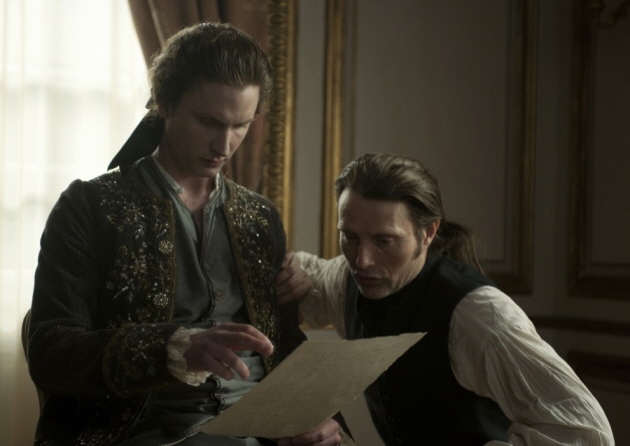
And that is how Dr. Johann Friedrich Struensee(Mads Mikkelsen) comes into their life. When the King seriously needs a doctor to attend him during his tour, Struensee reluctantly becomes one of the candidates after being persuaded by the minor Danish aristocrats who have been looking for a chance to be admitted into the royal court again. As a smart, sensible, and sophisticated man of the Enlightenment, Struensee quickly gains the King’s confidence during their meeting thanks to their shared interest, so he soon comes with the King to the royal palace as his personal doctor.

small_aroyalaffair03Caroline does not welcome this good-looking doctor much, but she is gradually drawn to him through his ideas about social reforms. To a woman suffocated by her environment, he introduces Rousseau, Voltaire, and other well-known thinkers representing the Age of Reason through his books, and they spend more time with each other for sharing thoughts, and, yes, there are many passionate moments as they are swept by the emotions generated between them.

But the story is not just about their romance, and it is also about how they try to bring social reforms into Denmark, which was oppressed under its aristocracy and the heavy influence from the Church at that time. Not many people in the court want the changes they glimpse from outside, and they try to keep their world intact as much as they can by using the King as their puppet/representative; all the King has to do in the Council is just signing the papers passed to him by them, and he does not feel bad about that except being bored by them.

Struensee and Caroline slowly come to realize what they can do about this problem. Starting with smallpox vaccination, they find a way to persuade and manipulate their King, who happily follows his best friend’s instructions and begins to behave ‘more normally’ than usual in the Council. Not long after that, Struensee becomes the “de facto regent” of the country, and he keeps introducing more progressive social reforms to Denmark – and that makes many people in the court, including the Queen Dowager Juliane Marie(Trine Dyrholm) and Ove Høegh-Guldberg(David Dencik), very unpleased about what’s going on.

small_aroyalaffair02The intrigues at the court naturally follow, and that makes the relationship between Struensee and Caroline more politically dangerous, but they cannot preventing themselves from showing their feelings even when they decide they should be more discreet and careful about their affair. Mads Mikkelsen, a talented actor who has steadily gained his international popularity since his villainous turn in “Casino Royal”(2006), is good as a taciturn handsome man who is driven by passion as well as idealism, and he and Alicia Vikander have a nice chemistry between them as a couple behind the throne who like the thrill from their political partnership as much as the warmth from their secret night meetings. It was fun and exciting for them at first, but they gradually find themselves still stuck in their world and its politics, and they have to deal with the series of consequent situations as the sense of danger is accumulating around them.

As the King between these two lovers, Mikkel Boe Følsgaard, a newcomer who won Best Actor award at the Berlin International Film Festival for his debut performance in this movie, is excellent in his portrayal of a tormented man who feels trapped as much as two people close to him, and his complex performance is as crucial as his co-actors’ in making the drama between their characters effective. Christian may be a simpleton who can be easily manipulated, but he has his own feelings as he struggles with his own problems and other difficult problems thrown at him, and Følsgaard has a small poignant scene where he shows his friend how much willing he is to be oblivious to what’s going on inside his palace for not losing a close friend who has been the best thing in his life.

“A Royal Affair” is chosen as Denmark’s official submission for the Foreign Language Film category of the 85th Academy Awards in the next year, and it might get the other nominations in the technical categories as well. The director Nikolaj Arcel makes a good use of the locations in Prague, and its gorgeous production design and sumptuous costumes are first-rate. The dialogues are a little too self-conscious at times, but the main characters and their story are believable and engaging, and the performances are enjoyable. This is a well-made period drama with some amusements, and at least your eyes won’t be disappointed.

royalaffair

Posted in Movies | Tagged , , , , | Leave a comment

Footnote (2011) ☆☆☆1/2(3.5/4) : A glory only for his father

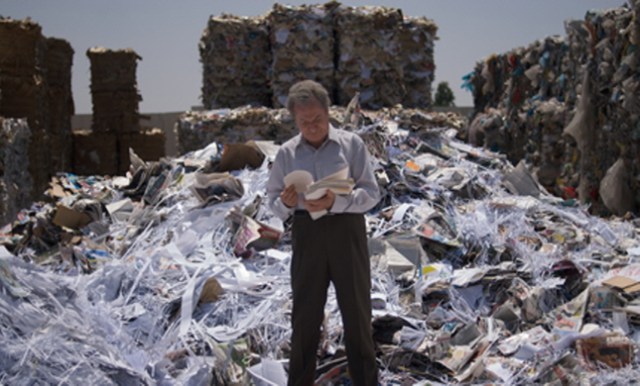
small_footnote09 Fathers are usually proud of their sons’ achievements, but that is not the case with the orthodox scholar patriarch of the Israeli film “Footnote.” His son’s success adds another layer of envy and resentment to a lifelong grudge, and he hates when that happens. He has regarded his son and other prominent scholars as a bunch of superficial philistines who merely happen to be more popular than him, but he cannot help but envy their academic positions, and he desperately hopes for recognition as he stubbornly and solitarily sticks to his own uncompromising research methods deep in the library.

Although it is about the people studying and researching in a specific field which is quite unfamiliar to many of us, “Footnote” is a smart and funny comedy driven by human errors and foibles familiar to all of us. The main characters are intelligent experts with vast knowledge in their field, but they can also be quite petty because they do not like each other for personal reasons which look trivial and silly to outsiders like us.

But they are very serious about their work, which indeed has considerable academic value, and some of them live with it until death tears them apart from it. As a philologist at the Talmud department of the Hebrew University of Jerusalem, Professor Eliezer Shkolnik (Shlomo Bar Aba) has dedicated many years of his life to literary study while strictly following his daily routine. He always goes to the National Library in the morning on a fixed route every day, where there is always a place for him. He spends his time with the old texts and records in the library for his private research, and he keeps working even at home. He wears headphones to keep from being interrupted by his silent wife (Alisa Rosen), who must have had many hard years due to his single-minded dedication (he sleeps on a small bed in his library while she sleeps in the other room).

small_footnote08

We come to know that there was a time when he was almost about to make a big breakthrough with his ambitious project. By checking and comparing more than 300 books in which the original text of the Jerusalem Talmud was quoted, Eliezer developed a revolutionary theory on the differences between the original text circulated around Europe during the Middle Ages and its current version. It took more than 30 years to nearly complete his research and thesis. His epic efforts may look not that important to us, but think about a recent biblical discussion on whether a centurion’s ‘pais’ healed by Jesus in the New Testament was his servant or his homosexual lover. People have endlessly discussed the intent behind the use of that single Greek word, and that is where philological research like Eliezer’s can provide more evidence and understanding.

While appreciating his meticulous scientific approach, my mind went back to some of the scientific research papers published in biology journals I’ve read during my graduate years. They usually had a big figure showing the alignments and comparisons of DNA or protein sequences from various species, which can provide the valuable clues for the next steps in research, and they all were swiftly done with special software programs. I enter very long sequences of data (usually around 1000 characters) into the yeast genome database available on the Internet, and it can show you every difference between the subject and the database in one picture within 5 seconds. I wonder how Eliezer feels if he sees that everything he had done with painstaking efforts for years can now be easily done with software in several months.

Anyway, he has been sticking to his research method — even after his big project was made totally obsolete by his main rival, Professor Grossman (Micah Lewensohn), who fortuitously encountered valuable material in Europe and quickly published a paper ahead of his rival. The result was an academic catastrophe: Eliezer never published anything significant again, due to Grossman’s constant interference and all he can show to others as his “achievement” is merely a mention of his name in one single footnote in another, famous Talmud scholar’s book. Though it seems he is recognized by his few close colleagues, he knows he has been ostracized and ignored by many of his peers, and that fact has always injured his pride as a scholar.

small_footnote10

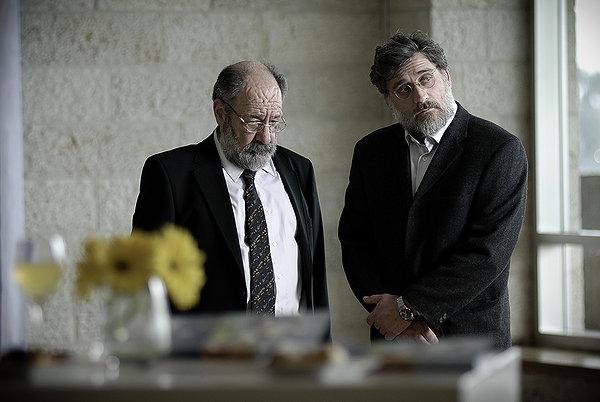
Funny thing is, Eliezer despises the academic success of a man who was actually inspired by his passionate dedication. His son Uriel (Lior Ashkenazi) is a far more popular and renowned scholar than he is, and now Eliezer has to see his son joining the Israel Academy of Sciences and Humanities. As the movie tells you in advance through its title card, this is certainly his most difficult day in life, and his sullen face is not brightened at all even when Uriel shows sincere gratitude to him as a good son during his speech in front of others at the ceremony. He especially hates the fact that his son is on good terms with Grossman, who also dislikes Eliezer.

And then, after several days, Eliezer gets a call, and something too good to be true happens to him. It is a call from the Ministry of Education, and he is told that he is chosen as the next recipient of the Israel Award, a prestigious honor coveted by everyone in the field. Those close to him is happy about this news, although they do not know the exact reason behind the decision. Uriel is flabbergasted about this surprise news because 1) the chairman of the committee which chooses the recipient is none other than Grossman; 2) everyone knows that Eliezer is not so popular with his peers; and 3) there is almost no significant literature or publication in Eliezer’s to support this odd decision, but he is pleased to see his father finally being recognized after so many years of obscurity to which he has been condemned.

It turns out that there was a serious mistake due to small confusion; the call from the Ministry of Education was intended for Uriel, not Eliezer. This error could have been rectified quickly, but the news about Eliezer being chosen as the recipient has already been leaked to the media. An emergent private meeting is promptly held, but it turns out it won’t be easy for the committee members, Grossman and Uriel to find a solution as they get more personal under pressure.

footnote07

The director/writer Joseph Cedar, who won the Best Screenplay award for this film at the Cannes Film Festival last year, keeps the comic momentum going while the characters’ difficult situation becomes uglier and messier for them. There is an amusing sight gag in which the characters have to shift their positions and chairs constantly whenever someone comes in during their clandestine meeting in a small, suffocating office. Their heated arguments are fueled by not only their epic stubbornness, but also by their pettiness, which comes with the territory.

Grossman, a genial but stern old scholar obstinately adhering to his own idea of principles, absolutely objects to Eliezer receiving the honor because it violates his principles. But, if what Uriel says is true, he may also be an unforgiving old man who hides grudges behind principles, and can be mean, ruthless, and unfair. That reminds me of one chief editor of a certain respectable biology journal who always rejected the manuscripts from one professor’s laboratory at my campus just because he would not recognize that professor’s research in spite of his considerable contribution and well-deserved reputation in his field. That professor once joked that he personally wanted him to die soon (that editor was a very old guy, by the way), but I wonder now whether there was a little bitterness inside his jovial words.

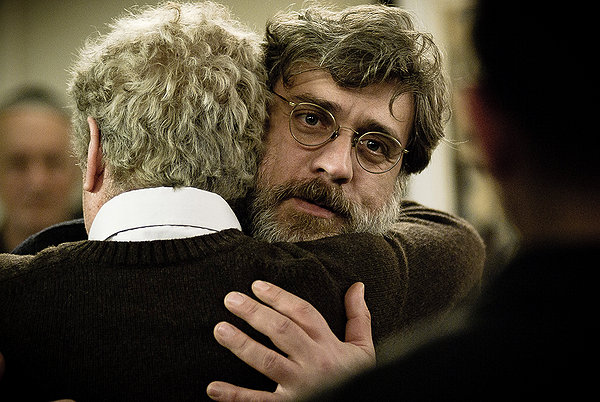
The story ultimately comes down to the personal level as it digs deep into the estranged academic/personal relationship between Eliezer and Uriel, who are driven further apart by this absurd situation. Even after Uriel learns that he does not know him very well through one funny incident involving lost clothes, he still respects and cares about his father. But, when he feels betrayed and insulted, he becomes as cranky as Eliezer, and he turns out to be not a good dad to his own son just like his father wasn’t to him.

footnote03

Nevertheless, he does not reveal the truth to anyone except his mother, who keeps the secret. While Shlomo Bar Aba and Lior Ashkenazi received lots of praise for their excellent performances as a father and a son who are distant from each other but actually more or less than two sides of a coin, Alisa Rosen deserves a special mention for her reticent but strong supporting performance as Eliezer’s long-suffering wife. I have no idea about how she tolerated her nearly uncommunicative husband, but, considering that she is an intellectual woman with a PhD degree, I guess she understands and accepts him and his work as a fellow intellectual, and her simple act later in the film implies a lot about how she feels and thinks about her ‘autistic’ husband.

“Footnote” is a very funny film which instantly tickled my past experiences with the academic department I have belonged to for more than eight years as a graduate student. I was amused by its several notable details reflecting the specific geopolitical condition of Israeli society, and I was also entertained by its cheerful approach to the story with exaggerated hyper-kinetic styles. This was regarded as overkill or clever gimmick by some, but I think it perfectly and hilariously fits with the characters’ reacting very seriously to the small academic matters most of us do not know or care about. In one exhilarating sequence where Eliezer’s stubborn but shrewd mind suddenly starts working as soon as he notices one small thing at one point, we are immediately swept up into his rapid thinking process, propelled by the overblown score by Amit Poznansky, for a cinematic joyride. We do not wholly understand the logic spinning inside Eliezer’s head, but his emotional state is as clear as an earth-shattering conclusion he should have seen from the beginning.

When the movie was introduced at the Busan International Film Festival in South Korea last year, it was introduced as “A Glory Only for His Father”. I think that title reflects well the ironic truth which the father, his son, and few other characters in the movie perceive perfectly as everything comes together at the point where a certain decision must be made. Some of you may complain that the ending is too indecisive and too much of an easy way out, but does it really matter, considering that these characters will be unhappy no matter how their messy circumstance is resolved? After revisiting the movie, I thought I had a solution for their difficulty, but, no, I know too well that they are eggheads too proud and egoistic to humble themselves.

footnote02

Posted in Movies | 1 Comment