We had a heavy snow at last night…
 How nice it is to encounter a little but special fantasy tale like “Beasts of the Southern Wild”. Like any excellent fantasy tales, this small film is based on the strong sense of reality filled with bountiful details to be appreciated, and it has a good story and a memorable character who carries the story with her feisty spirit. It looked alien to me at times, but I believed in its small fantasy world, and I was enchanted by its distinctive aspects as I admired its exceptional central performance.
While I saw beauty in its world, I also recognized the hardships surrounding its inhabitants. The background of the film is a town called the Bathtub, a small fishing community located probably somewhere in the offshore bayou area of Louisiana(the movie was shot in the locations in Terrebonne Parish, Louisiana, where many similar fishing communities actually exist). Mostly isolated from the world outside, the residents of the Bathtub are accustomed to being self-sufficient in their daily struggle to live, and they have good time together whenever there is a chance for that(“The Bathtub has more holidays than the whole rest of the world.”).
One of the residents is a little girl named Hushpuppy(Quvenzhané Wallis). She lives with her dad Wink(Dwight Henry), who is rather strict about how they live. He has his own place, and she has her own place, and she is not allowed to go into her dad’s place. His motif Is clearer as the story progresses; it is implied earlier in the story that he has some problem with his health and he knows that he may not live that long. Although he is not the one who will get the Father of the year award(at one moment, he slaps his daughter for her willfulness), we come to sense that Wink worries about her future without him, and he does what any dads will do in his circumstance, including teaching her how to catch a fish or how to eat a crab more, uh, manly.
 But the crisis comes a little too soon for them. Because of the rising sea level and frequent occasions of hurricanes due to global warming(or global climate disruption in a more correct expression), many fishing communities in the offshore areas of Louisiana have been threatened for years, and the Bathtub is no exception; when a very strong hurricane comes upon their area, most of the town is under the water on the next day.
While the other people evacuated in advance before the hurricane arrived, some people including Wink stayed, and they are stubborn about remaining in their hometown. Though they still can catch shrimps and crabs, the life in the Bathtub is harder for them under worsened conditions, but they keep moving on. The water is still high, but they find a way to live at one high spot. When the water gets too salty because of the levee near the town, they try a drastic measure for the problem, which, as one character worries, naturally draws the attention from the outside world.
The director/co-writer Ben Zeitlin, who adapted Lucy Alibar’s play “Juicy and Delicious” with Alibar, did a terrific job of creating believable alternative reality where some aspects of our reality are meshed well together with magical elements. Its budget was only 1.8 million dollars, but Zeitlin and his crews overcame their limits with the nice use of locations and efficient production designs, and the result is a vividly shabby and beautiful vision which sometimes evokes that post-apocalyptic beauty glimpsed from the desolate SF movies like the Mad Max series. In this world, the people use anything they can get to make their homes and the other things for their lives, and a good example is Miss Bathsheba(Gina Montana), who works as not only a teacher for kids but also a town pharmacist. She has many jars in her workplace, and, though I guess she is an experienced professional, I don’t know whether I can eat a ‘medicine’ given by her.
She teaches children about global warming and other things. She talks about some mythic creature named Auroch, which once roamed around the field but now are extinct due to the Ice Age, and that brings one crucial fantasy element to the story. Whether a certain scene is real or imagined is not clear, but it only emphasizes a small but important life lesson Hushpuppy learns through that uncanny moment.
 As an imaginative child who sees and listens and interprets the world surrounding her in her own way, Hushpuppy is the little force of nature to be reckoned with, and Quvenzhané Wallis, who was only 7 at the end of the production, gives an unforgettable performance as an innocent, fierce, and, strong-willed little girl who is actually stronger than we initially thought. Wallis’s performance is important in bringing the movie to her character’s viewpoint and thoughts; Hushpuppy can see the world with her innocent wonder(“The whole universe depends on everything fitting together just right.”), but she is also able to understand that the nature is not always pretty through hardships(“Strong animals know when your hearts are weak.”).
Her co-performers including are mostly inexperienced actors like her, and they also contributes to the natural mood in the film. Dwight Henry is especially notable as Hushpuppy’s unorthodox dad, and his scenes with Wallis are some of the most emotionally intense moments. Inexperienced actors have that raw quality which cannot be seen from seasoned actors, and Wallis and Henry never fail to deliver in their film.
“Beasts of the Southern Wild” has received lots of acclaims since it was shown in the Sundance Film Festival early in this year, where it received the Grand Jury prize along with the Cinematography award for Ben Richardson, who provides a very good realistic atmosphere for the story and its characters to move around. The movie is one of the most notable achievements of this year, and it somehow finds a way to grow on me a lot in spite of my tepid initial reaction(I must point out that its story is not one of its strongest points).
Maybe the End is eventually coming toward the Bathtub, but we know Hushpuppy will survive and move on no matter what happens. And I come to believe that our human race will probably manage to prevail even after our comfortable modern civilization is collapsed by global warming or anything catastrophic in a global scale. Who knows? Like Hushpuppy and her neighbours, we may be a lot more resourceful than we think.

 Sometimes actors can find a way to make the story work even when it looks not so special, and I enjoy watching how they make their materials into something watchable instead of something passable. “Trouble with the Curve” is a typical case of a family drama with a touch of “sports drama”, and it goes straight into its story without anything new, but it has good actors to lift its story. I do not think I gave sufficient interest to the story itself, but my eyes were fixed to their good performances, and I willingly followed the story without much boredom.
The movie drew attentions when it was released in US because the movie has a sort of a comeback performance by Clint Eastwood, who announced the retirement from acting with his film “Gran Torino”(2008). That was a terrific film, and Eastwood gave a fine performance which could be interpreted as a fitting finale to his illustrious acting career.
As the aging hero of “Trouble with the Curve”, Eastwood does his usual things in his comfort zone, and we know what kind of a guy Gus is as soon as we see him: a tough old guy stubborn about his way of living. He probably have to consider retirement, and he knows well that there are few years remaining in his long career as a baseball scout, but he keeps moving on like an old trooper who will never stop until his death. He always goes to the baseball games for himself, and his fellow scouts, most of whom are as old as him, welcome his presence in the bench while looking for anyone talented enough for their respective major league baseball teams just like him.
But his body starts not to follow his will well. At first, there were just minor problems, but it turns out that he has problems with his eyes probably due to glaucoma. To a scout like him, that is a serious problem. How can he know that someone is a good player to be recruited when he cannot see at all? This is not a good news especially when the owner of his team begins to depend on a new method of recruiting players through computerized statistics instead of the experiences of professionals like Gus(While watching the film, I could not help but think of “Moneyball”(2011), whose story was about how computerized statistics beat old professional scouts like Gus).
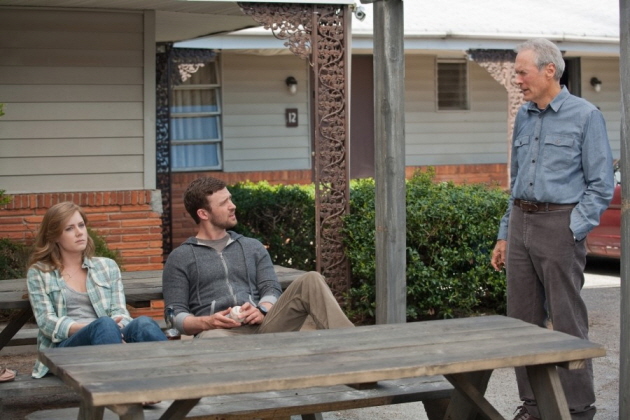 Fortunately, Pete Klein(John Goodman), his friend and direct boss, asks Gus’ estranged daughter Mickey(Amy Adams) to assist him. Although she is reluctant about helping her father mainly due to her busy work in a law-firm where she aspires to become its new partner, but she decides to take a ‘vacation’, and that is how their awkward journey begins.
They move around several baseball playgrounds in North Carolina where they may find good players for Gus’ team. They are distant from each other at the beginning, and there are some unresolved feelings between them, but, as you may have guessed already, they discover that they are still a father and a daughter. While assisting her dad, Mickey also comes across Johnny Flanagan(Justin Timberlaker), a young scout who was once a rising new baseball player scouted by Gus and then quickly retired due to unfortunate injury, and it does not take a lot of time for them to get close to each other.
This is surely a predictable plot, but the director Robert Lorenz, who worked as an assistant director in Eastwood’s directing works, handles his first film with a transparent approach, and the story advances in slow but appropriate pace though it is languorous at times. The movie is produced by Eastwood’s production company, and you will find several familiar technicians in the credit including the cinematographer Tom Stern, the editor Joel Cox, and the production designer James J. Murakami.
 In this familiar production environment, Eastwood effortlessly exudes his wrinkled charisma as an old star actor who still can hold our attention, and he has a nice chemistry with Amy Adams, who is effective as a lively contrast to grizzled Eastwood. Her character’s arch is predictable from the beginning, but Adams is an immensely engaging actress, and she imbues her character with warmness as well as stubbornness. John Goodman provides a small but nice supporting performance, and I appreciate Justin Timberake’s adequate job with his thankless role. His character is not that necessary in the story, but Timberlake is a likable actor, and he and Adams click with each other well even if there is no spark in their scenes.
On the whole, “Trouble with the Curve” is one of those safe products we have no trouble in accepting it. This is a simple and predictable drama where you can immediately know who good guys or bad guys are, and I bet you will instantly recognize at one point that a certain supporting character will definitely appear again for a nice feel-good payoff scene. As a matter of fact, I almost shouted “Trash can!” during one scene when a trash can appeared on the left corner of the scene before a ringing cellular phone was thrown into it.
But it throws its ball straight, and I liked the movie despite its several weaknesses. Although Clint Eastwood unwittingly contributed to a bizarrely ridiculous sight at the Republican National Convention in this late August, he is still an admirable actor/director to many of us, and that is why it is rather glad to be confirmed that he can come out of his ‘retirement’ and can act again if he is asked.
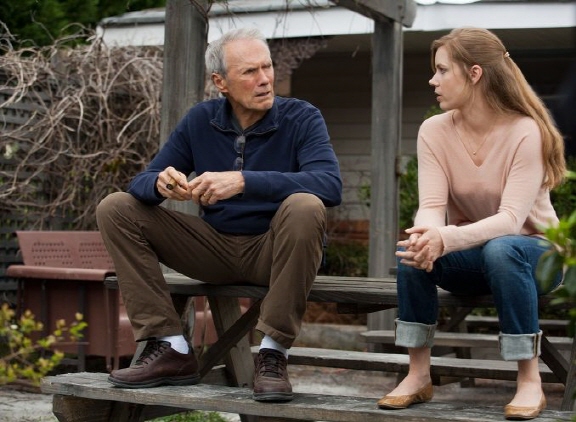
 Ned Rochlin is your average lovable idiot. He is a nice and pleasant dude, but the problem is that he trusts people a little too much and he thinks a little too less about what he says and does. The opening scene is a very good example of his foolish behaviors. When he sells his organic vegetables and fruits from his farm at the town market, a town police officer approaches and he indirectly asks Ned whether Ned can sell marijuana to him. Instead of evading the question, Ned promptly takes out marijuana in front of the officer, and he is even quite clueless about what the officer is trying to do to him.
“Our Idiot Brother” is a small sweet comedy about this gentle and hapless man who usually sees the good sides of the people around him. He makes many mistakes, and he makes others annoyed sometimes, but he is someone you cannot help but like him. He just wants to be nice to others, and he is really nice enough to be labeled as a ‘secular holy fool’, and I come to like him more than I did at the beginning.
After that hilarious opening scene mentioned above, Ned(Paul Rudd) is instantly arrested by that officer, and he is sentenced to several months in jail. I do not know how he spent his time in jail, but I must say that not many prisoners can receive hearty send-offs by both guards and prisoners like Ned, who looks as pleasant and optimistic as ever when he gets out of the prison.
But his situation is as not optimistic as he thinks. His former girlfriend Janet(Kathryn Hahn) does not accept him into their farm house, and this mean girl does not even allow him to take his beloved dog(its name is Willie Nelson, by the way) just because it did not originally belong to him. At least he has his kind mother(Shirley Knight) who welcomes him at their family house, but, even though he is naive, he knows that he has to lead an independent life as an adult, so he looks for any opportunities for a new start.
 His dear three sisters, who have been too busy with their own matters to take care of their idiot brother, reluctantly try to help Ned, but soon they realize they made a pretty big ‘mistake’. Ned has no malice to his sisters, but he is so naive and transparent that he becomes a truth teller who shakes their lives by saying wrong things at wrong moments. For instance, the eldest sister Liz(Emily Mortimer) is not so pleased about how Ned and her little son River(Matthew Mindler) spend lots of time together when their son is about to have an interview for the enrollment to some prestigious private school. Furthermore, thanks to Ned’s another blunder, She later realizes that her despicable husband(Steve Coogan) is nothing but a hypocritical adulterer who has cheated on her.
The other sisters’ lives are as problematic as Liz’s, and, of course, Ned also exposes their problems even though he does not mean to. Miranda(Elizabeth Banks) is a magazine writer looking for a big chance, and she gets a very good one through Ned by coincidence, but she soon finds that it is really unwise to use a simple-minded guy like Ned, who also indirectly makes her to face her rather ambiguous relationship with her neighbour/best friend Jeremy(Adam Scott). In case of Natalie(Zooey Deschanel), she faces a big personal problem which may destroy the relationship with her lover Cindy(Rashida Jones), and you will probably have a good idea about what will happen when Ned discovers it and then she lies to him. Even when he is lied to, Ned is an invincible truth teller who cannot tell lies even if he tells the lies received from others.
Paul Rudd has provided good comic performances through several recent comedy films including “Knocked up”(2007) and “Role Model”(2008), and he fully utilizes his natural comic talents in a likable performance while keeping his character from being totally idiotic. He may be an idiot as others say, and he may be a little too casual about weeds(At one moment, he unknowingly puts his parole officer, a kind guy who likes Ned, in a professionally difficult situation), but he is not that stupid. His goofiness comes out of his inherent good will, and, when he thinks it is wrong to do something at one moment, he is adamant about his decision no matter what.
 The director/co-writer assembles talented performers with good comic timings around Rudd, and they also bring considerable humor and warmth to the movie. Emily Mortimer, Elizabeth Banks, and Zooey Deschanel bring distinctive qualities to their respective characters; Ned’s sisters have many flaws including pettiness and selfishness, but they are essentially nice people who can learn the lessons from the clash with their ‘troublemaker’ brother, and they rise to the occasion when they have to do something for him. Though they do not have many things to do, Rashida Jones, Adam Scott, and Steve Coogan are welcoming additions to the story with their mere presences at the fringe of the story.
“Our Idiot Brother”, which is belatedly released in South Korea on this weekend and will probably be brought down soon before being sent directly to DVD store, is a charming film with good laughs which is as harmless and pleasant as its naive hero. Thanks to Paul Rudd’s good-natured performance, I believe and like his character, and you may remember someone similar to him in your life. They are easily fooled, and they are frequently laughed at, but they mostly do not care about that much while smiling and being nice to others around them. I’d love to have such guys like Ned – as long as I have nothing to hide from him.
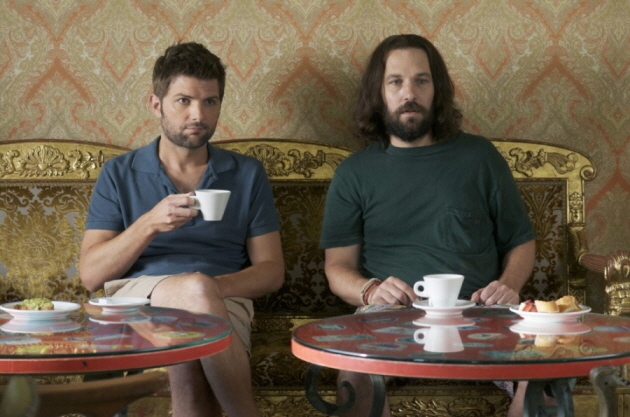
 Once upon a time, there was a movie called “The Blair Witch Project”(1999), and its unexpected success generated a sub-genre so-called “found footage”. While this low-budget genre has been continued through other successful cases like “Paranormal Activity”(2007), there also have been interesting attempts to mix this genre with other genres, and one of the best examples was “The Chronicle”(2012), an impressively creative juxtaposition between found footage and superhero story which has grown on me since I watched early in this year.
In case of David Ayer’s gritty film “End of Watch”, which arrives late in this year in South Korea, the movie is an interesting mix between police drama and found footage. The movie does not wholly depend on the cameras shown in the movie, but its tone is coherent on the whole, and it deftly moves between two genres to provide the visceral depiction of the perils its two main characters and their colleagues face every day.
The movie revolves around two young LAPD officers Brian Taylor(Jack Gyllenhaal) and Mike Zavala(Michael Peña). Their strong partnership/friendship feels palpable right from the scene when Taylor tests his digital video camera at the locker room in their police station. According to Taylor, he is attending a film class when he is off duty, and he wants to make a documentary based on their daily work. Besides his digital camera, Taylor also has a pair of tiny cameras which can be easily attached to their shirts, so they do not always have to be behind the camera during their duty.
Because their job is patrolling around a notoriously dangerous district in South Central LA, there are always plenty of gritty and disturbing materials to be recorded by Taylor or Zavala during their duty. In one house, they find the children locked and bound in the closet by their mother’s addict boyfriend. When they go into a house which seems to belong to some old lady, they encounter something far more horrible than stinking smell.
 And there are dangerous criminals who have no fear about attacking them and their fellow police officers on the streets. Their district becomes more violent recently because a powerful drug cartel in Mexico starts to spread its influence around the neighbourhood as it ruthlessly corners an Afro-American gang organization which originally occupied the area, and Taylor and Zavala gets in a serious trouble not long after they unknowingly meddle with the cartel’s major business operations while doing their duty as usual.
Their activities in the movie are frequently shown through several video recording devices including Taylor’s private cameras. Sometimes this approach does not work effectively due to its inherent limits such as shaky camera movement, but it works well to enhance the hyper-reality in the film in most cases although you have some doubts about the plausibility of several scenes involved with gangs(I understand some gangs tend to show themselves off, but, seriously, do they always have camera around them?), and the movie wisely does not limit itself to the boundaries of found footage whenever it is required to get out of the boundaries for being more active and intense.
The director/writer David Ayer has written or directed several notable gritty urban dramas such as “Training Day”(2001), which was fueled by Denzel Washington’s striking Oscar-winning performance, and “Harsh Times”(2005), which had one of the memorably intense performances by Christian Bale. “End of Watch” is filled with vivid atmosphere and authentic details thanks to his experiences with South Central LA during his adolescent years, and the result is both interesting and gripping to watch. As we watch Taylor and Zabala closely, we come to sense the danger and exhaustion in their work, and I was amused by a small detail about how they keep themselves awake during their night patrol.
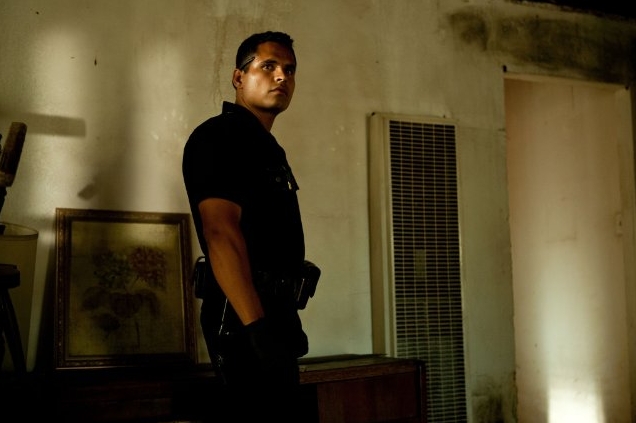 There are many guns and subsequent shootings throughout the movie, but its drama firmly holds its ground as it is ably supported by two strong performances. Jake Gyllenhaal and Michael Peña went through extensive preparation for their characters, and their performances are as real as the background surrounding them. While Gyllenhaal shows an unexpected tough side, Peña matches him well as his equally tough partner, and they are the main engine palpitating behind the movie. They are young, and they are sometimes a little reckless, but Taylor and Zabala are mostly dutiful officers who rarely forget what should be done in their several perilous situations in the film. When there are kids in a burning house and the firemen seem to be late, they immediately go inside the house to rescue them with no hesitation because it is their duty to protect and serve.
The supporting characters are more and less than functional in the story, but the movie has good actors to provide some life to their respective characters. Anna Kendrick and Natalie Martinez are respectively good as Taylor’s girlfriend and Zabala’s pregnant wife; when they meet each other for the first time, they quickly get close to each other through their men. David Harbour, America Ferrera, and Frank Grillo are adequate as the other police officers in the police station, and Grillo, who plays Taylor and Zabala’s direct boss, has a small nice moment when his character talks about one personal memory from his long career.
“End of Watch” is a solid police drama propelled by compelling drama, electrifying performances, and high-octane actions. Compared to its realistic depiction in the first two parts, the third act in which the main characters find themselves targeted by the drug cartel looks a little too artificial, but the movie does not lose its sense of reality at all even when it is amid lots of bullets showering upon its characters. Police dramas about two partners, or ‘cop buddy movies’, are dime a dozen, but “End of Watch” has a strong emotional core beneath its conventional elements, and it is definitely worthwhile to watch.

 Sometimes movies provide the moments I understand well with empathy even though I am completely different from their characters. I remember how I sympathetically reacted to one particular scene around the finale of “The Hurt Locker”(2008) because I would also be at a loss in its hero’s circumstance unless my family or others accompanied me. Several months after watching that movie, I thought about that scene after wandering alone around the aisles of a big supermarket in the suburban area of Des Plaines, Illinois for at least more than 20 minutes until I settled on a loaf of white bread and a bottle of marmalade after lots and lots of hesitation.
Among many terrific movies I have seen in this year, “Oslo, August 31st” came very close to me like that. I admired its close and honest observation on one summer day of its troubled hero, and, though I am not a drug/alcohol addict like him, I could instantly recognize the main source of his depression. Having spent almost 13 years at the campus with no notable progress despite lots of expectations I received at the end of the undergraduate course, I frequently get a frustrating feeling similar to his mood as I bitterly observe the changed looks of my campus and the absence of my fellow PhD candidates who have already advanced with further academic and personal progress. I tell myself that there is always hope, and that is true, but this melancholy always resides somewhere in my mind as I recognize my difficulty and try to continue my daily life at the campus as usual.
Such a moody atmosphere like that is hovering over Anders(Anders Danielsen Lie), who is finishing his time at the rehabilitation center outside Oslo. Regrettable and shameful about his wasted years, he wants to make a new start and leave behind his mess due to addiction, but it is not so easy for him to begin a normal life again even though he has been clean for several months. He is confused and depressed about his current state, and, when his another gloomy day begins, he even tries to commit suicide by drowning himself in the river before returning to the center as if nothing happened.
 This day is important for him, for he will have a job interview in the afternoon at some magazine in Oslo. He gets a permission to leave the center for a day along with money, and he soon arrives at the city where he grew up and worked as a writer, and we see how he spends this day. He visits his old friend. He spends some time with his friend and his friend’s family at the park nearby. He has an interview with the editor of the magazine. He goes to a restaurant for meeting his sister who is supposed to give him a key for entering his family home. He has a rest for a while before he goes to the birthday party held at a flat belonging to one of his friends, where alcohol comes handy to others – and him.
The story is as simple as I described above, but the director Joachim Trier and his co-writer Eskil Vogt unfolds a rich and engrossing character study from their simple premise which was inspired by Pierre Drieu La Rochelle’s novel “Le Feu Follet”. One of the best parts in the movie is when Anders visits his old friend’s home. Thomas(Hans Olav Brenner) jovially welcomes him at first, but there is a certain degrees of nervous awkwardness surrounding them as they casually talk about their old time and Anders’ recent rehabilitation process. While their conversation never feels like being too explanatory, the relationship between Anders and Thomas is clearly conveyed through their mundane dialogues, and we can sense that Thomas could have hit the bottom just like his friend did in their wild days.
Lie and Brenner look and talk naturally in their scenes as the close friends who hung around together a lot in their past, and these two good actors charge the scenes with the dynamic emotional interactions between their characters. Although Thomas shows care and thoughtfulness to his friend during their friendly private conversation at the park, he is no big help to Anders, whose mind is still wandering around with no particular plan for a new start. Thomas sincerely listens to his friend’s confusion and frustration, and he responds with some sound advices as a good friend, but he ends up confiding his discontent with current life to Anders. Yes, Thomas was luckier than his friend and he has nicely settled with his loving wife and cute little daughter, but he feels like being stuck in his daily life, though he is probably well aware of the fact that he is complaining and grunting about his normal life right in front of the man far less happy than him.
 They part nicely in the end, but their cordial conversation only accentuates Anders’ inner turmoil, and so do the city and its people he sees on the street. At the beginning, the movie opens with the montage of various footages showing many sights of the city, and we hear the series of short recollections from the people who lived in Oslo in the soundtrack. The things have changed, and most of the people he knows, including his long-suffering girlfriend, have also changed. To a man who had not been right in his mind for nearly six years and then suddenly finds himself far behind others, the city looks alien at times as it constantly reminds him of the passage of the time along with how much he ruined his bright potential in the past.
In a haunting scene at the restaurant, he looks outside as he silently hears the conversations going on around him. One girl talks to her friend about what she hopes to do in the future, and that makes a poignant contrast to Anders’ desolate state of mind. We hope lots of things when we are about to come out of our adolescent years, and we want everything we hope for to be realized in our future, but later we say we are fortunate with our life even if we get only one or two of our wishes.
It is lucky for Anders that he gets a nice chance for new job, but his interview with the editor only reveals that he really should have made peace with what he was before the interview. He comes to the editor’s office with a nice resumé, but the editor inevitably asks about his unexplained absence during last six years. The editor is actually a generous man who willingly listens to a critical thought on his latest column, and he does not look that shocked to learn that Anders is an addict, but Anders eventually botches up his interview not long after he uncomfortably admits that inconvenient fact to the editor. From his troubling behavior, I could see why the first important step in AA meeting is saying “Hello, I’m (fill the black), and I’m an addict.” in front of his fellow addicts; if you are not entirely frank about yourself, you cannot deal with your problems no matter how much you wish to step forward to your rehabilitation.
 He is surely clean as he says, but he is not as ready to be sober as he tries to believe(another lesson: rehabilitation center does not make you sober – it only gives you a good chance to be sober and the rest of job is yours), and that is why it is not so surprising to see Anders being unable to keep his clean state well later in the movie. He looks more pathetic, dishonest, and unlikable as the day is being over and his certain urge is increasing, but, thanks to Anders Danielsen Lie’s nicely nuanced performance, we come to understand him as a miserable complex human being on the verge of being swept down to another bottom by his personal demons. He can be a pleasant guy to talk with, and I came to worry about him, but I would sternly admonish him that he should take a biting comment thrown at him in one scene as a good lesson: “I’ve got friends worse off than you, but they don’t behave like assholes.”
In the end, the next day, August 31st, begins on the horizon, Anders remains as unhappy as before even after few “joyful” moments which may initiate another downward spiral in his scarred and fragile life. This sounds gloomy, but the movie is not entirely devoid of humanism and optimism, and Trier and his cinematographer Jakob Ihre look at the story and its hero and his surroundings with a remarkably calm, controlled, but intimate approach through their mostly stable handheld camera. In an understated but terrific longtake scene to be appreciated more than once, we come to learn a little more about Anders’ life with his family, who are incidentally not shown in the movie although being mentioned by him and others frequently throughout the movie. As far as I can infer from the movie, they have done everything for him as his supportive family, and you will agree with me that it is Anders who should find a way to bring changes for himself, not them.
 “Oslo, August 31st” vividly presents us the anxiety, frustration, and depression addicts struggle with on their tricky road to recovery. I do not have addiction problem(but maybe I should admit that I am a book and movie addict), but I was recently diagnosed with depression, and I could understand a lot what Anders is feeling and thinking as I was looking at his blank and confused face. When he said he contemplated on suicide, it came to my mind that I have gone through that kind of moments several times, although my dark contemplations and following attempts always ended like farce a la “Harold and Maude”(1971). I sometimes talked about them like jokes, but, unfortunately, the people around me seldom understood that I was merely trying to amuse them(On the other hand, they did not take them seriously if I tried to be serious).
I think now you worry about me a lot, but I assure you that I am a lot better than before in spite of another farcical upheaval around the end of this October. I had been medicated for a while, and I got my diagnosis, and I attended a weekly session. The doctor told me I had Asperger’s syndrome(I have suspected it for years – I guess that explains why I was quite repulsed by that disposable Bollywood film “My Name is Khan”(2010)), and a recent reliable test result supported her diagnosis. The doctor, a very kind woman, later talked with my parents and my long-suffering advisor professor, and my parents were relieved, and I will part nicely with my advisor professor in the next year; we accepted that our academic relationship did not work and we settled on Master’s degree instead of PhD degree.
When we were talking about my latest problems and struggles on one day, one professor I have known for years at the campus suggested to me that I should completely change my environment for a fresh new start. I am still not sure about accepting her advice as a guy who might have been stuck in one place and one field a little too long, but I think Anders really should accept that advice for a real change if he wants – after facing his problems more honestly, of course.

 New South Korean movie “26 Years” is not the worst South Korean film of this year, but it is the most disappointing South Korean film of this year. Its story has a very interesting historical subject, and it also daringly features one of the most controversial figures in the modern South Korean history who is still alive well in his country in spite of his infamous dictatorship in the past, but the result is a sloppy execution of a sensational story which could have been made into a far better film.
In the movie, the name of the figure in question is never mentioned, and he is only referred to as “the man” in the end credit, but I and the other South Korean audiences know too well about who he is. Before he was elected as the 11th President of South Korea, he overthrew the government with coup d’état, and he also squashed the demand for democracy from South Korean people in the name of national security. One of the atrocities committed under his regime was the bloody suppression of Gwang-ju Democratization movement on May 18th, 1980, and it is estimated that 4,122 people were killed by his soldiers in this brutal incident.
While the Gwang-ju Democratization movement is now officially recognized by the South Korean Government as a democratization movement, its tragedy left painful scars to many people who were directly or indirectly involved with it, and they especially are hurt by the fact that the man responsible for their pain is leading a luxurious life with no repentance or remorse about what he did(he argued at one point that all he had in his account was around $250 when the government demanded him to pay for his tax evasion). There are still the people supporting him, so it was no wonder to us that he was eventually released from jail even though he was found guilty at his trial.
 The movie, based on a popular web graphic novel by Kang Pool(I have heard many good words about it), is an entirely fictitious story about the people who decide to something about that injustice. Kim Gap-se(Lee Kyeong-yeong, far different from his recent chilling turn in “National Security”(2012)), the chairman of a respectable security company, has devised a plan as his repentance for what he committed in Gwang-ju during that time as a soldier, and, with the help from his loyal secretary(Bae Soo-bin), he recruits three ordinary people who lost their loved ones because of that man: a tough and cocky mobster(Jin Goo), an expert shooter(Han Hye-jin), and a rookie policeman(Im Seul-Ong).
The most effective moment in the film is a striking prologue animation sequence which shows us their respective hurtful memories from that tragedy. The people only demanded democracy through their non-violence demonstration, but the soldiers shot as ordered by their high commander, and many people, including innocent bystanders, were wounded or murdered while the media and the government labeled them as a violent mob manipulated by North Korea.
The movie spends considerable time on how they are assembled and what they plan for their mission, but this progress is not as exciting as we expect. They prepare their plan in some remote place like characters of caper movies, but the plan does not look that elaborate or compelling. In fact, the plan is completely discarded as at one point, and we get a simple sight of one character ready for her target with an air rifle in the middle of the street on broad day light. I understand they are very determined to finish their job, but what I saw was a very reckless attempt without enough consideration and preparation, and I was not so surprised by its outcome.
 By the way, what exactly are the characters planning for their secret mission? I don’t know, but all we can discern is that they are just gathering the information on their target and how much he is guarded all the time. According to Kim Gap-se, the inner structure of their secret base looks exactly same as that of the big house their target lives in while heavily guarded by his bodyguards, but the purpose behind his intention is never fully explained, and I wonder whether the people behind the movie chose to make two identical sets because of their low budget. When the target, played adequately by Jang Gwang, is shown in his house, all we can see from his big house somewhere in Seoul are 1) a big gate, 2) a nice garden, 3) one empty corridor, and 4) his drawing room and office in the desperate need of more decoration. I know it costs more than $250 to live in such a big house, but his house almost looks like an empty house – or an empty studio with leftover props.
There are also lots of technical deficiencies throughout the film which I could not help but notice. I was especially distracted by a sudden inclusion of a brief shot of one character, which has no apparent purpose in the narrative except showing us that he is held at some place by someone. There is an obligatory climax sequence around the target’s house, but the editing is so inefficient that the actions in three individual places do not mesh well with each other and do not even create enough tension to engage us at all, and its unnecessary melodramatic approach further hampers the remaining intensity in the sequence. The actors in the movie are well-cast, but they do not have lots of things to do except following the plot and the outlines of their respective characters, which are not always clear because of flawed narrative and flat characterization.
I heard that the production of the movie was mainly funded by the small donations from lots of citizens as it went through difficult production process, and the movie shows gratitude to them by including every name of them in its long, long, and long end credits, which bored me as much as the movie itself. I do not deny that the movie was made with sincerity and respect toward its subject and the people involved with it, but, alas, the filmmaking usually requires a lot more than heart.

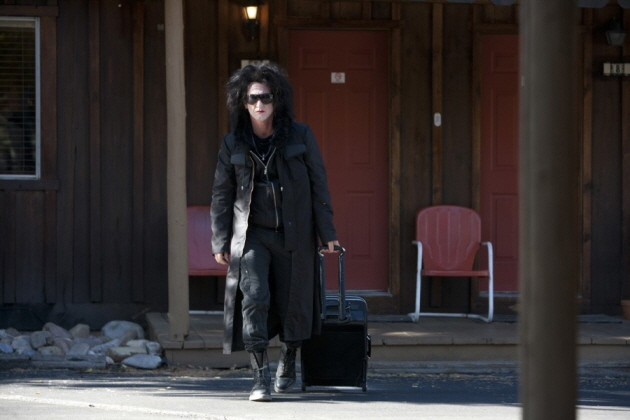 “This Must Be the Place” is an offbeat drama about a sad man who has been hiding inside his appearance of the past as his shell for a long time. When Cheyenne, played by Sean Penn in a striking appearance we have never expected from him, starts another day of his languid life, he goes through his usual routine. He manicures nails, rouges his lips, puts eyeliner around his detached eyes, and tidies up his bushy hair style from the 1980s before going outside in his punky black attire.
With such a showy style from the past, it is easy to draw attention from others around him, but he has been sort of a familiar fixture in his neighbourhood in Dublin. We come to learn that he aborted his lucrative career as a rock star years ago after he was devastated by some terrible tragedy which happened around that neighbourhood. While he has little interest in music or playing music now, his past career has supported him pretty well; he lives in a big manor with his caring no-nonsense wife Jane(Frances McDormand), who works as a fireman in the neighborhood, and money keeps coming to him thanks to the royalty of his songs, and, as a mild entertainment for him, he also tries stock investment through his friend’s help.
And the life keeps going on for him without any change. The people recognize him at times, but Cheyenne is not particularly interested in getting their attention. Though he has a sort of groupie hanging around him at the mall, but she is more like a daughter to be chaperoned by him. In one humorous scene, he sets up a date for her in his house as her matchmaker, but, to his disappointment, it ends not so successfully.
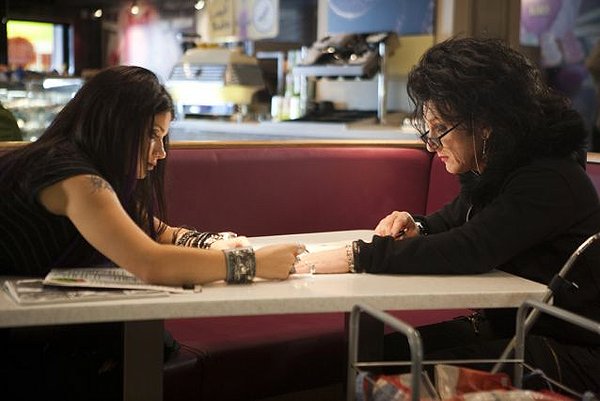 On one day, he gets an urgent message from his hometown in US. His father, whom he has not corresponded with 30 years, has few days to live, so Cheyenne returns to US, but he is too late because he chooses to travel by ship instead of plane due to his fear of plight, though he manages to attend his father’s funeral with his family and others while maintaining his usual attire and appearance. He looks odd compared to the others wearing formal attires, but they seem to accept what he is(or was).
After funeral, he come to learn that his father had been privately pursued a Nazi criminal hiding somewhere around US. Although that guy in question, named Aloise Lange, is not a major Nazi criminal like Josef Mengele or Adolf Eichmann, his father was determined to search for Lange because of his personal reason; when he was in Auschwitz concentration camp during the World War II, Lange deeply humiliated him, and Cheyenne’s father had wanted to get his revenge since that unforgettable moment.
After that point, the movie goes into road movie mode as Cheyenne starts his long journey for his father across the US continent, so we get lots of gorgeous views of plains and roads while following him and observing many small things happening around him. Besides the people who may give the crucial clues for finding Lange, he also meets and interacts with various people including a tattoo artist who is actually nicer than he looks and a mysterious old Indian who suddenly appears and then suddenly disappears. In fact, we even encounter Harry Dean Stanton at one point, who was the journey itself in Wim Wenders’ great road movie “Paris, Texas”(1984) and also was the arrival point in David Lynch’s gentle road movie “The Straight Story”(1999).
 As such people drift by him, Sean Penn subtly reveals a man-child with unresolved and resentful feelings remaining behind his detached face and tentative mannerisms. Penn has surprised us with unexpected performances as shown in “Sweet and Lowdown”(1999) and “Milk”(2008), and, again, he shows us something we have never imagined from him through one of his best performances; as deadpan as Bill Murray, he brings both humors and pathos to his passive character who somehow finds the will to accomplish his father’s mission even after spending so much time in his comfort zone. I do not know whether he has been searching for such a chance, but it is always nice to do something for breaking out of shell, isn’t it?
The movie is directed by Paolo Sorrentino. He impressed me a lot with his previous work “Il Divo”(2008), a very stylish and entertaining movie about a very compelling and enigmatic real-life politician who might be more insidious than the movie implies, and “This Must Be the Place” looks far different from “Il Divo” even though it is also stylish in its own understated way.
This is Sorrention’s first English film, but the movie shows no awkwardness in his transition, and, with his cinematographer Luca Bigazzi, Sorrentino engages us to his story with interesting visual ways of presenting the places and people on the big screen. I especially like the longtake scene where Talking Heads’ “This Must Be the Place (Naive Melody)” is performed along with an interesting set design at the concert in New York, and David Byrne, who was a founding member and principle songwriter of Talking Heads and composed the music for this film, makes a notable contrast to Cheyenne in one scene as his fellow musician who has adapted to the changes of trends while moving on with his career.
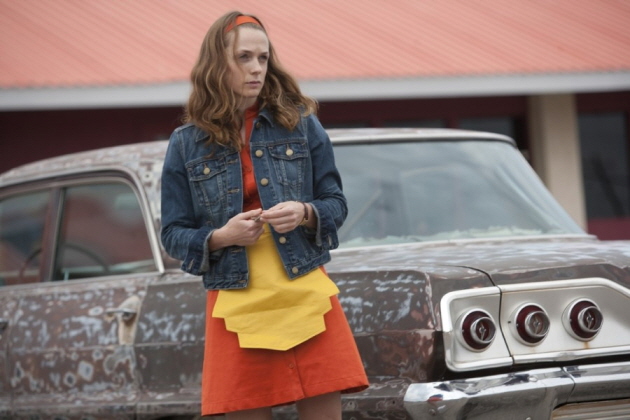 Sorrentino also nicely captures the small human interactions between Cheyenne and others he meet on the journey. In the middle of quest, Cheyenne comes to spend some time in one nice waitress’ home, and her young son asks him to play guitar for him. Though he says he does not play music anymore, he eventually plays, and it shows that he has not lost his touch yet in spite of his disinterest.
In road movies, there is always the arrival/resolution point waiting at the finale, and “This Must Be the Place” is no exception. It eventually arrives at the finale as expected, but it comes with more complexity and surprise while satisfyingly wrapping up its contents. With the juxtaposition of seemingly mismatched elements, the movie is a sad but humorous road movie which can also be regarded as a heartfelt coming-of-age tale, and Penn’s performance effectively holds the center even when the movie looks directionless. He so completely inhabits inside his odd character that it takes some time to recognize him at one point – and that’s why it really feels like a hopeful beam of sunshine glimpsed at the end of cloudy day.

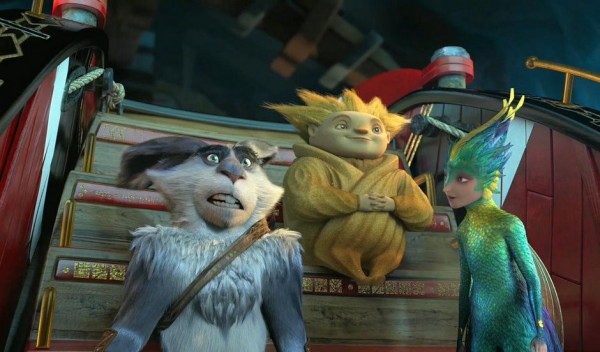
 We have “The Avengers” early in this year, and now we have “Rise of the Guardians” around the end of this year. Like various superhero characters were assembled to save the mankind in the former, the various Guardians of Childhood are assembled to save the innocence of children all over the world in this case, and the result is a nice gift set for the Holiday season packed with good sights and, of course, some fast and exciting action sequences to satisfy young audiences.
I am not familiar with the book “The Guardians of Childhood” written by William Joyce, so let’s only focus on the premise presented in its adapted version. For a very long time, there have been several guardians for the wonder and imagination and hope inside the unadulterated minds of children, and they are North(voiced by Alec Baldwin), Tooth(voiced by Isla Fisher), Bunny(voiced by Hugh Jackman), and Sandman, who does not talk but communicate with others through the figures he conjures above his round head.
We see what these members do when there is no serious threat to deal with. In case of North, he is apparently Santa Claus – with two tattooed arms(“Naughty” on the right arm – and “Nice” on the left arm). He does his annual Christmas business somewhere probably around the North pole as monitoring the brightness inside children all over the Earth at the control room at the center of his factory. He has elves in the factory, but they are more or less than hapless minions for comic relief, and a group of snowmen do most of works(Wait a minute, do they have snowmen in the North pole?).
 We see the other fun sights. Tooth is of course Tooth fairy, and she has lots of fairies who are little version of herself, and they fly all around the world for collecting the teeth from children and leaving coins under their pillows in exchange for them(I didn’t know that the Chinese children believe in Tooth fairy, by the way). Bunny, a big brash rabbit, is in charge of Easter, so we get a fabulous sight of many eggs marching for coloring and delivery later in the story.
While Sandman takes care of good positive dreams for children with his golden sandy power, Pitch(voiced by Jude Law), who is also called Bogeyman, represents the dark power of bad negative nightmare. As an arch-nemesis of the Guardians, he has been suppressed for quite a long time, but now he rises again for usurping the territory guarded by them, and they must stop him before he starts the dark age again.
In such a tale of good vs. evil like that, a reluctant hero comes with territory, and he is Jack Frost(voiced by Chris Pine), who is unexpectedly appointed as a new member of the Guardians by “man in moon”. His name particularly reminds me of one lousy holiday movie “Jack Frost”(1998), and I sort of expected Jack Frost in the movie to look like a cousin of Frosty the Snowman, but, no, to my little disappointment, he looks like a standard old boy(he is more than 300 years old) with his ever-youthful looks and white frosty hair.
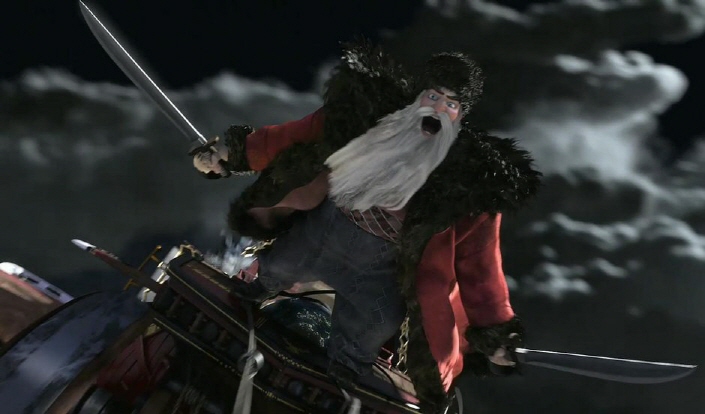 The story is as standard as he looks. Although he has lots of fun with delighting kids whenever winter comes, but he has been frustrated about being invisible to them and unappreciated by them. Chosen as a Guardian, he finally gets a chance to be promoted and visible, but he is still not so confident about himself because, well, he does not know who he really is, so a considerable part of the story is devoted to his inner search as Pitch is steadily increasing his malevolent power, which creates his army of smoky dark horses frequently swishing across the screen. The notable actors behind the characters are mostly unrecognizable in the voices they provide, but Jude Law is having a delicious fun behind his character. After all, playing a villain is more fun than playing a hero, and Law imbues Pitch with dark humor and insidious menace.
I must confess that I have some grumbles about the story due to its predictable storylines and other reasons. How the powers of the Guardians are supported is an interesting idea, but it is not utilized as well as I expected in the story. It was amusing to see Easter Bunny and Santa Claus working together for helping their colleague, but they do not look that serious even though their power and existence are being threatened at the very moment. And I was a little confused at one point by how winter comes so fast right after the moment of crisis during Easter.
 But at least I was not bored with the visuals in the animation. Each Guardian’s headquarter is depicted with colorful and distinctive details, and I marveled at Tooth’s palace at the top of the mountains where the teeth from the children are carefully stored. I also enjoyed Pitch’s huge gloomy lair, and I am sure that there must be the plaque which says “Abandon hope all you who enter here” somewhere around that dark place.
Like many recent digital animation films made, “Rise of the Guardians” is made in 3D. Although 3D is not that popular at least in my town, but they only showed it only in 3D at the advance screening at the local theater, and I had to pay extra money for that. As usual, I am not entirely sure about whether 3D is necessary, but I did not feel any need to take off my big 3D glasses during my viewing, and kids and parents around me had a good time with fun and excitement on the screen. It does not bring anything fresh to its fantasy genre, but “Rise of the Guardians” is entertaining none the less as a lightweight fun on the whole, and I won’t complain about its visible weaknesses.