Suddenly, Last Summer/Going South (2012) ☆☆☆(3/4) : Two summer afternoons

I remember one funny joke you have probably heard about. When a boy goes to a priest for confession, he confesses to a priest that he went to a strip club in the town at last night. With amused understanding, a priest says, “So you saw something you should not have seen, my boy.” A boy instantly replies, “Oh, yes, Father, I saw my dad at the club.”

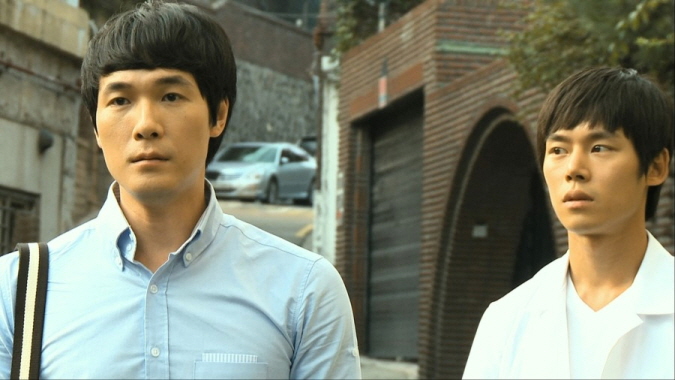
The reason why I thought about that old joke at the screening of Lee Song-hee-ill’s short film “Suddenly, Last Summer” is that its heroes were in a similar situation not shown in the movie. Poor Kyeong-hoon(Kim Yeong-jae), I guess all this nice high school teacher wanted was having a little free fun at a local gay bar as a closeted homosexual, but, unfortunately at that night, he was noticed by one of his students, and that student even took photos of him at that bar with his cellular phone.

His name is Sang-woo(Han Joo-Wan), and we come to see that he has had a crush on his dear teacher. Unlike his teacher, who is quite nervous about the situation because he can be fired for being gay, Sang-woo is quite open about his sexuality. He even wants to have a serious relationship with Kyeon-hoon, and he is very determined to do anything for that – including blackmailing his teacher with those photos.

So Kyeong-hoon reluctantly follows his pupil’s demand. They go around Seoul together while Kyeong-hoon visits several parents of his students. They go abroad a sightseeing ship on the Han River. It could go on like that while nothing happens, but Kyeong-hoon finds himself gradually attracted to Sang-woo’s passive-aggressive seduction even though he should not have a physical relationship with a minor at any case.

Although there is always sexual tension churning under its surface, the movie has a fun with its compelling drama of attraction and repulsion as it languidly looks around the sights of Seoul seen from a ship on the river. These sights remind me again that Seoul is really filled with many plain concrete apartment buildings here and there on the riverside, but they do not look awful at least. Along with many other buildings and bridges, they look actually nice on sunny summer afternoon in the movie, and I went along with its slow pace while appreciating the performances of its two lead actors.

Kim Yeong-jae conveys us well the conflicting emotions simmering inside him, and we feel sorry for his impossible situation; he can say no to Sang-woo, but Sang-woo will keep coming to him, and he does not know how much he can resist a growing temptation inside him. His co-actor Han Joo-wan is subtly seductive as a young homme fatale even though he looks a little too old at times as an adolescent character. We always should protect minors, but sometimes they can be more sexually active than we think, and that’s why some adults find themselves in big trouble thanks to the teenagers like Sang-woo(if he is really innocent as he claims, I am sure Kevin Clash will tell you a lot about that).

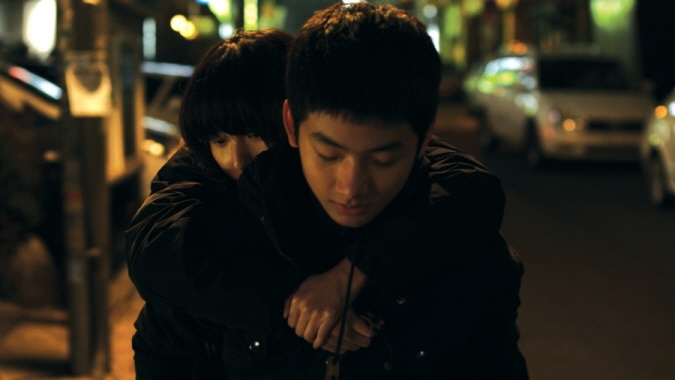
At the screening I attended, “Suddenly, Last Summer” was followed by “Going South”, another short summer afternoon story between two heroes with their own problem. Gi-tae(Kim Jae-heung) is so desperate about not losing Joon-yeong(Jeon Sin-hwan), with whom Gi-tae had a very intimate relationship at the army. Now Joon-yeong finished his obligatory service and got out of the army, and Gi-tae is almost at the end of his service, but Joon-yeong, still conflicted about his sexuality, does not want Gi-tae to be near him.

The movie begins with the awkward silent moment between two as Joon-yeong takes Gi-tae to the army base by his car on the last day of Gi-tae’s vacation. As the last desperate attempt, Gi-tae puts a sleeping pill in the coffee he gives to Joon-yeong. Although he must go back to his army base in less than an hour, Gi-tae drives the car to some remote place for having a private time between them. Joon-yeong is naturally angry about what Gi-tae has done when he wakes up, but, even while he harshly rejects Gi-tae, his repulsion is not that far from his desire.

This short melodramatic tale is relatively less enjoyable than “Suddenly, Last Summer”, but it has good things to be enjoyed. In contrast to the concrete urban atmosphere of the latter, “Going South” is filled with the fresh green rural atmosphere in its background, and its tranquility contrasts with a hostile psychological tug-of-war between two characters. We are again served with a nice duo performance in this case, and Kim Jae-heung plays well with his co-actor despite his lack of experience(this is his first movie).

At the beginning, the director/writer Lee Song-hee-ill initially planned to make an omnibus film consisting of three short films. The third one was “White Night”, and it was eventually separated from two other short films as it got extended enough to become a solo feature film during its production. I did not have a chance to see “White Night”, but I heard that it is also a good movie.

As an openly gay director, Lee Song-hee-ill has made several interesting films about homosexuality, and they can show you what is like to live as a gay in South Korean society, which are still not so kind to homosexuality in spite of many social progresses(According to the director, one actor left the production because his mother threatened to kill herself with a cross in one hand and a bottle of herbicide in the other hand as soon as she heard about his participation). “Suddenly, Last Summer” and “Going South” indirectly show me that aspect through their good stories, and I had a nice time with them – and they reminded me that South Korean society has still a lot to go for becoming a model advanced country.

Posted in Movies | Tagged , , , , , | Leave a comment

Keep the Lights on (2012) ☆☆☆(3/4) : Scenes from a gay relationship

They love each other, and they like to be with each other, but they admit in the end that their relationship does not work. “Keep the Lights On” tells an bittersweet romance tale about two gay men struggling with the problems in their relationship, but you will find the universal aspects from their best times and their worst times once you pass by the specifics in their story. Like any straight or gay couples, they are just two people attracted to each other, and they bitterly accept their failure as a couple like some of us did.

The movie observes on how the relationship between Erik(Thure Lindhardt) and Paul(Zachary Booth) is started, continued, shaken, broken, and finished during their 9 years. In 1998, Erik was a Danish documentary filmmaker struggling to advance his career in New York. He managed to make his documentaries thanks to his rich parents’ financial support, but he has not attracted significant attentions yet. When he appears in a radio program, he notices that its DJ is not so enthusiastic about his recent documentary while merely asking formal questions to him.

Anyway, he tries to move on with his next project(it is about an underground artist Avery Willard), and he also searches for a new lover through random encounters. Sometimes he uses phone sex service, and sometimes he has casual encounters with other gay men. One of them is particularly funny, for he seems to be more interested in how his own body looks than having a sex with Erik.

And then Erik gets involved with Paul, a lawyer who works in some publishing company, and their relationship becomes less casual as they spend more time with each other. They go to the museum together. They enjoy nice afternoon at the Central Park. They also meet Erik’s other friends, including Dan(Justin Reinsilber), Claire(Julianne Nicholson) and her husband Alassane (Souléymane Sy Savané).

But, as the time goes by, their romance is hindered by the problems which were apparent from the beginning. Besides that Paul usually shows distant attitude to Erik in spite of Erik’s patient love, Paul has addiction problem with drugs, and that hurts Erik a lot. At first, it looks like a minor character flaw, but Paul’s addiction problem starts to seriously affect the relationship between them. Sometimes Paul goes out and does not return to home for more than a day, and, when he returns, he never talks about where he has been. While the others around them begin to sense the strains in their relationship, Erik finally try to deal with the problem, and he gets some help from others to persuade Erik to check himself in the rehabilitation center, but the things keep getting complicated between them.

The movie feels biased at times because we never see the story in Paul’s viewpoint throughout the film. While we can understand why Erik keeps trying to maintain their relationship despite his frustration with Paul, Paul is usually masked by his private problems he is not willing to discuss openly with his partner. It looks like he does care about Erik, but, driven by his addiction, he is sometimes quite cruel to him; at one moment, he has an intercourse with a male prostitute as Erik remains at a loss outside the room.

What drives Paul such self-destructive behaviors hurtful to not only himself but also his partner? The director/co-writer Ira Sachs does not seem to have an answer for that, and that is not so surprising, considering that the movie is a partially autobiographical story inspired by Sachs’ experience with his former lover. I heard that those impressive pictures shown during the main title scene were actually drawn by Sachs’ current lover Boris Torres, and I was a little amused by the scene where Erik comes across a guy who is probably Torres’ fictional counterpart.

Despite the constant problems between them, Erik and Paul somehow continued their troubled relationship for several years. Even if they are not happy about their relationship, it takes some time for two people to be separated because they still have feelings about each other, and the movie observes the scenes from their private life with the considerable degrees of sensitivity and honesty. There are many unhappy moments, but there are also happy moments. They are angry about each other at one time, but they soon make reconciliation in their bed, and that pattern goes on and on till some point.

This could have been very monotonous due to inherent repetition, but we are constantly engaged thanks to the good performances by two lead actors, and Thure Lindhardt and Zachary Booth have a nice chemistry between them. While mainly focusing on Erik and Paul, the movie also looks at the supporting characters from time to time, and they add small nice details to the main story. In case of Claire, we get a scene where she has a brief but honest talk with Erik as his straight girlfriend, so we get the reversal of a familiar movie convention most of us are familiar with.

Like “Weekend”(2011), another sensitive drama on a bittersweet homosexual relationship, “Keep the Lights On” looks at the characters and their intimate drama with no particular need to make statement on its subject. Erik and Paul do not hide their sexuality from others, and the others see no problem with that. After the critical success of the movies such as “Brokeback Mountain”(2005) or “The Kids Are All Right”(2010), it looks like homosexuality now becomes a mere ordinary subject for stories, but I guess that’s not a bad thing as long as there are good stories to tell. How nice it is to see such a progress like that.

Posted in Movies | Tagged , , , , | Leave a comment

A Simple Life (2011) ☆☆☆1/2(3.5/4) : A long relationship between two good people

“A Simple Life” feels plainly but deeply touching as a heartfelt story about the life of two good people who have known and loved each other for a long time. They are not family in the strict sense, but they have been more or less than family to each other, and their life has been quietly moving in warmth and intimacy as the inexorable fact of life is approaching to them.

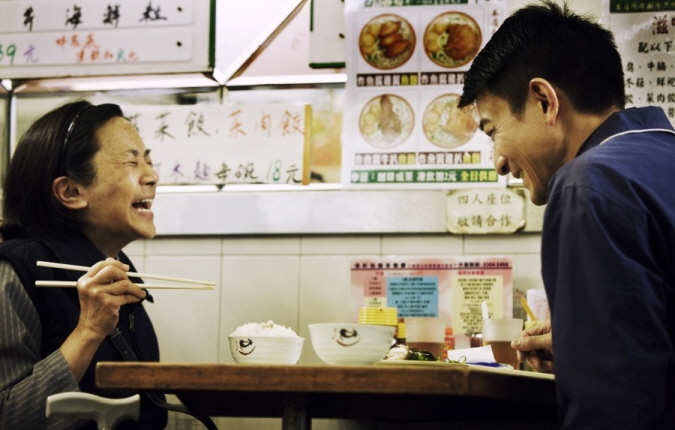
They are Ah Tao(Deannie Yip) and Roger(Andy Lau). When she was very young, Ah Tao was sent from her home in China to a wealthy family in Hong Kong, and she has devoted her entire life to serving this family as a housemaid. This sounds very depressing, but, when we see her for the first time, she is a nice old woman happily doing her shopping at the market in her neighbourhood. When she comes to her favorite vegetable story, the owner and employees are gladly ready for her. They snicker behind her back, but that is because they are always amused by her consistency, and they respect her as their good old customer.

Ah Tao has served the four generations of her master family, and most of them have gone or left Hong Kong. Now only family member in the family apartment(it looks a little small, but think about how expensive the real estates in Hong Kong are) is Roger, who works as a producer in some film company. Their daily life consists of simple routines; he wakes up, and he eats the breakfast prepared by her, and then he goes out for work. After her work is finished, she waits for him to return like a mother waiting for her son, and their day is over when he returns from his work.

But an inevitable change comes into their comfortable life. Ah Tao has already had some medical problem, and she collapses on one day, and, after being taken to the hospital, she finally decides that it is time for her retirement. Although she does not want it, Roger thoughtfully takes care of her retirement process. He finds a fairly decent place for the aged, and he willingly pays the bills like a good son. In fact, he introduces himself to the other old people at the facility as her godson during one scene.

So their life is changed, but the life keeps going on for them as usual. Roger keeps diligently working at his company or going abroad for business matters. While finding some difficulty with adjustment, Ah Tao gets tentatively accustomed to her new environment while befriending her fellow aging people and the staff members at the facility. Unless he is very busy, Roger regularly visits her, and they always enjoy each other’s company.

There is no sudden revelation or melodramatic turn in this gentle drama, but the director Ann Hui, an acclaimed film director who has been admired and respected in her impressive career, slowly pulls us to her story while sensitively capturing the warm and humorous human interactions between her characters within the tranquil rhythm of daily life reminiscent of Yasujirō Ozu’s works. The sadness in their life is deepened as the time goes by, but the humor always hangs around the screen. Ah Tao is a little intimidated by her new place, which filled with many impersonal cubicles for its residents, on her first day at the facility, and she observes many sad miseries among others in the facility, but she loses none of her warm, understanding attitude and she becomes a good friend to many of her fellow residents. One of them is particularly funny, because, while always looking for joie de vivre, he keeps asking around for money to spend on something.

And we come to see how deeply Ah Tao and Andy care about each other more than we thought while also observing how the other family members react to her health problem. The other family members all fondly remember her, and they are sincerely appreciate of her long-time service(for instance, Andy’s mother flies from US just for visiting Ah Tao and showing her gratitude along with gifts), and they kindly accept her as a family member at one big family event.

But they are not as close to her as Andy. The mutual love and concern is always palpable between them even when they jovially tease each other, and one of the most touching moment in the movie comes when they look around the things from their past which have been kept by her in a small room at their apartment. Although there is no serious problem in the relationship between Andy and his mother, Ah Tao looks more like his mother as she recollects their past with him during that scene.

The movie won several awards at the Venice Film Festival in the last year, and one of them was Best Actress award for Deannie Yip. While remaining gentle and warm throughout the movie, she remarkably expresses so many things inside her character through her aged face weathered by the passage of time, and she really deserves the award as the graceful emotional center of the film. Andy Lau, who looks surprisingly quite plain and ordinary compared to his performances in other more famous films like “Internal Affairs”(2002) and its sequels, matches his co-actress well with his understated performance, and we are always warmed whenever they are together on the screen. The other performers are well cast for their respective roles, and, if you are familiar with many Chinese movies and Hong Kong films, you will be very amused by the special appearances made by well-known filmmakers and actors in the movie.

“A Simple Life” is a film somberly shining with the better sides of our human nature through its universal family drama as it recognizes the limitedness of life we all have to face in the end. There are many emotional moments in the movie which has been growing on me since the first viewing, and I was particularly touched by an unexpected turn in a certain scene, which took me back to one surprisingly powerful moment in Yôjirô Takita’s “Depatures”(2008), an equally great film which also humanely deals with life and death through humor and sadness. I won’t go into details, but let’s say it is always moving to see a human being responding to the kindness from the other as much as he can out of his goodness, and you will agree with me on that after watching this beautiful human drama.

Posted in Movies | Tagged , , , | 1 Comment

Juvenile Offender (2012) ☆☆☆1/2(3.5/4) : Kids, please always use condom

When I was watching South Korean independent movie “Juvenile Offender” in the late screening at night, only two young couples were in the screening room. I have no idea about what they were expecting from the movie, but I sort of hope they could get an indirect important message from its story: boys and girls, there is nothing wrong about wanting to have a sex, but it is really necessary to use condom for protecting your future, a fragile thing which can be ruined forever by one momentary misjudgment.

When I saw a young teenager boy Ji-gu(Seo Young-joo) in the opening scene, that thought instantly came to my mind. He is with his girlfriend at her home, and it is apparent that they are going to have a sex just because the mood feels right to them. No matter how much adults emphasize the virtue of abstinence to teenagers, the hormones in their bodies always do exactly what they have been programmed to do during the history of mankind, and not many things can stop this biological impulse activated in their young fresh brains.

Ji-gu lives alone with his ailing grandfather in their shabby apartment. He cares about his grandfather, who has few days to live, but he frequently gets himself into troubles. While having been arrested by the police for several small crimes, he has also been involved with bad friends, and we see him and his friends breaking into some house for stealing money or any valuable things in the house. They do not have any serious thoughts about what they are doing; one of them says the house belongs to his rich uncle(really?), and the others have no problem in accepting his words.

Anyway, they are soon caught for their latest felony by the police, and they are quickly sent to the court for juvenile delinquents. Because Ji-gu is a 15-year-old “juvenile offender”, a teenager legally responsible for his felony according to the South Korean criminal law, and he has already been on probation, he is sentenced to another year at juvenile reformatory in spite of his amiable plea in front of the judge. He has no serious problem with that sentence, although he worries about his grandfather, who has been only family member to him for many years.

Several months later, his grandfather dies. After attending his funeral, Ji-gu finds himself more lonelier than before, but he accidentally learns about his mother, who left him to her parents when he was born in 13 years ago. She is Hyo-seung(Lee Jeong-hyeon), and, when she appears in front of his son, she looks quite young as a mother with a teenager son, because, well, she gave a birth to him when she was 17.

When his time at the reformatory center is over, his mother comes to take him to her residence, though she is so late that he is almost handed to a social service employee when she hurriedly arrives in. That may be forgiven easily, but it becomes clear to us that Hyo-seung will definitely not get the mother of the year award no matter how much she tries. She has a fairly decent job at a hairdresser’s shop, but she has been living like a guest at its owner’s apartment, and she keeps borrowing money from the owner through her ingratiating attitude and vapid promise for payback. She is as immature as his son, and it is no wonder that the owner(Kang Rae-yeon) eventually gets really sick of her later.

The movie gives no false hope about the incorrigibly hopeless circumstance of Hyo-Seung and Ji-gu. It is good to be together for a while as a mother and a son, but they do not get along well with each other with no real communication between them, and they are pushed toward more desperate states as the time goes by. Sad thing is that, even if they really want to get a better life, they are still big, unwise children who do not know how to reach for it and they do not learn anything from the constant hardships in their daily life. They do not like their jobs, but what the other options they have in their miserable life?

While calmly observing their slow descent, the director/co-writer Kang Yi-kwan fills his drama with interesting details and small humorous moments. As a guy who spent his adolescent years as a nerdy boy who always stuck to the rules and books, the realistic depiction of the daily routines of the boys at the juvenile reformatory is certainly interesting to observe. The reformatory in the movie looks less gritty than expected, but I guess its mundane atmosphere is not far from reality.

Lee Jeong-hee and Seo Young-joo are excellent as a mother and a son who are more like an older sister and her equally childish younger brother. Lee Jeong-hee, who has not been in movies often since her first movie in “A Petal”(1996), shows us here that she really should appear in more movies. Hyo-seung is pretty unlikable and pathetic at times due to her irresponsibility and indulgency, and Lee Jeong-hee never makes an excuse for her character while we feel both sorry and impatient about Hyo-seung. I worried a little about her circumstance without exit even though my eyes were rolling at her unchanged attitude, but I won’t lend her even $10 no matter what she says.

The newcomer Seo Young-joo, who is actually younger than his character, holds his own place well with his co-actress, and he also has nice scenes with Jeon Ye-jin, who plays Ji-gu’s unfortunate girlfriend. Through her irreversible social position, the movie, which was financed by the National Human Rights Commission of South Korea, indirectly tells us about how devastating the consequence of teenage pregnancy can be. Still influenced by traditional morality and ethics, South Korean society is very harsh toward pregnant teenagers who are usually ostracized by their families and others as social pariahs, and you can feel the resulting devastation on Jeon Ye-jin’s bleak face. Ji-gu promises to her that he will compensate for what he had done to her, but he only proves that he is someone she should stay away from forever; he is certainly an apple which does not fall far from its tree.

Like “Jejus Hospital”(2011), “Juvenile Offender” is a small gem which should not be ignored. Unfortunately, the movie is released around the time when more popular films occupy most of the South Korean theaters, and it was really lucky for me to find a theater showing this very good movie in my town. Through its intimate character drama supported by two superb lead performances, the movie effortlessly raises its social issues while never making a speech about them, and it makes us to think about them during its end credit. Hyo-seung and Ji-gu won’t probably get better, but we can prevent such another sorry situation like theirs, and that is the reason why I think young teenagers really should watch this movie. Kids, I must confess that I never had any experience with adolescent romance, but I must say this again as a considerate adult: please use condom no matter what happens.

Posted in Movies | Tagged , , , | 1 Comment

National Security (2012) ☆☆☆1/2(3.5/4) : A man tortured in the room

New South Korean movie “National Security” is a fiction based a true story, but the reality glimpsed from its fiction gave me and the audiences an unforgettably uncomfortable moment at the screening room at last night. We all knew what depicted in the movie really happened during that dark era depicted in the movie, but the movie deeply disturbed us as an uncompromising and unflinching observation on that frightening licensed brutality stomping on basic human rights – and its consequences still lingering on the minds of unfortunate people who had to go through such dreadful ordeals at that time as well as South Korean society which has remained haunted by its unpleasant memories of violent past.

When Kim Jong-tae(Park Won-Sang) is taken to the police station, he knows the reason for his arrest at least. Because he has been involved in the political activities calling for democracy against the dictatorships for many years, the police have been watching on him even when he decides to take a rest for having some free time for thoughts and his dear family. When cops suddenly come to him, he expects he will come back soon to his family because he has not done anything ‘wrong’ recently at least.

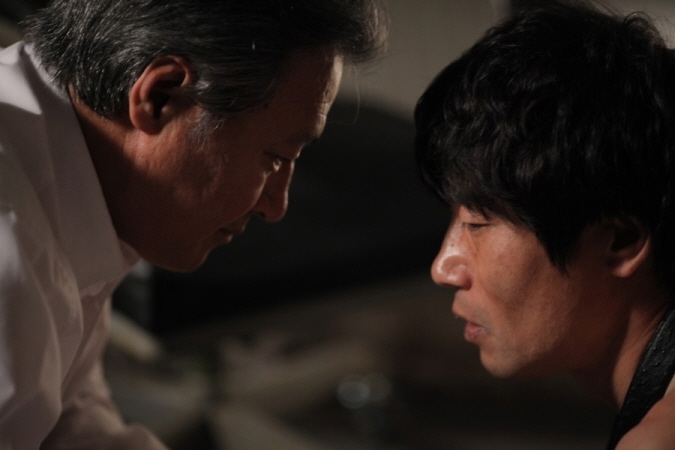
But, unfortunately, he was incorrect. As soon as he arrives at the police station, he is immediately taken to somewhere by the security police agents without proper procedure. It is September 4th, 1985, and it was the time when many South Korean activists were unjustly incarcerated and then ruthlessly tortured under the dictatorship. When Jong-tae finds himself locked up in some shabby room, he knows well where he is; he is brought to the infamous interrogation center at Nam-yeong dong in Seoul where agonized cries from interrogation rooms are frequently heard along the corridor outside every day.

 Because the police know everything he has done or said through secret wiretapping and any other means available to them, he really has nothing new to tell about his political activities, but that does not matter to them at all, for they can make him tell anything they want through tortures. At first, it is just forcing to write everything about himself and his life while not giving him any chance to sleep, but the intensity and barbarity in their cruel process increase day by day to extract ‘confession’ from him.

The authorities in the film are determined to make him into a North Korean spy/sympathizer, and I thought about how easy it was for them to make a big case of ‘spy organization’ whenever it was necessary for the dictatorship at that time – especially when big election is coming. There were surely North Korean agents trying to undermine the security of South Korean society(one of my uncles did lots of things to catch such dangerous people during his classified years at the National Intelligence Agency, and I respect what he did for our country although he was called to several recent hearings on the injustice committed at his agency during his time), but there were also lots of innocent people suddenly finding themselves labeled as the enemies of the state even though they were not as politically active as Jong-tae, and they were forced to make false confessions which would initiate another process of tortures and false confessions in the other interrogation rooms.

Like them, Jong-tae becomes humiliated and broken in a sadistically systemic process by the authorities in front of our eyes, and there are many grueling scenes in the movie which will make you wince and squirm a lot(I saw a couple sitting next to me leaving the screening room at one of its most intense moments), but the director Chung Ji-young firmly maintains a calm, honest, and objective attitude in these brutal scenes along with sincerity and passion pulsating behind the screen. His movie could have been easily degenerated into an exploitative torture flick, but it handles its subject effectively while not going too far, and its true horror comes not from the graphic depiction of tortures but the banality of evil shown from Jong-tae’s captors. Even when they are tormenting him, their minds are occupied with the details of their mundane daily life including sports game or date or promotion just like your average South Koreans in the 1980s, and this realistic depiction makes them more chilling. They are plain guys who really lived and ‘worked’ during that time, and it is rather scary to imagine how ordinary they would look outside their workplace.

As a good man trapped in a hopeless situation, Park Won-sang stays true to his unpretentious performance well even when he bravely puts himself into many difficult scenes including the one featuring that notorious waterboarding torture(they even mix red pepper powder into water at one point, by the way), and I sometimes worried about his safety during its production at time even though I knew they made this film with care and caution. Jong-tae’s mind sometimes recedes into his memory or hallucination, and that provides a few respites for the audiences although they are not really necessary except providing the background for the hero we worry and care about.

On the opposite, Myeong Kye-nam, Moon Seong-guen, and other actors support Park Won-sang well as the bullies very good at their barbarous work. The special mention must go to Lee Kyeong-yeong, who is truly terrifying with his phlegmatic professionalism a la “Marathon Man”(1976) as a torture expert who does know a lot about how to extract confessions from his subjects with maximum physical pains and minimal visible injuries. You think he goes far enough, and then he will stomp on you far more ruthlessly than you have ever imagined. To him, Jong-tae is merely another guy he will work on by any means necessary, and he has lots of works to do around South Korea. He even casually whistles “Oh My Darling Clementine” during his waterboarding sessions, and that makes the song sound as horrific as “Singin’ in the Rain” in “A Clockwork Orange”(1971).

In the end, this is not a spoiler, the happy ending comes to Jong-tae though he is eventually sent to the prison for his forced confession, because he is released few years later when the democratization is finally started in South Korea. Although the story and the characters are fictional, the movie is mainly inspired by the painful experience of a real-life political figure Kim Geun-tae, who later became a cabinet member in the South Korea government and sadly died in last year due to Parkinson’s disease, which was probably originated by that darkest time in his life.

You may think a torture expert in the movie is a composite fictional character, but he is also based on a real-life figure infamous for his tortures. After hiding from justice for a while, he eventually surrendered himself to the police and got a prison sentence, but he later got out of prison as a born-again Christian and pastor, although he was divested of his title because he behaved as if he had completely forgotten every atrocity he committed in the past. I recently read an article about him, and he remains as impertinent as before, but that is not shocking to me and others much, considering that the dictator who was above him and others at that time is still alive and guarded well in his big house in Seoul even at this moment. That former dictator argued in public at one time that only around $250 is in his possession, but, what do you know, he still can manage to go to an expensive golf club with his close friends, who remain influential and powerful at the top of South Korean society.

“National Security” is not a pleasant experience, but this is a hard but engrossing experience for it vividly evokes one of the darkest chapters in the modern South Korean history. In spite of some flaws including the occasional stiff dialogues in the screenplay, the movie effectively and earnestly reminds South Korean audiences how much their society have advanced since that era – and, as revealed in its powerfully resonant ending, how much its painful memories of violence has not been resolved yet.

Posted in Movies | Tagged , , , , | Leave a comment

Sinister (2012) ☆☆☆(3/4) : It eventually becomes sinister….

“Sinister” goes through a familiar route we have encountered from countless horror films about houses of ill omen. As a matter of fact, it is quite predictable at times, so I knew what would happen next as soon as it got dark in the house in the movie. Some strange sounds are heard in the soundtrack, and our hero tries to find out where they come from, and, although there is a little light source available to him, he keeps moving and glancing around in the darkness, while it seems something is lurking around him to frighten him and us.

You probably think I am complaining, but I assure you that the movie is a more effective horror movie than I initially thought. It has a good atmosphere to unsettle us, and it has a solid scary tale which handles well its many genre conventions including ‘false alarm’. I must tell you that there are several false alarms in the movie, but, rather than depleting the tension in the movie, they instead help accumulating the suspense inside a suburban house which can look very ordinary under the sun when you see it for the first time.

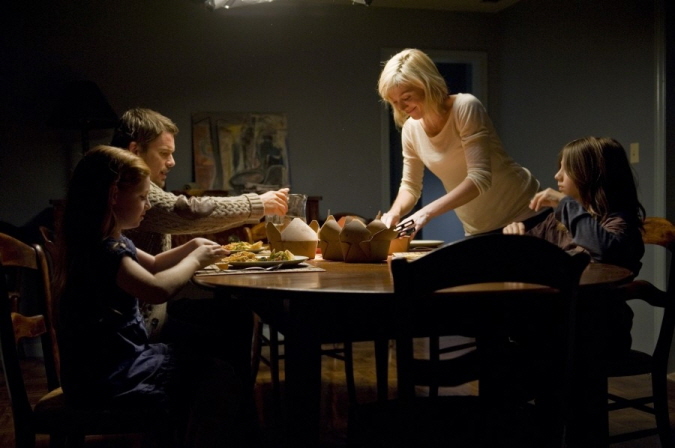
Besides the fact that it is a cheap one, the main reason why a true-crime writer Ellison Oswalt(Ethan Hawke) decides to move into this house is that he wants to write a non-fiction book on a terrible incident which happened in the house not so long time ago. Oswalt scored big with his early book “Kentucky Blood” years ago, but, though he has published several other books, he is still struggling to reach to the level of his previous success. He needs to support his dear family, and he desperately believes his new book will help regain his past fame.

But he makes a very unwise choice. When he and his family come to the house, he does not tell his wife Tracy(Juliet Rylance) and his kids that they are moving into the very house where whole family members except one were horribly murdered by someone at that time(that family member is still gone missing, by the way). The town people know why he comes to their neighbourhood, and the town sheriff(Fred Dalton Thompson) is not especially pleased because he does not like to see his unpleasant unsolved case brought to the spotlight again by Oswalt. Unlike his deputy(James Ransone), who is eager to help Oswalt’s private research when his boss is not looking at him, he does not welcome him a lot on the moving day.

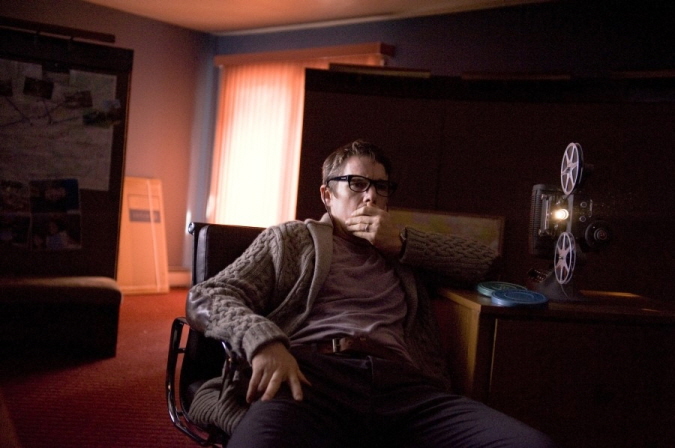
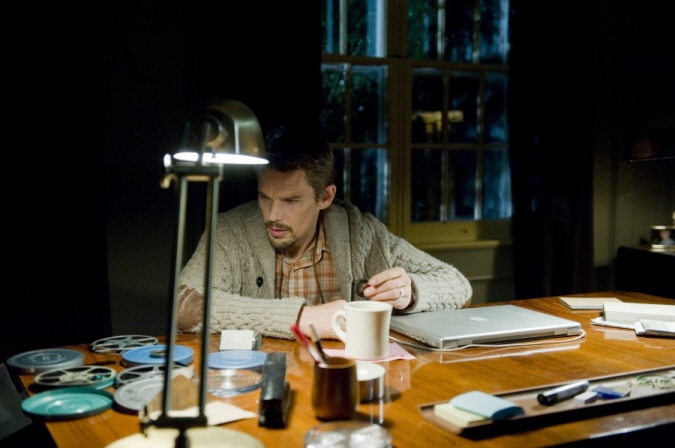
Everything seems to be all right for Oswalt and his family in the house despite the kids’ difficulty with adapting to their new environment, but they begin slowly to be influenced by its uncomfortable atmosphere. While confining himself to his office with the documents on the incident, Oswalt frequently hears strange sounds from the space above. When he looks around the attic, he comes across a mysterious box, and he becomes very curious about the cans of super 8mm film reels in the box. They may look like plain home movies, but we can see that they are something which should be not played at any circumstance.

Now it sounds like a worn-out horror story, but the director/co-writer Scott Derrickson knows how to hold our attention while building the sense of mounting dread around the characters and their space. The movie sets an ominous tone right from the start with its striking 8mm film footage opening scene, and it keeps going on with the series of distressing and disturbing moments in the house. While constantly checking the film reels which turn out to be not as mundane as they look on the surface(they are labeled as “Pool Party”, “Barbecue”, “Picnic”, and so on), Oswalt discovers something weird and ominous in these found footages. His wife later becomes angry about his lies about the house, and his kids start sensing the sinister mood of their house even though they are not allowed to go into their dad’s office and see what he is working on.

And Oswalt gets more obsessed about the case. Although the possibility of grave danger becomes more apparent to him as he attempts to dig deeper into the case, it is not easy for him to resist the chance of his next success even when he becomes far more disturbed than before while a bottle of whiskey is always ready besides him. Ethan Hawke is effective as a desperate man pressured and cornered by his obsession, and Juliet Rylance matches Hawke as an exhausted practical woman who has already run out of the patience with a writer husband she loves. With their co-child performers(Michael Hall D’Addario and Clare Foley), they convey to us well the uneasiness between their characters, and we come to fear for them as the story gets darker.

While the movie mainly focuses around the house, its supporting characters provide the welcoming respites from the accumulating tension in the story from time to time. Fred Dalton Thompson does a nice job with his functional character who turns out to be more considerate than we think, and James Ransone is amusing as a well-meaning deputy sheriff who wants not only his favorite author’s sign but also being mentioned in the acknowledgement section of Oswalt’s future book. In his brief but crucial uncredited appearance, Vincent D’Onoffrio is a college professor who gives Oswalt the valuable information which might provide a possible supernatural explanation for what is really going on in his house.

“Sinister” is a horror film fully operated by its genre conventions, but it works well in its boundaries. If you are a seasoned movie audience like me, you can easily predict what will happen in the end, but you may appreciate how it works. It hints to us what it will show to us, and it does deliver as much as it promised to us – as it arrives at its inevitable ending which has been dreaded rather then expected from the beginning.

Posted in Movies | Tagged , , , , , , , , | Leave a comment

The Trouble with Harry (1955) ☆☆☆1/2(3.5/4) : Shovelling on one fine autumn day

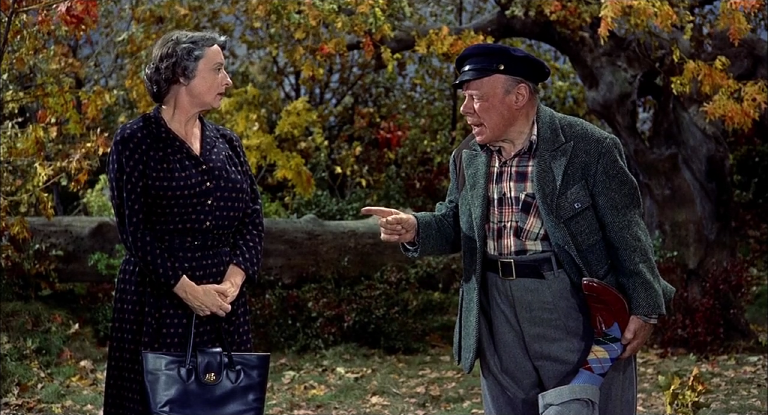
 While he has been called “the Master of Suspense”, Alfred Hitchcock has also been called “the Master of the Macabre”, and that title is exemplified well by his delightful black comedy “The Trouble with Harry”(1955), On the surface, it looks quite atypical compared to Hitchcock’s more famous works, but this is a vintage macabre story from a great director with a wry sense of humor, and it is also one of the most liveliest works in his exceptional career. Although somebody is dead, there is no suspense or danger or blond lady in the movie, and all we have to do is leisurely enjoying a pleasant walk with its funny characters as they try to deal with a bizarre trouble on one fine autumn day in their ordinary peaceful rural town in Vermont.

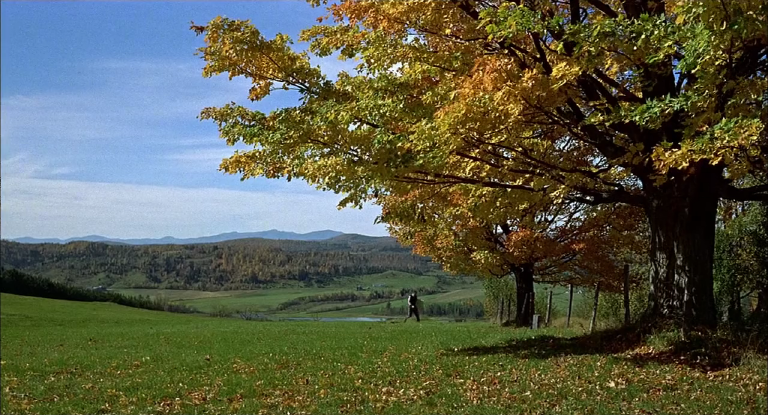
Right after the main title accompanied with the jaunty prelude by Bernard Herrmann on the soundtrack, we are introduced to the gorgeous scenery of the New England countryside under the autumn sky. Herrmann’s music goes into a pastoral mode with this beautiful sight decorated with yellow, red, brown, and green, and I think about how lucky we are to appreciate this beauty of nature thanks to a happy coincidence between two unconnected evolutionary processes: one being the deciduous plants developing such colorful ways of disposing their leaves before winter, and the other being our ancestor species evolving with an optic neuron system capable of sensing colors.

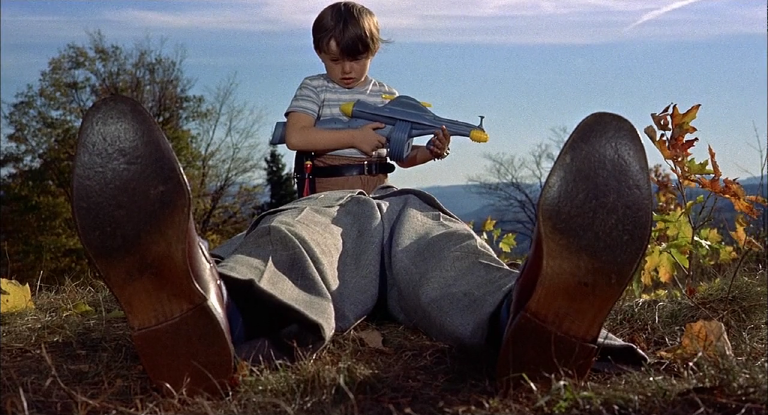
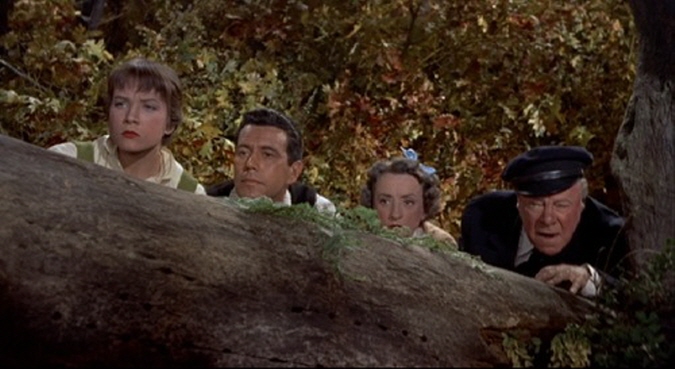
On such a lovely day like this, something unfortunate happens. Three gun shots are heard in the forest, and then a little boy finds a dead man laid on the ground. Not long after he goes away, the Captain Wiles(Edmund Gwenn) comes across the body while he is going around to check whether anything is shot by him. Because he believes he has killed that man by accident, he decides to hide the body before anyone sees him, but the circumstance becomes very difficult for him because it seems at least half of the residents in the town are drawn to the place. In case of the town doctor, he comes by the spot more than once while having no idea about what is on the ground, and he is so occupied with reading his book that he does not even notice the body even when he stumbles over it. My mom once said that I would keep reading books even when North Korea suddenly invaded, and I am sure she will be amused by his silly behavior.

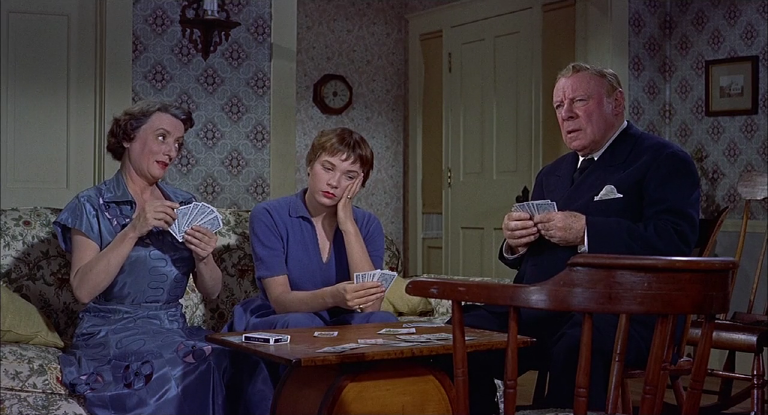
A funny thing is, the other characters do not react like ordinary people do when they see the dead body, either, It turns out the dead guy’s name is Harry Worp and it is later revealed that he came to the town for visiting Mrs. Jennifer Rogers(Shirley MacLaine), a young mother of a boy who finds Harry’s body at first. Harry is her husband she left years ago, but she is not so much concerned about his death, and neither are her neighbours. Harry’s death is just a mere annoyance in their daily life, so we get the series of bizarre moments such as when two characters having a courteous conversation over the body. They are a bit worried about the incident, but they are so detached to the inconvenient fact on the ground that it looks like they are in a British parlor comedy(Not so surprisingly, the background of Jack Trevor Story’s novel the movie is based on was originally British countryside),

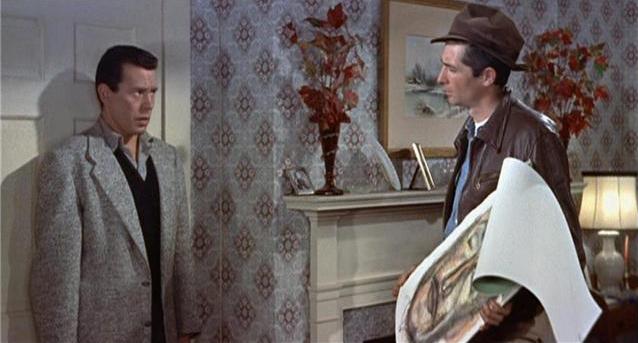
But, still, Harry’s body remains something which should be taken care of to the living involved, mainly due to the watchful eyes of Deputy Sheriff Calvin Wiggs(Royal Dano), who intuits that something suspicious is going on after hearing gun shots. Sam Marlowe(John Forsythe), a local unknown painter whose abstract paintings may deserve a small space in the Contemporary Arts section in the Art Institutes of Chicago for profound simplicity or simple profoundness, decides to help the Captain mainly because it can help his relationship with Jennifer, and so does Miss Gravely(Mildred Natwick), who has a very good reason to help the Captain besides her personal feeling toward him.

Poor Harry. Thanks to the constant shifts in their hearts because of sudden understandable conscience and hurried judgements, his body goes through lots of ordeals while the mystery of his death hovers over them like a ghost. It is buried and exhumed more than once, so there is lots of shoveling throughout the film, and it is even put into a bathtub at one moment. But I guess Harry will not mind about that, because, as one guy says in Errol Morris’ great documentary “Gates of Heaven”(1978), death is for the living and not for the dead so much.

This messy comic disturbance is observed with that detached attitude and dry humor we have seen from Hitchcock’s other works. A grim matter like death does not disrupt the quiet atmosphere of the town at all, and everything in the story is advanced like a weird funeral march on slow clockwork tempo. In fact, when Harry’s body appears for the first time, it looks like a body well-manicured right before a formal funeral – except that it does not have its coffin.

Hitchcock’s typical dry humor has never been prominent on the screen like it is in this movie, and that leads to the significant insight on his films. Stripped off almost everything that defines Hitchcockian thriller, the movie reminds us that Hitchcock’s thriller films essentially have droll sides inside themselves, and you will understand that Roger Ebert had a good point on why Mel Brooks’ amusing comedy “High Anxiety”(1977) was not entirely successful as the parody of Hitchcock movies in spite of its notable funny moments. How can it be possible to effectively spoof the movies which already recognize its absurdity in advance from the beginning?

While it is weirdly funny, “The Trouble with Harry” is also a quirky romance movie which gets more endearing through repeated viewings. What the main characters do for getting out of their trouble is unethical and illegal, but they are likable people who just do not regard death as seriously as we do. John Forsythe is your average guy on the next door with some interesting philosophical thoughts on fate and death, and Shirley MacLaine, who made a debut with this film at that time, exudes her plucky personality with wonderful comic talent we have enjoyed since this film. Now 57 years have passed and she is quite old, but MacLaine has lost none of her talent as shown in Richard Linklater’s black comedy “Bernie”(2011), which is incidentally also involved with the trouble with a dead body.

On the opposite of Forsythe and MacLaine, Edmund Gwenn and Mildred Natwick are very good counterpart, and they are in fact a better autumn romantic couple probably because of their age. With an actor with genial looks like Gwenn, you cannot possibly imagine anything mean or heartless from him(after all, he won an Oscar for playing ‘Santa Claus’ in “Miracle on 34th Street”(1947), didn’t he?), and you instantly feel that the Captain has no hard feeling toward Harry although he buries his body several times. Natwick is also fun as a spinster who turns to be abler than her lover in their cover-up job, and she has a good understated chemistry with Gwenn while their characters tentatively approach to each other like a mannered middle-aged British couple reluctant to cross the threshold between them. The moment around the ending when they open their hearts to each other more than before has a small poignancy in contrast to their crazy comic situation.

If there is the fifth main character in the film, it goes without saying that it is the autumn foliage gorgeously captured through Technicolor by the cinematographer Robert Burks, who was one of Hitchcock’s main collaborators and won an Oscar for Hitchcock’s other film in the same year “Catch a Thief”(1955). The movie is one of the most beautiful autumn movies I have ever seen, and the recent viewing through high definition confirmed to me how meticulously Hitchcock and his crew set its colorful atmosphere on the screen. When they could not shoot at the locations in Vermont due to the weather problem, they came back to California with loads of autumn leaves, and those leaves were attached to the trees at the studio by hands one by one. Though you can easily distinguish the studio shots from the location shots, the result looks almost flawless on the whole, and they really did a terrific job, especially considering that at least 50% of the shots were made at the studio.

And the movie was the beginning of the fruitful collaboration of Alfred Hitchcock and Bernard Herrmann, who had been well aware of each other since they began to work in Hollywood but had never gotten a chance to work with each other before this film. In contrast to many of his brooding classic scores like “Psycho”(1960), Herrmann composed a blithe score for the comic situations in the movie while never overlooking the macabre side of the story, and there is also a touch of folksy lyricism in his score whenever the movie looks at its picturesque background, such as when the characters are walking back to their town after finishing their latest work with shovels.

In the end, nobody gets hurt, and everyone is happy to be out of the trouble with Harry, and even Harry’s body gets what it deserves in the ironic finale. Compared to the masterpieces like “Rear Window”(1954) or “Vertigo”(1958), “The Trouble with Harry” looks pretty trivial as a minor work made during the most productive era of Hitchcock, but it is a very interesting work illuminating the foundation of his classic thriller films. No matter how much the things get morbid, pervert, and nightmarish, Hitchcock’s movies do not lose wit and humor, and “The Trouble with Harry” shows us a great director merely having a carefree fun with playing his droll funeral music with organ on one fine autumn day. Whenever the tree leaves become tinted with colors as the weather gets chilly, I feel an urge to revisit this colorful comedy, and, while having a pleasant time with it, I am reminded again and again that it is wise to go to the police immediately when you find a body. Not many Hitchcock movies can do that, you know.

Posted in Movies | Tagged , , , , , , | 1 Comment

Primary Colors (1998) ☆☆☆1/2(3.5/4) : A story of one fun political ride

When I watched “The Ides of March” (2011) early in this year, it took me back to my memories with Mike Nichols’ “Primary Colors” (1998), which already told us almost everything the former wanted to tell. When I watched it in 1999, it looked like a sarcastic story inspired by Bill Clinton’s first presidential election campaign in 1992, but now the movie looks more like a timeless political comedy drama which understands a lot about how politicians alternatively dazzle and disappoint us with their better and worse sides.

Nevertheless, when we look at Governor Jack Stanton (John Travolta) in the movie, we cannot help but think about Clinton. His white hair, his casual mannerism, his warm empathy, his energetic charisma, and his southern accent all clearly point out whom he is based on. The movie does not specify which state of governor Stanton is, but I am sure you have already figured it out for yourself.

According to Wikipedia, there are also many other fictional characters inspired by the real-life figures in “Primary Colors: a Novel of Politics,” the novel the movie is based on. The writer of this roman à clef is still officially “Anonymous” at present, but, around the time when the movie came out, everyone came to know that the writer in question was Joe Klein, who said in the after-note in the recent edition of his book that he chose to use an anonym just because he wanted his first novel to be judged objectively by his peers, and he did not intendf to throw a cheap shot at Clinton behind his book.

While I can accept that Klein just got a nice idea about the story of a larger-than-life politician a la “All the King’s Men,” I think Bill Clinton and his wife Hilary were the irresistible source of inspiration to him while he wrote the novel. After all, Mr. and Mrs. Clinton were smart and energetic people eager to do something for their country, and they were very entertaining as the residents of the White House to everyone including their political opponents. In fact, it is no wonder that many notable Hollywood movies about an American president were released during Clinton’s presidency; we watched Presidents appearing on the screen as an average guy replacing a real one, a romantic comedy hero, a prime murder suspect, a criminal attempting to get away with a murder case, a leader against a massive alien attack, a fighter against terrorists, an unseen man behind the outrageous conspiracy for covering his possible sex scandal, and a cunning and practical politician determined to have the first female vice president in the American history–and we surely had an interesting time with that trend at the theaters.

“Primary Colors” was made during that fun time, and it is one of the better ones. The movie observes Governor Stanton and his dramatic election campaign process through the eyes of Henry Burton (Adrian Lester), a famous civil rights activist’s grandson who happens to get on Stanton’s bumpy political ride around its beginning. Burton is a smart young man who has been trying to bring changes into the politics, but his idealism has been frustrated by the absence of progress, so he decides to choose a more practical approach through Stanton, who looks like a right guy he can work for.

Although he initially hesitates to participate in Stanton’s campaign, Burton soon finds himself quickly swept into the center of the dizzying political maelstrom as he is attracted by Stanton’s undeniable radiant charm. When Burton meets Stanton for the first time in the opening scene, Stanton is visiting a class for illiterates at a public library in New York. He listens to one sad, heartfelt personal story from one of the attending students, and then he movingly replies to that student and others in the class with the story about one of his uncles. I am rather skeptical about that story though he does have an “Uncle Charlie,” but he delivers it so well that he adds extra elevation to a big emotional moment in the room, and everyone loves to talk with him–including a female teacher who later has a private talk with him in his hotel room.

Not long after being impressed by him, Burton is quickly hired by Stanton even before he clearly makes up his mind. He sees how difficult his job is on his very first day at the campaign headquarters; Stanton is not famous or popular yet, and Burton must find ways to convince the Democratic voters that they should choose Stanton as the nominee for the upcoming presidential election. The campaign headquarter looks pretty disorganized at first, but it gets ordered under his supervision, though there are some eccentric people coming into the campaign as Stanton’s inner circle members. One of them is Richard Jemmons, played by Billy Bob Thornton who looks as distinctive as James Carville, and he gives a naughty “snake show” to one of the female workers. To everyone’s relief, she tactfully responds to his rudeness.

As they dramatically go up and down during the Democratic presidential primaries, the circumstances become more unpredictable to everyone in the campaign, mainly thanks to Stanton’s moral flaws, and they soon face troubles not so different from their counterparts in real life. Everyone including his wife Susan (Emma Thompson) senses that sex scandals will be seized upon by their opponents at any time to ruin Stanton’s chance for the nomination. If the unclean facts in his private life are bound to come out, they must know them before their opponents hand them to the reporters hungry for the latest scandals, so they really need someone good at handling Stanton’s dirt.

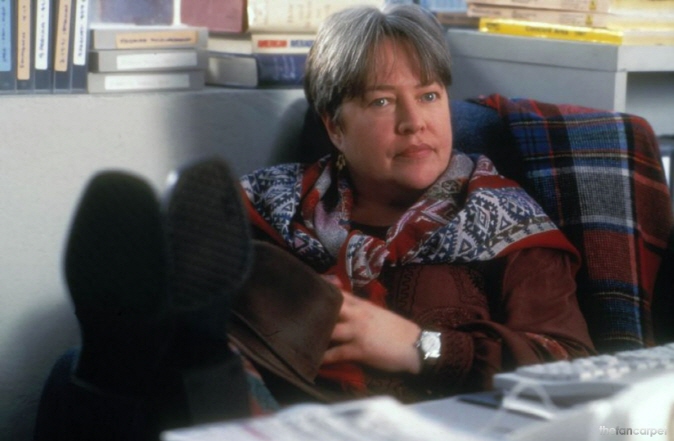
That is how the Stantons’ longtime colleague Libby Holden (Kathy Bates) comes into this busy picture as a fixer, or a “dust buster” as she calls herself. As a brash, zealous, and unstable woman ready to do anything for her close friends, Bates gives a juicy comic performance through the role she is destined to play. In one memorable scene, she storms into a sleazy lawyer’s office, and it is clear to everyone in the office that Libby is the unstoppable force of nature who will not go away unless she gets what she needs for fixing Stanton’s latest problem. (Klein actually had Bates in his mind when he created that character, although many people thought Libby was based on Betsey Wright.)

But even to her, there is a line she is reluctant to cross, and the movie raises several serious primary questions on politics in its comic story. We all know it is impossible to remain clean in the mud field called politics, but how far can they go in the name of political victory and following rewards? And how much can they remain true to their ideals and principles during that process? And can we vote for them while recognizing their grey morality area and human flaws?

They are not easy questions to answer, and the movie does not simplify its characters’ circumstances. When Libby tries a crucial test on the Stantons later in the story, she is deeply disappointed by their quick decision on certain negative information about their major opponent, but I can also see that the Stantons have a good point on their decision. So far, they have been playing fair with him, and they can continue to do that, but what if he is nominated instead of Stanton and then the Republican Party digs up that fact? Yes, it is against their principles, but shouldn’t they do that dirty job in advance before it can damage their party?

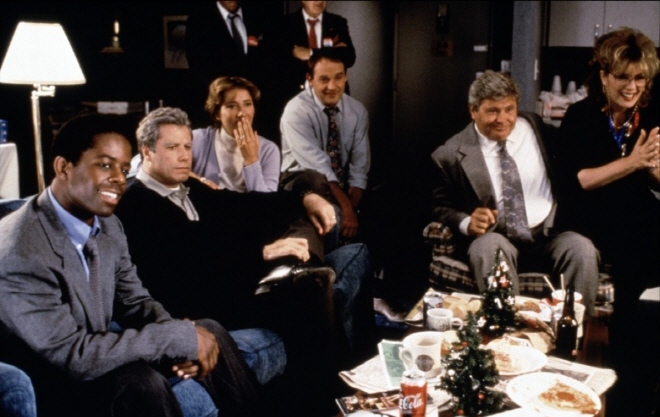
Elaine May’s adapted screenplay retains the humor in the novel while making its caricatures a little more human and complex through nice small details. There are many funny moments in the film, and I especially enjoyed a tickling private meeting between Susan, Burton, Jemmons and other staff members where they try to grasp the meaning behind Jemmons’ vague metaphors (please don’t ask me about what the hell dove or boar or forest are really supposed to mean). We can laugh at them for their silliness, but their human sides are revealed along with good laughs, and there is an unexpectedly poignant moment when Libby reveals an idealistic heart behind her cutthroat behaviors to her less seasoned junior during their bitter private talk.

Although he looks as if he were mimicking Bill Clinton on the surface, John Travolta gives us a vivid portrait of a compelling human being born to be a political animal with the right stuff–and some wrong stuff. It cannot be denied that Stanton is a weak, impatient, and childish man who cannot easily say no to the bimbos attracted toward him (I remember one guy’s amused remark on Clinton: “Why did he always get involved with cheap girls?”), but he is also a tenacious politician full of energy, ambition, and visions. He influences everyone around him even when he is not around them, and that aspect is amplified by Travolta’s enjoyable presence, which infectiously permeates into every minute of the movie.

Stanton really listens to people and sincerely wants to make the world better for them, and we see his better sides especially when he gives a speech to a group of unemployed factory workers. He gives them no false hope, and he honestly tells them they should go through the inevitable hard change for themselves, and he promises his future government will support them. On the whole, he ultimately comes to us a slick but charming politician with real ideas who is far more reliable than a Mitt Romney.

Travolta is surrounded by performers providing different colors to the story. While interestingly not imitating Hilary Clinton in her sympathetic performance, Thompson plays Mrs. Stanton as a strong-willed woman with equal political ambition who has endured lots of things from her imperfect husband. He continues to betray her not only as a husband but also as a political partner, but, no matter how much she is hurt and angry, she keeps standing firmly by him, probably because she knows (1) they should stick together in their rocky journey for their mutual political survival and (2) he will never leave her in spite of his constant infidelity.

While Bates always steals the scene whenever she commandingly appears on the screen, Billy Bob Thornton, Maura Tierny, and Paul Guilfoyle also add flavors to the busy process of campaign as the core staff members of the campaign, and Larry Hagman is a decent elder politician very reluctant about his sudden participation in a political game with Stanton. Adrian Lester is comparatively colorless as the observer of the story, but his approach is appropriate as an observant hero who gets enlightened more by his impressive experience with Stanton and his campaign. Burton may compromise his standard by changing his mind around the ending, but the movie does not judge his decision or Stanton’s persuasion behind it. He becomes disillusioned with Stanton as much as his co-workers, but he and others are eventually paid back as much as they invest, and everyone is happy in the end.

“Primary Colors” is an entertaining human comedy with sharp insights about the politics in our reality. It shows us that some kind of people live for being in politics, and it also reminds us that some of them are quite interesting people to know. They are such inspiring energizers that the other people surrounding them are held and swept by the excitement created by them as their campaign is approaching the finish line, and it is certainly never boring to work for them regardless of the final result. They are not perfect, but, as they say in South Korea, nobody is without dirt in his pocket, and sometimes they do deserve our votes as the people pushing the society forward, despite their flaws magnified by the ruthless system they belong to.

Although it did not succeed well at the box office when it came out, the movie is frequently remembered as one of the interesting movies about election, and Bill and Hillary are continuing their illustrious careers as an influential political couple in their party while remembered by many for their exciting and productive years at the White House during the 1990s. I know some of you may not agree with my opinion, but, folks, as Klein noted later in the recent documentary about Clinton’s presidency, it was a lot of fun to watch their domestic/political drama at the White House, wasn’t it?

Posted in Movies | Tagged , , , | Leave a comment

The Autumn Weekend (2012/11/03)


The sky is clear and blue and the trees look lovely under the bright sun…

Posted in Photos | Tagged , | 1 Comment

The animals at KAIST (2012/11/03)

                               
Besides the avian campus gang, we also have other animals at the campus.
Posted in Photos | Tagged , , , | Leave a comment