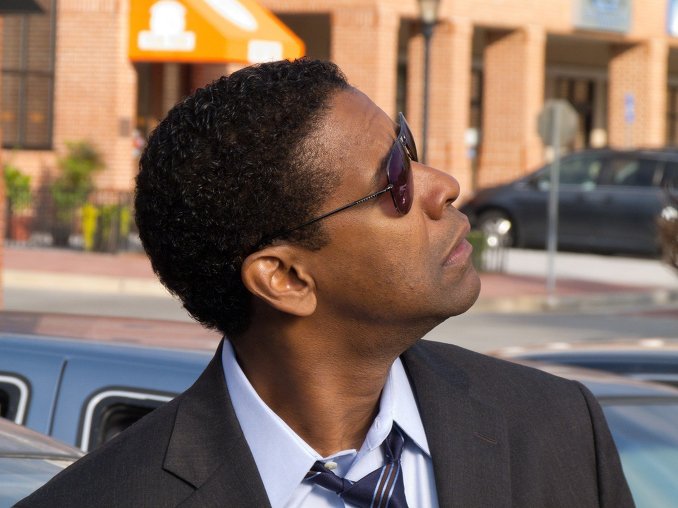
Silver Linings Playbook (2012) ☆☆☆1/2(3.5/4) : A conventional but offbeat rom-com

small_silverliningsplaybook01 I have heard from many people that “Silver Linings Playbook” is a conventional romantic comedy. They are right about that, but, as they also pointed out in their praises, the movie is a conventional romantic comedy stuffed with offbeat charms to please you. Sure, it dances with its predictable moves at many pre-determined points, and I exactly knew where it would eventually arrive in the end during my viewing, but it brings lots of freshness and oddness to its genre conventions mainly through its rather dark subject and the palpable chemistry between its lead performers. The result is immensely lovable and genuinely optimistic, and the movie certainly deserves its place as the best romantic comedy of 2012.

Like many romantic comedy movies, the movie begins its story with an unhappy hero, but Pat Solitano Jr.(Bradley Cooper) is quite an unhappy guy to observe. He has been suffering from bipolar disorder, and he even did not know about his mental problem until he totally screwed up his marriage. Due to a very violent incident involving his wife’s affair, his wife divorced him, and he lost his house and his job as a consequence, and now he has been in the mental health facility in Baltimore for 8 months.

Nevertheless, Pat tries to be optimistic with ‘positive thinking’ in spite of his uncertain future. Even before being released from the facility to live with his parents, he has become obsessed with regaining his wife back although the restraining order against him is still effective. He believes he can have his former happiness again through attaining this personal goal, and he even does not take drugs prescribed to him just because they always make his mind foggy and he believes he can live without them.

small_silverliningsplaybook06 While maintaining its lighthearted comical tone, the movie does not sugarcoat the reality of mental illness at all, and we come to see how insufferable Pat can be at times as he unintentionally disrupts his parents’ daily life many times. Madness may look romantic in some books and movies, but mental illness is not something you can easily live with every day, and you will probably come to admire how patient and understanding Pat’s parents are to their problematic son. Pat’s father Pat Sr.(Robert De Niro) also has his own obsession problem involving his favorite football team, and I really have no idea about how much his loving wife Dolores(Jacki Weaver) has tolerated her husband’s typical behaviors associated with obsessive–compulsive disorder.

On one day, Pat comes to meet Tiffany(Jennifer Lawrence), a sister-in-law of his close friend Ronnie(John Ortiz). Like him, Tiffany has her own mental problem; she became too promiscuous in her former workplace after suddenly losing her young husband, so she got fired and has been unemployed as a result. Not so surprisingly, Pat and Tiffany go through a Meet Cute/Meet Crazy moment while not realizing that they are attracted to each other during their first encounter at Ronnie’s house, and we get a very amusing moment as they share their experiences with prescribed drugs on the dinner table.

Their first meeting awkwardly ends, but their relationship begins to grow through their common problem. Tiffany actively approaches to Pat, and she gives an offer Pat cannot resist; if he practices with her as her dance partner for the upcoming dance competition, she will become a messenger between him and his wife for a while. Though initially reluctant about it, Pat eventually accepts this deal, so they begins to practice together at her house as the dance competition day is approaching.

small_silverliningsplaybook02

Now you have some pretty good idea about what will happen next. The movie mostly stays in its genre conventions as expected, but the director/screenplay writer David O. Russell takes a fresh approach to the conventions through his flawed but likable oddball characters, and it is fun to watch how the movie cleverly handles its offbeat elements in the confines of the conventions. Even the minor supporting characters like Pat’s psychiatrist(Anupam Kher) or Pat’s fellow patient Danny(Chris Tucker in a controlled comic mode) are colorful and lively as interesting characters, and they provide extra comedy at the fringe of the story while revolving around Pat and Tiffany. The dialogues in Russell’s screenplay based on the novel written by Matthew Quick are smart and earnest, and they are delivered with good comic timing by his talented actors.

As he did in his previous film “The Fighter”(2010), Russell draws uniformly good performances from his cast, and it is no wonder that “Silver Linings Playbook” became the first film which got Oscar-nominated in all four acting categories since “Reds”(1981). I must confess that I have never thought highly of Bradley Copper although recognizing his fairly good talent as a comedy actor, but he gives an excellent nuanced performance through deftly balancing his character on the line between humor and pathos. You may not want to live with Pat even at the ending, but Cooper presents his character as a nice man who cannot help himself sometimes in the struggle with his mental illness, and we come to care about Pat even though we cannot wholly like him.

The chemistry between the lead performers is always required for the success of romantic comedy movie, and Jennifer Lawrence’s spunky performance generates lots of chemistry through its effortless interactions with Cooper’s quirky performance on the screen. Since her breakthrough in “Winter’s Bone”(2010), Lawrence has been impressively advancing her promising career while appearing the blockbuster films such as “The Hunger Games”(2012), and now she pleasantly brandishes her comic talents as an unstable but plucky girl with lots of hearts. Lawrence and Cooper are pleasure to watch as a likable (and good-looking) couple, and she has a wonderful scene where Tiffany convinces Pat’s Dad with his own logics involving some ridiculous superstitions we have seen from hardcore sports fan from time to time.
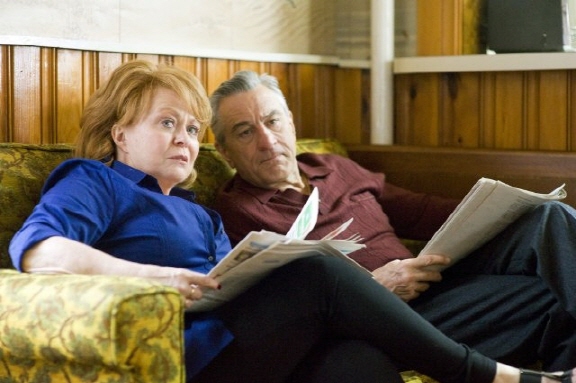
small_silverliningsplaybook03 As Pat’s obsessive dad, Robert De Niro, who has been rather disappointing during recent years, shows us that he has lost none of his talent as a great actor despite several awful movies he appeared in. Pat Sr. is so enthusiastic and fanatic about his favorite football team that he does not miss any match on TV(he has been banned from coming to the stadium for years due to his violent outburst in the past, by the way), and the way he tries to get a chance to start his own business through bookmaking makes an interesting parallel to Pat’s attempt to regain his wife; both of them try to be happy through their respective crazy ways fueled by their madness, and how their respective attempts are paid off in a way they never imagined is another amusement added to the story.

With Jacki Weaver, who deserves her surprise Oscar nomination as her small but crucial supporting performance, De Niro makes their scenes warm and sincere. Just like his son, Pat Sr. does not see his own problems while clearly observing the problems from his son, but he tries to connect with his son through sharing his enthusiasm with him, and his advice to Pat around the finale rings true even though we are not so surprised about what he says. Completely different from her diabolical performance in “Animal Kingdom”(2010), Weaver is less showy than her co-performers, but she is important in the story as the practical voice of sanity amid other characters’ craziness. As a long-suffering wife and mother, Dolores knows it is always hard to persuade her husband and her son to do something a little more sensible, but she keeps trying, and she gradually reveals herself as a solid ground supporting her incorrigible family.

small_silverliningsplaybook04 Like “Little Miss Sunshine”(2006), another popular comedy about dysfunctional family, “Silver Linings Playbook” shows how a familiar story can be freshened up a lot by distinctive elements for good comedy. As a matter of fact, I was really glad to see the movie sidestepping one of the most tedious conventions in romantic comedy at one point. There is a classic moment of misunderstanding we have seen from other countless romantic comedy movies, but the movie does not get trapped into such a cliché like that because its characters are the brutally honest people who immediately follow their heart as soon as they decide.

On the whole the movie is an engaging romantic comedy about human eccentricity(or insanity, perhaps). Even when it arrives at its expected ending, the movie reminds us that they are still have problems and will probably face the other troubles as their life goes on, but there is a silver lining inside their last scene; they become a little more optimistic about their life than before. This is nothing new, but the movie knows how to deliver it with deep empathy and good laughs as dutifully following its plot, and that is why it is one of the sweetest and wittiest comedies I encountered recently.
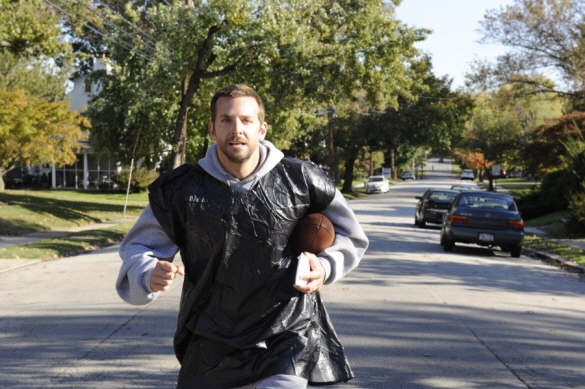
BRADLEY COOPER stars in SILVER LININGS PLAYBOOK

Posted in Movies | Tagged , , , , , , | Leave a comment

The Impossible (2012) ☆☆☆1/2(3.5/4) : A devastating and hurtful disaster drama

NAOMI WATTS and TOM HOLLAND star in THE IMPOSSIBLEI have seen many disaster films, but few ones were as devastating and hurtful as “The Impossible”. Inspired by a real-life story inside the most disastrous Tsunami incident in the human history, the movie reminded me of how little I knew about this huge catastrophe – and its chaotic aftermath which the characters in the movie painfully and desperately struggle through. Although its view on the disaster is notably biased, there are genuine emotions swelling in the movie through its rather subjective but intimate view, and that makes the movie a very powerful human drama we rarely encounter in its genre.

After its prologue subtitle, the movie instantly focuses on the Bennetts, an Australian family who has been living in Japan for years. They are about to have their Christmas vacation, and they are expecting to have a good time at their vacation place in Thailand. Henry(Ewan McGregor), a father of three boys, has some worry about his job in Japan, and the room they wanted is not reserved for them, but they come to spend a wonderful time with other guests on Christmas Eve – and we soon see them having a nice rest around the pool in the morning of that fateful day, December 26th, 2004.

The Indian Ocean Tsunami, which was previously shown in Clint Eastwood’s film “Hereafter”(2010) with striking effect during its beginning, is presented here with dramatic power to chill your nerve. Even before the people fully realize what is happening and run into safe places, everything is quickly engulfed and swept by the speedy and destructive wall of water, and this is a really terrifying moment to watch. When I saw the Tsunami indirectly on TV, it just looked like a wave merely advancing on the land, but, through the views of the characters in the movie, I got a gut-chilling feeling as watching the Tsunami ruthlessly sweeping everything in front of it; I would be as stunned as them if I were in their circumstance.

theimpossible05When the immediate danger is over, Henry’s wife Maria(Naomi Watts) luckily survives with her son Lucas(Tom Holland), but their ordeal is far from being over. Maria is badly injured, so it is Lucas’ job to support her while they are desperately looking for help. They fortunately arrive at the hospital, but the place has already become busy and chaotic with the increasing number of the injured. Lucas is nearly helpless in front of his mother’s suffering, but he does as much as he can do for helping her – and the others in the hospital.

Along with the Tsunami sequence, the part depicting their grueling ordeal is the best part of the film, and Naomi Watts, who was recently Oscar-nominated for this film, gives a strong physical performance which can reach to your nerve ends even when her character gradually becomes immobile on her bed due to her worsening health condition; every time Maria tries to move, we can feel how much hard and painful it is for her to do that, and Watts is devastating to watch as her character is weakened hour by hour.

As her confused son affected by the disaster as much as her, a young newcomer Tom Holland movingly holds the center during the second part of the story while delivering a performance which deserves to be mentioned along with Quvenzhané Wallis in “Beasts of the Southern Wild”(2012), Suraj Sharma in “Life of Pi(2012), and Kara Hayward and Jared Gilman in “Moonrise Kingdom”(2012). While feeling very awkward and burdened about becoming his mother’s only and equal partner during their quest for survival, this adolescent boy also sees a grave possibility of losing his mother and being left alone by himself, and his inner torment amid confusion is vividly conveyed to us through Holland’s harrowing performance.

Ewan McGregor, who is technically the lead actor in the credit, is also convincing as a normal family man during his scenes with other main performers, and his difficult search for his wife and eldest son is an effective dramatic parallel to the main plot. I heard that the family in the real-life story was actually Spanish(you can see their family photo before the end credit), but it is an understandable change considering that McGregor and Watts are more widely known actors who can draw more audiences. After all, the movie was made by the Spanish director and his Spanish crews, so I respect their choice.

small_theimpossible04Although the plot is pretty simple, the director Juan Antonio Bayona keeps holding our attraction through the real pains and desperation of his characters while establishing the bright but desolate atmosphere through the wide, bleak sights shown after the Tsunami. Even though I learned later that Watts and Holland were actually in a big water tank while they shot the Tsunami sequence, CGIs in the film look so believable that I could believe their characters were right in the middle of the ongoing disaster.

If there is a problem with the story, it is its biased view on the disaster itself. I noticed that, while tightly concentrating on its main characters’ physical and psychological pains, the movie does not focus much on the local people in Thailand, who were far more devastated in real life compared to the foreign visitors like the Bennett family(Around 230,000 people lost their lives in several South Asian nations at that time, and most of them were the local people). The Thai people in the movie are mostly depicted as the bystanders speaking a language incomprehensible to the main characters except few minor characters who can speak English, but at least they are shown in a positive view as the kind people willingly helping their injured visitors in spite of their own damages.

Despite its flaws, the emotional intensity in the movie is well accomplished by its one-sided but focused approach, and “The Impossible” succeeds in pulling strong emotions from its direct and earnest presentation of a story about ordinary people suddenly swept by a catastrophe beyond their imagination. Even though it gets a little too manipulative around the finale and you can clearly see that the movie is trying to pull strings behind the screen, it works thanks to the solid performances and straightforward storytelling. The movie does something different from many disaster dramas, and I think its undeniable results compensate a lot for its weak points.

small_theimpossible03

Posted in Movies | Tagged , , , | Leave a comment

Jack Reacher (2012) ☆☆1/2(2.5/4) : Don’t find him – He’ll find you

small_jackreacher01
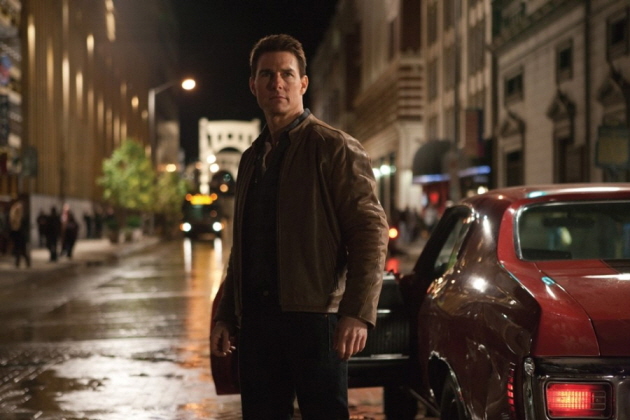
While watching “Jack Reacher”, I thought of one tagline very suitable for the movie: “Don’t find him – He’ll find you.” This one is so conventional that it can be used in any other action thriller films featuring tough guy hero who takes care of his matter for himself no matter how perilous his situation is, and that tells a lot about “Jack Reacher”, which has nothing to distinguish itself from its fellow macho movies except its few nice goodies I appreciated while not bored by it at the local theater.

The movie starts with a shocking incident which can be descried as a ‘locked case mystery’ where everything in the case is clearly pointing to one suspect. An ex-military guy is arrested for randomly shooting five innocent civilians under broad daylight, and the evidences are literally ready for the detective Emerson(David Oyelowo) and the district attorney Alex Rodin(Richard Jenkins) when they keep him in the custody. Besides an incriminating fingerprint found at the crime scene, they have the other strong evidences against him, and Rodin is very determined to get this guy executed – or incarcerated for the rest of his life if he admits his guilt.

The suspect, named James Barr(Joseph Sikora), is unusually calm considering his grim circumstance. While not saying anything about the case, he silently demands only one thing: get Jack Reacher(Tom Cruise). Reacher, a former US Army Military Police Corps officer with impressive military record who has been leading a lone reclusive lifestyle since he returned to US years ago, immediately goes to see Bar as soon as he hears the news about the incident, but, when he appears in front of Emerson and Rodin, Barr is unfortunately in coma due to the severe beating by his fellow inmates.

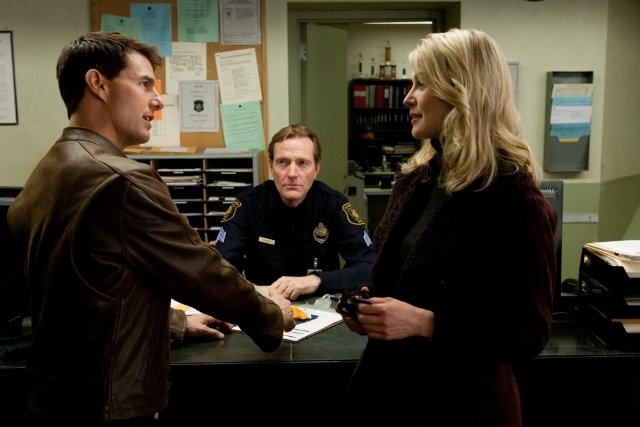
jackreacher02Reacher is rather baffled by Barr’s demand. Due to a similar incident in Barr’s past investigated by him, he knows too well that Bar is capable of such a cruel shooting as a trained sniper. He does not have much doubt about Barr’s guilt, and neither does Helen Rodin(Rosamund Pike), Barr’s defense lawyer who is also, yes, Rodin’s daughter. She clearly knows that her case is hopeless, but at least she tries to get any chance to save her client from death penalty while in conflict with her father, who has manipulated the legal system for the advance in his career.

Although he does not like Barr for what he committed in the past, Reacher looks on the case after being persuaded by Helen. Not so surprisingly, he begins to discern the suspicious things here and there in the case, and, naturally, we get those familiar sights from many thriller movies. First, we have several guys ‘surreptitiously’ watching on Reacher(he is quite a watchful guy, you know), and you will not be surprised to see Reacher show his hardcore toughness to the thugs who unwisely try to mess with him as his suspicion on the case becomes more solidified. Personally, I do not think I can spoil your entertainment by saying that there is an insidious figure behind everything.

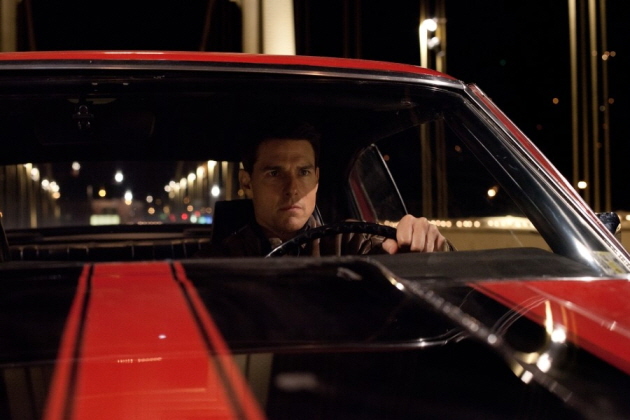
The plot is pretty predictable like that while it is riddled with many holes in it, but the director/screenplay writer Christopher McQuarrie makes a competent and smooth product with several enjoyable things. Its central chase sequence on the urban streets is handled well with a dry, efficient approach reminiscent of the action films made during the 1970s while the absence of music on the soundtrack makes it feel more effective and intense, and I was amused a bit by how Reacher uses his car as he dashes into the bad guys ready to shoot him in the open space during the climax part.

small_jackreacher05The movie is based on “One Shot”, the ninth book of the series written by Lee Child. I have not read any book in the series, but Tom Cruise does not look bad as a reticent tough guy although I heard that the original Jack Reacher looks a lot different from him as a taller and stockier guy. Reacher is not just a tough guy but a smart tough guy who can outsmart his opponents, and I liked how he investigates the case through his keen observation on several trivial things including the manufacture year of a certain coin as he does not reveal his thoughts much to the people around him.

The supporting performers around Cruise mostly play stock characters we are familiar with. I do not complain about the lack of sparks between Cruise and her because the relationship between their characters are strictly business throughout the story, but Rosamund Pike does not have many things to do in her bland role, and neither do Richard Jenkins and David Oyelowo, who mainly function as the characters Helen cannot wholly trust according to the Law of Economy of Characters. Robert Duvall is an old codger who gets involved with Reacher later in the story due to the reason I will not discuss about, and Jai Courtney, whom we will soon meet again in the latest Die Hard sequel, is adequately lethal as the main henchman, and Werner Herzog is the man behind Courtney’s character. Herzog always draws our attention with his uncanny presence and that odd German accent even though he usually sits or stands in the corners during his scenes, and he has a chilly moment when his character talks about how he survived at a Siberian prison camp.

“Jack Reacher” is not awful to watch, but it is more or less than a passable entertainment which will not impress you much, and you will not remember it much in the next morning after watching it. I will not deny that this is a well-made film and I had some amusement with its good elements, but it is a little too bland and predictable in my opinion compared to the other good films in its genre. I recently heard that there will probably not be the following sequels due to its disappointing result at the US box office and I do not feel particularly sorry about that news, but, considering good potentials inside the movie, I wonder whether it was a decision made too hastily.

jackreacher03

Posted in Movies | Tagged , , , , , , , | Leave a comment

Zero Dark Thirty (2012) ☆☆☆1/2(3.5/4) : Terror, Torture, Soldier, Spy

zerodarkthirty06 As far as we know, Osama(or Usama) bin Laden was officially dead in May 2011. That is a major ‘spoiler’ to Kathryn Bigelow’s “Zero Dark Thirty”, but the movie is a gripping espionage thriller about a long, exhausting journey its central character went through for finding(and killing) the man responsible for the atrocity which changed our worldview forever on September 11th, 2001. As the movie tightly grabs our attention with its powerful moments, its expected climax is slowly and inexorably coming to us, and its stark finale at the arrival point is all the more powerful because of everything shown to us before the finale. It is her  journey in the darkness filled with moral questions that matters, not the final result at the exit of the labyrinth.

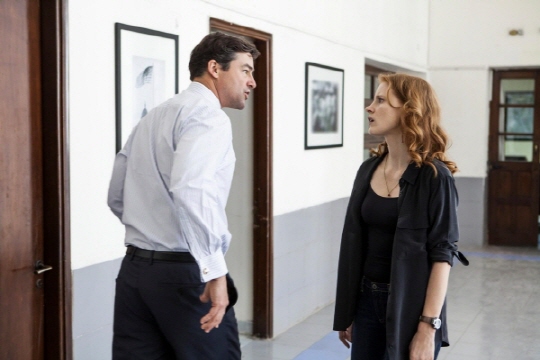
The movie patiently tells us how a young CIA officer Maya(Jessica Chastain), an embellished fictional counterpart of an unidentified real-life figure currently working in CIA, comes to throw herself into a difficult and dangerous job which demanded a lot from her from the very beginning. After the chilling opening scene which features only the recorded voices calling for help on that unforgettable day of 2001, the movie moves forward to 2003, and we see a ‘black site’ where CIA incarcerated the people who might give some clues on the whereabouts of Osama bin Laden. Maya’s fellow CIA officer Dan(Jason Clarke) tries to extract any valuable information from one of their prisoners, and he mercilessly tortures and humiliates that Arab prisoner as Maya watches the whole unpleasant process. When Dan says “When you lie to me, I hurt you.”, he really means it, and it is gut-wrenching to see how far he can go through his ‘enhanced interrogation techniques’ including that notorious waterboarding.

During this striking moment of raw violence, Maya flinches a bit at first, but, once she gets used to it in a short time, she keeps maintaining her cool composure(When the prisoner asks her for mercy at one point, she phlegmatically replies – “You can only save yourself by being truthful.”). She and Dan eventually get a possibly useful clue from that prisoner(but they succeeds only after deceiving him with lies), and she moves on while gathering and analyzing many other interrogation videos for her main goal – finding the hideout of Osama bin Laden, who is usually referred to as UBL among her CIA people. She thinks she found a good lead, but, as admitted by the characters in the movie, finding bin Laden is pretty much like trying to finding a needle in the haystack – and that haystack is pretty big while also being full of the possibilities of failure and danger.

zerodarkthirty07The director Kathryn Bigelow’s previous film was a great war movie “The Hurt Locker”(2008), which gave her the honor of being the first female winner of Best Director Oscar. “Zero Dark Thirty” is a lot like its logical extension; like the hero of “The Hurt Locker” struggles with the bombs and their unseen makers on the dangerous chessboard named Iraq, Maya plays her own strategy game for defeating her opponent hiding somewhere on another perilous chessboard far wider and far more complex and unpredictable. Not only she has to pay lots of attention to her work for covering her and her colleagues’ covert moves from al-Qaeda, but also she has to persuade and convince her superiors that she is following a right lead.

This process is basically tedious and frustrating on the surface as she moves around within the government buildings or concentrates on her work in the office, but, based on Mark Boal’s diligent screenplay consisting of the fictional elements and the first-hand accounts from the people involved in the operation, Kathryn Bigelow succeeds in making a taut thriller out of its rather loose narrative structure spanning around 10 years. Even when we get confused as the movie moves between many different locations and throws many things at us, we are guided by her firm, focused direction as following Maya through the dark labyrinth of modern espionage. Although we cannot see the whole picture, the movie assuringly stays in one direction which is frequently wound and turned as the time goes by, and it provides several tense moments including a nail-biting sequence clearly based on the real-life incident that happened on December 30th, 2009.

The movie is almost clinically efficient in moving its story forward in its labyrinth. It does not waste its time at all with the background history of its characters, and they are mostly defined by what they do for their work. It does not show anything personal about Maya or her co-workers and superiors, and that makes Maya look more focused and obsessed in her lonely struggle. She becomes more determined to get her unholy grail especially when, through her intuition supported by the gathered clues, she comes across a 60% chance of finding bin Laden at the location where they have never thought about. When I heard from the media about where he had been hiding(it was not so far from the Pakistan Military Academy), I could not help but think of that old Korean saying: “The lamp does not shine on its base.”

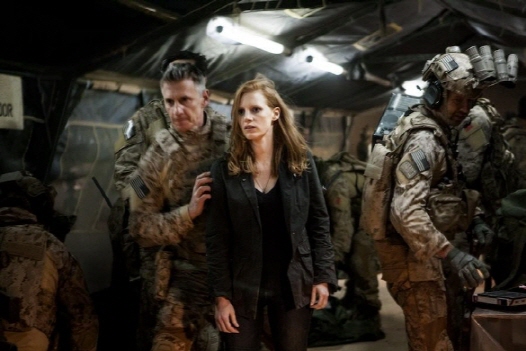
zerodarkthirty02Jessica Chastain’s commanding performance in the film has received lots of critical acclaims along with several critics awards and recent Oscar nomination. After suddenly capturing our attention in 2011, this marvelous actress has kept dazzling us with her immense versatility through the parade of excellent performances in the movies such as “The Tree of Life”(2011), “The Help”(2011), and “Take Shelter”(2011), and, again, she surprises us in this movie as a strong-willed woman who will not step back at any chance. There are few moments showing the vulnerability inside her, but Maya remains as a steely woman determined to push her mission forward in men’s world, and she is not afraid at all of blatantly expressing her opinions in front of her male superiors(“I’m the motherf****r who found this place, sir! “).

While the movie is tightly bound to Chastain’s fierce performance even when she is not on the screen, the other actors do their jobs in their functional but realistic performances which contribute a lot to the verisimilitude of the film. Kyle Chandler, Mark Strong, and James Gandolfini are Maya’s superiors at the CIA headquarter, Jennifer Ehle and Harold Perrineau are her co-workers, and Jason Clarke is a CIA guy who has no problem with moving from torture to office job. Joel Edgerton and Chris Pratt are two members of the US Navy SEALs Team put into the clandestine operation during the climax part, and the best thing about their performances is that they are completely mingled with their co-actors while rarely drawing our attention to themselves.

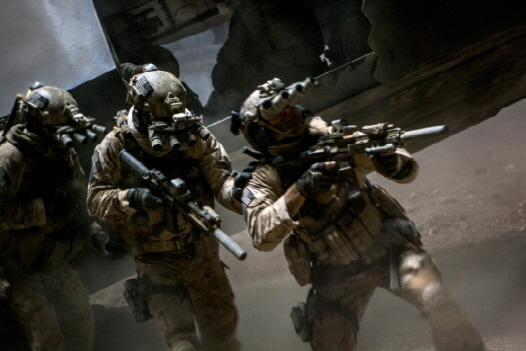
zerodarkthirty01Of course, the climax part is about how the US Navy SEALs Team raided upon bin Laden’s hideout in Abbottabad, Pakistan at the dawn of May 2nd, 2011. Even though everything does not look so clear in the darkness and I was not sure about its details because of that inherent weakness of this sequence, Bigelow and her actors and crews did a terrific job of generating the heavy amount of tension on the screen. It is a little confusing to watch as the soldiers are executing their risky operation while trying to hiding their activity from the Pakistani people living nearby, but the urgency during this sequence is almost unbearably palpable as it is shown through the relatively stable use of hand-held camera coupled with infrared camera; the operation must be finished quickly and precisely, or there will be a heavy price for failure.

The movie has been accused of condoning torture, but, even though I recognize a rather biased view of the movie, I do not think it approves of ‘enhanced interrogation techniques’, because it merely presents the torture scenes at the beginning as exactly what they really are. They are unpleasant and uncomfortable to watch as the level of harshness gets increased, and you may even feel lots of pity toward the prisoner although he is indeed associated with al-Qaeda. Yes, they managed to extract useful information from him, and it can be said that the information was one of their puzzle pieces which fortunately led them to bin Laden’s personal courier ‘Abu Ahmed’ later, but that awful fact about the savagery done under the US government and its allies in our reality remain clear in front of our eyes. They say the end justifies the means, but can we really say what have been done in the darkness during last 11 years was necessary evil?

zerodarkthirty09The movie does not answer that question during its many questionable circumstances, and neither does Maya, who reveals very little about what she feels or thinks about her work as zealously devoting herself to it. After crossing so many moral and ethical lines during her long quest in the grey espionage world, she finally arrives at the end point, but there is not much of the sense of triumph or payoff or relief; we see her briefly looking at the body in the bag(the movie does not show it directly to us, by the way), and she confirms it is him, and then she just leaves.

There have been some good movies about our changed world after 9/11 recently, and “Zero Dark Thirty” will definitely be remembered as one of them. The movie is a compelling thriller drama about the real people working in their shadowy world, and, like Ben Affleck’s recent film “Argo”, the movie crackles with tension even when it is coming toward the pre-determined finale. As a matter of fact, its running time(165-min) felt quite short as my body was tightly fixed on the seat, and my attention were completely glued to its sheer suspense well supported by Alexandre Desplat’s moody, restrained score.

The movie does not express any political opinion on its drama, and some may say it is a lazy and irresponsible attitude, but I think it is a sensible decision made by Boal and Bigelow because 1) its objective attitude can induce lots of thoughts and discussions from us and 2) the story is still being continued even at present. The man who initiated everything is now eliminated and his death surely brought some sense of closure to many people, but that was something which would eventually happen, and our global world still remains as unstable and problematic as it was right after 9/11. The last line in the movie is particularly haunting to me: “where do you want to go?” She cannot answer, and neither can her country – or our world.

zerodarkthirty05

Posted in Movies | Tagged , , , , , , , | 2 Comments

Django Unchained (2012) ☆☆☆1/2(3.5/4) : Another big trashy fun from Tarantino

small_djangounchained06Before sorting out my thoughts on Quentin Trantino’s new film “Django Unchained”, I checked my four-star Korean review on his previous work “Inglourious Basterds”(2009), and I was a bit amused by what I wrote at the beginning: “Asking Tarantino to find any film recommendable is not a very good idea – because those trashy films liked by him are possibly something we do not like much. But, in contrast, recommending his films is far safer.”

Decorated with shocking violence and bloody humor in his own distinctive pulpy style, “Django Unchained” is another insanely entertaining work from Tarantino, and it is safe to recommend it wholeheartedly for its electrifying mix of trashy fun and brilliant storytelling. Even though there are many holes in its loose narrative here and there, Tarantino is a confident storyteller who can capture our attention from the beginning to the end no matter how long his story is, and he keeps striking us with bloody violence and unexpected turns as the movie boldly dashes to its dark historical subject with the no-hold-barred attitude influenced by the trashy exploitation films he dearly loves. It is indeed trashy, but it is a big trashy fun, and his affection and talent elevate the materials into something far more stylish and enjoyable than your average exploitation film.

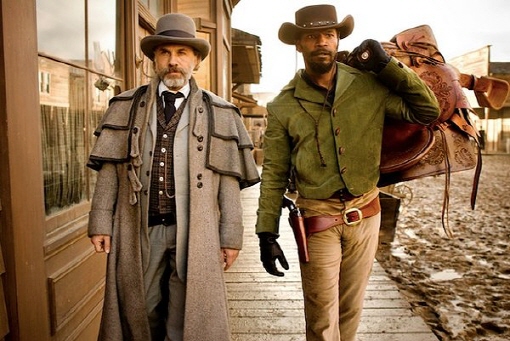
The story begins with a group of chained slaves being transported by a duo of slavers in the vast plain of Texas in 1858. When they are going through a remote forest later during night, they come across a German dentist named Dr. King Schultz(Christoph Waltz), who suddenly comes out of nowhere as riding his shaky wagon with a bobbling tooth model on the top. He has a special interest in one of the slaves because that slave can give him the crucial information about the men he has been looking for, and he is willing to buy him from the slavers at a reasonable price. Waltz, who was simply spellbinding in his villainous Oscar-winning turn in “Inglourious Basterds”, quickly holds the stage again with his seemingly courteous manner and Tarantino’s juicy lines to be deftly delivered by him; Schultz prefers smooth transaction as a sophisticated gentleman, but, if it is required, he can be very quick and ruthless as an efficient bounty hunter.

small_djangounchained03Schultz eventually comes to free the slave he wants, Django(Jamie Foxx), along with other slaves, and, after taking care of his latest business with Django’s assistance, Schultz offers Django a partnership. They become the partners for a while during winter season, and, as Django shows lots of potential in Schultz’s field(no, it is not dentistry), their business flourishes while winter is being over and spring is approaching(I wonder… are they only bounty hunters working around their region?).

Separated his wife Broomhilda von Shaft(Kerry Washington) for a long time, Django is determined to get her back, and Schultz is willing to help him(he despises slavery – that’s quite enough for the movie), but it turns out to be not that easy for them, for she is currently owned by Calvin J. Candie(Leonardo DiCaprio), a charming but vicious plantation owner in Mississippi whose average evening entertainment with his gentlemen at the exclusive club is ‘Mandingo fighting'(Oh, yes, Tarantino makes no secret about the reference to that infamous cult exploitation film “Mandingo”(1975) in his film). Through a tempting business offer, Schultz and Django manage to be invited to Candyland, the big Plantation owned by Candie where he trains Mandingo fighters, but they soon see they should be careful in Candie’s mansion – especially in front of the watchful eyes of Candie’s loyal butler Stephen(Samuel L. Jackson)

There are lots of shootings throughout the film and we can have some laughs as blood are splashed, sprayed, sprinkled, and strewn over the screen, but Tarantino makes it clear that there is nothing to laugh about the brutality of the American slavery before the Civil War, and he strikes our nerve hard with its sheer cruelty especially during the Mandingo fighting scene. As the white gentlemen are gleefully watching them like we enjoy a MMA fight on TV, two big black guys are forced to fight to the death with each other on the floor, and, while this does not look as horrible or gory as I feared before watching the movie, this scene shakes us with the sound effects full of pains and agonies even when the camera looks away from this savagery on the floor. It feels so brutal and savage that I even regarded it as a mercy killing when Candie hands a hammer to the winner for killing the loser in the end.

small_djangounchained04After going that far to shock and disturb us through the blatant and sensational conventions of exploitation film genre, Tarantino mercilessly and vengefully attacks the slavery through the bloody shoot-them-all action scenes as payoff while rarely losing the sense of humor. During the part involving an old bigoted plantation owner(Don Johnson) who is another case of the disgusting hypocrisy during that era, we get a very hilarious moment when he and his goons have a little problem with their hoods before executing their planned night attack. Even though they are advantageous in numbers, it is apparent that they are no match to Django and Schultz, and they eventually get what they deserve.

And there are wonderful scenes keeping being served to us while we are not entirely sure about where the movie is going. Christoph Waltz, who was rightfully Oscar-nominated for his performance in this film, has lots of fun with his delicious role whenever he has a chance to shine. It seems that Schultz is always right about what will happen and what should be done, but Tarantino and Waltz make Schultz quite an interesting character to behold. As he did in “Inglourious Basterds”, Waltz does a delightful waltz around the movie as a clever guy who can freely make transition in the mood on the screen at any point, and that fun aspect is well reflected by one sequence at the tavern of the town Schultz and Django ‘accidentally’ drop by. It initially looks like Schultz is recklessly asking for troubles through his bold acts, but he is still a smart guy with strong cards right inside his pockets even when many guns are pointed right at him.

While observing his dynamic interactions with Django throughout the film, I could see that it works as a road movie about an unlikely relationship between two different tough guys as it walks around the conventions of B-western film and revenge exploitation flick. Schultz is a killer who can eliminate many hunted men without any hesitation because it is his main business, but, like some of the likable characters in Tarantino’s films, he has his own moral and ethical codes, and, fueled by his changing relationship with Django, he finds himself driven to the spot he has never expected. How he deals with his matter of heart at certain point has an ironic and poignant tone, for, as the smartest man in the story, he surely and exactly knows what will happen due to his sudden illogical decision.

small_djangounchained02Waltz’s co-actors also have a ball in their respective roles. Jamie Foxx, who has been relatively lukewarm since “Ray”(2004) and “Collateral”(2004), gets a good chance to fully utilize his talent and charisma, and he does not disappoint us as he makes bold, confident movements on the screen and effectively counters Waltz’s colorfulness with his hard-boiled reticence reminiscent of the heroes of many spaghetti western films. At one point, he must hide his feelings while disguising himself as the worst kind of his race, and his shimmering outrage is barely hidden by his reticent face; he hates what he does, but he also knows he has to do it for what he wants.

On the opposite, Leonardo DiCaprio and Samuel L. Jackson are also impressive as the two vile sides of the American slavery. In his most unhinged role, DiCaprio does not hesitate at all to transform himself into a truly loathsome villain with Southern charm, and he has a memorably twisted moment in which he gives a demented phrenological lecture to his guests at the dining table with a skull, a saw, and a hammer. His lecture looks pretty ridiculous due to its outrageously unscientific theory, but it is also menacing thanks to DiCaprio’s zealous intensity dominating the scene, and I thought about how much the bigotry and racism at that time were supported by such terrible nonsense – how much the black people were suffered because of that.

With white hairs and eyebrows, Samuel L. Jackson plays Candie’s equally hateful butler Stephen, who instinctively senses something fishy about his master’s new guests at Candyland. Stephen is a textbook case of the people loyal to their rulers and oppressive to their people; while he behaves like a humble loyal servant in front of his master and other white people except when he can have a private talk with his master, he is a domineering tyrant to the servants and maids in Candie’s plantation and, possibly, the slaves in the plantation. Jackson bravely hurls himself into this stereotype role, and his intense performance as Uncle Tom from Hell chillingly reminds us of one undeniable aspect of how the slavery worked; while sternly controlled and managed at the upstairs by the masters, it was also willingly supported and operated at the downstairs by such traitorous conformists like Stephen.

small_djangounchained05“Django Unchained” is a very violent but highly entertaining movie full of the bloody fun we can expect from Tarantino. Robert Richardson’s cinematography is excellent especially when the camera looks at the vast white and green cotton fields, and Tarantino proves again that he is one of few directors as creative as Martin Scorsese in case of inserting the pre-existing songs and scores in the soundtrack(I was particularly impressed by his use of the Nicaragua rebel march from Jerry Goldsmith’s great score for “Under Fire”(1983) during the introduction scene of Candyland). In addition, you may be amused by many cameo appearances made by several ‘forgotten’ stars such as Franco Nero(he was the star of “Django”(1966)) and notable actors like Johah Hill. Tarantino tries acting again during one scene and it is a bit distracting to see his imperfect acting, but I will not complain because, well, it is his movie after all.

Though I think it is not as great as Tarantino’s best works such as “Pulp Fiction”(1994), “Django Unchained” is one of the more entertaining films in 2012. There have been complaints about his rather excessive use of that N-word, but we all know that the white people casually used that word during that time, and Tarantino is a good screenplay writer who can write enjoyable dialogues while using that word as many as he wants – and it is a pure pleasure to follow his unpredictable story with lots of bloody fun.

Personally, I think the movie could have been polished and tightened more considering its many notable flaws including the faulty handling of minor characters. There is some pace problem during its latter half, and I was a little confounded by the way some characters are introduced and then disappeared with no purpose, and I think the ending could have been a little more explosive. None the less, it is still a terrific joyride on the whole – as long as you can tolerate its stylish but excessive bloody violence.

small_djangounchained01

Posted in Movies | Tagged , , , , , , | 6 Comments

The Sessions (2012) ☆☆☆1/2(3.5/4) : He just wants to lose his virginity…

HJ12 A153_C015_0526WN_001.0001619.tif Mark O’Brien’s life is one of those moving life stories we encounter from time to time. After he contacted polio when he was 6, he spent most of his life as a paralyzed man depending on iron wrong, but he never gave up, and he eventually attended UC Berkeley while moved around the campus by his gurney. After his graduation, he had been active as a poet and a journalist before his death in 1999, and his life was the subject of an Oscar-winning short documentary film “Breathing Lessons: The Life and Work of Mark O’Brien”(1996).

I know, it sounds like ‘the disability of the week’ TV movie, but, based on one of the articles written by O’Brien, Ben Lewin’s “The Sessions” is anything but. While sensitively observing many difficulties in the daily life of its hero, it treats his private human wish with warm humor and deep understanding, and I was touched by how it tactfully and humanely handles its carnal subject which has been mainly used for cheap laughs nowadays.

To O’Brien, who is movingly played by John Hawkes in the movie, the life is not so easy even though he has been accustomed to his disability for many years. He has to spend many hours in the iron lung at his home, and he always needs the help from his assistants every day. He can go out for fresh air while still being on his gurney pushed by his assistant, but he has to take a respirator with him just in case. Though his paralyzed body is weak and skinny, at least he can control his head, and we see him using ‘mouth stick’ for calling someone or typing his writing.

On one day, while doing some research for his article, he learns about sex surrogate. After finding that the disabled can have a sex through the advice and help from sex surrogate, O’Brien becomes very interested in experiencing sex. While his sex organ can be erected, he is still a virgin, and he knows that he will not live long, so, after discussing with Father Brendan(William H. Macy) on whether his act can be approved in his religious view, he immediately starts his adventure into an undiscovered territory.

Thesessions03He finds and hires a sex surrogate, and the movie observes their sessions with the considerable degrees of sensitivity and tact. Cheryl(Helen Hunt) approaches to her latest work just like any experienced professional therapist would do; she makes it clear to him that there will be only six sessions and no more, and she will frankly teach him about sex step by step while being naked with him on the bed. Through its honest and sensible approach, the movie treats their nudity scenes with respect; they are naked on their bed not for fun but for their serious business. Her nudity is only for professional reason, and the intercourse between them is just another step of their process.

None the less, there are really humorous moments during this process, and they never feel cheap or vulgar because they are drawn from the understandable human behaviors and reactions we can identify with. Although he started lesson with clumsiness and awkwardness, it turns out that O’Brien’s genitalia, which has never been utilized for its main purpose besides urination before, is more sensitive than he thought, and their progress is more rapid than they expected – and something begins to grow between them during their sessions even though they are strictly a client and his therapist.

One of the major surprises during the recent announcement of 2013 Oscar nominees was that John Hawkes was not nominated for his heartfelt performance in this film. While depending mostly on his head in the challenging performance, Hawkes holds the emotional center of the movie as a likable man who loves life and is determined to directly learn about a valuable experience he thought he would never have in his life. The director Ben Lewin’s screenplay also pays considerable attention to O’Brien’s nurse, and the small scenes between Hawkes and the actors who play them(Moon Bloodgood, Earl W. Brown, and Annika Mark) are warm and tender.

On the opposite, Helen Hunt, in her best role since her Oscar-winning turn in “As Good As It Gets”(1997), gives a very good performance which deservedly received a Best Supporting Actress Oscar nomination. As going through the sessions with him, Cheryl comes to like him, and, even though her professionalism recognizes that her heart is going into that tricky area in her profession, she cannot help but be affected by the romance unintentionally ignited by her inside her client’s heart. I also like the way how the movie sees her husband(Adam Arkin) as someone more than a trivial character; he understands her work, but he does not welcome her business matter invading into their own private life.

Thesessions04William H. Macy, who has been always a dependable actor, also brings another layer of sunny humanity to the story as Father Brendan. Father Brendan is always ready to listen to one of his devoted believers in front of the altar in his church, and, during one of their conversations at the church, both clearly perceives one problem in O’Brien’s pursue for sex; even though his wish is sincere, extramarital copulation is technically a sin in their Catholic view. In the end, as a kind and open-minded priest who knows O’Brien well, Father Brendan gives him his practical blessing: “I know in my heart that God will give you a free pass on this one. Go for it.”

“The Sessions” is a special movie which sincerely deals sex with real feelings. It could have been silly and blatant, but it is instead both intimate and funny in its warm, delicate storytelling. It reminded me of how much sex has been handled in crude and juvenile ways in many movies – and that’s why I find this movie more special as it grows on me.

Now I remember what great film music composer Alex North said at the 1987 Oscar ceremony after receiving the honorary award: “I would like to make a humble plea to all of us involved in the movies. That is to encourage and convey hope, humor, compassion, adventure, and love, as opposed to despair, synthetic theatrics, and blatant bloody violence. And sex, sex, sex, by all means…. indeed, but with a bit of mystery, a touch of charm and elegance, and lots of imagination.” He would definitely love this movie.

052011_SurrogateJ_06.dng

Posted in Movies | Tagged , , , , , , , | 1 Comment

Cloud Atlas (2012) ☆☆☆(3/4) : Life is full of make-ups

cloudatlas02“Cloud Atlas” is something you do not often encounter at theater: an ambitiously epic folly which will dazzle or bore you at the big screening room. Though I am not entirely sure about my opinion on this giant messy tapestry, but I have to admit that the movie is a dizzy and enthralling kaleidoscope constantly and sweatily shuffling its good parts and bad parts to make some big, profound statement about humanity and the vast dimensions of time and space encompassing it.

As reflected by a symphony composed by one of many, many characters in the film, the movie is a giant symphony consisting of six elements rolling and clashing with each other across the time and the space. First, we meet a young American lawyer on a business trip associated with his father-in-law’s lucrative business during 1849; while he gets sick during his voyage across the Pacific Ocean, he gets acquainted with a stowaway from the island he visited, and their growing relationship will affect this young lawyer’s life forever. And then we meet a young British homosexual composer in 1936, who tries to find a breakthrough in his career through assisting a respectable aging composer living in Edinburgh; he finally finds what he has been looking for while doing his job as demanded, but there is a big cost for protecting his masterpiece. We also meet a young gossip magazine reporter living in San Francisco in 1973; she has yearned for a better thing in her career, and now she gets it – but it may cost her life if she is not careful enough.

cloudatlas05The movie also looks at our present and future as far as it looks back at our past. In 2012, we meet an old publisher who comes across a sudden unexpected chance which gets him lots of money, and then gets him blackmailed by thugs, and then gets him locked up in the facility for aging people. In 2144, a female refabricant, a new word for clone, gets a lucky opportunity for the escape from her oppressive system in Neo-Seoul; her adventurous quest with knowledge leads to her rebellion against the system, and her attempt may be not that futile although she is now waiting for her execution. In 2346, everything in the human civilization is now collapsed after ‘The Fall’; the Earth has been becoming more poisonous place day by day although it does not look bad for living on the surface, and the future of the remaining humanity on the Earth depends on two people far different from each other.

The movie spreads these six different storylines in front of you, and then it simultaneously drives them together in a style reminiscent of D.W. Griffith’s classic silent epic “Intolerance”(1916). This process will be pretty baffling to you; what is the common point between these six stories looking so different from each other? What is the connection between an old-fashioned voyage drama in the 19th Century and a modern urban thriller in the 20th century? Or how a SF drama in the glorious 22th century can be linked to a small comic struggle in our mundane world of the 21th century?

Like David Mitchell’s epic post-modern novel the movie is based on, the movie gradually reveals its various themes as each of its plots gets thickened. Mitchell’s novel has been regarded as an excellent but ‘unfilmable’ book due to its complex narrative structure connecting its six stories, and the directors/writers Lana and Andy Wachowski and Tom Tykwer tried a bold attempt during their hefty adaptation process; not only they modified the stories, but also they deconstructed and reconstructed the whole structure in the book for their movie.

cloudatlas04The end product is more chaotic than the book, but we come to recognize the common themes associated with the human history here and there as each story moves around alone or they are played together in their epic canvass. As soon as we are disgusted by the heartless exploitation through slavery in the 19th century, we see a murderously opportunistic side of modern capitalism, and then we also observe the inhuman cruelty supported by advanced technology. Regardless of time and space, oppression, exploitation, savagery, and other dark sides of human nature have been always with us since our ancestors evolved, and they still remain even at the final chapter of the human civilization on the Earth, as represented by the devil tempting one character in the movie.

While chillingly reminding us that our inherent flaws will keep driving us into mayhems and destructions in the future like they have done throughout the human history, the movie also reminds us that how much we are capable of goodness in spite of our unpleasant sides. We can help each other when facing the oppression determined to crush our spirits. We can do the right thing even if we can choose to ignore injustice. We can accomplish something good which may last against all odds. And we can show love and empathy to someone different from us.

All its subjects and themes are juggled compellingly in the movie even though they feel hallow and vapid frequently, and it was sort of fun to watch that process. Not all of the elements are good, but how they dance together to the very end is enjoyable to watch, and the movie are visually marvelous as it moves around different locations and times; even when you are lost in the middle of the movie, at least you always know where you are thanks to the distinctive moods established in each story.

small_cloudatlas06And there is its daring presentation of actors wearing various make-ups, which are superlative at times but pretty awful in other cases. One of the recurring themes in the movie is reincarnation, and, for emphasizing that aspect, the directors made their actors take various roles throughout the stories and decorated them with a wide array of make-ups. This approach reminds me of the ‘storyline’ of James Joyce’s impenetrable “Finnegans Wake”, in which its hero and other main characters are transformed or transmuted throughout their story which probably reflects the cycling nature of the human history.

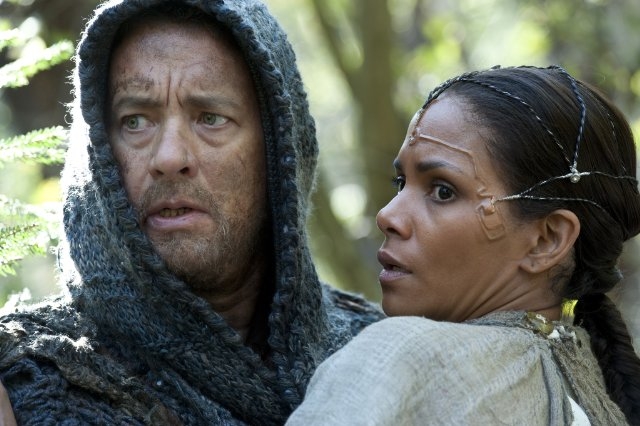
Like the movie itself, this daring attempt is half-success and half-failure. During the end credit, the movie shows us how many characters are played by each of its actors, and you will certainly be surprised in case of Ben Whishaw or Hugh Grant or Susan Sarandon because you cannot recognize some of the characters played by them unless you look at them closely. In contrast, we can help but laugh when Tom Hanks appears with tanned skin and bad accent or when Hugo Weaving appears as a drag queen version of Nurse Ratched or when Caucasian actors awkwardly appear as Asian/Korean characters.

As one of the Asian audiences, I must say I was kept being distracted/disturbed by the problematic make-ups I saw during the Neo-Seoul story. As Asian/Korean characters, Jim Sturgess, Hugo Weaving, Hugh Grant, Jim Broadbent, Halle Berry, and James D’Arcy look as if they were the love children of the racist Asian stereotypes in old Hollywood movies and Mr. Spock in “Star Trek”. I appreciated that the directors included bits of Koreans into their movie, but, boy, it is quite clear from the first appearance of Neo-Seoul that they do not know much about Korea just like David Mitchell was pretty ignorant about Korea when he wrote his novel. Seriously, it would have far less awkward it had been Neo-Tokyo – or Neo-Shanghai, perhaps.

cloudatlas03Despite my many grumbles about its shallowness and awkwardness, the movie manages to make itself work as an oddly interesting experience as it diligently rotates between its strong points and weak points. Like the movie, the actors all have their strong parts and weak parts, and the undeniable failure inside the movie is well reflected by an ironical fact that the actors are usually at their best when they wear less make-ups in the movie. Jim Sturgess looks pretty creepy as a Korean character, but he feels appropriate when he is in England or Scotland. Jim Broadbent is your guy when you need someone to play a cranky old man, and he provides lots of pleasures through some of his more fitting roles, and Halle Berry is good when she stays close to her real appearance. Even when he looks awkward, Hugo Weaving does not lose the sense of humor at all while he moves around the movie as its main villains, and Bae Doo-na provides the considerable amount of emotions to her character’s tragic but somewhat hopeful story as a clone opening her eyes to knowledge and feelings; her graceful performance is one of the main reasons I forgive David Mitchell and the directors’ faults a bit.

As I tried to sort out my myriad contradictory feelings and thoughts on “Cloud Atlas”, I concluded that the movie is “the best mess of 2012”. Some parts are really fantastic while other parts are utterly terrible. I want to admire it for its ambitious vision, but I also want to scorch it for its confounding mess. The movie is flawed and imperfect from the start to the end, and it is no wonder that the movie has been a love-it/hate-it film since its release. I do not think it is one of the best films in 2012 as some claimed, but its daring attempt is rather admirable even when it brandishes its worst side to the audiences. This big folly is surely a rare visual experience too interesting to be missed – even if its ultimate lesson is that life is full of make-ups.

cloudatlas07

Posted in Movies | Tagged , , , , , , , , , , , , | 1 Comment

Lincoln (2012) ☆☆☆1/2(3.5/4) : A portrait of a saintly and wily politician

small_lincoln07-01 During my childhood, I came across several sets of biographies of the famous historical figures for elementary school/kindergarten children, and Abraham Lincoln’s biography was a sort of obligatory volume in these sets like Jesus’ or Einstein’s was. Except nice illustrations, these biographies on Lincoln were not that good as far as I remember(I wonder… did Lincoln really start growing beard after reading a letter from a little girl?), but at least they gave my immature mind some basic historical knowledge about Lincoln, his era, and his great achievements.

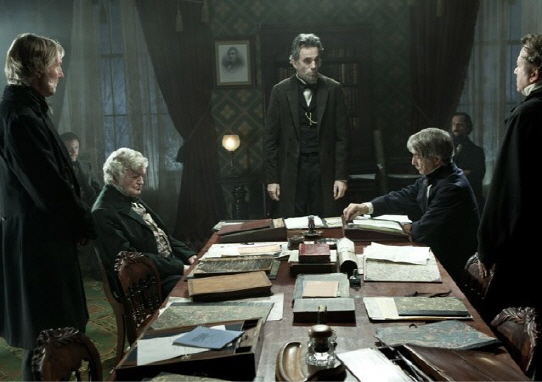
While presenting its subject with utmost respect and admiration, Steven Spielberg’s “Lincoln” presents a complex portrayal of a brilliant politician which is far more interesting and informative than the simple biographies of my childhood. It only focuses on the last year of Lincoln’s life, but Lincoln in the movie is vividly presented to us as a three-dimensional human being, and, through a very compelling mix of political thriller and historical drama, we come to learn that the final months of the Civil War were as important and difficult to him and his country as the Battle of Gettysburg was. As the brief opening scene on the battlefield suggests, Lincoln will have to fight and advance across muddy political world for attaining his ultimate goal and leading his country to changes – and he is willing to win his political battle by any means necessary.

It is January 1865, and the Civil War is approaching to the end after the major victory of the Union at the Battle of Gettysburg. Being successfully re-elected as the president in the last year, Lincoln(Daniel Day-Lewis) sees that a small but timely chance for passing the 13th Amendment to the US Constitutions. Although he issued the Emancipation Proclamation two years ago, Lincoln shrewdly perceives that it will not have any legal power once the war is over because it is not a federal law passed by Congress. They will certainly win the war, but the returning Confederate states will certainly disregard the Emancipation Proclamation, and that’s why the 13th Amendment should be enacted as a federal law for banning slavery completely in the country; if it is passed at the US House of representative before the end of the war, they can legally enforce it to the returning Confederate states later.

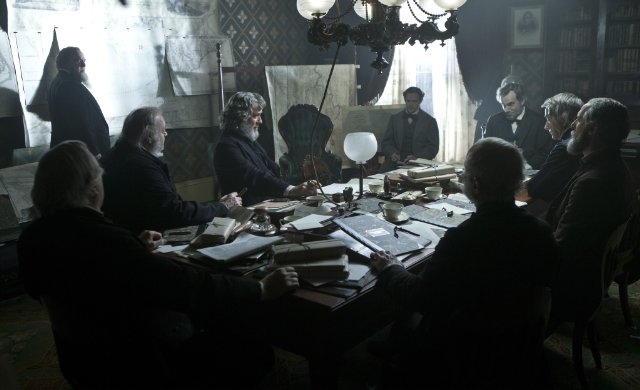
lincoln06 But the political circumstance in Washington D.C. is rather tricky for Lincoln and his dependable cabinet members including the Secretary of State William Seward(ever-reliable David Strathairn). While most of the Democratic Party members in the US House of Representatives are going through lame duck phase due to their failure to be re-elected in the last year, the Democratic Party still remains as a major block to the 13th Amendment; even if Lincoln unites all Republican Congressmen, he still need to draw additional 20 votes from the Democratic Party for getting it passed at the House. Furthermore, he also must maintain a fragile but crucial balance within his party between the conservative faction represented by Preston Blair(Hal Holbrook), who wants the peace negotiation with the Confederate for the immediate end of the Civil war, and the progressive faction represented by Congressman Thaddeus Stevens(Tommy Lee Jones), who has been adamantly passionate about the abolishment of slavery for long years.

Although we know his mission will be accomplished in the end, how Lincoln and his men pull all strings they can get for moving their political system is entertaining to watch because there are many universal aspects we can instantly recognize as we observe the people in the movie talking or negotiating with each other. Now or then, the political system has been mainly driven by petty human interests rather than lofty ideals, and the movie amusingly reminds us that the people in the politics are seldom changed. Lincoln allows Seward to hire three agents, or ‘lobbyists’, and, mainly functioning as a trio of comic reliefs for lightening up the somber mood in the story, these agents(played by James Spader, Tim Blake Nelson, and John Hawkes) are ready to do some dirty jobs for getting votes from Democratic Congressmen – including tasty bribery or irresistible offer of federal jobs.

Lincoln also carefully juggles other balls necessary for his political win. For satisfying Blair and his conservative faction, he initiates the peace negotiation with the Confederate, but he deliberately delays its progress while hiding it from his political opponents as well as the progressive faction. For having Stevens and his progressive faction as ally along with the conservative faction, he persuades the progressive faction not to be blatant about their political belief at the House for their mutual success at the end of January

small_lincoln02The movie is surely very talky, and there are many moments of conversations and oratories throughout the movie, but Tony Kushner’s terrific screenplay, based on the non-fiction book “Team of Rivals: The Political Genius of Abraham Lincoln” by Doris Kearns Goodwin, shines with eloquence and passion as it deftly moves our attention around the complicated and formidable political mechanism inside Washington D.C at that time. It is as solemn and serious as history drama can be, but it is also smart and humorous as any good political drama should be. Lincoln usually draws the attention of the people around him with stories and anecdotes before eloquently expressing his thoughts through long speeches, but he also knows how to tell a bathroom joke to draw big laughs from his men if he wants to lighten up the mood in their room a bit.

In contrast to the blatant but effective sentimental approach in his previous work “War Horse”(2011), Steven Spielberg takes a calm, restrained approach to Kushner’s screenplay while making the drama and its background feel vivid and real, and we are effortlessly drawn to the world in the past where the voting right for black people was a rather unfavorable radical idea and the White House was more opened to people. The movie mainly revolves around the shady interior scenes where most of the crucial interactions between the characters happen, the cinematographer Janusz Kaminski imbues gray/brownish wintry ambience to them using the cold winter lights from outside and the orange lights from fireplaces and lamplights, and the result is somberly beautiful to look at. The production design and costume are first-rate to say the least, and John Williams’ stately score seldom steps out to the front while subtly conveying the historical significance of the story to the audiences in the background.

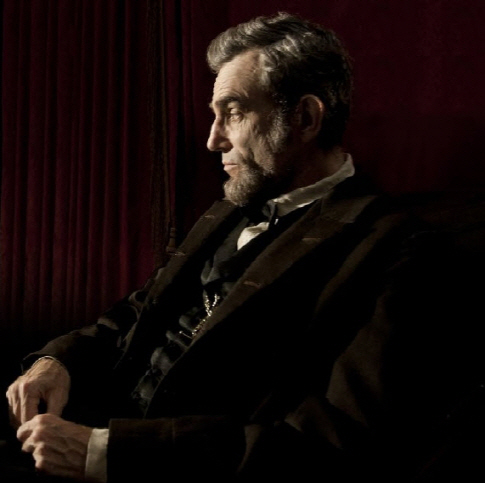
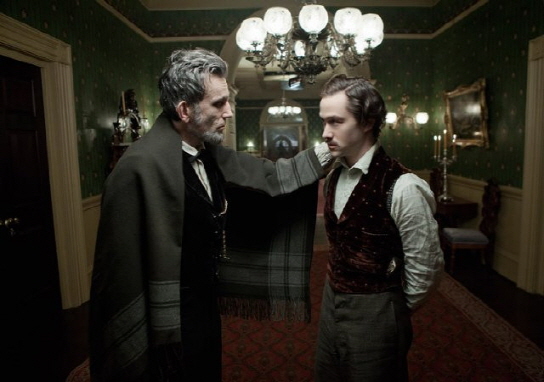
There have been lots of Oscar buzz about Daniel Day-Lewis during this Oscar season, and, considering his masterful performance in this film, I won’t be surprised if he wins his third Best Actor Oscar. Compared to his aggressive turns in “Gangs of New York”(2002) and “There Will Be Blood”(2007), Day-Lewis is far less showy here, but he gives an equally grand performance bountiful with fine human details to be appreciated. He is not just playing Lincoln on the screen; he wholly embodies Lincoln as a complex human being with many different sides, and we immediately accept him as Lincoln right from his first appearance.

small_lincoln01While not being far from Lincoln’s familiar historical image on the surface, Day-Lewis’s dexterous portrayal of Lincoln is intimate and intelligent, and it reveals not only a saintly man getting exhausted by the personal and political burdens but also a wily politician with immense insights on how the system and its people can be moved or manipulated. In spite of being weary due to the costly war which has been demanding a lot from him and his people and being haunted by the dark memories associated the death of one of his sons, he quietly moves on with dignity and calculation as handling the small and big matters thrown to him day by day, and we gradually see the steely resolve behind his mild mannerisms and soft-spoken words.

Spielberg assembles an impressive array of talented actors around Day-Lewis, and their superlative ensemble performance is one of the best ones in 2012. Even the small roles are filled by good actors like Michael Stuhlbarg, Bruce McGill, Lee Pace, Jackie Earle Haley, Walton Goggins, and Jared Harris, and the ensemble is pleasure to watch for providing different flavors and views to the story.

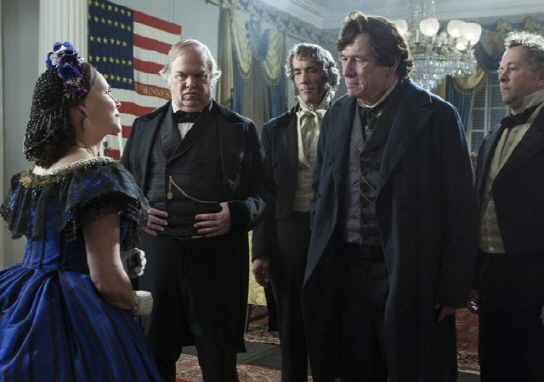
Sally Field plays Lincoln’s wife Mary Todd Lincoln, and her scenes with Day-Lewis are good private counterpart to Lincoln’s public life. Their son Robert(Joseph Gordon-Levitt) wants to join the army before the war it over, but Mary Todd is against that because she does not want to lose another son. Lincoln should do some negotiation job between them while trying not to hurt the feelings of both, and their conflict is eventually resolved with compromises and sacrifices like his political business

small_lincoln04 Tommy Lee Jones is also excellent as a seasoned politician with the ideals fueled by a matter of his heart, and he has a quiet but memorable scene with Day-Lewis in which Lincoln and Stevens have a private conversation at the basement of the White House. Despite their differences, they agree on what should be done for their country, and, as a pragmatic realist, Lincoln advises Stevens that he should compromise his principles for reaching to their common goal. Stevens comes to admit that there is nothing he cannot say for what both he and Lincoln sincerely want, so he rises to the occasion with a neutral but effective blow to his sniggering opponent at the House; “I don’t hold with equality in all things, only with equality before the law and nothing more.”

While it is one of the best works by Steven Spielberg, “Lincoln” is a fabulous historical drama to be remembered as the definite movie about Abraham Lincoln and his major accomplishment. Though the ending is not a surprise to you if you did not sleep during American history class, the movie is a gripping story which rarely becomes tedious during its long running time(150-min), and it is especially suspenseful during a long but tense sequence in which the fate of the 13th Amendment is being determined at the house as the congressmen in the House say aye or no one by one.

As several critics have already pointed out, the last 5 minutes of the movie is unnecessary, but it manages to maintain its restrained attitude even during that overkill at least, and the movie made me reflect on how that small but significant legal change initiated by a great American politician was followed by far bigger social changes during less than 150 years – and we witnessed one of them recently.

small_lincoln03

Posted in Movies | Tagged , , , , , , , , , , , | 3 Comments

Photos from one winter afternoon(01/06/13)

                                                                           
It was cold with snow, and the animals at the campus were hungrier than before…
Posted in Photos | Tagged , , , | 1 Comment

Flight (2012) ☆☆☆1/2(3.5/4) : The crash is not over for him yet

small_flight01He survives, but the crash is not over for him yet. After striking us with a gut-chilling sequence at the start, Robert Zemeckis’ “Flight” switches its gear into a slow but compelling character drama about a long personal crash of a flawed man who has deceived himself with illusion of self-control. He tries to believe he can have his life and himself under control, but he only finds himself keeps lying to himself and others as plunging himself down to the bottom where he has not reached yet.

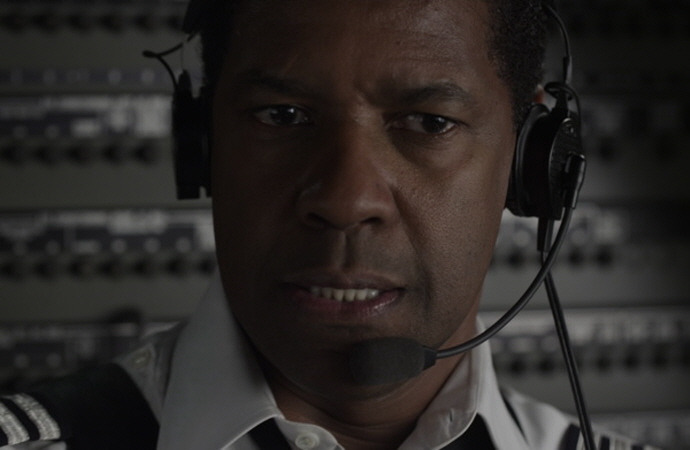
When we meet Whip Whitaker(Denzel Washington) for the first time, it is another difficult morning to begin for him. His hotel room, near the airport in Orlando, is strewn with bottles, and, still suffering from the hangover due to his wild last night with his co-worker, he stimulates his exhausted mind with cocaine. He soon regains his usual straight appearance when he walks out of his room – as a captain of a commercial airline ready for a morning flight assigned to him.

Cool and controlled on the surface, Whitaker does his job pretty well even though his body condition is legally not so suitable for operating a big flying vehicle with more than 100 people on board. When the plane leaves the ground, it suffers heavy turbulence, and Whitaker handles the circumstance with firm deftness unlike his nervous rookie co-pilot(Brian Geraghty). As soon as it is over, he drinks again when nobody sees him.

small_flight08And then he and his co-workers face a very dangerous situation. Due to some malfunction, the plane suddenly rapidly plunges to the ground below, and the possibility of certain death is apparent to everyone in the plane. In such a panic moment, Whitaker does something not many sober pilots dare to do; by manually operating his plane, he does a perilous stunt flight as he turns it upside down, and, miraculously, most of the people in the plane survive although few die during the crash landing.  Thanks to the convincing performances and realistic special effects on the screen, this terrific heart-stopping moment is so gripping and visceral  that it eventually becomes a sort of minor but crucial supporting character hovering above the rest of the story.

While recovering at the hospital and being praised as a brave hero, Whitaker immediately becomes the focus of the media – and the federal investigation by the National Transportation Safety Board. While how he succeeded remains an elusive mystery(all 10 simulated flights under the same condition failed), the investigation committee thoroughly investigates for finding the cause of the accident, and, not so surprisingly, Whitaker’s drinking problem attracts their attention due to his toxicology test at the hospital.

He can be jailed for operating the plane under influence if he is not careful about his drinking, but there is an interesting irony in his circumstance. Sure, he has enough skills and knowledge for saving his plane as a veteran pilot with long, impressive career, but could he have enforced such a risky and insane stunt like that if he had been sober? Yes, it goes without saying that he saved many people, but it cannot be denied that he had already endangered his passengers right from the beginning when he got on his plane.

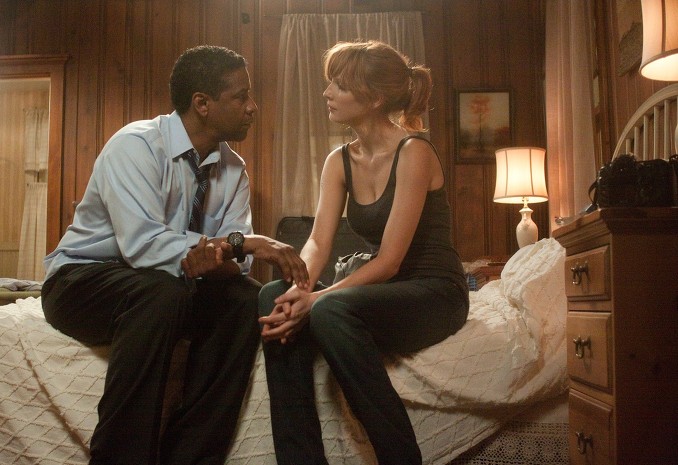
flight02Well aware of this professional negligence, Whitaker recedes into his family farmhouse from the media, and he tries to sort his messy life for pulling himself up. He removes alcohol from his house(one scene shows that there are many bottles amusingly placed here and there in the house). He also gets friendly with Nicole(Kelly Reilly), a young addict who comes across him through a coincidental encounter at the hospital, and there comes the possibility of the relationship between them as she moves into his home when there is nowhere else to go for her.

But, like any alcoholics struggling for control, he finds that it is not easy for him to stay away from alcohol, and it brings more troubles to him as the day for his testimony at the public hearing is approaching. He really needs help, but, like many high-functioning alcoholic, he keeps putting himself into denials and lies rather than admitting his problem. Nicole finds AA meeting is helpful for her sobriety and subsequent restart, but he does not like to be at AA meeting mainly because of the honesty surrounding him, which reminds him how much he has lied to himself for a long time.

John Gatin’s screenplay sometimes looks like a long crash course more or less determined for its alcoholic hero. The more he denies, the more he goes down through the circumstances beyond his control including the unlocked door to the hotel room next to his alcohol-free room – and he keeps disappointing the people around him who want to help him in one way or another.

flight04The movie wisely does not try to explain the cause of his alcoholism while focusing on his alcoholic behaviors(well, he drinks because he drinks, doesn’t he?), and Denzel Washington certainly deserves Oscar nomination for his uncompromising performance. Using his cool, confident image as a mask for hiding the inner turmoil inside his character, Washington excels especially when his character tries to convince others that he just drinks heavily at times, and he never allows any excuse even when his character looks pretty unflattering and pathetic. Look at the scene when Whitaker impulsively visits his ex-wife and son who do not welcome him much, and you can have a pretty good idea about how lousy he was to them as a husband and as a father in the past.

Whitaker may be able to get away with his drinking problem as he keeps drinking, but there is always his conscience somewhere in his mind, and that is why the one important scene near the ending is as intense as the crash landing sequence in the beginning; this time, his life, career, and conscience are his passengers, and he comes to see that there are only two flight courses for him – and neither of them will be easy for him at all. Even in such a tense and burdensome moment, Washington does not resort to overacting while presenting us the façade barely under control; everyone in the room is looking at him, and Whitaker must hide what has been eating him inside from them if he wants to survive with his career remained intact officially.

The supporting performers surrounding Washington effectively function as the elements of the story which guide or drive or corner Washington’s character into that point. Brian Geraghty is a good counterpart to Washington’s steely attitude during the crash landing sequence, and Kelly Reilly brings warmth to the story as a fellow addict; she likes and cares about Whitaker, but there is a point where a recovering AA meeting member can no longer be with an alcoholic mired in self-denial.

flight03On the opposite, Bruce Greenwood is a union representative trying to save his longtime friend’s career, and Don Cheadle is an efficient no-nonsense lawyer doing his job as paid; they are also frustrated about Whitaker’s drinking problem but they choose to ignore it as they do as much as they can for protecting his career. John Goodman steals the show as a flamboyant drug supplier who always comes handy to his client/friend as if he were a sort of devil ready to be summoned, and Melissa Leo sternly holds her single scene as the head of the investigation committee who will not accept any evasion from her witness.

The director Robert Zemeckis, who returns to feature film after more than 10 years(his last feature film was “Cast Away”(2000)), confirms to us through this movie that he has lost none of his skills as a feature film director even after having spent lots of time to his experiment with motion capture animation. The special effects are well used for its crashing impact to the story, and the story is handled well as a drama giving us some insights about addiction under his competent direction.

By the way, I heard some people complained that one certain line delivered around the ending is too much of a cliché, so I must say this clearly to you; I think there is no other line more honest than that familiar line, and, when you hear it in the movie, you will probably agree that it is exactly what should be uttered from him. After all, honesty is the first important recovering step for any addicts, isn’t it?

flight06

Posted in Movies | Tagged , , , , , | Leave a comment