SoulMate (2016) ☆☆☆1/2(3.5/4): Two girls’ dynamic friendship

soulmate06.jpg

While it seems to be another typical female tale of love and friendship, Chinese film “SoulMate” works thanks to its sincere storytelling and engaging performance. It looks predictable at first, but then it comes to hold our attention as vividly depicting the dynamic development of its two heroines’ relationship, and it certainly earns all the emotions displayed around its finale, which will touch you a lot more than you may expect.

The story begins with Li Ansheng (Zhou Dongyu) being asked about a popular web fiction written by her friend Lin Qiyue (Ma Sichun). That web fiction is based on their adolescent years, but Ansheng is not so willing to talk much about Qiyue for some reason, and she keeps her reticent attitude even when she later comes across Su Jiaming (Toby Lee), a guy who was once close to both of them.

As Qiyue’s web fiction is being read bit by bit, the past between Ansheng and Qiyue is presented to us via a series of flashback scenes. After their accidental encounter during one of their usual school days, Ansheng and Qiyue quickly befriend each other, and Qiyue even takes Ansheng to her home for having a dinner together. Qiyue’s good parents does not mind this at all, and Qiyue and Ansheng are certainly delighted when Qiyue’s parents allow them to spend the night together.

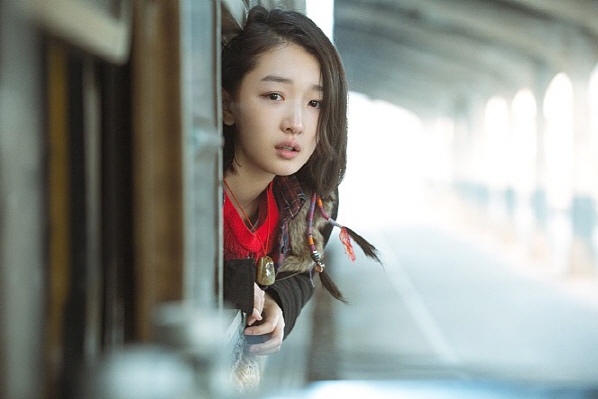
As these two girls grow up more over several years, we observe how different they are from each other – and how their different personalities complement each other. While Ansheng is more spirited and extroverted in comparison, Qiyue is more reserved and introverted in contrast. While Ansheng is eager to see more of the world outside after high school graduation, Qiyue has no problem with following her parents’ wish: going to a college and marrying someone later.
soulmate04

After respectively entering different high schools, Ansheng and Qiyue naturally begin to be separated from each other, but their friendship remains strong as before, and that is exemplified well by when they spend a cozy night together at Ansheng’s small shabby residence. As two very close friends, they can happily and openly talk about anything with each other, and they surely hope that they will remain each other’s best friend forever.

And then there comes a change they never expected. Qiyue has been attracted to a male student in her high school, and he is none other than Jiaming. After Qiyue confides to Ansheng about her interest in Jiaming, Ansheng decides to check out who he is, and that leads to a rather amusing moment between her and Jiaming, who is understandably baffled a bit by her sudden appearance right in front of him.

Not long after this meeting between Ansheng and Jiaming, Jiaming and Qiyue eventually get closer to each other via their accidental encounter at their school library. Yes, this is indeed a cliché, but their tentative approach to each other is depicted with enough amount of sincerity and sensitivity, and you may smile a bit as appreciating that.

Of course, Qiyue subsequently introduces Jiaming to Ansheng, and, alas, Ansheng and Jiaming soon find themselves feeling something between them. After they happen to reveal their mutual attraction to each other, Ansheng decides to do what may be best for all, but that only leads to a bitter moment between her and Qiyue, and they literally become more distant to each other even though they correspond with each other via letters.
soulmate05

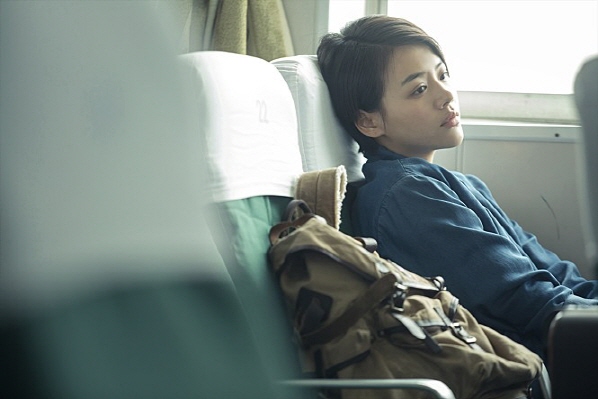
As Qiyue and Ansheng constantly push or pull each other over their unresolved matters of heart, the movie generates a number of emotionally tense moments, which surely show us that how friendship can be as intense as romance. While they still care about each other a lot, Qiyue and Ansheng sometimes cannot help but swept by emotions swirling around their increasingly strained relationship, and that only results in more hurts and regrets for both of them.

The movie also pays considerable attention to how they respectively struggle to find each own place in the world, and that adds more emotional resonance to the story. While Ansheng enjoys living as freely as she wanted, she comes to question her life choice, and so does Qiyue, who comes to make a very important decision for her life later in the story. I will not go into details on how they eventually converge to an expected moment of reconciliation, but I can tell you instead that the finale turns out to be quite poignant and I was both surprised and touched by that.

Under director Derek Tsang’s competent direction, Zhou Dongyu and Ma Sichun ably carry the film while effectively complementing each other’s performance, and I think I can expect to see more from these two wonderful actresses. As a guy put between their characters, Toby Lee is less prominent in his rather colorless role, but that is not much of a problem, considering that his character is more or less than a storytelling device to generate the conflict between our two heroines.

Although it may not bring anything new to its subgenre mainly represented by “Beaches” (1988), “SoulMate” is a well-made drama supported by genuine emotions nonetheless, and it deserves to be watched by more audiences out there. This is indeed one of better films I saw during this year, and I guarantee you that you will not be disappointed at all.

soulmate01

Posted in Movies | Tagged , | 1 Comment

Star Wars: The Last Jedi (2017) ☆☆☆1/2(3.5/4): It’s certainly not the last one

starwarsthelastjedi01

“Star Wars: The Last Jedi” is a big entertaining surprise. Fully developing the potentials glimpsed from “Star Wars: The Force Awakens” (2015), this ambitious piece of work not only excited me with numerous memorable sights but also intrigued me with its unexpectedly powerful storytelling. In short, this is the Star Wars movie I have never imagined I wanted, and you have to see for yourself how much it is willing to go further for new open possibilities on the horizon.

If “Star Wars: The Force Awakens” follows the playbook based on “Star Wars: A New Hope” (1977), the first half of “Star Wars: The Last Jedi” seems to follow the one based on “Star Wars: The Empire Strikes Back” (1980). Despite the big victory attained at the end of the previous film, the Resistance led by General Leia Organa (late Carrie Fisher in her final performance) has been cornered by the First Order, and the movie opens with the Resistance desperately fleeing from the relentless pursuit of the First Order fleet. Mainly thanks to a reckless but brave action of Poe Dameron (Oscar Isacc), the Resistance manages to evade the First Order fleet for a while, but the situation soon becomes quite more urgent and desperate, and it begins to look quite possible that the war will be eventually over with the total defeat of the Resistance.

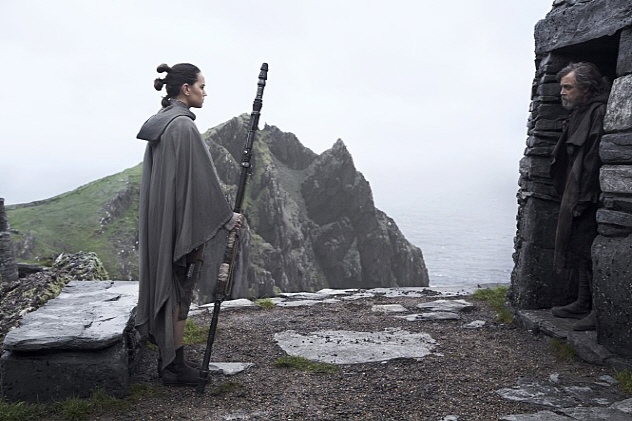
Meanwhile, we see what happens after Rey (Daisy Ridley) finally encountered Luke Skywalker (Mark Hamill) during the final shot of the previous film. Since his disastrous failure with his nephew Kylo Ren (Adam Driver), Luke has hidden in a remote island located in a distant island called Ahch-To for many years, and he still feels bitter and morose about his failure as a Jedi Master. He curtly refuses to teach Rey during their first encounter, but Rey is not someone who does not easily step back, so Luke reluctantly comes to give her some lessons on, yes, the Force.

starwarsthelastjedi03

As Rey and Luke begin to form a rather strained mentor/apprentice relationship, their conversations soon revolve around Kylo, who has served Supreme Leader Snoke (Andy Serkis) since he went to the dark side of the Force. As your average troubled petulant lad, Kylo is still seething and brooding over his patricide committed in the previous film, and Snoke, whose name sounds rather ridiculous (don’t confuse it with snorkel, by the way) but who is as evil and manipulative as Emperor Palpatine in the original Star Wars Trilogy, is going to use that and other things for pushing further Kylo to the dark side. When he savagely ridicules Kylo at one point, he certainly knows which buttons should be pushed, and we see that he gets exactly what he wants from his volatile apprentice.

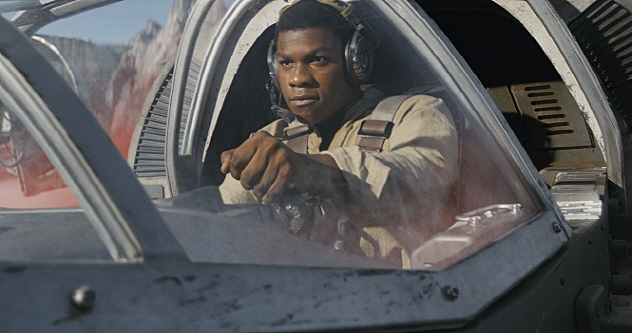
Besides these three main plotlines, there is an additional plotline involved with Finn (John Boyega) and Rose Tico (Kelly Marie Tran). After finding that there is a small possible chance to save the Resistance, Finn, a former stormtropper who defected to the Resistance, secretly goes for that chance with Rose, who is quite delighted to do something more important (and exciting) than guarding escape pods in their spaceship. Of course, things do not go as well as they hope, and the Resistance continues to run out of time as General Organa and other high-ranking members of the Resistance fear for the worst.

Busily juggling its multiple plotlines, the screenplay by director Rian Johnson sometimes feels a bit dragged especially during its middle part, but it steadily builds its narrative momentum as providing a number of effective dramatic moments which lead to unexpectedly strong story/character development. For example, it is quite engaging to watch how the drama between its two main characters is unfolded via a sort of hyperspace communication, and how this eventually culminates to a payoff moment later in the story is one of many satisfying things in the film. While the movie is possibly the darkest Star Wars film since “Star Wars: The Empire Strikes Back”, it is not entirely devoid of humor, and you will certainly get chuckles from its several humorous moments including the earlier one involved with Finn awakening from his unconscious state.

starwarsthelastjedi02

On the technical level, the movie is visually striking. While its battle sequences are as intense and exciting as those of “Rogue One: A Star Wars Story” (2016), they are always accompanied with nice artistic touches including the operatic use of red and white during the climax sequence. In case of a part involved with Finn and Rose’ adventure, the movie takes some time to show us something new and wondrous, and that reminds me again of why I have been charmed by the fantasy space world of the Star Wars series. I enjoyed various robots and creatures in the film including those crystal foxes, and I found myself being fonder of BB-8, who somehow operates well throughout the film despite frequently experiencing physical impacts from here and there.

The main cast members of the movie are stellar on the whole. While Daisy Ridley is commendable as the new center of the series, Adam Driver further solidifies his villain character, and John Boyega ably balances his character between cowardness and bravery. Oscar Isaac, Domhnall Gleeson, Kelly Marie Tran, Laura Dern, Gwendoline Christie, Anthony Daniels, Andy Serkis, Lupita Nyong’o, and Benicio del Toro are effective in their respective roles, and Mark Hamill and Carrie Fisher comfortably embody their familiar characters while functioning as the crucial parts of the story.

Although it may not reach to the pinnacle represented by “Star Wars: A New Hope” and “Star Wars: The Empire Strikes Back”, “Star Wars: The Last Jedi” succeeds in growing beyond the original trilogy, and it will be very interesting to see how much the following sequel is propelled by this significant achievement in terms of story and characters. Seriously, I have no idea on what will come next, but I am prepared to embrace more new things.

starwarsthelastjedi05

Posted in Movies | Tagged , , , , | 2 Comments

The Third Murder (2017) ☆☆1/2(2.5/4): A frustrating exercise in ambiguity

thethirdmurder01

Hirokazu Kore-eda’s new film “The Third Murder” is a frustrating exercise in ambiguity. At first, everything seems pretty simple in a murder case at the center of the story, but then it turns out that the case may be a lot more complicated, and the movie adamantly refuses to give any simple answer even in the end. While that storytelling choice could result in something compelling for us, the movie fails to generate enough human interest to engage us, and that was quite a surprise for me considering how effortlessly many of Kore-eda’s works interested me and then touched me.

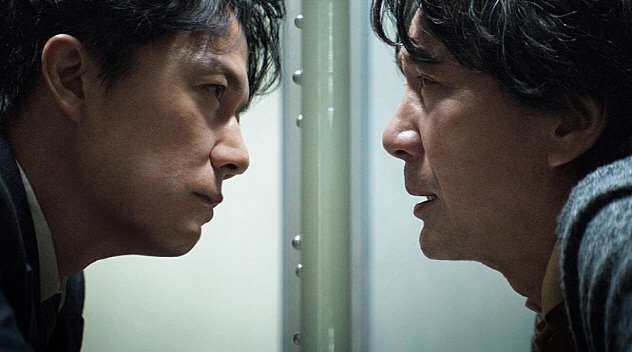
As shown during the opening scene, the murder in question is committed by a middle-aged ex-con named Misumi (Kōji Yakusho). The victim, whose body was burned after he was killed, was the owner of a factory where he worked, and it looks like he was murdered just because of money, though Misumi did not say much about his motive after being arrested by the police.

Misumi is going to be defended by a trio of lawyers at the upcoming trial, and one of his lawyers, named Shigemori (Masaharu Fukuyama, who previously collaborated with Kore-eda in “Like Father, Like Son” (2013)), turns out to be indirectly connected with Misumi. Around 30 years ago, Misumi was brought to a trial for committing a double murder, and it was Shigemori’s judge father who presided over that trial. When Shigemori later asks his father about that trial, his father replies without any hesitation that now he thinks he was too generous to Misumi at that time. After serving his lighter sentence, Misumi seemed to be rehabilitated and he even sent a sincere postcard to Shigemori’s father, but then he committed that murder not long after sending that postcard, and that was surely more than enough for Shigemori’s father to become rather skeptical about whether rehabilitation is actually possible for guys like Misumi.

thethirdmurder03

Anyway, Shigemori and his two colleagues continue to try as much as they can as Misumi’s lawyers. Because there is not much doubt on Misumi’s crime, they decide to focus on reducing his possible sentence, so they begin to work in two directions. They try to persuade the victim’s family to show a little compassion to Misumi, and they also try to prove that the nature of Misumi’s crime is technically less heinous than the prosecution team claims.

However, the more they delve into the case, the more Shigemori becomes unsure about the case. When he visits the crime scene along with one of his colleagues, he notices that the body was laid on the ground in a rather formal way, and he gradually comes to wonder about Misumi’s motive. Was it really motivated by his need for money? If it was not, what was really his motive?

Unfortunately, Misumi is not someone who can easily divulge whatever he is hiding behind his mostly detached façade. He has already changed his words on his motive behind the murder several times, and we are surprised to learn later that he did the pretty much same thing when he was arrested for that double murder in the past. While firmly maintaining his character’s elusiveness, Kōji Yakusho did a nice job of subtly suggesting his character’s feelings and thoughts, and, despite our increasing bafflement, we become more attentive to every word and nuance from his untrustworthy character.

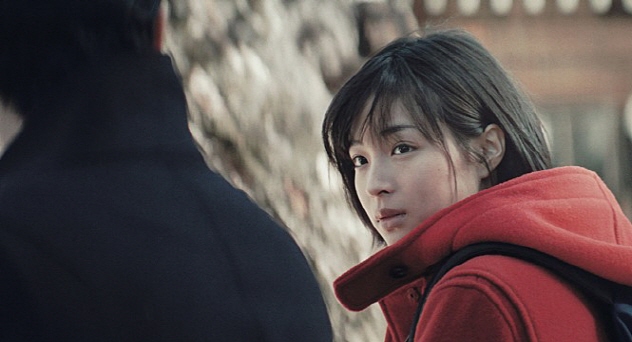
Things get more complicated after Misumi tells a magazine reporter something quite unexpected. I will not reveal anything here for avoiding spoilers, but I guess that I can tell you instead that, after that plot turn, Shigemori comes to focus more on the victim’s teenager daughter Sakie (Suzu Hirose), who, as implied by her first scene in the movie, seems to know something about the case. She is visibly conflicted, and she may tell something advantageous for Misumi if she is persuaded enough by Shigemori.

thethirdmurder04

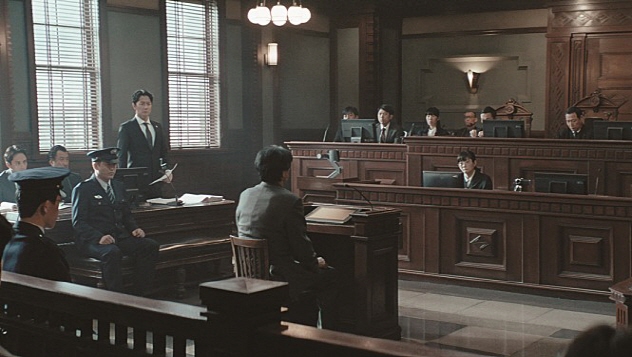
Now the movie may look like your average courtroom thriller to some of you, but it leisurely moves from one plot point from another instead, and that can be quite frustrating for you. Even after the trial eventually begins around the middle point of the story, the movie continues to stick to its glacial narrative pacing, and it does not generate enough tension to hold our attention. Accordingly, we come to observe it from the distance, rather than getting involved in its story and characters.

The movie was a really strange experience for me because I did not have any problem with Kore-eda’s slow, thoughtful storytelling approach before. His notable films like “Still Walking” (2008) and “After the Storm” (2016) may be too slow for some of you, but they never failed to engage me on emotional levels, and I was always moved by their gentle humanity. In case of “The Third Murder”, I merely felt distant while not caring much about its story and characters, and I only found myself annoyed by its manipulative ambiguity instead of being intrigued by it.

Overall, “The Third Murder” is disappointing, but I sort of admire that Kore-eda tries something different here, and I was not completely bored during my viewing at least. I liked its several small nice human moments such as the earnest conversation scene between Shigemori and his adolescent daughter, and I certainly appreciated its cold, gloomy atmosphere which is palpably established on the screen by cinematographer Mikiya Takimoto. The movie is a misfire indeed, but it is an interesting one at least.

thethirdmurder05

Posted in Movies | Tagged , , | Leave a comment

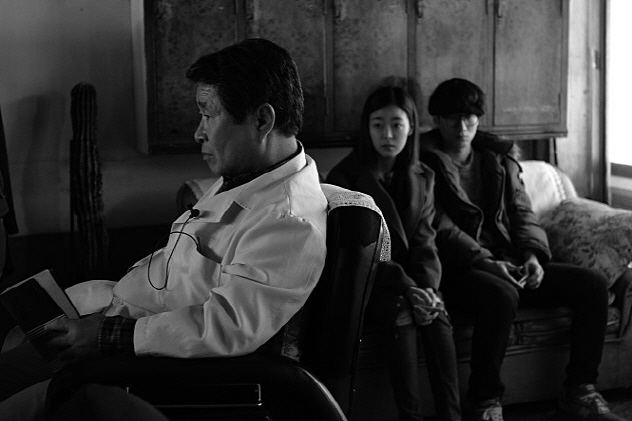
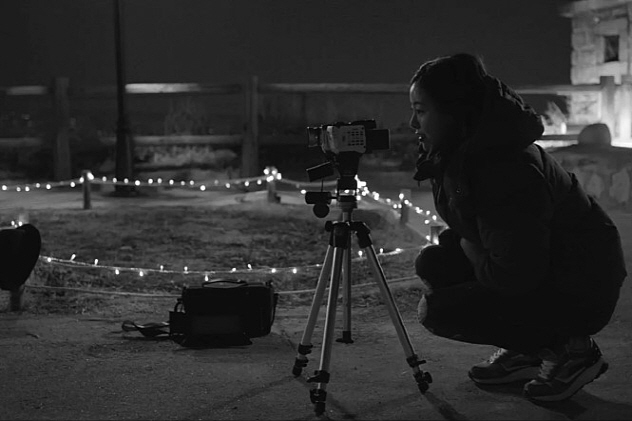
Merry Christmas Mr. Mo (2016) ☆☆☆(3/4): A deadpan filmmaking tale of one barber

merrychristmasmrmo02

South Korean film “Merry Christmas Mr. Mo” is advertised as a ‘black comedy stranger than paradise’, and that description is correct to some degrees. While I was a bit disappointed to find that it is not as uproarious or edgy as I thought, the movie works as a deadpan comedy film reminiscent of Jim Jarmusch’s works including, yes, “Stranger Than Paradise” (1984), and I had a fun with its small good moments which become more emotionally resonant around its expected arrival point.

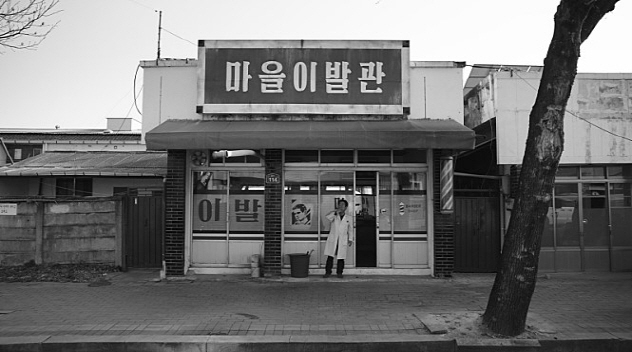
In the beginning, the movie dryly observes the mundane daily routine of Mo Guem-san (Ki Joo-bong), a middle-aged barber who has lived in some rural town for many years. While he walks to his barbershop in the morning, he encounters an adolescent boy who apparently knows him, and their following interaction effectively sets the overall tone of the film. Mo does not respond much when the boy says hello to him as passing by him, but then the boy says hello to him again as coming back to him, and he is only baffled a bit to our small amusement.

He spends many hours alone at his barbershop except when his few customers come, and that reminded me of a barbershop to which I went from time to time during 2015. Like his barbershop, that one was in a quiet rural town where I worked during that period, and its middle-aged owner, who was not so different from Mo, did not have many customers either. The movie did a good job of presenting several realistic details on the screen, and I must tell you that some of them instantly took me back to that barbershop I still remember well.

Once his working hour is over, Mo spends some time at a local swimming pool, and then he goes to an old-fashioned bar, which mostly feels quiet and empty just like his barbershop as classical music is played on the background. After that, he returns to his apartment where he has lived alone since his dear wife died, and we get some small laughs as watching him struggling to sleep on his bed.

merrychristmasmrmo04

And then there comes a bad news for him. He turns out to have a serious case of stomach cancer, and he is told by his doctor that he must go to a bigger hospital as soon as possible. As trying to process this bad news, Mo comes to reflect on his life on the whole, and then something comes upon his mind after watching his family’s old home video. For his estranged son who has aspired to be a filmmaker, he concocts the idea for a short film to be shot by his son, and we soon see him tirelessly working on the screenplay to be shown to his son.

However, his son, named Stephen (Oh Jung-hwan), is not exactly in an ideal status for that at present. Although he still dreams of being a filmmaker someday, he has been going nowhere for years, and the same thing can be said about his relationship with his girlfriend Ye-won (Go Won-hee), who has been clearly running out of her patience as shown from one brief scene between them. While he is goofing off in their tiny residence, she is diligently doing her work, and she flatly reminds him that he should be more serious about his life – and their relationship, of course.

When his father calls him, Stephen comes to see his father along with his girlfriend, and he is flabbergasted when Mo shows him his screenplay. After revealing to Stephen that he once wanted to be a film actor, Mo asks his son to help him making a short film, which will be shown to invited audiences on Christmas if everything works out all right as he wishes. Stephen is understandably reluctant, but he comes to agree to help his father, and so does Ye-won, who unexpectedly turns out to be more supportive than her boyfriend.

As these three main characters move here and there around a number of locations, the movie generates nice moments of low-key humor from their guerrilla filmmaking. You may chuckle a bit as Mo prepares his costume and ‘props’ for the shooting, and then there comes a very funny moment as they attempt to shoot a rather creative explosion scene, which I will not describe in detail here for not spoiling your fun.

merrychristmasmrmo05

Of course, the movie becomes more serious after a certain narrative point, but director/writer Lim Dae-yeong deftly balances itself between humor and drama, and his story continues to saunter along with its main characters while never losing its sense of humor. Beautifully shot in digital black and white film by cinematographer Moon Myung-hwan, the movie provides a number of wonderful visual moments as looking around its seemingly mundane locations, and the score by Ha Heon-jin effectively enhances the dry atmosphere surrounding the characters in the film.

As the comic/dramatic center of the movie, Ki Joo-bong is commendable in his understated lead performance; he surely knows he should keep his acting straight as much as possible, and the result is alternatively funny and poignant while also being one of the best South Korean movie performances of this year. While Oh Jung-hwan and Go Won-hee support Ki well, the other supporting performers in the film are also effective in their respective roles, and Kim Jeong-young is particularly good as a woman in Mo’s old past.

Although I initially felt impatient at times during my viewing, I eventually came to enjoy “Merry Christmas, Mr. Mo”, and I admire its strong points including distinctive mood and solid performance. Sure, it may be a little too dry and slow for you at first, but it is a charming and touching human tale about life and love nonetheless, and its finale will surely make you smile in the end.

merrychristmasmrmo01

Posted in Movies | Tagged , , , , | 1 Comment

The Other Side of Hope (2017) ☆☆☆1/2(3.5/4): Another deadpan film from Kaurismäki

theothersideofhope02.jpg

I remember well when I watched Aki Kaurismäki’s “Le Havre” (2011) during one cold evening of 2011 December. I watched it at a local arthouse theater which was as freezing as the outside, and I remember well when the theater manager offered me and other few audiences blankets before the screening. Once the movie started, I found myself gradually warmed by the gentle humanity glimpsed from its many wonderfully deadpan moments, and I later chose it as one of the best films of that year.

In his latest film “The Other Side of Hope”, Kaurismäki seems to return to his usual drab and cheerless mode which is mainly exemplified by “Shadows in Paradise” (1986), “Ariel” (1988), and “The Match Factory Girl” (1990), but this is another likable work which shares many traits with “Le Havre”. Like “Le Havre”, the movie willingly tackles immigrant issue, and it is engaging to watch how it makes some social/political points while effortlessly going back and forth between humor and pathos with its adamantly deadpan attitude.

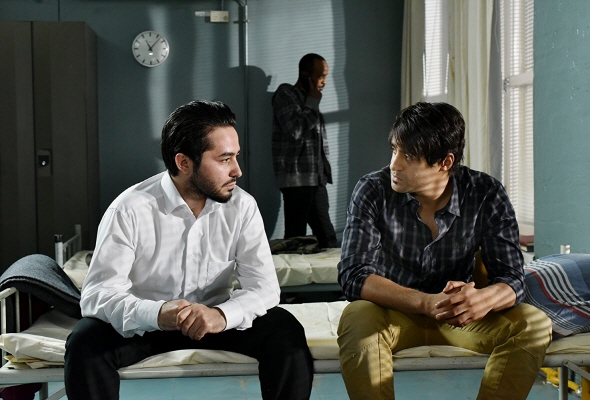
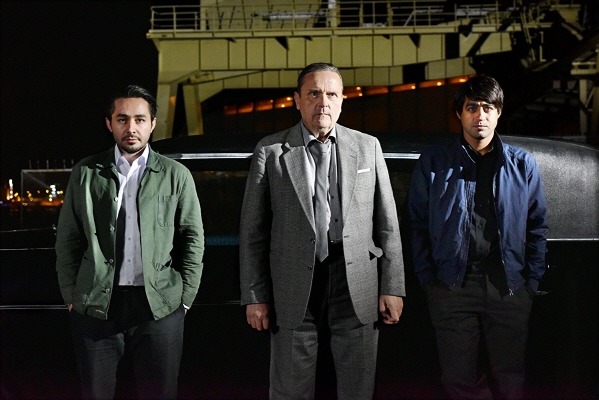
In the beginning, the movie introduces us to Khaled Ali (Sherwan Haji), a young Syrian man who sneaks into Finland via a coal ship coming from Poland. After getting out of a pile of coal in the ship, he instantly gets off from the ship, and the he wanders around the city for a while until he finds a place where he can wash himself before presenting himself as an exile to the Finnish Police.

After he is sent to a temporary shelter for many immigrants who are as desperate as him, Khaled is interviewed by an official from the Finnish Immigration Service, and we get to know a bit more about him. He used to work as a mechanic in Aleppo, but he lost not only his home but also many of his family due to the ongoing civil war in Syria, so he decided to get out of Syria along with his sister, who unfortunately got separated from him when they were in Hungary after going through Balkan.

theothersideofhope05

Khaled hopes that he will soon be in touch with his sister once he is allowed to settle in Finland, but, not so surprisingly, he continues to be stuck in the facility along with his fellow immigrants including an Iraqi guy named Mazdak (Simon Hussein Al-Bazoon). who quickly becomes his friend during their first encounter. As a guy who stays there longer than him, Mazdak willingly provides some help and advice to him, and Khaled appreciates his generosity especially when he helps Khaled contact a cousin who may find where Khaled’s sister is.

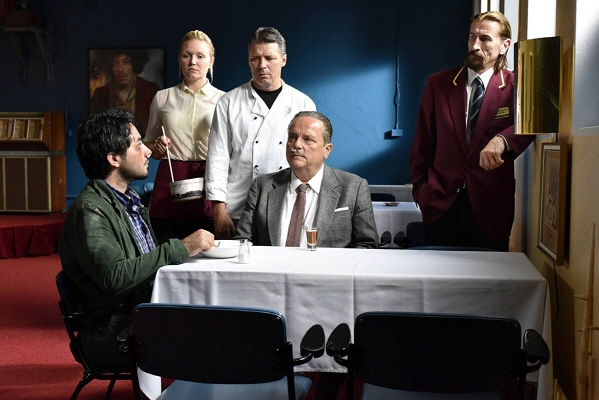
In the meantime, the movie also observes the ups and downs in its other main character’s drab daily life. Not long after his unceremonious separation from his wife, Waldemar Wikström (Sakari Kuosmanen) decides to quit his clothing salesman career, and we see how this sullen middle-aged guy goes through his retirement process. After selling every product in his storage to his buyers (one of them is played by Kati Outinen, who was memorable in “The Match Factory Girl”), he immediately goes to an illegal gambling place with all the money he has, and he comes to win a huge amount of money. While everything is calm and quiet during that scene, Kaurismäki subtly raises the level of tension beneath the surface, and we are amused a lot at times as Waldemar and other characters in that scene keep their faces straight to the end.

With the money he won from his gambling, Waldemar tries to start a restaurant business, but he turns out to be far less lucky in that. The restaurant purchased by him is quite a lousy one, and it has only three employees. The previous owner did not even pay the employees their delayed wage before running away with the cash he received from Waldermar, and the employees are not exactly model ones to say the least. When a customer happens to come into their restaurant at one point, they give him a pretty curt service which made my eyes roll.

theothersideofhope03

These two plotlines in the film eventually converge when Khaled escapes the facility and then comes to be hired by Waldermar, who actually met him during a brief scene around the beginning of the movie. Seeing that Khaled really needs help, Waldermar decides to protect and help Khaled as much as he can, and his employees go along with that without any complaint because, well, he is their boss.

While never overlooking the harsh reality which is mainly represented by a trio of racist thugs, movie keeps providing amusing deadpan scenes to savor. For drawing more customers, Waldermar and his employees try to do something different, and all I can tell you is that I was tickled a lot by the unexpectedly hilarious failure of their attempt.

Firmly sticking to the overall low-key mood surrounding them, the main cast members of the movie are effective in their respective roles. While Sherwan Haji brings quiet poignancy to his character, Sakari Kuosmanen is also solid in his stoic performance, and so are the other performers including Ilkka Koivula, Janne Hyytiäinen, Nuppu Koivu, Simon Hussein Al-Bazoon, and Kaija Pakarinen, who has a brief but lovely moment as Waldermar’s estranged wife.

“The Other Side of Hope”, which received the Silver Bear award at the Berlin International Film Festival early in this year, may demand some patience from you due to its slow narrative pacing and extremely dry sense of humor, but it is sort of endearing in the end, and you will come to reflect on its rather ambiguous finale for a while. I still do not know how to interpret the finale, but one line in the movie comes to my mind: “Dying is easy, but I’d like to live.”

theothersideofhope01

Posted in Movies | Tagged , , , | 1 Comment

Captain Underpants: The First Epic Movie (2017) ☆☆☆(3/4): Silly but uproarious

captainunderpantsthefirstepicmovie01

While being as silly as its title suggests, animation film “Captain Underpants: The First Epic Movie” is often quite funny as gleefully and knowingly embracing its sheer goofiness. When I watched its trailer early in this year, I thought it was just another passable animation film to be consumed and then forgotten by its target audiences, but then it received a considerable amount of positive reviews when it was released in US during this summer, and now I am happy to report that it gave me lots of laughs and chuckles during my belated viewing.

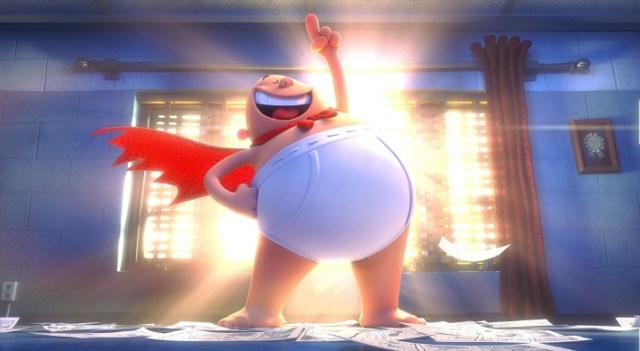
The film begins with the cheerfully crude animation opening sequence which shows the latest comic book character created by its two young heroes: George Beard (voiced by Kevin Hart) and Harold Hutchins (voiced by Thomas Middleditch). Whenever they can have a free time together, these two elementary school kids wield their boundless sense of humor and imagination through comic books they make together, and their latest story is about Captain Underpants, a superhero who wears nothing but a cape and, yes, underpants.

While they are not focusing on their comic books, Geroge and Harold usually plan small and big pranks to be committed at their school, and, not so surprisingly, they have been a constant source of annoyance to Mr. Krupp (voiced by Ed Helms), the mean-spirited principal of their school who has frequently made his students and teachers miserable. At one point, he announces an impromptu school event to be held on Saturday, and everyone is understandably depressed except Melvin Sneedly (voiced by Jordan Peele), a literally nerdy and humorless student who is willing to do anything for more score (Confession: he reminds me of my younger self…. a bit).

captainunderpantsthefirstepicmovie02

Anyway, our young heroes cannot resist the chance for another prank as nearly everyone becomes quite bored during that tedious school event, so they instantly go for that with considerable satisfaction, but, alas, Mr. Krupp has some surprise for them. He obtains an undeniable piece of evidence against them, and now he can do something he has wished to do for a long time.

Out of desperation, Harold and George attempt a rather absurd thing, and, to their surprise, it works a lot more than expected. Using his red toy ring, George somehow manages to hypnotize Mr. Krupp successfully, and that enables them to put him under their control. After a few trials, they decide to make him believe that he is Captain Underpants, and, to their delight, Mr. Krupp instantly talks and behaves like their beloved superhero.

Of course, the situation soon becomes messy and complicated for our young heroes as Mr. Krupp/Captain Underpants zealously bounces around here and there, and the film throws lots of gags and slapsticks into the plot as required. While it often feels a little too frantic, the movie keeps holding our attention with its brisk energy and nice comic timing, and that is exemplified well by a loony action sequence in which our young heroes busily try to save Mr. Krupp/Captain Underpants from many potential dangers to which he is incorrigibly oblivious.

And the story is actually sweet and sincere at times. Based on Dav Pilkey’s popular children’s book series of the same name, the screenplay by Nicholas Stoller understands well how important friendship is for young kids like George and Harold, and that aspect is humorously reflected by a hilarious scene showing their imagined future without friendship. While mainly functioning as an unwitting target for numerous moments of broad comedy, Mr. Krupp is depicted with some human quality nonetheless, and Captain Underpants comes to look more like his better side hidden behind his cranky appearance.

captainunderpantsthefirstepicmovie03

Meanwhile, there comes a villain later in the story. When he begins his first day at the school as a new science teacher, he presents himself as Professor P (voiced by Nick Kroll), but it turns out that there is a good reason why he does not reveal his real name to his students. I do not dare to reveal it here, but I can guarantee to you instead that you will get plenty of laughs when it is eventually revealed to everyone in the school.

Anyway, Professor P comes to concoct a diabolical plan for eradicating the origin of his longtime grudge, so the movie eventually serves us your typical climatic action sequence, but the film thankfully does not lose its sense of fun even at that point. While it does not exceed our expectation, we still get laughs as before, and we come to cheer for not only our young heroes but also their dimwitted superhero.

The voice cast of the film are solid in their respective roles. While Kevin Hart and Thomas Middleditch bring mischievous spirit to their respective characters, Ed Helms has lots of fun especially when his character rapidly switches back and forth between himself and his alter ego, and Nick Kroll virtually chews his every moment in his delightfully exaggerated voice performance, which is indubitably the best thing in the film.

“Captain Underpants: The First Epic Movie” is directed by David Soren, who previously directed “Turbo” (2013). He did a better job here in this film, and it is a shame that the film did not do well at the US Box office compared to “Cars 3” (2017) and “Despicable Me 3” (2017), which are, in my trivial opinion, less funny and exciting in comparison. To be frank with you, this is one of the funniest films of this year, and I hope there will be a sequel someday.

captainunderpantsthefirstepicmovie06

Posted in Movies | Tagged , , , | 1 Comment

Whose Streets? (2017) ☆☆☆1/2(3.5/4): A vivid, close look into the Ferguson uprising

whosestreets03

Documentary film “Whose Streets?” gives us a vivid, close look into the Ferguson uprising, and there are several raw, intense moments which will captivate you first and then linger on your mind for a long time. While it is definitely on the side of those protestors, it is undeniable that this thought-provoking documentary makes its sharp points on racism and other serious social issues in the American society, and it urgently reminds us that there should be real changes for many American people out there.

As many of you know, the uprising was sparked by the tragic death of an 18-year-old African American boy named Michael Brown Jr. On August 9th, 2014, Brown was shot by a 28-year-old white police officer named Darren Wilson shortly after the robbery in a convenient store happened in Brown’s neighborhood in Ferguson, Missouri, and the incompetently handling of this terrible incident by the Ferguson Police led to the shock and anger of many black resident in Brown’s neighborhood. For example, Brown’s body was left on the spot for several hours even after police officers arrived, and, as shown from several footage clips shot by smartphones, those police officers did not try much in calming the gathering crowd while only caring about covering up the shooting scene from the crowd.

This infuriating action of the Ferguson Police angered more black people in the city. That was soon followed by a big demonstration in which many black people willingly participated, and the Ferguson Police responded to this quite aggressively. Heavily armed police officers came along with armored cars and many other things they were willing to use against demonstrators who were not armed in contrast, and the violent chaos naturally ensued once they started to suppress demonstrators.

whosestreets02

Those violent moments during the demonstration were presented through not only the footage clips shot by Directors Sabbah Folayan and Damon Davis and their cinematographer Lucas Alvarado Farrara but also the ones shot by the smartphones and video cameras of a number of people who were right in the middle of the demonstration, and the result is often quite captivating despite the understandably rough quality of those footage clips. The sense of urgency and tension is palpable on the screen as the situation becomes more volatile, and we can really sense how precarious the circumstance was for everyone in the demonstration during that time.

As the demonstration continued for several days, it accordingly drew more attention from the media, and then the Governor of Missouri declared the state of emergency. The National Guards was brought into the city shortly after that, and, as reflected by several TV news footage clips, the American media was mostly interested in the violent side of the demonstration. As one interviewee in the documentary cynically points out, the American media focused more on those burned properties than a real problem represented by Brown’s death, and the Ferguson Police flatly evaded its responsibilities in the meantime.

While the first wave of the demonstration was eventually ended on August 25th, the second wave followed only three months later. Another African American boy was fatally shot on October 8th, and that certainly reminded many black people in Ferguson again of their grave social injustice. When the grand jury decided not to indict Wilson on November 24, 2014, they became quite angry again, and that was followed by another tense moment between them and the Ferguson Police.

It must be mentioned that the documentary wholly sticks to the demonstrators’ viewpoint from the beginning to the end. It does not provide any viewpoint from the other side, so it can be said that the documentary is biased from the very start, but I guess that is the whole point of the documentary. It intends to present the demonstrators’ narrative opposing to the one which was constantly emphasized by the Ferguson Police and the American media, and it did a pretty good job of vividly conveying to us how indignant the demonstrators were – and why they were so angry like that.

whosestreets06

Although it is a bit difficult to follow its free-flowing storytelling at first, the documentary gradually engages us via its emerging narrative structure, and some of the interviewees in the documentary become more prominent in front of our eyes. In case of David Whitt, he is a recruiter of civilian organization Cop Watch, and we get several intimate moments when the camera observes him spending some time with his children. Like many others, he wants a better word for his children, and we come to admire his passion and courage especially when he protests against the clearing of the memorial spot for Brown.

If I have to choose a standout among the bunch, that will be Brittany Farrell, a tireless activist who is also the mother of a young girl. While there is a sweet moment between her and her lesbian lover, there is also a fierce moment showing how she and others bravely protested in the middle of a highway, and she comes to us as a spirited woman who cannot be easily stopped. In fact, she later became a qualified nurse, and I sincerely hope that she will keep going on as usual.

Those social issues presented in “Whose Streets?” remain unresolved in the American society, and I am afraid the situation will get worse thanks to that racist scumbag currently residing in the White House, but the documentary tentatively suggests some hope in the end. Sure, there are still lots of difficulties on the road to more progress, but what was initiated in Ferguson has drawn the attention of many more people at least, and I really wish that things will get better in the end.

whosestreets05

Posted in Movies | Tagged , , , , | 1 Comment

Abacus: Small Enough to Jail (2016) ☆☆☆1/2(3.5/4): A small decent bank under crisis

abacussmallenoughtojail01

As watching documentary film “Abacus: Small Enough to Jail”, I could not help but roll my eyes at the absurd legal injustice shown in the documentary. Here is a small decent bank which has provided a considerable financial help to many people of its local community, and it is often infuriating to see how this bank was openly indicted for a minor fraud case which, as far as I could see from the documentary, was not the fault of a Chinese American family who has diligently run this bank for many years.

In the beginning, we meet Thomas Sung, the founder of the Abacus Federal Savings Bank. Born in Shanghai, 1935, he emigrated to New York City when he was young, and then he went to a law school to be a lawyer. After noticing that many of his fellow immigrant people in Chinatown could not get loans from American banks, he came to decide to establish a bank for his people, and his bank soon came to deal with numerous local customers in Chinatown. During one scene, Sung shows us a room full of safe deposit boxes, and we can sense that he is genuinely proud of being someone very trustworthy to many people out there in Chinatown.

When Sung and his wife watch Frank Capra’s “It’s a Wonderful Life” (1946), which is incidentally his favorite movie, there is a clear parallel between him and James Stewart’s decent hero in that classic film. Like Stewart’s character, Sung sincerely wanted to help people, and his wife later tells us about how much he was dedicated to his work. Although he had to make a long commute between the city and a suburban area outside the city every day, he kept going on nevertheless, and, as a result, he and his bank have been a pillar of his community for more than 30 years.

abacussmallenoughtojail03

We also meet Sung and his wife’s four daughters: Jill, Vera, Heather, and Chanterelle. Although not all of them joined the family business, they are good daughters any father would be proud of, and we often see Jill and Vera doing their work as two top executives of the bank. While Heather works as a physician, Chanterelle studied law and then worked in the NYC District Attorney’s office for several years, but then she came to leave her position after watching how her family’s bank was unjustly treated by the NYC District Attorney’s office in early 2015.

That legal trouble began when it turned out that there was a mortgage fraud committed by one of the loan officers working in the Abacus Federal Savings Bank. After discovering this fraud, the bank promptly took actions; the loan officer responsible for this financial crime was fired and then reported to authorities, and two other loan officers were also fired for similar fraud after the following internal investigation. Everything was thoroughly examined, and it seemed this would be a small criminal incident to be forgotten within several years.

However, the NYC District Attorney’s office thought differently. After the subprime mortgage crisis in 2008, the public opinion on banks was not so good at all as many big major banks including Goldman Sachs and Chase Bank evaded their responsibility for this huge financial crisis while impertinently getting the bailout money from the government just because they were ‘too big to fail’. Although it was virtually nothing compared to what was openly committed by those big rotten banks, what happened in the Abacus Federal Savings Bank was still something which could draw lots of publicity, so District Attorney Cyrus Vince Jr. immediately went after it, and, as shown from the TV news footage clips in the documentary, he certainly made a big show out of it.

abacussmallenoughtojail04

Although the documentary maintains a fairly objective attitude as giving Vince a chance to present his viewpoint on the case, it is undeniable that the Sung family and several people who worked in their bank were mistreated to a considerable degree. When the loan supervisor of the bank and other indicted employees were escorted by law enforcement officers, they were chained together as if they were dangerous felons, and they were even exposed to many cameras during that humiliating process.

While they were well aware of how hard and difficult it is fight against the government, Sung and his family decided that they should do as much as they could for protecting their longtime reputation. As the camera closely observes their family meetings where they seriously discuss about their trial, the documentary vividly captures the distinctive personalities of Sung and his family, and we come to admire more of their humble resilience and solidity. They are decent good people indeed, and they certainly do not deserve to be pushed into such a plight like that.

“Abacus: Small Enough to Jail” is directed by Steve James, who made a big breakthrough with his great documentary film “Hoop Dreams” (1994) and then directed several wonderful documentary films including “The Interrupters” (2011), and “Life Itself” (2014), which was a loving and entertaining tribute to my late friend/mentor Roger Ebert. Although its running time (90 minutes) feels rather short, the documentary succinctly makes its points well while never losing its human dimension, and I appreciate the authentic sense of people and locations in the documentary while also touched by those intimate moments shown from Sung and his family. In short, this is one of the best documentary films of this year in my inconsequential opinion, and I wholeheartedly recommend it to you.

abacussmallenoughtojail02

Posted in Movies | Tagged , , , | 2 Comments

The First Lap (2017) ☆☆☆1/2(3.5/4): Anxious uncertainty in their life

thefirstlap01

Subtly sensitive and somberly observant, South Korean film “The First Lap” looks into the anxious uncertainty of a young ordinary couple. Like any other young happy couples, they simply want to continue their life as usual, but then they become more aware of how uncertain and vulnerable their relationship is, and the movie gradually immerses us into the quiet emotional undercurrents around them.

In the beginning, we get to know a bit about Su-hyeon (Cho Hyun-chul) and Ji-young (Kim Sae-byeok). While Su-hyeok works at a private art institute, Ji-yeong is a contract employee in some network enterprise, but their respective careers do not seem to be going anywhere at present. Su-hyeok has considered applying for a graduate course, but, as shown from a later scene in the film, he does not know well what to do for that. While she may get promoted someday, Ji-young has been stuck in her current position for years, and maybe she should consider any other option for her career.

At least, they have been fine as living together for 7 years, but there comes a small unexpected thing. Ji-young tells Su-hyeon that her menstruation has been unusually late, and they naturally cannot help but wonder whether they can be more committed in their relationship than before. Maybe they should marry for solidifying their longtime relationship, but neither of them is particularly willing to move onto the next step of their relationship.

Meanwhile, they are invited to the new apartment of Ji-young’s affluent middle-class parents. The mood is initially cordial between them and Ji-young’s parents, but it soon becomes clear to us that her mother is not so happy to see that Ji-young has not married yet. When Ji-young’s mother expresses her dissatisfaction more blatantly during their dinner, Ji-young apparently feels hurt by that, and the mood becomes very awkward to everyone.

thefirstlap04.png

In contrast, Ji-young’s father respects whatever his daughter wants, and he has a frank conversation with Su-hyeon while they are outside the apartment. Ji-young and her mother also come to have a private moment between them, but Ji-young only finds herself more frustrated and exasperated, and that evening eventually ends as she and Su-hyeon leave earlier than expected.

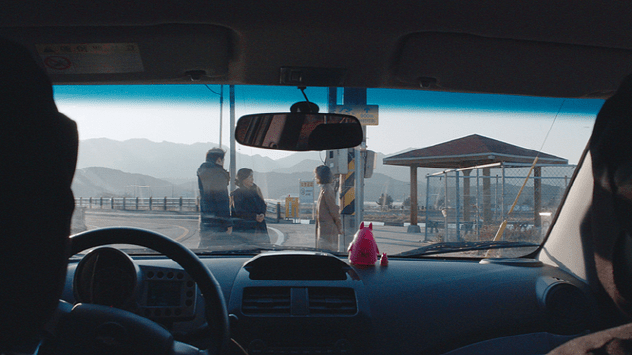
A few days later, Su-hyeon and Ji-young go to his hometown together for attending his father’s birthday party. Their drive to his hometown is mostly pleasant, but we soon see why Su-hyeon is reluctant to bring Ji-young to his hometown. While his family is less affluent than her family, his father is nothing but an alcoholic loser, and there is a brief scene where Su-hyeon glumly looks around his father’s messy residence.

At least, Su-hyeon’s long-suffering mother is nice to Ji-young as well as Su-hyeon, and we get a warm moment as she and Ji-young prepare for the birthday party together, but then there comes a point where she decides that enough is enough. The movie wisely sticks to its restrained mode even during that moment, and the result is one of the most effective moments in the film.

As they see how problematic their respective parents are, Su-hyeon and Ji-young become more anxious about their future. Will they able to continue to live together as usual? Will they able to accept those inevitable changes coming into their relationship in the future? At one point, they happen to have a small argument with each other, and that only makes them feel far more uncertain about where their relationship is going now.

thefirstlap03

Leisurely rolling its two main characters from one narrative point to another, the movie is brimming with considerable spontaneity thanks to the competent direction by director/writer Kim Dae-hwan, who previously made “End of Winter” (2014). Several key scenes in the film were actually improvised during the shooting, and one of these scenes was really shot in the middle of a big political event which was recently held in Seoul. Many of private scenes between Su-hyeon and Ji-young are always presented with genuine intimacy and tenderness, and we instantly accept them as two people who have been close to each other for years.

Never interrupting the overall low-key atmosphere of the movie, Kim Sae-byeok and Cho Hyun-chul constantly engage us via their unadorned natural performances. During one particular long take scene, not many things seem to happen on the surface as the camera calmly observes their characters from its static position, but they ably convey their characters’ emotional states even when we cannot see their faces, and this scene somehow becomes funny and poignant in the end.

While definitely demanding some patience from you due to its low-key tone and slow narrative pacing, “The First Lap” is a rewarding experience on the whole, and I admire its thoughtful handling of mood and characters. Nothing much is resolved between its two main characters even during the finale, but you will come to understand and emphasize with them as closely observing them, and you will also hope that things will soon get better for them. Everything is uncertain as before, but they are still young, aren’t they?

thefirstlap05

Posted in Movies | Tagged | 1 Comment

Murder on the Orient Express (2017) ☆☆1/2(2.5/4): Slick but passable

murderonorientexpress02

I remember well when I read Agatha Christie’s classic mystery novel “Murder on the Orient Express” for the first time. I was a 9-year-old boy who devoured many various mystery novels ranging from Sherlock Holmes to Philip Marlowe, and that novel quickly became one of my favorite mystery novels for its dexterous handling of mystery and atmosphere. Even though I remember many details of the novel quite well, I often read it again just for appreciating its mood and plot mechanism, and I also enjoyed the 1974 film adaptation version starring Albert Finney and the 2010 TV adaptation version starring David Suchet.

Naturally, I had some expectation on the new film adaptation of Christie’s novel when I heard about its production in last year, but I found myself observing it from the distance while never fully involved in its story and characters. Although nothing is particularly wrong in terms of technical details and I appreciated some new things in this version, the movie comes to lose its sense of fun during its second half, and the overall result is less entertaining than the 1974 film in comparison.

The story begins in Jerusalem, 1934. A serious case of theft recently happened, and there are three culprits: a priest, a rabbi, and an imam. As these culprits are brought to the Wailing Wall, there comes Hercules Poirot (Kenneth Branagh), who is, according to himself, the greatest detective in the world. Although his brilliant mind initially seems to be more occupied with having two exactly identical eggs boiled precisely for 4 minutes, he soon solves the case, and then he goes to Istanbul for having a vacation he really needs now.

murderonorientexpress03

However, right after he arrives in Istanbul, there comes an urgent message from London, and that means he must depart from the city as soon as possible. He quickly gets on the Orient Express along with an old friend who happens to be an executive of the train company, and the Orient Express soon begins its glamorous journey across the Europe continent with various passengers including Poirot.

As the train rapidly moves through wintry landscapes, we meet Poirot’s fellow passengers one by one. They are played by Penélope Cruz, Willem Dafoe, Judi Dench, Johnny Depp, Josh Gad, Derek Jacobi, Leslie Odom Jr., Michelle Pfeiffer, Daisy Ridley, and Olivia Colman, and it is not much of a spoiler to tell you that one of their characters is murdered during one night, not long after asking for protection from Poirot, who flatly declines the request because he does not feel right about it.

While the train is stopped due to an avalanche which happened around the time of the murder, Poirot is asked to handle the case. Although he is reluctant at first, he eventually agrees to do that, and he soon starts to interrogate the other passengers on the train one by one. Of course, every passenger on the train is a possible suspect, and he is ready to detect any particular thing from them during his interrogation.

As the adapted screenplay by Michael Green moves from one interrogation scene to another as required, Director/Lead actor Kenneth Branagh and his technical crew try as much as they can for constantly holding our attention. While Cinematographer Haris Zambarloukos’ camera provides a number of nice visual moments as fluidly moving here and there around inside and outside the train, the production design by Jim Clay and the costume by Alexandra Byrne are exemplary in their authentic period details, and the score by Patrick Doyle, who has been one of Branagh’s major collaborators, is also fabulous as accentuating some dramatic points in the film as demanded.

murderonorientexpress04

However, the movie did not engage me as much as I hoped, while failing to bring enough personality to its story and characters. Sure, the characters of Christie’s novel are more or less than cardboard characters mainly functioning as potential suspects, but they are enjoyable caricatures at least, and that aspect is preserved well in the 1974 film mainly thanks to Finney and its other stellar cast members including Lauren Bacall, Martin Balsam, Ingrid Bergman, Jacqueline Bisset, Jean-Pierre Cassel, Sean Connery, John Gielgud, Wendy Hiller, Anthony Perkins, Vanessa Redgrave, Rachel Roberts, Richard Widmark, and Michael York.

While the main cast members of the 2017 film are relatively less impressive, they also instantly draw our attention right from the start, and it is a shame that most of them do not have many things to do except filling their respective spots. While Cruz and Dafoe are particularly wasted in their mediocre roles, Jacobi, Gad, Colman, and Dench acquit themselves well, and Ridley and Odom Jr. feel flat compared to Connery and Redgrave in the 1974 film. In case of Depp, he suitably exudes unpleasant vibe during his scenes, and Pfeiffer is effortlessly flamboyant as the most colorful character among a bunch of possible suspects in the film.

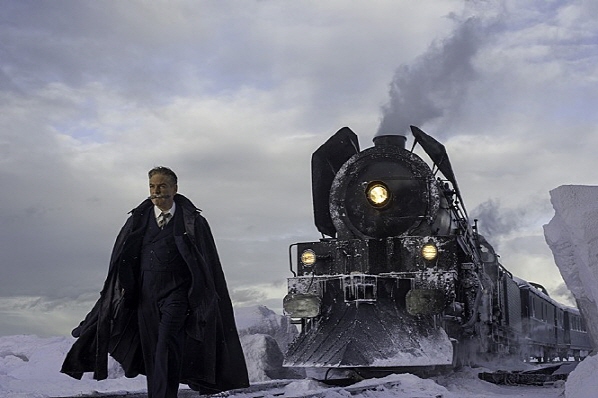
As the center of the movie, Branagh did his job a bit better than expected. With that big, distracting gray mustache on his face, he looks awkward at first, but he manages to hold the film together. Though he is less memorable compared to Finney or Suchet, Branagh mostly succeeds in conveying to us his character’s wit and intelligence, and he certainly relishes the moment when his character eventually explains the case in front of everyone during the expected finale.

“Murder on the Orient Express” is not entirely satisfying to me, but it is not wholly without entertainment. Sure, I found myself wanting to revisit the 1974 movie during my viewing, I had a mildly engaging time on the whole at least, and you will probably enjoy the movie more than me if you have not yet encountered Christie’s novel or its adaptations.

murderonorientexpress01

Posted in Movies | Tagged , , | 1 Comment