My Happy Family (2017) ☆☆☆1/2(3.5/4): When she walks away from her family

myhappyfamily01

Georgian film “My Happy Family”, which is currently available on Netflix, is a small unexpected surprise which amused and touched me a lot. On one level, it is an intimate female drama about a woman who tries to reach for her own life and identity, and there are a number of nice sensitive moments which let us emphasize more with her complex conundrum. On the other level, it is a thoughtful family drama which cares about not only its heroine but also other family members around her, and there are several humorous moments as its heroine finds herself continuing to get involved with her family members even while she tries to walk away from them.

The story begins with the opening scene which shows its heroine looking around a cheap apartment located somewhere in Tbilisi, the capital city of Georgia. Her name is Manana (Ia Shugliashvili), and we come to gather that this middle-aged female teacher has considered leaving her husband and family, but she is still wondering whether she can really do it or not. After all, she and her family have lived together in her family apartment for more than 20 years, and it is certainly not easy for her to leave behind what has been a big important part of her life.

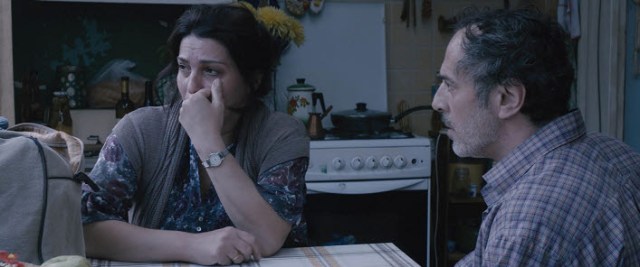
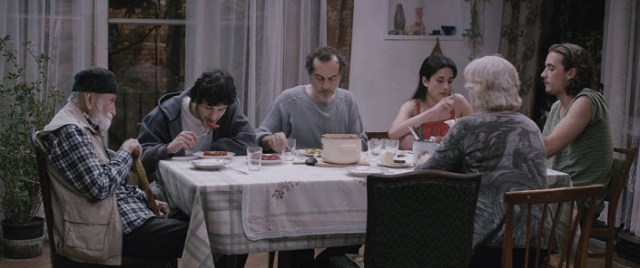
When she comes back to her family apartment, we understand more of her longtime frustration and exasperation. While her parents, her husband, her two children, and her son-in-law are going through their dynamic domestic life as usual, she is merely being around them except when they need her. Her mother always annoys Manana with her fastidiousness, her husband is not exactly cordial to Manana although he has been pretty much like a son to his parents-in-law, and Manna’s children still depend on their parents and grandparents even though they have already entered adulthood.
myhappyfamily02

And then two individual incidents happen. When her 52nd birthday comes, Manana says to her family that she does not want any particular celebration for her birthday, but, not so surprisingly, nobody listens to her, and their apartment is soon crowed with her family members and her husband’s several friends. As they drink and sing together, Manana feels more frustrated and isolated than before, and there are some cringe-inducing moments as we see how oblivious they are to Manana’s feelings.

On the next day, she goes to her school as usual, and she talks a bit with one of her students, who has frequently missed her class for a while. It turns out that this young girl recently got married but then eventually divorced, and, as talking with her, Manana comes to realize that she must make a quick, firm decision just like her student did.

We subsequently see the consequence of her decision. Her mother understandably becomes quite hysterical as a conservative woman who has never dreamed of leaving her family, and Manana also has to deal with several old relatives who try to persuade her to change her mind. In contrast, her husband is rather phlegmatic while respecting her decision, and so do her children, who, unlike many of their old relatives, think that their mother does not have to be bound by old family values.

Once she moves into that apartment, it looks like everything will be fine for her. She cleans the apartment, she brings some furnitures and other things into the apartment, and she finally gets a chance to enjoy free time in her own private space. As a piece of classic music is played in the background, she relishes a slice of cake while feeling more comfortable than before, though she is not so sure about what will be next for her.

myhappyfamily03

While she tries to settle in this changed status of hers, the movie rolls her story along a series of episodic moments, which respectively make her reflect more on her past, present, and future. At one point, Manana comes across an old schoolmate she has not met for years, and they later go together to the reunion party of their schoolmates. While she talks with her other schoolmates, an old hidden secret in the past is revealed to her by coincidence, and her quiet emotional turmoil is contrasted with the joyous mood surrounding her.

And, to our amusement, her family keep coming to her in one way or another. As she gets more involved in her children’s personal matters, Manana feels like being drawn back to her family, and she does not like that much, but she still feels obligation as a member of her family. In addition, her husband becomes a little more active than before when she comes to a family celebration later in the story, and that eventually leads to the funniest moment in the film.

Deftly balancing their movie between humor and drama, Directors Nana Ekvtimishvili and Simon Groß draw unadorned natural performances from their main cast members. As steadily and fluidly moving around the performers in the film, Cinematographer Tudor Vladimir Panduru’s handheld camera vividly captures the nuances and details in their performances, and we are constantly absorbed into their characters’ reality. While Ia Shugliashvili’s terrific acting functions as the emotional center of the movie, the other performers surrounding her are also solid in their respective roles, and Merab Ninidze is particularly good as a baffled guy who tries to understand what has been eating his wife.

Some of you may be dissatisfied with its deliberately open-ended ending, but “My Happy Family”, which was introduced in South Korea as “Manana’s Elopement”, is still a wonderful drama which transports us to a specific background and then engages us with its universal human elements, and it is definitely one of the most memorable movies of this year to me. I am glad that it is widely accessible at present, and I urge you to watch this superlative work as soon as possible.

myhappyfamily04

Posted in Movies | Tagged , , | 1 Comment

Radiance (2017) ☆☆1/2(2.5/4): Another gentle, meditative work from Naomi Kawase

radiance03

To be frank with you, Naomi Kawase’s works have been an acquired taste to me. Although I admired the serene atmosphere of “The Mourning Forest” (2007), I felt impatient at times during my viewing, and I doubt whether I will feel any urge to watch it. In case of “An” (2015), it is far more accessible in many aspects, but it was a little too sappy and sweet for me, and that impression did not change much even after I watched it again for checking whether my initial impression was wrong.

Her latest work “Radiance”, which received the Prize of the Ecumenical Jury at the Cannes Film Festival early in this year, is another quintessential work from Kawase, so I had some difficulty in processing the film during my viewing. It is surely as gentle and meditative as you can expect, and it has some nice intimate moments to remember, but I am not so sure about whether it works as well as intended. I surely appreciate its good intentions, but I constantly felt distant from its story and characters, and I accordingly became a bit cranky instead of being immersed into the movie.

At least, its story subject intrigued me to some degrees. Its heroine Misako (Ayame Misaki) works in a company which makes the audio transcripts of movies for the visually impaired, and the early scenes of the movie show us her admirable professional dedication. Her latest assignment is an arthouse movie directed by some aging director/actor (he is played by Tatsuya Fuji, who has been mainly known for his unforgettably disturbing performance in “In the Realm of the Senses” (1976)), and she wants to do her best for vividly conveying the visual elements of the movie to the visually impaired audiences. Even when she is not working, she practices her skill on streets, and you can see that she is quite good at transcribing whatever is on her sight.

radiance04

For checking whether her latest draft for the movie is as effective as required, she and her boss bring in a group of visually impaired people, and we see these people listening to Misako’s audio transcript and the movie together. Once the movie is over, all of them give some complimentary words to Misako while suggesting a few modifications, and it looks like her job is almost done.

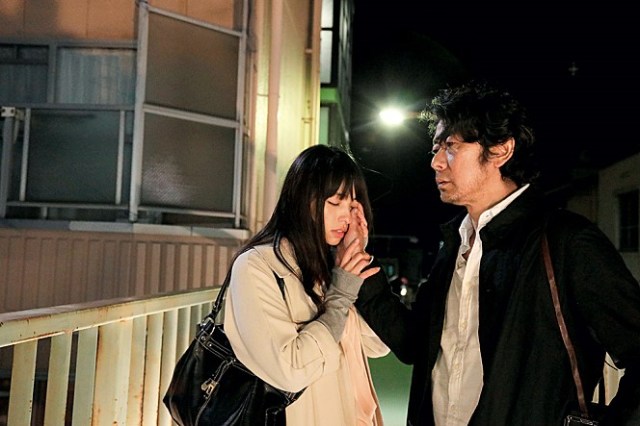
However, Misako comes across the objection from one guy in the next session. He is a middle-aged photographer named Nakamori (Masatoshi Nagase, who previously collaborated with Kawase in “An”), and he argues that she tries too much while not giving her blind audiences enough space for imagination. When he later argues more about that, Misako comes to lose her patience, and she coldly replies to him that he probably lacks imagination from the beginning.

Anyway, as getting to know him bit by bit after visiting his residence, she begins to see that he may have a good point in his argument. Nakamori was once a prominent photographer, but he has been losing his eyesight day by day, and he is well aware of that he will be completely blind someday. While he is now focusing on computer programming instead of photography, he still feels like shooting more photographs before his eyesight is gone forever, and he sometimes goes outside for photographing with his old camera.

As he and Misako come to spend more time together, certain feelings are gradually developed between them, but the movie thankfully does not push them into conventional plot although it is filled with sentimentalism like Kawase’s other works. Leisurely watching how they respectively struggle with each own matter, the movie serves us with several lovely visual moments including the one involved the bright evening sunlight on a mountain peak, and that moment later resonates with the most notable line in the film: “Nothing is more beautiful than what disappears before our eyes.”

radiance02

Nevertheless, I somehow came to care not much about the story and characters of the movie, and I kept noticing its notable flaws during my viewing. The sequence involved with Nakamori’s worsened state feels a little too contrived in my inconsequential opinion, and the same thing can be said about Misako’s supposedly profound epiphany moment around the ending. For emphasizing the themes of her story, Kawase frequently uses close-up, and that visual approach works in a number of key moments in the movie, but it also feels too stuffy and blatant from time to time.

The performers in the movie are competent in their low-key performances. While Masatoshi Nagase conveys well his character’s bitter desperation to us, Ayame Misaki imbues her character with genuine sincerity, and they are always convincing in their interaction on the screen. In case of the supporting performers in the film, they effectively fill their respective functional roles, and Kirin Kiki, who was the best thing in “An”, makes a nice indirect cameo appearance later in the story.

While it has several nice things to appreciate, I still cannot recommend “Radiance” mainly because I did not react to it well and decided to stick to that gut feeling of mine. Did I expect wrong things from this arthouse film? Was my mind fixed too much on what I thought it should be? Will my initial impression be changed if I watch it again with a more open-minded attitude? You may admire the movie more than me, but please remember that it will require a certain amount of patience.

radiance01

Posted in Movies | Tagged , , | Leave a comment

Romans 8:37 (2017) ☆☆☆(3/4): Inside a Christian community

romans83701

South Korean film “Romans 8:37” is something we do not encounter everyday: a thought-provoking Christian film which does not give us any easy answer in its gloomy tale of faith and disillusionment. As an agnostic atheist who grew up in a Buddhist family, I naturally observed its story and characters with a certain degree of skepticism and criticism, but some of you may have different opinions on them, and that is why the movie is worthwhile to watch in any case.

The movie starts with the burial of a dead guy who was a brother-in-law to its hero Gi-seop (Lee Hyun-ho), a young Christian man who has struggled to advance in his religious career. Compared to his father-in-law or his other brother-in-law Yo-seop (Seo Dong-gab), Gi-seop is far less prominent as merely being a missionary, and he has lived in a shabby home along with his hard-working wife and their cute little daughter. As shown from one brief scene, his wife sometimes feels exasperated as clashing with his idealistic viewpoint, but she understands him well as a fellow Christian who grew up with him, and we can sense how their religion plays a large part in their daily life.

Meanwhile, there has been a power struggle between the former pastor of his church and Yo-seop, who was recently appointed as the new pastor of the church but has not gotten along with well with his predecessor. Besides using his considerable social/political influence, Yo-seop’s predecessor also attempts some dirty tactics to tarnish Yo-seop’s reputation, and we get a series of darkly amusing scenes which show us how nasty people can be in the name of faith and self-interest.

As Yo-seop’s position is being threatened, Gi-seop comes to decide that he must help his brother-in-law as much as he can, and this actually looks like a smart decision for him. After all, Yo-seop has been regarded as a rising new star in his Christian community, and everyone knows well that Yo-seop’s predecessor is your average corrupt pastor. If Gi-seop and his colleagues can try harder and endure longer, they and Yo-seop may eventually win in this unpleasant ongoing struggle, and that may help Gi-seop’s career in the future.

romans83703

While fending off those dirty tactics from Yo-seop’s predecessor, Gi-seop and his colleagues try to secure more deacons on their side, and they also attempt to make a sort of deal with Yo-seop’s predecessor. When Yo-seop is later thrown into an internal investigation just because of ‘heretical’ words used during one of his sermons, the situation is utterly serious for Yo-seop and everyone around him; in the worst situation, it will lead to the end of Yo-seop’s career, and that will invariably affect the life and career of people working for him.

And then there comes an unexpected possibility of scandal. When Gi-seop and his colleagues come to learn that there will be a TV news report on a sexual violation committed by Yo-seop, they are understandably skeptical at first, but then Gi-seop listens to a tape recording given to him by a TV news producer. It seems quite possible that the man he has respected for years really did horrible things to a number of young women as suspected, and Gi-seop finds himself shaken by shock and confusion. As a matter of fact, he knows the alleged victims well, and that certainly makes him feel quite bad.

The rest of the story focuses on how this potential scandal is handled by the church, and you will not be surprised at all if you are familiar with those shocking recent news reports on how sex crimes were covered up in religious communities. As he becomes more determined to expose Yo-seop’s felony in public, Gi-seop soon comes across the opposition from his elders, and there are not many people on his side. When a bunch of church elders gather together during one certain scene, their group presence is palpably felt on the screen, and we accordingly come to discern how their system will inexorably work for themselves.

romans83705

While surely critical of its religious subject, the movie still respects the faith of Gi-seop and other few good characters in the story. In case of one scruffy pastor who gives sermons to his congregation at his small residence, he is a jaded realist compared to Gi-seop, but he is also a compassionate guy, and I actually enjoyed his down-to-earth sermons to his congregation. In case of Gi-seop’s venerable father-in-law, he turns out to have his own fault in his life, but he has sincerely tried his best for repentance, and that aspect of his is contrasted with the hypocrisy of Yo-seop, who admits his sin but then impertinently justifies his rehabilitation.

Director/writer Shin Yeon-shick, who previously made “Fair Love” (2009), “The Russian Novel” (2012), “Rough Play” (2013), “The Avian Kind” (2014), and “Like a French Film” (2015), draws good realistic performances from his cast. While Lee Hyun-ho is effective as the moral center of the movie, Seo Dong-gab has a couple of intense scenes which reveal his character’s more despicable side, and the supporting performers surrounding them are also solid in their respective roles.

Although “Romans 8:37” is sometimes limited by its hero’s narrow viewpoint (I wish it put more focus on the victim characters, for example), it gives us a vivid, realistic look into his small world at least, and I observed that with curiosity while admiring its realistic storytelling approach. I believe its target audiences will appreciate its details more than me, but this is still an interesting work accessible to any audience, and I think you should give it a chance.

romans83702

Posted in Movies | Tagged , , , | 2 Comments

On Body and Soul (2017) ☆☆☆(3/4): An unusual romance tale from Hungary

onbodyandsoul01

While it is your average workplace romance tale, Hungarian film “On Body and Soul” draws our attention through its unusual setting at first. Here are two different people who happen to be connected with each other via a rather preposterous situation, and the movie calmly and sensitively depicts the gradual development of their relationship. While we are amused by their situation at times, we also get to know more about them as they try to get closer to each other, and then we are touched as their story arrives at its expected arrival point.

After the dreamy opening scene showing a stag and a doe in a winter forest, the movie begins its story with Endre (Géza Morcsányi), a middle-aged man who works in a slaughterhouse as its financial director. As a guy who had lots of affairs in the past but eventually became tired of that, he has merely gone through his daily life without any particular excitement and happiness, and his solitary lifestyle is amusingly contrasted with the married life of his close colleague. He frequently grumbles about his marriage in front of Endre, but he cannot possibly say no to his wife, who also works in the same slaughterhouse.

As Endre and others in the slaughterhouse do their jobs as usual, the movie pays considerable attention to the work process inside the slaughterhouse. During one scene, we see an ox promptly (and painlessly) killed once it is settled inside a slaughter machine, and then we observe how its carcass is subsequently processed by several workers. This is indeed a bloody process, and you may be disturbed to see this, but you may also be reminded of how necessary this process is for human population out there.

onbodyandsoul02

The meat obtained from those slaughtered oxen is evaluated by Mária (Alexandra Borbély), the new quality examiner of the slaughterhouse. While quite precise and efficient in her work, this young pretty woman does not get along well with others mainly due to her autistic behaviors, and the first encounter between her and Endre is pretty awkward to say the least. He tries to be nice to her, but she is unintentionally blunt and frigid in her distant attitude, and their conversation is soon over as she moves to other spot for having a lunch alone. To be frank with you, this reminds me a lot of how clumsy I am in interacting with others as a guy diagnosed to be in autistic spectrum; like her, I always look strained whenever I have to communicate with others, and I usually have no problem with working alone for hours.

Meanwhile, the movie keeps showing that stag and doe shown in the opening scene, and we come to see the reason for that when Endre hires a psychiatrist for the psychological evaluation of everyone in the slaughterhouse after a certain incident. During his interview, he tells the psychiatrist several private things including his recent dream, which features, of course, that stag and doe in question. Not long after that, Mária tells the psychiatrist that she recently dreamed of the same thing, and that certainly catches off guard not only the psychiatrist but also Endre and Mária.

While perplexed by this strange coincidence, Endre and Mária find themselves becoming closer to each other day by day. As continuing to share the same dream, they naturally wonder whether it really means something to them. Although he is much older than her, Endre is intrigued by a new possibility of romance he never imagined before, and he wants to go further in their relationship if she consents to that.

onbodyandsoul03

However, though she is also interested in getting closer to him, Mária is not so sure about whether she can do that. While she is often averse to being touched, she does not know how to present herself to him more amiably and romantically, and we get several humorous moments as she tries her best for that. While often analyzing what is going on between her and Endre, she frequently visits her psychiatrist for getting more counsel, and she later gets a nice advice from an old female janitor in the slaughterhouse.

While we get some good chuckles from her clumsy emotional journey, the movie also makes us care about that, and director/writer Ildikó Enyedi, who won the Golden Camera award at the Cannes Film Festival for “My Twentieth Century” (1989) but has been rather silent for more than 15 years since her previous film “Simon, the Magician” (1999), imbues her film with quiet sensitivity and deep empathy. Under her gentle, thoughtful direction, her two lead performers give unadorned nuanced performances, and I especially like how their characters’ contrasting personalities are presented via the notable details of their respective apartments. While Mária’s apartment mostly looks slick and barren with its clinical atmosphere, Endre’s apartment relatively looks more intimate and fuller in comparison, and that contrast is further emphasized by the respective locations of their apartments.

“On Body and Soul” received the Golden Beat award at the Berlin International Film Festival besides the FIPRESCI Prize and the Prize of the Ecumenical Jury, and it was also recently selected as the Hungarian entry for the Best Foreign Language Film at the 2018 Academy Awards. Although it falters a bit around the finale, the movie keeps holding our interest through its two engaging main characters, and I enjoyed their gentle human drama as appreciating its good mood and performances. This is essentially a typical love story, but it is done well with care and intelligence, and I like that.

onbodyandsoul05

Posted in Movies | Tagged , , , | 2 Comments

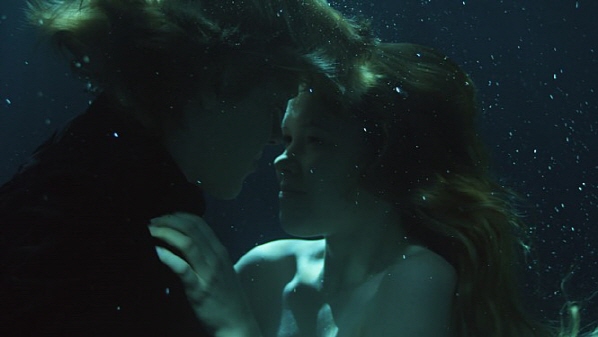
The Lure (2015) ☆☆1/2(2.5/4): A Polish musical film with two man-eating mermaids

thelure02.jpg

Deliberately weird and whimsical, Polish musical movie “The Lure” is destined to be a cult film. While it provides several lively musical sequences to delight you, it is also a dark horror melodrama about two beautiful but lethal mermaids, and there are a number of unpleasant moments which will definitely make you cringe for good reasons. Although it unfortunately loses its narrative momentum during its incoherent second half, it surely leaves considerable impression on you with its distinctive style and excellent soundtrack, and I sort of admired its quirky genre experiment even though I came to observe it from the distance.

After the main title presented via sketchy animation style, the movie introduces us to its two mermaid heroines: Silver (Marta Mazurek) and Golden (Michalina Olszańska). When a female nightclub singer, played by Kinga Preis, and her two male band players, are having a drinking time near the river in Warsaw, Silver and Golden approach to them from the river while singing the first song of the movie, and the guys are certainly transfixed by the mermaids’ seductive singing even though there is also a certain degree of danger behind their alluring sensuality.

Not long after this accidental encounter, Silver and Golden are taken to a posh nightclub where the singer and her band players work. It is around the 1980s, so the singer and her band players perform a song which further accentuates the period background of the movie, and Cinematographer Jakub Kijowski’s camera fluidly moves around here and there along with the house manger as he tries to trace something literally fishy in the nightclub.

thelure03

He eventually comes upon Silver and Golden, and they willingly show him their true appearance. As long as they remain dry, they just look like two young beautiful girls, but their seemingly human appearance has a certain anatomical defect, and they are transformed back to their true appearance whenever they are watered. Surprisingly, the house manager is not so shocked by this, and Silver and Golden instantly get hired for showing themselves as well as their singing talent.

As our mermaid heroines are excited by their encounter with the human world, we are served with a fabulous musical sequence involved with their shopping spree in Warsaw. I must say that a department store in Warsaw during the 1980s does not look as good as Macy’s, but it looks lovely at least as extras are cheerfully dancing around the main performers, and the bouncy spirit of this sequence is as infectious as “La La Land” (2016).

Right from their first performance in the nightclub, Golden and Silver quickly become popular. They are initially the accompanying performers for the singer, but it does not take much time for them to take the main stage instead of the singer, who is certainly not so pleased about this change but accepts it anyway. Like Preis, Mazurek and Olszańska perform the songs in the film for themselves, and I enjoyed how these three actresses’ solid singing performances ably carry several key musical scenes of the movie.

In the meantime, we come to see the hidden nature of our mermaid heroines. While Silver wants to repress their nature mainly because she becomes infatuated with the singer’s bass player, Golden has a different thought. At one point, she seduces a guy and then goes to a spot near the river along with him. What happens next is not very pleasant to say the least, and we later get a wry musical scene involved with a tough female cop who knows what Golden did but cannot help but be attracted to her.

thelure01

While the first half of the movie constantly amuses us with many bizarre moments like that, the second half frequently suffers from clunky narrative and thin characterization. Although it continues to provide good musical scenes, we can clearly sense that the movie is spinning its wheels during this part, and that only makes us more aware of how contrived its plot is – and how thin its main characters are. The movie later attempts some melodrama as evoking that famous fairy tale by Hans Christian Andersen, but its characters do not have enough depth to support that, and it eventually comes to trudge down to its expected finale without much dramatic effect. As a matter of fact, I was so bored by its lagging plot progress that I wanted to shout like this during my viewing: “Okay, It’s over! Bite! Please!”

Despite my considerable dissatisfaction, I still appreciate its good elements including its commendable soundtrack, which I checked right after watching the movie. Hopping from one musical style to another, the soundtrack is pretty entertaining although most of its songs are performed in Polish, and I am actually listening to it right now as writing this review. Director Agnieszka Smoczynska, who received the Special Jury Prize at the Sundance Film Festival early in last year, did a competent job in technical aspects, and the overall result is a flawed but curious exercise in style and music.

In my mind, “The Lure” is compared to Brian De Palma’s “Phantom of the Paradise” (1974), a deranged horror musical film which goes as wild as it can with its many insanely outrageous moments. I wish “The Lure” were as crazy as that movie, but it ultimately falters and fizzles to my disappointment, so I give it only 2.5 stars although I enjoyed its good parts. Now I am listening to its soundtrack again, but I doubt whether I will soon watch the film again.

thelure05.jpg

Posted in Movies | Tagged , , , | Leave a comment

Dancesport Girls (2017) ☆☆☆(3/4): Dancing high school girls and their good teacher

dancesportsgirls04.jpg

South Korean documentary film “Dancesport Girls” is filled with genuine positive spirit. Here are a bunch of high school girls who simply enjoy themselves as preparing for their big moment to come, and it is really fun to watch them doing their best under their good teacher’s guidance. Although the reality outside their school is not that bright, they feel free and happy as they dance together, and we gladly go along with that as appreciating their warm, youthful energy on the screen.

The main background of the documentary is Geoje, an industrial city which has depended on its shipyard business for many years but is recently going through a depression. The documentary does not go into details much on that, but it occasionally looks at the big shipyards of the city instead, which look quiet and empty with no particular sign of activities.

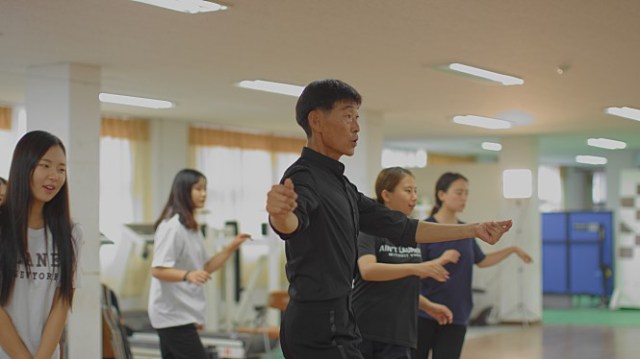
In Geoje Girls Commercial High School, we meet a group of girls who practice dancesport after their school time. While they do not have much interest in school lesson (some of them even let themselves asleep during that time, by the way), they are all enthusiastic about this extracurricular time of theirs, and we soon see them dancing together in their practice place.

We also meet their teacher Lee Gyoo-ho, who has done a lot more than merely teaching them dancesport. Besides supervising the girls’ practice sessions, he always makes sure that they have a good time together, and I noticed how he casually interacts with his students without any forced authority. Sometimes he looks like a close friend to them, and their comfortable relationship is exemplified well by one cheerful scene in which they have a meal together.

dancesportsgirls02

Meanwhile, they have to be a little more serious than usual because, as shown in the beginning of the documentary, there will soon be a sportdance competition for high school students. They all want to do their best for what may be the highlight of their last year in the school, so they come to practice more than before, and we are accordingly served with several nice practice scenes. As music is played in the background, they try to dance together as well as they can, and, as far as I could see, they dance better than a bunch of girls I once encountered during my gym time.

The documentary also gives glimpses of their life outside the school, and some of these girls become a little more prominent to us than others. In case of a girl named Hyeon-bin, she works as a part-time employee during evening, and we see her practicing some dance moves a bit whenever she has a little free time. While Si-yeong will have to live alone for a while because her father must go to Seoul for a better business chance, Eun-jeong has to take care of her young siblings for herself, and Ji-hyeon has to prepare for her job application, which many of her schoolmates will do sooner or later.

In case of their teacher, the documentary shows him spending his free time with his adolescent daughter in their small apartment (his wife is never shown in the documentary, by the way), and we can clearly sense their close relationship during their conversation scene. When he later has a lunch with his fellow teacher, he tells his colleague that he does not expect any particular reward for what he has done for his students for years, and we come to admire more of his humble decency and dedication.

As the competition day is approaching, there come some problems and conflicts among the girls. Yes, there is a serious moment when the teacher must remind them that they must be more focused, but he never raises his voice, and everyone agrees to his words. When it is apparent that one of his students is having a drinking problem, he does not admonish her at all, and he lets her talk about why she sometimes drinks at night. When she is still suffering from hangover later, he gives her a practical solution without any hesitation, and that is the most amusing moment in the documentary.

dancesportsgirls03

Eventually, they go to the competition while being fully prepared, and the documentary entertains us with a series of good dance performance scenes shot during the competition. Sticking to its leisurely narrative pace, it wisely avoids cheap suspense, and then we come to get a modest but sweet finale which makes us reflect on what we observed from the girls and their teacher.

The documentary was originally made for a TV documentary series of Korean Broadcasting System (KBS). When director Lee Seung-moon came to Geo-je, he intended to focus on the declining shipyard business of the city, but then he found a more interesting subject from Lee Gyoo-ho and his students, so he came to change his initial plan. After broadcast in 2017 April, the documentary was re-edited for the theatrical release in 2017 September, and my review is based on the theatrical version, which is, as far as I heard from others, a bit different from the TV version in several aspects (the TV version is accompanied with a narration, for example).

While it could have shown more about its engaging human subjects, “Dancesports Girl” is still a satisfying documentary on the whole, and it gives me some feel-good moments to remember. I don’t know what lies ahead of these spirited girls, but I really hope that they will keep moving on as remembering their joyous moments.

dancesportsgirls01

Posted in Movies | Tagged , , , | 1 Comment

A Quiet Passion (2016) ☆☆☆1/2(3.5/4): The life and poetry of Emily Dickinson

aquietpassion05

While she is now regarded as one of the great American poets during the 19th century, Emily Dickinson (1830-1886) did not get much recognition during her lifetime. Although she wrote nearly 1,800 poems, only a few of them were published while she was alive, and most of those published poems were significantly altered by her publishers just because her style did not fit to the conventional poetic rules during that period. She kept leading her reclusive lifestyle in the meantime, and her brilliance is recognized only after her sister found a cache of poems she kept to herself for many years.

Some of you may think that Dickinson’s life is a depressing subject to watch, but “A Quiet Passion” presents her story with not only good mood but also considerable wit and spirit. While it is as somber as you can expect from the movie about a reclusive real-life heroine, it never overlooks that quiet but palpable spiritual/artistic passion inside her, and the result is a vivid, splendid drama which shows us some interesting things about her life and poetry.

The opening scene of the movie, which is set in Mount Holyoke Female Seminary, Massachusetts, effectively establishes the tone for its story and heroine. The schoolmistress demands her students to choose between two groups according to how strong their religious faith is, but young Dickinson, who is played well by Emma Bell at this point, defiantly refuses to make a choice because she believes she does not belong to any of two groups. That behavior of hers certainly displeases the schoolmistress, and we are not so surprised when her family later comes to the school for taking her back to their home in Amherst, Massachusetts.

aquietpassion01

Dickinson’s family is relatively liberal in the standards of their time. Her parents allow their children to have their own independent mind, and that aspect is amusingly reflected by a deadpan scene where they have to spend some time with a very religious relative who does not regard highly of the outspoken attitude of Dickinson and her two siblings. While sticking to courteous manners, Dickinson and her siblings have a wry fun with indirectly expressing their moral opinions, and that may remind you of those witty parlor conversations from Jane Austen’s novels, which were published not long before Dickinson’s birth.

Because they are still young, the passage of time feels trivial to Dickinson and her siblings, but time quickly passes as it always has, as shown from one beautifully melancholic montage scene. One by one, Dickinson and her family members stand in front of a camera, and we see each of them gradually changed as they get older.

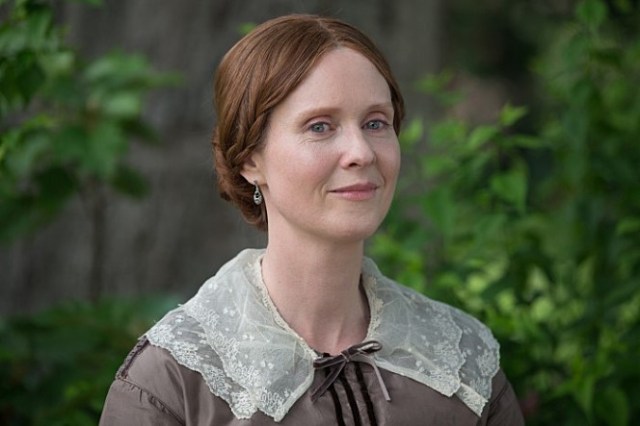
Although she now looks less lively and gaunter than before, Dickinson, who is now played by Cynthia Nixon, still retains her spirit, and so does her sister Vinnie (Jennifer Ehle). While they still live in their family house without any particular possibility of marriage, they always find something to amuse and excite them, and they surely welcome Vryling Wilder Buffum (Catherine Bailey), a smart, forthright woman who instantly clicks well with them during their first meeting.

Meanwhile, Dickinson continues to write poems as usual. After getting a permission from her father, she has her own private time for writing poetry during early morning, and she already published several poems although she did not get any recognition for that (her first published poem was anonymously introduced, for instance). When she shows some of her poems to a handsome married minister she happens to be infatuated with, she cannot help but look like an anxious suitor, and she surely becomes happy when he shows considerable admiration toward her poetry.

aquietpassion04

While she looks like a free spirit at times, Dickinson continues to stick to her insular domestic life along with her sister, and her life in the family house is sometimes not very happy. She clashes with her family members from time to time, she begins to suffer from a chronic illness, and she becomes more reclusive than before.

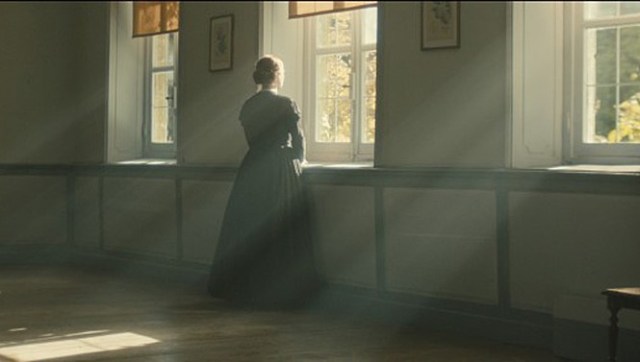
Some of her notable poems are quoted throughout the film, and director/writer Terrence Davis, who previously impressed me a lot with “Of Time and the City” (2008) and “The Deep Blue Sea” (2011), did a commendable job of contextualizing them into drama and images. While the movie was shot in Belgium, its period atmosphere is quite authentic, and Cinematographer Florian Hoffmeister provides a number of beautiful moments including a striking scene involved with Dickinson’s imaginary object of desire, which she may desperately yearn for but cannot embrace easily.

And Cynthia Nixon gives a superlative performance to remember. I came to notice her only after “Sex and the City” (2008) and its awful 2010 sequel, but then her heartbreaking performance in “James White” (2015) showed me more of her talent, and her acting here in this movie is certainly one of the best ones I saw during this year. Nixon is also surrounded by a number of good performers including Keith Carradine, Jodhi May, Catherine Bailey, and Jennifer Ehle, and Ehle deserves praises for being an equal acting match for Nixon in their several scenes.

As I told you before, I cannot understand poetry well, but I can appreciate good films about poetry at least, and I found that “A Quiet Passion” is an admirable movie packed with fabulous elements including Nixon’s performance. While it is indeed one of those ‘slow’ movies, it is not your typical stuffy period drama at all, and I sincerely recommend you to give it a chance.

aquietpassion02

Posted in Movies | Tagged , , , | 2 Comments

The Sweet Hereafter (1997) ☆☆☆1/2(3.5/4): A cold but harrowing tale of loss and grief

thesweethereafter06

There is one haunting monologue scene in Atom Egoyan’s “The Sweet Hereafter”, one of the saddest films I have ever seen. One of its main characters recollects one eventful summer day he experienced a long time ago, and he vividly describes when he was on the verge of executing an emergency incision on his young baby daughter’s neck after she was bitten by some poisonous bug. While preparing himself for the worst situation, he did everything a good father can do under such a circumstance like that. Fortunately, he did not have to cut his daughter’s throat, but he only found himself losing his daughter after she grew up later. Every word coming out of his mouth is tinged with sad, bitter resignation, and he is still trying to make sense of the most painful part of his life.

He is a middle-aged urban lawyer named Mitchell Stephens (Ian Holm), and his first scene in the movie shows him having a phone conversation with his daughter, who has been drifted away from him for many years as mired in drug addiction. Maybe she simply wants to have a sincere talk with her father this time, but he sticks to his detachment as dreading the worst (“I don’t know who I’m talking to right now.”), and that leads to another hurtful moment between them.

Stephens has just come to a small rural town which has been devastated by a recent terrible accident. In one cold, snowy winter morning, a school bus carrying a bunch of local kids crashed into a frozen lake after skidding on an icy road, and 14 children were killed as a consequence. As many of these unfortunate kids’ parents cope with resulting anger and grief, their urge to blame whoever is responsible for the accident grows stronger, and Stephens is going to persuade some of these parents to file a class action lawsuit for damages.

thesweethereafter03

While he meets his potential clients one by one, he is presented as someone who cannot be merely defined as a righteous crusader or an opportunistic ambulance chaser. As a guy who virtually lost his child, he deeply sympathizes with his potential clients, and he wholeheartedly believes that they must get any sort of financial compensation, but he is also driven by cool professionalism. This complex human side of his is exemplified well by the scene where he succeeds in persuading a grieving couple to hire him. After patiently listening to them, he uses every bit of his sincerity and resolution for convincing them of the moral necessity of the lawsuit, but he cannot help but a little excited as he later goes outside to get a document to be signed by them.

In the meantime, the movie frequently flashes backward and forward among its three different time points. While the ‘present’ part shows Stephens’ steady work process step by step, the ‘past’ part presents the town and its people before the accident, and the ‘future’ part revolves around Stephens’ accidental encounter his daughter’s childhood friend on an airplane, which, as clearly shown in the beginning, happens around 2 years after the accident.

This non-linear narrative initially seems artificial, but, like many of Agoyan’s notable works including “Exotica” (1995), the movie, which is based on the novel of the same name by Russell Banks, works as fluidly flowing along its own emotional narrative with precise dramatic effects. For instance, observe how Stephens’ estranged relationship with his daughter is juxtaposed with another father and daughter relationship in the film – and how these two contrasting but equally problematic relationships resonate with each other as we get to know more about them later.

thesweethereafter04

Above all, we see more of how sad and devastating the accident was for many people in the town. In case of one of those dead kids, he was apparently loved by his parents as well as many others in the town, and the school bus driver, who luckily survived along with some of the kids on the school bus, laments on his bright potential which is distinguished forever now. With many of its kids gone, the town has virtually lost its hope and future, and the wintry mountainous landscapes surrounding the town further accentuate the stark sense of gloom and isolation around the screen.

That overwhelming sadness hovering over the town and its people is powerfully amplified during the accident scene, which is the most emotionally shattering moment in the film. As the camera calmly watches the bus and its young passengers who have no idea on what is soon going to happen, Mychael Danna’s score, which often feels like medieval funeral march music, prepares us for their imminent tragedy. When the accident eventually happens, the movie only shows its shocking outcome from the distance, but the result is a sheer emotional gut punch which still shakes me hard as much as when I watched the movie for the first time during one hot summer evening of 2007.

Meanwhile, the movie gradually reveals secrets and lies behind its town characters. During one early scene in the film, Stephens talks with a couple running a motel where he stays, and he asks them about anyone decent and respectable enough to be a plaintiff to be represented by him. Whenever the wife suggests someone, the husband scoffs at her as a guy who does not have anything good to say about his neighbors, and it later turns out that this couple is not a very ideal plaintiff either.

thesweethereafter02

While many town people are deluding themselves with the false hope and expectation from not only Stephens’ lawsuit but also other possible lawsuits in the future, there are two people who do not welcome this much as discerning the situation more clearly than others. One is Billy Ansel (Bruce Greenwood), who is the owner of a local gas station/garage and lost his two kids in the accident. As a guy who lost his wife a few years ago, he knows too well that there is no other way for him and others besides accepting pain and grief and then living with them for the rest of life, so he has nothing but anger and contempt toward Stephens when they happen to encounter each other.

The other one is Nicole Burnell (Sarah Polley), a serene teenage girl who is one of several kids who survived the accident. She was lucky indeed, but now she cannot walk anymore due to her spinal injury, and we sense that she is not so pleased to see that her parents care more about whatever they can get from the lawsuit than her current devastated state. During one flashback scene, she reads Robert Browing’s poem “The Pied Piper of Hamelin” to two kids babysat by her, and there is an unmistakable parallel between her that sad crippled boy in the Piped Piper story, which can also be juxtaposed with Stephens’ attempt to lead his potential clients toward the lawsuit.

Later in the story, she has to give a testimony which will determine the validity of lawsuit, and she does something which is pretty much like a sobering slap to everyone involved with the lawsuit. How did she come to her decision? And what exactly was her motivation? Even while accompanied with her calm narration, she does not give us any easy answer as maintaining her phlegmatic façade as usual, and neither does the movie.

thesweethereafter01

Although the movie feels distant at times due to Egoyan’s cerebral storytelling approach, its human characters are depicted with understanding and compassion nonetheless, and his cast members bring considerable humanity to their respective roles. As the gray moral center of the movie, Ian Holm’s masterfully understated performance is utterly captivating to say the least, and he is particularly superb during the aforementioned monologue scene. Almost everything in that scene depends on his subtle suggestion of whatever is churning behind his character’s weary face, and we cannot help but pay attention to that just like the other character listening to him during that scene.

The performers surrounding Holm also leave lots of impression with their nuanced performances. While notable performers like Sarah Polley, Bruce Greenwood, Maury Chaykin, and Arsinée Khanjian (she is Egoyan’s wife, by the way) may draw more of your attention first, they and other supporting performers in the film are uniformly excellent in their ensemble performance while having each own moment, and Polley, who has focused more on filmmaking than acting during recent years, performs two nice songs for the movie.

Although it is often very tough to watch, “The Sweet Hereafter” is superlative in its uncompromising but undeniably compassionate depiction of a bleak human condition. While coldly recognizing the devastating aspects of human loss, it ultimately comes to us as a sensitive and humane lament to muse on, and I was especially touched by the gentle tenderness of its closing scenes. Their scars will never be gone, but they can be healed, can’t they?

thesweethereafter05

Posted in Movies | Tagged , , | Leave a comment

Mudbound (2017) ☆☆☆1/2(3.5/4): A tale of two families in Mississippi

mudbound04.jpg

Filled with so much of the sense of life and location, “Mudbound”, which is currently available on Netflix while getting a limited theatrical release in US, makes a vivid, powerful impression on us. Right from its very first scene, it transports us into its specific period background, and then it engages us via a bunch of distinctive characters, and then it moves us through their achingly human melodrama about love, hate, and resilience. Besides working well as a classic Southern family melodrama, it feels timeless in its contemporary perspective on race, gender, and history, and it goes without saying that the current situation of the American society makes the movie all the more relevant.

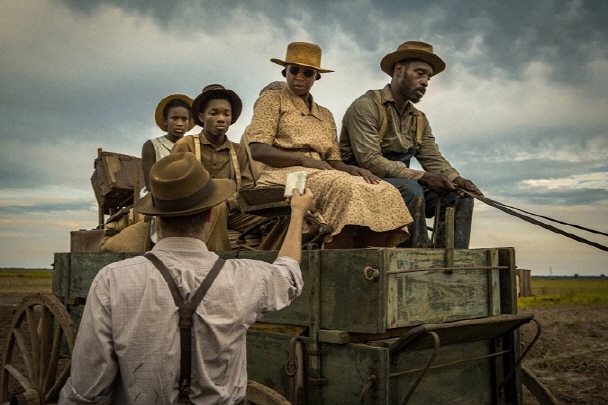
The story revolves around two different families living in a rural area of Mississippi around the 1940s: the McAllans and the Jacksons. The McAllans move to that area after Henry (Jason Clarke), the head of the family, buys land and a house for his lifelong dream of owning a farm, but it soon turns out that he made a very big mistake. He belatedly realizes that he is swindled by the previous owner of the house, so he and his family have no choice but to live in a shabby house located in his purchased land instead, which, not so surprisingly, does not look good at all with its muddy ground.

While Henry’s cantankerous racist father Pappy (Jonathan Banks) openly mocks him for that, his wife Laura (Carey Mulligan) stands by him although she is not very pleased about how her husband unwisely puts her and their two children into poverty and misery. When she met him several years ago, she did not love him much, but his proposal gave her a chance to get out of her dull life as an unmarried woman in her family, so she grasped it without hesitation. She has willingly accepted her role in his life, but that does not mean she always obeys to him, and that is exemplified well by when she adamantly sticks to her position during their argument involved with her piano.

mudbound03

The Jacksons are a black family living and working in Henry’s land. Hap (Rob Morgan) and his wife Florence (Mary J. Blige) have worked hard for many years, and they hope for a better future for them and their children, but, as Hap wearily muses in his narration, that always feels like a distant dream as he and his family struggle to make ends meet every year. While Henry seems to be nice and kind to them as their new employer, the nature of their racial relationship is evident whenever Henry demands something from Hap and Hap’s family, and Hap and Florence know too well to say no to their employer.

However, their son Ronsel (Jason Mitchell) thinks differently after being sent to Europe during the World War II. During his time in Europe, he experiences far less prejudice and bigotry than before, and that experience surely makes him more aware of the unfairness of his world. When he comes back to his hometown after the war is over, his rather defiant attitude naturally draws the attention of some white folks, and we instantly sense an approaching trouble when he happens to be blocked by Pappy and two other white guys at a local grocery shop.

Meanwhile, Ronsel finds an unexpected friendship from Jamie (Garret Hedlund), Henry’s younger brother who also went to the war. While operating as a bomber plane pilot during the war, Jamie experienced a traumatic battle moment which he has been trying to dull with alcohol, and Ronsel understands that well because he also had his own grim battle experience. As they come to spend more drinking time together in private, they become each other’s best friend, but that is certainly something which will not look nice to Pappy and many other white guys in the town.

mudbound01

As deftly shuffling its main characters’ different perspectives, the screenplay by Director Dee Rees and her co-writer Virgil Williams, which is based on the novel of the same name by Hillary Jordan, lets us understand and emphasize with each of them. It may depend on narration a bit too much, but the multiple narrations in the film are imbued with the qualities of rough poetry. Sure, they sound plain and simple at first, but they somehow feel eloquent and colorful in their own way, and, above all, they effectively function as our intimate window to the main characters’ thoughts and feelings.

After ably establishing the humanity of its main characters, the movie fluidly rolls them along the plot for what will happen among them next, and its main performers give one of the best ensemble performances of this year. While Jason Clarke is fine as a pathetic flawed man who is often oblivious to his many shortcomings, Garrett Hedlund gives his best performance as a charming but troubled guy struggling with his personal demons, and Carey Mulligan is suitably dowdy in her nuanced performance. Rob Morgan and Mary J. Blige also are very good in conveying their characters’ weary resilience, and I particularly appreciate how Blige, who has been mainly known for her musician career, brings quiet dignity to what will be remembered as one of the notable breakthrough performances of this year. Jason Mitchell, a promising actor who recently drew our attention through his breakout performance in “Straight Outta Compton” (2015), brings considerable intensity to his character, and Jonathan Banks, a veteran actor who has been more prominent since his supporting performance in TV series “Breaking Bad”, is appropriately hateful in his vile role.

After making her second feature film “Pariah” (2011), Rees has been regarded as a talented filmmaker to watch, and “Mudbound” surely confirms that through its commendable achievement. Besides its stellar ensemble performance and thoughtful storytelling, the movie is also admirable in technical aspects including its authentic period atmosphere, and it is a bit shame that its many audiences will see on small screens instead of watching it at movie theater. I know it is a cliché, but I am willing to say that this is one of the best films of this year, and I really cherish it for evoking what William Faulkner once said: “I believe that man will not merely endure: he will prevail.”

mudbound02

Posted in Movies | Tagged , , | 2 Comments

Battle of the Sexes (2017) ☆☆☆(3/4): Feminism Vs. Sexism

battlesofthesexes01

“Battle of the Sexes” is a mild but entertaining comedy drama which closely looks at an amusing sports event between two contrasting real-life figures. Although it sometimes feels a bit unfocused, the movie works as an engaging tale while supported well by two good performances at its center, and its sharp points on feminism and sexism are relevant considering that our society still needs more changes for gender equality.

It is 1973, and Billie Jean King (Emma Stone) is at the height of her professional tennis career, but then there comes a big matter she is going not to overlook. Although her and other female tennis players have been as popular as male tennis players, the top prize for female tennis players in an upcoming tournament is only $1,500 while the top prize for male tennis players is no less than $12,000, and King and Gladys Heldman (Sarah Silverman), the founder of World Tennis magazine who has also been the main supporter of King and other female tennis players, are certainly angry about that. They promptly confront Jack Kramer (Bill Pullman), who is the executive director of the Association of Tennis Professionals (ATP), for protesting about that, but Kramer simply disregards their protest as casually expressing his sexist view, so King and Heldman decide to form a separate tennis tour for female tennis players.

Of course, it is initially not so easy for King and other female tennis players to do their separate tennis tour. Because of the lack of sponsorship, they have to sign a contract while receiving only one dollar from Heldman, and they are also suspended by the United States Tennis Association (USTA). Fortunately, they soon get the sponsorship from Philip Morris thanks to Heldman’s diligent efforts, and then everything goes well for them as they continue their tour around a number of cities in US. Yes, it is a bit weird for us to see feminism being sponsored by a cigarette company, but they had to grasp any option available to them, didn’t they?

battlesofthesexes03

Meanwhile, King finds herself in an unexpected romantic relationship with a hairdresser named Marilyn Barnett (Andrea Riseborough). As Barnett works on King’s hair, something sparks between them, and they come to spend more time with each other. Because she is married, King naturally feels conflicted about her growing feelings toward Barnett; she does not want to hurt her faithful husband Larry (Austin Stowell), but she continues her relationship with Barnett anyway, and their relationship soon becomes an open secret to everyone around them. When Larry makes a surprise visit to his wife later, he quickly guesses what is going on between his wife and Barnett, and that eventually leads to a frank conversation between him and Barnett.

King’s story is intercut with that of Bobby Riggs (Steve Carell), a 55-year-old former tennis star who still needs more excitement in his life. Not so surprisingly, he has a serious gambling addiction problem, and we get a small amusing moment when he wins a Rolls Royce from a silly tennis bet but has to hide that from his concerned wife Priscilla (Elisabeth Shue), who loves and cares about him a lot but has been losing her patience on him.

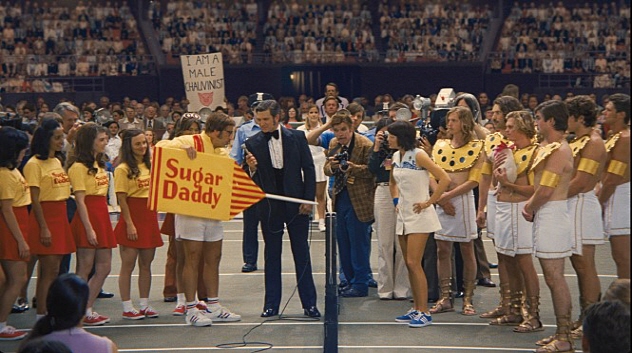
Watching the rise of King and other female tennis players, Riggs sees an opportunity to bring him back in spotlights. He wants to do a big public match with King for showing that he has lose none of his ability (and virility, of course), so he calls her at one night, but King flatly rejects his offer. In her view, Riggs’ proposed match is no more than a silly public stunt to promote him, and she does not want get involved with that at any chance.

However, she comes to change her mind after watching how much Riggs openly wields sexism along with many other guys including Kramer, so she decides to do a match with Riggs, who gladly accepts her challenge as boosting his ego further in public. Simon Beaufoy’s screenplay never overlooks Riggs’ unpleasant male chauvinism, but it also pays considerable attention to Riggs’ human sides, and Steve Carell’s enjoyable performance balances his character well between humor and drama. Riggs is surely a jerk full of braggadacio, but he is an understandable one at least, and Carell later has a small good moment when his character happens to have a serious conversation with his wife.

battlesofthesexes02

While cheerfully depicting the absurd aspects of King and Riggs’ eventual match which was held at the Houston Astrodome on September 20th, 1973, the movie also emphasizes how it was important for King and many other women out there, and Emma Stone gives a fine performance as a smart, spirited woman ready to do a necessary battle for her strong feminist belief. Although she looks a bit more plain than usual, Stone is engaging to watch as before while ably functioning as the solid human anchor of the film, and we certainly come to root for her character during the expected finale.

The supporting characters in the film are less developed in comparison, but they are played by a group of reliable performers at least. While Andrea Riseborough exudes natural charm as King’s lover, Alan Cumming is flamboyant as a substantial gay character in the film, and Sarah Silverman surely enjoys every showy moment of her character. In case of other notable performers like Elisabeth Shue, Austin Stowell, and Bill Pullman, they are stuck with thankless roles, but they bring some life and personality to their respective characters nonetheless.

“Battle of the Sexes” is directed by Jonathan Dayton and Valerie Faris, who previously debuted with “Little Miss Sunshine” (2006) and then made “Ruby Sparks” (2012). Like their two previous film, the movie is funny and likable, and I especially enjoyed its authentic period atmosphere, which is effectively established right from the very beginning with its deliberately old-fashioned studio logo. While its finale could have been more focused and impactful in my inconsequential opinion, the movie does its job as much as intended, and the result is a winning crowd-pleaser I am willing to recommend.

battlesofthesexes5

Posted in Movies | Tagged , , , , , , | Leave a comment