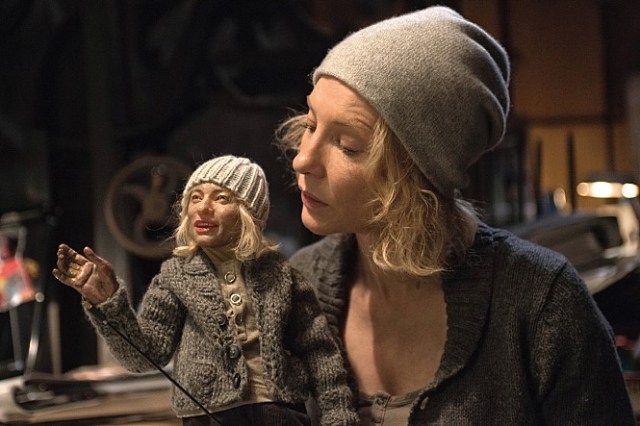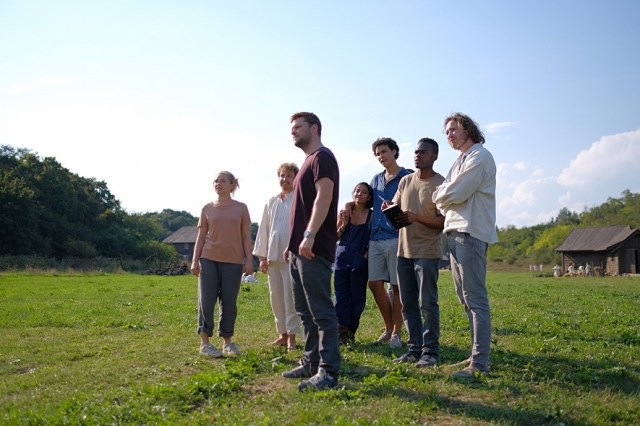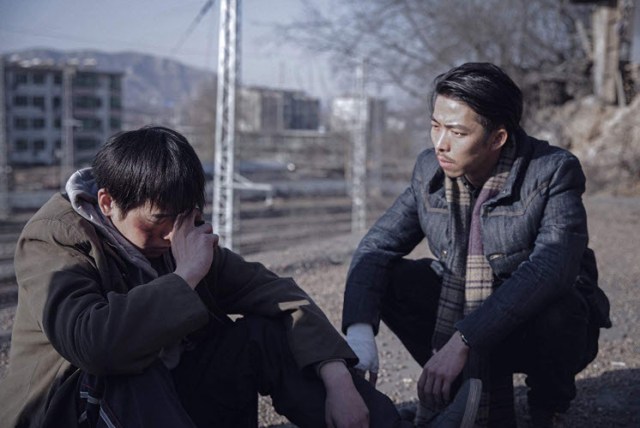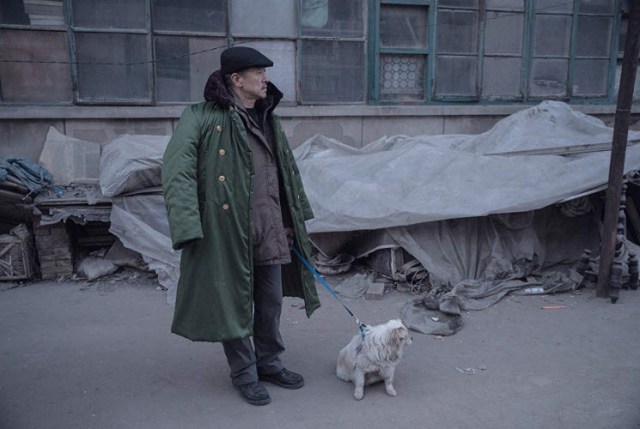
Sauvage (2018) ☆☆☆(3/4): The seedy daily life of a young male prostitute

sauvage01

The hero of French film “Sauvage” is one of the most miserable movie characters I have ever seen during recent years. While casually going through his seedy daily life without no discernable future, this young man simply wants to love and be loved, but, alas, love is something he cannot get easily in his harsh world, and it is sometime quite difficult for us to watch how he comes to let himself driven further into more misery and despair.

After the opening scene which will catch you off guard for a good reason, the movie phlegmatically observes how Léo (Félix Maritaud) and his fellow male prostitutes work at some remote site near Paris during daytime. They patiently wait on the road as cars and people pass by from time to time, and we watch some of them eventually getting the opportunity to earn a bit of cash.

Léo has been friendly with a male prostitute named Ahd (Eric Bernard), who says to Léo that he is not a gay but does not hesitate to sell sex and his body to his male customers at all. During one early scene in the film, he and Léo are taken to the residence of a disabled middle-age guy, and Léo is willing to provide whatever is demanded by their latest customer along with some intimacy, but Ahd is more strict about his sexual service, as shown from his refusal to kiss that customer.

As time goes by, Léo and Ahd become closer to each other, though Ahd is reluctant to admit his affection toward Léo. While he often protects Léo from a number of troubles including a guy notorious for his sadistic tendency, he usually distances himself from Léo while searching for any sugar daddy to help him escape from his shabby status, and that certainly frustrates Léo a lot.

sauvage03

Furthermore, it gradually turns out that Léo really needs to see a doctor for his deteriorating physical condition. Although it is not AIDS at least, he frequently coughs, and he does not try to do anything about that even after getting some medical help from a kind doctor genuinely concerned about his worsening health. He keeps prostituting himself as usual, and he also often uses drugs just like many of his colleagues.

And Ahd becomes more estranged from Léo, especially after he finally gets some old guy willing to not only support him and but also live along with him. Quite depressed by this, Léo subsequently submits himself to an obnoxious gay couple who cruelly abuse and humiliate him, and that is surely the most painful moment in the film.

While steadily maintaining its dry, calm attitude, the movie sometimes strikes us with the raw, unflinching presentation of sex and nudity, and director/writer Camille Vidal-Naquet, who received the Louis Roederer Foundation Rising Star Award when the movie was shown at the Cannes Film Festival in last year (This is his first feature film, by the way), skillfully handles a number of graphic sex scenes in the film. Like Alain Guiraudie’s “Stranger by the Lake” (2013), the movie does not flinch from full frontal nudity at all, and the overall result does not feel gratuitous thanks to its unadorned realistic approach coupled with some tactful touches.

Meanwhile, the movie also gives us a few small tender moments. After Ahd eventually walks away from him, Léo gets some consolation from a foreign male prostitute, and it looks like they can work and live together as a couple, but it does not take much time for him to see that Léo’s heart is still yearning for the other person. At one point, he flatly but sincerely reminds Léo of why their relationship will not work, and both of them come to accept that fact with bitter resignation.

sauvage02

In case of a middle-aged Canadian guy whom Léo comes across on one day, he tentatively approaches to Léo, but Léo cannot love him back even after getting considerable help from this kind guy, and we come to sense the growing conflict inside Léo around the time when he is about to take a big step for his future later in the story. His eventual decision may not be sensible, but we are not so surprised as, to some degree, understanding his matters of heart.

The movie depends a lot on the talent and presence of its lead actor, and Félix Maritaud, who incidentally also appeared in two other recent notable queer French films “BPM (Beats Per Minute)” (2017) and “Knife+Heart” (2018), gives a fearless performance alternatively engaging and harrowing. Although the movie does not tell us much about his character’s past, Maritaud fills his character with considerable life force, and he is also supported well by several other substantial supporting performers surrounding him. While Eric Bernard is believable during his key scenes with Maritaud, Nicolas Dibla is equally fine in his supporting part, and Philippe Ohrel is suitably gentle and caring as a possible sugar daddy for Léo.

On the whole, “Sauvage” is definitely not something you can casually watch on Sunday afternoon, but it is an admirable piece of work, and, in my humble opinion, it is also one of interesting debut feature films I saw during this year. Sure, this is basically another typical story about a prostitute with a heart of gold, but it is shown and told well with striking realism and commendable commitment, and you may find yourself having some empathy on its hero as watching the haunting last shot of the film.

sauvage04

Posted in Movies | Tagged , , | Leave a comment

Child’s Play (2019) ☆☆1/2(2.5/4): He’s a very bad doll…

childsplay01

“Child’s Play”, the remake of the 1988 horror film of the same name, is a nasty genre piece packed with scares and gores. I was only mildly amused and entertained during my viewing, and that made me keep wondering whether this remake was really necessary or not, but it is at least a fairly competent product which was less terrible than I feared.

The remake version goes for a little more ‘realistic’ approach compared to the original version. While the doll in the original version happened to be possessed by the spirit of a mad serial killer, the doll in the remake version is an artificial intelligence robot which happens to be programmed to be devoid of any safety/restriction measure by an exhausted and exasperated Vietnamese factory employee. This premise is a bit less creepy, but we may find it more plausible when our world becomes more familiar with artificial intelligence in the near future.

What follows next is pretty familiar to you if you watched the original version before. Not long after that reprogrammed doll happens to be sent back for a ‘minor’ malfunction at a local shopping mall where she works, Karen Barclay (Aubrey Plaza) decides to bring it to her adolescent son Andy (Gabriel Bateman) as an early birthday present for him, and Andy gladly accepts the doll, though he is not as excited as she expected because, as he points out, he is a bit too old to play with a doll.

childsplay03

While the doll, which somehow names itself ‘Chucky’, annoys and disturbs Andy during their first night, Andy becomes more accustomed to Chucky as days go by, and we get a little sweet montage scene showing how Andy and Chucky become close via more interactions between them. Andy often feels awkward about himself as a kid with hearing disability who recently moved to a new neighborhood along with her mother, so Chucky is willing to be Andy’s best buddy as programmed, and things get better for Andy when he and Chucky happen to come across two neighborhood kids on one day, who are impressed by Chucky’ uninhibited use of words and think that is, yes, totally cool.

Of course, we all know that the story will soon take a very disturbing tone, and the movie does not disappoint the audiences as Chucky reveals more of his darker sides. As Andy’s best buddy, Chucky is inclined to do anything for Andy, and there is a very uncomfortable scene involved with a pet cat which Andy does not like much – and that is just only the beginning.

Getting frightened more and more by what Chucky is capable of, Andy tries to handle the situation for himself, but the situation gets only worse for him, and, not so surprisingly, nobody believes him when he finally comes to try to warn others around him of how dangerous Chucky really is. As a result, the body count keeps getting increased, and Chucky becomes more violent and resourceful than before as your average deranged AI robot.

While giving us a series of vicious moments of mayhem and blood, the movie also provides us a few sharp moments to be appreciated. I was amused and horrified by one crucial scene where Chucky absorbs the graphic moments of a violent horror film then attempts to stab someone for his best friend’s entertainment, and that reminds me of how AI can be influenced by the dark sides of our human nature. Considering how much AI can be smarter than us someday, it will be frightening when a powerful AI happens to learn and acquire hate and violence just like Chucky in the film.

childsplay02

Everything in the story eventually culminates to a tense climatic sequence set in the shopping mall, and that is when Chucky goes further with his murderous nastiness. Although I must confess that I cannot help but miss Brad Dourif’s enjoyably malicious voice performance in the original version, Mark Hamill, who has been mainly known for his iconic role in the Star Wars movies but is also a wonderful voice actor who did a marvelous job in a number of TV animation series including “Batman: The Animated Series”, did a solid job on the whole, and his insidious voice performance is one of the main reasons why the movie works to some degree even during its predictable finale, which incidentally features one of certain old genre clichés.

On the other hand, the other main cast members of the film are stuck with their relatively less colorful roles, though they did as much as they can for filling their respective spots. While young performer Gabriel Bateman is believable in his character’s gradual descent into dread and panic, Aubrey Plaza shows here a more serious side of her talent despite her rather thankless job, and Brian Tyree Henry, who has been more notable to us thanks to his wonderful supporting performances in “If Beale Street Could Talk” (2018) and TV series “Atlanta”, manages to hold his own small place as a sympathetic cop who happens to be one of Andy and Karen’s new neighbors.

In conclusion, “Child’s Play”, directed by Lars Klevberg and written by Tyler Burton Smith, has some good things for scaring and entertaining us, but I hesitate to recommend it as it is less enjoyable than the original version while being more violent and vicious. Like the original version, the movie leaves some possibility of sequels during its last scene, but, considering how terrible most of the sequels of the original version were, I do not have much expectation.

childsplay04

Posted in Movies | Tagged , , , , | Leave a comment

The World Before Your Feet (2018) ☆☆☆(3/4): Walking more than 8,000 miles in NYC

theworldbeforeyourfeet04

When I spent several weeks of 2010 April in Chicago, some of the most memorable moments came from when I walked around here and there in the city. I remember the Swedish Bakery and several other interesting places I came across as walking along the streets and alleys of the Andersonville neighborhood during one cloudy evening. I remember those lovely and expensive houses I saw while sauntering in the Gold Coast neighborhood during one chilly afternoon. And I also remember well a number of gorgeous modern architectures I checked one by one as loitering around here and there in the downtown area of the city.

These and other memories of Chicago were somehow vividly evoked inside my mind as I watched documentary film “The World Before Your Feet”, which is about the personal journey of one plain guy who has walked more than 8,000 miles (about 12,800 km) in New York City for more than six years. As observing him doing far more than merely walking along those numerous streets and alleys of New York City, I became more curious and amused about him and his ongoing journey, and the documentary eventually made me reflect more on my brief but wonderful experience of exploring many different areas of Chicago by my feet.

After the opening scene showing its hero walking in around various area of New York City, the documentary lets us get to know him bit by bit. Although he was initially a civil engineer, Matt Green became tired of being stuck in office cubicle for the rest of his life, and he got more motivated when he and his younger brother respectively experienced a nearly fatal experience. After discerning how life can be cut short at any moment, he eventually decided to go for what makes him happy, and that was how he came to focus on walking.

theworldbeforeyourfeet03

At first, Green tried to walk from the East Coast to the West Coast with a few equipments including a perambulator to carry his small luggage instead of his back, and we see him eagerly showing and telling his long but rewarding walking experience to a bunch of kids. As he walked down roads, he often spotted beautiful moments to behold and be photographed, and we accordingly get a number of lovely nature photographs including the one showing a vast field full of yellow flowers.

After successfully finishing his transcontinental journey, Green looked for another walking mission, and he soon found it. He decided to walk all the alleys and streets of the five boroughs of New York City, and the documentary shows us how steadily and diligently he has walked around here and there in the city during next 6 years. We see him walking around in some remote areas of Staten Island. We observe him moving around in some livelier areas of Queens, Brooklyn, and the Bronx. And we later see him strolling in some busier regions of Manhattan.

Although he has been technically unemployed, Green has been leading a modest way of living as wholly focusing on his walking project. He has friends and some other people willing to allow him stay at their residences for a few days, and he sometime earns some small income via taking care of houses and pets. In case of a number of different cats taken care of by him, they provide some of the most amusing moments in the documentary, and I was particularly tickled by a naughty grey cat named Mufasa.

theworldbeforeyourfeet02

While he seems to be just covering one block after another, Green usually does some research on where he is going to walk around, and that is how he often spots interesting things during his walk. Along with him, we observe several different barber shops which distinguish themselves a bit via deliberate misspelling, and we also look at a number of ‘Churchagogues’, which were once synagogues but are changed into Christian churches. Although these buildings are modified a lot on the surface, there are still some traces of their old history, and Green is willing to be our tour guide to point out those curious remnants.

We also meet several other people who have been as passionate about walking around in the New York City as Green, and they certainly have some interesting things to tell us. We are introduced to a black writer who talks about how he has to be more careful about his attire and appearance while walking outside, and then we meet an old professor who already accomplished his own walking project over the city some time ago.

In the meantime, the documentary keeps providing us engaging moments to be savored, and Green provides thoughtful comments from time to time. We see a bunch of different memorial murals on the 9/11 terror attack in 2001, and Green points out how diverse these murals are in terms of style and content. When he visits a big tree known as the oldest tree in the city, he muses on how much time has passed around the tree, and you may wonder how many more centuries it will have witnessed.

Although it loses its focus a bit during its second part, “The World Before Your Feet” is still a charming and intimate documentary, and director Jeremy Workman, who also produced and edited his documentary, did a competent job of presenting his hero and New York City with interest and affection. Sure, New York City has never been a boring place to us, but the documentary presents to us a fresh perspective on the city via its eccentric hero, and you may want to walk around in the city when the documentary is over.

theworldbeforeyourfeet01

Posted in Movies | Tagged , , | Leave a comment

Toy Story 4 (2019) ☆☆☆1/2(3.5/4): Another closure for Woody and his friends

toystory404

“Toy Story 4”, the latest animation feature film from Pixar Animation Studios, is another entertaining entry of the endearing franchise which has lasted for more than 20 years. While its existence seems rather redundant at first due to that nearly perfect finale in “Toy Story 3” (2010), the film soon comes to delight and entertain us a lot as deftly handling its interesting ideas and colorful characters via sharp wit and good-hearted humor, and it eventually delivers us a substantial amount of emotional power just like its predecessors.

The story begins at the point not long after the ending of “Toy Story 3”. As many of you remember, Woody (voiced by Tom Hanks) and his toy friends including Buzz (voiced by Tim Allen) and Jessie (voiced by Joan Cusack) were handed to a young girl named Bonnie (voiced by Madeleine McGraw) when their longtime owner grew up to be a lad leaving for his college, and things have been pretty nice for them as they become more adjusted to their new young owner, but then there comes a new challenge. Bonnie is soon going to have her first day in a local kindergarten, and, like a caring parent, Woody cannot help but become worried about whether she will be fine at the kindergarten without him and other toys, though he has not gotten much attention from her during recent days.

In the end, Woody decides to slip into Bonnie’s backpack while she and her parents are busy with preparing for her first kindergarten day. As witnessing how hard and difficult it is for Bonnie to adjust herself to a new environment, he comes to feel that he must do anything to help Bonnie, and his consequent action induces Bonnie to make a crude stick figure, which actually helps her a lot in interacting well with her teacher and classmates.

As a new toy of hers, that crude stick figure in question becomes alive as soon as it is created. Named ‘Forky’ (voiced by Tony Hale) by Bonnie, he is quickly thrown into panic as quite baffled by his own existence, and we get one of the funniest moments in the film as Woody tries to calm down Forky while hiding themselves from Bonnie and other human figures as much as he can.

toystory402

Anyway, Woody manages to take Forky safely to Bonnie’s home, and the other toys in Bonnie’s room warmly greet Forky, but he remains to be as confused and frightened as before. When Bonnie and her parents later come to take a road trip together, Forky frequently attempts to escape, and that certainly brings more headaches to Woody and other toys brought along with them.

Of course, Woody subsequently finds himself stuck with Forky when they happen to be separated from Bonnie and other toys, and that is when he eventually finds a way to make Forky accept that he is really something precious to Bonnie. As Woody talks to Forky a bit about his long history, the movie generates some nostalgic poignancy for its audiences, and that is wonderfully counterbalanced by Forky’s endearing goofiness.

However, it turns out that their journey back to Bonnie and their fellow toys is more difficult than expected. When Woody and Forky finally arrive at a carnival where Bonnie and her parents stay for a day, Woody sees something familiar inside a local antique shop, and that leads them to a baby doll named Gabby Gabby (voiced by Christina Hendricks), who wants to take away a certain small object from Woody for attaining what she has desired for years. Although she mainly functions as the antagonist of the story, Gabby Gabby are depicted with a surprising amount of empathy and understanding, and you will feel sorry for her lonely and miserable status.

toystory403

The story becomes more interesting when Woody later encounters his old girlfriend Bo Peep (voiced by Annie Potts), who, as already shown from the prologue scene, was separated from Woody and other toy figures 9 years ago. While looking as gentle and tender as before on the surface, Bo Peep has been turned into someone as feisty and lively as Jessie, and Woody accordingly comes to depend a lot on her for returning safely to Bonnie and his friends along with Forky.

In the meantime, the story also focuses on Bonnie’s other toys as required, and I must point out that this part is the weakest spot in the film. While I enjoyed a running gag involved with the ‘inner voices’ of Buzz, it eventually became a little tiresome to me, and I was a bit disappointed to see that the other main toy characters of the film are usually more or less than background figures, though it is undeniably fun to see how all of them and some other toy figures including Duke Caboom (voiced by Keanu Reeves) and Ducky and Bunny (voiced by Keegan-Michael Key and Jordan Peele, respectively) work together for Woody and Forky’s safe return during the literally bumpy climax sequence of the film.

Despite its several weak aspects, the screenplay by Stephany Folsom and Andrew Stanton, which is based on the story by no less than eight writers including Folsom, Stanton, and director Josh Cooley, keeps pulling off a series of emotional moments to be appreciated, and the film eventually culminates to the finale as powerful as that tear-jerking one of “Toy Story 3”. I will not go into details here for not spoiling anything, but I can tell you instead that moment is something you have never thought you needed, and you will be touched a lot especially if you grew up along with the franchise like I did. Yes, this is basically another goodbye, but “Toy Story 4” did its job much better than I anticipated, and I am certainly glad for that.

toystory401

Posted in Movies | Tagged , , , , | 2 Comments

Che: Part Two (2008) ☆☆☆(3/4): Che at the wrong place and time

cheparttw001

For some reason unknown to me, Steven Soderbergh’s “Che” was recently released in South Korea although it has been more than 10 years since the movie came out in 2008. I already saw it in 2010, but I was willing to give it another try for re-examining my initial opinion, and I am glad to report that it is still the most ambitious work from Soderberg during last two decades, though I remain to be not very enthusiastic about it unlike some other critics and audiences.

The movie is divided into two parts: “The Argentine” and “Guerilla”. While these two parts are inseparable in terms of storytelling, I decided to review each of them because they are separately shown in South Korea, so the review will mainly focus on what I felt and observed as watching “Guerilla” at a local arthouse movie theater in my hometown.

“Guerilla” is set at the time point which is around seven years after Fidel Castro and his No.2 guy Ernesto “Che” Guevara (Benicio del Toro) succeeded in overthrowing Fulgencio Batista’s dictatorship in Cuba, 1959. While he was later appointed as one of Castro’s cabinet members, Guevara suddenly disappeared in 1965, and then Castro subsequently announced to the public that Guevara left Cuba for spreading their spirit of revolution around other countries out there.

In 1966, Guevara is ready to sneak into Bolivia, but he drops by Cuba first for meeting Castro and his dear wife and children. While successfully disguising himself as a family friend, he spends some nice time with his wife and children, and then he leaves for Bolivia along with his several Cuban comrades, who are, like him, quite determined to spread their ideology around those poor people in Bolivia.

cheparttw002

At first, things look promising to Guevara and his comrades, but it soon becomes apparent to us that they are bound to fail for several overlooked factors. Bolivia has also suffered from right-wing dictatorship just like Cuba once did, but Guevara and his comrades did not get much favor or support this time. While local left-wing factions do not welcome them much, those poor people of Bolivia do not like them a lot either as frequently being sandwiched between Guevara and the Bolivian Army. In case of one poor farmer, he finds himself in a very difficult situation as incidentally getting himself associated with Guevara and his soldiers, and he has no choice but to cooperate with the Bolivian Army.

In addition, the Bolivian government was already quite ready to stop Guevara right from when he arrived in the country, and it also gets considerable help and support from the US government. As briefly implied in “The Argentine”, the US government has been watching on Guevara’s activities after the Cuban revolution, and we soon see several American military advisors coming to Bolivia for training the Bolivian Army soldiers more for suppressing Guevara and his soldiers.

As calmly and closely observing how the situation gets worse and worse for Guevara and his soldiers for next several months, Soderbergh, who also unofficially worked as the cinematographer of his film as before, gives us a number of tense moments without resorting to any unnecessary thrill or excitement. While we occasionally get several battle scenes as expected, they are mostly handled via a dry, restrained approach, and, though we do not get the whole picture of what is exactly going on around Guevara and his soldiers, we become more aware of the growing sense of doom and desperation around them.

cheparttw003

While he can just quit and then go back to Cuba and his family, Guevara adamantly sticks to his ideological belief, and that comes to seal his fate in the end with more misery and ordeal. Around the time when he is eventually captured by the Bolivian Army, he looks far shabbier and shaggier than before, and Soderbergh presents Guevara’s eventual demise on October 9th, 1967 via a very effective subjective viewpoint to be appreciated.

Although “Guerilla” is less enjoyable compared to “The Argentine” due to its gloomy mood, it is also held well together by the strong lead performance from Benecio del Toro, who shows here a commendable case of committed acting as he did in “The Argentine”. While we do not come to learn anything particularly personal about him, Guevara in the film comes to us as a compelling human figure to observe thanks to del Toro’s unadorned natural acting, and I admire how del Toro and Soderbergh strenuously stick to their clinical depiction of a revolutionary who simply lived and died for his ideological belief. I must tell you that my political stance is quite far from Guevara’s (I am a liberal who grew up as a staunch anti-communist, by the way), but I observed Guevara in the film with constant fascination nonetheless, and I came to understand why he is still famous even at present, though I personally think he would roll in his grave if he came to learn about how his political image has been turned into a popular commercialized brand during recent years.

On the whole, “Guerilla” precisely complements what is presented in “The Argentine”, and these two parts work together well to give us the vivid, uncompromising presentation of two different important periods in Guevara’s life. Although they are a rather dry, tough stuff to say the least, they are worthwhile to watch for Soderbergh and del Toro’s admirable efforts, and I think you should give them a chance someday.

cheparttw004

Posted in Movies | Tagged , , | Leave a comment

Che: Part One (2008) ☆☆☆(3/4): Che at the right place and time

chepartone04.jpg

Steven Soderbergh’s “Che”, which happened to be released in South Korea in last weekend, is probably his most ambitious work during last two decades. While it is often a bit too dry and austere for some of you, this still works as an engaging observation of one fascinating historical figure, and you may be impressed by its achievements regardless of your opinion on that figure in question.

The movie is divided into two parts: “The Argentine” and “Guerilla”. While these two parts are inseparable in terms of storytelling, I decided to review each of them because they are separately shown in South Korea, so the review will mainly focus on what I felt and observed as watching “The Argentine” at a local arthouse movie theater in my hometown.

Mainly set in Cuba during 1955-59, “The Argentine” looks into the slow but eventual political advance of Ernesto “Che” Guevara (Benicio del Toro), a young Argentine doctor who became a communist revolutionary as associating himself with Fidel Castro and other Cuban communist revolutionaries. After the opening scene showing their secret meeting in Mexico City, the movie promptly shows them leaving for Cuba for beginning their revolution, and then we see Guevara operating in a rural region of Cuba along with a number of soldiers under his command.

chepartone03

Now this looks like the familiar setup for an epic war film, but the movie strenuously avoids clichés and conventions as firmly sticking to the ongoing situation surrounding Guevara and his soldiers. While we sometime hear about what is going on in the other parts of Cuba, we never get the whole big picture of the Cuban revolution, and the movie simply moves from one episodic moment to another while seldom paying attention to various other characters in the film besides Guevara.

This can be quite tedious and burdensome to you at first if you do not know much about Guevara’s life, but, thanks to Soderbergh’s deft direction, the movie gradually draws more attention from us via its uncompromising presentation of Guevara via a single-minded narrative focus. While looking usually quiet and pensive, Guevara in the film is presented as an intense man quite determined to devote himself to his ideological belief, and you can sense that he would have went all the way for his cause even if he and Castro had lost. Fortunately for them, many people in Cuba had been pretty sick of Fulgencio Batista’s dictatorship at that time, and the movie occasionally show us how they came to gain more support in public. As Castro occupies more of Cuba step by step, more left-wing political factions gather around Castro, and we observe how Guevara and his soldiers steadily draw more favor from those poor peasants out there. At one point, Guevara orders the execution of two deserters for what they did to a peasant family, and that certainly makes a good impression on locals.

In addition, the morale is not that high among Batista’s police officers and soldiers, especially when it becomes clearer to everyone in Cuba that things are indeed falling apart for his regime. Around the time when Guevara and his soldiers come into a city named Santa Clara in late December of 1958, the sense of defeat is palpable among their opponents, and there is a brief amusing moment when a colonel hurriedly walks away from his position with a false excuse.

chepartone02

During the part depicting the Battle of Santa Clara, the mood becomes more tense as expected, but Soderbergh deliberately stays away from any chance of thrill or excitement. While efficiently conveying to us the considerable peril surrounding Guevara and other soldiers around him, the movie adamantly maintains its dry, clinical tone nonetheless, and Castro and his revolutionaries’ eventual triumph is presented as something no more than a flat historical fact to induce some thoughts and reflections from us. To be frank with you, as phlegmatically watching many Cuban people cheering for the end of Batista’s dictatorship on the screen, I could not help but reflect on how Castro and Guevara subsequently opened the door to another dark period of oppression, which has lasted for more than 60 years.

Although my political stance is quite far from Guevara’s (I am a liberal who grew up as a staunch anti-communist, by the way), I still think Guevara in the film is an interesting human figure to observe, and Benecio del Toro, who deservedly received the Best Actor award when the movie was shown at the Cannes Film Festival in 2008, is flawless in his unadorned natural performance. Without any artificial moment, he diligently and stoically carries the film from the beginning to the end, and the other notable supporting performers in the film are also effective while being more or less than mere parts of the historical/political background surrounding Guevara in the film, though Demián Bichir, Rodrigo Santoro, Édgar Ramírez, and Oscar Issac probably draw more notice from us now considering the current status of their respective acting careers.

Anyway, “The Argentine” establishes well the ground for “Guerilla”, and you will admire them more if you watch them together. I must confess that the recent viewing of “The Argentine” and “Guerilla” did not change my initial opinion on them much, but they are still worthwhile to watch thanks to Soderbergh and del Toro’s admirable efforts, so I recommend you to try “The Argentine” first.

chepartone01

Posted in Movies | Tagged , , | Leave a comment

The Edge of Democracy (2019) ☆☆☆(3/4): The unraveling of democracy in Brazil

theedgeofdemocracy04

Brazilian documentary film “The Edge of Democracy”, which was released on Netflix yesterday, is often uncomfortable and depressing to watch especially if, like me, you have been disturbed by the rise of extreme right-wing political factions around the world during last several years. Like Donald J. Trump in US or Brexit in Britain, the unraveling of democracy in Brazil is another horrific example of that disturbing global political trend, and the documentary gives us a calm, sobering overview on that while deftly weaving an aching personal perspective into its unabashedly partisan narrative.

After opening with an archival footage clip showing former Brazilian president Luiz Inácio Lula da Silva, who is usually called ‘Lula’ in public, leaving for a prison where he would be incarcerated for more than 10 years, the documentary looks back on the last five decades of the Brazilian society. After the coup d’état in 1964, the country went through a gloomy period of military dictatorship for next 21 years, but it eventually begin to make a slow progress toward democracy as more of its citizens came to protest against the military dictatorship, and that was when Lula, who was initially a local labor activist, came to rise as a prominent political figure.

Director Petro Costa, who was born in 1983, reminisces a bit about how things initially looked hopeful for her parents and many other people demanding democracy for their country. Although Lula failed to win the presidential election three times in row after the end of the military dictatorship in 1985, he and his supporters did not give up nonetheless, and he eventually got elected in 2002, though he had to make some compromise with those powerful business and political figures for his significant political victory.

theedgeofdemocracy01

Anyway, the mood was optimistic as Lula entered the presidential palace in Brasilia in 2003, and he and his government did not disappoint the people of Brazil as pushing forward a number of policies for stimulating the economic growth of the country. While the economic wealth of the country was considerably increased, the quality of life was also improved for those poor working-class people out there thanks to Lula’s bold welfare policy, and it seemed everything would continue to go pretty well for Brazil and its citizens around the time when Lula was succeeded by Dilma Rousseff in 2011, who incidentally got the honor of being the first female president of Brazil.

However, Rousseff’s presidency soon came to face a number of unexpected troubles, and things subsequently began to fall apart. As the national economy took a big downturn due to several causes, public discontent and unrest were accumulated against Rousseff and her government, and that was eventually exploded through a massive protest, which further accelerated the decline of the public support of Rousseff and her government.

And then there came a huge corruption scandal involved with several executives of a state-run oil company named Petrobras. As the investigation led by federal judge Sergio Moro was continued, many conservative politicians started to criticize and blame Rousseff, and she consequently became far less popular than before while Lula was also blamed a lot for this corruption scandal. The public demand for her impeachment was increased day by day, and there was really nothing she could do except following what was forced upon her and her government by her political opponents.

The documentary showed us how unjust the process for her impeachment was. Although there was not any concrete evidence to incriminate Rousseff, her opponents kept demanding her impeachment, and Michel Temer, who was her vice president, and Eduardo Cunha, who was the president of the lower house, were willing to get her impeached by any means necessary for their political gain. As a result, the majority of the lower house voted yes to Rousseff’s impeachment in 2016 August, and Temer instantly filled the vacant position, but, ironically, he got exposed for his own corruption not long after that.

theedgeofdemocracy03

Meanwhile, Lula decided to run for the presidential election again, but then he was targeted by Moro, who was very determined to make his investigation into a political circus to boost his public popularity. After his prosecutors gave a ludicrous PowerPoint presentation for showing those hungry news reporters how Lula was supposedly associated with the corruption scandal, Moro personally interrogated Lula for a rather absurd charge, and then the court swiftly ruled that Lula was guilty as charged.

And the situation got worse as an extreme right-wing politician named Jair Bolsonaro came into the picture. Although his public support was less than 10% at first, he gradually gained more public support while the Brazilian society became more polarized than before, and the documentary calmly but chillingly showed how things got pretty ugly as the election day approached. As far as I could see from the documentary, Bolsonaro, who eventually got elected in last year, is a man as vile and hateful as Trump, and it is surely unnerving to see that there are many people in Brazil quite willing to go along with his virulent right-wing ideology.

Overall, “The Edge of Democracy” will linger on your mind for a while with its grim prospect on the ongoing social crisis in Brazil, and Costa did a skillful job of presenting facts and then making her points as steadily maintaining her restrained but intimate approach. I can only hope that the circumstance will get better for her and many others in Brazil someday, but, boy, considering what is going on around in the world these days, I have to admit that it is really hard to be optimistic.

theedgeofdemocracy02

Posted in Movies | Tagged , | 1 Comment

Hotel Mumbai (2018) ☆☆1/2(2.5/4): A brutal docudrama on the 2008 Mumbai Attacks

hotelmumbai02

“Hotel Mumbai” intends to be a vivid, intense, and disturbing presentation of the 2008 Mumbai Attacks, and it succeeds to some degree although I feel rather ambivalent about its overall result. While it is often gripping and chilling as depicting what happened on that terrible day in Mumbai, it occasionally seems to be on the verge of exploitation, and I often wondered whether the movie is really necessary, even though I was often captivated by its numerous intense moments during my viewing.

During the opening part, the movie puts us right into what was about to happen in Mumbai on November 26th, 2008. A bunch of young members of the Lashkar-e-Taiba Islamist militia sneak into Mumbai by a boat, and then, as instructed by their handler, they separately prepare themselves for executing a series of terror attacks at a number of crowded sites in the city including the Chhatrapati Shivaji Terminus railway station, which was the first one to be attacked as shown in the film.

Meanwhile, we see how everything looks fine and usual at the Taj Mahal Palace Hotel at the same time. We see David (Armie Hammer) and his wife Zahra (Nazanin Boniadi) arriving at the hotel with their little baby, and we also observe how that day does not begin well for Arjun (Dev Patel), a young hotel staff member who happens to lose his shoes while leaving his shabby family home and has no choice but to wear the ones to which his poor feet do not fit well.

After leaving their baby to their young nanny, David and Zahra go to a restaurant in the hotel supervised by chef Hemant Oberoi (Anupam Kher), and it looks like they are going to have a lovely evening there, but then they and many other people in the hotel are suddenly thrown into a very dangerous situation. Shortly after causing a pandemonium outside the hotel, four armed terrorists come into the hotel along with lots of scared people, and then they immediately start their another attack, which results in the death of many unfortunate people who happen to be around them.

hotelmumbai04

The guests in the restaurant manage to hide from the terrorists because of Arjun’s quick response, and they later come to a safer place thanks to Oberoi and other hotel staff members, but David and Zahra cannot help but concerned about their baby and nanny, who are stuck in their hotel room as the terrorists begin to go around inside the hotel to kill more people. David eventually decides that he must do something for saving their baby and nanny, but he soon come to see that he may get himself killed at any moment no matter how much he tries to be careful in every step.

Meanwhile, the movie also shows what is going on outside the hotel. The local police quickly arrive, but they are not prepared well enough to deal with the situation, and the Special Forces unit from Delhi has not arrived yet. When they try to enter the hotel at one point, they are soon attacked by the terrorists, and many people in the hotel become more desperate as the terrorists subsequently enter the final stage of their plan.

Busily juggling many different characters during its first half, the movie, which is inspired by the 2009 documentary film “Surviving Mumbai”, keeps maintaining the level of tension and suspense on the screen, and it often strikes us hard with those callous acts of violence committed by the terrorists. Constantly driven by their handler’s virulent fanaticism, they are quite determined to kill as much as they can, and this horrific attitude of theirs makes a gut-chilling contrast with a brief but morbidly silly moment reflecting their banality of evil.

hotelmumbai03

As entering its second half, the movie attempts to add more tension and suspense to the story as focusing more on the bravery of some of its main characters against the terrorists, and that is where the movie begins to falter. While the eventual climactic sequence is certainly as intense and gritty as expected, I was disturbed a lot by how this sequence is blatantly and graphically presented on the screen, and that unpleasant impression did not go away from my mind even during the following epilogue part accompanied with relief and, yes, some healing process.

The main performers in the movie dutifully fill their respective archetype roles. While Armie Hammer and Nazanin Boniadi bring some humanity to their characters, Jason Isaacs is mostly stuck with his thankless role, Dev Patel holds his spot well with his earnest performance despite a few heavy-handed scenes including a small conversation scene between his character and one of the terrified hotel guests. In case of Anupam Kher, he effortlessly exudes calm, benevolent authority during his several big moments, and you may come to wish that the movie would be more about his character and other hotel staff members.

In conclusion, “Hotel Mumbai” is competent in technical aspects, and director/co-writer/co-editor Anthony Maras, who wrote the screenplay with John Collee, did a commendable job of throwing us into the chaos and horror of the 2008 Mumbai Attacks, but I still hesitate to recommend it due to its ethically questionable storytelling approach. Sure, it is not supposed to be a feel-good movie at all, but it merely presents atrocities without enough tact and consideration, and that still bothers me even at this point.

hotelmumbai01

Posted in Movies | Tagged , , | Leave a comment

Birds of Passage (2018) ☆☆☆1/2(3.5/4): A criminal family drama set in Colombia

birdsofpassage01.jpg

“Birds of Passage”, which was selected as Colombia’s entry for Best Foreign Language Film Oscar in last year, is a compelling mix of crime drama and anthropological interest. While it is another drug crime story set in a South American background, the movie distinguishes itself via its distinctive cultural/ethnic elements, and it gives a number of striking moments to remember as calmly observing the rise and fall of one indigenous clan in the northern part of Colombia during the 1960-80s.

At the beginning, the movie opens with a tribal ceremony celebrating the adulthood of a beautiful young woman named Zaida (Natalia Reyes). After being blessed by her mother Úrsula (Carmiña Martínez), Zaida begins to dance on the ground while surrounded by many others, and that is how she comes across a young man named Rapayet (José Acosta), who dances well along with her in front of others and subsequently asks for the permission to marry her from Zaida’s father, who is incidentally the chief of her clan. While Zaida’s father has no problem with his daughter getting married to Rapayet, he demands Rapayet a considerable amount of assets as the dowry for his daughter, and Rapayet is determined to pay his future father-in-law as much as demanded.

On one day, Rapayet and his colleague/friend Moisés (Jhon Narváez) come across an opportunity to earn lots of money quickly. They happen to learn that a group of American Peace Corps guys are looking for marijuana, and, fortunately for them, Rapayet knows where to get it. A bunch of his distant relatives have illegally grown marijuana in a nearby forest for years, so all Rapayet and Moisés have to do is functioning as a middleman between this clan and those American Peace Corps guys, while, of course, getting some money during this criminal transaction.

birdsofpassage02

Once they succeed with their first trial, Rapayet and Moisés become bolder than before. After meeting an American guy willing to do more business with them, they deliver and sell far more marijuana than before, and it does not take much time for Rapayet to deliver the promised dowry to Zaida’s father, who eventually joins Rapayet’s growing criminal business along with Rapayet’s uncle Peregrino (Jose Vicente Cotes), who has functioned as an adviser/advocate for his nephew.

While clearly discerning what is going on among Rapayet and the other men of their clan, Zaida and her mother have no problem with that because their clan come to enjoy a lot more prosperity than before. Not long after their two children are born, Zaida and her husband eventually move to a big modern house located in the middle of their region, and Rapayet’s business keeps growing with more money and marijuana, though he does not enjoy his power and wealth much unlike Tony Montana.

As many of you have already expected, there is also the price Rapayet has to pay for protecting his criminal family business. When Moisés becomes a serious problem for the business, Rapayet is advised to eliminate Moisés as soon as possible, but, unfortunately, he comes to hesitate to handle this matter, and that results in a lot more blood than expected. He eventually decides to take care of the matter for himself, but then he only finds himself haunted by the consequence of his inevitable action from time to time.

Several years later, things become unstable again thanks to Rapayet’s brother-in-law Leonidas (Greider Meza), who was once an innocent kid but now grows up to be your typical hothead with a streak of meanness. When he takes a sneak peek on the young daughter of Rapayet’s business partner, we can instantly sense a trouble, and then he goes further with his willful rudeness in a way which will probably remind you of that infamous final scene of John Waters’ cult film “Pink Flamingos” (1972).

birdsofpassage03

Rapayet and his close associates try to handle the following problematic situation caused by Leonidas, but the circumstance only becomes worse with more violence and blood between them and their business partner who is now turned into a vengeful opponent. At one point, Úrsula attempts to get the support and help from other clans in the region, but they sternly remind her of what has been lost due to her clan’s criminal business, and she has no choice but to make a humiliating compromise for the survival of her clan, though it later turns out that she will have to sacrifice far more than that as she and her daughter have feared.

While firmly maintaining its dry, austere storytelling approach, the movie dexterously weaves some supernatural elements into the story, and directors Cristina Gallego and Ciro Guerra, who previously worked together as a producer and a director in Oscar-nominated film “Embrace of the Serpent” (2015), did a superb job of juxtaposing contrasting story elements throughout the film. While the movie has several gut-chilling moments of violence, it also occasionally shines with stark beauty generated from those wide, barren landscapes shown on the screen, and cinematographer David Gallego, who previously worked in “Embrace of the Serpent”, deserves to be commended for these vividly beautiful moments captured well by his camera.

On the whole, “Birds of Passage” may be too dry and slow for some of you, but it will be a rewarding experience if you show some patience, and it is definitely one of more impressive films I watched during this year. Sure, this is basically a familiar stuff, but it comes with specific mood and details to be savored, and I am certainly willing to revisit it someday for appreciating more of its haunting beauty.

birdsofpassage04

Posted in Movies | Tagged , , | 1 Comment

Aniara (2018) ☆☆1/2(2.5/4): Space voyage of the Damned

aniara01

Swedish SF film “Aniara” is akin to watching a slow but inexorable progress toward utter despair and sheer hopelessness. Although it is often too clinical for us to care about what is going on in the story, the movie works to some degree as giving us some morbid but interesting moments to reflect on, and you may appreciate how the movie adamantly sticks to its phlegmatic attitude even when it solemnly arrives at its destination in the end.

During the opening scene, the movie succinctly establishes its futuristic background. As the human society crumbles more or more due to wars and global climatic changes, many people on the Earth decide to leave for Mars, and we see hundreds of passengers boarding an enormous spaceship ready to begin its three-week journey to Mars. As following our unnamed heroine who is one of the crew members of the spaceship, we look here and there around in the spaceship, and you will probably be amused to see how its interior looks like a big, luxurious combination of shopping mall and hotel.

As the captain of the spaceship guarantees a safe trip, everything feels fine to everyone on the spaceship, but, of course, there comes a very serious problem not long after the spaceship leaves the Earth. Due to its unexpected collision with some big space junks, the spaceship gets drifted away from its routine course, and, to make matters worse, it cannot re-position itself to the routine course as losing all of its nuclear fuel during that collision. The captain announces that they can still go to Mars, but he also notifies that they will be stuck in the spaceship for quite a long time until the spaceship reaches to a certain spot where it will be able to change its course via planetary gravitation pull.

aniara04

Our heroine, who works in a sort of meditation room where passengers are soothed by those happier memories of their life on the Earth, is a bit more optimistic than others, but her roommate, who has some considerable astronomical knowledge, is quite skeptical in contrast. At one point, her roommate argues that there is no possibility of turnaround for the spaceship from the beginning, and, not so surprisingly, she turns out to be correct when our heroine later happens to have a private conversation with the captain, who does not want any chaos and confusion resulted from that awful truth.

Anyway, the situation seems to be under control for a while thanks to the self-sustaining life support system of the spaceship. While the level of luxury understandably is decreased for everyone on the ship, the basic amount of food and oxygen is constantly provided to everyone thanks to an algae farm built within the spaceship, and our heroine continue to sooth and comfort many passengers whenever they get depressed about their current status.

However, as the spaceship and its crew members and passengers continue its uncertain voyage across the space, the circumstance becomes gloomier for everyone step by step. At one point, our heroine is unnerved by the increasingly frequent errors of the AI system controlling her meditation room, and she immediately reports that to the captain, but the captain casually ignores that because he prefers his passengers to be calmed and soothed as much as possible. In the end, a disastrous incident of malfunction happens, and that is certainly a big mental blow to everyone in the spaceship.

aniara02

After that point, everyone in the spaceship slowly begins to descend into more despair and, yes, madness. While the captain and his crew members try to keep everything in order, some of passengers kill themselves as the voyage becomes longer than two years, and many passengers come to join a religious cult. At one point, our heroine finds herself participating in an orgy-like ritual along with a female pilot to whom she has been attracted, and they become closer to each other as the pilot gets pregnant not long after that ritual.

The pilot and our heroine subsequently experience a bit of hope and joy after the birth of their child, but the circumstance remains depressing as usual. When it is discovered that a certain object is heading to the spaceship, everyone on the spaceship become a lot more optimistic than before, but, alas, they will have to wait for at least one more year before its arrival, and we come to have more fear and dread on that grim possibility from which they have desperately tried to look away.

And the movie continues to drone on and on. The screenplay by directors/writers Pella Kagerman and Hugo Lilja, which is based on the 1956 poem of the same name by Harry Martinson, is uncompromising in its dry, austere storytelling, but it eventually comes to lose its narrative momentum during its last 30 minutes, and it is also often hampered by its rather thin characterization, though its main cast members did a good job of filling their respective archetype roles as much as they can.

Intriguing and compelling at times as pushing its stark story premise as far as it can, “Aniara” can be regarded as a cautionary SF fable on our fragile existence in the universe, and I admire its technical aspects although I felt too distant to its story and character during my viewing. Yes, this is certainly not for everyone, but you may give it a chance if you want something different from usual SF Hollywood blockbuster films.

aniara03

Posted in Movies | Tagged , | Leave a comment