Little Woods (2018) ☆☆☆(3/4): A tale of two desperate sisters

littlewoods01

“Little Woods” is a melancholic tale of two women struggling with their increasingly desperate circumstance. While this is essentially your typical American independent film intended as a cold slice of life, the movie is a competent piece of work equipped with good storytelling and palpable realistic mood, and it is also supported well by the engaging performance from its two talented main performers.

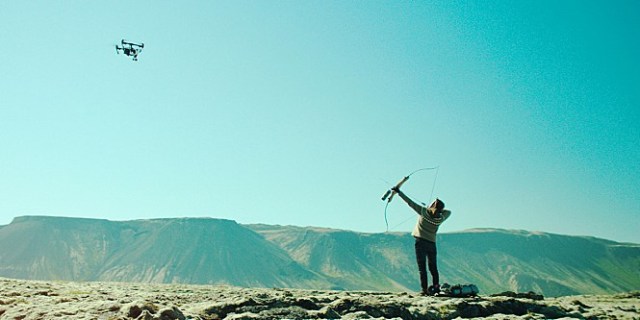
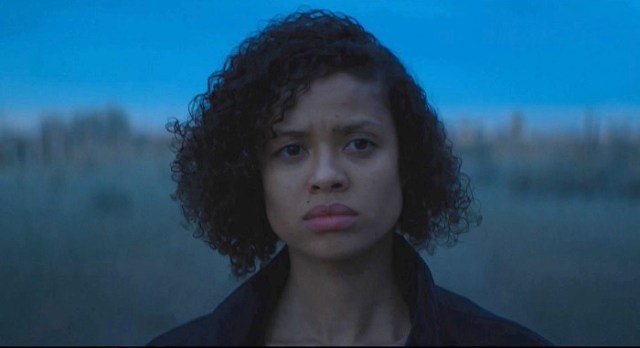
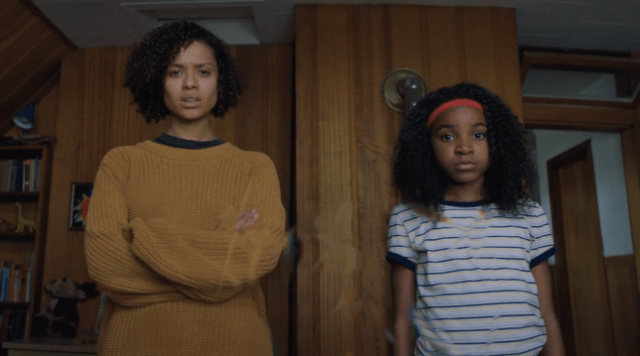
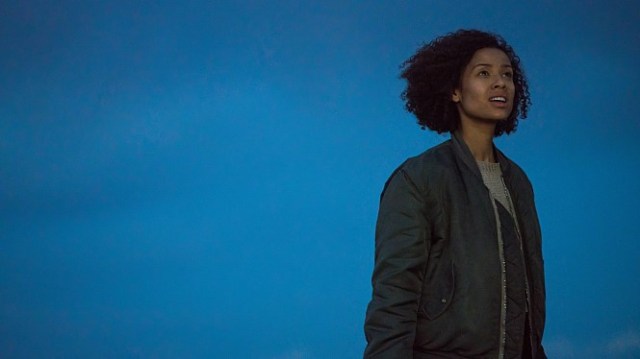
Tessa Thompson, who has been one of the most promising new performers since her breakout turn in “Dear White People” (2014), plays a young female drug dealer named Ollie, who was recently arrested for illegally crossing the border between North Dakota and Canada with a bag of prescription medicine pills. Because she managed to hide her drug in a nearby woods right before the arrest as shown during the opening scene, she has been on probation instead of being sent to jail, and she is now ready to make a new start as her probation period will be over after 8 days. While staying away from her old business as much as she can, she has diligently earned her living through several odd jobs including providing lunch to local construction workers, and her generous probation officer is willing to help her get a better job.

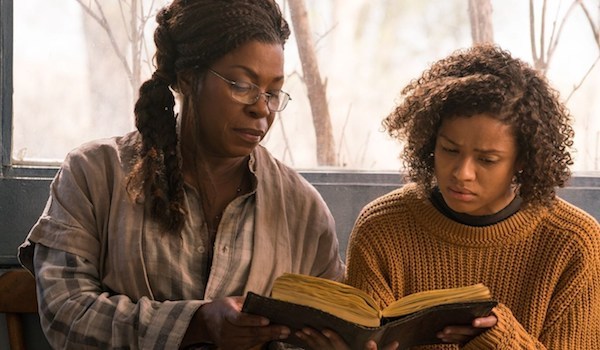
Of course, there soon comes a trouble which puts Ollie in a difficult situation. Her sister Deb (Lily James) happens to get pregnant not long after breaking up with her ex-boyfriend Ian (James Badge Dale), and she is not exactly in a very good situation for having another child besides her little son. She and her son have been living in a shabby trailer car which may be taken away someday for its illegal parking, and they cannot move to Ollie’s house because the house, which originally belonged to Ollie and Deb’s recently diseased mother, is due to be foreclosed by a local bank. After some negotiation at the bank, Ollie manages to decrease the amount of the down payment necessary to prevent the foreclosure, but neither she nor Deb has enough money for that, and it looks like there is nothing they can do about this impending matter of theirs.

littlewoods03

Eventually, Ollie becomes determined to do anything for obtaining the money to prevent the foreclosure, and she accordingly finds herself pulled back into her old business. After she retrieves that bag of pills from the woods, she promptly begins to sell them with some assistance from Ian, and it does not take much time for her to obtain a considerable amount of money.

She intends to quit once she earns enough for her and Deb, but things get a little more complicated as expected. While she must evade any chance of suspicion from her probation officer, she also has to deal with a local drug dealer for whom she once worked for, and there is a tense moment when she happens to be confronted by that guy, who is naturally not so pleased with what she has recently been doing in his business territory.

Meanwhile, we also see how Deb tries to deal with her unwanted pregnancy. When she comes to learn more about the considerable cost she has to pay for pregnancy, she decides to have an abortion, but there are not many options for her from the beginning. There is not any legal clinic for abortion around her town, so she has no choice but to go to her old friend and then contact someone who will do an illegal abortion for her, but then there comes another trouble which hits hard not only her but also Ollie.

As its two main characters are accordingly pushed to their inevitable choice later in the story, the movie calmly maintains its non-judgmental attitude while gradually increasing the tension under the surface, and it also did a good job of establishing the sense of isolation and desperation around the main characters in the film. As it becomes more apparent to them that they have no one to depend on except each other, Ollie and Deb come to stick together for taking care of their trouble, and we come to care more about what is being at stake for them.

littlewoods02

Like any good small character drama films, the movie depends a lot on the talent and presence of its main cast members. While Thompson certainly deserves all the praises which she received for her performance here in this film, Lily James, who has been more prominent since her performances in “Cinderella” (2015) and “Mamma Mia! Here We Go Again” (2018), is equally fine as another crucial part of the story, and I particularly appreciate how she and Thompson instantly establish a long relationship between their characters right from their first scene. Although Ollie and Deb do not talk that much about their family history, we can clearly sense how much they have known each other for years, and we later get a poignant scene where they happen to get a chance to be a bit more honest to each other.

In case of other notable cast members in the film, they bring life and personality to their seemingly thankless roles. While Jack Kirby is seedy and menacing as the aforementioned local drug dealer, Lance Reddick exudes quiet decency with some watchfulness as Ollie’s probation officer, James Badge Dale, who has been always dependable since I noticed him for the first time via his small but impressive supporting performance in “Flight” (2012), is especially good during one surprisingly emotional scene with James.

“Little Woods” is the first feature film from director/writer Nia DaCosta. Although she only directed one short film before making this movie, the overall result shows that she is a promising filmmaker with considerable potential, and I was not surprised to learn later that she was recently selected as the director of the upcoming sequel to “Candyman” (1992). Although I have some skepticism on that film, it will be interesting to see how much she will advance with it, and I will certainly look forward to watching it.

littlewoods04

Posted in Movies | Tagged , , , | Leave a comment

Ask Dr. Ruth (2019) ☆☆☆(3/4): America’s most famous sex therapist

askdrruth04.jpg

I like good documentary films about interesting human lives, and “Ask Dr. Ruth” is one of such cases. Here is a remarkable old German lady who moved to US after surviving the World War II and then became an unlikely celebrity willing to talk anything about sex for helping and enlightening many people out there, and the documentary gives us a lively and engaging portrait of this exceptional woman who is still active even at this point despite being over 90.

The documentary begins with how Dr. Ruth Westheimer is going through her usual daily schedule. While living alone in her longtime residence located in the Washington Heights neighborhood of New York City, she is ready for another busy day full of many things to do, and we subsequently see her going here and there for giving interviews or lectures.

In the meantime, she tells us about her dramatic life course. She was born as Karola Ruth Siegel in Germany in 1928, and her parents were members of a local Orthodox Jewish community, which certainly was thrown into danger when the country was dominated by the Nazi Party during the 1930s. Not long after Westheimer’s father was taken to a labor camp along with many other Jewish people in 1938, Westheimer’s mother decided to send young Westheimer to Switzerland, and, sadly, their eventual separation at a train station was the last time when young Westheimer saw her mother.

Along with many other Jewish kids, young Westheimer came to stay in an orphanage, and she soon got accustomed to her changed situation. Although she and other Jewish kids were demanded to do a number of jobs including taking care of other kids in the orphanage, things were not that bad for them, and, above all, they were safe from the horror of the World War II, which they later came to learn from a group of Jewish orphans who fortunately managed to escape into Switzerland.

askdrruth01

While desperately hoping for her reunion with her family, young Westheimer remembered and then followed what her parents always emphasized to her. Although she was not allowed to study in high school like many other girls, she diligently taught herself through the school textbooks borrowed from her first boyfriend, and there is an amusing scene where Westheimer visits his residence and talks with him a bit about their old time in Switzerland.

When the war was over, young Westheimer was indirectly informed that her parents did not survive the war, and there is a painful moment when Westheimer visits the Holocaust memorial center in Israel for confirming what exactly happened to her parents. Thanks to the remaining records, she comes to learn that her father died in Auschwitz, but, to her sadness, she cannot find what really happened to her mother, who was simply disappeared at some point during the war.

Not long after the end of the war, young Westheimer went to Israel, and she subsequently participated in the war between Israel and Arab after being trained as a sniper. During that dangerous time, she could almost lose both of her two legs due to a serious injury, but she managed to recover fully from the injury in the end, and she later went to Paris along with her first husband for their respective academic education courses.

When her first husband decided to go back to Israel a few years later, Westheimer chose to stay in Paris for more study, so they came to have a divorce under mutual agreement, and then she met her second husband, with whom she moved to US in 1956 when she fortunately acquired enough money for that. Although she divorced again not long after coming to US, she never lost her spirit at all while keeping going as usual, and then she came to meet her third husband Fred Westheimer, who was her lifelong spouse till his death in 1997.

askdrruth02

While working at Planned Parenthood, Westheimer became more interested in psychosexual therapy, and that led her to more education and studies. After getting a Ph.D. degree in Columbia University, she studied under a researcher named Helen Singer Kaplan during the 1970s, and she came to absorb more knowledge on sex and human mind while also becoming a qualified sex therapist.

And then there came a big break for her in the 1980s. She was asked to do a radio show on sex, and nobody expected much as sex was still a sensitive matter about which not many people were willing to discuss openly even at that time, but, what do you know, her radio show soon became quite more popular than expected although it was initially broadcast at Sunday midnight. Thanks to her no-nonsense approach to her sexual subjects as well as her irrepressible personality, Westheimer quickly drew lots of public attention, and a series of archival footage clips show us how much popular she became at that time.

Although she has usually stayed away anything involved with politics, Westheimer did not flinch at all from discussing those hot issues including abortion and AIDS, and she has also been a staunch advocate of gender equality for many years. She does not want to be called a feminist because she thinks she has been not as active as, say, Gloria Steinem or Ruth Bader Ginsburg, but her daughter and granddaughter sharply point that she is indeed a feminist, and that is one of the most funniest moments in the documentary.

On the whole, “Ask Dr. Ruth” gives us the engaging overview on Westheimer’s life and career, and director Ryan White presents his human subject with considerable affection and respect. She has surely lived her life well while also enjoying her works, and I am sure that she will keep going for the rest of her remaining life.

askdrruth03

Posted in Movies | Tagged , , , | Leave a comment

Dilili in Paris (2018) ☆☆1/2(2.5/4): A little mystery in Paris the Belle Époque

DililiinParis02

I was ready to enjoy French animation feature film “Dilili in Paris”, but it did not satisfy me enough. Sure, the film provides a number of lovely visual moments to be appreciated, and I was amused by the frequent appearance of real-life figures throughout the film, but it is also hampered by its thin narrative and superficial characterization especially during its second half. Although the overall result is admirable in technical aspects, the film often feels like the overextended version of a animation short film, and I found myself checking my watch from time to time despite its short running time (94 minutes).

During the opening scene which comes to reveal its absurd and twisted aspect in the end, we are introduced to a little Kanak girl named Dilili (voiced by Prunelle Charles-Ambron), and then we see how things have been pretty good for her since she came to Paris some years ago. Although it is around the early 20th century and she naturally faces racial prejudice at times as a girl of mixed blood, she does not mind that at all while comfortably staying in a big mansion belonging to some rich countess, who has been her guardian since she was found on a ship sailing to France (She never appears in the film, by the way).

Anyway, when she is doing a sort of part-time job during the opening scene, Dilili happens to encounter a young scooter deliveryman named Orel (voiced by Enzo Ratsito), and they instantly become close friends although they are total strangers to each other from the beginning. While quite surprised by how courteous and sophisticated Dilili actually is, Orel is willing to befriend Dilili, and Dilili is surely excited to have a friend who will take her to here and there in the city.

DililiinParis03

However, they are soon reminded of a certain mysterious menace lurking around the city. There is a secret criminal organization which has terrorized the citizens of Paris, and it has been particularly notorious for kidnapping young girls for some unknown purpose. After she is almost kidnapped by a member of this criminal organization at one point, Dilili becomes determined to track down this criminal organization although she is just a small kid, and Orel is certainly ready to help her.

Fortunately for them, Orel happens to be acquainted with a number of famous real-life figures who may provide them some help or information. First, they meet a group of young rising artists including Pablo Picasso and Henri Matisse, and that is just the beginning. Besides other prominent artists of the Belle Époque such as Claude Monet, Henri de Toulouse-Lautrec, and Auguste Rodin, they also meet Louis Pasteur and Marie Curie, and they later come across Prince Edward of England while trying to stop the latest crime of the criminal organization.

As these numerous historical figures come and go, the film constantly provides several wonderful scenes via its cell animation style. When Dilili and Orel visit a well-known singer named Emma Calvé (voiced by Natalie Dessay), she is singing a new song composed by Claude Debussy on a big swan boat floating on an underground pool, and then we are treated with a rather spooky moment as she and our two main characters go through the intricate underground sewer system of the city. In case of a part involved with Toulouse-Lautrec, we see those cancan dancers of the Moulin Rouge as expected, and then we get a brief but jolly moment when Toulouse-Lautrec has a little but precious moment of joie de vivre along with Dilili and Orel.

DililiinParis05

Eventually, Dilili and Orel come to discover what the criminal organization has been planning at its underground lair, and the situation becomes a little darker as Dilili is taken to that underground lair, but that is where the story comes to lose its narrative pacing as well as its charm and spirit. While the story seems to be trying to deliver a serious social message as Dilili and other several female characters in the story stick together for stopping a deplorably misogynous criminal mastermind behind the criminal organization, their opponent is a rather unimpressive villain, and it is all the more disappointing to see that the supposedly urgent situation in the story is resolved too easily and languidly in the end.

As I became more dissatisfied with the film, my mind was taken back to director/writer Michel Ocelot’s two previous works “Kirikou and the Sorceress” (1999) and “Tales of the Night” (2011). Sure, they also show some weak points in terms of story and character, but these two cell animation films have enough charm and style to compensate for their flaws at least. While I came to admire the plucky spirit of that tiny hero of “Kirikou and the Sorceress”, I also loved the simple but undeniably beautiful cell animation style of “Tales of the Night”, and I certainly had a good time as watching these two animation film together during one evening.

Compared to these two previous works by Ocelot, “Dilili in Paris” is less impressive on the whole, and I must tell you that it soon began to be faded away from my mind as I subsequently revisited Hayao Miyazaki’s great animation film “My Neighbor Totoro” (1988), which happened to be re-released in South Korean theaters a few weeks ago. While it is fairly charming and likable, I still think the film could be improved more through tighter storytelling with more depth, so I cannot recommend it, but I will not stop you if you simply want to kill your free time – or if you just want to see something different from those run-of-the-mill digital animation films out there.

DililiinParis04

Posted in Movies | Tagged , , , | Leave a comment

Rolling Thunder Revue: A Bob Dylan Story by Martin Scorsese (2019) ☆☆1/2(2.5/4): A rambling Bob Dylan documentary from Scorsese

rollingthunderrevue03.jpg

Bob Dylan has always been an iconic but distant figure to us. Sure, he has given us numerous memorable songs such as “Blowin in the Wind” or “Knockin’ on Heaven’s Door” for more than 50 years, but he has also been pretty enigmatic as going his own way, and we are still fascinated with him nevertheless. As having been your average longtime Bob Dylan neophyte throughout my life, I have only had a mild interest in his life and career, but I will not deny that I was quite intrigued by what was presented in Martin Scorsese’ HBO documentary film “No Direction Home: Bob Dylan” (2005) and Todd Haynes’ unconventional biography film “I’m Not There” (2007), which are, in my humble opinion, the best presentations of Dylan’s life and career.

As fondly remembering these two works, I certainly had some expectation on Netflix documentary film “Rolling Thunder Revue: A Bob Dylan Story by Martin Scorsese”, but I only found myself mired with bafflement and confusion instead of having more interest and fascination with Dylan’s life and career. As looking over Dylan’s legendary comeback concert tour in 1975, the documentary attempts to capture the mood and spirit surrounding the concert tour, but it somehow comes to lose its focus and perspective despite the prominent presence of Dylan in front of the camera, and I am not that sure about whether its whimsical shuffling of fact and fiction really works as well as intended.

Because the documentary does not provide much background information on Dylan’s concert tour, which was named Rolling Thunder Revue by Dylan himself without much thought or consideration, I guess I have to provide you a bit of background information I gathered from Wikipedia. Since that motorcycle accident in 1966, Dylan had stayed away from spotlight during next several years, but he eventually made a gradual comeback around the early 1970s, and he came to perform along with the Band during their concert tour in 1974. Not long after that concert tour, he came to decide to do another one, and he wanted to approach closer to his fans and audiences this time via performing in smaller auditoriums in less populated cities.

rollingthunderrevue02

For this concert tour, he gathered a group of musicians including Patti Smith, Ramblin’ Jack Elliott, Ronee Blakley, Joan Baez, and a female violinist named Scarlet Rivera, who was, according to Dylan, a rather odd woman for her eccentric aspects. In addition, Dylan had Allen Ginsberg follow the concert tour as a sort of spiritual companion for him and others in the concert tour, though I must confess that I was often wondering about what the hell Ginsberg was doing there except hanging around with Dylan from time to time.

As far as I could see from the documentary, Dylan wanted Rolling Thunder Revue to be a creative musical circus for him and his musician colleagues, and he often put a semi-transparent mask or white make-up on his face when he performed his songs on the stage. During his present-day interview, he argues that he could convey the truth to his audiences more effectively in that way, but, to be frank with you, I do not believe his argument much. His disguise looks merely silly to me, and I only came to muse that he might have looked a lot like the Joker if he had put more white make-up on his face.

In case of music and performance in the documentary, they did not engage me as much as I hoped. Sure, the documentary will not disappoint those Bob Dylan fans out there as providing many moments of Dylan and other musicians singing a number of recognizable songs such as “Mr. Tambourine Man”, but these moments do not particularly feel interesting or spirited to me, and the documentary simply meanders from one moment to another while not generating enough sense of clear narrative we can hold onto.

At least, Scorsese assembles a group of curious figures to be interviewed. While it is a little poignant for us to see late Sam Shepard, Ronee Blakley and Joan Baez are willing to tell more about their respective experiences with Dylan, and Sharon Stone has an amusing anecdote about her first encounter with Dylan. At that time, she was just an anonymous pretty young girl, but she happened to draw his attention via one coincidence, and she came to make Dylan interested in a certain famous rock group.

rollingthunderrevue01

However, I have to remind you that some of the interviewees in the documentary are not real people. In case of Stefan Von Dorp, who is presented as a filmmaker struggling to shoot the concert tour during that time, is not a real person but an actor named Martin von Haselberg, and you may recognize Michael Murphy if you have ever seen Robert Altman’s acclaimed HBO mini-series “Tanner ‘88” (1988). I guess Scorsese tries to have a little fun with mixing fact and fiction here in this documentary, but the result is too dry and plain to be appreciated in my opinion. Come on, if a subject is as vague as Bob Dylan, what is the point of making a fun of it?

During its last 30 minutes, the documentary becomes relatively more focused along with the performance of “Hurricane” and “Knockin’ on Heaven’s Door”, though they come too late for us. Rubin ‘Hurricane’ Carter, whose unjust legal ordeal was the subject of the former song, eagerly reminisces about his touching encounter with Dylan, and we do not have any doubt on Dylan’s sincerity while watching him passionately performing that song on the stage.

In conclusion, “Rolling Thunder Revue: A Bob Dylan Story by Martin Scorsese” is not a total bore, but it is also often baffling and frustrating due to its unfocused narrative flow, and I would rather recommend you to watch “No Direction Home: Bob Dylan” instead, which will give you more insights on Dylan’s life and career. He is indeed one of the greatest American musicians of our time, but he will probably remain distant and elusive as before, and that is the only definite truth we can get from this flawed documentary.

rollingthunderrevue04

Posted in Movies | Tagged , , , | Leave a comment

I Am Mother (2019) ☆☆☆(3/4): A slow but tense SF thriller on AI and motherhood

Iammother01

To be frank with you, I did not have much expectation while watching the trailer of Netflix film “I Am Mother”. Right from the first shot in the trailer, I had a pretty good idea about what it is about as well as how it is about, and I must say that the movie itself did not exceed my prediction much, but it is a modest but fairly engaging SF thriller film driven by not only its though-provoking ideas but also the tense and unnerving relationship dynamics amidst its few main characters – and that was more than enough for me to forgive several glaring weak aspects in the movie.

At the beginning, the movie establishes its gloomy futuristic background step by step. Due to some catastrophic global incident which seems to wipe out the entire humanity on the Earth, a clandestine underground facility is activated, and we meet an artificial intelligence robot which is going to take care of this facility alone for itself. The facility contains thousands of frozen human embryos to be used for the restoration of the human race, and we see the robot selecting one of these frozen human embryos and then putting it in a high-tech incubator where the embryo will grow up to be a baby girl after 24 hours.

More than 10 years later, the robot is now acting as ‘Mother’ to an adolescent girl whom it simply calls ‘Daughter’ (Clara Rugaard). While having learned a lot under Mother’s guidance for many years (You may be amused as she is watching the old clips from The Tonight Show Starring Johnny Carson), Daughter sometimes wonders about the world outside, but Mother often emphasizes to Daughter how the outside world is still dangerous, and there is a rather cruel moment when it ruthlessly exterminates a tiny biological creature found by Daughter just because it cannot allow any possibility of contamination.

Iammother05

At least, things do not look that bad for Mother and Daughter despite their many years of isolation. Although Mother is often strict to Daughter, it has been devoted to Daughter’s welfare just like any good mother, and it also promised to Daughter that she will have another family member someday if she is qualified enough for taking care of her future sibling.

Of course, there soon comes a problem into their small world. If you have seen the trailer, you surely know what kind of problem Mother and Daughter are going to face, but now I have to advise you not to read the rest of my review, because I may tell you too much even though I will try to avoid any possible spoiler as much as I can.

Because it was already shown in the trailer and the promotional poster, I can tell you that there is another main character in the story, who is played by Hilary Swank. Through the encounter with that character, Daughter begins to question what Mother has told her for many years, and that naturally leads to the growing tension between her and Mother, which comes to look more insidious as willing to suppress whatever is going on between Daughter and Swank’s character.

Iammother03

Although the movie could be improved by tighter storytelling with some more clarification and deliberation on what is exactly going on among its main characters, director Grant Sputore, who wrote the story with his screenplay writer Michael Lloyd Green, did a good job of holding our attention with a number of compelling moments which provoke some thoughts and reflections on its ideas and themes. As observing the increasingly problematic interactions between Mother and Daughter, the movie automatically evokes a bunch of notable movies about mother and daughter relationship ranging from “Mommie Dearest” (1981) to “Terms of Endearment” (1983), and it also reminds us of “Ex Machina” (2014) and several other recent SF films which explored our longtime fear and fascination with artificial intelligence. At times, Mother seems to be more than a bundle of programmed responses and behaviors, but then we come to observe its cold-blooded logical nature, and that aspect is chillingly conveyed to us when Daughter happens to discover something quite disturbing and horrifying later in the story.

The movie begins to falter when it tries to move its story and characters to the next local step during its last act, but it continues to engage us despite its several missteps, and its three principle performers carry the film well together. While Hilary Swank manages to balance her rather thankless character between sympathy and suspicion, newcomer Clara Ruggaard is convincing in her character’s gradual development along the story, and Rose Byrne is alternatively assuring and menacing in her calm, monotonous voice performance, which is, along with Luke Hawker’s motion capture performance and the special effects by Weta Workshop, is crucial in presenting Mother as something a lot more than a mere story tool.

Although it is less successful compared to “Ex Machina”, “I Am Mother” did its job as much as intended as a smart, intelligent SF tale, and I was entertained enough by its skillful moments despite my occasional disappointment with a number of weak elements in the film. It did not surprise me much in terms of story and characters, but it induced me to have some musings on artificial intelligence, and, to be frank with you, now I am wondering about how artificial intelligence will regard the movie if it finally becomes possible in our time. I really have no idea, but it will be pretty cool and interesting to hear a self-reflective opinion from artificial intelligence, won’t it?

Iammother04

Posted in Movies | Tagged , , | Leave a comment

Varda by Agnès (2019) ☆☆☆1/2(3.5/4): Her last words

Vardabyagnes04.jpg

I wish I had encountered the works of Agnès Varda earlier. During that wild period when I relentlessly devoured many works of various great filmmakers as your average young cinephile, I somehow missed many of her notable films except “Cléo from 5 to 7” (1962), and I only came to learn more of her life and career after reading Roger Ebert’s enthusiastic review on her acclaimed documentary film “The Beaches of Agnès” (2008), which I finally watched it early in last year along with her two other excellent documentaries “The Gleaners and I” (2001) and “Faces Places” (2017).

When her latest documentary film “Varda by Agnès” was shown at the Berlin International Film Festival early in this year, I was glad to see Varda keeping going strong as usual even though she was soon going to have her 91st birthday, but then she suddenly passed away on March 29th, and I still remember well when I came across the news of her death via Twitter. At that time, I was going to a local arthouse movie theater for watching Oscar-nominated documentary film “RBG” (2018), and, while quite surprised, I instantly told the news to an acquaintance of mine, who was also caught off guard by the news as a fellow cinephile.

While it feels more poignant now as becoming Varda’s last work, “Varda by Agnès” feels like a pleasant stroll nonetheless as vividly showing us that Varda did not lose any of her wit and spirit even around the end of her life and career. As being warm, witty, and ebullient as usual, she is willing to sit down and then talk a lot about her life and career in front of her audiences, and watching her musing on many things including her notable films is pretty entertaining to say the least.

Vardabyagnes03

At first, she tells us about the early years of her filmmaking career. After debuting with her first feature film “La Pointe Courte” (1955), she made several short films as honing her filmmaking skills, and then she rose to prominence with her second feature film “Cléo from 5 to 7”, a great film which sensitively observes the 90 minutes of a young popular singer who becomes quite agitated by the sudden possibility of terminal illness. Although she simply shot the film around real urban locations in Paris mainly due to its small production budget, Varda effortlessly imbues the film with considerable verisimilitude, and she explains a bit on a number of subtle visual touches in the film including a brief moment steadily showing the heroine walking down the stair step by step.

Around the time when “Cléo from 5 to 7” came out, Varda married Jacques Demy, with whom she went to Hollywood not long after the critical/commercial success of Demy’s “The Umbrellas of Cherbourg” (1964). During their time in Hollywood, Varda made a few works including a short film about the Black Panther Party, and she enthusiastically tells us about how much she was interested in capturing the dynamic cultural trend in the American society during the 1960s.

Although she was relatively less prolific during the 1970s, Varda subsequently came back with “Vagabond” (1985), which has been regarded as another great film in her career. At one point, Varda gives us an amusing moment to demonstrate the importance of the frequent tracking shots throughout the film, and we also get another fun moment when her leading actress Sandrine Bonnaire appears along with her and then talks about how it was often difficult for her to play her rather unlikable character.

Vardabyagnes05

In the 1990s, Varda made “Jacquot de Nantes” (1991), which meant a lot to her because it was inspired by the early years of her husband, who died not long before the movie came out. While “A Hundred and One Nights” (1995) was a critical/commercial flop, the movie had various movie stars ranging from Marcello Mastroianni and Anouk Aimée to Robert De Niro and Harrison Ford (!), and Varda recounts a fun episode on how strenuously De Niro prepared himself for his one-day shooting.

As entering the 21st century, Varda found an unexpected source of artistic inspiration: digital camera. As fascinated with the possible artistic freedom through digital camera, she decided to use it for vividly capturing various kinds of gleaning, and that led to not only “The Gleaners & I” but also a wonderful piece of installation art which was inspired by the production of that fabulous documentary. While subsequently making several other pieces of installation art, she kept working as a filmmaker as usual, and she certainly delighted us a lot with “The Beaches of Agnès” and “Faces Places”. She became more aware of her mortality than before, that did not stop her at all from pursuing her artistic vision as well as joie de vivre, but and these two lovely documentaries clearly showed us that she was still willing to share more with us through her art despite her declining physical condition.

Although it is relatively less special compared to Varda’s recent documentary films, “Varda by Agnès” is a solid swan song on the whole, and I was constantly amused and entertained by what Varda shows and tells during its 114-minute running time. I must point out that the documentary is technically more or less than a series of short lectures, and I still wish it would tell us more about Varda’s overlooked works such as “One Sings, the Other Doesn’t” (1977), but it did a fairly good job of giving us the compact overview of Varda’s life and career at least. We were lucky to see how steadily and diligently this great filmmaker had advanced during last six decades, and we will surely miss her more as time goes by.

Vardabyagnes01

Posted in Movies | Tagged , , , | 1 Comment

Gloria Bell (2018) ☆☆☆(3/4): As she reaches for more love and happiness

gloriabell04.jpg

They say you should not try to fix it if it is not broken, and that saying is applied well to Chilean filmmaker Sebastián Lelio’s new film “Gloria Bell”, which is the American version of his previous film “Gloria” (2013). While not so different from the original version in many aspects, the movie stays true to what makes the original version work so powerfully and beautifully, and it certainly helps that the movie is ably held together by one of the best movie actresses in our time.

During its early part, the movie shows us the mundane daily life of Gloria Bell (Julianne Moore), a middle-aged woman who has lived alone for several years since she divorced her husband and her two children came to live their own life respectively. While she has been content with the current status of her life, Gloria is still willing to reach for more love and happiness as shown from the opening scene unfolded in a local bar, but, so far, she has not had much success, and that makes her a bit depressed as she returns to her residence alone.

However, she is not someone who can be easily daunted, and we observe how active Gloria is for living her own life as usual. For example, she contacts her two children from time to time, and there is a small humorous scene where she spends some time with her son Peter (Michael Cera), who has to take care of his baby son for a while as his wife is doing some self-discovery travel outside. At her workplace, she often cheers up a colleague with whom she has worked for many years, and I could not help but smile as watching their brief afternoon respite outside the workplace.

And then there comes what may look like a good opportunity for Gloria. While going through another usual evening at that local bar, Gloria happens to spot a guy who also seems to be interested in her, and they subsequently get quite closer to each other after the formal introduction between them. Although she knows nothing about him, Gloria lets herself swept by the mutual attraction developed between them, and Arnold (John Turturro) turns out to be quite willing to go further than a mere one-night stand. Shortly after their first encounter, he contacts Gloria for a proper date, and she certainly feels happier than usual as spending more time with him.

gloriabell01

However, there is one big problem in their relationship. Although he has lived alone after divorcing his ex-wife some time ago, Arnold usually bends himself to the frequent demands from his ex-wife and their two daughters who are still not so independent despite being as old as Gloria’s two children, and this tendency of his comes to annoy and frustrate Gloria more and more, no matter how much she tries to understand and tolerate him.

In addition, Arnold shows a rather inconsiderate side when he and Gloria come to her son’s birthday party. As Gloria and other family members including her ex-husband Dustin (Brad Garrett) become jollier together as remembering their good old time, Arnold becomes petty and sulky in the corner, and then he commits a very rude thing which certainly hurts Gloria’s feeling while also baffling her family members.

While Gloria tries to deal with her problematic relationship with Arnold, the movie keeps maintaining its lightweight tone, and it is engaging to watch how the story continues to flow from one wonderful moment to another. Although these moments are more or less than the recreation of what was shown in the original version, Lelio skillfully presents these moments at least, and I found myself enjoying again a certain crucial moment involved with a skeleton puppet. While Gloria does not say anything during this moment, we can clearly sense her thoughts and feelings, and we are not so surprised when she later comes to give another chance to Arnold.

gloriabell03

As the center of the movie, Julianne Moore gives another stellar performance to be mentioned along with many other memorable ones in her long, illustrious career. While her performance here in this film naturally overlaps with Paulina García’s acclaimed work in the original version, Moore finds her own way to present the character, and the overall result reminds me again that great performers illustrate characters instead of merely playing them on the surface.

Lelio also assembles a number of notable performers around Moore, and they fill their respective roles as much as required. While John Turturro brings some sensitivity to his increasingly unlikable character, Michael Cera, Caren Pistorius, and Bred Garrett are solid as Gloria’s children and her ex-husband, and Garrett is particularly good when his character cannot help but become emotional as looking at old family photographs. Although she only appears in a couple of scenes, Holland Taylor leaves considerable impression on us as Gloria’s mother, and Rita Wilson and Sean Astin are also fine in their minor supporting roles.

On the whole, “Gloria Bell” does not surpass the original version, but it is surely another commendable work from Lelio, who initially drew our attention with “Gloria” and then impressed us more with “A Fantastic Woman” (2017), which garnered him a Best Foreign Language Film Oscar, and “Disobedience” (2018). Although I would recommend the original version first, the movie itself is still entertaining and interesting enough for recommendation thanks to not only Lelio’s competent direction but also Moore’s superlative acting, and I think you will appreciate it more if you have already watched the original version.

gloriabell05

Posted in Movies | Tagged , , | 1 Comment

Girl (2018) ☆☆☆(3/4): A transgender girl trying hard to be a ballerina

girl01

Belgian film “Girl”, which was selected as the official submission of Belgium to Best Foreign Language Film Oscar in last year, often made me nervous for good reasons. As calmly and closely looking into the ongoing daily struggle of its transgender adolescent heroine, the movie often feels tense and unnerving for the growing emotional turmoil beneath its mild, mundane atmosphere, and then it strikes us hard with a number of understated but powerful moments to remember.

During the early part of the film, we gradually get to know Lara (Victor Polster), a teenage transgender girl who has been preparing for her gender reassignment surgery. Because she has to wait for a while as going through a rather long process of hormone treatment and psychiatric evaluation as required, she cannot help but feel frustrated and agitated even though she is mostly treated well by her doctors, and even the considerable emotional support from her supportive single father and her little brother does not seem to help her much.

Lara is instructed to keep herself fit and healthy enough for her gender reassignment surgery, and she has no problem with that, but there is one complication. She is recently allowed to be trained at some prestigious ballet academy, but she must readjust her body in many physical aspects, and that certainly demands a lot from her right from the very start. For catching up with other female students in the ballet academy, she has to practice many basic ballet movements a lot during the additional training sessions with her generous ballet teacher, and some of you may wince whenever the movie shows how much demanding this process is to her poor feet, which frequently have to endure many strenuous ballet movements.

girl02

And she keeps feeling not so right about her body as before. Any of female students in her high school does not mind Lara using the same bathroom with them, and those young girls in the ballet academy let Lara having a shower with them, but her male body parts constantly remind her that she is still a boy. She tries to cover up her male genitalia as much as possible, but that still does not make her comfortable at all, while also subsequently causing the possibility of jeopardizing the preparation process for her gender reassignment surgery.

As Lara becomes more frustrated and troubled than before, the movie slowly and subtly dials up its level of tension on the screen, and there are several calm but emotionally intense moments which are difficult to watch at times. While she and her father come to conflict with each other due to the growing emotional gap between them, she also comes to clash hard with her little brother over a small private matter, and she keeps herself getting pushed further and further at the ballet academy in the meantime. As the camera fluidly follows her every ballet movement, we cannot help but become unnerved as sensing more of her pain and agony, and, not so surprisingly, there eventually comes a moment when she comes to face her physical/psychological limit.

What happens next later in the story as well as several other uncomfortable moments in the film have understandably drawn lots of criticism, and I must tell you that I often found myself questioning the intentions of director/co-writer Lucas Dhont during my viewing. As adamantly focusing on Lara’s face and body, the movie sometimes seems to objectify her from the distance instead of emphasizing with her, and I am still wondering whether the story, which was inspired by the life experience of a real-life transgender ballerina, should really be driven to its logical extreme around its finale (That real-life transgender ballerina in question approved the movie, and she later attended its premiere at the Cannes Film Festival in last year).

girl03

Anyway, the movie is still worthwhile to watch for several good reasons. Never allowing his movie to slip away from its frighteningly dry realism, Dhont steadily and skillfully captures whatever is churning behind his heroine’s seemingly serene façade, and Victor Polster, a non-professional male performer who happened to be selected after the unsuccessful gender-blind audition of around 500 candidates, is unforgettable in his extraordinary performance which won him the Un Certain Regard Jury Award for Best Performance at the Cannes Film Festival. While looking convincing as required during those numerous ballet practice scenes in the film, Polster did a commendable job of conveying to us his character’s deepening emotional struggle without any false move, and that is why we are shocked but not so surprised when his character decides to do something quite drastic in the end.

In case of a few other main performers surrounding Polster in the film, they are also effective in their natural acting. As Lara’s caring father, Arieh Worthalter is excellent when his character lets out his concern and frustration during one of his key scenes with Polster, and young performer Olivar Bodart holds his own small place well as Lara’s little brother, who turns out to have his own emotional issue to deal with.

In conclusion, “Girl”, which won the Caméra d’Or award for best first feature film as well as the Queer Palm award at the Cannes Film Festival, is definitely not an easy movie to watch at all, and I can see why it is disliked by some audiences and critics, but I still appreciate how it handles its sensitive subject with considerable intimacy and verisimilitude. As a matter of fact, I am glad to see that its controversial side has been leading to more talks and discussions on the proper representation of transgender movie characters, and I sincerely hope that there will be other good movies willing to show and tell us more about transgender people out there.

girl04

Posted in Movies | Tagged , , | Leave a comment

Rocketman (2019) ☆☆☆(3/4): A typical but flamboyant biographical jukebox musical film

rockeman01

“Rocketman” is a typical but flamboyant biographical jukebox musical film based on the life and career of a man who has been one of the most successful musicians in our time. While it is often generic and predictable in terms of story and characters, the movie is still fairly entertaining thanks to its brash mix of style, music, and performance, and I often found myself gladly going along with its bouncy energy and spirit despite some reservation.

The man in question is none other than Elton John (Taron Egerton), and the movie opens with when Elton voluntarily checks into a rehabilitation center for addicts while wearing his gaudy and colorful concert attire. As he casually admits to others at a meeting supervised by his counselor, he has struggled with serious addiction problems for many years, and, after recently hitting his latest bottom, he is ready to face his personal demons while also reflecting on many ups and downs in his life and career.

As Elton begins to ramble and whine on his life and career in front of his counselor and fellow addicts (how patient and generous they are!), the movie promptly takes us to his early years. During that period, he was a shy, introverted suburban kid named Reginald Dwight, and he was not that happy as growing up under his problematic parents who did not love much each other, but he felt happy whenever he let himself driven by his considerable musical talent. As getting the constant support from his grandmother, he was eventually allowed to study in the Royal Academy of Music, and we soon see him growing up to be a young adult musician full of hope and ambition despite his unknown status.

rockeman02

This is surely a familiar setup for your average rags-to-riches musician drama film, and the screenplay by Lee Hall does not exceed its genre conventions much, but the movie overcomes them with a series of wonderful musical moments driven by those popular songs of Elton. There is an enthralling scene where various suburban people singing and dancing around Elton and his younger self, and then there comes a little spirited moment when young Elton imagines himself conducting an orchestra for himself, and then we are served with another joyous song and dance scene which makes a smooth transition from Elton’s childhood period to his following adulthood period.

After performing at local pubs for a while, Elton is eventually brought to a record company run by Dick James (Stephen Graham), and Elton’s manager Ray Williams (Charlie Rowe) subsequently introduces Elton to a young lyricist named Bernie Taupin (Jamie Bell). While they do not click that well together at first, Elton instantly responds to Taupin’s lyrics with his relentless musical output, and that is the beginning of their long friendship/partnership during next several decades.

Once Elton and Taupin finally present something sounding good enough to Williams and James, Elton is allowed to take next several steps for his career, and it looks like nothing can stop him. After his breakthrough performance in LA, his career rapidly goes up and up with more hit songs, and he soon comes to reach to the top of his field while also regarded as the next big British pop star after the Beatles.

Around that time, Elton comes across a guy named John Reid (Richard Madden), who does not flinch at all from the mutual romantic feeling developing between them but subsequently turns out to be a wily opportunist. After pushing away Elton’s business associates, Reid becomes the one who manages everything in Elton’s life and career, and Elton has no problem with that while gradually letting himself emotionally abused by his lover/manager.

rockeman03

With his increasing feeling of self-hate, Elton comes to tumble into more despair and frustration. While pushing himself into more work as shown from a dizzy but dazzling musical sequence where he rotates from one big concert to another, he also begins to develop serious alcohol and substance problems, and that accordingly makes him more distant to a few good people close to him including Taupin, who is not so pleased to see his friend/partner getting worse and worse than before.

Of course, there eventually comes a dramatic moment when Elton comes to realize that he must do something for himself right now, and I must point out that the movie later falters a bit with several clichéd moments including the one where Elton make peace with various important figures in his life, but it is still engaging to watch due to the energetic lead performance by Taron Egerton. Besides doing a fantastic job of embodying Elton John’s contradicting personality, Egerton deftly handles numerous musical performance scenes through the film as singing Elton’s songs for himself, and he is also supported well by several good supporting performers including Jamie Bell, Richard Madden, Bryce Dallas Howard, Stephen Graham, Charlie Rowe, Gemma Jones, and Tate Donovan.

“Rocketman” is directed by Dexter Fletcher, who recently drew some attention for temporarily handling the notoriously troubled production process of “Bohemian Rhapsody” (2018) instead of Bryan Singer. While not breaking any new ground in its genre territory, the movie keeps engaging and entertaining us thank to Fletcher’s competent direction, and I think its overall result is a bit better than “Bohemian Rhapsody” at least. Sure, it is full of genre conventions and clichés, but it is imbued with enough style and gusto to compensate for its weak aspects, and I must tell you that it refreshed me a bit when I watched it at last night. I was very tired when I walked out of the screening room around midnight, but I felt good about the movie nonetheless, and that was more than enough for recommendation.

rockeman04

Posted in Movies | Tagged , , , , | 1 Comment

Dark Phoenix (2019) ☆☆(2/4): A lackluster finale for the 19-year-old franchise

darkphoenix01.jpg

“Dark Phoenix”, the last chapter for what was begun with “X-Men: First Class” (2011) and then continued with “X-Men: Days of Future Fast” (2014) and “X-Men Apocalypse” (2016), is messy and tedious to say the least. While merely trudging from one clunky moment to another, this mediocre dreck does not generate any tension or narrative momentum at all, and it is quite dissatisfying even when it is supposed to deliver a grand finale for what has been steadily built up via its several predecessors.

After the prologue set in 1975, the movie begins with the latest heroic moment of a bunch of mutant characters led by Charles Xavier/Professor X (James McAvoy). When a space shuttle is suddenly thrown into an unexpected big trouble caused by what looks like an solar flare, Xavier promptly sends his several mutants for rescuing those astronauts in the space shuttle, and, despite the considerable risk in this urgent circumstance, everyone including those astronauts safely returns in the end.

However, there is one problem. During the last minutes of the rescue mission, Jean Grey (Sophie Turner), a young mutant capable of psychokinesis and mind reading, happens to be exposed to that mysterious flare, and she fortunately manages to survive this incident, but it soon becomes quite apparent that something serious is happening inside her body and mind due to this incident. Despite the efforts of Xavior, Raven Darkhölme/Mystique (Jennifer Lawrence), and Hank McCoy/Beast (Nicholas Hoult), she becomes far more unstable as scared and confused about her increasing power and ability, and she also become quite angry once she comes to learn of what Xavier has suppressed inside her mind.

darkphoenix02

After one big subsequent clash with Xavior and her fellow mutants which results in a tragic consequence, Grey goes to Erik Lehnsherr/Magneto (Michael Fassbender), who has quietly been living in a remote spot along with some other mutants. At first, he does not want to get involved with Grey at all, but then he becomes quite vengeful when Hank approaches to him and then informs him of what Grey inadvertently committed, and that naturally puts him into another conflict with Xavier, who still believes there is a chance for Grey despite those havocs caused by her.

Meanwhile, the situation becomes more complicated when it turns out that there are a group of alien entities who want to get the source of Grey’s power. Led by their leader who happens to assume the appearance of Jessica Chastain shortly after the arrival in the Earth, they will not stop at nothing to get what they need for conquering the Earth (is that a spoiler?), and it does not take much time for them to confront Xavier and Lehnsherr, who soon come to see that they should stick together for stopping these aliens regardless of their different opinions on what they should do with Grey.

Considering its numerous characters and sprawling plotlines, the movie may need to be as long as, say, “Avengers: Endgame” (2019), but the screenplay by director/writer Simon Kinberg unwisely attempts to do everything within less than 2 hours, and the result frequently suffers from the deficiency in terms of story and characters. While the villains in the story are even less interesting than that big bad guy of “X-Men: Apocalypse”, our mutant characters remain to be more or less than plot elements to be moved around here and there as required, and that is the main reason why we do not sense much of what is being at stake for them even during the climactic part of the movie.

darkphoenix04

On the technical level, the movie provides us lots of CGI actions as expected, but they mostly look dull and uninspired on the whole, and that made me a bit nostalgic about “X-Men: The Last Stand” (2006). While that film was not very good in some aspects, I was rather generous to it because it delivered several big, enjoyable moments as demanded, and, in my trivial opinion, it did a better job of handling its similar plotline.

Above all, the movie seriously wastes the considerable talent of its main cast members. James McAvoy, Michael Fassbender, Nicholas Hoult, and Jennifer Lawrence comfortably slip into their respective roles as before, but none of them is particularly utilized well here in this film, and I was not so pleased to see Lawrence stuck in her thankless task without many things to do. In case of other notable performers in the film, Sophie Turner and Jessica Chastain try to have some fun as dabbling in their respective characters’ dark sides, but they are hopelessly limited by their bland characters, and the same thing can be said about Tye Sheridan, Kodi Smit-McPhee, Alexandra Shipp, and Evan Peters, who sadly does not give us anything as funny and exciting as what he did in “X-Men: Days of Future Past” and “X-Men: Apocalypse”.

Besides being one of the most disappointing summer blockbuster films of this year, “Dark Phoenix” is a lackluster ending for the 19-year-old franchise full of ups and downs ranging from “Logan” (2017) to “X-men Origins: Wolverine” (2009), and the only consolation for us is that, considering the ongoing trend of recent superhero movies, the franchise will be rebooted sooner or later. It is not as terrible as I dreaded before walking into the screening room, but it was quickly disappeared away from my mind once I promptly moved onto another movie to watch, and that was all.

darkphoenix03

Posted in Movies | Tagged , , , , , | Leave a comment