Breathless (1960) ☆☆☆☆(4/4): Still bold and spirited

For many years, watching Jean-Luc Godard’s ground-breaking film “Breathless” has felt like homework for me. To be frank with you, I usually prefer François Truffaut’s movies to Godard’s, and I usually find many of Godard’s films rather cold, haughty, and distant, though I admire some of his early works including “Vivre sa vie” (1962) and “Band of Outsiders” (1964).

However, my impression on “Breathless” is changed a bit now, probably because I recently watched Richard Linklater’s “Nouvelle Vague” (2025), which is a lightweight dramatization of the making of “Breathless”. As watching “Nouvelle Vague”, I came to have more understanding on what Godard boldly attempted to do at that time, and that makes me appreciate more of that precious lightning captured inside “Breathless”.

Even before “Nouvelle Vague” came out, the story behind the making of “Breathless” has been known well to many of us for many years. Godard wrote the screenplay from the story conceived by Truffaut, but he and his cast and crew members frequently depended on instant improvisation, as he tried to break all the conventions and rules for making something different just like many of his fellow critics of Cahiers du Cinéma who became the leading figures of the French New Wave during the 1960s. 
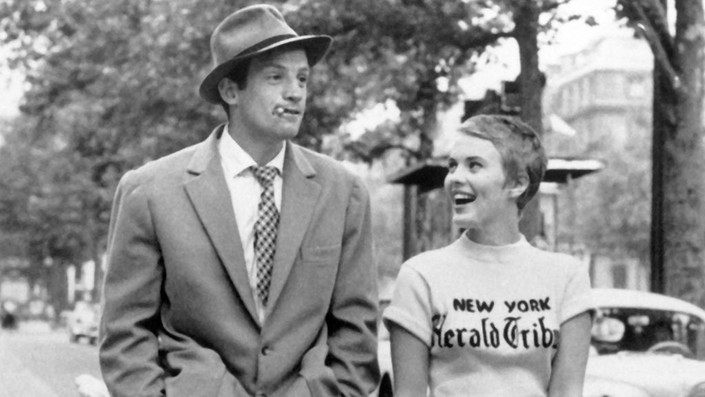
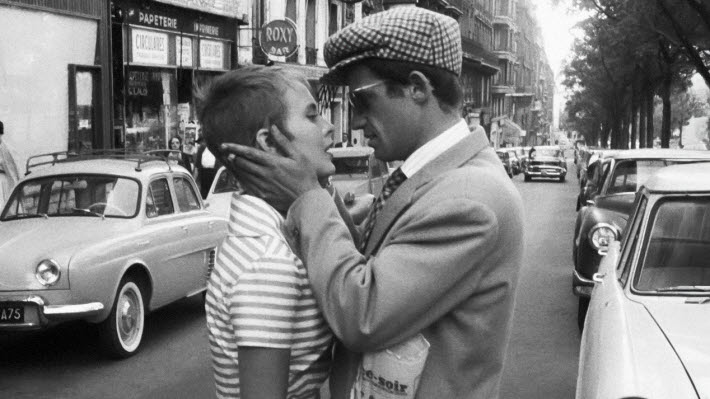
As amusingly shown in “Nouvelle Vague”, even Godard seemed not to know what exactly he was trying to make with his cast and crew, but his audacious cinematic gamble led to one of the most important breakthroughs in the movie history. Yes, he and the movie changed the vocabulary of cinema forever via the bold and unconventional utilization of jump cut, and its frequent jump cuts still catch our attention with the sheer audacity actually coming from practical reasons (He needed to shorten the movie to a considerable degree during the post-production period, you know). At the same time, we are drawn more to the raw energy and excitement generated by its defiantly free-flowing narrative and its two broad but undeniably compelling lead characters, and you may come to understand more of whatever Godard has attempted since this remarkable first feature film of his.

One of the two lead characters in the film is Michel Poiccard (Jean-Paul Belmondo), a young small-time car thief who is a textbook case of “style-but-no-substance”. Whenever he is not doing anything criminal, he often tries to imitate those gangster characters of the Hollywood movies from the 1940-50s, and this aspect is particularly evident when he looks into the photograph of Humphrey Bogart for a while at one point in the middle of the story.   

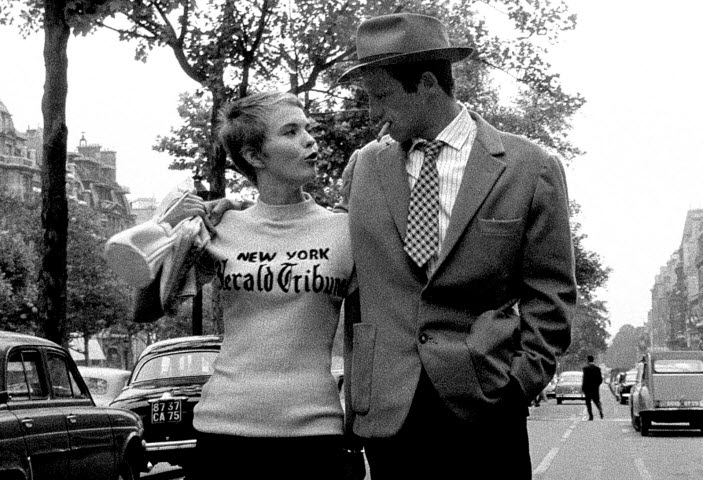
At the beginning of the story, Michel gets himself into a very serious trouble. Not long after stealing another nice big car, he finds himself pursued by a couple of police officers, and he inadvertently killed one of them. Needless to say, he becomes quite desperate as looking for any chance to grab some money to help his getaway, but then he gets irresistibly attracted to Patricia Franchini (Jean Seberg), a young and beautiful American who has aspired to be a newspaper journalist while also being about to enroll in Sorbonne University in Paris.

Most of the movie focuses on the offbeat romantic interactions between these two different figures. Even though the time keeps running out for him, Michel wants to spend more time with Patricia, but Patricia remains rather distant to him even though it is apparent that she is intrigued by his vapid but amusing panache. Their romantic tension eventually culminates to an assured long-take scene unfolded inside Patricia’s little residence, but, again, Patricia keeps her counsel to herself as much as Michael Corleone. While both of them just began their respective movie acting careers before appearing together in the film, Jean-Paul Belmondo and Jean Seberg effortlessly complement each other as fully embodying their respective archetype roles, and their iconic characters certainly opened the door for many other similar movie couples such as, yes, the titular characters of Arthur Penn’s equally great breakthrough film “Bonny and Clyde” (1967).  

Meanwhile, the movie cheerfully bounces from one narrative point to another as occasionally adding a series of self-conscious touches to amuse you. You will smile a bit when Cahiers du Cinéma briefly appears early in the film, and Michel’s occasional alias, Laszlo Kovacs, is the name of Belmondo’s character in Claude Chabrol’s 1959 film “Web of Passion” in addition to being the name of a well-known Hungarian cinematographer. While cinematographer Raoul Coutard brings a lot of realism and verisimilitude to the screen via several unorthodox shooting methods used by him and Godard (He even shot one certain scene while hiding inside a rather small wooden box, for example), the care-free attitude of the movie is often accentuated by the jazzy score by Martial Solal.

In the end, like many other criminal movie couples, Michel and Patricia come to face the inevitable end of their deviant fun and excitement, and that is where the movie becomes a bit elusive. In what can be regarded as a pretty self-serving act, Patricia comes to betray Michel, and Michel leaves a little gesture along the very bitter final word at the end of his casual but undeniably striking death scene. While Coutard’s camera looks into Patricia’s face at the very end of the film, Patricia remains elusive as before, and we keep wondering where her heart really lies.

On the whole, “Breathless” still feels young and spirited just like many other great films such as Orson Welles’ “Citizen Kane” (1941), and it will surely take you back to the time when Godard was really cool and interesting. I still have reservation on most of his later films including “Goodbye to Language” (2014), but he did contribute a lot to cinema at least when he was young and wild, and we can still appreciate that.
Posted in Movies | Tagged , | Leave a comment

My Sunshine (2024) ☆☆☆(3/4): A coming-of-age drama on ice 

Japanese filmmaker Hiroshi Okuyama’s latest film “My Sunshine” is a modest but engaging coming-of-age drama to be appreciated for several good reasons. While the story and characters are quite familiar to say the least, the movie patiently builds up its mood and story as doling out little human moments to observe, and the overall result is another interesting work from its talented director.

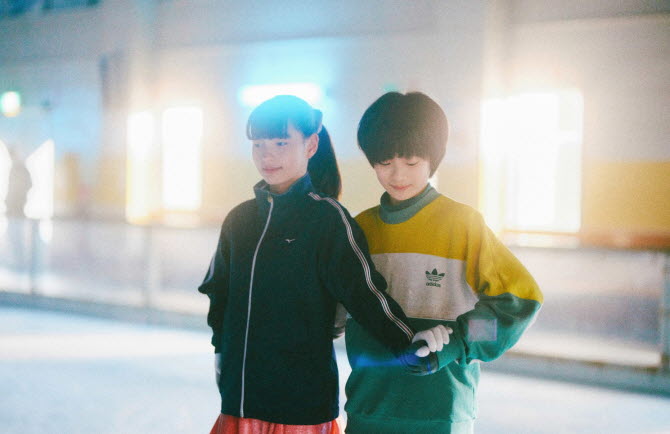
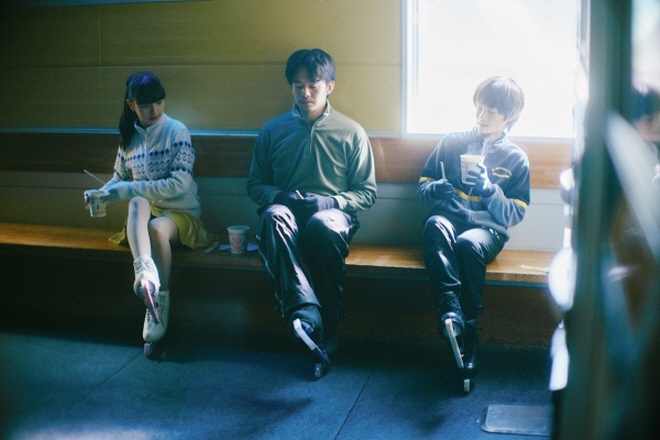
The movie mainly revolves around three main characters, and the opening scene introduces us to one of them, who is a young boy named Takuya (Keitatsu Koshiyama). Besides stuttering at times, Takuya does not get along that well with his schoolmates, and that is more evident to us when he plays ice hockey along with them during one cold winter day. He merely participates in the game as the goalkeeper without much enthusiasm, and, not so surprisingly, many of his schoolmates complain about his lack of effort after the game is over.

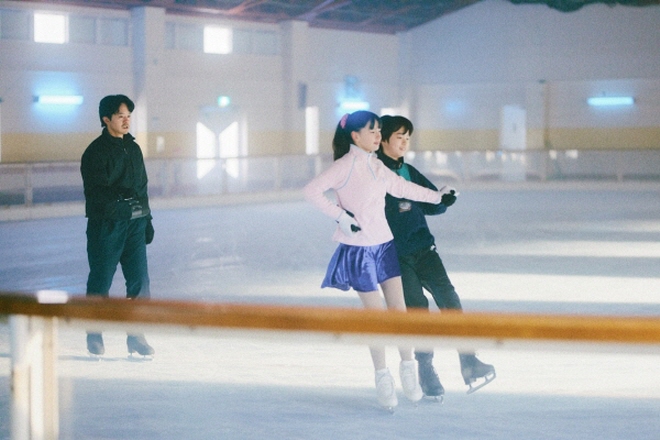
Anyway, Takuya continues to practice hockey along with them during next several days, and then something begins to draw his attention on one day. He and his schoolmates happen to practice on the same rink where several female figure skaters around his age are also doing some practice together, and, what do you know, he cannot help but become mesmerized by all the graceful movements of figure skating. Soon, he begins his own practicing alone on the rink, and that happens to draw the attention of Arakawa (Sosuke Ikematsu), a figure skating coach who has been teaching several young female figure skaters after he returned to his hometown.

Probably because he saw his younger self from Takuya, Arakawa eventually starts to help and then teach Takuya. Although it takes some time for getting himself more accustomed to figure skating at first, Takuya comes to show more potential along with more enthusiasm, and Arakawa later decides to pair Takuya with Sakura (Kiara Nakanishi), who is one of those young female figure skaters under his coaching.

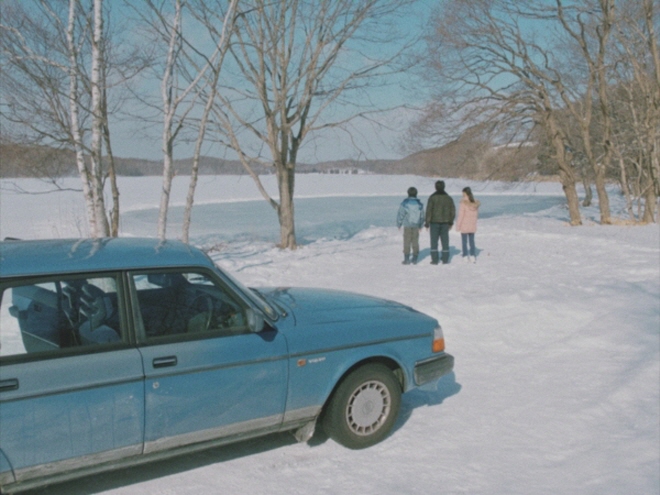
Now the story looks more like an icy winter version of Stephen Daldry’s Oscar-nominated coming-of-age drama film “Bilie Elliot” (2000), but the movie sticks to its dry and restrained attitude as leisurely rolling its story and character from one narrative point to another. Yes, Sakura, who is evidently interested in getting closer to her handsome male coach, is certainly not so pleased at all when she has to train along with Takuya, but she goes along with Arakawa’s decision anyway, and she turns out to be a fairly good partner for Takuya. Yes, Takuya surely shows more improvement in response, and that brings extra joy and excitement to his mundane middle-class daily life. Neither his parents nor his older brother is particularly supportive, but they do not mind him practicing figure skating instead of ice hockey at all, and he comes to dedicate himself more to that under Arakawa’s steady guidance.

Meanwhile, the screenplay written by Okuyama, who also served as the editor and cinematographer of the movie, gradually reveals a bit about Arakawa’s inner life. As reflected by a bunch of old stuffs belonging to him, he was once a very famous figure skater, and he cannot help but become a bit wistful even though knowing well that his days of glory were way behind him now. In addition, it is revealed that he has something he has mostly kept to himself, and, not so surprisingly, that leads to a little conflict when Sakura happens to discover that later in the story.

It goes without saying that the story eventually arrives at what is supposed to be a big moment for its three main characters. However, the movie sidesteps expected genre clichés a bit to our little surprise, and there comes a somber moment of personal self-reflection for Arakawa, who comes to muse more on what he really wants from the rest of his life. The following finale is a bit too restrained in my humble opinion, but you may appreciate how the movie pulls out small signs of optimism from each of its three characters at least. 

The movie relies a lot on the effortless interactions between its three main cast members, who all give good performances under Okuyama’s competent direction. While Keitatsu Koshiyama humbly holds the center with his unadorned earnest acting, Kiara Nakanishi ably fills her role with enough presence and personality, and Sosuke Ikematsu has his own moments to stand out while diligently supporting his two younger co-stars as required. In case of several figure skating scenes in the film, these scenes are skillfully handled with enough realism, and both Koshiyama and Nakanishi look convincing on the rink while occasionally brightening up the mood. 

In conclusion, “My Sunshine”, which belatedly came to South Korean theaters in this week although it was premiered at the Un Certain Regard section of the 2024 Cannes Films Festival and then was shown in the Busan International Film Festival in the same year, is relatively drier than “Billie Elliot” and many other similar coming-of-age drama films out there, but it distinguishes itself enough mainly thanks to its sensitive mood and storytelling. Although it is one or two steps down from his impressive first feature film “Jesus” (2018), Okuyama confirms to us again that he is another promising Japanese filmmaker to watch, and I will certainly keep watching on his advancing filmmaking career.

Posted in Movies | Tagged , , | Leave a comment

Poppoya (1999) ☆☆☆(3/4): The life of a station master

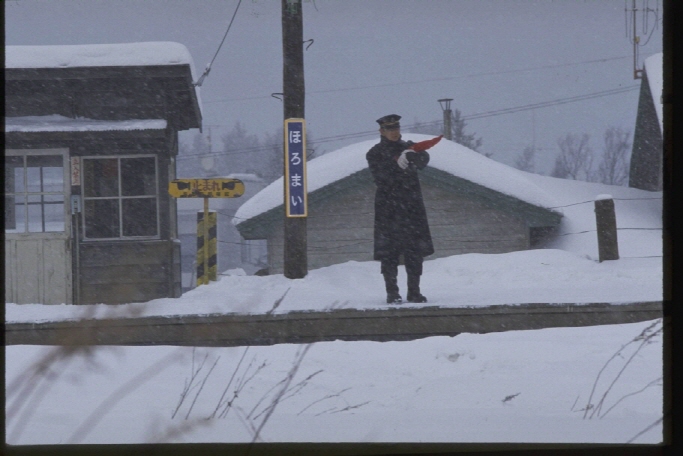
Japanese filmmaker Yasuo Furuhata’s 1999 film “Poppoya” is the story of one dedicated railway station master. While he has simply devoted himself to his menial occupation for more than 20 years without much complaint at all, he has also kept a lot of personal feelings to himself just for doing his professional duty day by day, and the movie is often poignant as gradually revealing his humanity along the story.

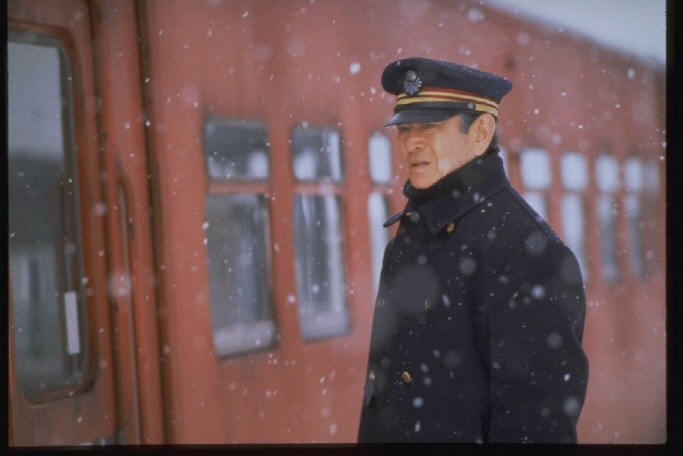
The early part of the film quickly establishes its hero’s early years. During the 1950s, Otomatsu Satō (Ken Takakura) was a diligent lad who worked as a train operator in some rural region of Hokkaido. Around the 1970s, his train company eventually promoted him a bit, and that is how he became the railway station master of one small coal mine village.

However, things have been recently not so good for Satō. After the coal mine was shut down several years ago, the village becomes far less populated than before, and then the train company decides to shut down the line. His close colleague suggests that he should move onto some other job just like him after his upcoming retirement, but Satō does not care much about that at all, while mostly being occupied with his daily job at the station as he has always been.

And we get to know more about his plain private life. He and his wife, who unfortunately died a few years ago, once had a daughter after many years of attempting to have a child between them, but, alas, their precious daughter died due to a sudden illness even before having her first birthday. Nevertheless, Satō kept focusing on doing his professional duty as usual, and this certainly hurt his wife’s feelings a lot, though she still loved and understood her husband.

While he has surely been lonelier since his wife’s death, Satō remains surrounded by his close colleague and several others who really care about him. Although he is not a very social person compared to his close colleague, many of his colleagues in the company regard him with a lot of respect and admiration because of his longtime professional dedication. In case of a sweet old lady who has ran a little restaurant in the village for many years, she has been pretty much like another family member to Satō, and there are a couple of moving flashback scenes showing how she came to take care of a little boy along with Satō and his wife after that boy happened to lose his single father due to an unfortunate mine accident.

While the weather gets a lot colder and snowier during what turns out to be his last winter season at the station, Satō continues to work as if nothing changed much, but there soon comes a number of small events unfolded around him. His close colleague visits him just for having a little drinking night along with him, and they naturally become a bit wistfully nostalgic about their shared past. In addition, Satō is visited by three different girls one by one when he is working alone by himself, and, though they are supposed to be the granddaughters of one of his village neighbors, he cannot help but become protective about them as being moved a bit by something special about them.

Steadily building up its story and characters bit by bit, the screenplay by Yoshiki Iwama, which is based on the novel by Jirō Asada, gives us more glimpse into its taciturn hero’s quietly beating heart. Just because of his unflappable sense of duty and pride, Satō has always restrained himself throughout his whole life, and the recurring memories of his wife and daughter lead him to more sadness and regret. Sure, he could have done better for them, but he and his wife also had some little happiness together in their married life, and there is a touching scene when he comes to have an unexpected moment of consolation later in the story.

Needless to say, everything in the film depends a lot on the subtle but engaging lead performance by Ken Takakura, whom you may recognize for his notable supporting turns in several American films such as Ridley Scott’s “Black Rain” (1989). While looking quite dry and restrained in his low-key appearance, Takakura deftly conveys to us his character’s inner feelings without overstepping at all, and that is why several key moments in the film are so dramatically effective. Whenever Satō cannot help but show his emotions a bit, Takakura’s minimalistic acting shines with small human touches to observe, and we come to care more about his character than before.

Around Takakura, several other main cast members in the film come and go as functioning as livelier counterparts to his low-key acting. While Nenji Kobayashi provides some comic relief as Satō’s close colleague, Shinobu Otake brings a bit of precious human warmth to the story as Satō’s loving but fragile wife, and Yoshiko Tanaka, Ryōko Hirosue, Hidetaka Yoshioka, Masanobu Ando, and Ken Shimura have each own moment to shine along the story.

On the whole, “Poppoya”, which means “railroad worker” (鉄道員) in Japanese, is basically your typical sentimental melodrama, but it is tastefully handled via good mood and storytelling in addition to being supported well by the commendable efforts from its main cast members. Right from the beginning, you will clearly see where it is going, but you will be touched to some tears when it eventually arrives at its destination point.

Posted in Movies | Tagged , , , | Leave a comment

Good Fortune (2025) ☆☆1/2(2.5/4): The trouble with an angel

Aziz Ansari’s first feature film “Good Fortune” is a mildly amusing comedy which could push its comic promise further before arriving at its predictable ending. Thanks to the game efforts from Ansari and several other main cast members in the film, I was not bored at all during my viewing, but I also wished the story could go further with their considerable comic talent.

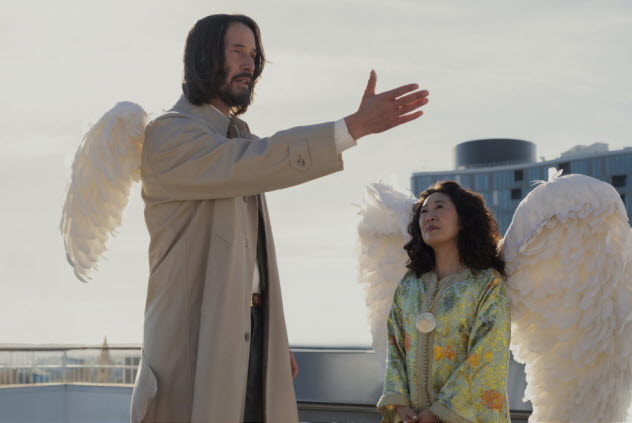
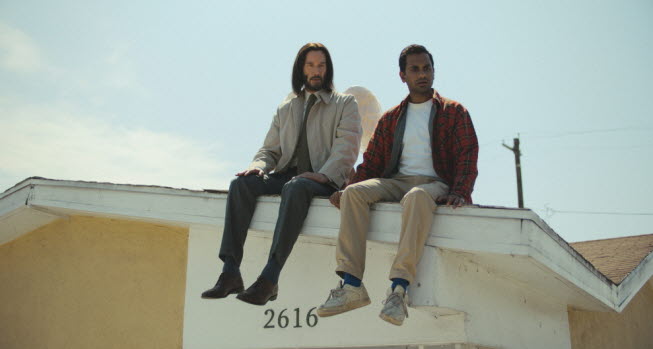
At first, we get to know about an angel named Gabriel (Keanu Reeves), who has worked as a hidden guardian preventing people from having car accidents due to texting during their driving. Although he has saved a lot of people for many years, Gabriel has been tired of his current position, and he desperately wants to get promoted for doing something more important and meaningful.

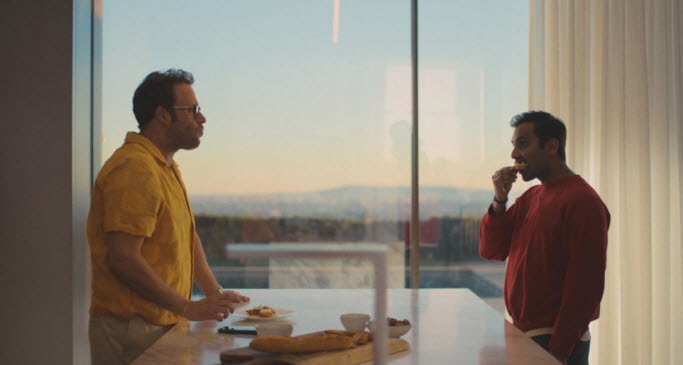
Just for proving himself to his supervisor, Gabriel tries to help a plain lad who has been struggling a lot due to his very desperate economic status. While he once aspired to become a documentary filmmaker, Arj, played by Ansari, has to do several different jobs for making ends meet day by day, and then there comes a nice opportunity via Jeff (Seth Rogen), your average wealthy tech bro who instantly hires Arj once Arj shows him that he is willing to do anything for any kind of stable income. However, Jeff soon fires Arj just because Arj crosses the line a bit, and then things get worse and worse for Arj after that.

Just like James Stewart’s hero in Frank Capra’s “It’s a Wonderful Life” (1946), Arj becomes quite depressed as facing the bottom of his life, and that is when Gabriel enters the picture. He initially tries to show Arj how his life will be in the future, but Arj does not become hopeful or optimistic at all despite Gabriel’s efforts, and that eventually makes Gabriel do a rather drastic thing. He switches the positions between Arj and Jeff, and now Arj comes to enjoy everything once belonging to Jeff, while Jeff comes to serve Arj without remembering anything about his previous position in contrast to Arj.

Gabriel just tries to show Arj that wealth and privilege cannot buy happiness, but, what do you know, Arj finds himself enjoying more of all things Jeff’s money can buy. When the time for his decision comes later, he refuses to change his position with Jeff’s, and Gabriel only ends up complicating the situation further. In the end, his supervisor comes for handling this big problem, and Gabriel consequently finds himself being stuck in Jeff, who is not so pleased to say the least after belatedly realizing what happened to him due to Gabriel’s well-meaning but unwise actions.

What follows next is a sort of lightweight version of Wim Wenders’ “Wings of Desire” (1987). Besides losing his small wings, Gabriel becomes a human being as a part of his ongoing suspension, and he gets to know and experience more of human condition. While he often finds himself in a lot of despair and frustration as struggling to live just like Arj did, he also discovers a number of good things to cherish, such as tasting a hamburger for the first time.

As Ansari’s screenplay shifts its focus a bit more toward Gabriel’s narrative arc, Keanu Reeves often shines with his enjoyable deadpan comic performance. While he looks as phlegmatic as he did in “John Wick” (2014) and several following sequels, he is often effortlessly funny as his character clumsily bounces from one point to another along the story, and we actually come to care more about his character more than expected.

On the opposite, Seth Rogen, who has steadily amused us in one way or another for more than 20 years since I noticed him for the first time via his supporting role in Judd Apatow’s “The 40-Year-Old Virgin” (2005), functions as an effective counterpart to Reeves. Yes, Jeff is pretty disagreeable at first just like many of those tech bros in our increasingly troubled world, but he is amusing to watch thanks to Rogen’s good comic talent, and he also did a convincing job in his character’s gradual transformation along the story.

Compared to his two co-stars, Ansari somehow falters mainly due to his relatively less interesting character. We are supposed to care about Arj as much as Gabriel and Jeff, but the movie feels rather distant to his character arc, probably because of the showy comic materials given to Rogen and Reeves’ characters. There is a subplot involved with the possible romance between Arj and a supporting character played by Keke Palmer, but this does not seem to go anywhere except its expected arrival point.

In addition, I was particularly disappointed to see two excellent performers simply coming and going without much to do on the whole. As Gabriel’s no-nonsense supervisor, Sandra Oh is under-utilized during her several key scenes with Reeves, and Stephen McKinley Henderson, who plays one of the senior angels early in the story, manages to leave some impression during his very brief appearance.

Overall, “Good Fortune” works to some degree mainly thanks to the solid comic performances from its reliable main cast members, and Ansari makes a fairly competent directorial debut here, though I have regarded him with some reservation for several reasons including that his alleged sexual misconduct which drew a lot of attention in early 2018. I must confess that I still hesitate to say anything nice about him, but I can tell you at least that you will probably enjoy the movie more than I did, and that is all, folks.

Posted in Movies | Tagged , | Leave a comment

Super Happy Forever (2024) ☆☆1/2(2.5/4): Not much beyond his self-pity

Self-pity can be one of the most tedious things to observe. As watching the first half of “Super Happy Forever”, I kept wondering why I should pay attention to the drab and superficial presentation of its rather uninteresting hero’s self-pity, and this impression of mine unfortunately remained to the end even though the movie later shifts its focus to the other main characters in the story and becomes a bit more engaging to my little relief.

The main background of the story is a resort hotel located in a seaside town named Atami. Although it is about to be shut down within a few days, Sano (Hiroki Sano) and his nurse friend Miyata (Yoshinori Miyata) came to spend several days at the resort mainly for some group activity involved with Miyata, and we come to sense that there is something wrong about Sano as observing how passive and quiet he usually is compared to his friend.

Although he does not tell much, we gradually gather what recently happened to Sano. Around 5 years ago, he came across a woman named Nagi (Nairu Yamamoto) at the same resort, and their accidental encounter led to their romance and then their marriage. Alas, Nagi suddenly died not so long ago, and Sano has felt a lot of grief as well as guilt, while regretting how he was not a very good husband to his wife.

However, the movie merely observes its hero’s self-pity and guilt from the distance without adding much insight or understanding on his ongoing melancholy. As a result, Sano often looks like your average pathetic jerk who does not seem to care much about how he often makes others around him including his friend very uncomfortable to say the least. Yes, we all can be quite pathetic and annoying as struggling with our personal pain and grief, but the movie fails to bring more human details to observe from its hero. Despite the earnest efforts from Hiroki Sano, his character ends up becoming a tepidly one-note character instead of becoming a human figure to engage us more along the story, and Yoshinori Miyata does not have much to do except looking patient or frustrated as required by the story.

Thankfully, the story subsequently moves onto its second act, which is more interesting as looking into how Sano and Nagi met 5 years ago mainly via Nagi’s viewpoint. She was supposed to come down to the resort along with a female friend of hers, but her friend suddenly could not come due to a serious family matter of hers, so Nagi had no choice but to spend next several days alone in Atami.

As wondering here and there without any particular plan, Nagi happens to have a little encounter with Sano via a rather amusing incident at the lobby of the resort. Although this encounter of theirs is quite brief, Nagi and Sano recognize each other when she comes across him again later, and what follows next is the slow but gradual relationship development between them. Although they are certainly total strangers to each other, something seems to click between them as they interact with each other more and more, and they even come to spend some time with Sano’s nurse friend.

Meanwhile, several notable story elements appearing in the first half pop up here and there during this part. For example, we come to learn why Sano becomes quite fixated on one particular red cap after Nagi’s death, and we also get to know why a certain famous classic pop song by Bobby Darin means so much to him and Nagi. In addition, there is also a young Vietnamese woman working in the resort, and it goes without saying that she will play a small but substantial part later in the story.

Nevertheless, I still did not care much about the story and characters as becoming more aware of the narrative design of the movie. Even during the second half, Sano remains a rather under-developed character, and Nagi sometimes feels a little too elusive while mainly defined by her frequent forgetfulness besides her natural charm. At least, Sano and his co-star Nairu Yamamoto generate enough chemistry during several key scenes of theirs in the film, and it is a shame that the screenplay by director/co-editor Kohei Igarashi and his co-writer Koichi Kubodera does not provide them more human elements for fleshing out their respective roles more.

In case of its technical aspects, the movie is mostly solid on the whole thanks to Igarashi’s competent direction. He and cinematographer Wataru Takahashi did a commendable job of filling the screen with a subtle sense of melancholy during the first half, and that is contrasted well with the relatively more relaxing tone of the second half. Although I have never been to Atami, this little town looks like a nice place for vacation as far as I can observe from the movie, and you may come to have the same thought after watching it.

Overall, “Super Happy Forever”, which comes from a phrase used in that group activity associated with Sano’s nurse friend in the story, does not satisfy me enough for recommendation even though it bored me less than I expected at first. Fortunately, Juzo Itami’s 1985 film “Tampopo” was the next movie to be shown at the same screening room right after I watched “Super Happy Forever”, and I gladly grabbed the chance without any hesitation. As a matter of fact, you will have a much better time with that film instead of watching “Super Happy Forever”, and you will surely thank me for my inconsequential recommendation.

Posted in Movies | Tagged , , | Leave a comment

Father Mother Sister Brother (2025) ☆☆☆1/2(3.5/4): A trio of sublime family dramas from Jim Jarmusch

Jim Jarmusch’s latest film “Father Mother Sister Brother”, which won the Golden Lion award at the Venice International Film Festival in last year, is as dry, humorous, and touching as you can expect from him. As doling out its three different stories loosely connected with each other via several recurring story elements, the movie thoughtfully and sensitively explores complicated family relationships, and the result is definitely one of the most engaging works from last year.

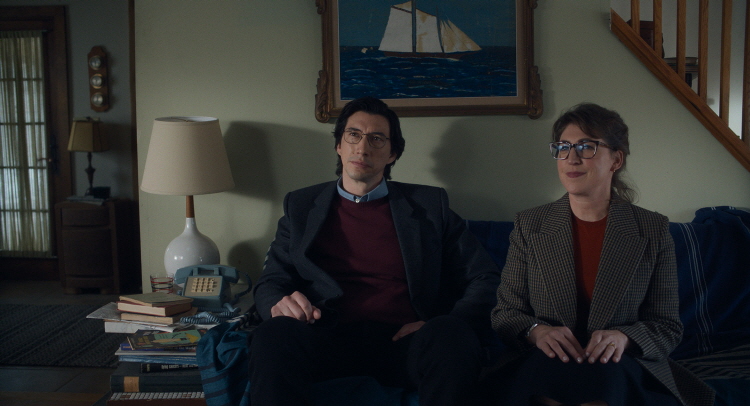
The first story, which is titled “Father”, is mainly about the rather flawed relationship between an old dude, played by Tom Waits, and his two adult children Jeff (Adam Driver) and Emily (Mayim Bialik). At the beginning, we see Jeff and Emily coming to a house where their father has lived alone by himself for years, and we come to gather how they have often been distant to their father. They do care about him, and he has sometimes needed some help from them due to one problem after another, but they still do not know or understand him that well on the whole. 

Anyway, the plot thickens a bit when they eventually arrive at their father’s house and then spend some time with him. As observing how their father’s house does not look clean or neat at all, they come to worry more about his welfare, but they are also reminded again of that existing distance between them and their father. They are sincerely concerned about how he has been, but, to their little bafflement, he does not want to tell much about that while rambling about some other things instead.

In the end, it is revealed to us that their father is not particularly enthusiastic about their visit from the very beginning, and we get an unexpected comic moment when he turns out to be more occupied with something else besides his children’s visit. Waits, who previously appeared in Jarmusch’s several previous films including “Down by Law” (1986), is dryly amusing in his deadpan comic performance, and he is supported well by Adam Driver and Mayim Bialik, who also have their own small humorous moments without overshadowing Waits at all.

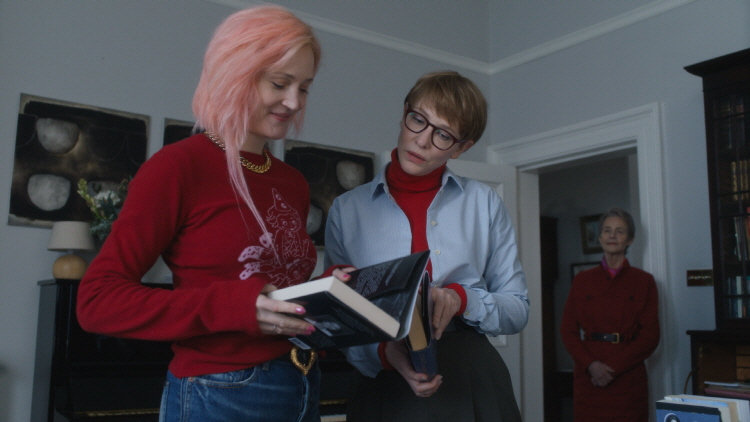
The second story, which is titled “Mother”, revolves around one little family tea party among one middle-aged woman, played by Charlotte Rampling, and her two daughters Timothea (Cate Blanchett) and Lilith (Vicky Krieps). Although they all reside in Dublin, Ireland, these three ladies do not meet each other much outside this annual tea party of theirs, and we come to gather the reason as Lilith and Timothea separately arrive in their mother’s cozy house. Besides their apparently different personalities, their mother is not a very affectionate woman to say the least, and it is clear that their mother usually cares more about Lilith than Timothea.

However, the mood feels gentle and casual on the surface as their mother is courteously serving tea to Timothea and Lilith. As she admitted to someone else on the other line of the phone in an earlier scene, their mother tries to show equal love and care to both of her two daughters, but she cannot help but show more attention to Lilith. This evidently hurts Timothea’s feelings from time to time, though she does not signify her emotional pain that much to her mother or her younger sister.

As the camera of cinematographers Frederick Elmes and Yorick Le Saux continues to focus on their tea party conversation, we get to know more about these three ladies. While Timothea has a fairly successful professional career just like her mother, Lilith is your average superficial online influencer, and their personal difference is more evident from their contrasting attires. Both of them wear red blouses just like their mother, but Timothea’s attire is more subdued compared to her younger sister’s, and this interesting contrast in their attire choice accentuates more of how Lilith has received more attention from their mother.

Nevertheless, we gradually sense some degree of emotional bond among Timothea, Lilith, and their mother. Sure, they may never get closer to each other, no matter how many tea parties they are going to have again. Nevertheless, they are still capable of understanding and caring about each other despite their flawed relationships, and that is why their last scene is accompanied with quiet emotional poignancy. While Rampling, who is no stranger at all to looking gracefully unflappable, holds the center, Cate Blanchett and Vicky Krieps flawlessly complement each other from the beginning to the end, and you may not mind at all even if these three wonderful actresses act more together for a much longer running time. 

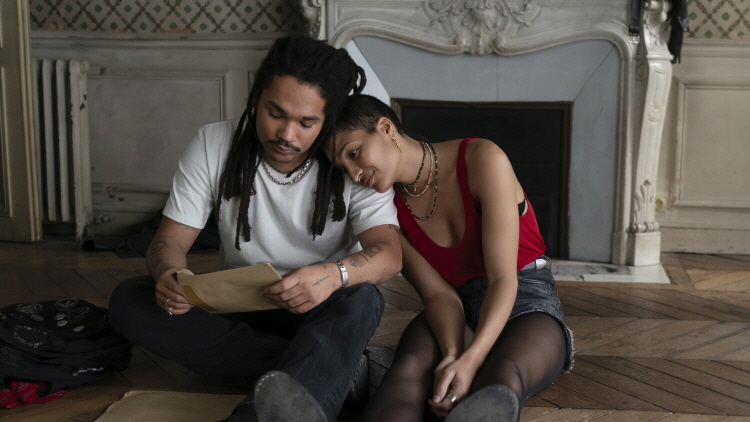
The third story, which is titled “Sister Brother”, is about the ongoing personal grief of two twin siblings Skye (Indya Moore) and Billy (Luka Sabbat). Their parents recently died due to some unfortunate airplane accident, and they are about to drop by their parents’ apartment in Paris, which has already been emptied out by Billy in advance not long after their parents’ death.

As these two siblings talk about their deceased parents, we come to gather that their parents had a pretty unconventional life which never bored them at all. As looking into some personal stuffs left by their parents, Billy and Skye cannot help but become a bit nostalgic, but they also recognize that there are many things they still do not know about their dear parents.

Although it is relatively less impactful to the other two stories in the film due to its rather thin and languid narrative, the third story still works as we are often amused by the recurring story elements such as rollerblading, and you will also be moved by the effective utilization of Dusty Springfield’s “Spooky” around the end of the story. In addition, Indya Moore and Luka Sabbat are solid in their earnest acting, and we can clearly sense a long history between their sibling characters thanks to their effortless interactions on the screen.

In conclusion, “Father Mother Sister Brother” demonstrates that Jarmusch still can amuse and engage us a lot although he has been rather quiet during last several years since his last film “The Dead Don’t Die” (2019). To be frank with you, I do not like some of his works such as “Dead Man” (1995) and “The Limits of Control” (2009), but many of his better works always have something amusing or moving to reflect on, and I can assure you that “Father Mother Sister Brother” is one of such cases.

Posted in Movies | Tagged , , , | Leave a comment

The Muppet Christmas Carol (1992) ☆☆☆(3/4): Michael Caine as Scrooge – with the Muppets

There is a good reason why Charles Dickens’ 1843 novella “A Christmas Carol” has been a classic work to be remembered and cherished by many of us. Above all, this is a striking ghost story with chilly and spooky qualities to haunt your mind for the rest of your life, but it also touchingly reminds us that it is never too late for any of us to try to be a better person as long as you are not dead yet.

In case of Brian Henson’s 1992 film “The Muppet Christmas Carol”, it leans more toward the latter aspect of Dickens’ novella instead of being truly spooky and chilly like Robert Zemeckis’ 2009 animation film, but that is not much of a problem at all. After all, we usually cannot help but feel warm and delighted whenever those lovable Muppets appear on the screen, and they even do some musical numbers for some extra jolliness.

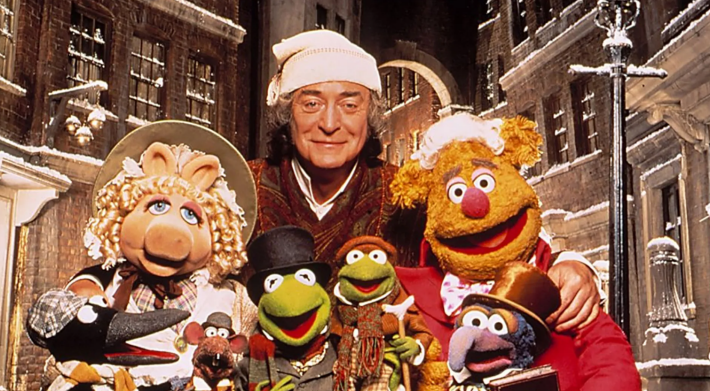
Of course, you cannot possibly have any of these likable Muppets play Ebenezer Scrooge, the old, mean, and grouchy hero of Dickens’ novella. He is instead played by Michael Caine, and Caine, who has always been one of the most engaging actors of our time, effortlessly embodies the harsh and unpleasant sides of his famous character right from the beginning. Yes, he can be quite funny and likable as shown from many of his notable films such as Woody Allen’s “Hannah and Her Sisters” (1986), but he also can be very nasty as shown from Neil Jordan’s “Mona Lisa” (1986), and he subtly conveys to us his character’s deplorable personality while generously allowing those Muppets to steal the show from him from time to time.

And the Muppets in the film are certainly fun and interesting to watch thanks to their colorful appearances and personalities. For example, the Great Gonzo, performed by Dave Goelz, appears as Charles Dickens and also serves as the narrator of the story along with Rizzo the Rat, who is performed by Steve Whitmire. In case of Bob Cratchit, Scrooge’s seriously underpaid clerk, he is played by Kermit the Frog (He is also performed by Whitmore, by the way), and Miss Piggy, performed by Franz Oz, plays Mrs. Cratchit (Please don’t ask me how the hell they can have several children between them).

The main plot of the film is not so far from Dickens’ novella on the whole. As Christmas Eve is being over, almost everyone in London is eager to embrace the ongoing holiday cheer more, but Scrooge is definitely not one of such people. As a matter of fact, he could have Cratchit and all of his other employees work on Christmas if Cratchit did not manage to persuade him to change his initial decision.

During the night of Christmas Eve, Scrooge is visited by the ghosts of his two recently deceased business partners Jacob and Robert Marley, who are respectively played by Startler (performed by Jerry Nelson), and Waldorf (performed by Goelz). Looking quite miserable to say the least, these two ghosts come to give an important news for Scrooge. Three different ghosts of Christmas will soon come to him one by one, and Scrooge must learn from each of these three supernatural figures before it becomes too late for him.

And, of course, Scrooge does learn something from each of these three different Christmas ghosts. From the first one, who represents Christmas Past, he is reminded of how lonely he was during his innocent childhood period – and when he unwisely missed a precious chance for love when he grew up a bit older later. From the second one, who represents Christmas Present, he comes to see more of how he has been quite unlikable to many of others around him – and a little fact that he is still capable of affection and compassion despite that. From the third one, who represents Christmas Future, he beholds what may soon happen if he does not change himself – and how his life will eventually arrive at its final destination.
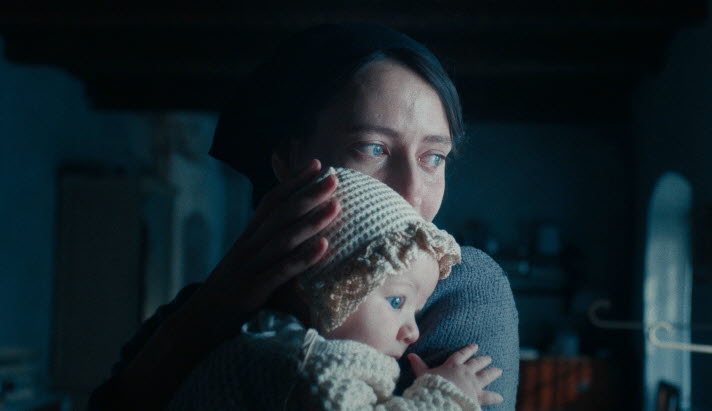
Many of the expected key moments in the film are not very spooky or chilly, but the movie keeps holding our attention with a considerable amount of charm and spirit. Those endearing Muppets in the film always bring us smiles and chuckles, and I particularly enjoyed the comic interactions between the Great Gonzo and Rizzo the Rat, who occasionally provide an amusing comment as following the story together. Furthermore, some of them also feel sincere and touching in the story, and Kermit the Frog is particularly poignant when he shows a bit of genuine gratitude to his employee in front of his wife and children.

And there are several good musical numbers to cheer you up more. The songs by Paul Williams are not really catchy in my humble opinion, but they work mostly well in the context of the story, and it is certainly fun to see Caine trying a bit of singing around the end of the story. He may not be a good singer, but he does not sound strained at all, and that is more than enough for us in my inconsequential opinion.

On the whole, “The Muppet Christmas Carol” still works as a solid Christmas season movie for everyone even though it has been more than 30 years since it came out. Although I learned about its existence in the early 1990s, the movie has somehow eluded me for many years, and now I am glad to report to you that it is one of more entertaining Christmas films during last several decades.

Posted in Movies | Tagged , , | Leave a comment

Santosh (2024) ☆☆☆(3/4): Her complicated case

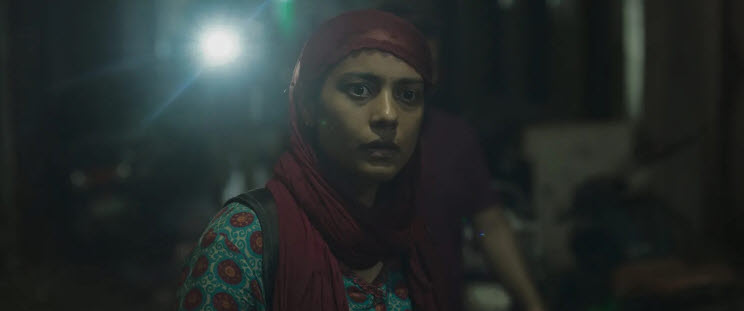
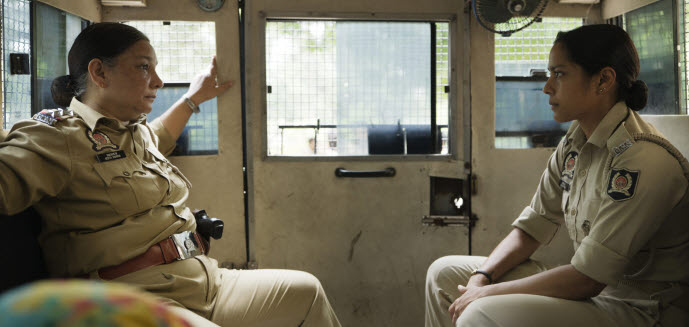
“Santosh”, a Hindi-language film which was incidentally selected as the British entry for Best International Film Oscar in last year (It was subsequently included in the December shortlist, by the way), is a dry but engaging police procedural drama. As following the viewpoint of a young female rookie police officer struggling with many obstacles including systemic corruption and discrimination, the movie vividly and powerfully presents a number of serious social issues in the Indian society, and we gradually get its points as observing the very murky moral situation surrounding its increasingly conflicted heroine.

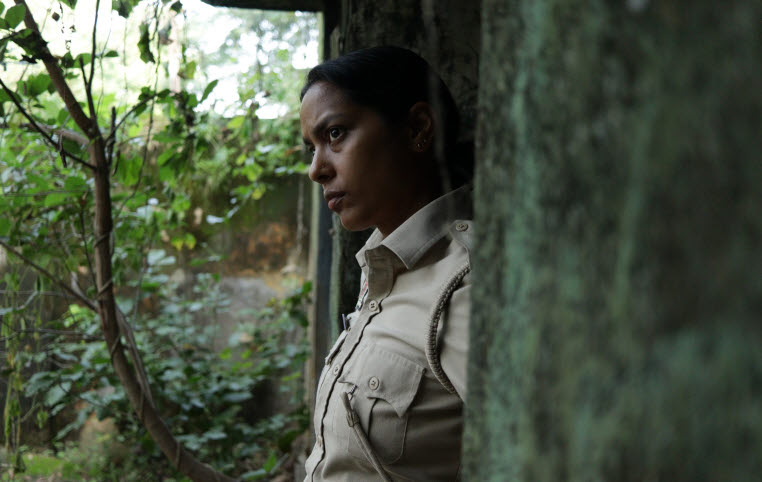
At first, the movie quickly establishes how things have been quite difficult for Santosh Saini (Shahana Goswami), a young woman living in somewhere in north India. She was once happily married to her husband who worked as a local police officer, but her husband recently got killed when he and other police officers attempted to suppress a big riot, and she has been quite devastated by this sudden death of his.

When she is notified that she will not get any compensation for her husband’s death and also will have to move out from their current residence, Santosh becomes all the more desperate, but there comes a seemingly nice option for her. All she will have to do is inheriting her deceased husband’s job under a process called “compassionate recruitment”, and we soon see her beginning to work as a new police officer in some rural region.

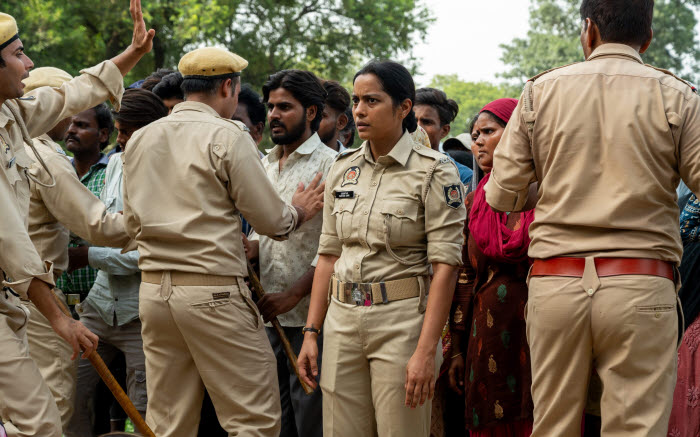
However, not so surprisingly, Santosh soon comes to see how difficult it often is for her to work as a female police officer. For example, her station chief does not care much about whether she can be a good police officer or not, and he does not even hesitate to have her stay in his residence just for helping his wife a bit. While there is one female police officer in the police station, she is not so friendly to Santosh, and Santosh does not approve much of how her female colleague handles their menial cases. For example, when they catch some lad for a minor misdemeanor involved with a girl around his age, that female colleague deliberately humiliates him just for setting an example for other young people, and Santosh cannot do or say anything as a rookie police officer.

Meanwhile, Santosh comes across a desperate request from a guy from local “Dalit” neighborhood (It is a term used for untouchables and outcasts, who represent the lowest stratum of the castes in the Indian subcontinent). A few days ago, his 14-year-old daughter was suddenly disappeared for no apparent reason, but nobody in the police station is particularly willing to help despite some subsequent efforts from Santosh.

In the end, the situation becomes much more serious when the dead body of that missing girl is eventually found and then leads to a lot of public criticism on how the police mishandled her case from the very beginning. As a result, a new chief comes to the station, and Santosh comes to have some expectation, mainly because the new chief, Geeta Sharma (Sunita Rajwa), is a female police officer who looks experienced enough to handle such a sensitive case like this.

Along with Geeta, Santosh goes further in their ongoing investigation, and it does not take much time for them to focus on a certain figure who looks like a very possible suspect. When it turns out that this figure in question was also disappeared not long after that girl’s death, Santosh becomes more determined to catch this suspect, and Geeta seems to be willing to help and assist her junior as much as possible.

Needless to say, the case turns out to be a bit more complicated than it seemed at first, and the screenplay by director/writer Sandhya Suri, a British-Indian female filmmaker who makes a feature film debut here after making a couple of documentaries and a short film, enters rather murky moral areas along with its heroine as she comes to see more of how problematic her system is in many aspects. While almost everyone in the police station wants to close the case as soon as possible without looking back at all, there is also the pressure from a prominent public figure with considerable power and influence, and many people in that dead girl’s village, who have always been disregarded and discriminated throughout their whole life just because of their caste background, do not trust Santosh and many other police officers at all for good reasons.

In the end, there comes an inevitable point where Santosh gets herself involved in the case much more than she wanted, and this only leads to more conflict and disillusion for her. As her character becomes more unnerved and conflicted along the story, Shahana Goswami’s good performance firmly holds the center as required, and her earnest acting is complemented well by the more seasoned appearance of Sunita Rajwar, who ably suggests whatever her deeply jaded character had to endure and then accept in the past.

In conclusion, “Santosh” feels rather modest at first, but its several quiet but powerful moments will linger on your mind for a while after it is over. It does not surprise us much as we can clearly see where the story is going from the beginning, but it still holds our attention to the end, and that is more than enough for recommendation in my humble opinion.

Posted in Movies | Tagged , , | Leave a comment

Vermiglio (2024) ☆☆☆1/2(3.5/4): In a small mountain village

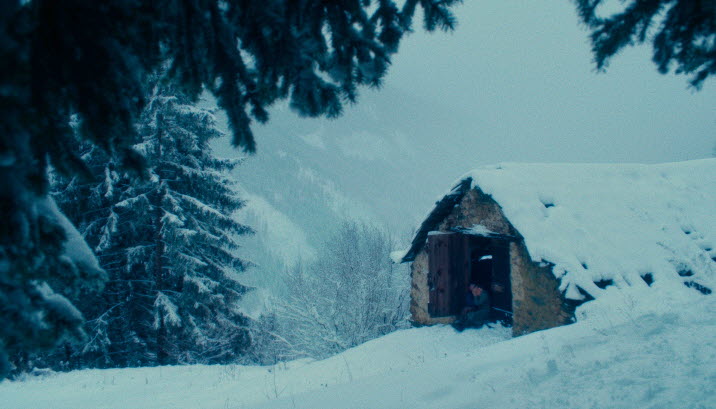
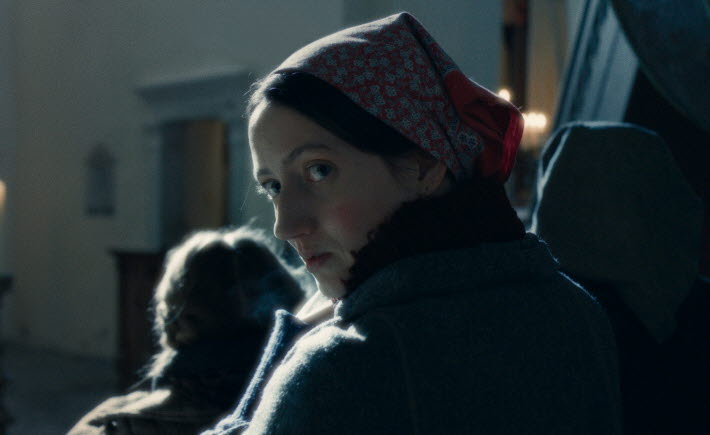
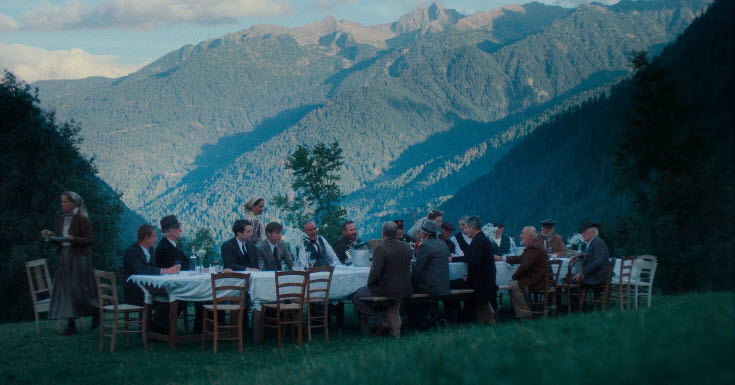
“Vermiglio”, which was selected as the Italian submission to Best International Film Oscar in last year (It was later included in the December shortlist, by the way), is an immersive experience to remember. Slowly and patiently developing the mood and characters along the calm narrative, the movie works as the vivid and realistic presentation of a family life in one small Northern Italian mountain village during the 1940s, and we become more engaged as understanding more of the female repression inside the family at the center of the story.

At first, the movie gradually lets us get to know what has been going on in that village in question. The World War II is being over outside in 1944, and Cesare Graziadei (Tommaso Ragno), a middle-aged man who works as a teacher for young kids as well as illiterate adults in the village, and many other villagers are simply waiting for the end of the war in their rather isolated mountain region, and the opening part of the film somberly illustrates their another cold and snowy winter day of theirs.   

And we come to gather that Cesare and the village people have been hiding two deserters for a while. One of these two figures is the son of one of the villagers, and the other is Pietro Riso (Giuseppe De Domenico), a Sicilian lad who saved his fellow deserter not long before they ran away together. Although many of the villagers do not trust him that much just because he is an outsider, Pietro has not caused much trouble as hiding in a barn outside the village, and he has virtually been an open secret among Cesare and many other villagers.

However, not so surprisingly, we soon sense a little trouble to come. As he appears more in the village, Pietro becomes interested in getting closer to one particular beautiful young woman in the village, and that is none other than Lucia (Martina Scrinzi), the eldest daughter of Cesare. They just regard each other at first, but then they get more attracted to each other, and then we get a little amusing moment when Pietro, who is an illiterate trying to learn how to read and write under Cesare’s tutelage, tries to express his love toward Lucia.

 Needless to say, it does not take much time for Cesare and his wife Adele (Roberta Rovelli), who recently gave birth to their ninth child, to see what is going on between Lucia and Pietro. While not particularly pleased about this situation, Cesare is not so angry about that either, mainly because, as a young unmarried female adult, Lucia must leave the family in one way or another, and it looks like to Cesare that Pietro can be a fairly good husband for her.

As days goes by with some seasonal change, we get to know more about Lucia’s family – and how many of them are often unhappy and discontented under their patriarchy system. When Adele is devastated later for being about to lose her young baby due to some unspecified but serious illness, Cesare does not console her much just because the village doctor tells him that she is already pregnant again. While most of Lucia’s younger brothers and sisters are still too young and innocent to sense how their future will be stuck in their village, Ada (Rachele Potrich) and Dino (Patrick Gardner) have been quite frustrated about that, and Ada is particularly displeased when her father does not let her have more education for an understandable but petty reason.

The somber personal drama among the main characters of the film is often accompanied with the crisp presentation of the wide landscapes surrounding them, which often accentuates their seemingly constant isolated life condition. As a matter of fact, they sometimes seem stuck in an older period, and we are surprised a bit when we see a modern bridge and a big bus later in the film. Director/writer/co-producer Maura Delpero, who deservedly received the Grand Jury Prize when the movie was premiered at the Venice International Film Festival in last year, and her cinematographer Mikhail Krichman did a commendable job of bringing a palpable sense of life and people into the screen, and we find ourselves getting more immersed into that while often noticing small and big details on the screen.

It also helps that the main cast members of the film are believable in their respective roles. They all look like they have lived in the background of the movie for years, and we come to care more about some of their characters as these figures go through each own emotional conflict later in the story. We are disgusted more about Cesare’s callous attitude to the women in his family and the hidden hypocrisy behind that, and then we are also saddened more as observing what his wife and daughters have to suffer under their patriarchy system.   

In addition, Delpero also handles well her several young performers, who feel quite natural during several key scenes of theirs. Whenever their characters faintly whisper to each other during their bedtime, we observe more of how much they see and hear despite still being young and innocent to what is really going on around them, and that brings a little poignancy to the story.       

 Overall, “Vermiglio”, which is incidentally Depelro’s second feature film after “Maternal” (2019), is one of those “slow” arthouse film which requires some patience from you at the beginning, but it will engage and then impress you more than expected once you go along with its patient storytelling approach. In short, this is one of the more impressive works I watched during this year, and I think you should give it a chance someday.

Posted in Movies | Tagged , , | Leave a comment

Tampopo (1985) ☆☆☆1/2(3.5/4): For making a perfect bowl of ramen

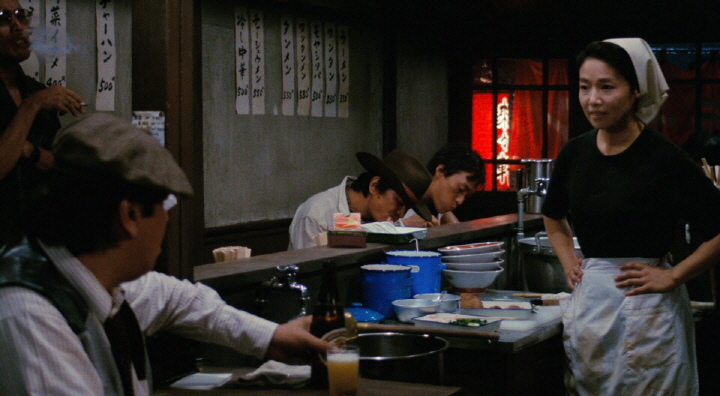
Japanese filmmaker Juzo Itami’s 1985 film “Tampopo”, whose 4k remastered version is currently being shown in South Korean theaters, is a first-rate food movie filled with a lot of wit and charm to be savored and then appreciated. While cheerfully following its main characters’ sincere and comic efforts for making a perfect bowl of ramen, the movie also presents a number of humorous vignettes as sort of side dishes to taste and enjoy for a while, and you will surely feel like having a full meal in the end.

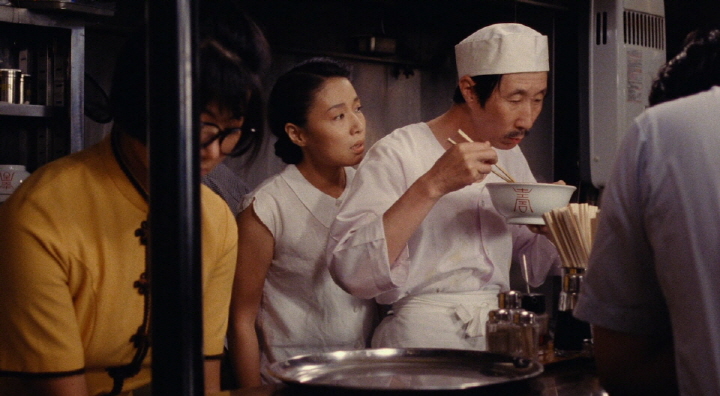
The main story of the film revolves around a little ramen restaurant belonging to a young widow named Tampopo (Nobuko Miyamoto, who was Itami’s wife and frequent collaborator). During one rainy evening, a truck driver and his younger partner happen to drop by her ramen restaurant, and, not long after finishing his bowl of ramen, the truck driver comes to fight with one of Tampopo’s frequent customers over a petty issue. In the end, the truck driver finds himself staying at Tampopo’s house due to his resulting injury, and then he makes a rather brutal but honest comment on how sub-par her ramen is in many aspects.

While feeling quite daunted to say the least, Tampopo also discerns that her unexpected guest does know much about the qualities of ramen, so she requests him to be her teacher/advisor for improving her ramen. Once he agrees to do that, the truck driver teaches her one thing after another, and you will have some good laughs especially when they look into several other ramen restaurants in the neighborhood. Needless to say, Tampopo and the truck driver sometimes need to be a bit sneaky while they do their research on those better ramen restaurants, and there is a little funny moment later in the story when Tampopo pretends to be a dissatisfied customer to extract more information from the chef of one fairly successful ramen restaurant.

In addition, Tampopo and the truck driver get some extra help from two unlikely experts. One of them is an old homeless man who turns out to be quite knowledgeable about ramen, and we get a hilarious scene where he and his fellow homeless men show a surprising amount of culinary insights. When Tampopo and the truck driver happen to save an old rich man’s life, they are introduced to the chauffeur of that old rich man, and, what do you know, this dude turns out to be a considerable ramen expert and is very willing to help Tampopo’s ongoing project.

While steadily rolling its main story to its expected finale, the movie doles out a series of quirky comic moments around the fringe of the story. These moments are not directly connected with the main story, but all of them are connected with food and eating in one way or another, and some of them are quite wry and naughty to our little amusement. In case of a couple of sex scenes involved with a lot of different types of food, we are served with a weird but funny cross between Adrian Lyne’s “9 1/2 Week” (1986) and Dušan Makavejev’s “W.R.: Mysteries of the Organism” (1971), and this is certainly something we cannot see everyday. I also like an uproarious comic scene involved with eating spaghetti, and I must tell you that the sound effects in this scene are as hilarious as that infamous fart scene in Mel Brooks’ “Blazing Saddles” (1974).

You may roll your eyes more than once during these and other offbeat moments in the story, but the movie, which is clearly influenced by the works of Jacques Tati as well as Luis Buñuel (Itami was particularly inspired by Buñuel’ 1974 film “The Phantom of Liberty” (1974), by the way), presents them with a lot of humor and insight based on human nature. We can often be quite silly as following our basic human needs including eating right from when we are born into this world, and that is particularly exemplified well by a vignette involved with a guy who still cannot stop his food love even though he is soon going to a dental clinic for some serious treatment. You may laugh for his silliness at first, but then you will come to have a knowing smile as observing a bit of human nature from his silly behaviors.

Anyway, the movie always goes back to making a good bowl of ramen, and there are surely several moments to make you hungry for ramen during your viewing. I still remember how wonderfully the movie presents a bowl of freshly cooked ramen with a lot of juicy details to observe at the beginning of the story, and I was alternatively touched and amused by that inevitable moment when Tampopo finally reaches the end of her lesson and then demonstrates her improved culinary skill (Is this a spoiler?).

The main characters in the film are more or less than broad archetypes, but they leave indelible impression thanks to the spirited efforts of the main cast members. While Nobuko Miyamato often elevates the movie with her plucky performance, Tsutomu Yamazaki is effective as a gruff but ultimately generous man, and he and Miyamato click well with each other as suggesting a low-key sense of romance between their characters. In case of several notable supporting performers in the movie, they also have each own moment to shine, and you may be delighted to see Kōji Yakusho and Ken Watanabe during their early career years.

In conclusion, “Tampopo”, which incidentally means “dandelion” in Japanese, is brimming with a lot of charm and amusement even after 40 years it came out, and I am still smiling a bit as reflecting on many of its funny or tasty moments. In my trivial opinion, that is what a good movie can do, and I am already willing to revisit this modest but undeniably charming movie sooner or later.

Posted in Movies | Tagged , , | Leave a comment