
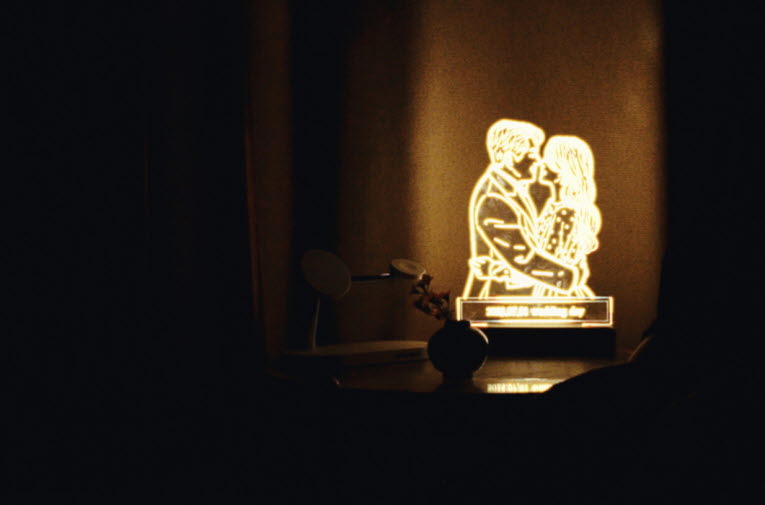
South Korean independent film “The Glimmering” is a little misguided total bore. I did not care at all about what it is about or how it is about, and, despite my attempt to be open-minded about whatever it intends to do, the movie made me all the more disappointed and frustrated in the end. To be frank with you, after the movie was finally over, I quickly walked out of the screening room even though there would soon be a Q&A session after the screening, because I might throw any angry question during the Q&A session due to that accumulated annoyance and frustration during my viewing.
I am sure that director/writer Lee Won-young, who also serves as the editor/producer of the movie besides performing in front of the camera as its lead actor, is quite sincere and serious about his movie. Right before the screening, I happened to see him arriving at the movie theater for attending the Q&A session, and he looked like a fairly nice guy to me during that brief moment. As a matter of fact, I actively avoided him when I left the screening room right before the Q&A session.
In the movie, Lee plays an unnamed married guy who incidentally teaches Mongolian history at some college. In the opening scene, his character and several others are having a dinner conversation, but we can only listen to their mundane conversation because the camera simply and adamantly focuses on two little kids playing together around them. Because these two kids do not appear again in the film without serving any purpose at all, I am still asking myself what the hell is the point of this opening scene.
Anyway, after another pointless scene showing the hero of the movie doing some online lecture, we get a private moment between the hero of the movie and his wife. After his wife cooks a late dinner for him and goes out, he eats alone by himself while watching a TV news about the coup d’état attempt by President Yoon Suk-yeol at last night, which is a very convenient tool for establishing the contemporary period background of the film (That incident happened on December 3rd, 2024, by the way).
A few hours later, the hero receives a phone call, and he becomes quite devastated. His wife suddenly died for some unspecified reason, and then we see him returning to their home right after her following funeral. At first, he seems to be struggling a lot for processing his grief, and then he finds himself becoming unable to speak probably because of that. Needless to say, he has to cancel his online lecture as well as his several other work schedules, and he becomes all the more isolated in his growing grief.
And then something odd happens to him. It seems that his apartment is haunted by the ghost of his dead wife, and, though he still cannot speak, he tries to communicate with her as much as possible. In the end, he eventually finds a possibly effective way to communicate with her, and that seems to bring some peace to his grieving mind.
However, we remain distant to whatever is happening on the screen, mainly because the movie deliberately puts the distance between us and its story all the time. For example, the camera seldom shows much of the face of the hero except for a very few moments, and the sole close-up shot in the film incidentally belongs to his brother. As the camera just looks straight at his face from its static position, this pathetic dude relentlessly grumbles and whines about his failed marriage in front of the hero during next several minutes without much interruption at one point in the story, and you will soon be bored a lot by his petty misery, while not seeing much point in this particular individual moment.

Furthermore, we never get to know that much about the hero or his wife at all. Except for his profession and that immense personal grief of his, the hero of the movie is quite a vapid cipher, and the movie does not even try to bring any depth or insight to his relationship with his wife. While there is a nice nocturnal scene during his encounter with his dead wife’s ghost, it seriously lacks the emotional substance to support it, and, again, we observe this supposedly sad moment from the distance without much care or attention.
Most of all, I was distracted a lot by how the movie attempted to incorporate one of the most shocking moments in the history of South Korean democracy into its narrative. Sure, President Yoon’s irresponsible coup d’état attempt was quite a shock to many of us in South Korea, but I do not see any particular reason in the narrative juxtaposition between that and the story itself, and the same thing can be said about the certain Mongolian elements in the story. While they surely add a bit of exotic touch to the last act of the story, they still feel like being tacked onto the story without much emotional resonance, and the following ending brings another disappointment to us without clarifying much of whatever happens to the hero in the end.
On the whole, “The Glimmering” is probably one of the most tedious cinematic experiences I had during this year. While it can be accepted as a little technical exercise by the director, whatever he attempts to achieve here unfortunately did not engage me at all, and the only consolation for me is that its running time is thankfully short (64 minutes). Nonetheless, now I must quote what my late mentor Roger Ebert often said: “No good movie is too long and no bad movie is short enough.”


