Jean-Luc Godard’s 1963 film “Contempt”, whose recent 4K restoration version was released in selected South Korean theaters in last week, is a distant but fascinating cinematic experiment. Although I am not so enthusiastic about the film unlike many others, the movie is still interesting to observe and appreciate as one of several notable works from Godard during the 1960s, and you may also occasionally sense a bit of the considerable tension between him and his producers behind the screen.
When the movie was made, Godard was regarded as one of the coolest filmmakers in the world after making his first feature film “Breathless” (1960), which is regarded as one of the most significant milestones in the movie history. Along with many other young and ambitious French filmmakers such as François Truffaut, Agnès Varda, Éric Rohmer and Jacques Demy, he was on the front line of the French New Wave during the 1960s, and he received more acclaims and praises via several subsequent films including “My life to Live” (1962) and “The Little Soldier” (1963) before working on “Contempt”.
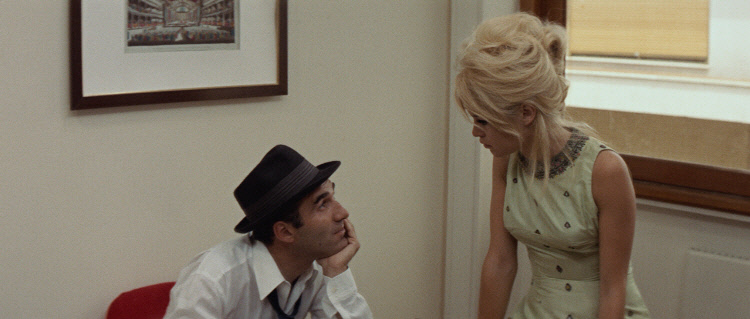
However, things did not go that well for Godard in case of “Contempt”. To him, the movie, which is adapted by him from Italian writer Alberto Moravia’s 1954 novel “Il disprezzo”, was a sort of experiment on whether he could push himself a bit toward commercial filmmaking, but he did not get along that well with his producers Georges de Beauregard, Carlo Ponti, and Joseph E. Levine. For example, his producers insisted that the movie should show more of the body of their lead actress Brigitte Bardot, and Godard followed their demand as shooting the opening scene which does present more of her body, but he deliberately made this scene look quite tame. Sure, his usual cinematographer Raoul Coutard’s camera observes a lot of Bardot’s body, but there is not any sense of sensuality or tantalization at all, and we come to pay more attention to her character’s frustratingly banal conversation with her writer husband Paul Javal (Michel Piccoli).
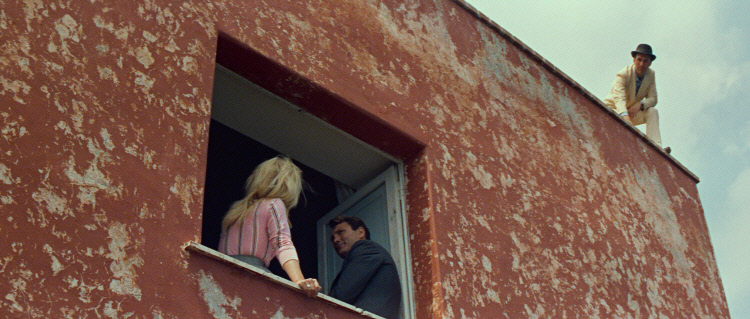
And then we see how their supposedly stable relationship gets imploded mainly due to how much Paul lets down his wife, Camille, in one way or another. He is recently hired as the screenplay writer for some big Hollywood movie production led by an American producer named Jeremiah Prokosch (Jack Palance) in Italy, and Prokosch is not so amused about whatever his director, who is played by legendary German filmmaker Fritz Lang, has been doing for a while. He promises to Paul that he will get paid well for writing a new version of the screenplay which is incidentally based on Homer’s “The Odyssey”, and Paul is quite willing to bend himself in exchange for that. In fact, he even has his wife be around Prokosch even though it is clear that Prokosch is interested in getting closer to her.
Needless to say, Camille is not so pleased about that, and that leads to a memorable sequence where she and her husband argue a lot with each other inside their new apartment. The more they argue with each other, the more apparent it is to us that there is a growing emotional gap between them, and we are not so surprised as Camile comes to show more frustration and, yes, contempt toward her husband, who still cannot see why his wife becomes quite angry and frustrated with him.
At one point during this sequence, Paul tries to be more reasonable with his wife, and Godard and Coutard make a notable visual choice to draw our attention. As Paul and Camille’s conversation goes on, Coutard’s camera moves back and forth between them, and their growing emotional distance is amplified further on the widescreen of 2.35:1 ratio. However, Godard was not so willing to use Cinemascope from the very beginning, and you may be amused a bit when Lang throws a wry comment on that early in the story: “It wasn’t made for people. It’s only good for snakes – and funerals.”
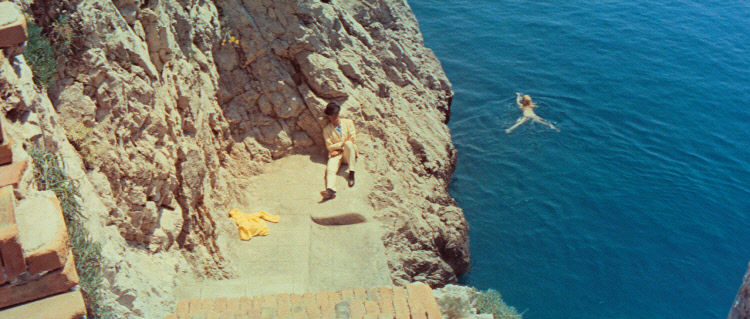
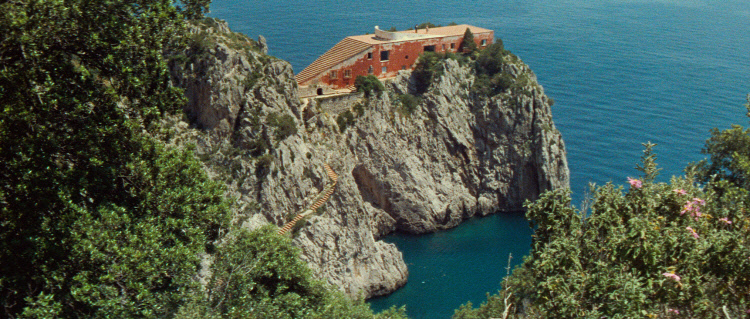
As the story eventually arrives at its last act mainly set in some big summerhouse in Capri, Italy, the movie gives us some sunny and beautiful location shots besides a bit more of Bardot’s body, but it sticks to its detached attitude as before. In the end, there is nothing but contempt in Camile’s relationship with her husband, and Paul is all the more devastated by what suddenly occurs next.
The main cast members often struggled during the shooting because of Godard’s improvisational filmmaking style, but most of them acquit themselves fairly well on the whole. As the main star of the film, Brigitte Bardot, who incidentally passed away in last year, is quite natural in her sensual presence, and she certainly holds her own place well among her fellow main cast members. While Michel Piccoli is effectively petty and contemptible as required by his increasingly unlikable character, Jack Palance often feels strained in contrast mainly because of the clash between his supposedly slick character and his usual rugged screen persona, and Fritz Lang simply enjoys himself to the very last scene of the film.
Overall, “Contempt” is not that great compared to “Breathless” or “My Life to Live”, but it has a number of interesting elements including the game efforts from its main cast members and the memorable score by Georges Delerue (You may remember that Martin Scorsese, who admires the movie a lot, utilized its indelible main theme for accentuating the equally troubled marital relationship at the center of his 1995 film “Casino”). I merely admire the movie instead of loving it, but that is what we usually feel about most of Godard’s works, isn’t it?