Kiyoshi Kurosawa’s 2001 film “Pulse”, which was released in South Korean theaters a few weeks ago, is as ambiguously creepy and disturbing as you can expect from Kurosawa. Being rather slow and opaque in terms of narrative, the movie certainly demands some patience from us at times, but its subtly uncomfortable sense of insidiousness is something you can easily forget after watching it.
The story begins with one strange incident which happens to Michi Kudo (Kumiko Asō) and her several friends who work with her at some plant shop in Tokyo. One of her friends, who has worked on a computer disk for their shop’s sales records, becomes suddenly disconnected from them for no apparent reason, so Michi visits a shabby apartment where he lives. At first, he seems mostly fine on the surface, but Michi senses something weird about him, and then she finds that he suddenly committed suicide.
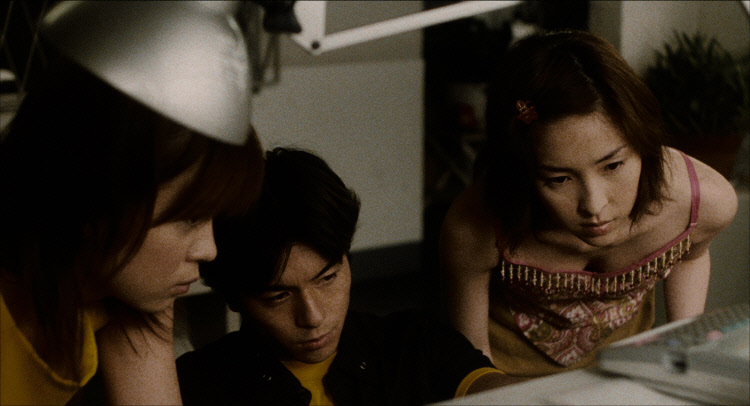
While baffled about this terrible incident, Michi and her other friends later discover something strange from that computer disk from that dead friend of theirs. There is a photograph showing not only that dead friend but also what looks like a ghost, and then Michi and her friends gradually find themselves going under the elusive influence of whatever drove that dead friend to suicide.

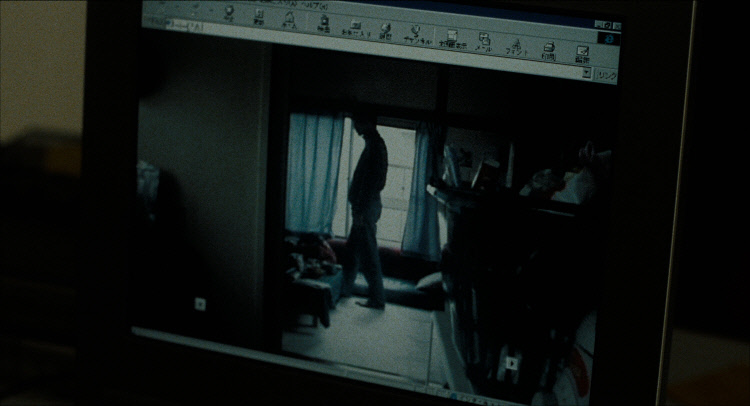
The story also introduces us to Ryosuke Kawashima (Haruhiko Kato), a college student who recently started to use the Internet even though he is not so good at using computers. While clumsily doing some online surfing, Ryosuke comes across a strange website showing a very disturbing video clip, and he is all the more baffled when his computer is turned on then connected to that odd website by itself. He subsequently requests some technical help from a female student who knows a lot more about computer than him, but she cannot provide any clear answer as this website turns out to be much weirder and more elusive than expected.
Meanwhile, things get more alarming around the main characters in the story. More people are suddenly vanished or commits suicide, and the city comes to feel more emptier and moodier than before. Michi and her friends naturally try to understand what is really happening around them, but whatever is coming upon them and many others in the city seems inevitable, and the movie accordingly gives a series of fearful moments as they are surrounded more and more by whatever is menacing them step by step. At one point, the camera of cinematographer Jun’ichirô Hayashi simply observes something slowly approaching to one of the main characters, but the result is undeniably tense and disturbing because of the overwhelmingly grim atmosphere, and we come to brace ourselves for what may happen next to that character.
The movie later gives us a sort of expository moment via one minor supporting character. According to this character, the realm of the dead has been probably over-popularized, so more and more ghosts slip into the realm of the living, and this disturbing trend seems to be more accelerated via the Internet. As living people see more of those dead people, they are more inclined to commit suicide, and this only exacerbates that problem.
Still, the movie does not give any definite answer even when its two storylines eventually converge as expected. As the city gets slowly crumbled, the situation becomes more desperate for the remaining main characters, and the increasingly chaotic and gloomy mood surrounding them may remind you of those dystopian novels by J.G. Ballard. Although the ending is predetermined as reflected by the opening scene, the movie continues to hold our attention with the growing sense of doom and frustration, and it is not so surprising that the movie was intended to reflect “The Lost Decades”, a lengthy period of economic stagnation in Japan followed by the asset price bubble’s collapse in 1990.

I must confess that I often felt distant to the story and characters throughout the film. The characters are more or less than mere plot elements to be manipulated according to the grim design of Kurosawa’s screenplay, and we usually do not care that much about them. Sure, we are unnerved a lot whenever they are terrified in one way or another, but we still observe their fear and desperation from the distance.
In addition, I also could not help but notice how the movie often looks dated from time to time. Because computer technology has advanced a lot during last 25 years, the computers and websites shown in the movie look quite old-fashioned to us, and you may become a bit nostalgic whenever you hear the sound of the old version of modem.
Nevertheless, “Pulse” is still fascinating to watch for several good reasons including its indelible mood and details to be appreciated, and it makes me admire more of the undeniable talent of Kurosawa, who has steadily advanced during last four decades with a series of interesting works ranging from “Cure” (1997) to “Wife of a Spy” (2020). Two years ago, he has become quite active as making not only the French remake of his 1998 film “Serpent’s Path” but also two other notable works “Cloud” (2024) and “Chime” (2024), and then he gives us “The Samurai and the Prisoner” (2026) in this year. I have not seen that film yet, but I and other South Korean audiences will soon see “Serpent’s Path” in movie theaters, and I guess that is a pretty good way of killing some time before watching “The Samurai and the Prisoner” later.