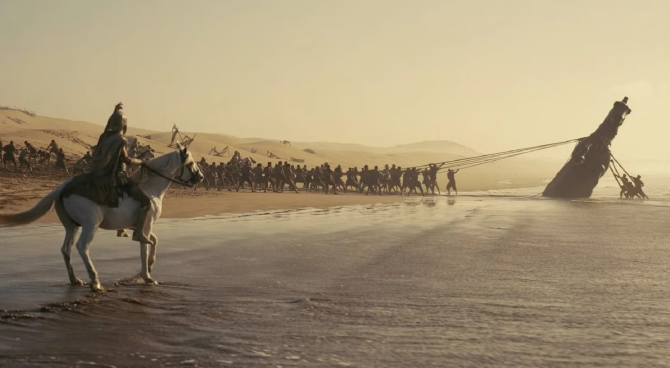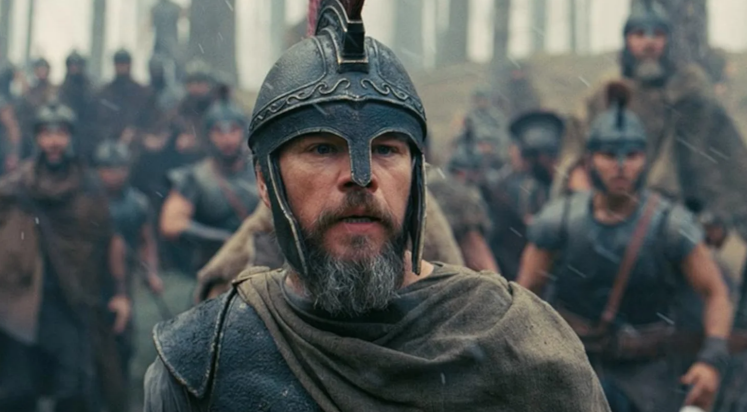
Christopher Nolan’s new film “The Odyssey” is a stark and gritty spectacle quite determined to overpower and then exhaust you. Based on the ancient Greek work of the same name by Homer, the movie may disappoint you for not having much awe or wonder or fun on the whole, but it is often quite intense and visceral under Nolan’s confident direction, and my eyes and mind were constantly engaged for its long running time (173 minutes) despite some reservation.
While mostly following the plot of Homer’s work, the movie will probably remind you more of some of Nolan’s previous works such as “Inception” (2010) and “Oppenheimer” (2023). Dexterously juggling multiple narrative lines which will surely converge later in the movie, the movie stays focused on the agony and conflict of its white male hero, and, as many of you know, that has been Nolan’s usual subject for many years.
Needless to say, Odysseus in the movie, played by Matt Damon, is not your average clean-cut hero at all. He is a weary and conflicted man who has to face the consequences of his morally questionable choices and actions in and after the Trojan War, and Damon did a good job of conveying to us his character’s inner struggle and conflict along the story. During the early part of the story, Odysseus has been stuck in some remote island along with a mysterious woman named Calypso (Charlize Theron), and, though his old memories have been faded for a while under her care, he gradually begins to remember what happened during the war – and how he got lost as desperately trying to go back to his small island kingdom.
And what he slowly begins to remember again is not so pretty to say the least. As many of you know, Odysseus concocted that famous scheme for ending the Trojan War at last, and we see the considerable amount of sacrifice behind that. He and many others have to be locked inside that big wooden horse for several days at least before it is eventually taken inside Troy, and, needless to say, that is not so fun for them at all.
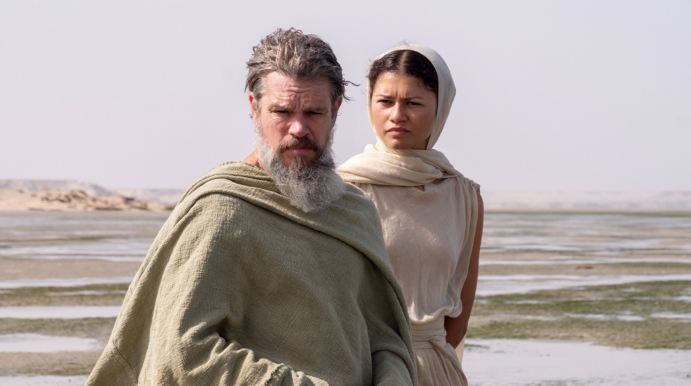
After the war was finally over, Odysseus unwisely decided to sail his ship along an independent course, and that is the beginning of many different dangers and plights for him and his soldiers. Rather than going for wonder and fun, the movie goes all the way for horror and bitterness, and that is particularly exemplified by a sequence involved with a one-eyed giant figure played by Bill Irwin. While we are horrified by the savage sides of this entity, we also observe that his daily life is irrevocably disrupted by the unwelcomed invasion of Odyssey and his crew, and we find ourselves feeling more of both horror and disgust.
Later in the story, Odysseus is told about his destiny which is probably determined by those Greek gods or whatever. He becomes determined to defy against that as much as possible, but his and his crew’s struggles only seem to lead them to their pre-determined fate, and that makes him all the more agonized than before. In fact, he sometimes cannot help but talk a bit with a Greek goddess played by Zendaya, though the movie is rather ambiguous about whether he actually imagines this or not.
And the movie continues to serve darkly intense moments worthwhile to watch from big movie theater screen. There is a horrifying scene involved with a witch lady named Circe (Samatha Morton), and you will wince a lot even though you already know what she is going to do to Odysseus’s hungry crew. In case of Charybdis and Scylla, I was rather disappointed to see that these two monstrous entities are not shown that much on the screen, but I still admire how deftly Nolan presents his hero’s utterly impossible situation with considerable intensity and gravitas.
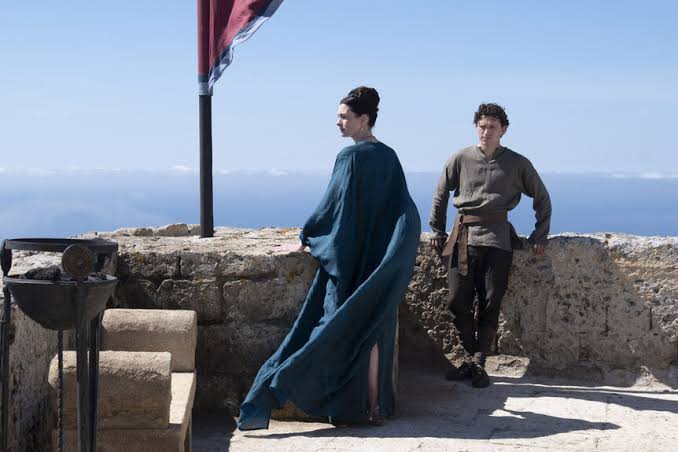
Meanwhile, the movie also pays attention to the struggle of Penelope (Anne Hathaway) and Telemachus (Tom Holland), Odysseus’s wife and their young son. As waiting for Odysseus for almost 10 years, they have had to tolerate the insolence of Penelope’s numerous suitors including Antinous (Robert Pattison) in their palace, and Telemachus comes to feel more need to do anything under their increasingly daunting situation. After all, if his mother ever decides to marry one of those despicable suitors, his position will be quite unstable to say least.
It is not much of a spoiler to tell you that 1) Telemachus eventually meets his father and 2) the story inevitably culminates to an intensely brutal climax sequence where Odysseus returns at last and shows everyone who the boss is. Nevertheless, the movie continues to hold our attention to the end as its multiple narrative lines converge and then powerfully resonate with each other, and its bitterly overwhelming catharsis, which is driven by what has haunted Odysseus for years as well as his emerging desire for vengeance, makes us care enough to reflect more on the ending.
And I admired the top-notch technical achievement from Nolan and his crew members, some of whom incidentally worked with Nolan in “Oppenheimer”. I will not be surprised if cinematographer Hoyte van Hoytema, editor Jennifer Lame, and composer Ludwig Göransson, who all won their respective Oscars for “Oppenheimer”, get Oscar-nominated again along with Nolan in next year, and the movie is indubitably another highpoint for their respectable filmmaking careers.
However, I also observed that the spectacles in the film sometimes overshadow the human qualities glimpsed from the story and characters. While Nolan places various recognizable performers here and there around Damon, their characters are more or less than background details except several notable cases, and that is a bit of letdown for me. Again, Nolan falters more than once in the depiction of female characters, and that is particularly evident from the two different characters played by Lupita Nyong’o. There has been a lot of ridiculous controversy surrounding Nolan’s casting choice, but, what do you know, Nyong’o simply comes and then go in her very brief appearance, and that is disappointing in my humble opinion.
Anyway, many of the main cast members in the film are thankfully strong enough to leave some impression on us. Anne Hathaway, Charlize Theron, Samatha Morton, Mia Goth, and Zendaya manage to overcome their rather under-written roles, and Morton is simply uncanny as a sort of dark twin to her memorable psychic character in Steven Spielberg’s “Minority Report” (2002). While Tom Holland, who is having quite a year thanks to this movie and Destin Daniel Cretton’s “Spider-Man: Bran New Year” (2026), carries his part well, Robert Pattison has some juicy fun with his unpleasant villain character, and several other performers including Benny Safdie, Elliot Page, Jon Bernthal (It is a bit weird for me to see him sharing the screen with Holland again after I watched “Spider-Man: Brand New Day” in last week, you know), Corey Hawkins, Himesh Patel, and John Leguizamo are also solid in their respective supporting roles.
In conclusion, “Odyssey” is frequently stupendous for its spectacular mood and visual, and that is more than enough for compensate for several glaring weak points in terms of story and character. I am not so sure about whether this is one of Nolan’s best works, but, considering its enormous critical/commercial success at present, it will solidify Nolan’s status more, and I can only hope that this may lead him to trying something other than your typical conflicted white hero. Yes, it is difficult for any good filmmaker to come outside his usual artistic territory, but haven’t we had already seen enough of him doing same things during last two decades?