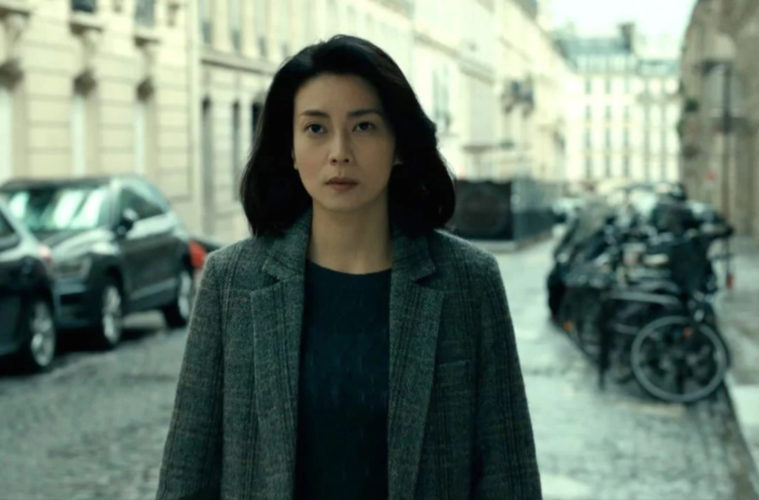
Kiyoshi Kurosawa’s 2024 film “Serpent’s Path”, which is the remake of his 1998 film of the same name, is an interesting attempt which does not always work in my humble opinion. While mostly not so different from the original version in terms of story and characters, the movie occasionally feels rather strained in its new background, and it eventually does not surprise me a lot compared to the original version.
This time, the story is set in France instead of Japan, and the opening scene shows the beginning of a criminal plan executed by a man named Albert Bacheret (Damien Bonnard) and a Japanese psychiatrist named Sayoko Mijima (Ko Shibasaki). They kidnap a guy named Laval (Mathieu Amalric), and, after putting him in the trunk of their car, they quickly take him to an abandoned building where they are going to torment him for extracting any confession from him.
The motive seems very simple at first. Some time ago, Albert’s little young daughter was murdered in quite an atrocious way, and this poor little young girl’s death is involved with some shady organization with which Laval was associated. Quite convinced that Laval is the one responsible for his daughter’s death, Albert begins to corner Laval in one way or another with some assistance from Mijima, who remains mostly calm and detached in contrast to her accomplice.
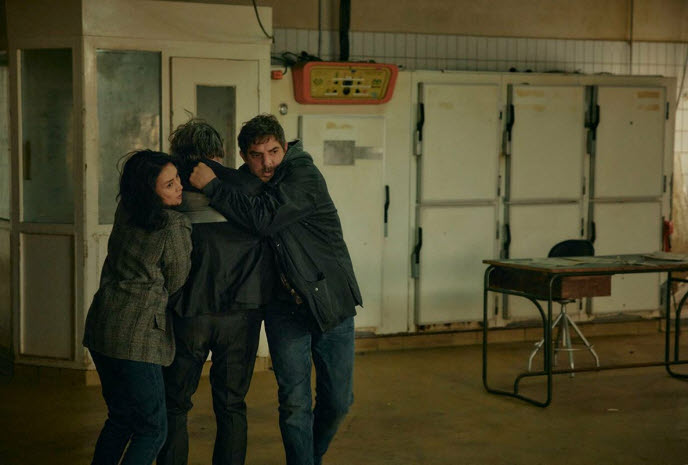
However, their plan becomes complicated after Laval desperately claims that the killer of Albert’s daughter is actually some other member of that organization. Albert and Mijima subsequently decide to kidnap that figure in question too, and that figure in question soon ends up being chained to a wall along with Laval, who is certainly not so amused to be stuck along with that dude.
Meanwhile, we get to know a bit more about Mijima and Albert. He met her at a local hospital where she has worked as one of its staff members, and she was quite willing to help him as observing how troubled he looked in grief and guilt after his daughter’s death. While she does not tell that much about her motive, Albert gladly accepted her help, and we observe how he comes to depend more on her – especially when both of their two captives claim that they did not kill his daughter.
The adapted screenplay by Kurosawa and his co-adapter Aurélien Ferenczi remains rather elusive about Mijima, who looks quite ready to go further than her accomplice but still does not reveal much on the surface. There are a few little private moments which show a bit more of the feelings and thoughts behind her phlegmatic façade, and there is also a subplot involved with a Japanese patient of hers. Nonetheless, she remains cold and distant as before, and we come to wonder more about her ulterior motive.
We become more uncomfortable as Albert and Mijima approach closer to whatever may lie at the end of their plan. That shady organization associated with their captives turns out to be much more horrendous than expected, and they also have to confront more bad guys on their way. In the end, there comes a climatic sequence where they face someone at the center of that organization, and then it turns out that Albert is no better than their captives from the very beginning.
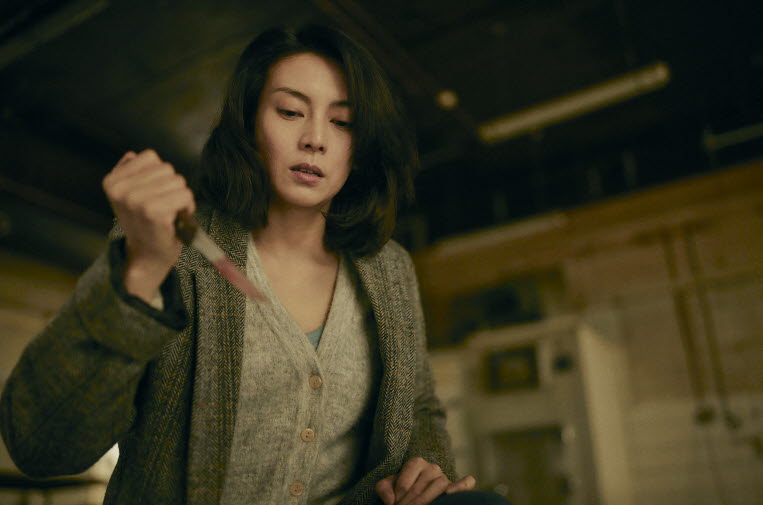
However, the overall result of the remake version is relatively dissatisfying compared to the original version, which handles the story and characters more effectively and succinctly within its shorter running time (85 minutes). The remake version, which is around 30 minutes longer than the original version, somehow lags from time to time, and it also does not surpass that grim and disturbing quality of the original version even though mostly sticking close to the plot and characters of the original version. While the original version often distinguishes itself with the murky sense of anxiety behind its clinical attitude, the remake version feels rather flat and sterile with its slick texture and mood, and it also falters more than once during the finale, which is a bit too contrived due to some modification for a little surprise for us.
Anyway, it is a bit intriguing to see how Kurosawa shows some competence in a foreign territory. As a matter of fact, he already tried on French language film in “Daguerrotype” (2016), and, just like Hirokazu Kore-eda in “The Truth” (2019), he does not have much problem in handling his mostly French cast members. While being not so awkward in her French speaking, Ko Shibasaki gradually takes the center of the story as required, and Damien Bonnard is effective as the other crucial part of the story, and several other cast members including Mathieu Amalric, Grégoire Colin, and Slimane Dazi are also solid in their respective supporting parts.
In conclusion, “Serpent’s Path” is fairly watchable as Kurosawa tries a little variation experiment on one of this notable works, but I would rather recommend the original version instead. Nevertheless, with this film and two other films “Chime” (2024) and “Cloud” (2024), Kurosawa had a very productive year in 2024, and he already made his next film “The Samurai and the Prisoner” (2026), which was incidentally shown at the Cannes Film Festival early in this year and will probably be shown here several months later. I am certainly looking forward to watching that new film of his, and I sincerely hope that I will be more interested and engaged.