
Albert Serra’s 2022 film “Pacifiction”, which happened to be released in South Korean movie theaters not long after his recent documentary film “Afternoons of Solitude” (2024) arrived there, will definitely baffle or confound more than once during its rather long running time (165 minutes). As your typical arthouse movie, it certainly requires a considerable amount of patience from you right from the very beginning, but it may eventually come to you as an interesting work to be admired and appreciated – once you go along with its adamantly languid mood and narrative pacing.
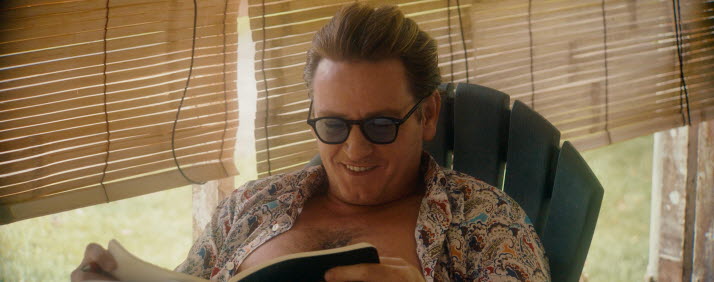
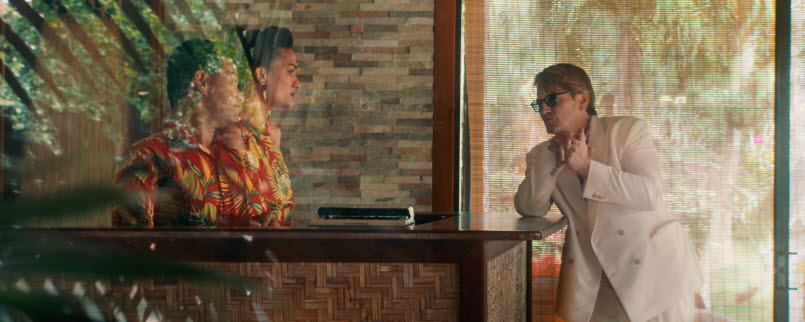
The main background of the story is set in the French Polynesian island of Tahiti, and the movie gradually immerses us into its seemingly peaceful tropical atmosphere surrounding High Commissioner De Roller (Benoît Magimel), a jaded French government official who is supposed to serve those local people as representing his government but looks more like a privileged white member of the local community. His first scene in the film shows him casually spending time at a gaudy nightclub, and we later see him paying a friendly informal visit to a bunch of local dancers supervised by a transgender lady named Shannah (Pahoa Mahagafanau).
We observe how De Roller goes through his autopilot mode while merely maintaining his appearance and authority day by day. During one meeting with a group of local people, he initially seems attentive to whatever is told to him, but it gradually becomes evident to us that he does not care that much about those local people and their life on the island. While he makes sure that he remains connected with some important figures on the island as usual, he is usually more occupied with having a good time during many evenings and nights, though he does not seem to get much fun from that.
Meanwhile, the island and its people slowly begin to get disturbed by a certain alarming rumor. It seems that the French government is planning to do another nuclear weapon test somewhere in their area even though more than 20 years have passed since the last one, and there are actually some small but alarming signs here and there in the island. As shown from the opening scene of the film, a group of French navy soldiers who are incidentally the crew members of a submarine frequently come and then go, and there is also a rather suspicious foreign dude who may come to the island for checking on whatever the French government is planning here.
Because he does not know or hear anything from his government, De Roller is certainly quite baffled to say the least, though he soon embarks on checking on whether that rumor about nuclear weapon test is really true. At first, he tries to get any possible information from that foreign dude when he later becomes rather ill and then is nursed by Shannah, but Shannah, who is incidentally willing to get closer to De Roller, notifies to De Roller that she cannot find anything particularly suspicious from that foreign dude. In case of those French Navy soldiers and their middle-aged admiral, they also do not reveal anything to De Roller at all, and that makes De Roller all the more frustrated than before.
As De Roller’s attempts keep leading him to futile dead ends, we observe more of the growing little cracks on what has been like an eternal paradise for him. While there are still some figures willing to help and support him in one way or another, now he must deal with a bunch of local people ready to protest against the possible nuclear weapon test sooner or later. As this throws more annoyance upon him, he even wonders whether they are actually connected with any of the foreign governments spying on whatever is being planned by the French government behind its back, but, again, he cannot get any confirmation on that.

Steadily maintaining not only its slow narrative pacing but also a subtle sense of anxiety beneath the surface, the movie doles out a number of impressive moments to linger on your mind for their undeniable visual beauty. There is a stunning scene where De Roller joins others in riding on a relentless series of big ocean surfs, and Serra and his cinematographer/co-editor Arthur Tort did a commendable job of imbuing this highlight moment with considerable verisimilitude and lyrical natural beauty. Around the end of the story, the screen is injected with hallucinogenic qualities for reflecting more of the hero’s confusion and frustration, and then the movie eventually arrives the final scene which seems to reveal more to us at first but then throws us into more bafflement without much sense of resolution.
As far as I can see, the movie is intended as a pensively sardonic examination on French colonialism, and I think the movie mostly succeeds in that task. Although my mind often struggled to grasp what it is about during my viewing, I admired its palpable sense of life observed from its main background, and I also enjoyed the effective low-key acting from its main cast members. While Benoît Magimel diligently holds the center, several other main cast members including Pahoa Mahagafanau, Marc Susini, Matahi Pambrun, Alexandre Mello, and Sergi López are also well-cast in their respective supporting roles, and Mahagafanau often steals the show during her several key scenes in the film.
Overall, “Pacifiction” made me a bit impatient more than once during my viewing, but I conclude that it is still worthwhile to watch for its indelible mood and style. I must confess that I am not entirely sure about whether I actually understand everything in the film, but it was an interesting cinematic experience for me on the whole, so I recommend you to give it a chance someday.


