Moneyball (2011) ☆☆☆1/2(3.5/4) : A sports drama operated by numerical analysis

The underdog sports dramas are usually about fighting against all odds for win, but “Moneyball” is a different kind of underdog sports drama – it is about managing with odds and numbers for win. For assembling the baseball team with the best chance to win the games, they tried a different way, and the result was a remarkable success; the record of their American major league team, the Oakland Athletics, was dramatically changed in 2002. It was initially at the bottom with serial defeats, and then it surprised everyone by suddenly rising with the record-breaking feat – that eventually opened the door for a new way of managing baseball team a lot different from the tradition of more than 100 years.

For Billy Beane(Brad Pitt), the general manager of the Oakland Athletics, the situation is difficult at the end of the season in October, 2001. His team has just lost to the New York Yankees in the final for the American league championship. Sure, people say there is always another time, but it is very hard for Beane to get another time with a good chance. They cannot get good players easily because his team cannot afford high salary for them unlike other major league teams with more assets(at that time, the value of the Oakland Athletics was around $ 38 million; the New York Yankees was around $ 112 million). Furthermore, when their contracts are expired, the good players in his team are usually recruited by the other teams offering a higher payment, leaving the holes to be filled up before the season starts. This time, his three star players leave the team after the season ended – that makes his situation more desperate.

There is no way to assemble the team as good as before with limited assets, but Beane keeps searching for the other way. He soon finds a possible solution from Peter Brand(Jonah Hill), the Yale graduate who does not know much about how to play baseball, but knows how to analyze the baseball players with Sabermetrics, the specialized analysis based on the statistical mathematics(the term came from the acronym of the Society for American Baseball Research, by the way).

 Right from the moment when Beane spots Brand in the meeting at the Cleaveland Indians, you can see that Brand is a typical nerd character. He is a quiet, shy lad who speaks with lots of reluctance. While occupying his place at the corner, he whispers his opinions to the other guy in the room to whom people would listen more, rather than voice them for himself. However, when it is demanded, he gives the answers with clear certainty based on his data analysis. Beane sees the solution for him in Brand’s opinion on baseball players; if some baseball players are really undervalued like Brand says, why not buy them with the cheap prices he can accommodate?

The movie is based on Michael Lewis’ nonfiction book “Moneyball: The Art of Winning an Unfair Game”. The screenplay by Steve Zallian and Aaron Sorkin, developed from the story by Stan Chervin who initially adapted the book, may be not so informative about Brand’s method, but it is very engaging even for the non-baseball fan like me because it is not just numbers and baseball game results. The movie is also an excellent drama about the people who attempts the method nobody has tried before, and it is sometimes quite funny, for it draws a lot of humor from the human interactions between the characters, spiced with the witty, insightful dialogues which constantly made me and the audiences laugh at the screening at last night(My personal memorable line: “Would you rather get one shot in the head or five in the chest and bleed to death?”).

I especially like the way the movie contrasts Brand with other professional recruiters at the Atlantic Athletics. They are all old middle-aged guys with lots of experience in their field, so they are befuddled by a young expert from nowhere with whom their boss wholly agrees. They has depended on subjective experience and intuition for spotting good players, but now here comes the guy who discards everything they believe and emphasizes the objective numerical values including on-base percentage for estimating the value of the players to be recruited or discarded. They are naturally not so happy about that, and neither is the team manager Art Howe, played with indomitable passive aggression by Philip Seymour Hoffman, who won Best Actor Oscar for his great performance in the director Bennett Miller’s previous work “Capote”(2005). Howe may accept that Beane recruits the baseball players not good enough in his view, but he is the boss whenever the game begins.
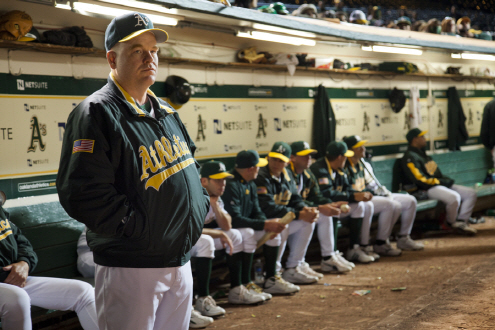
 Beane does not seem to particularly like this new way, either. He was a failed major league player who was thought to have a big potential when the recruiters came to him with the promise of a successful career. When they first meet, Brand frankly says to Beane that he would not even been recruited as a top player if Brand had estimated him with his method at that time. But Beane sticks with Brand simply because he wants to win. If he fails, his career will be ruined forever, but he believes this gamble is only chance to achieve his goal, no matter how much he is frustrated in the process. It is one thing to assemble the team; it is another thing to manage the assembled team and the other people.

Brad Pitt’s good performance gradually reveals a driven man with doubts and worries trembling inside behind his casual facade. As a general manager making hard decisions, he tries to keep his cool attitude, but he can’t fool us or the daughter he dearly loves. Whenever the game is played, he is always out of the field while nervously waiting for the result. Like him, the movie does not look at the baseball games much except some crucial moments, because what happens between the games matters more to its story. The players are more or less than the secondary characters – they can be traded at any time whenever it is deemed necessary, though the movie recognizes them as someone more than the assets from time to time.
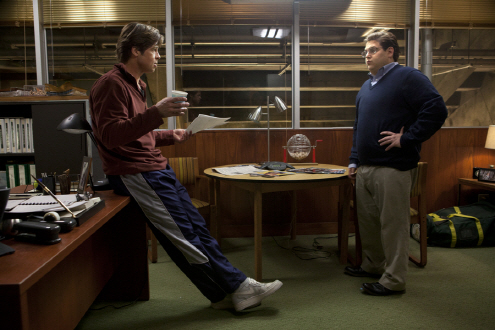
Although Peter Brand is a fictional composite character based on Beane’s assistant Paul DePodesta and other assistants who helped him(Depodesta did not like himself portrayed as a nerd, so he did not allow his name to be used – but he helped the production none the less), Jonah Hill gives an understated but vivid performance on the opposite of Pitt. Many good moments in the film come from the scenes between Pitt and Hill. My favourite scene is when Beane tries to get the deal he wants on the phone while Brand is providing the information at his side. Even without the music to pump up the intensity, the scene is as energetic as Wall Street thanks to the deft timing and precise response of two talented actors.

Because one of its screenplay writers is none other than Aaron Sorkin, who won an Oscar for his great work in “The Social Network”(2010), “Moneyball” is immediately compared to that movie in my mind. Both movies has a nerdy character and the changes brought by him and others, and both of them do not directly say whether the changes depicted in their respective stories are good or bad.

Through its somber handling of the ending, the movie seems to imply that it is rather critical about the system which regards the players as something more or less than a bunch of digits in the computer data. Whether you like that or not, the change has already begun, according to the epilogue. People love baseball, but it has been strictly business to some people. They will try anything to control or increase the odds in plays if it seems to work; Sabermetrics only accelerates that trend. At least, there is still good old unpredictability on the field – for now.

Posted in Movies | Tagged , , , , | 1 Comment

Le Quattro Volte (2010) ☆☆☆1/2(3.5/4) : Charcoal, man, goat, tree… and charcoal

“Le Quattro Volte” does not explain anything to us. It does not even try to tell us the idea that inspired this beautiful, reticent film. But I am not complaining about it, because the movie does not have to explain about itself at all. There are some inconsequential dialogues in the film, but you won’t need the subtitle because it shows everything you need to understand or think about it. It watches the world and the circle of life with intriguing serenity, and that induces us to muse or focus on what is shown on the screen for around 85 minutes.

The movie observes the four stages of life on the earth as thought by Pythagoras. First, we meet an old shepherd in a rural town in Calabria, Italy. He goes to the wide field on the hills with the goats herded by him everyday. Surrounded by beautiful green mountains seen from the distance, everything is quiet except the wind, the bells attached to his goats, and their constant bleats.

We see him milking one of the goats. We see him going to some house in the town to give something. He goes to the church, where the dust on the church floor is collected, packaged, and given to him by some middle-aged woman. At home where he lives alone, he mixes it with water in bottle and drinks it every night before he sleeps. Even though he does not speak, we can easily surmise that he thinks it is sort of medicine to him. To me, it is more like drinking a batch culture of bacteria, but never mind.

 With his minimalistic approach using repeated scenes accompanied with static, unchanged compositions, the director Michelangelo Frammartino shapes the pattern in this slow daily life without much change. From time to time, the camera calmly watches its subjects without movement. Nothing seems to happen at first in its wide shots, but there are small things happening around the screen and our eyes are drawn to them. We get some small information, including where the old man lives, along with the amusement coming from subtle humor. There is a shepherd dog prancing around an old shepherd and his goats, and it has a funny role in the impressive long take sequence where the camera slowly pans back and forth between one point to the other point while observing the progress of the religious ceremony in the town(I learned later it is Easter Procession).

We later see the old man dying on his bed, surrounded by the goats accidently released from the stable. His funeral is soon followed, and a baby goat is born. Like any newborn kids, it has a sticky beginning right after coming out of its mother’s womb. Still covered with mucus, it struggles to stand on the ground with its four feeble legs. It is not so easy at its first trial, but it eventually succeeds, while it looks less sticky than before.

The focus moves from the man to the goats at this stage. After the old man is gone, they, including that kid, are now herded by the other men barely shown to us. The goats look pretty much same at first, but, when the camera looks them closer, you can see the notable differences between them besides the fur colors and the small tags attached to their ears. I especially noticed the various shapes of their horns. Some goats have those horns in smooth shape familiar to us; the other ones have the ones of more curious shapes. Sometimes it looks like they have overgrown the branches on their head.

 The life of these animals is not changed much after their previous owner died. As usual, they get out of the stable in the morning and come back later. The kid stays with other kids in the stable, and these young, cute animals get along with each other pretty well. After some time later, they also go out along with the adult goats and see the world outside for the first time. However, the kid gets separated from the herd by accident. Left alone, it wanders around the forest. It finally finds its shelter under some big tree while the darkness falls.

The change of seasons follows. The snow falls in the winter, and then spring returns, and that tree remains in the same place. While watching it, I thought about how much the plants have evolved throughout its long history. Unlike animals, they could not move to more favorable environment, so they had to evolve more diligently for the adaptation to the changing environment they are stuck in from the start. They have quite been successful, while supporting many animal species including us.

After the spring returns, the tree is soon utilized by the town people. They cut it with the chainsaw, skin it, and then bring it to the town. Some town event is held, and the town is livelier than before with many people. For some purpose not explained, they use it as a pole with the branches on the top of it. When the camera watches it from the distance, it looks like a palm tree; a man actually climbs up to the top like the gardeners in LA do.

 After the event is over, the pole is chopped into the pieces, which are sent to the place where they make charcoals. Their work progress is interesting to watch. Those chopped pieces are placed with other pieces of the woods. The workers assemble them into a big kiln step by step. Once the work is completed, it is covered with hays and black soils. They put the fire inside the kiln, and the smokes arise from the holes on its surface, which we saw in the opening scene. The circle is completed – it will begin again.

“Le Quattro Volte” means ‘four times’. After watching it, I learned that it reflects Pythagoras’ belief in “four-fold transmigration” of souls. Even if you do not know well about it(don’t worry, neither do I), the movie is an absorbing experience on the cycle of life in nature. I do not believe in reincarnation, but aren’t we all made of the atoms, which will, after we are disintegrated, go to the other life forms or the minerals in the world?

Posted in Movies | Tagged , , , , , , , , , | 3 Comments

Photos from Sunday afternoon (11/06/11)

                                 
It was a cold, rainy/cloudy afternoon…
Posted in Photos | Tagged , | 1 Comment

Beginners (2010) ☆☆☆(3/4) : It is never too late to come out

They say it is never too late to pursuit the happiness in our life. In Mike Mill’s “Beginners”, Hal makes a good example to his son Oliver. Hal has recently lost his wife and he is over 70, but he is very willing to begin the new chapter of his life. He confesses to his son that he has been gay all the time, and then he searches for the love of his life, who, to our surprise, comes quite easily to him. Though Hal is told he has few years to live because he has cancer like his deceased wife, he does not mind much, because, to a man at his age, it is rather a relief to know that the closing time is near.

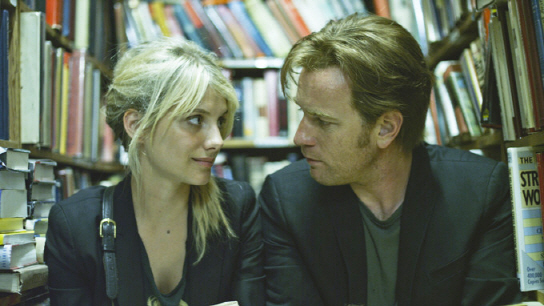
In contrast to his father happy to come out of closet, Oliver, played by Ewan McGregor with a good understated performance, is an emotionally stunted man afraid of getting out of his comfort zone. When a French actress named Anna(Melanie Laurent) approaches to him at the party, he is reluctant to begin a new relationship, but the relationship is soon formed between two people who share a similar problem with love and commitment.

The movie moves between three different time points: Hal’s remaining years seen through Oliver’s eyes, a growing relationship between Oliver and Anna at present, and Oliver’s childhood with his mother(Mary Page Keller), who, according to Hal, knew that he was gay from the beginning but chose to marry him anyway. While Hal was mostly absent due to his work, Oliver and his mother spent lots of time together. While the marriage seemed to be cordial at least(we never know exactly about how she felt about her superficial relationship with Hal), Oliver’s mother was lively in her own way. She tried to have a good time with her introverted son, but he remains composed and moody.

 Through his childhood memories, we come to understand that Oliver does not change much even after he grows up and becomes a fairly successful artist. Like her mom, the people around Oliver want him to have some fun along with them, but he has been content with living alone in his apartment after his failures with four relationships. He likes Anna, but he hesitates to move their relationship to the next stage because he is afraid of another ruined relationship, which is ironically caused by his worry about that. But this time, Oliver comes to realize he is responsible for his unhappiness. He tries to make their relationship work, though both have no idea about what’s next for them.

As a couple with problems, McGregor and Laurent have nice chemistry together right from their atypical encounter at the costume party. He dressed up as Dr. Sigmund Freud, and she, dressed up as a gentleman, lies on the couch. They could play doctor and patient, but, unfortunately, she has gotten laryngitis and can’t talk. She instead communicates with him through written notes. She is correct about his mental state: “Why are you at the party if you’re sad?”

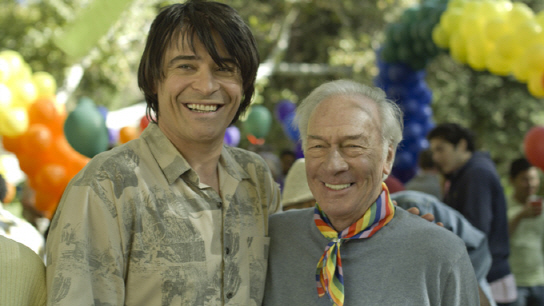
Still with unresolved feelings after his father’s death, Oliver looks back at back at his time with his father in his last years, who enjoyed his remaining time as a man finally frank about his sexuality while trying to get close to his son. Christopher Plummer has been noticed by us for more than 40 years since he played Captain von Trapp in “The Sound of Music”(1965), but he has recently been more interesting with the memorable performances including his Oscar-nominated turn in “The Last Station”(2009). His work here is both subtle and delightful. Once he comes out of closet to his son, Olive actively pursues his happiness. He goes to a gay bar and talks about the experience with his son on the phone later. He gets acquainted with his new gay friends and joins their activities including gay pride parade.

And he is happy to have the first boyfriend in his life. Andy(Goran Visnjic) is a handsome guy who works as a gym trainer and is studying to get a pyrotechnic license(I learned for the first time that fireworks require the license). Plummer conveys us his character’s feeling without a word when his partner goes out to meet someone else. Although they agree to have an open relationship and Hal can accept the fact that he is old and Andy is young, he knows it hurts sometimes because of his love. But he cares about Andy anyway, and, surprisingly, so does Andy. Visnjic has a poignant scene between him and McGregor. Andy really misses Hal; he was not only a father figure he never had but also a partner he loves.

With the story partially based on the relationship between him and his father, the director/writer Mike Mill makes a warm human drama mixed with quirky humor. I liked his movie “Thumbsucker”(2005) for its offbeat but believable characters free of conventions and their equally convincing story, and the same can be said of this movie, too. Hal’s part may to be too interesting to be remained as a subplot for the story of Oliver and Anna, but it serves its purpose as the father’s heartfelt lesson to his son in his crucial moment.

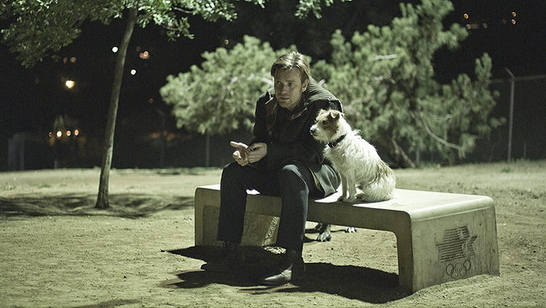
The movie has small funny moments, and it tries several quirks for humor, including showing the things reminded in Oliver’s mind through quick visual montages. The quirkiest one is, what do you know, Hal’s dog left to Oliver. A dog speaking to its owner could be distracting, but the movie has some way of making this silly premise acceptable at least for a while. Anyway, don’t the dog owners sometimes feel that their dogs can communicate with them, at least in their imagination?

“Beginners”, which will be soon released on DVD and blu-ray in US and released at theaters in South Korea, is a low-key but humorous human drama. We have come across its familiar life lesson in many other good dramas/comedies, but it has nice, engaging people, and it has its own story to tell. In addition, there is that Jack Russell dog. It is so lovable with its shaggy looks that I’d like to caress it.

Posted in Movies | Tagged , , , , , , | 1 Comment

The Help (2011) ☆☆☆(3/4) : A mild “Giseongpoom” about that turbulent time

“The Help” reminds me of the term I frequently use for description when I write movie reviews in Korean: “Giseongpoom”, which means “ready-made product” in English. I and other South Korean critics use that word if the movie we talk about is safe, non-provocative, and, above all, crowd-pleasing, made with competent direction. Movies of this kind are usually nothing new or groundbreaking, but we do not deny the fact that it is a nice movie to be appreciated by both the audiences and us.

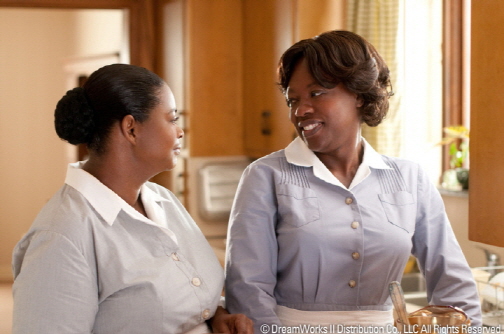
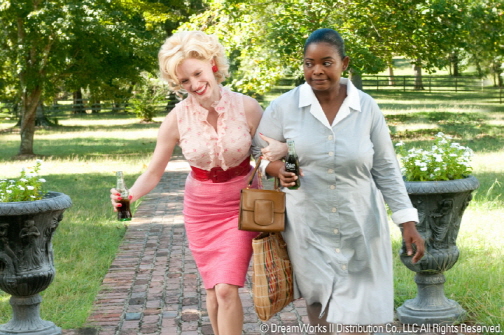
The story of “The Help” is about the friendships between four women in Jackson, Mississippi in 1963. Aibileen Clark(Viola Davis) and Minnie Jackson(Octavia Spencer) are colored maids who have been silent about what they have seen or heard from their insensitive white employers. They do talk about that, but it is only when they are with other colored maids in their neighborhood, not with the outsider like Eugenia ‘Skitter’ Phelan(charming Emma Stone).

Skitter is a white girl who recently returns to her affluent home after her college graduation. Her mother(Allison Janney) wants her to get married as soon as possible, but she is determined to be a writer, so she goes to the local newspaper. She gets a job, but she does not know well about how to advise the female readers on the domestic matters in kitchen, so she approaches to Aibileen for help when she is invited to the social meeting held by Aibileen’s employer.

 And then, Skitter gets an idea about the book to be published. She suggests to Aibileen to talk about her life story with her employers; and she also wants the stories from the other maids. Aibileen has the reservation about it, which is not so surprising, considering that the 1960s was the most turbulent time in the American modern history. The Civil Rights Movement has just started, and its violent clash with the racism in the South is briefly glimpsed in the movie(Medgar Evers, a real-life civil rights activist, is shot by a KKK member in their neighborhood). Talking openly with the white people like Skitter is a taboo in Aibileen and Minnie’s world; that can mean lots of danger to them.

But Aibileen has the painful story to tell, and she decides it is time to open her mouth. She raised 17 white baby girls with lots of care and love in her life as a maid/nanny while her employers were absent, but she never had enough time to take care of her son. Her white baby girls were eventually grown up to be just like her racist employers – and her recent employer’s daughter will probably follow that progress, no matter how much both adore each other. Her son was fortunately grown up well with the education she never had, but he died in another unjust case of racism. Viola Davis has always been impressive even when she made a short appearance, and now she takes the center of the story with quiet resilience revealed minute by minute.

 Her close friend Minnie also has her own story to tell. Her boss, Hilli Holbrook, is a mean, heartless woman effectively played by Bryce Dallas Howard. Minnie is fired just because she used the bathroom in Hilli’s house, not the one outside the house. As a matter of fact, Hilli is so racist that she even proposed the bill for a separate toilet for the colored maids at white employers’ houses. That may sound outrageous to you, but it was the time when racial segregation was accepted everywhere in the place like Jackson. Octavia Spencer, who has been relatively unknown before this movie, has a breakthrough in her career as the lively maid who cannot suppress her feelings often in her transparent face. Minnie gets her revenge she reveals later, and it is one of the hilarious scenes in the movie, well delivered with a good timing by Spencer, Howard, and Sissy Spacek, who has a small fun as Hilli’s mother on the verge of senility.

After fired by Hilli, Minnie has virtually no employer to hire her because of the lie spread by Hilli, but she is fortunately hired by Celia Foote(Jessica Chastain). Celia has been ostracized by Hilli and other women in the town just because she looks common in their eyes and, most of all, she marries Hilli’s former boyfriend. With her wonderful performance, Chastain brings humanity to her seemingly superficial character. It shows from her first appearance that she is not well adjusted to her new world while nervously trying hard to fit into it. Her unwise decision, along with several coincidences and misunderstandings, causes a disaster at the charity party(for starving African children, by the way), but, after having learned that she is different from other employers, Minnie stands by her as a friend and both touchingly confirms to each other that they are good friends.

Skitter’s story is less interesting material compared to others’ because it is a familiar one we have seen many times from the movies about racism with white heroes/heroines. She is one of those good white characters who realize there is injustice caused by racism and are determined to do something about that. Right after coming back to her home, she is upset to know that the maid she had been close to was fired by her mother. Of course, she comes to know the reason behind that from her mother, who naturally realizes later that she did a wrong thing to her dear maid through the book written by her daughter and the colored maids, and then gets over her racism with a predictable feel-good moment for the audiences.

There have been articles about how “The Help” sanitizes that turbulent era, and I agree to them to some degrees. Though the movie rightfully reminds us that it was hard time for the colored people and lots of injustices were done to them, the turbulence during the Civil Right Movement is always at the margin like the news from outside the town. In history, lots of people took risks far bigger than the one taken by the characters in the movie, and some of them lost their lives like Medgar Evers or three activists in Mississippi Burning incident. Alan Parker’s “Mississippi Burning”(1988) is a biased, manipulative film, but I admire how it vividly shows us how violent that time was in Mississippi; I think it is more honest about the volatile atmosphere of that time than “The Help”.

But maybe I expect too much from the movie, which is based on Kathryn Stockett’s bestseller with the same name and never intends to step out of it. I am reading it now out of curiosity, and it is one of those nice, mildly pleasant books you can read without worry. Considering how much these wonderful actresses, who deserve to be nominated for the ensemble awards, bring to their roles, the movie could have been better and more moving, but I think I can accept it as “a good Giseongpoom”. The performances compensates for its many flaws and they are good enough to hold my attention for more than 2 hours.

Posted in Movies | Tagged , , , , , | Leave a comment

My FFC review for Bleak Night (2010)

My second review for South Korean movie “Bleak Night”(2010), one of the best South Korean movies of this year, is posted at Roger Ebert’s Far-flung correspondent site.

If you want to read it, click here.

My original review is here. https://kaist455.wordpress.com/2011/06/12/bleak-night-2010/


Posted in Movies | Tagged , , , | Leave a comment

The Tree of Life (2011) ☆☆☆1/2(3.5/4) : From the vast universe to one small life

“The Tree of Life”, Terrence Malick’s ambitious new film, is a dazzling kaleidoscopic panorama rare to watch. Sometimes it seems ponderous, and sometimes it feels bloated, but it is an overwhelming visual feast to be remembered and discussed. I cannot explain to you everything in the film but, while watching it, I could feel that it is musing on the universe we live in as well as our life on the earth. Its utmost seriousness may bore you at first, but it regards its two main subjects equally in its solemn but deeply humane view, and the resulting juxtaposition is nothing short of stunning. Our life is surely far smaller than the whole universe still expanding even at present, but it reminds us that our life is a small universe as wondrous as the vast world of time and space encompassing it.

The movie is serious about what it intends to meditate on. We see the flickering lights on the screen in the opening scene. What is it? I know it is not the Big Bang, but the quote from the Book of Job preceding this scene somehow made me think about it: “Where were you when I laid the earth’s foundation … while the morning stars sang together and all the sons of God shouted for joy?”

After introducing the main characters, the movie sweeps us across the passage of time on the Earth from the beginning. The sun is born. The early solar system is organized. The earth is born along with its other fellow planets. The young earth is convulsed with volcanic activities. The sea and the land we know are made. The evolution of life forms is commenced in the sea. We soon see the dinosaurs in the forest. We know they are CGIs, and we can laugh over that, but the director Terrence Malick adds an interesting touch. A dinosaur lies dying near the river. The predator dinosaur approaches to it. When it is ready to kill and eat its prey as its nature demands, it regards the dying dinosaur for a moment – what does it think?

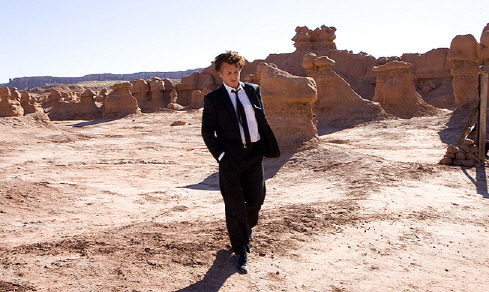
 At the center of such a huge, ambitious canvass, there is a small life on the Earth sprawling before our eyes. When we meet Jack(Sean Penn) at present, he seems to be a successful architecture working in some anonymous city. While we do not get to know much about him, his current life is well represented by the sterile environment surrounding him. After having some conversation with his father on the phone, he starts to contemplate on lots of things through his musing narration, including God, the world, and, above all, the fragmental memories from his early life, including the suicide of his younger brother which left his parents quite devastated at that time.

The movie freely moves around the memories from Jack’s adolescent years in a non-chronological stream-of-consciousness narrative. Young Jack, played by Hunter McCracken with a good natural performance, grew up with his two younger brothers under his ordinary parents in the neighborhood somewhere in the Midland around the 1950s, realistically created by Malick’s usual collaborator Jack Fisk, filled with small details.

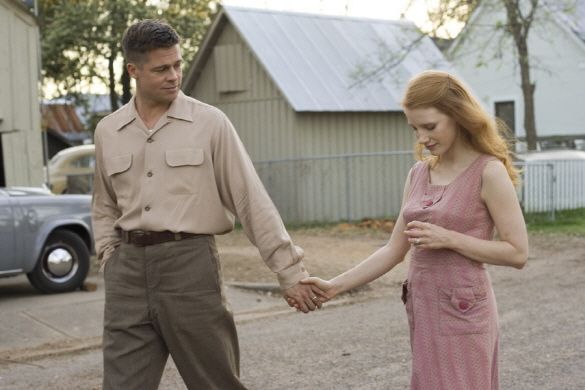
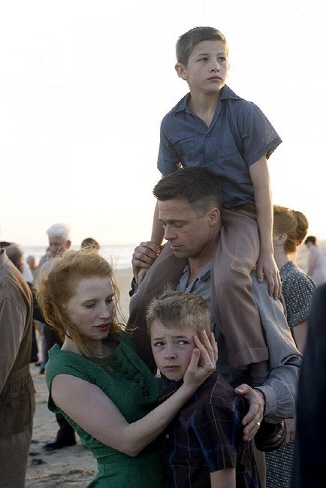
As the narration implies, Jack’s parents are contrasting figures in his life as ‘nature’ and ‘grace’. His father(Brad Pitt) is a stern guy who can be a nice father but also can be a harsh man to his three sons. He tries to teach them about the world outside unfair to him, but that only makes him no more than a tyrant in their eyes. In contrast, his mother(Jessica Chastain) is a kind and generous woman who express the love to her boys more openly. In the religious viewpoint of the movie, their contrast is naturally connected with the contradicting image of Christian God, who gives life with grace and then takes them away according to the merciless law of the nature he makes. Pitt is good as a plain flawed man with an unfulfilled dream who loves his sons in a rather misguiding way. Chastain is radiant as a gentle soul who embraces them without condition.

 There is not much of a story in conventional sense in the film, whose main synopsis is easily summed up as how Jack and his younger brothers spent their idle time together when they were young on those bright summer days. They run around the field with their dogs. They swim in the pool with other kids. They climb on a tree in their neighborhood. They hang around with other kids. They have joyful times with their mom at home when their father is not at home. Even when you get lost in the maze of Jack’s memory(maybe you will ask yourself which of Jack’s brothers would suicide while watching the movie), there are lots of small, emotional scenes filled with beauty and intimacy. You may probably remember how comfortable it was to have someone who will turn the light off after you were asleep. Or, have you ever enthusiastically followed a truck spewing the disinfectant gas from its behind? I did and I loved to do that(By the way, I grew up in the 1990s, so, unlike the 1950s, they did not use DDT).

Compared to this part, the strongest and most powerful one in the film, the rest of the film feels somewhat redundant at times when it attempts to be grand. None the less, like Malick’s few but memorable films, the movie remains as an absorbing viewing experience flowing and scanning around the images lingered on your mind. No matter how you think about that long interlude about the history of the Earth, the comeback work by the special effect master Douglas Trumbull, famous for his work in Stanley Kubrick’s “2001: A Space Odyssey”(1968) and other notable SF movies, is spectacular to watch. Emmanuel Lubezki’s dynamic cinematography is always captivating, whether it shows the nature or the people or the objects. Even in the scenes of adult Jack, Lubezki imbues the cold modern buildings with certain awe not that different from how I looked at the modern skyscrapers of Chicago through my small digital camera during last spring.

 Like “2001”, its soundtrack is impressive; the diverse collections of the classic pieces by Brahms, Bach, Mahler, and other composers fills the soundtrack along with Alexandre Desplat’s restrained score in the film. While they might not leave the impression as striking as Kubrick’s movie, they certainly add considerable extra power to several important scenes in the film.

Honestly, I am still debating with myself about how I can more accurately describe “The Tree of Life”. I am still at a loss about what exactly it tries to say or express to me and other audiences. But I can say without any doubt that “The Tree of Life” is one of those awe-inspiring movies I will gladly visit it again. It tries to look widely at the big picture while focusing closely at the small spots in it. It may aim too high, but the movie nearly accomplishes its challenging task, and the result is a moving, exceptional piece of work. After the movie ended, I discussed with others about the film for more than 10 minutes and we agreed on one thing; even if you don’t understand it, it will grow on you as something special. 

Posted in Movies | Tagged , , , , , , | 2 Comments

Cats in KAIST (2011/10/25)


The weather is getting chilly, and they want more food.

Posted in Photos | Tagged , | 1 Comment

Drive (2011) ☆☆☆1/2(3.5/4) : A stylish action film with an enigmatic driver hero

“Drive” works not only as an entertaining action film with lots of style but also as a compelling character study with a fascinatingly enigmatic character surrounded by an array of the interesting characters. While the action sequences in the movie are impressive enough to talk about after watching it, the characters occupies the equal position as the strong element to hold our attention to their story. We are excited by the actions, and we are also fascinated by the characters.

The hero of the movie played by Ryan Gosling is the quintessential case of existential hero, the term which can be simply defined by “I do, so I exist.” He has no name: he is just named “Driver” in the end credit, and that can say everything we need to know about him. His lonely life is occupied by his cool, dispassionate professionalism. Legally, he works as a stunt car driver at the movie set while also working at the garage owned by Shannon(Bryan Cranston). Illegally, he moonlights as a wheelman working for criminals.

In the opening scene, Driver has just been hired by some criminals. He is a model employee; he is strict, careful, resourceful and efficient. He never asks about their job. With a car from Shannon’s garage prepared for him, he waits for his employers for limited time as he demanded to them, while monitoring the police radio communication. When the police start to chase after them, he evades their pursuit with cool calculation and meticulous timing; it is sort of refreshing to see the sequence where the car action is not just all about driving tough and fast with lots of noises.

He lives alone in some apartment building. There is not any person close to him. Even Shannon later says that he knows almost nothing about Driver, who suddenly appeared to him several years ago and has not talked much about him. Recently, Shannon wants to put him into the car race, but he needs some money for the car, so he makes a choice which is probably unwise; he comes to be associated with the criminals, Bernie(Albert Brooks) and Nino(Ron Perlman), who have some shady history with Shannon.

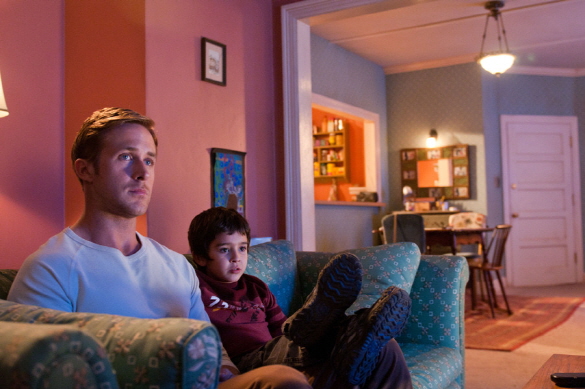
 Meanwhile, Driver initiates a friendly relationship with one of his neighbours, Irene(Cary Mulligan). Her car is broken on one day when they come across with each other. He naturally helps her, and they become a little closer than before. Irene lives with her young son Benicio(Kaden Leos), and it is possible that he can be a father figure to this young boy, though their relationship is more like a boy and his kind, friendly artificial intelligence babysitter.

While there is indeed an unspoken feeling between Irene and Driver, their situation gets complicated when Irene’s husband Standard(Oscar Isaac) is released from prison. Surprisingly, though I guess he senses what has been going on between his wife and her neighbour, he is gentle to Driver. Standard cares about his family and wants to make a new start, but soon he is forced to do something criminal to be free from his criminal life. Driver, who cares about Irene’s happiness, finds himself getting involved in Standard’s job, which turns out to be far more perilous than Driver thought at first.

The director Nicholas Winding Refn, who previously made “Bronson”(2009), imbues his film with the dry, bleak atmosphere reminiscent of those lean, taut Hollywood action movies made during the 1980s(I don’t know whether it is intentional or not, Albert Brooks has an amusing line about them in the movie). The cinematographer Newton Thomas Sigel makes impressive use of lights and shadows to give noirish feel to the film, and Cliff Martinez’s atmospheric electronic score, which may be not very enjoyable on CD, enhances the retro style of the movie along with the several songs from the 1980s.

There are excellent action sequences in the film, and the best thing about them is, like the ones in “Bullitt”(1968) or “To Live and Die in LA”(1985), they look real while it is quite thrilling. Unlike those bland CGI actions with which we are frequently served every summer in these days, we see the cars are really running fast or crashing with each other on the screen. The movie also values the importance of suspense before it pedals to pump up adrenaline into the screen; sometimes it is more entertaining to wait while trying to guess what will happen with the ticking sound of a wristwatch and the hero’s intense concentration.

As a taciturn hero who follows the footsteps of his equally quiet seniors including Alain Delon in “Le Samourai”(1967), Ryan Gosling, one of the most talented young actors working in Hollywood, does a terrific job as a lonely man who does not reveal much about himself to others. He does not say anything except when it is necessary, but Gosling creates a believable human character with small gestures and faint facial expressions. We do not know exactly about his thoughts and feelings, but we always sense the presence of the mind working behind the seemingly nice but coldly detached face of his.

Gosling’s character is surrounded by the colorful supporting characters who are far more opened than him. Carey Mulligan may be too elegant to live in the unglamorous side of LA, but the quiet chemistry between her and Gosling is palpable even though they do not often touch each other. Bryan Cranston plays a guy whom you can depend on when you do something illegal. He is a nice man but he is tactless – and he inhabits in a ruthless world, which is represented by Ron Perlman and Albert Brooks. Perlman is vain as a guy who thinks himself as a figure bigger than what he actually is, and Brooks gives a quiet but memorable performance as a man who does not like dirty works but knows he has to clean the messy situation with no loose ends, absolutely. Considering many of Brooks’ comic performances, this is a successful case of cast against the type.

The screenplay by Hossein Amini, based on James Sallis’ novel, is not entirely perfect due to the third act relatively weak compared to the rest of the movie. That does not matter much, because, above all, the characters are interesting to observe; it does a very nice job of presenting them to us as someone more than stereotypes we usually expect from its genre. I believed their world, and I was absorbed in their story while thrilled by the well-executed actions. “Drive” is a product as slick, precise, and intelligent as it can be or you desire to be – and it does drive well.

Posted in Movies | Tagged , , , , , | 2 Comments

Punch (2011) ☆☆☆(3/4) : His enemy, His teacher, and… His neighbour

If you are a South Korean and you were relatively lucky while going through ruthless South Korean education system, you probably had at least one teacher who ‘bothered’ you a lot in your school days. He had a lot of interest in you, and he might make you crazy because he made no secret about that in front of your classmates and your family. I knew that too well. Several teachers at my middle school saw that I was an oddball among students, and they cared about me a little bit more than other students. Some of them actually visited my parents just because they lived near my home.

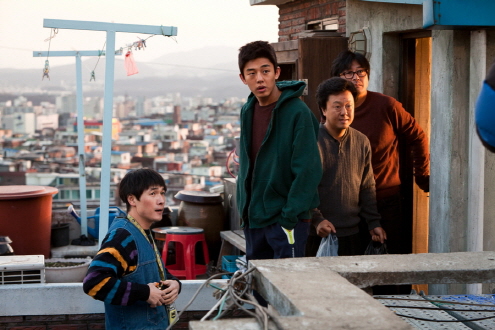
To a high school student named Wan-deuk(Yoo Ah-in), the hero of South Korean coming-of-age drama “Punch”(2011), his teacher Dong-joo(Kim Yoon-seok), or Dung-joo as Wan-deuk called, looks like a formidable nemesis who will never go away from his life. Don-joo is always near him whether it is at the school or outside the school. At the school, with lots of banters, Doo-joo blatantly mentions about Wan-deuk’s poor household or low grade in front of Wan-deuk’s classmates – much to Wan-deuk’s humiliation. Wan-deuk is not so free from Dong-joo even at his rooftop home, because he lives right next to his home. No wonder Wan-deuk goes to the church nearby and prays to the higher existence living somewhere above the sky to give his annoying enemy eternal peace for his peace of mind.

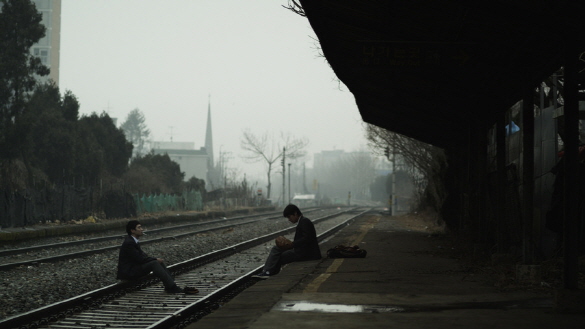
However, sadly, his pray remains unanswered. The more he resists, the more Dong-joo intrudes upon Wan-deuk’s family life, which is the emblem of the lower class life in South Korean. Since his Filipino mother(Jasmine Lee) left them a long time ago, Wan-deuk has lived with his father and his ‘uncle’ Min-goo. Wan-deuk’s father has been ridiculed for being short(in the book, he is more like a dwarf, but Park Soo-yong is not the shortest actor in the movie and he is certainly taller than Peter Dinklage). His workplace, a cabaret where he has worked as a dancer, is recently closed, so Wan-deuk’s father tries to find a way to make a living with a mentally deficient Min-goo(Kim Yeong-jae), but,  in the society not so kind to the weak and poor, it is not easy for them to do that.

 This may sound gloomy to you, but the movie is a lighthearted tale from the beginning in spite of several grim subjects hanging around the story. Though he is not exemplary as “the teacher of my life”, it is clear that Dong-joo likes his students despite his seemingly casual and occasionally crass behavior to the students. He especially cares about Wan-deuk, and, thanks to Kim Yoon-seok’s amusing performance, we instantly sense that Dong-joo will be the teacher Wan-deuk can lean on no matter how much he annoys Wan-deuk everyday.

The movie is rather free from the conventions we expect from this kind of film. Above all, Dong-joo does not change the Wan-deuk’s life much. Wan-deuk grudgingly accepts Dong-joo as the part of his daily life, but their relationship is still a love/hate relationship except becoming more endearing a little than before. At Dong-joo’s recommendation, Wan-deuk, who is a notorious rough boy at his school, goes to the gym for learning kickboxing, but, although he has indeed some talent, the sport does not dramatically change his life. The movie is grounded well on reality; this is not the one where a guy suddenly realizes his terrific talent hidden inside him and then wins all the way to the championship in a glorious climax.

But we feel Wan-deuk’s life getting a little better with the directions than before, while watching the characters roll around together inside its story. Rather than following the conventional plot, the movie leisurely strolls around small, nice moments from the interactions between characters. There is a foul-mouthed neighbor who is sick of the frequent loud exchanges between Wan-deuk and Dong-joo outside, and his complain made the audience laugh every time. He has a sister who live with him(she writes ‘existential martial art fantasy novel’), and she is pretty enough to draw Dong-joo’s attention – that leads to several humorous moments in the movie.

Meanwhile, Wan-deuk also gets intimated with one of the girls in the school after some cruel prank on her done by other students. She is No. 1 overachiever in the class, and he is No.1 underachiever in the class. How can that be possible? I don’t know, but it is more than the opposites being attracted to each other; he is nice to her, and so is she to him.

 Besides all these happenings around them, the dynamic relationship between Wan-deuk and Dong-joo remains as the center of the movie, and the chemistry between Kim Yoon-seok and Yoo Ah-in is enjoyable to watch – they do not have tell us directly about the small changes inside their relationship while never stepping out of what they are. Yoo Ah-in is a little too tame as a rebellious teenager, but he has enough delinquent naivety as a problematic high school student instead. He has nice scenes involved with his awkward reconnecting with his Filipino mother who comes back to his life, and he quietly conveys to us conflicted emotions inside his character.

Opposite to Yoo Ah-in, Kim Yoon-seok proves again he is one of the most entertaining performers we have in South Korea. While capable of being ruthless as shown in “The Chaser”(2008) or “The Yellow Sea”(2010), he also can be a funny guy with his gruff charm reminiscent of that of Walter Matthau. Dong-ju can be insufferable sometimes at least in Wan-deuk’s view, and Kim Yoon-seok mix the human flaws and decency into his complex character so effortlessly that I eventually found him a lot more lovable busybody than I thought. He looks like a lousy, bullying teacher at first, but he is a good one; I knew such teachers like him, and I was glad to be taught by them. Besides, he is really passionate about what he does; outside the school, he gets into some problems with the authorities because of the people he tries to help and protect. Dong-ju may be an asshole sometimes, but you will accept him as your asshole.

“Punch” is a funny, pleasant, and energetic coming-of-age drama with interesting people abound in its story. While recognizing the shabby sides at the bottom of South Korean society along with some serious social issues including illegal immigrant workers, the movie balances itself well between drama and comedy with an optimistic note in the end. Wan-deuk learns that Dong-ju is the best and worst thing in his life – who wouldn’t agree to that?  

Posted in Movies | Tagged , , , , , , , | 5 Comments