Trumbo (2015) ☆☆1/2(2.5/4) : A passable biopic about one legendary Hollywood writer

trumbo05

As a biography film about one legendary Hollywood figure, “Trumbo” looks trivial compared to his larger-than-life status. Here is a man who steadily fought against the injustices inflicted upon himself and his ill-fated colleagues for years while never bending his hardcore left-wing political beliefs, but the movie merely chronicles what happened during the darkest period of his life in Hollywood. Its subjects are certainly worthwhile to be told and shown, but what we get here is a passable TV movie instead of something more passionate and interesting.

It is 1947 in Hollywood, and Dalton Trumbo (Brian Cranston) has been riding on his fame as one of the top screenplay writers in the town, but the storm is gathering as he and his colleagues are increasingly concerned about the Red Scare being spread around the country. When fascism swept across Europe during the 1930s, Trumbo and many other left-wing American figures joined the Communist Party USA (CPUSA), and that had been tolerated for a while as the Soviet Union became one of their nation’s allies during the World War II, but the tide was turned once the war was over and then followed by the beginning of the Cold War, and the American society became warier of the increasing influence of the Soviet Union and China during that period.

And that was when the House Un-American Activities Committee (HUAC) came in. Unfairly deemed as the enemies of the American society, many people around the country were brought to this really shameful un-American committee in Washington D.C. and then forced to testify about their former/current left-wing political activities or against people close to them, and Hollywood was no exception. While several prominent right-wing Hollywood stars including John Wayne and Ronald Reagan were willing to step forward for driving communism out of Hollywood, the powerful moguls of top Hollywood studio films made the blacklist for avoiding public accusation and protecting their industry, and their blacklist resulted in many personal pains and tragedies during the reigning years of HUAC, which reached to the peak with the rise of Senator Joseph McCarthy during the 1950s.
trumbo04

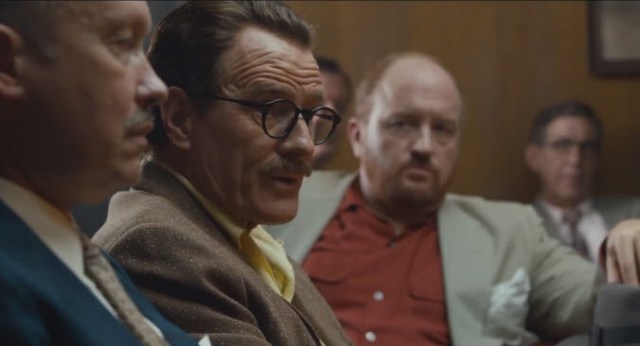
As partially supported by Trumbo’s friend Edward G. Robinson (Michael Stuhlbarg), Trumbo and his close colleagues fight together against HUAC. When they are subpoenaed to the committee, Trumbo and his friend Arlen Hird (Louis C.K.) refuse to testify about anything, and they soon become unemployed and ostracized like many other blacklisted people in the town. They are also jailed for contempt of Congress, and they bitterly hear more bad news from HUAC while serving their time in prison.

When Trumbo is released, he accepts with resignation that nothing can really be done outside for a while, but he does not stop at all. He keeps writing screenplays, and his friend Ian McLellan Hunter (Alan Tudyk) willingly becomes the front writer for one of Trumbo’s screenplays which becomes the basis of a certain classic Hollywood film. Trumbo is also hired by the King Brothers Production, and its owners Frank and Hymie King (John Goodman and Stephen Root) do not mind about employing Trumbo and other blacklisted writers at all as long as Trumbo and his team quickly write or re-write heaps of screenplays for their cheap B-movies, though Trumbo and his colleagues still have to hide behind pseudonyms.

As Trumbo works for more than 15 hours every day under his constantly demanding schedule, he keeps pushing hard not only himself but also others close to him. His family have to move to a smaller house due to their economic difficulty, and they also have to work as his assistants while Trumbo concentrates on writing during every waking hour of his. As Trumbo’s long-suffering wife, Diane Lane does not have many things to do except showing her character’s admirable patience, and the same thing can be said about Elle Fanning, who plays Trumbo’s rebellious daughter who becomes as passionate about social issues as her father.
trumbo01

In the end, as some of you already know, things eventually get better for Trumbo. His screenplay for “The Brave One” (1956) wins an Oscar although the award officially goes to his pseudonym Robert Rich at the ceremony. Not long after Kirk Douglas (Dean O’Gorman) requests Trumbo to write the adapted screenplay for “Spartacus” (1960), Otto Preminger (Christian Berkel) visits Trumbo for himself, and Preminger’s film “Exodus” (1960) becomes a big blow to the blacklist along with “Spartacus” as both Douglas and Preminger stand by Trumbo and keep his name in their respective films.

This is surely a dramatic life story, but the director Jay Roach and his screenplay writer John McNamara, who adapted Bruce Cook’s biography “Dalton Trumbo”, fail to generate sufficient narrative momentum despite a good lead performance by Bryan Cranston, who did whatever he could do with his role and is recently rewarded with his first Best Actor Oscar nomination. Occasionally wielding his character’s wit or cigarette, Cranston is wholly prepared to show warts and all of Trumbo, but he is not helped much by the weak screenplay which monotonously trudges across the time span of more than 20 years. In case of its many historical inaccuracies pointed out by critics, I could overlook them easily because I usually respect artistic freedom in fiction, but the result is flat and unengaging with no particular new insight into Trumbo or that struggling period of him and others. Many scenes feel artificial in its mood and dialogue, and I became more annoyed by the frequent appearances of subtitle to remind us of the passage of time at every major plot turn.

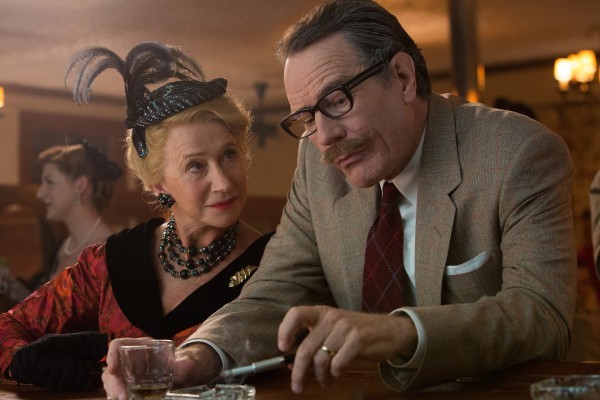
Besides Cranston, “Trumbo” has a few good things to watch, and they make the film tolerable to some degrees. Louis C.K., who can switch himself easily between humor and pathos as shown from his TV comedy series “Louie”, shows a more serious side as a fictional character who is the composite of several real-life people, and Michael Stuhlbarg has a small bitter scene which reminds us of how many of us can be easily bent under social pressure. John Goodman delightfully chews his scenes as a brash movie producer who will not tolerate anyone who dares to interfere with his business, Christian Berkel keeps his face straight as your average stiff German filmmaker, and Helen Mirren is deliciously hateful as malicious Hollywood gossip columnist Hedda Hooper. Like Cranston, they all call for a better film probably buried somewhere inside this forgettable outcome, and that is a shame indeed.

trumbo03

Posted in Movies | Tagged , , , | Leave a comment

Joy (2015) ☆☆☆(3/4): A messy rags to riches tale supported by Jennifer Lawrence

joy01When I was going through another miserable day of my graduate course during the early 2010s, it happened to be my turn to clean the floor of my laboratory, and I used a newly bought mop for the first time. While equipped with a bucket for washing water, the mop was capable of self-wringing through its clever handle design and a spinning basket in the bucket, and it was one of a few commercial cleaning tools which really impressed me for inventiveness and convenience. I did not have to wet my hands or bend my back for washing the mop, and, of course, I got extra time for my procrastination through this convenient mop.

While the Miracle Mop invented by Joy Mangano in 1990 looks different from the one I used, I instantly recognized the same mechanism of self-wringing when her mop was shown in “Joy”, which is loosely based on Mangano’s real-life story. Although it is not perfect at all in its uneven tone and incoherent narrative, everything in the film is somehow held together to some degrees thanks to its exceptional actress’s star presence, and I even came to be a bit easy on its last-minute contrivance which could have annoyed me a lot.

After the offbeat prologue which briefly depicts her childhood years along with her grandmother’s sweet narration, we meet Joy Mangano (Jennifer Lawrence), a struggling divorced mother of two children who has been stuck in a drab life of constant problems to be taken care of by her. When she was young, she was a bright kid full of hope and aspiration, but her dream of inventing useful things seems to be out of her reach at present as she is busy with supporting not only her two children but also the other members of her dysfunctional family. While her two kids are taken care of well by her grandmother Mimi (Diane Ladd), Joy’s mother Terri (Virginia Madsen) spends most of her days with her favorite TV soap drama, and her ex-husband Tony (Édgar Ramírez, who is far from his gritty turns in “Carlos” (2010) and “Zero Dark Thirty” (2012)) is still living in the basement although they got a divorce two years ago.

joy05And there is her father Rudy (Robert De Niro), who left his family a long time ago but has been around the family while running his local garage which happens to have a shooting range right next to it. She lets her father in the family house after his third marriage failed, and Tony is not so pleased to share his place with his ex-father-in-law who does not think highly of him. She also takes care of her father’s messy accounting matters, but she is not appreciated much by him or her petty half-sister Peggy (Elisabeth Röhm), who frequently disregards Joy whenever it suits her.

When she happens to lose her recent job, Joy becomes more desperate, but then she gets one good idea of invention, and, fortunately, she comes across an opportunity to commercialize her idea. She manages to convince Rudy’s rich girlfriend Trudy (Isabella Rossellini) to invest a considerable amount of money to her idea, and, mainly thanks to Tony, she luckily meets Neil Walker (Bradley Cooper), an executive of an influential TV home shopping network company who sees the potential from her and her invention.

While this is a familiar rags to riches story, the screenplay by the director David O. Russell and his co-writer Annie Mumolo  is mostly engaging although not all of its attempts work. Some of the supporting characters in the film are too broad or underdeveloped, and the plot often goes astray as juggling its many elements. In case of a major conflict during its third act, it is resolved too quickly and artificially for the feel-good ending to be delivered, and the ending itself is overlong in its sentimental mood.

joy02

In spite of its glaring flaws, the movie has a number of things to entertain us even while it stumbles here and there. I was amused by how Russell uses Terri’s favorite soap TV drama during some of its comic moments (Russell actually hired real soap TV drama performers to play those soap TV drama characters in the film, by the way), and there is a breezy scene where Neil shows Joy how things work in his workplace. As Joy looks around the place along with Neil, his employees busily work for whatever to be advertised and sold to their many viewers around their local region, and it is hard to be cynical about the excitement in the air whenever a product gets thousands of calls from customers hooked by its infomercial.

Since her breakthrough turn in “Winter’s Bone” (2010), which is still her best moment to date, Jennifer Lawrence has been a force of nature in Hollywood along with her stellar performances including an Oscar-winning turn in “Silver Linings Playbook” (2012), and she radiates with her own star quality as usual here in this film. Thanks to her natural charm, we instantly like Joy and then come to root for her, and Russell surely knows how to use his star actress’s talent to full effect during several fine moments which led to her fourth Oscar nomination a few days ago. While prominent performers like Robert De Niro, Édgar Ramírez, Virginia Madsen, Isabella Rossellini, Diane Ladd, and Bradley Cooper come and go around her, Lawrence keeps commanding her scenes as the star of the film, and that takes me back to how she diligently supported the Hunger Games series even when it began to lose its steam during its two-part final chapter.

As he did in his previous films including “Silver Linings Playbook”, and “American Hustle” (2013), Russell assembles a group of his usual performers and tries to roll them together for another fun to have, but the result is less satisfying in comparison while being a bit more focused than “The Fighter” (2010) thanks to Lawrence’s plucky central performance. She is only 25, but it seems nothing can possibly stop this smart talented actress’s ongoing advance, and she definitely proves it again here as swiftly mopping the floor for her imperfect film.
joy03

Posted in Movies | Tagged , , , | Leave a comment

The Danish Girl (2015) ☆☆1/2(2.5/4): Which girl, you mean?

thedanishgirl01Unlike most of us who are fine with our sexual identity, some people are not comfortable with their body, and many of them are willing to go outside our conventional definition of sexuality. Regardless of whether we approve of this or not, we can only imagine what they feel before and after they make their final decision on that medical surgery which will affect their life and body forever in many ways.

Compared to its fascinating real-life hero who was one of the first recipients of sex reassignment surgery, “The Danish Girl” does not have its – pardon my language – balls to lose. While it does closely observe the transformation process he goes through, the movie is so mild and safe that it never goes deeper into the risks and challenges he and his devoted life partner come to face, and that is all the more disappointing, considering that it has two good performances which surely deserve better than this.

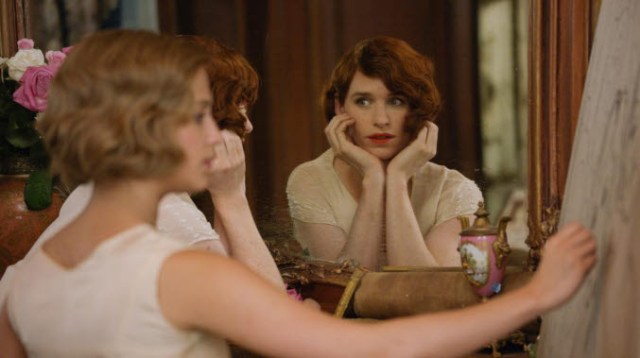
Eddie Redmayne and Alicia Vikander play Einar and Gerda Wegener, a Danish painter couple living in Copenhagen of 1926. While Einar has been quite successful with his landscape paintings, Gerda has been frustrated with how her portrait paintings keep getting overlooked, but they are happy together as wholeheartedly supporting each other’s career.

On one day, Einar happens to be a temporary model for his wife’s painting when her ballerina model is being late. As posing with female apparel in front of his wife, he feels closer to his feminine side he has never fully faced before, and that is the small beginning of his gradual transformation. As time goes by, his alter ego is slowly emerged from inside him, and he finds himself more drawn to being ‘Lili Elbe’.

thedanishgirl02

To Gerda, her husband’s change feels like a fun play at first. She lets her husband wear her bedroom clothes, and she helps him looking more feminine through her clothes and make-ups when they are about to go outside for a party where some of their friends will also attend. As artists, Einar and Gerda are not afraid of trying something new and interesting, and Lili and Gerda cannot help but be giddy and excited about their disguise in front of others. Although she is initially nervous, Lili has no problem in being introduced as Einar’s female cousin, and she even becomes the new model for Gerda, who is surprised by not only how much Einar looks different but also how Lili becomes a muse for Gerda’s unexpected artistic success.

But they feel more confused and conflicted as Lili puts more strains on their relationship. Lili gets herself involved with a guy named Henrik (Ben Whishaw), but then it turns out both of them want different things, and that hurts Einar as well as Gerda. She tries to understand and comfort her husband for maintaining their relationship, so she approaches to his old childhood friend Hans Axgil (Matthias Schoenaerts, who is as under-utilized as Whishaw) after she and Einar move to Paris later, but that only complicates their situation while Einar eventually decides upon what can be best for him – and her, perhaps.

Eddie Redmayne, who has been rapidly rising along with his solid works including a recent Oscar-winning turn in “The Theory of Everything” (2014), is well-cast in his role. With his boyish face and lithe appearance, he shows full commitment in his character’s tentative grasp of his true sexual identity during the first half of the film, and it is a shame that the movie does not give us enough human understanding of his character except some occasional dramatic moments to emphasize his torments and conflicts. No, I do not demand any cheap Freudian explanation on Einar’s sexuality, but the movie seems reserved and hesitant about who he is. In fact, it is also very reluctant to explore more into Lili’s relationships with two men around her, and that is why the second half of the movie feels particularly disappointing.

thedanishgirl03

On the opposite, Alicia Vikander, who is deservedly Oscar-nominated along with her co-star, is equally wonderful as her character goes through her own struggles along the story. Gaining her own career success, Gerda becomes more confident than before, and she strongly believes that she and her husband can endure a big change in their marriage, but she only finds her doubts growing more and more as their relationship becomes more strained. Can their mutual love be remained same as before even after he goes beyond the point of no return? And can she still see her husband’s former self from his irreversibly changed appearance?

Probably because of the inherent limits in its real-life story, the screenplay by Lucinda Coxon, based on David Ebershoff’s novel which is a fictionalized account of Einar and Gerda’s relationship, often stumbles. That weakness becomes more problematic when Einar’s sex reassignment surgery begins in the end under the supervision of an understanding German doctor played by Sebastian Koch. It is indeed a very important incident for Einar and Gerda, but the depiction of the surgery and its aftermath is so soft and maudlin that you may mistake his surgery for a tonsillectomy if you do not pay enough attention to it.

“The Danish Girl” is a good-looking period drama film on the whole, and the director Tom Hopper, who previously won an Oscar for “The King’s Speech” (2010), did a tasteful job of taking us to a period when sexual minorities were unjustly regarded as perverts or mental patients. Its story may be well-intentioned, but it only scratches the surface of its potentially rich materials. As pointed out at the end of the movie, Einar was indeed brave enough to let himself changed into Lili permanently through a very risky experimental surgery, but, folks, do we really get to know either of them? To be frank with you, I am not so sure about that.

thedanishgirl04

Posted in Movies | Tagged , , , , | Leave a comment

Creed (2015) ☆☆☆1/2(3.5/4): Something Old, New, and Unexpected

creed03“Creed” is an underdog movie true to the dogged spirit of its old senior in many ways. Faithfully following its senior’s footsteps with some bittersweet sense of nostalgia, the movie also brings a considerable amount of fresh energy into the franchise which is going to be 40 years old in this year, and it is unexpectedly vigorous and surprisingly poignant in its pulsating mix of old and new things. It is indeed predictable and conventional in its familiar genre formula, but the movie did its job far better than I expected, and it definitely deserves its own place right under its senior as a well-made sports drama packed with lots of vigor and heart.
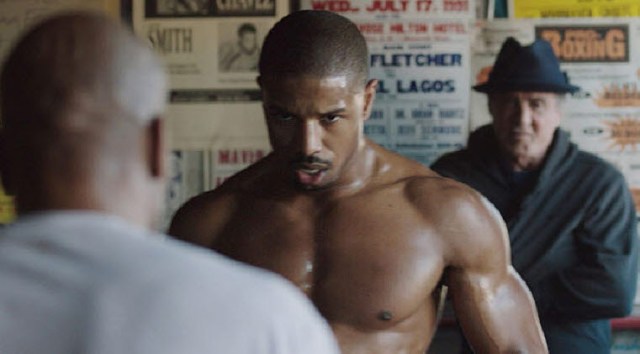
During the prologue scene set in 1998, we are introduced to a young boy named Adonis “Donnie” Johnson (Alex Henderson), an illegitimate son of Apollo Creed. As many of you know, Creed was Rocky Balboa’s opponent in “Rocky” (1976) and “Rocky II” (1982), but then he eventually became Balboa’s close friend in “Rokcy III” (1982). Donnie was born shortly after his father died during his last match in “Rocky IV” (1985), and he did not know about his legendary father until Apollo’s widow Mary Anne Creed (Phylicia Rashad) visits him when he is serving his time in a youth detention center.

17 years later, Donnie, who is played by Michael B. Jordan from this point, is now working in some financial company in LA, but, not so surprisingly, he has been aspiring after his own boxing career despite his stepmother’s objection. After going through several matches in Mexico, he wants to go up higher with better training, but no professional boxing trainer in LA dares to displease Mary Anne, who still exerts considerable influence as reflected by her big, luxurious mansion where she and her stepson have lived. Phylicia Rashad has a nice understated scene when her character comes to face a difficult moment she has probably feared for years; she cannot approve of her stepson’s decision on his own life, but she has no choice but to respect his choice as his caring mother, while quietly worrying about what will possibly happen to him.

creed02

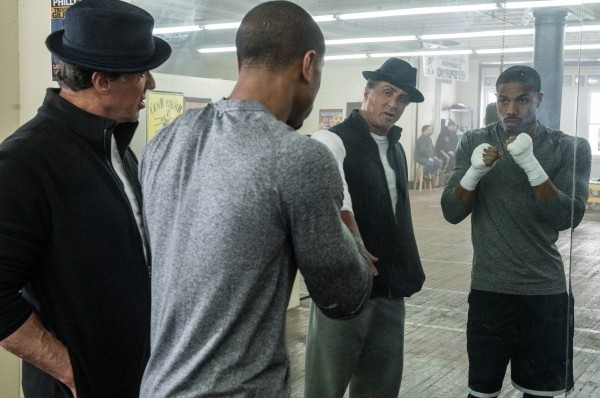
Donnie moves to Philadelphia, and then he approaches to, yes, Rocky Balboa (Sylvester Stallone), who has been humbly going through his twilight years since his last match in “Rocky Balboa” (2006), which was regarded as the send-off chapter of the franchise before “Creed” came. Although he is glad to meet his old friend’s son, Rocky is reluctant to coach Donnie, but then he changes his mind later, so we are served with their training scenes around good old neighborhoods of Philadelphia, which do not look that changed much compared to what we previously saw from “Rocky Balboa”.

While these training scenes feel routine at first, the director/co-writer Ryan Coogler, who previously made an impressive debut with “Fruitvale Station” (2013), make them look vivid and authentic under naturalistic mood, and the movie palpitates along with these scenes which function as the solid dramatic ground for the relationship between Donnie and Rocky. As they spend more time with each other through rigorous training sessions including the one involved with chickens (don’t worry, they are not pummeled like that beef in “Rocky”), Donnie and Rocky become close to each other like father and son, and Jordan and his older co-star click well with each other especially when there comes a sudden news which will test the bond between their characters.

Sylvester Stallone, who may be a sentimental favorite in the current Oscar race for his heartfelt performance here in this film, surely knows and understands well his character, with whom he has always been associated since he rose to his stardom through “Rocky”. Like Rocky did during the long history of the franchise, Stallone went through a fair share of ups and downs as managing to prevail throughout his long career, and the movie has a number of genuine emotional moments generated from the undeniable resonance between Stallone and his character. While he sees another possibility in his remaining life through his friend’s son, Rocky is also constantly aware of how close his life is coming to the end, and one quiet but harrowing scene unfolded at a local cemetery shows us how much he feels lonely as sensing more of his mortality everyday (“Time takes everybody out; time’s undefeated.”).

creed04Jordan, a promising young actor who has kept steadily advancing since his breakthrough turn in “Frutivale Station”, remains as the center of the film in his strong unadorned performance which is alternatively intense and sincere. While physically convincing on the screen, Jordan is engaging to watch as a good-natured lad trying hard for an opportunity to prove himself outside his dead father’s big legacy, and he also has a good chemistry with Tessa Thompson, who plays a girl with whom Donnie happens to be romantically involved by chance. Like Donnie, Thompson’s character has her own aspiration she will follow to the end in spite of several obstacles including her deteriorating hearing ability, and the screenplay by Coogler and his co-writer Aaron Covington thoughtfully handles the development of this intimate relationship with sensitivity and intelligence.

The boxing match scenes in the film are as good as you can expect, and I especially admire one dynamic long-take sequence which is flawlessly executed from the beginning to the end as the cinematographer Maryse Alberti’s handheld camera fluidly moves around here and there in the end. In case of the expected climax sequence featuring a big match between Donnie and an aggressive British lightweight champion played by Tony Bellew, it is gripping and exciting even though we can clearly see its eventual end from the distance even before the bell rings for the first round, and I appreciated that the movie gives a little understanding to Donnie’s opponent, who has his own personal stake in their match.

To be frank with you, “Creed” does not break any new ground in its genre, but it successfully accomplishes its main goals with lots of respect to its senior. While giving another chance to one of the most beloved American movie heroes, it touches upon our fond memory of the franchise through many recognizable things including Bill Conti’s triumphant theme and that certain famous spot in front of the Philadelphia Museum of Art, and it also shows its own potentials through its new hero who is as interesting as his old mentor. I heard that there will probably be a sequel to follow, and I do not expect that much about what will come next, but I do not deny that the movie itself is quite a surprise to say the least. This is indeed the best film in the franchise since “Rocky”.
creed01

Posted in Movies | Tagged , , | 2 Comments

The Hateful Eight (2015) ☆☆☆1/2 (3.5/4): A snowy and bloody deathtrap a la Tarantino

thehatefuleight06 Quentin Tarantino’s “The Hateful Eight” is a violent, bloody piece of work drenched in stylish excess and vicious black humor. This aspect will not surprise you if you are familiar with many of Tarantino’s sensational works, but this eighth film of his is quite mean, brutal, and ruthless even in his standard. After establishing its cold, snowy ground with a bunch of various untrustworthy characters stuck within a closed space, this savage western film mercilessly and relentlessly strikes us hard with how much its unlikable characters are literally hateful to the core, and you will be gripped by its ambitious take-no-prisoner exercise in bloody nihilism for more than 2.5 hours – or repelled by its relentless serving of simmering murderous hate and barbaric remorseless violence on its big, wide canvass of 65 mm film.

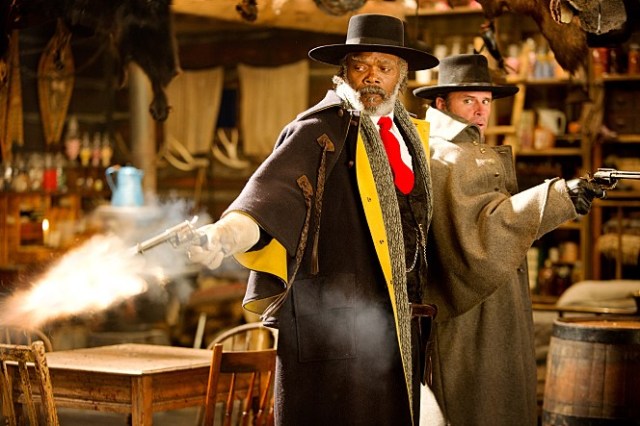
Its set-up is simple. After the ominous score by Ennio Morricone is played over the snowy winter landscapes of some rural area in Wyoming during the 1870s, the first chapter of the movie opens with the accidental meeting between two bounty hunters Major Marquis Warren (Samuel L. Jackson) and John Ruth (Kurt Russell) on the road to a small town named Red Rock. Because the weather is getting worse, Warren, who had been stranded on the road before coming across Ruth, needs any possible ride for him and the corpses of three recently deceased outlaws, and, after some cautious negotiation process between them, Ruth lets Warren into his stagecoach, which has been only occupied by him and his feisty outlaw prisoner Daisy Domergue (Jennifer Jason Leigh) while being driven by a driver named O.B. Jackson (James Parks).

Ruth has to be very careful about his ride, for it is highly possible that Daisy’s gangs are going to ambush him for her rescue at any point. While he trusts Warren to some degrees because they met each other before, Ruth is suspicious of another guy they come across later. Chris Mannix (Walton Goggins) says that he is going to Red Rock as the newly appointed sheriff of the town, but this Southern guy does not look that reliable from the start, and his blatant racist attitude certainly annoys and offends Warren, a black man who fought for the Union during the Civil War while gaining some notoriety for his ruthlessness on the enemies.

thehatefuleight03And then Ruth and Warren come across more things to worry about. As the weather gets far worse than expected with a freezing blizzard, the stagecoach stops by Minnie’s Haberdashery, and they and others in the stagecoach have to spend at least a few days in this place until the blizzard is attenuated. Ruth and Warren become more watchful than before as they notice a few strange things in this place. They are told that the owner of the haberdashery is currently absent due to a family matter, and the haberdashery is being taken care of by a Mexican guy named Bob (Demián Bichir). In addition, there are Oswaldo Mobray (Tim Roth), a British hangman who will probably execute Daisy as a certified professional; Joe Gage (Michael Madsen), a cowpuncher on the return trip to his home; and General Sanford Smithers (Bruce Dern), a former Confederate general who seldom moves on a sofa near the fireplace in his numb, flaccid state.
While this is indeed a classic locked-space mystery setup originated from Agatha Christie’s “Ten Little Indians”, a.k.a. “And Then There Were None”, the movie is also clearly influenced by that cold, claustrophobic paranoid mood among a group of isolated characters in John Carpenter’s sticky SF horror thriller film “The Thing” (1982). Tarantino even uses the unused portions of Morricone’s score for that film, and there are also a few visual nods to Carpenter’s film as the movie emphasizes the blistering cold weather encompassing the haberdashery and the characters inside the place.

Not so surprisingly, it slowly turns out that this typical situation is not just a simple matter of vigilance as Tarantino’s screenplay begins to twist the situation through the diabolical mechanism of hate and hostility among its main eight characters. Although O.B. may as well be the ninth member of the group, I guess he cannot be included in the group because 1) he is really who he seems to be on the surface and 2) he is not hateful enough to join the club.

thehatefuleight09

If many of the characters in “The Thing” have tentacles or claws to be sprung out of their bodies, all of the main characters in “The Hateful Eight” have each own detestable sides to be spewed from their racist/misogynistic minds, and this is not a pretty sight at all. As usual for a Tarantino film, the dialogues in the film are frequently rude and profane with lots of swears, but Tarantino is a talented writer who does know how to write good dialogues to grip our attention, and we come to follow his plot with morbid fascination as we dislike his pretty unlikable character more and more. Sure, there is not any character we can root for in the film in contrast to other notable Tarantino’s films including his best work “Pulp Fiction” (1994), but we instead find ourselves wondering about how much Tarantino will push the characters and their tense, volatile circumstance further.

And, boy, he does push his materials quite hard into his own pulpy area fueled by those trashy violent exploitation films he dearly loved. Once everything is set during its first part, the movie goes all the way for blood and violence along with a number of nasty turns for shock and awe, and Tarantino is clearly having a naughty fun with smashing and pulverizing genre elements to pieces as he previously did in “Inglourious Basterds” (2009) and “Django Unchained” (2012). I do not dare to go into details, but I can warn you that there will be lots of mayhems besides several merciless killings to be committed inevitably (is that a spoiler?), and you will definitely cringe at some of these very violent moments.

Although their characters are more or less than stereotype puppets to be shot or maimed as required, the performers in the movie play their unsavory characters with gusto, and most of them have each own despicable moments to savor. While Kurt Russell has a fun with his obnoxiously brash character, Samuel L. Jackson is still as commanding as his Oscar-nominated turn in “Pulp Fiction”, and he and Bruce Dern have a stupefying showstopper scene as Jackson’s character sadistically taunts Dern’s character for a dastardly purpose which is very clear to everyone in the haberdashery. It is delightful to see Tim Roth and Michael Madsen being together on the screen since Tarantino’s debut work “Reservoir Dogs” (1992), and Demián Bichir and Walter Goggins are also solid as wielding sneaky sides along with their co-stars.

thehatefuleight07

The standout in the cast is Jennifer Jason Leigh, who is utterly feral and ferocious as hurling herself into many brutal moments which will remind you of her fearless performance in “Last Exit to Brooklyn” (1989). While her hellcat character frequently feels like a casual punching bag in the film as often beaten or punched by the other characters in the film who have no qualms on showing their misogynistic view, Leigh is totally committed to her thoroughly unrepentant character, and it is oddly interesting to see how her treacherous performance intensely clashes with the racist/misogynistic elements in the film, which are pungently presented with cold disgust. As I think more about its story and characters, most of the characters in the film are not wholly innocent in its bitter nihilistic picture regardless of whether they can be defined as victims or victimizers, and the movie sometimes feels like an evil twin of Paul Haggis’s “Crash” (2004). The haberdashery can be viewed as a microcosm of the American society, and the finale of the film comes with one hell of nasty bloody irony involved with how two opposing racist views come to find a common area of hate and join together for that.

It comes to my mind that the movie may be Tarantino’s own “Barry Lyndon” (1975). Like Stanley Kubrick, Tarantino confidently, or arrogantly in some people’s view, believe that he can hold our attention as long as he wants, and he shows here that he is capable of that through his mastery of storytelling and filmmaking techniques. As widely publicized, the movie was shot on 65mm film using Ultra Panavison 70, and Tarantino and his cinematographer Robert Richardson effectively utilize the format. While the movie usually stays around inside the haberdashery, it seldom feels stuffy as its main space are fully presented on the widescreen of 2.76:1 ratio, and you can appreciate the details of Yohei Taneda’s production design and Courtney Hoffman’s costumes on the big screen. I only watched the film through the digital screening (the digital release version of the film is 20 minutes shorter than the 70mm roadshow version, which Tarantino prefers), but it still looked impressive to me, and Richardson did a beautiful job of establishing its wintry atmosphere along with the occasional shots of vast snowy landscapes to watch.

Shamelessly excessive and self-indulgent, “The Hateful Eight” could be shortened to be a more taut and impactful experience, and I do not like it as much as Tarantino’s more, uh, likable works, but I felt both excited and exhausted as walking out of the screening room at last night. Since “Reservoir Dogs” and “Pulp Fiction”, there have been countless imitators of his style during last 23 years, but Tarantino is still around the top of his game, if not at the top of it. I still feel rather ambivalent about the film, and I think he will soon have to find another breakthrough if he wants to keep going on, but, for now, I interpret my reaction to this film in a positive way.

thehatefuleight05

Posted in Movies | Tagged , , | 4 Comments

Room (2015) ☆☆☆1/2(3.5/4): Inside and outside their small room

room6Beginning with one very grim human condition, “Room” takes us into a small isolated world of its two main characters who have depended only on each other for years. While we are horrified by the darkness of their terrible circumstance, we are also touched by their intimate relationship which has been a tiny but precious light during their many unimaginable days of captivity, and the movie becomes all the more powerful as observing the resilience of their deep mutual love which leads them to the possibility of hope and salvation in the end.
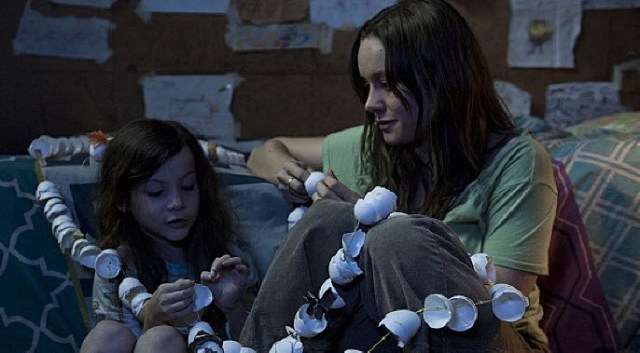
In the beginning, we watch the daily routines of ‘Ma’ (Brie Larson) and her young son Jack (Jacob Tremblay), and we gradually gather the stomach-churning horror of their living condition. Ma has been held as a captive since she was kidnapped by some very twisted guy seven years ago, and Jack was the result of his frequent sexual exploitation on her. While never telling him about his biological father, she has raised Jack alone with some assistance from her captor, and the occasional warm smiles on her weary face tell us how much she has lived through her son as a way of surviving through her seemingly endless captive status.

For Jack, their small space, called ‘the Room’ by them, is simply the whole world he has been comfortable with since his birth, and he innocuously describes to us how he came into the world, while not being aware of the horror behind his birth and his abnormal childhood years. He learned well how to speak and read thanks to his good mother, but she has told him that nothing is real beyond their room, and he believes her words without any question even though the young inquisitive mind of this five-year-old kid roams around inside the Room from time to time.

And we also meet “Old Nick” (Sean Bridgers), a monstrous man who has been locking Ma and her son inside a garden shack in the backyard of his house located in some suburban neighborhood. Whenever he is about to enter the shack, Ma puts Jack in the closet for a while, but that does not completely shield her predicament from Jack, who, like any other child in his age, is curious about what is going on outside the closet.

room01Through his close, intimate approach to the story, the director Lenny Abrahamson, who previously directed offbeat comedy film “Frank” (2014), sticks tightly to Ma and Jack’s isolated environment. We are immersed into their limited viewpoint as the cinematographer Danny Cohen’s camera usually stays close to them as if it were another captive in their space, and Abrahamson’s two lead performers are believable in their unadorned but captivating portrayal of a human relationship under an extraordinary circumstance. The screenplay by Emma Donoghue, who adapted her acclaimed novel of the same name, is an engaging mix of pathos and innocence, and the movie also works as a nail-biting thriller when Ma begins to realize that she must do something very risky for herself as well as her son.

After I came to notice her small supporting turn in “The Spectacular Now” (2013), Brie Larson has been a new talent to watch. While she has continued to draw my attention through her supporting roles in “Don Jon” (2013) and “Trainwreck” (2015), she was particularly good as the earnest heroine of “Short Term 12” (2013), and the scene where her character silently shows her empathy and understanding toward one of the troubled kids under her supervision was one of the most moving moments in that small gem.

In “Room”, Larson gets another good opportunity to utilize her talent, and she is quietly heartbreaking in her plain but haunting embodiment of her character’s accumulating pain and exhaustion. Carefully balanced between resignation and stubbornness, her unpretentious performance subtly conveys her character’s persistent struggle against her gloomy situation, and that is exemplified well by a brief scene where Ma tries hard for any chance of rescue along with Jack. As they are ‘playing’, the scene chillingly implies that they did this many times before, and that further accentuates how much they are isolated from the outside world by their captor, who may wipe out their existence forever someday if that suits him.

As the movie puts more emphasis on Jack’s awakening on the true nature of his closed environment, Jacob Tremblay becomes more prominent as his adult co-star’s equal acting partner, and this remarkable young actor gives an astounding performance to strike us with its considerable emotional depth and clarity. While being cheerful and innocent under his mother’s protection, Jack is not a mere cute stereotype at all, Tremblay is confident and electrifying as a smart, sensitive boy who learns and grows everyday in spite of the restrictions imposed upon him.

room03Tremblay and Larson never take any single wrong step as they push or pull each other in the vibrant depiction of their characters’ relationship. When Ma and Jack clash with each other over what is really real or not at one point, their conflict and pain feel palpable to us as the camera alternates between the powerhouse actings by Larson and Tremblay, and then there comes a tense sequence in which Jack must be very brave as he follows his mother’s desperate measure for what may be their last chance of rescue.

Because the trailers and advertisements of the film do not hide it at all, it is not much of a spoiler to tell you about the eventual narrative turn in the middle of its story, but I let you appreciate for yourself how the movie precisely and exquisitely handles this dramatic transition. All I can tell you is that it is alternatively heart-pounding and heart-warming with the frequent close-up shots of Tremblay’s expressive face, which tells so many things including his character’s overwhelmed state of mind in front of a wide open world he has never seen before.

In contrast to the dark, moody tone of the first half of the film, the second half of the film feels warmer and sunnier in comparison as Ma and Jack are finally free and safe in the outside. While they are recovering at a hospital, we meet Ma’s parents, who must have gone through their own hard time after their daughter was gone missing. Nancy (Joan Allen) welcomes her returned daughter and her grandson into her cozy home, but Robert (William H. Macy), who is not living with his wife now, is a little more reluctant to accept this changed circumstance.

room04We now observe Ma and Jack’s slow, difficult rehabilitation process, and it is harrowing to see how they are still not entirely free from their former condition. Jack is often bewildered by his new world which is far more open and comfortable, and he sometimes misses his former world where there were only him and his mother. Tremblay is achingly tentative as Jack takes his first steps into the world outside, and it is touching to see how quickly Jack adapts himself well to his new environment. Kids are vulnerable indeed, but they always surprise us with the resilience in their young plastic mind, and what Tremblay achieves here is as memorable as Abraham Attah’s strong work in “Beasts of No Nation” (2015), which is another unforgettable child actor performance of 2015.

While humbly letting her young co-star take the center, Larson is devastating as her character struggles with her psychological wounds. Acutely aware of many lost years during her captivity, Ma, whose real name is Joy, frequently feels angry and confused while trying to process the changes in her and her son’s life, and Larson wisely does not overstate her character’s inner turmoil during a painful scene where Joy faces difficult questions about the ordeal she does not fully recover from yet. Thanks to Larson, Tremblay, and Abrahamson’s honest, thoughtful direction, it is genuinely poignant to see how Joy comes to regain her strength through her dear son, and that is another touching moment in the film.

With Tremblay and Larson as its heart and soul, “Room” comes to us a heartfelt drama of powerful human emotions, and it is certainly one of the best movies of 2015 in my inconsequential opinion. Remembering how much I was moved during its finale accompanied with pure elevation, I am now reminded of what William Faulkner once said: “I believe that man will not merely endure: he will prevail.” When the movie is over, you will see that he was right.

room05

Posted in Movies | Tagged , , , , | 4 Comments

The Good Dinosaur (2015) ☆☆1/2(2.5/4) : My Boy Spot

gooddinosaur01While it is a slick animated feature film on the technical level, “The Good Dinosaur” is not wholly satisfying in terms of story and characters, and that is a surprise considering that it is made by none other than Pixar Animation Studios. Sure, there have been a few low points this legendary animation studio went through since its groundbreaking start with “Toy Story” (1995), but even its lesser films such as “Cars” (2006) and its underrated 2011 sequel have more personality compared to this film, which is not awful at all but rather forgettable on the whole.

Its premise is based on an intriguing story idea. In its alternative world, an asteroid which could have caused the extinction of dinosaurs happened to merely pass by the Earth 65 million years ago, so dinosaurs have been allowed to evolve a bit for next several millions of years as a result. While still roaming on the Earth as before, they become more cultured than before, and their present world somehow looks like the American frontier we have seen from countless western films.

In case of Henry (voiced by Jeffrey Wright) and Ida (voiced by Frances McDormand), this Apatosaurus couple have been managing their small farm in the middle of vast wilderness while raising their three children: Buck (voiced by Marcus Scribner), Libby (Voiced by Maleah Padilla), and Arlo (voiced by Raymond Ochoa). Although they walk on four feet, they can do a lot of things including plowing their corn field and watering the crops, and it is sort of amusing to watch how they work at their farm, though I wish the film showed us how they can build such a cozy family house like that or make rudimentary means for their farm work (how do they make ropes, for instance?).

gooddinosaur05Anyway, the harvest season comes again, and the family work harder for stocking their silo with harvested corns, which will support them during the upcoming winter. Henry assigns Arlo to guarding the corn silo from critters, and Arlo is eager to prove himself as his older siblings already did, though he is still not so confident while being afraid of many things including a pack of hideous chickens in their farm (my another question: what is the possible use of chickens for a herbivore dinosaur family? Chicken manure, perhaps?)

While he is on the guard, Arlo encounters a tiny feral human boy, and their first meeting accidentally leads to a sad tragedy for Arlo. When Arlo and his father are chasing after the boy along a nearby river outside their farm, the rainstorm suddenly begins, and, in a moment reminiscent of the similar scene in “The Lion King” (1994), Henry is killed by a sudden flood shortly after he manages to save his son in time.

When Arlo happens to encounter that boy again some days later, he is naturally enraged to see the critter who is responsible for his dear father’s death in his anguished view, but then he inadvertently gets himself tumbled into the river while chasing after the boy. When he regains his consciousness, he realizes that he is swept far away from his farm along with the boy, and that is the beginning of their long journey to Arlo’s home.

The rest of the story is as predictable as you can expect from its setup. The boy is named Spot as Arlo eventually comes to accept him as a friend to accompany and help him, and Spot (voiced by Jack Bright) virtually becomes his loyal puppy dog as reflected by his doggy behaviors, which probably mean that the human species in this alternative world was evolved from canines instead of monkeys.

gooddinosaur02During their journey, Arlo and Spot meet various types of dinosaurs, and these dinosaur characters are more or less than the reptilian version of western film archetypes. There is a dopey moment involved with a shamanic Styracosaurus voiced by the director/co-writer Peter Sohn, and then we get a bunch of nasty pterodactyls lead by Thunderhead (voiced by Steve Zhan). Arlo and Spot also encounter a Tyrannosaurus cowboy family running a longhorn ranch, and Sam Elliot is amusingly imposing in his voice acting as the tough, seasoned head of this family with lots of sharp teeth (God helps whoever happens to deal with them over their longhorns).

On the visual aspect, “The Good Dinosaur” is flawless as serving us with a number of enticing moments unfolded along with vivid background details, but I observed the film from the distance rather than being emotionally involved in its story and characters. I heard later that there were lots of story development problems during its pre-production stage, and that may explain its weak narrative base. While Arlo and Spot are likable characters to please young audiences, they are not distinctive enough to distinguish themselves from similar duos we have seen from many other films, and they are not as memorable as other Pixar Animation characters we have loved. Although the film manages to pull out a few good emotional moments from its mismatched duo, the plot is often flat and uneven due to its incoherent mix of genres, and its third act is clichéd to the bone along with a typical climactic action sequence, though I liked a witty reference of “Jaws” (1975) during that sequence.

Compared to the wonderful achievement in “Inside Out” (2015), “The Good Dinosaur” is a mildly disappointing work. I was not bored, but then I was reminded that the Pixar Animation Studios did a lot better than this many times before, so I cannot recommend it to you. Young audiences will surely have no problem with enjoying its colorful dinosaur characters shown on the screen, but I doubt whether they will remember these dinosaurs like I have fondly remembered the dinosaur characters of “The Land Before Time” (1988).

Sidenote
Short animated film “Sanjay’s Super Team” is shown before the movie begins. While bored during his father’s meditation, a young Indian boy imagines Hindu gods as his favorite superheroes, and the result is colorfully dynamic with a small note of poignancy in the end.

gooddinosaur03

Posted in Movies | Tagged , , , , , , | 1 Comment

Spotlight (2015) ☆☆☆1/2 (3.5/4): All the Church’s Men

spotlight06It is always interesting to watch professionals doing their best together. “Spotlight” gives us such an experience like that, and this top-notch journalism drama is calm, concise, comprehensive, and straightforward just like any good investigative article you read from newspapers. While its journalist characters are grasping the staggering scale of their unexpected scoop which will affect not only their city but the whole nation in the end, we are absorbed into the vivid, meticulous presentation of their slow but steady work progress against the corrupted system, and we become more aware of what is being at stake for them as their deadline approaches day by day.
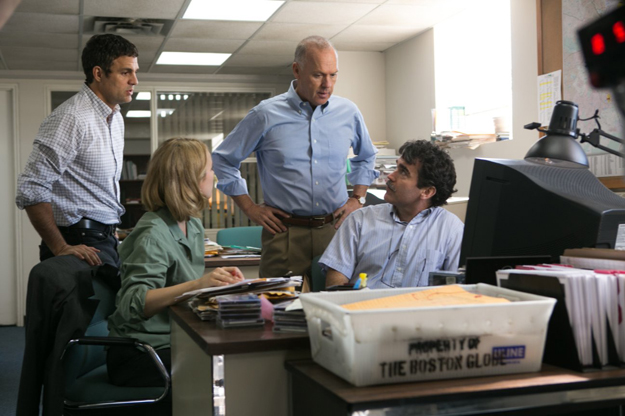
The movie is based on a real-life story of the Boston Globe’s Spotlight Team members, who won the Pulitzer Prize in 2003 for their extensive coverage of how the child sex abuses by Catholic priests in the Boston area had been covered up by the Boston Archdiocese for many years. As shown at the end of the film, this shocking news turned out to be a mere tip of the iceberg, and the public image of the Catholic Church was considerably tarnished as a consequence as more cases of child sex abuses in the Church were revealed after the Spotlight Team’s devastating disclosure in 2002.

After the chilly prologue scene set in Boston, 1976, the movie moves forward to when the Boston Globe is about to have its new editor in 2001. Although he is not a Bostonian and still needs to learn more about the city and its local culture, Marty Baron (Liev Schreiber) is ready to fill the position, and the key figures in the Boston Globe including Ben Bradlee Jr. (Richard Slattery) and Walter “Robby” Robinson (Michael Keaton) are willing to work under their new boss who smoothly settles in his position with his diligent professionalism.

spotlight01The Spotlight Team has been independently operated under Robinson’s supervision, and we meet his three reporters: Michael Rezendes (Mark Ruffalo), Sacha Pfeiffer (Rachel McAdams), and Matt Carroll (Brian d’Arcy James). After Baron suggests to Robinson that they should dig more into the case of a Catholic priest who turns out to be responsible for numerous cases of child sex abuse, the Spotlight reporters instantly embark on the further investigation on whether the Boston Archdiocese really turned a blind eye on its bad apple. They may not be surprised when it turns out to be true, but they are shocked to learn that this is not a singular case at all. There are far more sexual predators wearing shepherd’s skin around the city, and the Archdiocese has been concealing these dangerous guys and their crimes just for protecting its holy public reputation.

As they continue their investigation, the Spotlight Team reporters come to see that they must be really careful and discreet now. While it goes without saying that their ongoing investigation can be scooped by their rival newspapers at any point, what they are going to report will be a very unpleasant news to many of their Catholic subscribers in the city to say the least. Although Robinson and his reporters are not that religious, the Catholic Church has been a major part of their daily life in Boston in one way or another, and they cannot help but be amazed by how this awful truth has been hidden from them and many others in the city for years.

Closely following each small step of their investigation progress, the screenplay by the director Tom McCarthy and his co-writer Josh Singer draws a big, exasperating picture of systemic corruption with sobering details to horrify or infuriate you. We meet two different lawyers who know a lot about how the Church has silenced many helpless victims of child sex abuse behind its back, and Billy Crudup’s slick cynicism contrasts well with Stanley Tucci’s dogged righteousness. While one believes he did as much as he could do for his clients, the other is determined to do anything legally possible for justice, and Tucci delivers one of the best lines in the film: “If it takes a village to raise a child, it takes a village to abuse them. That’s the truth of it.”

spotlight02We also observe how mighty the Boston Archdiocese is as an opponent who can pull many strings through its considerable social/political influences around the city. The Spotlight Team members keep getting blocked from the courtroom documents which are necessary for their investigation, and they also feel the pressure from the outside in several directions. When Baron meets Cardinal Bernard Law (Len Cariou), this seemingly benevolent cardinal fully expects the Boston Globe to be on his church’s side, and that surely makes their meeting rather awkward. Regardless of how much Cardinal Law was actually responsible for the injustices committed under his leadership, you will roll your eyes to learn that he was virtually exempted from his scandalous blunder by his superiors in Rome while promoted to a more prestigious position later.
The most harrowing moments in the film come from the survivors of child sex abuse who are still struggling with what happened to themselves, and McCarthy thoughtfully handles these scenes with restraint and respect without sensationalizing their personal traumas. In case of the guy who initiated a support group for him and his fellow survivors, he looks unreliable at first, but then we come to sense the pain and frustration behind his fidgety appearance. He and some other survivors try to look all right while telling their individual stories to the Spotlight Team reporters, but they eventually reveal their psychological damages as recounting how they were sexually exploited by men they once believed and trusted. When  Pfeiffer visits a pedophile priest at one point, this short but creepy scene suggests that familiar virulent cycle of abuse.

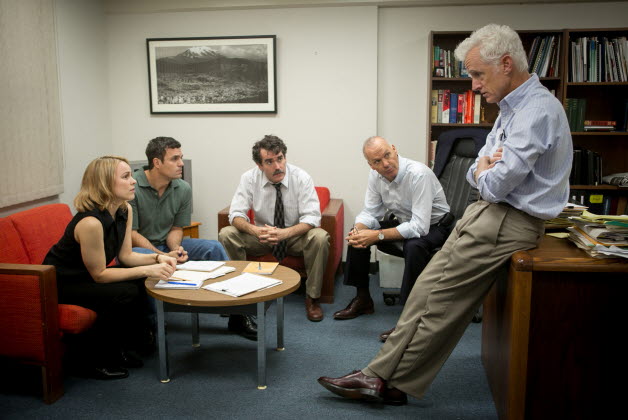
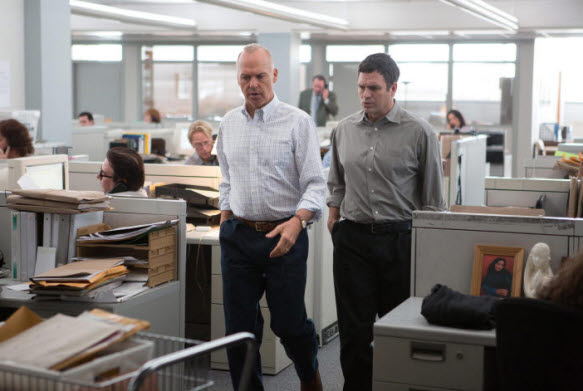
Balancing itself well among these various story elements, the movie keeps focusing on the strenuous activities of its earnest journalist characters, and McCarthy and his crew including the cinematographer Masanobu Takayanagi and the editor Tom McArdle bring the substantial amount of efficiency and verisimilitude into their film. The scenes in the Boston Globe are filled with the palpable vibe of journalism reminiscent of “All the President’s Men” (1976), and the actors look believable in their mundane surrounding background of offices and meeting rooms. We instantly accept that their characters have worked there for years, we come to pay more attentions to what they are doing or what they are going to do next, and we are gripped by the unseen tension hovering over their workplace.

S_07041.CR2

As shown from his previous films including “The Station Agent” (2003), and “The Visitor” (2007), and “Win Win” (2011), McCarthy is a skillful director very good at drawing fine performances from his performers, and he did a commendable job again here with a group of very talented performers. As effortlessly embodying their characters, they play so well with each other that we always get the dynamic sense of teamwork whenever their characters gather together to discuss on their work. Although movie does not show much of their personal life, their distinctive personalities are vividly conveyed through their professional behaviors, and that is more than sufficient for us to get to know who they are and what motivates them.

While Mark Ruffalo and Michael Keaton may be Oscar-nominated for their respective performances, it is difficult to single out any particular performer from the fabulous main cast in the film. Like Keaton, Liev Schreiber and John Slattery are subtle and measured in their stout performances, and Schreiber leaves an indelible impression even when the camera looks at him from the distance around the end of the film. Rachel McAdams is effectively understated when we get the glimpses of her character’s private life, and Brian d’Arcy James has his own small moment when his character happens to discover an inconvenient fact about his neighborhood. While Tucci and Crudup are constantly entertaining to watch, Neal Huff, Len Cariou, Paul Guilfoyle, and Jamey Sheridan are also notable in their small supporting roles, and Richard Jenkins, who was Oscar-nominated for his touching performance in “The Visitor”, provides an uncredited voice acting as a psychotherapist who gives some alarming research information to the Spotlight Team reporters.

“Spotlight” is a humble but exceptional drama about good investigative journalism, and it admirably and powerfully sticks to its modesty and honesty to the very end. It reminds us of what professional journalists can possibly do for our society, and it makes a strong point through its gripping story packed with human interest and social issues. They had a story which needed to be told to the public, and they did a really good job on the whole – and so does the movie.

spotlight03

Posted in Movies | Tagged , , , , , , | 2 Comments

Brooklyn (2015) ☆☆☆1/2(3.5/4) : A young immigrant between two different worlds

brooklyn02“Brooklyn” is a simple but touching film with lots of heart and mind. This is basically a classic coming-of-age drama with an innocent touch of fairy tale, but it is told so well through exemplary storytelling, commendable period mood, and first-rate performances that I found myself fully absorbed in its young immigrant heroine’s emotionally complex situation. Like many immigrants coming into US before or after her, she reaches for a life of good opportunities, and the movie shines with genuinely moving moments as she immerses herself in her new world and then comes to make an important decision for her changing life.

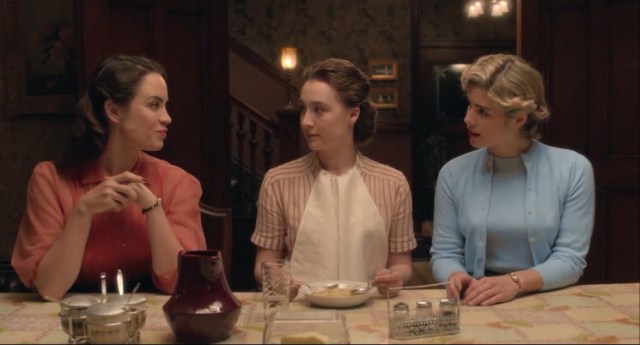
It is 1952, and Eilis Lacey (Saoirse Ronan) is a young girl who has lived for her whole life in a small town of County Wexford, Ireland. Although the life in her hometown is not that bad for her, her mother Mrs. Lacey (Jane Brennan), and her older sister Rose (Fiona Glascott), Eilis is willing to get out of her stuffy town for a better life, so Rose, who has been the diligent breadwinner for her family for years, makes arrangements for Eilis’s immigration to US, and now Eilis is going to New York by herself while leaving behind her dear family, who can only wish her good luck as seeing her off at the port.

Her long journey across the Atlantic is difficult due to several reasons including seasickness, and everything is alien and uncertain to her when she arrives in New York, but Eilis is fortunately helped and supported by her fellow Irish immigrants. She already has a place to stay at a boarding house in the Irish neighbourhood in Brooklyn, and her landlady Mrs. Kehoe (Julie Walters, who surely knows how to be both petulant and lovable) and the other young female boarders in the house gradually become her alternative family. Besides working at a department store, she also attends night college classes for her future career as a bookkeeper, and her kind, generous sponsor Father Flood (Jim Broadbent, who is certainly the No.1 choice for your average avuncular character) is always ready to be someone she can lean on.

brooklyn05

In addition, Eilis comes across the first real chance of romance in her life through Tony Fiorello (Emory Cohen), a gentle handsome lad from the Italian neighbourhood in Brooklyn. While Eilis is initially reluctant to respond to his sincere affection toward her, something does spark between them during their accidental encounter at a dance hall, and their developing relationship further solidifies her settlement. Feeling happy and confident, she is now more accustomed to her new environment, and it looks like she and Tony can have a life together someday.

While never pushing its plot too hard, the movie delicately moves along with its heroine as depicting the internal and external changes she goes through, and the director John Crowley did a fabulous job of establishing the palpable atmospheric contrast between her two different worlds on the screen. The opening scenes in Eilis’s hometown feels moody and suffocating in their muted color tones, and we observe its negative sides mainly through Miss Kelly (Bríd Brennan), a mean old lady who is contemptuous of most of the customers of her local grocery shop. The cinematographer Yves Bélanger smoothly shifts the tone to a warmer and brighter mode during the New York scenes, and they are filled with recognizable period details evoking the nostalgic quality of the 1950s.

It goes without saying that the world shown in the film is the romanticized version of a bygone era in the past, but it also recognizes pains and sorrows behind immigration without disrupting its gentle mood. When Eilis and other boarders do a volunteer work for poor Irish guys under Father Flood’s supervision, the deep melancholy hovers around these shabby people who left their homeland a long time ago, and this scene poignantly culminates to the impromptu performance of an old traditional song by one of them.

Eilis understands their homesickness well. The more she gets settled in New York, the more she misses her family. Although she keeps sending letters to them for telling them how much she thinks about them everyday, that does not change the fact that she has been separated from them across the ocean, and she naturally begins to have doubts on whether she really can settle in New York as she wished.

brooklyn03

And then she receives a sudden news from her hometown. She returns to her home as a dutiful family member, and she comes to realize that she must make a choice between her old and new worlds. While she is no longer a plain, mousy town girl she once was, Eilis finds herself drawn to her old familiar world because of her changed current status, and that change is reflected well by how her town looks brighter than before on the screen. She also acquaints herself with Jim Farrell (Domhnall Gleeson), and this decent local young man seems to be a safer choice than Tony, though there is a certain matter she will have to deal with if she chooses to fully accept Jim’s courtship.

You may easily guess which way she will choose in the end, but the movie keeps engaging us through her growing dilemma. After watching how strong the bond between her and her family is even during their long-distance interactions, we come to understand why Eilis is so reluctant to go back to New York. As noticing how much she has learned and experienced in her new world, we come to see why she cannot just put aside her time in New York. Tony is still waiting for her return, and she misses him as much as she missed her family while she was in New York.

Deft and thoughtful in handling its heroine’s personal drama, the screenplay by Nick Hornby, which is based on the novel of the same name by Colm Tóibín, also provides nice funny moments to amuse and tickle us, and Hornby, who was previously Oscar-nominated for his excellent adaptation job in “An Education” (2009), shows again his considerable talent in mixing witty humor and good-natured laughs into sensitive drama. I was both touched and amused by how Eilis gets a help from a kind stranger during her difficult journey to New York, and that scene feels more resonant when you reflect on it later. I enjoyed the spirited exchanges among Mrs. Kehoe and her boarders during their dinner scenes, and I smiled as watching Eilis doing some dining practice before she visits Tony’s Italian family for dinner, mainly because I still remember well when my younger brother taught me the same thing many years ago.

brooklyn04

The supporting characters in the movie may be broad, but they are imbued with enough life and personality to impress us. While Jim Broadbent and Julie Walters are dependable as usual, Bríd Brennan has a juicy nasty moment when her character shows her more despicable side at one crucial point in the story, and Fiona Glascott and Jane Brennan give heartfelt performances with each own fine moment to remember. Emory Cohen, who is a lot better here in contrast to his problematic acting in “The Place Beyond the Pines” (2012), is charming and likable as generating the tender chemistry with his co-star, and Domhnall Gleeson, who was quite busy in last year with a number of solid films including this one and “Star Wars: The Force Awakens” (2015), dutifully holds his small place as a possible alternative for Eilis. Eva Birthistle, Emily Bett Rickards, Eve Macklin, Nora-Jane Noone, Mary O’Driscoll, Samantha Munro, and Jessica Paré are also effective in their respective minor supporting roles, and the special mention goes to young actor James DiGiacomo, who steals the show during his brief appearance as Tony’s precocious little brother.

As the center of the movie, Saoirse Ronan is simply superb in a performance of rich nuances and understated grace. Since her uncanny Oscar-nominated turn in “Atonement” (2007), this young talented Irish actress has steadily advanced with several notable performances during recent years, and now she fully blossoms as a legitimate adult actress here with her strong performance. Ronan is believable and compelling in her intimate presentation of Eilis’s gradual transformation, and her expressive face is effectively utilized as an unadorned window to the continuing personal awakening inside her character.

Like Todd Haynes’s “Carol” (2015), which is also set in New York during the 1950s incidentally, “Brooklyn” is a superlative period drama film filled with quiet but powerful moments. As it transports us to its world in the past, its good story makes us empathize with its heroine’s wide-eyed view, and we become involved a lot in her drama. When we listen to her phlegmatic voice during the penultimate scene in the film, we are reminded of how much she has been changed through her journey, and that is why that scene is so moving. It is a very hard decision for her indeed – but we are also touched to see her taking another bold forward step for herself.

Brooklyn-2015-Stills-Wallpapers

Posted in Movies | Tagged , , , | 1 Comment

Macadam Stories (2015) ☆☆1/2(2.5/4) : Three stories from a shabby apartment building

asphalte01In a drab urban neighborhood where everyone looks lonely and isolated, “Macadam Stories” unfolds three different odd stories in parallel. While sharing the common tone and background with each other, these comic tales rarely intersect with each other, and that aspect further emphasizes the sense of loneliness and desperation around its main characters as it often looks like they are the only people in their gray monotonous world.
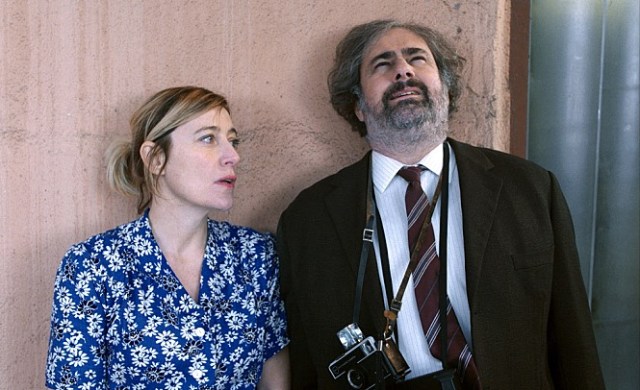
The opening scene is incidentally the most crowded one in the movie. In one shabby apartment building in the serious need of elevator repair, most of its residents agree during their meeting that they should pay together for the repair, but there is the sole voice of dissent among them. Sterkowitz (Gustave Kervern), a sloppy, passive middle-aged bachelor guy who lives alone at his home on the second floor, does not understand why he should give money for the repair fund even though he does not use the elevator, and his rather narrow-minded view naturally exasperate others at the meeting.

Anyway, his neighbors eventually decide that Sterkowitz will not be allowed to use the elevator for not contributing to the repair fund, and he sees no problem with that, but then, what do you know, he soon finds himself in the need of that elevator in question. After getting himself injured due to one silly incident involved with his new exercise machine, he will have to be stuck in his wheelchair for a while, so now he definitely needs the elevator more than ever.

asphalte02For dealing with his difficult situation, Sterkowitz comes to devise a way to use the elevator without coming across his neighbors. He notices a considerable time gap during night, so he starts to sneak out at night with his wheelchair, and that is how he happens to encounter a weary nighttime hospital employee played by Valeria Bruni Tedeschi. Probably inspired by a movie he previously watched on TV, he lies about himself during their first conversation, and he keeps going along with that deception as he continues to meet her during his routine night hours. They approach to each other bit by bit, but our sad sack guy is clumsy as usual – and she looks weary and depressed as before.

Meanwhile, we meet Charly (Jules Benchetrit, who is the son of the director/co-writer Samuel Benchetrit), a teenager resident who has been accustomed to the absence of his parents at their home. On one day, he notices that a middle-aged woman moves into the opposite apartment, and he begins to be curious about his new neighbor probably because she is played by none other than Isabelle Huppert, a fascinating French actress who has seldom been boring to watch on the screen.

Jeanne Meyer, Huppert’s character in the movie, turns out to be an aging actress behind her prime, and one of Huppert’s previous films, “The Lacemaker” (1977), is cleverly used at one point when Jeanne shows her old film to Charly. While Jeanne feels confused and bitter about how things have gone downhill for her, Charly is willing to help her besides taking care of a door lock problem, and she comes to discern a new possibility in her career as spending more time with him. Huppert and her young co-star are believable especially when Charly and Jeanne are making an audition tape for her, and the awkward comic tension around their characters is conveyed well to us as they struggle to find the right tone for the tape.

The third story in the film is probably the most whimsical one in the bunch. Because of some accident which is neither told nor shown to us, an escape capsule containing NASA astronaut John McKenzie (Michael Pitt) is fallen onto the top of the apartment building. While NASA bureaucrats try to take care of this outrageous situation without any serious public embarrassment (I am sure that the movie will not be NASA’s favorite film at any chance) John has no choice but to stay at an apartment which belongs to an old Algerian lady named Madame Hamida (Tassadit Mandi).

asphalte04Although there is a language barrier between them from the beginning, John begins to enjoy and appreciate the hospitality of this sweet old lady who has been living alone since her son was sent to prison. As he becomes a sort of surrogate son for her, John feels more comfortable than before although he is going to be picked up by his people once his current messy situation is over. The movie has a small fun with John and Madame Hamida’s rudimentary communications over the language barrier, and we get a humorous scene when they talk over an American TV soap drama they are watching together.

“Macadam Story”, which was released as “Asphalte” in France, is partially based on the stories from Benchetrit’s autobiographical short story collection “Les Chroniques de l’Asphalte”. As bundling its stories together, the dry, melancholic atmosphere in the film is maintained well along with nostalgic cultural details evoking the 1980s, and Benchetrit also accentuates the stuffy environment surrounding his characters through the use of screen ratio of 1.33:1.

The influences from Jacques Tati, Jim Jarmusch, and Roy Andersson have been mentioned since it was shown at the Cannes Film Festival early in last year, but “Macadam Stories” looks less impressive compared to Andersson’s recent film “A Pigeon Sat on a Branch Reflecting on Existence” (2014), another deadpan comedy which also deals with melancholic human loneliness encompassed inside dispirited urban world. While I laughed a lot while watching that hilarious film, I was just mildly amused in this case, and that was all I experienced.

asphalte03

Posted in Movies | Tagged , | Leave a comment