
 “Anomalisa” is a stop-motion animated film from Charlie Kaufman, and this is certainly another odd, fascinating work from a talented writer/director who wrote the screenplays for “Being John Malkovich” (1999), “Adaptation.” (2002), “Eternal Sunshine of the Spotless Mind” (2004), and his directorial debut work “Synecdoche, New York” (2008). Again, he looks into matters of human mind through an offbeat approach full of surprises and amusements, and the result is a unique work which is funny, insightful, and touching in its whimsical mix of melancholy, humor, and romance.
Its hero Michael (voiced by David Thewlis) is a self-help book author who is going to Cincinnati, Ohio for his book promotion at a hotel customer convention when we meet him during the opening scene. He has been lonely, desperate, and frustrated while feeling distant from others around him including his own family, and we soon notice this depressed guy’s warped state of mind right from the beginning. Everyone around him looks all the same while speaking in the same voice provided by Tom Noonan, and that reminds me of that famous scene in “Being John Malkovich”, where John Malkovich himself enters his own mind and sees a world literally full of Malkoviches.
While lodging at a hotel where the convention is being held, Michael prepares for his speech for the next day in his comfortable hotel room, but he comes to think more about his old girlfriend living in Cincinnati. Their breakup was unpleasant to say the least as reflected her old letter sent to him during that time, but now he wonders whether he can reconnect with her. He eventually calls her, so she comes into the hotel bar for meeting him, but that turns out to be disastrous to his dismay.
But then he comes across an unexpected chance when he returns to his room and takes a shower. He happens to hear a voice which seems to come from one of the other rooms on the same floor, and he is attracted to the voice because it sounds different from those many identical ones around him. He immediately searches for the source, and that is how he comes to meet Lisa (voiced by Jennifer Jason Leigh), a woman who is attending the convention along with her friend. She somehow looks different from others in his view, so Michael suggests that she and her friend should go down to the bar along with him, and he gets to know a little more about Lisa while spending time with them at the bar.
 This is basically a conventional setup for romance tale, but the movie is imbued with quirky sensibility to entertain us, and Kaufman and his co-director Duke Johnson did a superlative job of making their characters on the screen look real and believable through skillful stop-motion animation. The body movements of the characters in the film are smooth and fluid without any awkwardness, and their presentation of emotions are conveyed well to us although they are still somewhere around the Uncanny Valley. We often notice their artificial quality, but that aspect somehow fits with the surreal atmosphere in the film, and Kaufman and Johnson often push that aspect to nice comic effects for our amusement. For instance, the movie does not flinch from nudity at all, you will see very clearly that the movie is rated R for good reasons.
The movie is also sincere and serious about its hero’s emotional matters. In objective view, Michael is no more than a miserable loser attempting an extramarital affair, but we come to understand his need and desperation as he clumsily approaches to Lisa. In case of Lisa, this shy woman is happy to receive the unexpected attention from a stranger, and we sense the mutual feeling growing between her and Michael as they talk more and more with each other.
In the end, they come to have their own private time in Michael’s room, and they eventually move onto the next logical step as being more comfortable with each other on the bed. I will not go into details, but I can tell you that Kaufman and Johnson find an effective way to present this rather graphic scene without looking silly or gratuitous. Accompanied with Carter Burwell’s restrained but sensitive score, it feels warm, tender, and intimate as two characters tentatively try to get closer to each other, and it also manages to sidestep the Uncanny Valley successfully and tastefully while letting us gradually involved in what is being exchanged between them.
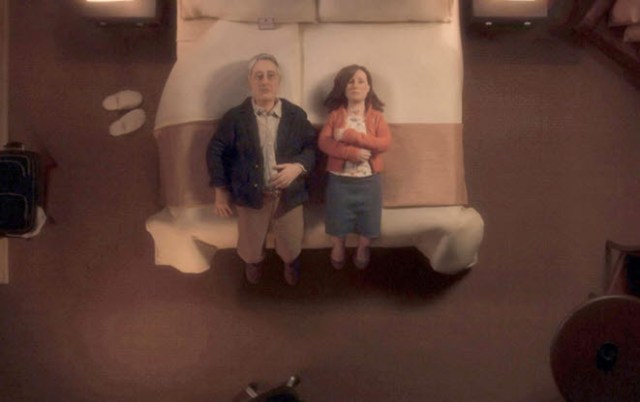
It also helps that David Thewlis and Jennifer Jason Leigh click well with each other in their voice performance. Thewlis is excellent as a sad man struggling with his deep emotional problems, and Leigh, who is far softer than her nasty Oscar-nominated turn in “The Hateful Eight” (2015), complements her co-star well with her gentle performance. Noonan, who drew my attention for the first time through his crucial supporting turn in “Synecdoche, New York”, has lots of fun with handling the rest of the characters in the film, and his flat, monotonous voice further accentuates the drab environment encompassing Michael and Lisa with great effects.
While less dense and cerebral compared to Kaufman’s previous works, “Anomalisa”, which deservedly received an Oscar nomination for Best Animated Feature Film, is mostly successful in its bold storytelling experiment despite its few flaws including its overlong third act. It is definitely weird, but it ultimately looks into human matters we can empathize with, and it eventually illuminates a few important things about human relationship.
While watching the movie, I was reminded of that good advice on relationship which is given to the young heroine of “Juno” (2007) by her no-nonsense father: “Look, in my opinion, the best thing you can do is find a person who loves you for exactly what you are. Good mood, bad mood, ugly, pretty, handsome, what have you, the right person is still going to think the sun shines out your ass. That’s the kind of person that’s worth sticking with.” I think Kaufman would wholeheartedly agree to that.
Sidenote: The movie is based on the play of the same name which was written by Kaufman under the pseudonym Francis Fregoli. His pseudonym came from the Fregoli disorder, a rare mental disorder in which, according to the Wikipedia, “a person holds a delusional belief that different people are in fact a single person who changes appearance or is in disguise.”




 Watching Japanese animated feature film “When Marnie Was There” is a bittersweet experience because this may be the last work from Studio Ghibli, which has been in a ‘temporary’ hiatus period since “When Marnie Was There” was released in Japan in 2014 July. After its two leading animation directors Hayao Miyazaki and Isao Takahata went into retirement after their respective swan songs came out in 2013, the future of Studio Ghibli became more uncertain than before, and now it looks more possible that its great era is really being finished with “When Marnie Was There”, which is incidentally its 20th feature film.


 They have known and lived with each other for many years, but now they start to feel anxious and uncertain about their relationship after a sudden news comes in from the old past. As its aging couple begin to ruminate more on their long life and relationship, “45 Years” closely observes small emotional ripples around them, and its somber but intimate presentation of their personal conflict gives us searing moments of quiet but powerful emotions. The more they reflect on the past, the more they feel confused and bitter about what was lost or gone a long time ago, and they inevitably come to have questions and doubts on their seemingly stable relationship. Have they been just stuck with each other from the beginning without really knowing each other? And can they still go on together during the rest of their remaining life, in spite of this unexpected crisis to shake both of them?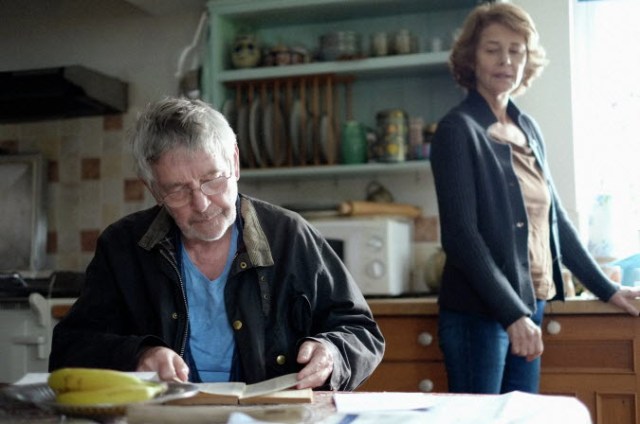
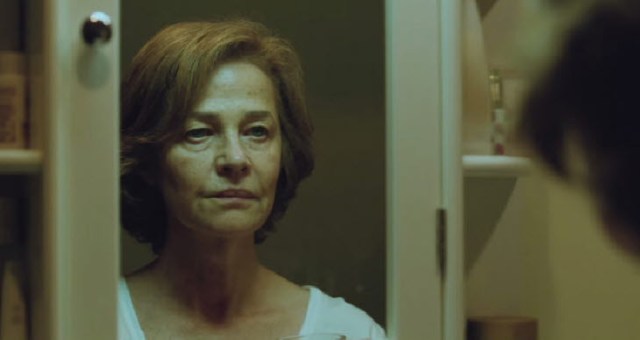

 Calmly looking into its plain working class hero’s quiet economic struggle, French social drama film “The Measure of a Man” shares his desperation and frustration with us during the first half and then throws some hard moral questions during the second half. Can he live with the price he must pay for maintaining a hard-earned status he cannot easily give up? And what can he really do in front of the harsh capitalistic reality which corners not only him but also many others around him?
 As Thierry keeps looking for any chance of employment, we see more of how difficult the situation is for him and his family. He feels happy and comfortable whenever he is with his loving wife and their disabled son, but they may have to sell their apartment someday if that is necessary for sustaining their current situation. In addition, their son, a bright teenager boy whose spirit is not hindered by his disability at all, wants to go to a better school for his academic aspiration, and that means there will be another financial burden for his parents.
 Anyway, that painful moment seems to give Thierry a lesson to be learned, for we soon see him being employed as a security guard at a local branch of some big supermarket chain. While occasionally watching around this wide place, he also learns how to operate many CCTV cameras placed here and there around the ceiling, and we get an interesting scene which shows how this place is being monitored at each second through those cameras. Some of them can actually be moved along their tracks while not noticed by anyone below, and we also hear about how certain customers can be spotted as potential shoplifters.


 Around this Monday, I finished reading “Joyland”, one of Stephen King’s recent novels. While its story revolves around a dark murder mystery involved with one plain but special amusement park in North Carolina, I enjoyed its vivid, affectionate description of that amusement park, and one of the memorable things in the book was its fun house. While its visitors know what they are probably going to get once they enter this place, they do get scared or thrilled thanks to its nice surprises to shock and delight them during their ride, and I was amused by the details on how this facility is operated for its visitors’ scary fun time.
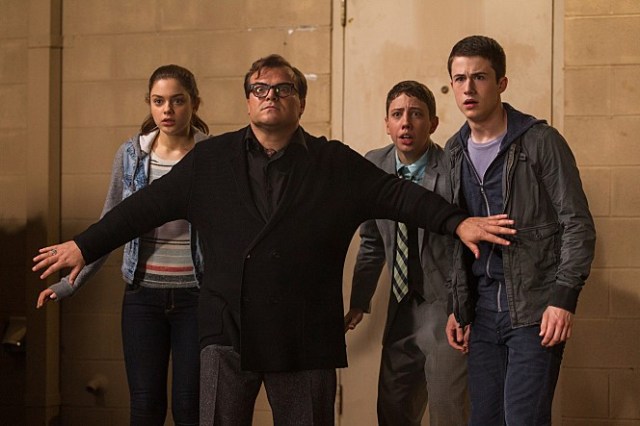
 But their relationship soon faces the objection of Hannah’s father, who looks very determined to keep himself and her daughter away from others for some reason. Zach naturally wonders about what is really going on between this strange father and daughter, so he eventually sneaks into the writer’s house along with his nerdy schoolmate Champ (Ryan Lee), but, as soon as they enter the house, the boys realize that they come into a situation they do not entirely understand yet. When they enter the writer’s library, they find many mysterious books locked on their cover, and it turns out that the writer is none other than R.L. Stine (Jack Black).
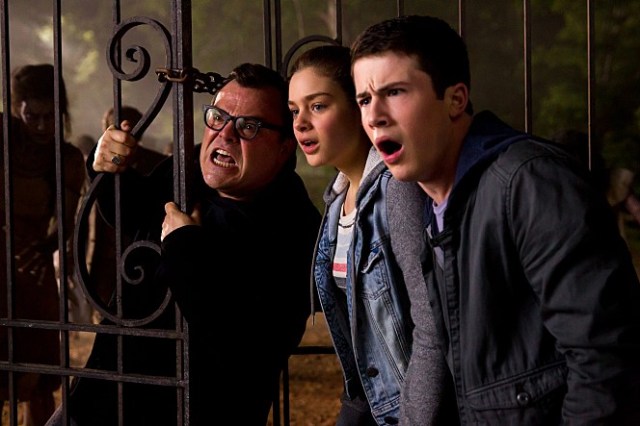 As Zach, Champ, Hannah, and Stine try to find any possible solution for this messy emergency, the movie keeps throwing lots of CGI creatures into the screen. While these creatures look scary enough to maintain the constant level of tension and excitement in the film, there is always the sly sense of humor behind their scenes. You may notice a number of humorous references to several well-known horror films such as “The Blob” (1958) and “The Shining” (1980), and I particular liked a menacing black car reminiscent of the similar evil vehicle in cult horror film “The Car” (1977).
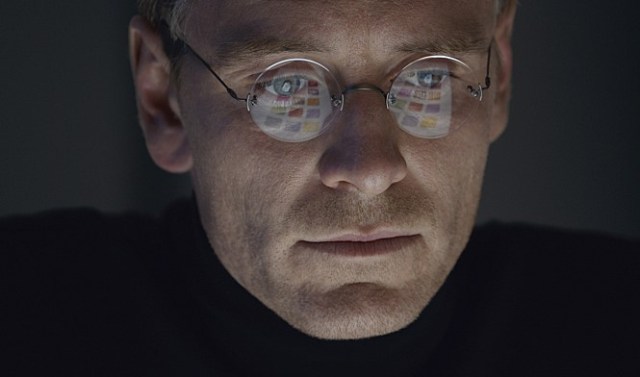 Through its fictional narrative structure, “Steve Jobs” attempts to give us a complex portrayal of one fascinating real-life figure whose grand, ambitious visions have influenced our modern world – or our modern electronic industry and market at least. Although its dramatic presentation is not exactly revealing especially if you are very familiar with the subject, the movie works a very engaging character drama fueled by its smart screenplay and excellent performances, and it is entertaining to see how it smoothly moves through its three individual main stages with style and mood as constructing a multi-dimensional portrait both human and abstract.
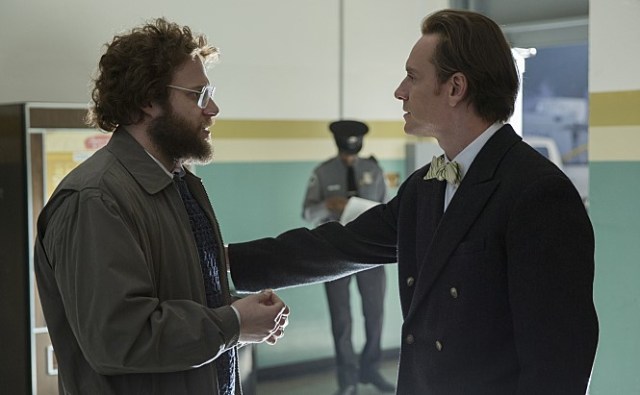 Like “The Social Network” and “Moneyball” (2011), Sorkin’s screenplay for “Steve Jobs” is packed with long well-written dialogue scenes, and we go along with its swift narrative flow as these dialogues scenes are delivered quick and fast by the wonderful performers in the film. Although he does not resemble Jobs much compared to Ashton Kutcher in “Jobs” (2013), Michael Fassbender, who is no stranger to playing cold, intense characters with dark shades, is electrifying as a callous but charismatic man relentlessly driven by his single-minded ambition, and we have no problem in accepting him as Jobs from the start. While Kate Winslet, who is deservedly Oscar-nominated along with Fassbender, is fabulous as his equal acting match, Seth Rogen shows again how effortlessly he can dial down his comic persona whenever it is necessary, and Jeff Daniels and Michael Stuhlbarg are reliable as usual while having each own moment in front of Fassbender. As Job’s daughter, Makenzie Moss, Ripley Sobo, and Perla Haney-Jardine are flawlessly connected together in their performance, and their scenes with Fassbender are poignant as Jobs clumsily shows his better side through his strained relationship with his daughter, who has somehow grown up well despite her problematic childhood years and becomes a bit closer to her distant father in the end.


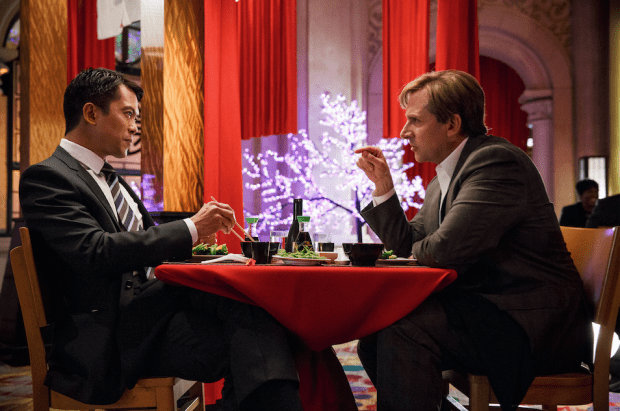
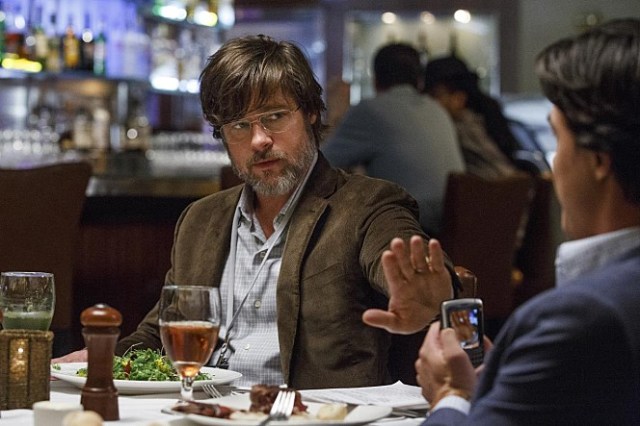 While many of real-life people in Lewis’s nonfiction book are presented through their fictional counterparts with changed names, the characters in the film are imbued with vivid, distinguishable personalities, and the talented cast members of the film smoothly inhabit their respective roles. Christian Bale, who is recently Oscar-nominated for his good performance (the movie is also nominated in four other categories including Best Picture), is dependable as a brilliant but socially awkward man who adamantly sticks to his belief and principles despite the mounting pressure from his angry boss and investors who do not believe his dour prediction on the market, and I personally appreciated how well Bale embodies those notable behavioral patterns of Asperger’s syndrome glimpsed from his eccentric character. Ryan Gosling’s easy-going charm is countered well by Steve Carell’s intense presence, and Carell deftly moves back and forth between comedy and drama as his character reveals personal conflicts behind his righteous anger toward the system he and his colleagues belong to. In his humble supporting performance, Brad Pitt, who also participated in the production of the film, effectively complements his two younger co-actors John Magaro and Finn Wittrock, and several notable performers including Hamish Linklater, Rafe Spall, Jeremy Strong, Adepero Oduye, Marisa Tomei, Melissa Leo, Karen Gillan, and Tracy Letts are also solid as the minor supporting characters in the film while Margot Robbie, Anthony Bourdain, Selena Gomez, and Richard Thaler have each own little fun during their short cameo appearances.
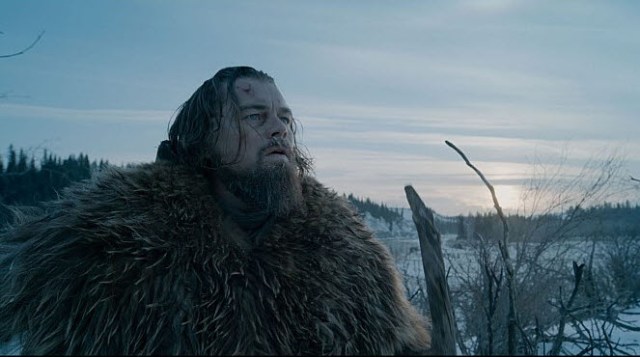 Grim, grisly, and grueling, “The Revenant” is determined to overpower you with its cold, stark beauty of vast wilderness as well as its gray, gloomy depiction of extreme human conditions. This brooding western tale of survival and revenge is a tough, exhausting experience to say the least, but what is accomplished on the screen is so vivid and visceral that we cannot help but stare at the screen even during some of its most intense moments which brutally test the weakness of human body as well as the strength of human will. The movie is indeed one of those ‘feel-bad’ films, but its big, bold, and ambitious gestures for greatness are something to watch even though it is not always successful in reaching out for its greatness.
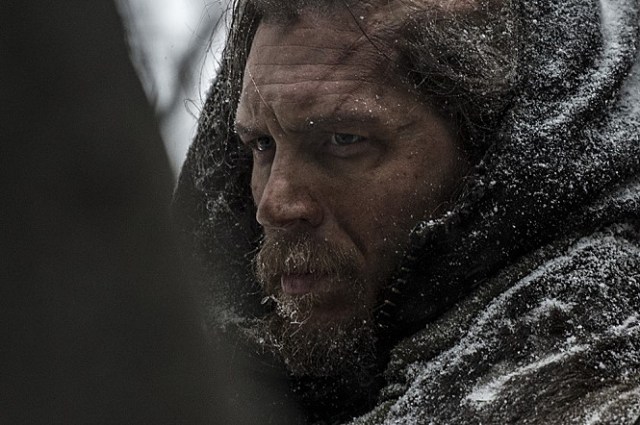 Unfortunately, another bad incident follows shortly after Captain Henry and others leave behind these four guys. Hawk is killed by Fitzgerald, and that happens right in front of Glass, who is still helpless and speechless under his deteriorating condition. After hiding Hawk’s body, Fitzgerald lies to Bridger, and Bridger, who was not around there when the killing occurred, comes to help Fitzgerald burying Glass alive in the ground. He later realizes Fitzgerald deceived him, but there is nothing he can really do except regretting over his misjudgment and following Fitzgerald’s demands.
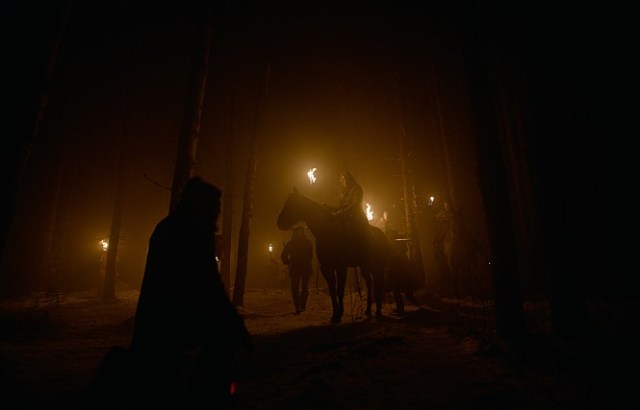 While Glass’s grueling quest for survival is the center of its story, the movie also pays attentions to other characters at times. We see some more difficulties Captain Henry and his men face before they finally arrive in the army barrack, which is a mere faint reminder of civilization in its dim, shabby appearance. We meet another group of hunters around the wilderness region, and we see more of Elk Dog (Duane Howard), the Arikara tribe’s stern leader driven by his personal motive. Most of the Native Indian characters in the film are more or less than hostile extras at the fringe of the story, but their hostility is depicted with some understanding on their position, and some of the bleakest scenes in the film remind us that their opponents are no better than them.


