
 No other love can warm my heart
Now that I’ve known the comfort of your arms
No other love, oh the sweet contentment
That I find with you everytime, everytime
– from the song “No Other Love”
They feel something tingling between their hearts when their eyes meet across the space between them. They tentatively approach to each other as they feel more of their mutual attraction, but they are well aware of the possible consequences of what binds them so strongly together, for their romance is a taboo which even they are not willing to talk about.
Based on Patricia Highsmith’s romance novel “The Price of Salt”, Todd Haynes’s “Carol” is a somber, melancholic period drama about two different women who happen to be romantically involved with each other, and it is quietly captivating thanks to the restrained but sensitive direction and the powerful duo performance to remember. As the movie immerses us into a bygone era in the past when homosexuality was wrongfully regarded as immoral perversion by many people, we come to empathize more with what its two heroines see from each other, and we are touched by their human yearning and passion churning below the surface. They are simply happy to be with each other, and all the obstacles around them are put aside for a while when they look at each other, though they are bound to face these obstacles sooner or later.
It is New York during the Christmas season of 1952, and Therese Belivet (Rooney Mara), a young woman who works as a temporary sales clerk in some Manhattan department store, comes across Carol Aird (Cate Blanchett) during another usual day at the department store. Not long after Therese notices Carol looking onto a toy train set, this glamorous lady comes to Therese and then talks with her for a while, and Therese recommends the train set for the Christmas present for Carol’s young daughter.
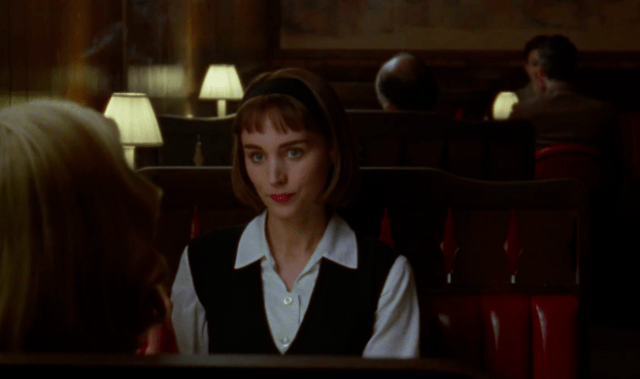
After her satisfying purchase, Carol accidentally leaves behind her gloves on the counter. Therese directly sends them to Carol by mail, and then Carol invites her to a lunch out of gratitude. As they get to know more about each other, Carol suggests that they should spend Christmas together at Carol’s house located outside New York, and Therese accepts the offer. She is more enamored of Carol as time goes by, and Carol is also drawn to Therese’s undifferentiated youthful beauty ready to blossom.
As Therese is more conscious of her sexuality, we get the glimpses of the gradual process of her emotional maturation through small but significant moments. While her passionate feeling toward Carol grows, she comes to see how superficial her relationship with her current boyfriend Richard (Jake Lacy) is. She also becomes more active in following her aspiration of being a professional photographer, and her growing interest in photography is encouraged by Carol as well as Dannie (John Magaro), one of Therese’s friends who works in the New York Times and is willing to provide an early career opportunity for her.
While Highsmith’s novel is limited within Therese’s viewpoint, the adapted screenplay by Phyllis Nagy, who was a friend of Highsmith and tried to get the movie made for many years after her friend’s death in 1995, pays considerable attentions to Carol’s side for its narrative balance, and we see how she has been lonely and frustrated in her affluent daily life. Although she is about to divorce her husband Harge (Kyle Chandler), she must keep her appearance as demanded by him because she does not want to lose the custody of her dear daughter. When her daughter or Therese is not around her, her only comfort comes from Abby (Sarah Paulson), her longtime friend who was once her lover and is still a close friend of hers.
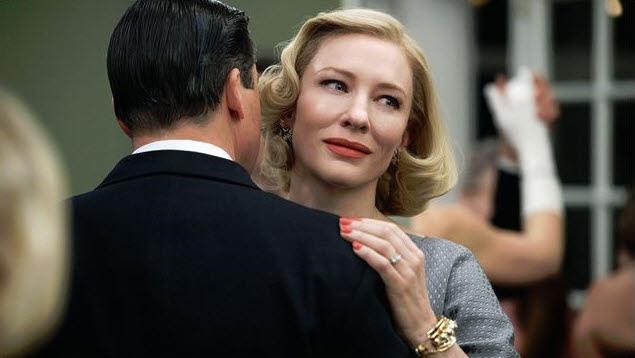
One of the interesting things in “Carol” is the depiction of how its era was much more oppressive for sexual minority people in contrast to our time, and the movie subtly and acutely observes that prohibitive trend around Carol and Therese. When Therese spots two women during one party, we can clearly sense their intimate relationship them although they do not tell and she does not ask. During Carol’s legal conflict with her husband over their daughter’s custody, her relationship with Therese is virtually an elephant in the room for everybody including Carol, and no one dares to delve too much into this ‘immorality’ matter. It is no surprise that Highsmith, who was already famous for her classic crime thriller novel “Strangers on a Train”, used a pseudonym when “The Price of Salt” was published in 1952; while homosexuality was a pretty risky subject from the beginning, it was all the more daring to suggest the possibility of happiness for its two star-crossed lovers.
The director Todd Haynes is no stranger to this territory. His previous film “Far From Heaven” (2002) is an achingly beautiful period drama influenced by Douglas Sirk’s classic melodrama films during the 1950s, and I admired it for how it aptly balances itself between respectable homage and refreshing modern perspective. As its suburban housewife heroine played by Julianne Moore struggles with her matters of heart after realizing her husband’s closeted homosexuality, the movie delves straight into several social subjects which would have been deemed too risky and sensitive for Hollywood during the 1950s, but it is also quite faithful to the style and mood of Sirk’s films through its painstaking period details, and the result is a very poignant mix of classic and modern elements.
While “Carol” is more subdued in comparison under its gloomy wintry atmosphere, Haynes and his crew fill their film with aesthetic touches to admire. New York during the 1950s is recreated well with the authentic mundane sense of time and space thanks to the production designer Judy Becker and the costume designer Sandy Powell, and Carter Burwell’s understated score calmly suggests the emotional currents surrounding Therese and Carol. The cinematographer Edward Lachman brings warm, intimate mood into the private scenes between Carol and Therese through soft lighting and muted color tone, and these scenes feel like small glowing fires for these lonely women. When Carol and Therese finally reach to the breakthrough point of their relationship, Haynes and Lachman present this crucial moment with tender sensitivity and tasteful eroticism, and we are reminded of why we are often swept helplessly by our romantic urge no matter how much we are prohibited from doing so.

The movie ultimately depends on its two talented lead actresses, who are respectively at each own career peak here and will be definitely Oscar-nominated in the next year. Exuding the mesmerizing aura of classic Hollywood star actress, Cate Blanchett is luminous as an older woman who impresses her young lover a lot with her beauty and confidence, and she is also fantastic when she reveals her character’s vulnerability behind her regal composure later in the story. During the scene where Carol comes to make an important choice for herself as well her daughter, Blanchett is superb during this melodramatic moment, and her beautiful face barely holds the emotions simmering inside Carol.
Rooney Mara, who won the Best Actress award along with Emmanuelle Bercot in “Mon roi” (2015) at the Cannes Film Festival early in this year, is equally superb as the other half of the duo, and the tentative emotional dance between Carol and Therese is always compelling thanks to the natural chemistry between Mara and Blanchett. While Blanchett holds the ground, Mara deftly goes up and down with her character’s external/internal transformation along the story, and she is believable in every moment of her acting as her character slowly becomes more matured and confident with her own burgeoning grace. Thanks to her rich nuanced performance, the movie works not only as a romance tale but also as a coming-of-age drama, and we come to notice how much Therese is changed around the end of the story.
Since the critical and commercial success of “Brokeback Mountain” (2005), sexual minorities have become more common story subjects for movie audiences during recent years, and several notable homosexual romance films including “Weekend” (2011) and “Blue is the Warmest Color” (2013) drew our attention for their frank depiction of sexuality. While constantly interesting us with its evocative mood and specific details, “Carol” also handles its heroines’ sexuality with a lot of honesty and sensitivity, and the result is a touching love story which will linger on you for its haunting beauty and bittersweet poignancy. Love hurts indeed, but our heart cannot help but feel happy in front of love – and we are bound to believe that is worth a lot regardless of the cost.

 “Results” is a lightweight comedy about three characters who are not very good at perceiving or expressing their feelings. While its jaunty narrative feels too loose at times, the movie thankfully does not push them into genre conventions, and it generates small nice comic moments as observing how they push and pull each other in their strained relationships.
 While Danny seems to be ready to follow whatever his private trainer instructs him to do, it is apparent that he is not that serious about his training program to start. I must confess that I have been pretty lousy in my own weight control during recent years, but eating more than half of a large-sized pizza after the first meeting with your trainer is too low even in my deficient standard.
 One of the most amusing moments in the film comes from when Trevor and Kat come to have a dinner with a successful Russian trainer Trevor has admired. What is being exchanged between Trevor and Kat is quite clear to Grigory (Anthony Michael Hall) and his young wife, but Trevor and Kat are still reluctant to admit their mutual feelings just because they do not want to complicate their business relationship.

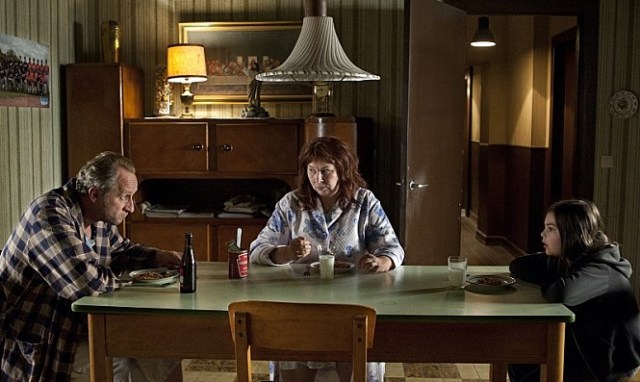 What if God really exists somewhere? What if he is merely a mean cranky guy with the absolute power on our world? And what if things can be changed for us? Belgian comedy film “The Brand New Testament” is cheerfully sweet and naughty with its subversive premise, and its many whimsical moments will tickle you with the barbed laughs inside them. Although the movie often becomes sappy in its more serious moments, it never loses its sense of irreverent black humor, and it keeps rolling its surreal satire until it eventually arrives at its preposterous ending for another good laugh.
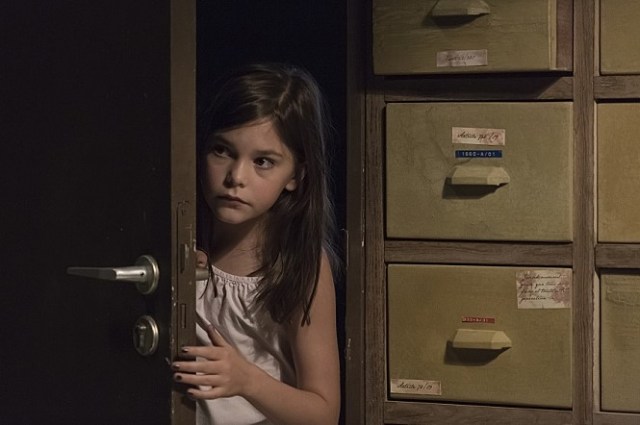 On one day, God’s daughter finally decides that enough is enough after suffering another cruel abuse from her father, so she begins to rebel against her father while he is less watchful than usual. First, she deliberately causes the malfunction in his father’s computer, and then she also spreads the certain classified information on life and death all over the world. That surely causes a worldwide mental shock when people begin to realize that it is not a joke at all, and the movie has lots of fun with how people react to this absurd situation in different ways. In case of one guy, he keeps hurling himself into many different kinds of dangers, and how he manages to survive as determined by his fate becomes a running gag throughout the film.
 While the most outrageous moment in the film is from an old married woman who comes across a chance of unexpected romance (Catherine Deneuve, who is still graceful as usual, is commendable for playing her character straight without a wink even when she casually shares the space with her new love), the sweetest moment comes from a young sick boy who recently learns that his death is quite near. As spending some time with the boy, God’s daughter wants to help him as much as she can, and that leads to one big funny sequence where many people are waiting for their scheduled time of death on the beach.
 Inspired by Antoine de Saint-Exupéry’s classic novella of the same name, animation feature film “The Little Prince” has few magical moments, but, unfortunately, it does not leave much impression after it is over. While its first half is often buoyed by a number of memorable moments from de Saint-Exupéry’s novella, the main story of the film still feels less special and interesting in comparison, and that becomes more problematic when the film tries to take its own flight during the second half.
 While I was involved in these wonderful visual moments, I also found that the rest of the film is too weak to hold my interest because of its predictable plot and flat characterization. Its heroine’s strained relationship with her mother is clichéd to say the least, and the screenplay by Irena Brignull and Bob Persichetti handles the bittersweet truth behind the Aviator’s personal plan too lightly without going deep into its associated dark themes. As a result, the film does not have enough narrative momentum to propel itself toward more wonders when our heroine decides to take active steps for herself as well as her dear friend later in the story, and it eventually becomes less enchanting than before as heading to its superficial ending.
 Charlie Brown and his gangs in late Charles M. Schulz’s classic newspaper comic strip “Peanuts” have been cultural icons around the world since when it was started in 1950. Like many of you, I came to encounter these simple, broad, but memorable cartoon characters through animation films during my childhood years, and then I became more familiar with Schulz’s comic strip during my adolescence years as a part of learning English along with a little culture lesson. I cannot still forget a little boy who drove Charlie Brown’s sister Sally crazy as keeping talking about “The Great Gatsby”, and I am still amused by Peppermint Patty’s confusion with zucchini and Zamboni.
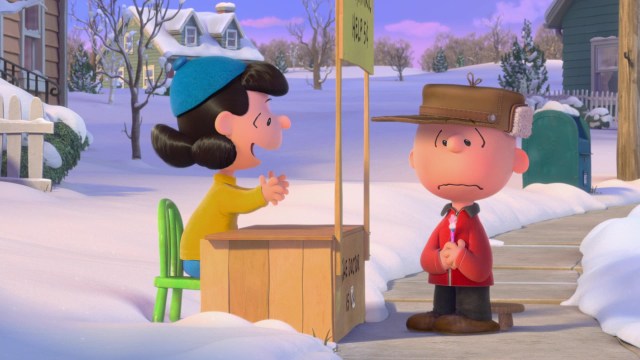 In the meantime, our hero Charlie Brown tries again to fly his kite, though, as we all know, he is bound to fail again like he did in many of his previous attempts. I was once tickled by one of his predicaments involved with that notorious ‘kite-eating tree’, but I also felt sorry for his miserable failure. He may be a loser as he frequently feels so, but he is a lovable one we are willing to hug, and there is something touching about how this round-headed kid tries to go on with smile and optimism despite the countless failures in his daily life. In the other words, he is just like many of us in our own life.
 It is a shame that Snoopy’s story in the film does not feel as awful as all those supposedly bad ones he wrote in Schultz’s comic strip. Sitting on the top of his doghouse, Snoopy frequently imagines himself being the World War I Flying Ace with his bird sidekick Woodstock and other bird friends as the repair crew, and what we get here is no more than a series of standard animation action sequences merely functioning as mediocre filler materials for the film.
 The characters in Hirokazu Kore-eda’s new film “Our Little Sister” are always gentle and courteous with lots of smiles except during a few little rocky moments in their mild daily life. This could be pretty mellow or tedious, but the movie is simple and elegant in its soothing rhythm of life, and I found myself smiling as being immersed into its relaxed mood. I enjoyed those warm, intimate scenes between its likable characters, and I was willing to spend more time with them as their story completed its full narrative circle.
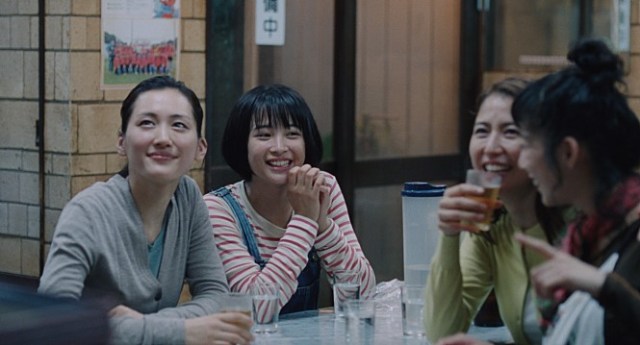 Feeling comfortable at her half-sisters’ home, Suzu quickly gets accustomed to a new environment. She joins a local junior soccer team, and she continues her education at a local junior high school while making news friends. When she becomes acquainted with a boy in her new class, it is pretty obvious from their little Meet Cute moment that they will be more than schoolmates, though they do not like to admit it in front of their schoolmates.
 While the characters in the film often look a little too neat and clean in their ample decency and kindness, the director Hirokazu Kore-eda, who adapted Akimi Yoshida’s manga “Seaside Town Diary”, doles out small precious human moments under his calm, effortless direction. In its loose plot structure, Kore-eda’s adapted screenplay freely moves back and forth between laughs and tears, and it never feels sappy or manipulative as handling its characters with sincerity and care. When one awkward family meeting is developed into a conflict as expected, this situation is tactually handled while nobody raises their voice, and how it is later resolved has small poignancy. The characters in the movie may just be people who exist only in fiction, but they look believable in their human behaviors, and we come to like and care about them as being amused or touched by their relationships.


