— I previously wrote the review for “The Yellow Sea” in late December of 2010. This is the second review written after I watched the director’s cut version in this week.
If you want to read my original review, click here.
Looking back at the Hollywood blockbuster action films of 2011 when the year was about to end, I found none of them could top the raw realism of the ambitious South Korean thriller “The Yellow Sea”(2010). When I endured “Transformers 3” in last summer, I had no excitement at all with those pointless loud actions decorated with weightless CGI. In case of “The Yellow Sea”, the real people and the real vehicles are put into the actions on the screen, and they are certainly far more visceral than those big, humongous CGI robots fighting on the streets of Chicago.
“The Yellow Sea” is the second work by Na Hong-jin, who made a stunning debut with “The Chaser”(2008). I chose that movie as the best South Korean film of that year without any hesitation for many good reasons. It provided me a series of very intense moments of suspense and excitement while its seedy hero racing against the time to save his ill-fated employee from the horrible serial killer with no remorse but a chisel and a hammer. It was so absorbing that, overwhelmed by its urgency, I and other audiences were really quiet throughout the film; I even could hear someone near me faintly uttering a gasp during the devastating moment when one supporting character made a fatal mistake of trusting a stranger.
“The Yellow Sea” is another chase story, but this is a tale a lot different from “The Chaser”. Its landscape is not only far bigger but also far darker; this is a ruthless world propelled by the destructive impulse of the human nature which only generates more chaos and mayhem, and it certainly makes the characters in the film pay dearly for their foolishness in the end. Without a doubt, this movie is a grim experience, but it excites us with its sheer power relentlessly pushing the plot to the ending even when it is getting exhausted and collapsed during its final chapter. And it also manages to have some bitter laughs from observing how its characters screw up their matters while struggling in its convoluted noir plot which I also struggled to understand a bit during the first viewing.
 In the international version/director’s cut, the movie gives you the important information you need to know at the start. The story begins in Yanji, the capital of the Yanbian Autonomous Prefecture in China which is the border region between China, North Korea, and Russia. Lots of Korean people moved to this area during the 20th century for getting out of the oppression due to the Japanese Occupation (1910-1945), and many of them chose to stay even after the World War II ended. Most of Korean Chinese people, called Joseonjok or “Chaoxianzu” in Chinese, in this area can speak both Chinese and Korean while being assimilated into the Chinese society. When I saw “Dooman River”(2009), a cold but sad film directed by Zhang Lu(he is also a Chinese of Korean descent), one of interesting sights from its barren border town is the police station with the nameplates respectively written in Chinese and Korean hung at its front.
After the Cold War was over, China and South Korea have been no longer enemies since the 1990s, and Joseonjok people began coming to South Korea for earning money like other immigrant workers from Southeastern Asia and Africa. Some of them live and work legally, but the others do not, so they have been one of the social issues in South Korea along with the other illegal immigrant workers. They are not often treated fairly, and I heard the news about them from time to time.
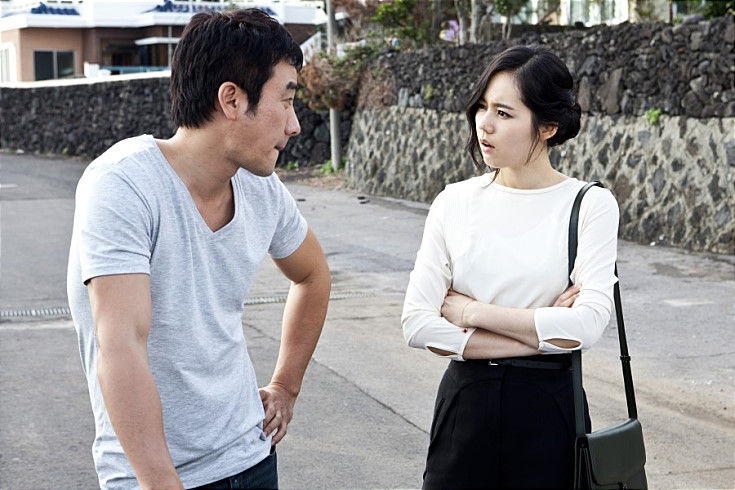
Gu-nam’s wife also went to South Korea, but there has been no news or money from her for a long time. Gu-nam(Ha Jeong-woo), who works as a taxi driver in Yanji, has been frustrated about that. While living alone in a squalid apartment building(their only daughter lives at his mother’s home), he has been mired in the despair and gambling debt. The loan sharks, to whom he owes 60 thousands Yuan(around $9500), keep visiting his home, and they sarcastically remind him that even selling all of his organs will not solve his problem. To make the matters worse, he has recently been fired from his job.
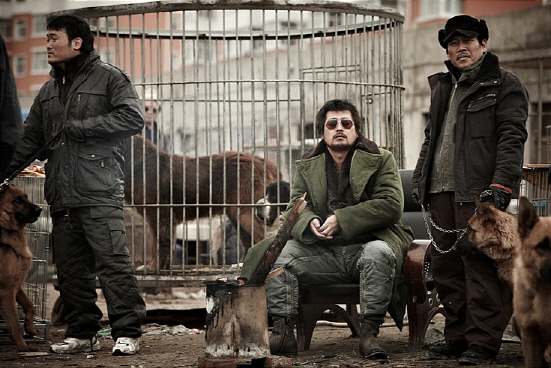 On one day, the local crime boss Myeon Jeong-hak(Kim Yoon-Seok), or Myeon-ga in short, approaches to him with the offer he cannot refuse. If Gu-nam goes to Seoul and kills some guy, Myeon-ga will resolve his gambling debt problem. In addition, because there is some spare time before the deadline, he will also get the chance to search for his wife while he is in South Korea. Gu-nam accepts the offer; he takes a train to Dalian and then boards a small ship along with the illegal immigrants for going across the Yellow Sea to South Korea.
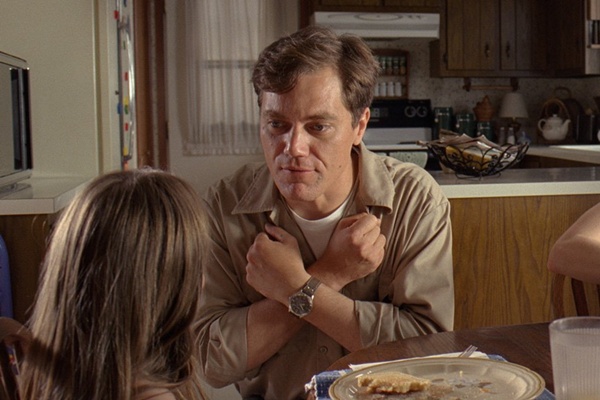
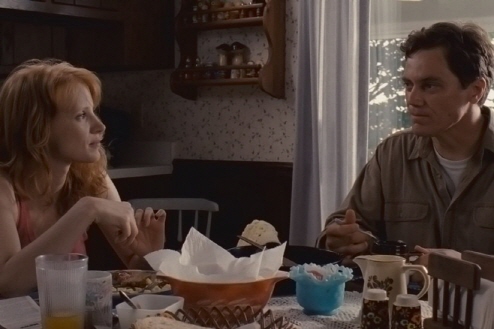
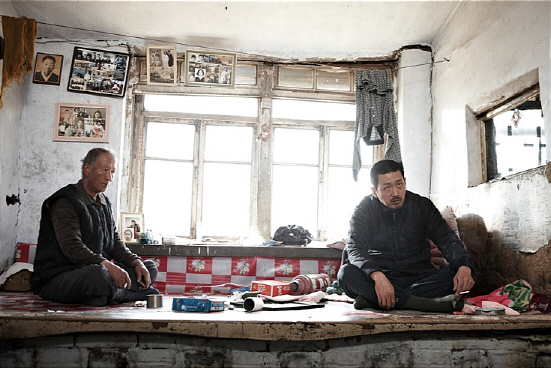
The story is divided into the four titled chapters. The first chapter(“Taxi Driver”) is focused on establishing its hero and his hopeless daily life, and Na Hong-jin does a good job of vividly capturing the gray, depressing feeling surrounding Gu-nam and others. Shot in Yanji and the surrounding areas, the places and the people feel authentic with the painstaking details on clothes and sets, and, above all, that harsh feeling of cold winter days(From my original review: “It may will make you want a big cup of hot coffee when you walk out of the theater.”). Gu-nam does not talk much about himself except the seemingly meaningless opening narration on the epidemic of rabies during his childhood, but the small moments with few dialogues tell a lot about his miserable life. There is a brief scene with his father-in-law who has nothing else to say except his short apology to him while Gu-nam is looking at the smashed glass frame of his wedding day photograph. They were probably happy at that time, but now he is frequently haunted by the dream of his wife having an affair with someone in South Korea. Does she really abandon him as the others around him say?
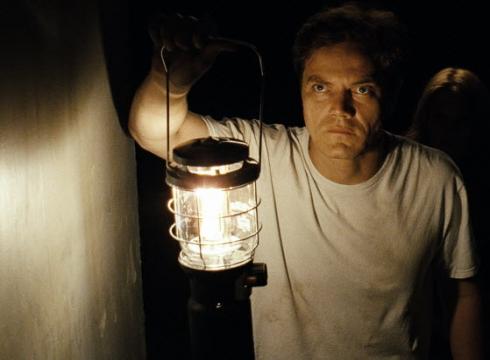
 The movie takes a considerable amount of time in the languid pace while slowly building the tension with the approaching deadline. The second chapter (“Murderer”) is about how alien the South Korea society is to Gu-nam. He is mostly taciturn, but the people, including the guy he is supposed to kill, always see who Gu-nam is through his awkwardness and accent. While concocting a fairly clever plan for executing his hit job through the rudimentary night surveillance on his feet, he also searches for his wife, but, despite some helpful information about her, there is not much success in his search.
Finally, there comes the moment when he has to commit a murder as Myeon-ga demands, and here is a very good scene which is suspenseful in Hitchcockian way. It’s a quiet cold winter night again, and Gu-nam is waiting for his target while hiding at the place across the building where the target lives on the top floor. But an unexpected thing happens in front of his eyes before he is ready to go inside the building. The calm but intense suspense is meticulously presented through the motion-detecting light-bulb at each staircase of the building. Though it is merely observing these lights serially turned on then off from the outside, the circumstance is clearly conveyed to us and Gu-nam, who must do something though he knows the situation becomes more perilous after the target eventually arrives at and goes inside the building.
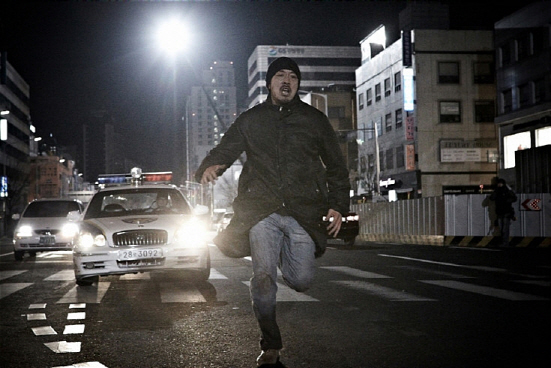
The bloody incident happens, so Gu-nam soon finds himself hounded by the police and others. One of the best moments in “The Chaser” was its exciting chase sequence along the narrow alleys, and Na Hong-jin does not disappoint us in this case. He tries to top that with the rapid sequence in which our unfortunate hero has to run as fast as he can through the alleys and streets while attempting to evade a bunch of policemen and several patrol cars. In this movie, the people are really running, and the vehicles get clashed or crashed with the real impact on the screen, so you may wonder how Ha Jeong-woo went through all these situations while still in his character. We can discern where they used stunt men and special effects through shot-by-shot analysis, but he might actually have survived through them, perhaps.
 Right from the third chapter(“Joseonjok”), the plot gets more thickened and complicated. It turns out that a crime boss operating in Seoul, Kim Tae-won(Cho Seong-ha), is involved with the incident. He is desperate to cover his trails by any means necessary, so he wants to eliminate Gu-nam before the police catch him. However, the circumstance becomes more chaotic and confounding to him and others, and the story becomes more unpredictable when Myeon-ga enters with his gangsters into South Korea to take care of the problem in his own way. Tae-won is willing to allow that if Myeon-ga solves his trouble as he promises, but…
It is possible that you will be lost in the convoluted storyline. Three are several things left unexplained with big and small holes in the plot, and the relationships between the characters are a little too complicated; maybe I need a big diagram for your better understanding if you ask me to explain. Even Korean audiences like me can fail to get a barely audible but crucial clue when one character mumbles that out unconsciously before he dies, but most of you will probably watch it with the subtitle, so you will easily understand what he says.
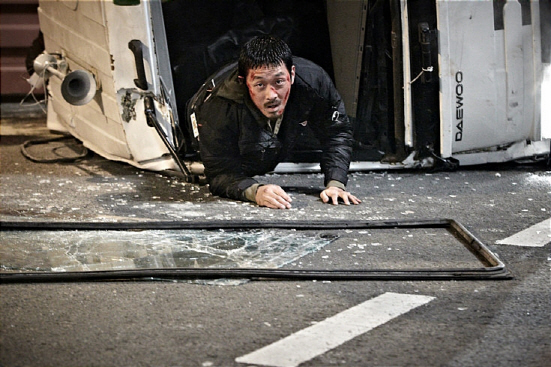
Nevertheless, the movie has enough power and ambition to drive its complicated story on the high-tension level, and it is darkly exciting. In its nightmarish circumstance, anything can happen, so the story sometimes goes against our expectations while holding our attention tightly even when we are a little confused. There is the terrific extended action sequence where one kind of chase is quickly followed by the other kind of chase. This is quite intense because we can see the two cars are not CGIs and they are clashing with each other really hard while avoiding the other cars on the road in spite of choppy editing and shaky camera work – and the movie even has a real big container truck for a big moment to impress us.
 Like “The Chaser”, the movie is a grisly violent film, and many characters, mostly criminals, get killed or injured in the process. You will probably recall Takeshi Kitano’s recent film “Outrage”(2010), a mathematic exercise of violence about the bloody meaningless war between Japanese gangsters. The gangsters in “The Yellow Sea” are no wiser than them; they try to solve their problem, but they remain stuck in the same position while wasting their time and efforts. Their foolishness makes their mess bigger and bloodier and more chaotic, and the movie has a morbid fun with their stupidity. The biggest irony in the story comes from the fact that the urban South Korean gangsters are quite unprepared for the beastly brutality of Myeon-ga and his less sophisticated men. Besides a hatchet and a knife, Myeon-ga also wields a big animal bone, which incidentally comes handy to him during one cringe-inducing fight scene, with no mercy to the guys who dare to stand on his way. While it is quite horrific to watch its frank, realistic handling of violence, the movie mercifully leaves some of his brutal rampage to our imagination.
Because it is the chase story and has more distinctive characters, “The Yellow Sea” does not lose our interest despite the distant attitude toward its mayhem. In addition, it cares about some of its characters. Gu-nam becomes sympathetic to his target’s wife as he faces the possibility that his wife may be murdered. When he comes across her by coincidence, he promises to her that he will find who is responsible for her husband’s death and his misery. The problem is, Gu-nam is no more clever than cops or gangsters in the film, and, even during the last chapter(“The Yellow Sea”), there is nothing much he can do except staying alive. He later arrives at the quiet revelation scene where he stares at two characters from the distance at some place while saying nothing. Certainly there is the sense of betrayal and disillusion in the air, but it seems there is a lot more than that in Gu-nam’s disoriented mind.
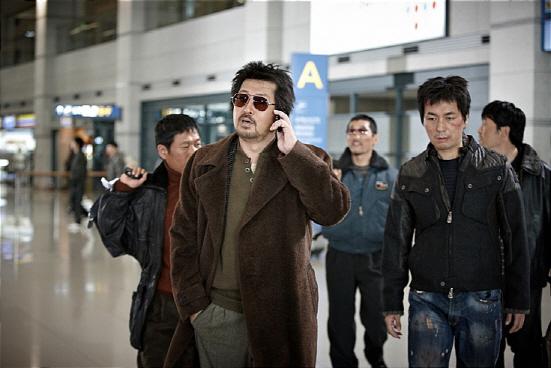 The main performances are crucial in holding the film amid the violent carnage. Ha Jeong-woo, who scared the hell out of me with his chilling portrayal of a sadistic serial killer in “The Chaser”, is now a flawed noir hero writhing in the confusion beyond his control. Gu-nam is not entirely likable, but we come to feel sorry about his plight while watching him grasping for anything to survive. On the opposite, Kim Yoon-seok, who chased after his co-actor in “The Chaser”, is subtly menacing and then strikingly merciless as the larger-than-life villain, and Cho Seong-ha also gives a solid performance with increasing panic behind his face as the crime boss who turns out to have a motive quite petty compared to all the troubles caused by it.
Several months after its original theatrical version (157-min) was released in South Korea in late December of 2010, Na Hong-jin made the director’s cut because the theatrical version was hastily edited during its hurried post-production. The director’s cut was introduced as the international version at the Cannes Film Festival in last year, and I saw it recently. My intial impression with the theatrical version is not changed much after watching this version, but this version indeed shows notable Improvements. The story is progressed more smooth and tighter in a shorter running time(140-min), and I could follow the plot more easily than before.
“The Yellow Sea” is a very compelling thriller crackling with its dark nihilistic force. Its ending is a rather anti-climactic compared to what it has built and smashed along the plot, but, the more I think about it, it works as the fitting finale for the story which ultimately turns out to be a tragedy of mistrust. When the movie came out, there were some discussions among the audiences on its ambiguous last scene – Is it real or imaginary? The sad thing is, that does not matter to poor Gu-nam anymore. He really should not have crossed the Yellow Sea.


 “A Cat in Paris” is an enjoyable lightweight animation – and I had a good time with this breezy entertainment. Though it is pretty short(the running time is less than 70 minutes), but that is enough for its simple adventure tale of an adorable mute girl, a good-hearted criminal, and one likable pussycat which happens to be shared by them without their knowledge.
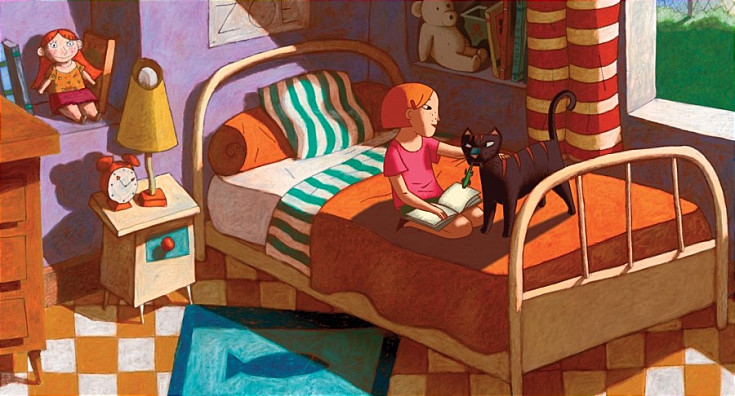 We know from the beginning that the cat has been leading a double life. Besides spending some time with Zoé during the afternoon, it has a secret night life with a young burglar named Nico(voiced by Bruno Salomone). He and the cat swiftly move above the rooftops without being noticed, and then Nico smoothly sneaks into his target building while evading the watchful eyes of night guards with the flexible agility probably only possible in the world of animation.
 The second half of the story is about how the characters get involved with each other and how their encounters are led to the adventurous night to remember. At one night, Zoé gets out of her house to follow her cat out of curiosity, but she gets more than she wishes for unfortunately. She comes upon Costa and his accomplices when they discuss about their plan. She immediately runs away from them, but she is quickly cornered by them – and Costa does not like a potential witness.