The Avengers (2012) ☆☆1/2(2.5/4) : Something good, Something bad, and Nothing new

 One of my personal sweet memories with Ebertfest, which is currently being held as usual in Urbana-Champaign, Illinois, was the gift basket I received at the hotel room on its first day. It contained various things including two bottles of wine and several kinds of cookies, and, though I would not taste much of them for the reasons I will not discuss in details in this review, I was happy to get it, and I still feel happy when I watch its photo posted at my blog.

You may wonder why I am talking about such a small, inconsequential thing like that, which is millions miles away from “The Avengers”, one of the biggest Hollywood blockbusters of this year. I tell you the reason right now – the movie is more or less than a snack gift set intended for the targeted audiences, and they will get as much as they pay. Here are good ones, and there are bad ones, but there is nothing new – and everything is wrapped up pretty nicely, and competently, with the big, loud, and well-made actions to entertain us instead of that nice black ribbon on my gift basket. To be frank with you, I was less impressed by the film than my precious gift, but do I really have to complain about the movie when it does exactly what it intends to do with the full service for its eager audiences?

Let’s look at its plot, which is more or less than the placeholder for the superheroes of Marvel Comics we have previously encountered in other 6 blockbuster films. Loki(Tom Hiddleston), the villain of “Thor”(2011), is back in business with his another evil plan. Intended to open the big portal to somewhere far, far from the Earth, he steals some mysterious powerful energy source named Tesseract(I am sure some of you have seen it in “Captain America: The First Avenger”(2011), right?) from the secret US government agency named SHEILD(Strategic Homeland Intervention, Enforcement and Logistics Division). His theft in the opening scene is accompanied with the spectacular catastrophe in which the characters manage to survive because it is CGI.

SHIELD quickly goes into the emergency mode. Nick Fury(Samuel L. Jackson), the director of SHIELD, decides it is time to gather a small group of people with special talents as the team for this serious situation, so we see the familiar characters one by one, including Tony Stark/Iron Man(Robert Downey Jr), Steve Rogers/Captain American(Chris Evans), Dr. Bruce Banner/The Hulk(Mark Ruffalo), Thor(Chris Hemsworth), Natasha Romanoff/Black Widow(Scarlett Johansson), and Clint Barton/Hawkeye(Jeremy Renner).

The director/screenplay writer Joss Whedon takes a considerable time in introducing these characters and distributing them appropriately in the ploy. Tony Stark is a little annoyed by the call when he is having a fun as Iron Man as usual, and Steve Rogers still has some adjustment problem after waking up in the 21th century, and Bruce Banner has managed to get his spectacular anger management issue under the control for a while, and, in case of Thor, well, he is Thor with the mighty hammer, and that explains all.

Though Whedon does a passable job of juggling many characters while keeping his story moving during the first half of the story, the movie frequently feels like a bland product from assembly line. Each piece is placed in the right place, but it somehow lacks synergy. It gives each of the superheroes the adequate space for some drama or humor, but there is nothing new revealed through their union. This is pretty much like watching the celebrities who just happen to meet each other at the gas station on the crossroad. I understand it is not easy for them to get along with each other, but their interactions or conflicts almost stall the narrative sometimes. At one point, I wanted to say something to Iron Man and Thor on the condition that I will not be injured: “Hey, guys, why don’t you just have a talk instead of fighting with each other, especially when a bad guy is waiting for you to be captured outside the screen?”
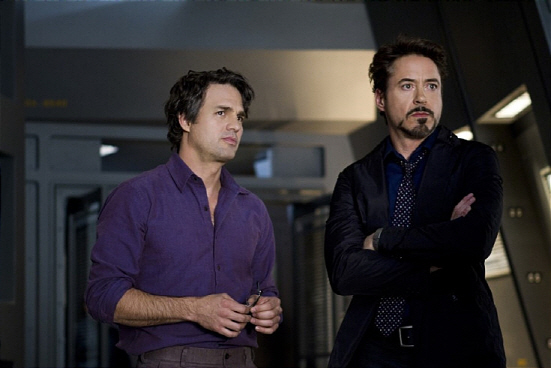
There are good things along with bad things in this mixed bag. Not so surprisingly, Robert Downey Jr. has a sardonic fun again as Iron Man; too bad there is no one who can counter his snarky wit in the film except Mis Pepper Potts(Gwyneth Paltrow), who appears only, alas, in three scenes. Mark Ruffalo is good as a man who has been burdened by his brutal alter ego; Dr. Banner is initially brought in as a technical consultant, but we all know there will come the time he should be very, very angry.

On the other hand, Captain America is less interesting than before, probably because his earnestness is not suitable for the 21th century. But he is not that boring compared to Thor, a noble thickhead whose evil brother Loki is as bland as him and far blander when compared to other great comic book villains I have encountered. When I saw Chris Hemsworth and Robert Downey Jr. in the trailer, I saw a little possibility of witty Downey channeling Groucho Marx and clueless Hemsworth channeling Margaret Dumont. They could have made a funny superhero version of Marx Brothers film if the filmmakers had decided to be a little more challenging.

In case of ‘less special’ characters, I have to say that Scarlett Johansson and Jeremy Renner manage to hold their respective places as the super agents surrounded by the superheroes, but what their characters really need are their own genuine stories to tell. Samuel L. Jackson, who has been diligently appearing in Marvel Comics films as Nick Fury, is as commanding as he always has been, and I hope he can teach me how to get out of the underground research building in less than 2 minutes(you will never know what will happen at my lab). And I like the boyish enthusiasm hidden inside the officious Agent Phill Coulson(Clark Gregg), whose job and live are probably envied by many comic book fans. If you cannot be a superhero, the next best thing is assisting them on their side. Who knows, you may have your dramatic moment to inspire them.

There are also several other things I liked. I enjoyed the sight of a huge aircraft carrier hovering in the sky and the expected action sequence in the aircraft. I sincerely welcomed the climax sequence on the streets of Manhattan in the third act, because 1) the movie finally stops spinning wheels in its tedious build-up process and 2) the actions on the screen are more well-organized than that dreadful climax sequence of “Transformers 3”(2011). People are still running away amid lots of, lots of, and lots of CGIs and noises, but, in this case, you always know where the characters are and to which direction they are moving. Unlike Michael Bay, Whedon did not waste his budget to nothing.

Above all, literally or metaphorically, our superheroes soar through this frantic moment with the sense of fun and excitement. But I am thinking of one familiar line now: “Thank you, (fill in the blank – the multiple answers are allowed), you save the day, but why did you come so late?” Before its third act started, I eventually surrendered to the temptation of checking my watch, and that was not a good sign to me.

In addition, Loki and his merry band of CGI cohorts are not menacing enough to provide the tension in the climax. Tom Hiddleston tries the best as he can, but Loki remains as a petty second-rated villain with family issue who always needs bigger villains to depend on, and I and the audiences certainly got a big chuckle when this spoiled kid got the spanking time. Oh, boy, I must report to you that some of the audiences actually thought that he was (gasp) cute. Maybe you think Lex Luthor is silly and funny, but he is not cute at all.

So, just in case you are still confused about my opinion on “The Avengers”, I tell you I had a simple conclusion with the convenient mathematical method. Due to the regrettable lack of synergy between its superheroes, the calculation is simple. I gave 3 stars to “The Hulk”(2003) and 2.5 stars to its sequel. I gave 2.5 stars to both Iron Man movies, and I gave “Thor” 2 stars, and I gave “Captain America” 3 stars. Therefore, my average rating for these movies is around 2.6 stars, so I think it is fair to give “The Avengers” 2.5 stars. If you have different opinions on these movies, then do the math for yourself. You may have a conclusion different from mine, perhaps, and I won’t stop you from buying the ticket. You have my word.

Sidenote: Never mind about 3D. I enjoyed the brightness of 2D while missing nothing.

Posted in Movies | Tagged , | 3 Comments

A Muse (2012) ☆☆☆(3/4) : An aging writer desiring his muse

 “A Muse”, South Korean melodrama released here on this weekend, follows the footsteps of many stories about an old dude whose heart is suddenly trembled by the appearance of young beauty in front of them. A good thing about this film is that, while very serious about how much he wants her in spite of his age, it knows how silly the hero’s desire looks from outside. I and the audiences got several good laughs while we came to care about him and, above all, a young girl who unwittingly places herself between two men.

The man who desires after that girl is Lee Jeok-yo(Park Hae-il with lots of make-up). He is a poet who has been revered by many people as one of the giant figures of South Korean literature, and the people even consider building the memorial museum for his achievement. He does not like being treated like an artifact, so, except accepting invitations from time to time, he lives alone in a cozy country house somewhere outside Seoul.

Although he is surrounded by many books in his library, his career as a poet looks like having been terminated for a long time. He has been assisted by one of his pupils, Seo Ji-woo(Kim Moo-yeol). Ji-woo becomes famous because of his first novel which is not only critically acclaimed but also commercially successful. As his mentor, Jeok-yo should be proud of his pupil’s success, but he does not seem to be pleased a lot when he receives the book. None the less, Ji-woo keeps coming to his mentor’s house, and he works for his mentor as an unofficial housekeeper and secretary; he cooks the meal, and he takes care of the daily appointments for Jeok-yoo.


On one day, their daily life becomes a little different when they find a young high school girl waiting for them when they arrive at Jeok-yoo’s house. Her name is Eun-gyo(Kim Go-eun), and she says she just comes to the house to get a part-time job. Jeok-you reluctantly hires her, but, while watching Eun-gyo’s innocent beauty, Jeok-yo begins to feel something stirring in his heart. At one rainy night, she comes to his house due to her personal reason, and he lets her into his house. Though nothing much happens on that night, he sees that he really wants Eun-gyo – but he also knows that he is a guy too old for the relationship with the girl idolized by him.

As several local critics pointed out, I have to admit that it was awkward to see Park Hae-il as the aging character after watching his virile physical performance in South Korean action film “War of the Arrows”(2011) in last year. He is currently 35, so it is rather hard to accept him as a man around 70 in spite of the make-up on his face and upper body. In fact, he looks more natural when he plays the younger version of his character in the wistful fantasy sequence imagined by his character.

But, despite this undeniable awkwardness, Park Hae-il gives an adequate performance as a man who pathetically remains young at heart. Some old men do not learn much even after they become quite old, and Jeok-yoo is one of those silly examples. Maintaining its serious attitude, the movie approaches to the hilarity of Hong Sang-soo’s films sometimes, and there is a funny scene where Jeok-yoo almost risks his life just because he wants to look good and nice to Eun-gyo.

If he were not an artist, he would look merely silly. Struggling with the carnal yearning created many good works in the history of literature, and the same thing can be said about Jeok-yoo’s circumstance. Maybe his body remains old and wrinkled, but, what do you know, his aesthetical creativity in his heart is rejuvenated at full mode, so his desire is sublimated into his new work which is probably as good as that famous Nabokov’s novel.

With his new work, the situation gets more complicated due to the reason you should discover for yourself while watching the movie. While all these things happen, Ji-woo is not particularly happy about what is happening between his mentor and a girl. Though the movie is not successful in handling this triangle relationship between its main characters(I heard the book, written by Park Bum-sin, did a better job), we come to understand the true nature of the relationship between Jeok-yo and Ji-woo, who are bound to each other by the jealousy and admiration not in the way you expect.

Between her co-actors, Kim Go-eun gives the best performance in the film as the character who is a lot more than the object of the desire. While radiating unadulterated charm around the screen, Kim Go-eum makes us believe her obliviousness to her effects on the other characters, and then she is convincingly transforms her character into a more active player in the story. She and Park Hae-il have a wordless scene when her character starts to sense the feelings inside the man she endearingly calls ‘grandpa’, and this eventually gives little poignancy to the bittersweet feeling of the last scene.

The director Jeong Ji-woo, who debuted with “Happy End”(1999), makes a surprisingly compelling movie with the subject which some of you find unwholesome and uncomfortable. Although the movie is advertised as a lurid and sensational melodrama only because of nudity and sex scene, “A Muse” is a sensitive drama while slowly revealing its sensuality in a tasteful way. I think the movie is a little too long, and I am not wholly satisfied with the ending, but I liked the mood surrounding the country house a lot – and I cared about what will happen to its main characters. In the end, we come to see that Eun-gyo gets more benefits and lessons – and she deserves them as a beautiful muse inspiring a wonderful piece of art.

Posted in Movies | Tagged , , | 2 Comments

Tiny Furniture (2010) ☆☆1/2(2.5/4) : The Unbearable Aimlessness of Being Graduated

Although it has the mood and feelings I can understand and appreciate, “Tiny Furniture” somehow kept losing my interest in spite of its admirable achievement on the screen. It virtually has no plot at all and I do not have any objection about its approach, but I constantly had the feeling of being stuck with very superficial persons I do not want to meet again, so I frequently felt bored by them despite its small good moments revealing the new emerging talent behind the camera.

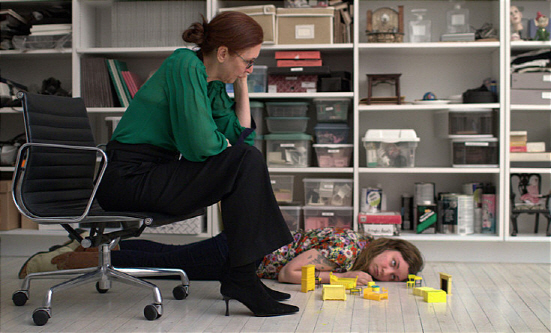
Maybe, as the other reviewers said, I should accept its intended tediousness as the realistic presentation of the unbearable aimlessness of being graduated. Aura, played by the director/writer Lena Dunham, has just graduated from her university in Ohio, and she is coming back to her mother’s apartment in New York when we first meet her. She knows that she has to lead her life as a grown-up, but she has no particular plan about her future except that she does not want to do boring jobs for earning money. She says she will stay at the family home for a while because she has no money to start with, but she may be stuck there forever with her family.

The family home is a nice, clean, and comfortable apartment with modern style in lower Manhattan, but it is not easy for Aura to get along with her detached family. Her mother Siri(Laurie Simmons, Dunham’s real-life mother) is mostly occupied with her work unless she is distracted by her daughter. Aura’s younger sister Nadine(Dunham’s real-life sister Grace Dunham) is a typical case of flat, moody passive aggressiveness. While Aura was absent, Nadine has formed the close relationship with her mother, so Aura frequently feels alienated.

Her ‘friends’ do not help Aura a lot. When she goes to the party held by one of her friends, Aura meets again her childhood friend Charlotte(Jemima Kirke). Charlotte is a funny but shallow girl who can amuse you for around 5 minutes at the party and then makes you desperately search for others to talk with in the room, but Aura starts to spend the time with Charlotte, probably because there is nothing else to do for her at present. Anyway, she gets a nice job in some fancy restaurant not far from her home. All she has to do is taking reservations before the restaurant is opened.

Meanwhile, two men come into her life, and neither of them can be considered as a good boyfriend. At the party, Aura comes across a guy named Jed(Alex Karpovsky), who has recently gained a short-term fame thank to his goofy YouTube clip called “The Nietzscherian Cowboy”. I have no idea about how such a superficial clip like that(he rides a mechanical horse while quoting Nietzsche with a toy gun) becomes so popular like that on the Internet, but I know anything can be regarded as funny or ‘creative’ on these days. Jed is a pretentious prick who hides his plain status behind his petty rationalized excuses; when he has no place to stay with no money, he deliberately makes Aura allow him into her family apartment, and then he continues to stay there until his presence is not tolerated by Aura’s mother anymore. Despite all of these caddish behaviors, he still behaves as if nothing serious happened.

In case of Keith(David Call), a chef working at the restaurant where Aura works, he is no better than Jed – or worse than him. Aura seems to like him, but she is stood up by him on their first date, and Keith currently has a girlfriend, which is his main excuse for not appearing on that date. You think her circumstance is messy, wait until you see how low it hits the bottom at some unlikely place for having sex during one lonely night. It is really depressing and pathetic to watch two people desperately trying to get what they both want with the absence of the passion in their miserable behavior.

Though I lost my patience from time to time, I could admire how carefully Dunham made her first film. She makes good use of the places in the movie including her mother’s home, and the urban atmosphere of lower Manhattan is established well around her characters. It shows that the shots in the movie are thoughtfully composed, and the cinematographer Jody Lee Lipes, who briefly appears in the film, does a fine job with Canon EOS 7D HDSLR digital camera. Even though they had little artificial lightning during the production, the movie always looks clean and crisp while watching its characters with cool detachment, and you will be surprised that its production budget was around $50,000 only. This is a good example of the efficient filmmaking.

Though the characters in the movie are unlikable in various degrees, Dunham’s screenplay presents some of them as the understandable people through good dialogues and sharp humor. Though Aura is a self-absorbed lazy girl who keeps making unwise choices, I could see that she is also a nice girl painfully wandering with no direction while searching for love and happiness she wants. It is only a matter of the time until she gets wise up to recognize her reality and think about 1)what she actually can do and 2)what she really wants to do for her life, but when will it happen at last? I have to admit that it is quite frustrating to look at her wandering, probably because I went from the kindergarten straight to the graduate school without any serious stop. Maybe my turn will come when I finally get a doctoral degree and then I am demanded to start leading my life on my own.

While giving a competent acting, Dunham also succeeds in pulling good realistic performances from most of her co-performers. You may wonder whether the interactions between Dunham and her family members in the film are based on the reality(like her character, Laurie Simmons is a well-known artist in real life), but I heard that Simmons is a lot warmer than her character. Although it is said that the movie is part-autobiographical, this is a work of fiction, after all.

Even with considerable degrees of appreciation, I still remain not so sure about whether I like “Tiny Furniture”. I understand what it is about and how it is about, but I feel distant to its subject and approach. It comes to my mind that the similar thing happened when I saw Michael Tolkin’s “The New Age”(1994) at 2010 Ebertfest. It was another well-made drama about the characters struggling and wandering in their shallow aimlessness, and, though it had some interesting aspects, I was not entertained sufficiently. As one of my friends said to me at that time, the reason might be that I was not particularly thrown to that movie as a non-American audience not so familiar with its subject, and I guess the same thing probably happened while I was watching “Tiny Furniture”. At least, you and I can agree with each other that Lena Dunham is a talent to watch, right?

Posted in Movies | Tagged , , , | 2 Comments

The Future (2011) ☆☆☆(3/4) : Their whimsy and uncertain future

“The Future” will definitely be one of the quirkiest movies I saw in this year, and, though it is only April, it will stay on or near the top of the list assigned to such films at the end of year. It features several moments of sheer whimsy to confound me and interest me; I watched them with the certain degrees of curiosity, and the movie turned out to be a lots more than fancy whimsy. It seems aimless at first, but it looks at its characters with warm understanding, and there is the sad poignancy generated from the strained relationship between two people who try to prepare themselves for the next stage of their life but find it more difficult than they thought.

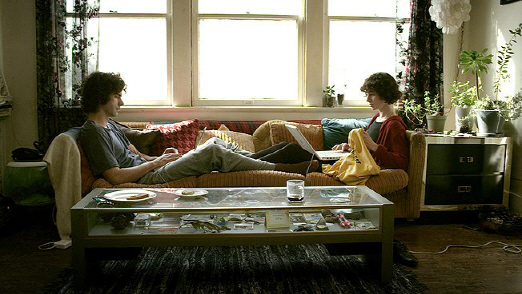
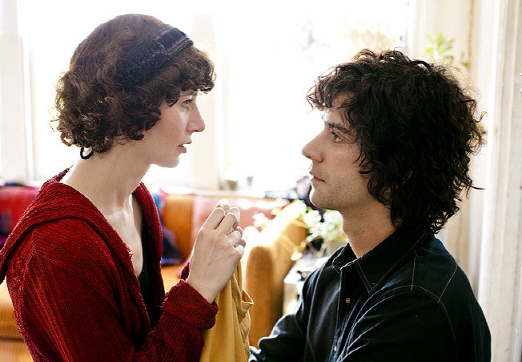
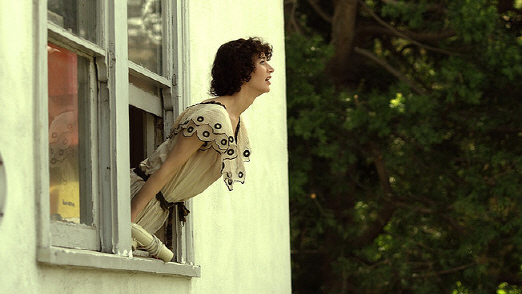
The life of Jason(Hamish Linklater) and Sophie(Miranda July) may not be affluent, but they are happy and satisfied although there has not been much change in their life. Sophie teaches dance to the children in the community center(I do not think she was a professional dancer), and Jason works at their cozy home as a counselor technician on the phone. There is no kid between them, and I do not know whether they have friends or not, but they have a fun with each other’s oddities like young children playing house.

Well, they are about to have some change at their home. They decide to be more responsible than before as grown-ups, so they go to the center for abandoned animals, and they choose one sick cat which will likely die within a few years even at the best condition. Taking care of a sick pet takes lots of efforts, and that means Jason and Sophie really have to change their lifestyle a lot. They will not probably have free time between them as much as before.

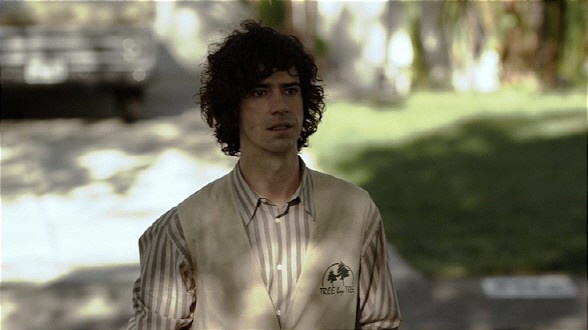
Because the cat has to be at the center at least for a month before it is all right to be taken care of by them, Jason and Sophie has one good idea about their upcoming change. It is true that they have been pretty much free for a while, but why not live a far more freely as themselves for a month before wholly committing themselves to their cat for a long time? They immediately start their plan; Sophie quits her job and tries to make a YouTube clip every day with her dancing at the home. Jason also quits his job, and he chooses to work a solicitor selling trees from door to door.

In the ordinary reality, nothing much would happen, but this is a quirky film where something interesting keeps happening out of the coincidence, and soon Jason and Sophie meet interesting persons respectively. After visiting several houses without any significant results, Jason arrives at the house where one resourceful old man(Joe Putterlick) lives. This old guy is good at fixing many things, and Jason eventually buys a fixed hair drier for Sophie, rather than selling him the trees. He also gets some wisdom about the relationship from the old man, who had lived with his deceased wife for a long time and knows one or two things about how the relationship develops into the next stage – or gets terminated instead.

Meanwhile, Sophie also has the interesting time of her own. In another coincidence, while frustrated about the lack of her creativity, she happens to get acquainted with one middle-aged guy(David Warshofsky) through one phone call. She soon visits his home, where he lives alone with his daughter(she keeps digging a hole at the backyard for another whimsical reason to be revealed later). When they are together at the living room, you can see what will eventually happen, but the director/writer/lead actress Miranda July handles this uncomfortable situation in a tactful and sensitive way. After all, he is not a bad man, and Sophie probably understands his need.

Because of what happened between him and Sophie, the relationship between Sophie and Jason becomes rocky, and the movie goes into a weirder moment when Jason is able to stop the current of the time when Sophie is on the verge of telling the truth which may hurt the bond between them. While the time is stopped, Jason even talks with the moon high above the sky. It is surely bizarre, but what do you possibly expect from the movie whose narrator is their sick cat? Shown only with its cute paws(one of them is bandaged), it talks to us about its hope and expectation to us in the manipulated voice of Miranda July. This sounds silly, but it is not as silly as you think, and the cat’s narration eventually leads to one sad moment later in the story.

Miranda July, who is also well-known as the performance artist with established career, made a nice impression on me and others through her first film “Me and You and Everyone We Know”(2005). Like “The Future”, that movie made me both confounded and curious with various odd, funny scenes to be remembered when I saw it in 2007. I liked it though I did not think I completely understood it, but, when I saw it again later with DVD, I found it more admirable and lovable than before. I especially love the warm hilarity resulted from the interaction between two characters who come to face each other for the first time after the series of their very creative dirty chats on Internet.

I am afraid I am hopelessly too inarticulate to describe the offbeat charm of “The Future”. While this second work from Miranda July is relatively less impressive than her previous work, “The Future” certainly confirms July again as the interesting director with her own distinctive style. It may be too quirky for your taste, but I liked how it delightfully and effortlessly moves between humor and sadness with its quirky heart put in the right place. You may also like it, too, perhaps, if you think a talking cat is not too strange.

Posted in Movies | Tagged , , | Leave a comment

The Ides of March (2011) ☆☆☆(3/4) : Idealism has no place in politics

One main weak spot of George Clooney’s “The Ides of March” is that its sharp message is hardly regarded as cynical in our days. It is virtually impossible for everyone to remain clean in the mud field called politics, and most of us know that too well through what we have witnessed from our politicians. Even when we try to maintain a little piece of idealism during the elections, it is bound to be betrayed and stabbed, like Julius Caesar was on the ides of March as told by Plutarch and Shakespeare.

The ides of March, or March the 15th, is the important date for everyone in the movie. It is the day of Democratic Ohio primary, whose result will be a major factor to determine the Democratic presidential Candidate for the upcoming election. Because there is no serious competition in Republican Party, everyone knows that the winner in the Democratic Party will virtually be the next president of USA, so there have been fierce competitions inside the Democratic Party and, as you expect, the picture is not so pretty.

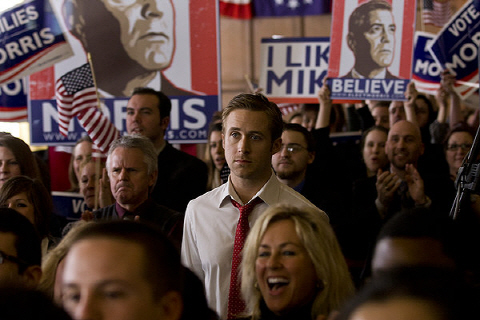
Stephen Meyers(Ryan Gosling) is the junior campaign manager working for Mike Morris(Geroge Clooney), the incumbent governor of Pennsylvania who is the leading candidate in the Democratic primary. He is pretty popular with his openly liberal progressive view which would make Barack Obama look like a conservative GOP(his campaign poster is clearly derived from Obama’s, by the way), but his status as a candidate has not been completely clinched yet. If he loses in Ohio Primary, it will be a major setback in his campaign, and the senator Thompson(Jeffrey Wright), who can significantly affect the primary with his 356 delegates, may choose to side with Morris’ major rival.

With his direct boss, the senior campaign manager Paul Zara(Phillip Seymour Hoffman), Meyers has been working hard for the man he believes in. He is young but he is not that naive; he has some experiences about how to react to playing dirty and how to play dirty. He and others know that winning is indeed more important than anything else in the election, but he also believes Morris will bring the change to the country, and he is determined to do everything he can do for him.

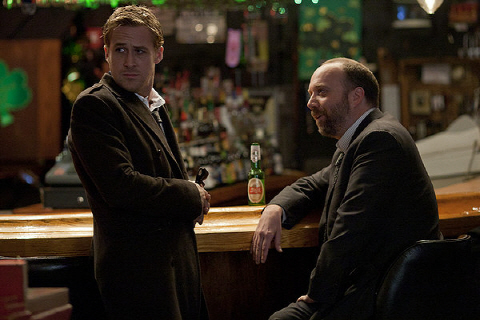
However, although he thinks he knows how tricky the world of politics is, he finds himself in the circumstance more treacherous than he expected. First, there comes a suspicious offer from Tom Duffy(Paul Giamatti), the senior campaign manager of the opposite camp. Does he seriously consider Meyers as an important talent to be scouted, or does he have the other sneaky intentions? While realizing that Duffy’s offer is not as trivial as he thought, Meyers also comes to face some truth which can potentially be fatal to the campaign – he must do something about it.

While we may complain that the story is familiar and predictable, the director George Clooney, who adapted Beau Willimon’s play “Farragut North” with his partner Grant Heslov and Willimon, presents us an interesting, if not revealing, look at the combative political process before the main election. While it is very hard to go through the presidential election, it is also really hard to go through the selection process before that. Even though they are in the same party, they can be ruthless and nasty to each other because of the political success in front of them. Having observed the GOP primary in this year, which is darkly and insanely comic compared to this film, I was not that surprised at all by what I saw in the film. As a matter of the fact, considering the recent news about South Korean politicians(we’re also ready for the presidential election in this year), this trend seems to be quite universal.

While you may not be enlightened by what Clooney tries to tell you, you can be at least entertained by the good ensemble assembled by him. While Clooney takes a backseat as the smooth politician you can like, Ryan Gosling is dependable as the hero who comes to learn that he should know better about the field he runs into. Gosling can be likable as shown in “Crazy, Stupid, Love”(2011) and also can be enigmatic as shown in “Drive”(2011), and here he shows us the plausible progression of his character’s inner transformation while rarely overstating it. When we see his face in the last scene, we come to see how much different Meyers becomes as a wiser political animal. As other people around him realize, he is a quick learner who can apply his lesson to the situation as soon as he learns it.

Gosling and Clooney are surrounded by the colorful supporting cast. As the experienced and jaded seniors of their dirty world, Phillip Seymour Hoffman and Paul Giamatti respectively have the dialogues to be delivered with gusto, and both do deliver them as well as they are demanded. Jeffrey Wright is notable as an opportunistic politician willing to side with whoever gives him a better offer, and Marisa Tomei is sexy and sparky as a journalist who cannot be stopped unless you give her a tasty scoop, and Evan Rachel Wood is a young intern who gets close to Meyer and then turns out to be a crucial factor in the second half of the story.

While I was watching “The Ides of March”, Mike Nichols’ “Primary Colors”(1998) instantly came to my mind and I noticed several similarities shared by both. I think that movie is a better movie about politics due to its more insightful view on politics and its inherent negative sides resulted from human flaws, but I want to say that “The Ides of March” is a good film with the message of which we have to be reminded again from time to time whenever we are supposed to vote. Cynicism is not good for us – but neither can idealism be.

Posted in Movies | Tagged , , | 1 Comment

Jesus Hospital (2011) ☆☆☆(3/4) : An uncomfortable story about family and religion

The unlikable heroine of South Korean independent film “Jesus Hospital“ felt pretty repellent to me at first. Though the Christian people I have known or met were very nice people I still remember with fondness, I also know that there are the other Christians in South Korea who are the big insult to the benevolent teaching of Jesus. I have never come across such people fortunately, but I have heard a lot about their embarrassingly fanatic behaviors to the non-Christians like me, including openly saying in public that they will go to hell if they do not believe in Jesus.

Hyeon-soon(Hwang Jeong-min) will say like that if I tell her that I am an atheist. She will be also very hostile if other relatively conventional Christians question her belief. Rather than going to the church like others, she has the periodic meeting with her fellow believer where they pray or read the bible. I know some of Korean Christians say a prayer with rather hysterical chanting, but what they say during their prayer in the movie is odd and incomprehensible to understand to my ears.

She and her family have been distant from each other for years. She lives alone at her home while her grown-up daughter Soo-jin(Han Song-hee) lives separately from her. In case of her siblings, it is apparent during their family meeting that Hyeon-soon and her siblings are not on good terms. Only family member liked by Hyeon-soon is her aging mother, who knows that there is little time for her life but does not worry about that a lot because she thinks she lives enough. If that is God’s will, than so be it.

Two months later, what Hyeon-soon’ mother has expected eventually happens, and now she has been in coma for six months with a very little chance of recovery. Her children except Hyeon-soon decide that it is the time to let their mother go. They are tired, and the medical care bill has been quite burdensome to each of them. All they have to do is signing the papers and then removing the respirator from their comatose mother while saying goodbye to her.

However, Hyeon-soon does not let that happen. She believes God is speaking to her, and she thinks her mother will wake up someday just because God told her so. Her siblings are naturally angry about her when she blocks them. They have a good reason to be furious because Hyeon-soon did not bear any expense for caring their mother, but we cannot completely side with them. Hyeon-soon lives poorly while barely making the ends meet through her milk delivery, so it may be not right to dismiss her opinion just because she did not pay any of the hospital bills for her mother. But we also can say that Hyeon-soon’s siblings suffer enough financially or emotionally and letting their mother die is the best solution for all of them and their mother, who showed no attachment to her remaining life before being hospitalized.

While judging neither of their conflicting views which are based on their respective religious belief, the director Lee Sang-cheol and the director/co-screenplay writer Shin A-ga makes a dark, compelling family story about how the religion affects not only the views on the serious matter of life and death but also the relationships inside the family. Although the past of Hyeon-soon and others is not fully explained in the film except a few moments, it goes without saying that Hyeon-soon’s fanatic belief has been a major factor in making herself alienated from others. Her husband seemed to leave her a long time ago because of that, and her daughter, who begins to live her own life with her well-meaning but clueless husband, looks not so pleased when her mother calls.

But Hyeon-soon and Soo-jin are still a mother and a daughter, and the movie goes into a more complex family situation when Soo-jin agrees to help the other family members’ plan for stopping Hyeon-soon. She feels no qualm about that at first, but there comes the moment when she finds that something valuable is missing at her mother’s home, and she makes an important decision after knowing that why it was gone.

The original Korean title is “Mink Coat”, which was the present given to Hyeon-soon’s mother in the film which works as the crucial factor in the story. The directors said that they decided to choose it as the title because of the contradictory nature of fur coat, whose warm comfort is provided by the savageness beneath it. The similar thing can be said about family; it provides the comfort you need, but it also can be a suffocating cage filled with anger and resentment.

Through its realistic hand-held camera approach, the movie sticks close to the characters with the suffocating feeling intensified by the performances. Hwang Jeong-min, who appeared in a few movies including “Save the Green Planet!”(2003), gives a captivating lead performance as a firm fanatic believer with lots of grudges against her family, She looks as crazy as Kathy Bates in “Misery”(1990) at first, but we come to understand indirectly how she has clung to her religion while shunned by other family members, and we feel a little sorry for her when her belief gets almost crushed when she faces an agonizing dilemma. Her co-actors are also instrumental in making the drama work as Hyeon-soon’s antagonizing family members. We come to see their hypocrisy behind them, but we also regard them as the human beings with understandable flaws and hurt feelings inside them.

“Jesus Hospital” is a small but intense and uncomfortable drama with one of the best female performances in South Korean films of this year. Compared to its engaging narrative, the climax and following ending feel hurried and artificial because it is a little hard to believe that almost everything in the film happens for less than 24 hours, but, folks, those stiff believers are usually persuaded or awakened by not our common sense or logics but how the world(or the hand of God, shall we say) slaps them hard, aren’t they?

 
Sidenote: I was born on March 3rd, 1983 at Jesus Hospital in Jeonju, South Korea. It is sort of amusing to see my birth place used as the movie title, although the movie has nothing to do with that hospital.

Posted in Movies | Tagged , , , , , | 1 Comment

Monsieur Lazhar (2011) ☆☆☆1/2(3.5/4) : A substitute teacher in charge of the class in grief

The terrible incident suddenly happens in one Canadian elementary school during the mundane but shattering opening sequence of “Monsieur Lazhar.” While the students enjoy the free time outside the building, one of the schoolteachers is found dead, hanging herself up in her classroom. The other teachers quickly cover this tragedy from the kids as soon as they come to know what happens, but it leaves her students in shock and grief as a consequence even after some time has passed and the classroom has been repainted.

When the principal, Mademoiselle Vaillancourt(Brigitte Poupart), needs a substitute teacher for the deceased teacher’s class, one man appears in front of her out of nowhere. He is an Algerian immigrant named Bachir Lazhar(Mohamed Fellag, who is credited as Fellag in the film), and he is willing to work as a substitute teacher. According to him, he was an elementary school teacher for 19 years in his country he has recently left from.

Lazhar is a gentle, likable man, so he is instantly hired by Mme. Vaillancourt, and soon he meets the kids in the class assigned to him. The start is a little rocky at first because he sets his standard a little too high for his young students(he uses Balzac’s novel for the dictation test) and there is the cultural gap between them. But, after some few quick adjustments, everything goes pretty smoothly as before in the class; the students like him, and so do the other teachers in the school.

However, Lazhar discerns that there remain unresolved emotional matters beneath his class. He thinks his students should be more opened about how they feel about that incident. Although they get the periodic counseling sessions with a child psychiatrist, he believes he and other teachers should be more active about his students’ problem. Most of the other teachers, including Mme. Vaillancourt, understand his point, but they are reluctant or object to Lazhar, because the rules like the zero-tolerance-for-touching policy have confined their roles so much that dealing with their students is like, as one teacher in the movie says, handling radioactive waste.

The director Philippe Falardeau, who also adapted Evelyne de la Cheneliere’s one-man play for his movie, does a good job of setting the daily rhythm and atmosphere of the school life on the screen for his story. His story is not locked in the predictable conventional plot we can expect from the movies about teacher or teaching, so it moves with its free will around its hero and the other characters surrounding them while establishing them as the real people with the serious matters to deal with. The movie does not feel the need to push them into the plot, and it calmly observes their interactions with cool restraint while never overplaying its deep emotions beneath the surface. We learn a lot about them while watching them even though they do not tell about themselves or their backgrounds much.

One small but important fact about Lazhar provides a little tension to the story. It is revealed early in the film that he was not a teacher as he said. As the matter of fact, he has not even been accepted by the Canada Government yet because he is currently under the examination for deciding whether he can be judged as a political refuge seeking asylum.

The movie suggests that Lazhar may understand what some of his students are struggling through as a person still in his personal grief, but it does not choose an easy way of handling this connection between M. Lazhar and the students, and neither does Mohamed Fellag, who gives a quiet honest performance as a humble decent man with lots of empathy. Though he is not really a teacher(but his deceased wife was), Lazhar has the right stuff to be a good teacher. He cares about the students, and he likes to be with them while helping them. Maybe he lacks some professional knowledge for teaching a class, but he can manage the difficult situations in his classroom tactfully with common sense. What he says to his students at one fragile moment is the universal truth that can applied to any school on the earth; “A classroom is a home for.. it’s a place of friendship, of work, and of courtesy. A place full of life – where you devote your life”

It should be mentioned that the kids in the movies give the believable performance as a group under Falardeau’s direction. Even you do not know all of their names, each of them is a distinctive part of the class, and, how they generate the mild but busy dynamics together under the cool gaze of the camera in their classroom is nothing less than natural.

Two young performers are especially notable as the crucial supporting characters in the story. Sophie Nélisse is a smart little girl more outspoken about the incident affecting her and others than her classmates. She is curious about her substitute teacher who comes from the other country, and she comes to like him probably more than anyone else. She becomes his close ally when he attempts to deal with the grief problem of the class, and Nélisse and Émilien Néron, who is also good as an anguished boy hurt a lot by the incident and the following guilt resulting from it, have a calm but intense scene with quiet emotional power.

“Monsieur Lazhar”, which won Six Genie awards(it’s Canadian Oscar) including Best Picture and was recently nominated for Best Foreign Film Oscar early in this year, is a touching drama whose emotions slowly and powerfully resonate after it is over. Teaching is a lot more than passing the knowledge to the students and, in its simple but subtle storytelling, the movie shows us how important the connection between the teacher and the students is in that process. The last scene is particularly moving though the camera looks at the characters from the distance. Sometimes, the teacher also gets something valuable from the students in the class.

 
Sidenote: The movie will be shown on May 1st and 3rd at 2012 Jeonju International Film Festival in my hometown. Don’t miss the chance if you have the time to go there.

Posted in Movies | Tagged , , , , , | Leave a comment

The photos from several days of 2012 April

                            
It is warm now, and the flowers are everywhere – and the cats are hungry.
Posted in Photos | Tagged , , , | Leave a comment

Terri (2011) ☆☆☆(3/4): A lonely teenager getting out of his shell

It is always better to have someone who cares about you than to be alone, and that is what the hero of “Terri”(2001) learns gradually through one of his high school teachers. Because of what I have just said, you will probably think this is another “the teacher of my life” movie, but “Terri” is a different film free of such a convention like that. With the considerable level of intimacy and low-key humor, the movie observes how its characters roll or spin in its seemingly loose plot. Through that process, we get to know more about them than before, and that is why even a small step forward gives us lots of optimistic feeling even though not many things are changed in the end.

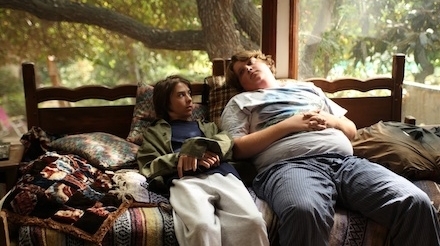
When you look at him, you won’t be surprised to know that Terri Thompson(Jacob Wysocki) is one of those lonely teenagers in high schools who are alienated or ridiculed by other students. He is a big, obese kid with disinterested attitude, and he does not particularly care about how others, including his teachers, think about him unless they keep annoying him. For instance, he goes to his school while still wearing a pajama just because he is comfortable in it. At least, he alternatively wears a striped one and a black one.

He has been pretty much content with his solitude. He has no friend, so he spends his free time at his house, where he lives with his uncle (how Terri was left alone with him is not clear; judging from one conversation, his parents were presumably dead). Though his uncle(Creed Bratton – you may recognize him as one of the funny supporting characters in American TV series “The Office”) is ill and senile, Terri’s life with his uncle is not as bad as you think. Their little home is a cozy and comfortable place(I guess his uncle worked as an artist before his illness), and Terri has taken care of his uncle well; though he suffers frequent lapses, his uncle gets a little better than usual from time to time.

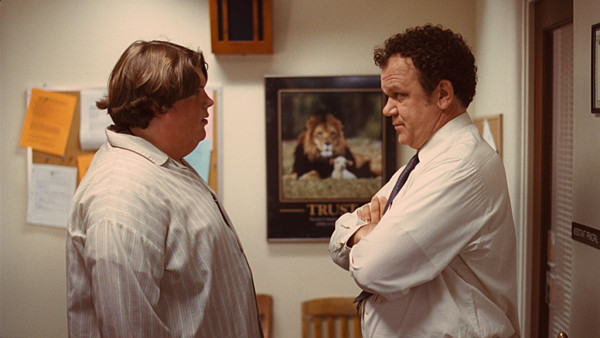
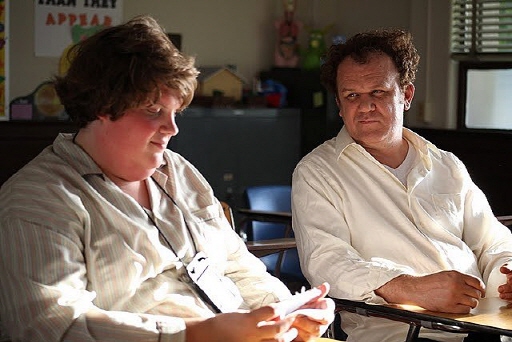
But on one day, someone comes into his quiet life. He is the vice principal of his school, Mr. Fitzgerald(John C. Reilly). Mr. Fitzgerald calls Terri to his office, and he tells Terri that he cares about him because he thinks Terri is one of the “good-hearted kids”. Although Terri is reluctant about Mr. Fitzgerald’s approach, they start to have their private meetings.

While there is no big change coming from that, Terri’s life is a little more crowded than before. First, indirectly through his meeting with Mr. Fitzgerald, he comes to get acquainted with Chad Markson(Bridger Zadina), one of the other school kids counseled or disciplined by Mr. Fitzgerald. Though they are a lot different from each other in many aspects including appearance and character(unlike Terri, Chad is a nervous troublemaker desperate for attention), the relationship is somehow formed between them. Soon Chad comes to Terri’s house as his friend, and he is greeted by Terri’s uncle with the toasts with baked bean.

Terri also gets close to one girl named Heather Miles(Olivia Crocicchia) with whom he attends the home economics class. During the class, he happens to witness that she lets one nasty male student touch her private part after being importunately demanded by him. When Heather is called to the Mr. Fitzgerald’s office due to that happening, Terri stands up for her. When she becomes a pariah in the school after the incident, he sits next to her. When she is about to get herself into a trouble, he becomes more active than usual to dissipate the tension. She is grateful for his acts, and the mutual affection grows between them. Their exchange through the notebook is one of the warm, sweet moments in the film; he is nice to her, and so she is.

“Terri” is the first film in Jacob Wysocki’s short career, but this newcomer actor effortlessly gives a nuanced performance as a shy, gentle teenager who slowly gets out of his shell while being connected with the others approaching to him. Terri looks disinterested at his school, but, he is a smart kid, and sometimes there comes the moment when his intellectual curiosity is stimulated, such as when he comes to observe by coincidence how the food chain in the nature works. Right after he throws away the dead mice killed by the mousetraps in the attic, the bird flies in and eats one of them. He is delighted, so he tries to get more dead mice with the mousetraps for getting another chance to observe. As his uncle points out, what he does is a rather cruel act, but at least his motive is not sadistic at all, and he learns a lesson from his wrongdoing.

Wysocki is supported well by John C. Reilly, one of the most reliable supporting actors in Hollywood who can lift his co-performer without drawing any attention to himself. While Mr. Fitzgerald appears to be a funny guy at first, Reilly makes his character a sincere man with good intentions as well as human flaws. Though he is not one of those inspiring teachers we have seen in other movies, Mr. Fitzgerald really wants to help the students he is concerned about because he also went through hard time during his school years. Reilly is especially wonderful when his character honestly admits to Terri that he lied to Terri and he may disappoint Terri again in the future while imparting a simple but truthful life lesson to him(“Life is a mess, dude, but we’re all just doing the best we can.”).

Like Wysocki, Bridger Zadina and Olivia Crocicchia are natural as their respective characters, and they and Wysocki make the crucial scene later in the story precise and believable in its progression. They decide to spend the night together in the shack next to Terri’s house, and, though they just want to have a little fun, the circumstance becomes a lot more awkward and unpredictable with the alcohol and the drug stolen from Terri’s uncle. Regrettable things could happen in such a situation like that, but, fortunately, they manage not to cross the line.

The director Azazel Jacobs, who wrote the story with the screenplay writer Patrick Dewitt, made a warm coming-of-age drama about how not being alone can make some difference in one’s life. The movie made me recall when one of my middle school teachers said I was the loneliest student in that class. I did not take it seriously, and I was not interested in having a friend, and I remained one of the infamous students in the school(every student knew me), but I was helped by my teachers(mainly due to my excellent grade). I have to say that some of them were not model educators, but I am still grateful for them – I visit them whenever I get the chance to drop by the school.

Even when the movie is over, many things remain unresolved for Terri and others. Their life will go on, and there may be other complications in their relationships in the future. But now Terri has someone he can talk with, and he also has friends. Someday, maybe he will find that he can be comfortable in other clothes besides his pajamas.

Sidenote: The movie will be shown at 2012 Ebertfest on April 26th – and it will be also shown on April 27th and May 2nd during 2012 Jeonju International Film Festival held in my hometown. I can’t go, but you can go, perhaps.

Posted in Movies | Tagged , , , | Leave a comment

A Dangerous Method (2011) ☆☆☆(3/4) : The analysis of an academic triangle

The characters in “A Dangerous Method” talk, listen, discuss, disagree, and argue during the most of its running time, and they are very serious about what they deal with. The movie is surely a talky period drama, but it is not as ponderous as you think, and it is a intriguing and intellectual drama about the early age of psychoanalysis represented by the two influential pioneers of the field – and the woman who happened to be academically associated with both of them.

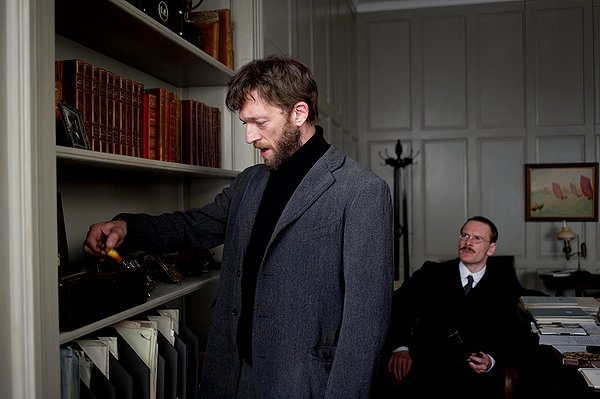
The story opens with one unstable patient being sent to the mental institution in Switzerland in 1904. Her name is Sabrina Spielrein(Keira Knightley), and her extreme behaviors apparently show that she is suffering from the severe case of hysteria. Dr. Carl Jung(Michael Fassbender) takes an interest in her, and he thinks her case can be a good subject of the clinical study for supporting the theory recently proposed by Dr. Sigmund Freud(Viggo Mortensen),

What we see through Jung’s trial is the interesting presentation of basic psychoanalytic methods in early stages, which is essentially not so different from what the analysts of our era do. While they are alone in the room, he lets Spielrein talk about her past experience, and he attentively listens to her while sitting behind her. They also have some privation conversation while she is relatively relaxed and comfortable.

Regardless of how you think about psychoanalysis or how much it has been helpful to the scientific understanding of the human mind, it certainly helps talk more openly about the inner problems inside us. Jung’s trial is very successful; he discovers the Freudian origin of Spielrein’s hysteria, and then Spielrein gets recovered enough to start studying, ironically, psychoanalysis in the college for getting her doctoral degree.

And, through this success, Jung gets acquainted with Freud. As the first pioneer of his field, Freud regards Jung as the heir apparent to his psychoanalytic theory, but, though he enjoys the lengthy conversation about the interpretation of dreams with the man he admires, Jung has a different idea about how their field should be developed, so, as some of you know, they are bound to conflict with each other. Jung start to advocate the mythicism as the tool for exploring their undiscovered country, which Freud stubbornly rejects it as nonsense.

The situation gets more complicated when the intimate but inappropriate relationship between Spielrein and Jung(he’s a married man, by the way) gets overlapped with the strained academic relationship between Jung and Freud. Though this triangle is not as kinky as you might think, the director David Cronenberg’s cool, analytic approach to the story makes their interactions, which mostly consist of lots of conversations and discussions, fascinating to observe. I am just vaguely familiar with their metaphysical knowledge and theories, but I kept listening to what they say with the constant amount of fascination. The movie is based on Christopher Hampton’s play “The Talking Cure”, which is based on John Kerr’s nonfiction book “A Most Dangerous Method”, and Hampton, who adapted his play for the movie, provides the conversations compelling enough to hold our interest to his episodic plot. After all, the characters in the film are professionals; they know what they are talking about, and they really talk about something while using familiar terms like ‘libido’.

It is sort of strange to see that Cronenberg made such a mild conventional period drama like this, but, considering how he has evolved from the master of bloody body horror to the master of intense psychological drama, it’s not that surprising. In his early movies like “Videodrome”(1983) or “The Fly”(1986), the bodies of his characters are the anarchic stage for their inner conflicts, which would fascinate both Freud and Jung. In his recent films, Cronenberg moves from the body to the mind with the more subtle approach for the examination of human psyche, and this movie seems like a logical arriving point.

The three main performances are all commendable, and the most notable is Keira Knightley, who embodies the sheer intensity of the tumultuous state of an unstable mind. Looking at the early scenes where she struggles to speak while her body uncontrollably twitches, you will not be surprised even if she turns into something freakish like the characters of the early Cronenberg films. After dialing down her intensity later in the story, Knightley becomes more convincing as an intellectual and passionate woman who struggles to find her place as a scholar between two giant figures of her field with her eclectic theory.

Michael Fassbender, who gets lots of acclaims through his uncompromising performance in “Shame”(2011), is less showy in this film, but he is effective as a stern man struggling with his dark conflict. Though he recognizes the desire inside him, Jung also knows how professionally and privately dangerous his relationship with Spielrein is. How he eventually treats her is very cruel, but it also makes him miserable a lot.

While Vincent Cassel, who plays a libidinous rogue psychoanalyst Otto Gross, has his own fun moment as the impish devil whispering the temptations into Jung’s ears, and Viggo Mortensen gives a humorous performance as Dr. Freud, who always looks like he has all the answers – with a cigar in his hand(if his cigar were a little longer in the film, I could describe it as “phallic”). As much as Jung is afraid of advancing his relationship with Spielrein, Freud is protective of his precious field, and it is one of the main reasons behind his disagreement with Jung. The movie also makes an interesting point about the class difference between Freud and Jung as a Jewish and a protestant; when they board the ship to America, Jung goes to the first class cabin while Freud has go to the second class cabin.

When they are about to arrive in America, Freud asks Jung, “Do you think they know we are on our way, bringing them the plague?” Though most of their theories have been changed or revised during the last century, their ideas have certainly influenced our perception on the human mind a lot while infiltrating into our consciousness. I must say I do not know much about psychoanalysis, but, to be frank with you, I won’t deny that I have a small fun whenever I get the chance the use terms like “Freudian” or “Jungian” in my reviews.

Posted in Movies | Tagged , , , | 1 Comment